Free Walking Tour Buenos Aires: Recoleta to La Boca

From a theatre turned bookshop past Recoleta's marble tombs and Plaza de Mayo to the old railway curve of Caminito, all on foot.

12 Stops 12.1 km ~2 h 50 min walking
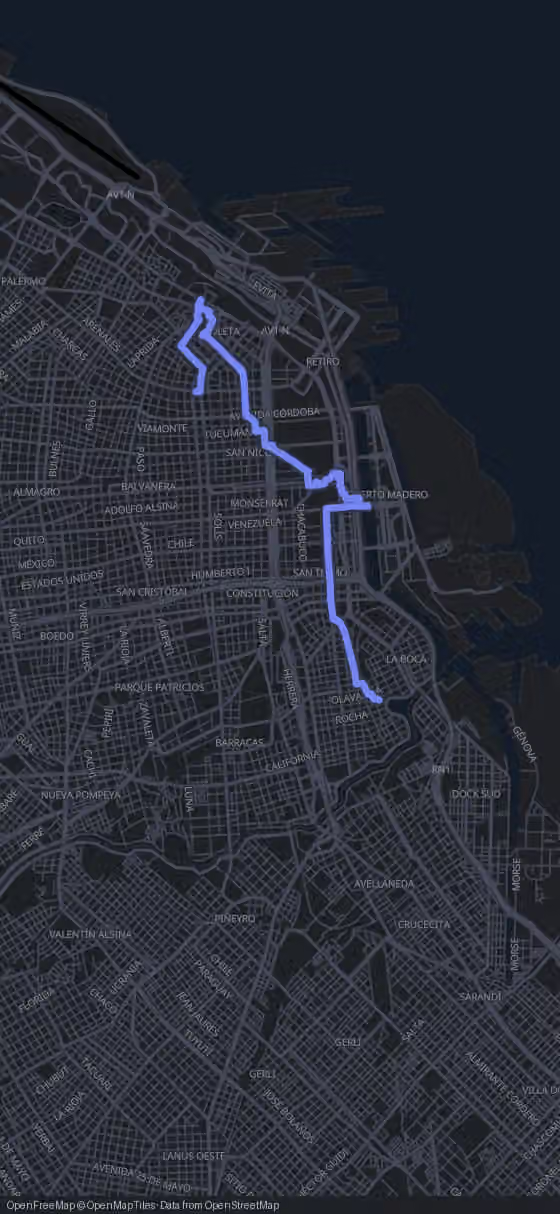
Route map for the Buenos Aires walking tour
Stop 1 of 12
3.6 km·45 min
El Ateneo Grand Splendid
Head northwest toward the Floralis Generica
Hola, welcome to Buenos Aires. I'm Alex, and a theatre from the golden age of tango found a remarkable second life.
Try this tour with Alex

Buenos Aires on foot: the route at a glance

Twelve stops lead from El Ateneo Grand Splendid in Barrio Norte to Caminito in La Boca: 12.1 km and 2 h 50 min of pure walking, around eight and a half hours with the visits worth making inside. Every stop is free to enter except a visit inside Teatro Colón.

Route, map and GPS navigation from stop to stop are free in your browser. If you want company, the optional AI Tour Guide leads the walk as a conversation, telling the stories and following what catches your interest.

Open free GPS & optional AI Tour Guide
This short shows highlights of the route. All 12 stops follow below.

The Route

Walking Map of Buenos Aires from Barrio Norte to La Boca

12 stops 12.1 km 2 h 50 min walking
Tap to load interactive map

The 12 stops along this route

  1. El Ateneo Grand Splendid in Buenos Aires, stop 1 on the self-guided walking tour
    1El Ateneo Grand Splendid
  2. Floralis Genérica in Buenos Aires, stop 2 on the self-guided walking tour
    2Floralis Genérica
  3. National Museum of Fine Arts in Buenos Aires, stop 3 on the self-guided walking tour
    3National Museum of Fine Arts
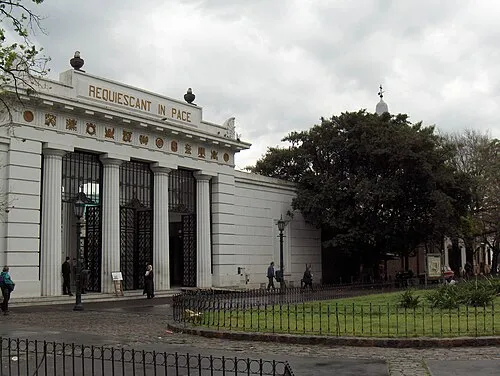
  4. Recoleta Cemetery in Buenos Aires, stop 4 on the self-guided walking tour
    4Recoleta Cemetery
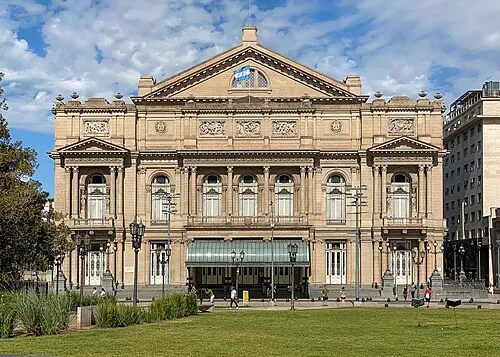
  5. Teatro Colón in Buenos Aires, stop 5 on the self-guided walking tour
    5Teatro Colón
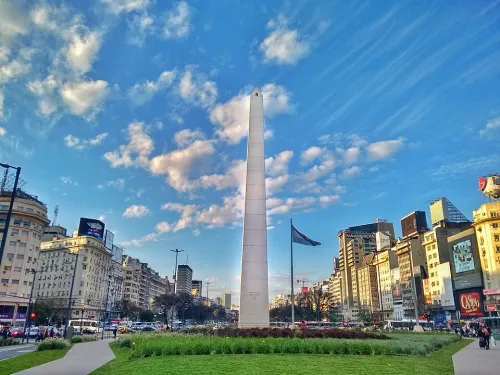
  6. Obelisco in Buenos Aires, stop 6 on the self-guided walking tour
    6Obelisco
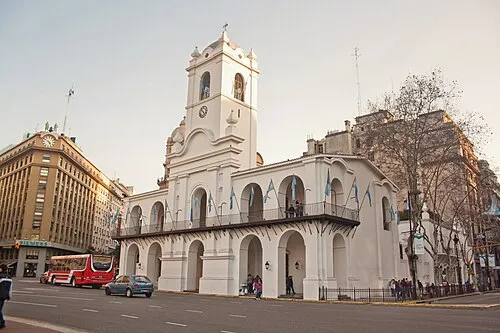
  7. El Cabildo Museum in Buenos Aires, stop 7 on the self-guided walking tour
    7El Cabildo Museum
  8. Plaza de Mayo in Buenos Aires, stop 8 on the self-guided walking tour
    8Plaza de Mayo
  9. Casa Rosada in Buenos Aires, stop 9 on the self-guided walking tour
    9Casa Rosada
  10. Puerto Madero in Buenos Aires, stop 10 on the self-guided walking tour
    10Puerto Madero
  11. San Telmo Antique Fair in Buenos Aires, stop 11 on the self-guided walking tour
    11San Telmo Antique Fair
  12. Caminito in Buenos Aires, stop 12 on the self-guided walking tour
    12Caminito
  13. That's the full route.

    Walk it with an AI Tour Guide talking you through every one of these streets.

    Start free in your browser
    You made it

The Buenos Aires Walking Tour, Stop by Stop from Bookshop to Caminito

  1. 1

    El Ateneo Grand Splendid

    El Ateneo Grand Splendid in Buenos Aires, stop 1 on the self-guided walking tour

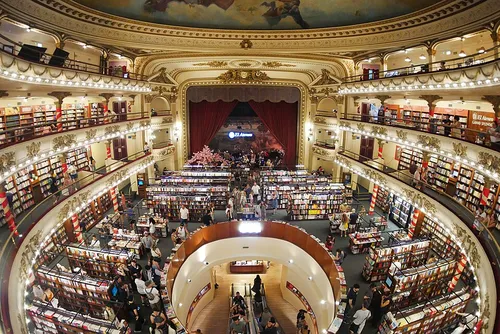
    Walk through the door on Santa Fe Avenue and you are standing in a theatre. El Ateneo Grand Splendid opened in May 1919 as the Teatro Gran Splendid, designed by the architects Peró and Torres Armengol for the impresario Max Glücksmann. Look up: the ceiling frescoes are by the Italian painter Nazareno Orlandi, and the caryatids are by the sculptor Troiano Troiani, whose work also decorates the cornice of the city legislature.

    The hall once held 1,050 seats, and tango names such as Carlos Gardel, Francisco Canaro, Roberto Firpo and Ignacio Corsini performed on its stage. In 1924 Glücksmann started Radio Splendid, broadcasting from the building, and his record company Nacional Odeón made some of the early recordings of the great tango singers of the day. By the late 1920s the theatre had become a cinema, and in 1929 it showed the first sound films presented in Argentina.

    The bookshop came much later. Grupo Ilhsa leased the building in 2000, the architect Fernando Manzone led the conversion, and shelves took the place of the cinema seats. The ceiling, the carvings, the crimson stage curtains and the auditorium lighting stayed. You can sit and read in the old theatre boxes, and the café is at the back of what was once the stage. More than a million people come through the doors each year; The Guardian ranked it the second most beautiful bookshop in the world in 2008, and National Geographic named it the most beautiful in 2019.

    Entry is free, so half an hour here costs you nothing but time, even if you leave without a book. From the bookshop it is 1780 m, about 24 minutes on foot, to the giant steel flower in United Nations Square.
    Hours
    Mon–Sat: 09:00–21:00 | Sun: 12:00–21:00
    Price
    Free entry (bookstore; "Experiencia Grand Splendid" on 3rd floor paid separately via Passline)
  2. 2

    Floralis Genérica

    Floralis Genérica in Buenos Aires, stop 2 on the self-guided walking tour

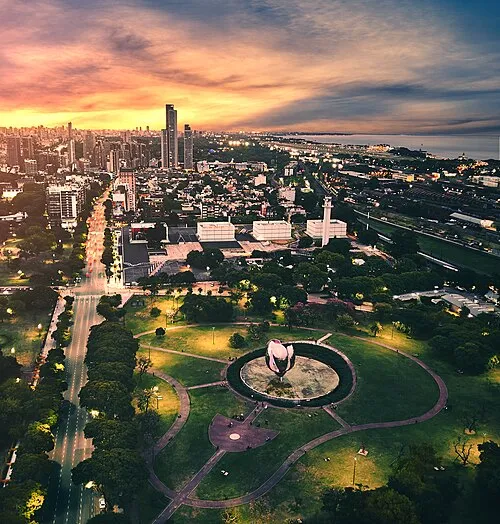
    Floralis Genérica is a flower 23 m tall, made of stainless steel on an aluminium frame and weighing eighteen tons, raised over a reflecting pool in United Nations Square. The Argentine architect Eduardo Catalano gave it to the city in 2002. The pool is more than decoration: it also protects the sculpture, while the paths through the surrounding park let you circle it and see its six petals from different angles.

    Catalano described it as a synthesis of all the flowers and, at the same time, a hope reborn every day at opening. The name carries the same idea: Floralis for the flora, Genérica because it stands for every flower in the world.

    It was built to move. An electrical system was designed to open the petals at 8 in the morning and close them at sunset, letting a red glow shine from inside at night, and to close them in strong wind. Four nights a year were meant to stay open: 25 May, 21 September, 24 December and 31 December. It never ran smoothly: at the inauguration the petals would not close until a technical fault was fixed two months later. In 2010 the mechanism was switched off to protect the sculpture, and the flower stood open until 2015, because, as Catalano himself noted, one petal had been installed incorrectly.

    Ten minutes is enough here. The National Museum of Fine Arts is only 210 m away, 3 minutes on foot.

    Hours
    Open 24/7
    Price
    Free
  3. 3

    National Museum of Fine Arts

    National Museum of Fine Arts in Buenos Aires, stop 3 on the self-guided walking tour

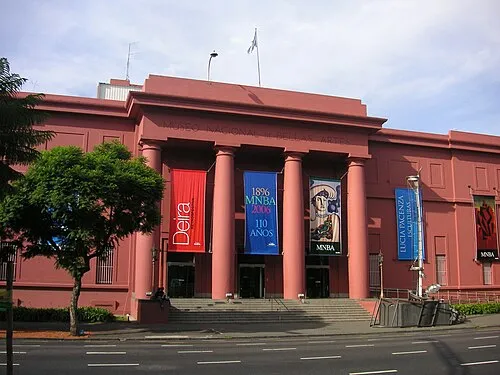
    The National Museum of Fine Arts (Museo Nacional de Bellas Artes) holds works by Goya, Rembrandt, Van Gogh, Rodin, Manet and Chagall, and entry is free. The permanent collection counts 688 major works plus more than 12,000 sketches, fragments and pottery pieces, spread across 34 halls.

    The building has a past of its own: it went up in 1870 as a drainage pumping station, and the architect Alejandro Bustillo adapted it before the museum moved in in 1943. That was its third home. It first opened on 25 December 1895 on Florida Street, under its first director, the painter and critic Eduardo Schiaffino, in the building that now houses the Galerías Pacífico shopping mall. In 1909 it moved to Plaza San Martín, into a pavilion originally built in Paris as Argentina's pavilion for the 1889 exhibition, then taken apart and brought to Buenos Aires. That pavilion was demolished in 1932.

    From 1955 to 1964 the director Jorge Romero Brest modernised the building and its collection, acquiring modern art partly through the Torcuato di Tella Institute, then a leading promoter of avant-garde Argentine artists. The contemporary Argentine art pavilion opened in 1980; at 1,536 m² it is the largest hall in the museum.

    Go in if you have an hour and any interest in painting; it costs nothing. From here Recoleta Cemetery is 680 m away, 10 minutes on foot.

    Local name
    Museo Nacional de Bellas Artes
    Hours
    Mon: Closed | Tue–Fri: 11:00–19:30 | Sat–Sun: 10:00–19:30
    Price
    Free
  4. 4

    Recoleta Cemetery

    Recoleta Cemetery in Buenos Aires, stop 4 on the self-guided walking tour

    Recoleta Cemetery (Cementerio de la Recoleta) is a city of mausoleums and vaults in marble, crowded with sculpture. It opened on 17 November 1822 under governor Martín Rodríguez, with Bernardino Rivadavia as government minister, and was the first public cemetery in Buenos Aires. The French engineers and architects Próspero Catelin, Charles Henri Pellegrini and Phillipe Bertrès laid it out, and the government kept plots aside for the people who shaped the new state.

    It was among the first projects meant to give the colonial Spanish city a French look. In 1880 Torcuato de Alvear, the city's first mayor, had the architect Juan Antonio Buschiazzo remodel it: a brick wall went up around it, the paths were paved and the neoclassical entrance you walk through was built.

    The grandeur belongs to the late 19th century, when Argentina was a rising economic power and the city's wealthiest families moved to Recoleta and raised splendid family tombs here. Many are the work of important architects, more than 90 are National Historic Monuments, and the cemetery as a whole has been a National Historic Museum since 1946. Walk slowly and read the names over the doors.

    Entry is free, and it is best not to leave it for late in the day. Give it at least 45 minutes. Then comes a long leg: 2080 m, around 29 minutes, to Teatro Colón.

    Local name
    Cementerio de la Recoleta
    Hours
    Daily: 09:00–17:00
    Price
    Free
  5. 5

    Teatro Colón

    Teatro Colón in Buenos Aires, stop 5 on the self-guided walking tour

    Teatro Colón is the city's house for opera, ballet and concerts. National Geographic counts it among the ten best opera houses in the world, and in a survey of leading conductors by the acoustics expert Leo Beranek, its hall came out first for opera acoustics and second for concerts.

    The building replaced an earlier theatre of the same name that opened in 1857. After a process lasting twenty years, the present theatre opened on 25 May 1908 with Verdi's Aida. The leading singers and opera companies of the age came here, some of them continuing their tours to Montevideo, Rio de Janeiro and São Paulo. Decline followed that heyday, and then a large restoration: the theatre closed in October 2006 and reopened on 24 May 2010. It has been a National Historic Monument since 1991.

    It is very much a working house. The resident orchestra, choir and ballet are based here, as is the Buenos Aires Philharmonic, together with an arts institute, an orchestral academy and a children's choir.

    This is the one stop with a ticket, with lower prices for residents, pensioners and university students. Go in if music or grand interiors are your thing; otherwise the facade costs nothing. From the theatre it is 430 m, 7 minutes, to Plaza de la República and the Obelisco.

    Hours
    Mon–Sat 09:00–20:00; Sun 09:00–17:00
    Price
    ARS 34.000 (general/foreigners; residents ARS 17.000, pensioners and university students ARS 7.000)
  6. 6

    Obelisco

    Obelisco in Buenos Aires, stop 6 on the self-guided walking tour

    The Obelisco rises 67.5 m where Avenida Corrientes crosses Avenida 9 de Julio, white stone over reinforced concrete. It went up in 1936 to mark 400 years since the first founding of the city, designed by Alberto Prebisch, one of the main architects of Argentine modernism, at the request of mayor Mariano de Vedia y Mitre.

    The speed is the story. Work began on 20 March 1936 and finished on 23 May: the German firm G.E.O.P.E., Siemens Bauunion, Grün & Bilfinger completed it in 31 days with 157 workers, pouring fast-hardening Incor cement in sections of 2 m. It cost 200,000 pesos and used 680 m³ of concrete and 1,360 m² of white Olaen stone for the facing.

    Look at the top: the tip is blunt, there are four small windows just below it, and the lightning rod is too high to make out. Only three years after it was finished, in June 1939, the city council voted to demolish it, citing cost, looks and public safety. It is still standing.

    Ten minutes in the square is plenty. The next leg is 1160 m, about 17 minutes, to the Cabildo; on the way you walk along Calle Florida, where the fine arts museum first opened in 1895.

    Hours
    Freely accessible, no opening hours
    Price
    Free
  7. 7

    El Cabildo Museum

    El Cabildo Museum in Buenos Aires, stop 7 on the self-guided walking tour

    The Cabildo is a small museum in one of the historic buildings around Plaza de Mayo, and entry is free.

    On a first visit, treat it as optional. On this walk it works as a threshold: you pass it on your way into the square, where Plaza de Mayo and Casa Rosada are waiting. Go in if the collection draws you; walk on without regret if not. From the Cabildo it is 260 m, 4 minutes, into the square.

    Hours
    Mon–Tue: Closed | Wed–Sun: 10:30–18:00
    Price
    Free
  8. 8

    Plaza de Mayo

    Plaza de Mayo in Buenos Aires, stop 8 on the self-guided walking tour

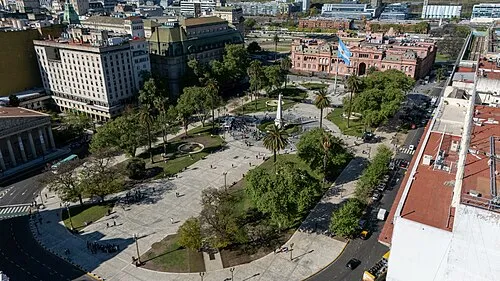
    Plaza de Mayo faces Casa Rosada, the seat of the national government. Around it stand the historic Cabildo, the Metropolitan Cathedral, the City Government building, the head office of Banco Nación and the head office of the national tax and customs agency. Three major avenues start from its west side: Presidente Julio A. Roca, Presidente Roque Sáenz Peña and Avenida de Mayo.

    The square marks the place where the city was founded for the second time, in 1580. Its present shape dates from 1884, when the Plaza de la Victoria and the Plaza del Fuerte were joined by tearing down a building called the Recova Vieja that had separated them.

    This is where Argentina gathers to protest and to celebrate: apart from the declaration of independence and the battles fought for it, almost every decisive national event has played out here. Look for the Pirámide de Mayo; in 1941 the sculptor Manuel Félix Vilaboa was commissioned to make a bronze plaque on the edge of its flowerbed summing up its history.

    Under the square, about two hectares in size, lie three underground stations: Plaza de Mayo on line A, Catedral on line D and Bolívar on line E, useful if you want to break the walk here. Casa Rosada is 330 m away, 4 minutes on foot.

    Hours
    Freely accessible, no opening hours
    Price
    Free
  9. 9

    Casa Rosada

    Casa Rosada in Buenos Aires, stop 9 on the self-guided walking tour

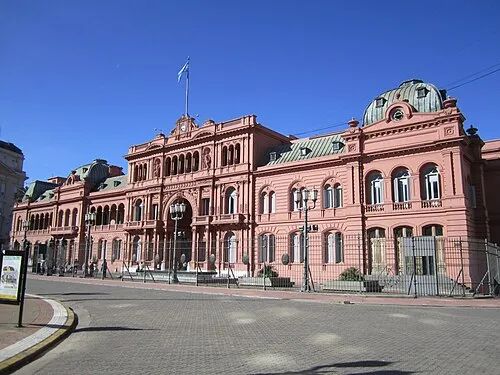
    Casa Rosada, the pink house, is the official workplace of the president of Argentina; its formal name is Casa de Gobierno. The president normally lives elsewhere, at the Quinta de Olivos. The building closes the eastern end of Plaza de Mayo, and its baby pink colour has made it one of the emblems of Buenos Aires.

    This spot was once the shoreline of the Río de la Plata. A fort stood here from 1594, built on the orders of the city's founder Juan de Garay; in 1713 a masonry castle with turrets, the Castle of San Miguel, replaced it and became the nerve centre of colonial government. After independence, Bernardino Rivadavia, the government minister when Recoleta Cemetery opened, had a neoclassical portico added in 1825 as president. In 1857 the fort came down for a new customs house, an Italianate building by the British Argentine architect Edward Taylor that was the largest in Buenos Aires from 1859 until the 1890s.

    Inside is a museum with objects from former presidents, free to visit. There are also free guided tours of the government house, which must be reserved beforehand at visitas.casarosada.gob.ar. Worth it if Argentine politics interests you; make the reservation before you set out.

    From here the route heads for the water: 1060 m, 15 minutes, to Puerto Madero.

    Hours
    Museum Wed–Sun 11:00–18:00 (last entry 17:30); guided tours of the government house Sat–Sun & holidays 10:00–18:00 (prior reservation required at visitas.casarosada.gob.ar)
    Price
    Free (museum entry and guided tours both free; tours require prior reservation)
  10. 10

    Puerto Madero

    Puerto Madero in Buenos Aires, stop 10 on the self-guided walking tour

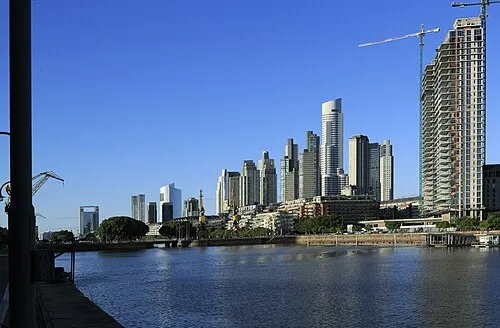
    Puerto Madero is a barrio along the bank of the Río de la Plata and part of the central business district, lined with high-rise towers and luxury hotels in current architectural styles. Property here is by far the most expensive in Buenos Aires, at twice the level of the next barrio.

    After the colonial square and the presidential palace, the change of scene is sharp, and the waterfront promenade is a good place to slow down for twenty minutes before the last part of the walk. From the waterfront it is 1540 m, about 23 minutes, to San Telmo.

    Hours
    Freely accessible, no opening hours (district/waterfront promenade)
    Price
    Free
  11. 11

    San Telmo Antique Fair

    San Telmo Antique Fair in Buenos Aires, stop 11 on the self-guided walking tour

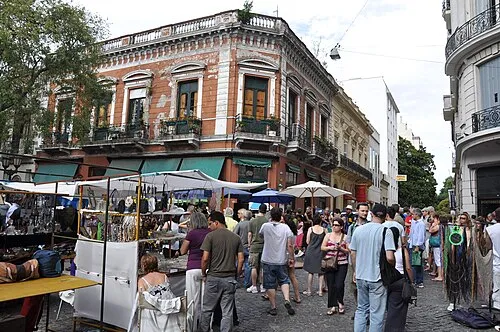
    The San Telmo Antique Fair (Feria de San Telmo) runs on Sundays. The architect José María Peña started it in 1970; today it has 270 stands, and around 10,000 people come every Sunday, most of them visitors from around the world.

    Antiques and cultural objects are the main draw, but the streets around it are part of the show: tango dancers and orchestras play for whoever passes, and you can eat at the restaurants or buy typical food from informal sellers.

    On a Sunday, give yourself an hour to browse. On any other day there is no fair, so this becomes a short pass through San Telmo.

    The final leg is the longest of the route: 2550 m, about 35 minutes, to Caminito in La Boca, passing Plaza Dorrego and the National Historical Museum on the way.

    Local name
    Feria de San Telmo
    Hours
    Sundays
    Price
    Free
  12. 12

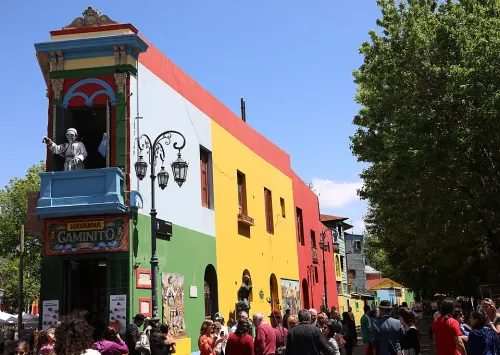
    Caminito

    Caminito in Buenos Aires, stop 12 on the self-guided walking tour

    Caminito is a curving pedestrian lane in La Boca, about 150 m long, with one end facing the Riachuelo at the Vuelta de Rocha. Since 1959 it has officially been a street museum, closed to traffic.

    Its curve has two layers of history. A stream once ran here into the Riachuelo and had to be crossed by a small bridge, which is why this corner of the barrio was called Puntin, little bridge in the Genoese dialect. Later a freight railway branch, built in 1866 and closed in 1928, followed the same line, and the lane traces its abandoned track.

    The name comes from tango. Juan de Dios Filiberto's 1926 music for the tango Caminito was inspired by this place. The lyrics are another story: Gabino Coria Peñaloza wrote them about a path in Olta, in La Rioja province, and in 1971 a street in Chilecito was also named Caminito in his honour. A walk that began in a theatre where Gardel sang ends on a tango title.

    Caminito is free and open at all hours. This is where the route ends.

    Hours
    Open 24/7
    Price
    Free
Walking tour route map of Buenos Aires Route loaded
El Ateneo Grand SplendidFloralis GenéricaNational Museum of Fine ArtsRecoleta Cemetery+8
All 12 stops are already on the map.
You just press start.
AI Tour Guide

You've read the route from Recoleta to La Boca. Now walk it with a guide in your ear.

Press start wherever you are, even hundreds of kilometres from Buenos Aires, and the guide begins telling its stories right away. In the city, pick any of the 12 stops to start from: it leads you there, then talks with you the whole route, asking, listening, remembering, and shaping the tour around your answers.

12stops 12.1km 2 h 50 minwalking 13languages
▶Start the tour free

Free to start · Runs in your browser · No app, no download

Shorter Ways to Walk Buenos Aires

Twelve stops in one day is a lot. The route splits naturally into three sections, each good for a half day.

Books, art and tombs in Recoleta

Stops: 1, 2, 3, 4

For a calm half day with the bookshop, the steel flower, the fine arts museum and the cemetery. 37 minutes of walking, and all four are free to enter; the Experiencia Grand Splendid is an optional paid extra.

Opera house to presidential palace

Stops: 5, 6, 7, 8, 9

For anyone who wants the political and cultural heart of the city: Teatro Colón, the Obelisco, the Cabildo, Plaza de Mayo and Casa Rosada. 32 minutes of walking. Teatro Colón is the only ticket; the Cabildo and the Casa Rosada museum are free.

Sunday by the water and in La Boca

Stops: 9, 10, 11, 12

For a Sunday, when the San Telmo fair is on: Casa Rosada, Puerto Madero, the fair and Caminito. 1 h 13 min of walking and no entry fees; reserve the guided tour of the government house beforehand if you want it.

How Long This Buenos Aires Tour Takes with Museums and Theatre

The whole route covers 12.1 km with 2 h 50 min of pure walking. Add half an hour in the bookshop, an hour each in the fine arts museum and Teatro Colón, 45 minutes among the tombs and shorter pauses elsewhere, and you arrive at roughly eight and a half hours, before any long lunch.

Start at El Ateneo Grand Splendid at 10:00 on a Wednesday to Saturday and that pace brings you to the museum shortly after 11:00, to Recoleta Cemetery around 12:15, to Teatro Colón around 13:30, to Casa Rosada a little before 16:00 and to Caminito around 18:00.

Split into sections, the Recoleta part takes about three hours with visits, the centre from Teatro Colón to Casa Rosada a little under three, and the Sunday section from Casa Rosada to Caminito a little over three with an hour at the fair.

Before You Set Off in Buenos Aires

  • Start and finish: The recommended start is El Ateneo Grand Splendid on Santa Fe Avenue; the route ends at Caminito in La Boca, not where you began. You can join at any stop and follow the order from there.
  • Best day: Wednesday to Saturday work best for the full route. Sunday brings the San Telmo fair, so on a Sunday the section from Casa Rosada to Caminito works best.
  • What it costs: The route, the map and the GPS navigation cost nothing, and only Teatro Colón charges for a visit inside. The AI Tour Guide is optional: 100 free credits to start, then either €19.99 for this tour all-inclusive with no time limit, or credits at €5 per hour.
Walking tour route map of Buenos Aires
AI Tour Guide

Your guide is ready when you reach the bookshop.

Press start and a voice AI Tour Guide takes it from here: leading the route through Buenos Aires, telling the stories, and turning your walk into a real back-and-forth conversation. No app or download is needed; it runs in your browser.

12stops 12.1km 2 h 50 minwalking 13languages
▶Start the tour free

Free to start · Runs in your browser · No app, no download

What the AI Tour Guide adds between Recoleta and La Boca

On this walk the stories run across stops: Bernardino Rivadavia turns up at the cemetery gate and again at the palace portico, and tango runs from Gardel on the Grand Splendid stage to the song named after Caminito. The AI Tour Guide picks up whichever thread you respond to and carries it further, and it can tell you about the family behind the mausoleum you stop in front of, something no written route can foresee. You can interrupt it at any moment.

A Real Conversation A voice AI Tour Guide greets you, leads the whole route, and tells the stories and facts as you walk, asking what you want to see and keeping a real conversation going. Not a recording you press play on.
Map Navigation Follow the route on the map and walk at your own pace. You choose where to start and when to move to the next stop.
Ask Anything Curious about a building you pass? Ask your AI Tour Guide on the spot and the conversation carries on.
13 Languages Switch language anytime. No separate tour needed.
Start free in your browser

Common Questions About Walking Buenos Aires

What is the Experiencia Grand Splendid?

A separate, paid experience on the 3rd floor of El Ateneo Grand Splendid, booked through Passline. The bookshop itself is free to enter without it.

How far is La Bombonera from Caminito?

About 400 metres. The Boca Juniors stadium is close enough to add on foot once you finish the route at Caminito.

What is a good day trip from Buenos Aires?

Colonia del Sacramento is the closest at 51 km; Montevideo and Rosario are further out. Each has its own walking route with free GPS navigation.

Which other Argentine cities can I explore on foot the same way?

Mendoza, Salta, Bariloche, Puerto Iguazú and Ushuaia all have walking routes built the same way.

Is the tour really free?

Yes. The whole tour is free: the route, the interactive map and the navigation cost you nothing. Only the voice AI Tour Guide is optional and paid: you test it with 100 free credits, then you pay either €5 per hour or €19.99 for this whole tour, with no time limit. Admission to one of the 12 stops is not included: Teatro Colón charges its own entry fee.

Do I need to download an app?

No. Everything runs in your phone browser. Open the route and start walking, no download and no sign-up required.

Do I need to book the walking tour in advance?

No booking needed. This self-guided tour is available anytime. Open the route in your browser and start walking. The AI Tour Guide works instantly, no app, no reservation required.

What languages is the AI Tour Guide available in?

The AI Tour Guide speaks 13 languages, so you take the tour in your own language and can switch at any time.

Can I skip stops or change the route?

Yes. Skip any stop, spend extra time at places you like, or start the route from any point. It is your walk, you set the pace.
Image credits
▶ Start free in your browser Runs in your browser, no app, no download