Free Walking Tour Denver: LoDo to the Gold Dome

From the Great Hall of Union Station to the river where Denver's gold rush began and on to a dome of real gold leaf: one loop through the city on foot.

12 Stops 8.8 km ~2 h 9 min walking
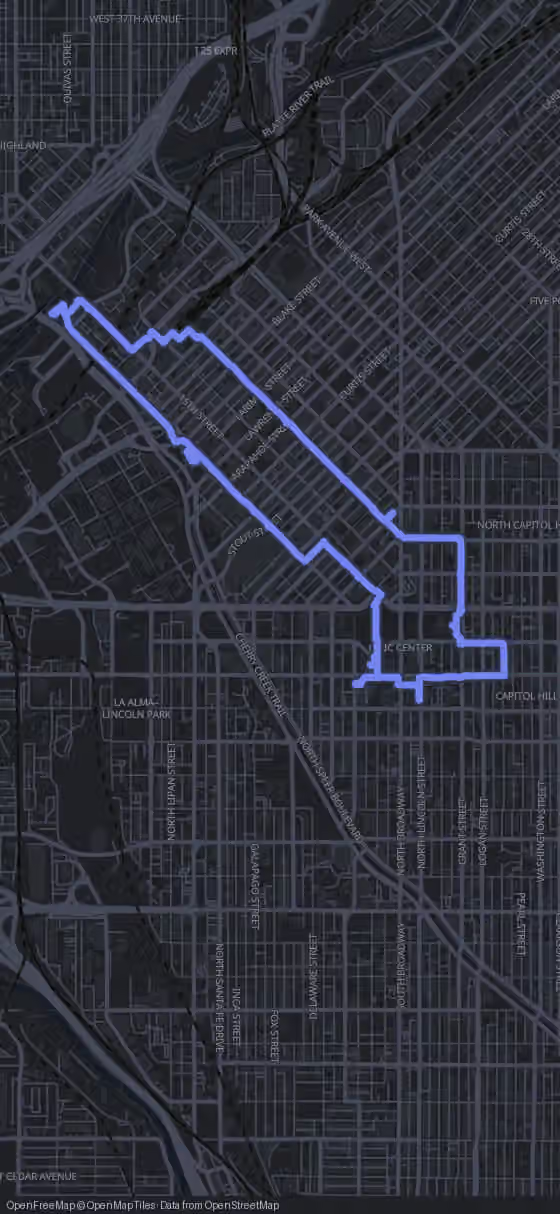
Route map for the Denver walking tour
Stop 1 of 12
480 m·6 min
Union Station
Head west toward the Museum of Contemporary Art Denver
Hey, welcome to Denver. I'm Alex, and the city's origin story begins where two waterways meet.
Try this tour with Alex

What this Denver loop covers

Twelve stops on a loop that starts and ends at Union Station, from LoDo and the riverbank to the museum quarter and the Colorado State Capitol. The route is 8.8 km with 2 h 9 min of pure walking; on foot alone that makes about 3 h 40 min, with two museums a full day.

The outdoor stops and the Capitol cost nothing, the six museums charge admission. Route, map and GPS navigation from stop to stop are free in your browser, and the optional AI Tour Guide can lead the walk as a conversation.

Open free GPS & optional AI Tour Guide
This short shows highlights of the route. All 12 stops follow below.

The Route

Walking Map of Denver: the LoDo and Civic Center Loop

12 stops 8.8 km 2 h 9 min walking
Tap to load interactive map

The 12 stops along this route

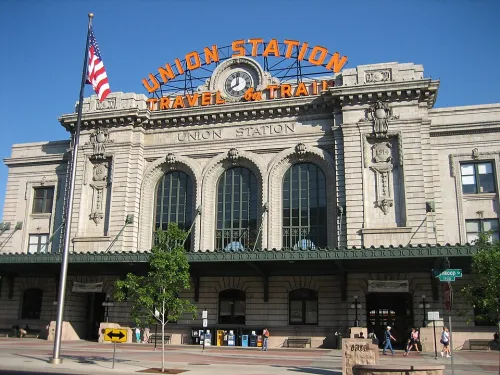
  1. Union Station in Denver, stop 1 on the self-guided walking tour
    1Union Station
  2. Museum of Contemporary Art Denver, stop 2 on the self-guided walking tour
    2Museum of Contemporary Art Denver
  3. Confluence Park in Denver, stop 3 on the self-guided walking tour
    3Confluence Park
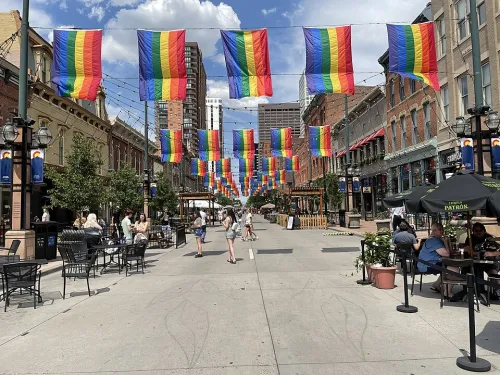
  4. Larimer Square in Denver, stop 4 on the self-guided walking tour
    4Larimer Square
  5. 5Blue Bear Sculpture
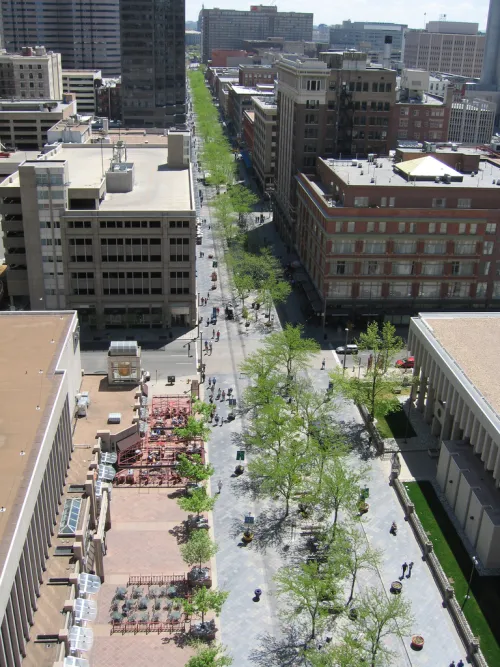
  6. 16th Street Mall in Denver, stop 6 on the self-guided walking tour
    616th Street Mall
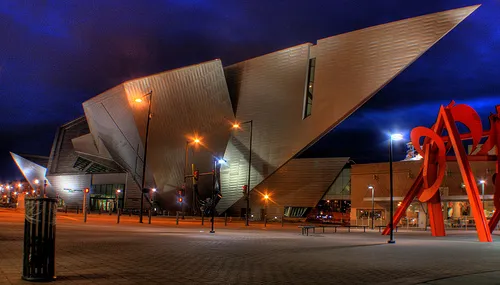
  7. Denver Art Museum, stop 7 on the self-guided walking tour
    7Denver Art Museum
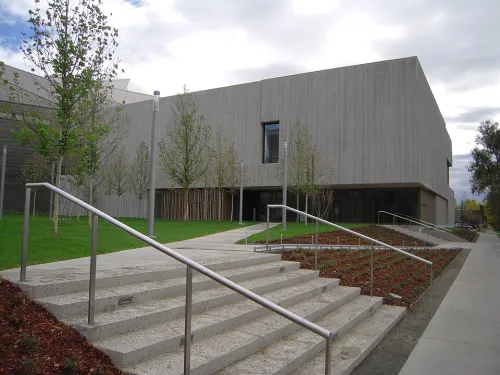
  8. Clyfford Still Museum in Denver, stop 8 on the self-guided walking tour
    8Clyfford Still Museum
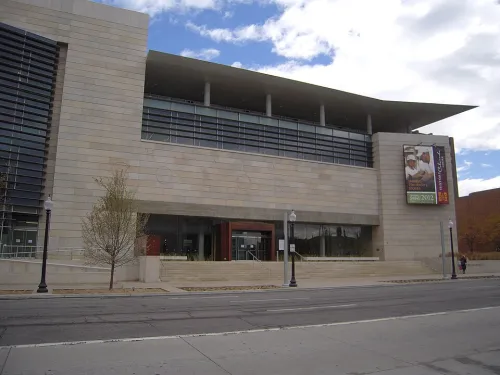
  9. History Colorado Center in Denver, stop 9 on the self-guided walking tour
    9History Colorado Center
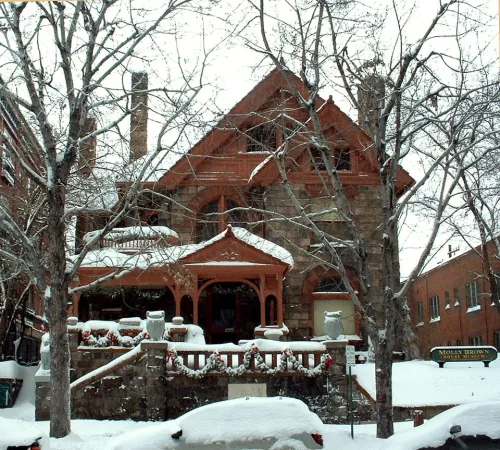
  10. Molly Brown House Museum in Denver, stop 10 on the self-guided walking tour
    10Molly Brown House Museum
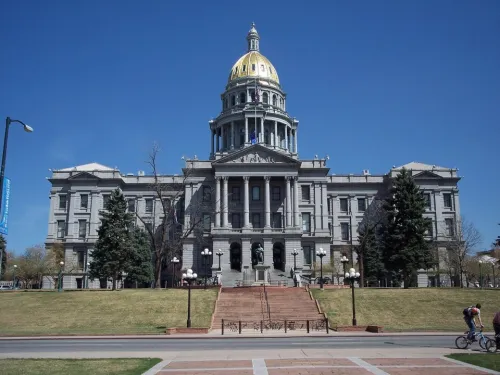
  11. Colorado State Capitol in Denver, stop 11 on the self-guided walking tour
    11Colorado State Capitol
  12. 12American Museum of Western Art
  13. That's the full loop.

    Walk it with an AI Tour Guide talking you through every one of these streets.

    Start free in your browser
    You made it

Your Denver Walking Tour, from Union Station to the Capitol

  1. 1

    Union Station

    Union Station in Denver, stop 1 on the self-guided walking tour

    Your walk begins at 17th and Wynkoop Streets, in front of the station house in Romanesque Revival style. Behind it lie a modern open-air train shed, an underground bus station with 22 gates and the light rail station: this is still Denver's main transportation hub. The Great Hall costs nothing to enter, so step inside for a quarter of an hour.

    The building exists because travelers once had to haul their luggage across town. By 1875 Denver had four separate railroad stations, and changing lines was a nuisance. The Union Pacific proposed one central “Union Station”, and in February 1880 the owners of the four lines, the Union Pacific, the Denver & Rio Grande, the Denver, South Park & Pacific and the Colorado Central, agreed on this site. Kansas City architect A. Taylor drew the plans, and the depot opened in 1881.

    In 1894 a fire that started in the women's restroom destroyed the central part. The Kansas City firm Van Brunt & Howe designed a larger replacement, and the enlarged central portion you see today was completed in 1914. Both depots had a tall clock tower with four faces. In 1906 the city added a grand arch in front of the station, built from 70 tons of steel with more than 2,000 light bulbs for $22,500, spelling “Welcome” on both sides.

    After a major renovation from 2012, the old railyards became a new quarter, and in summer 2014 the station house reopened with the 112-room Crawford Hotel, restaurants and shops. From here it is 480 m, about 7 minutes, to a museum that tries to blur the line between street and gallery.
    Hours
    Daily 05:30–24:00 (Great Hall); 24/7 for transit passengers & Crawford Hotel guests
    Price
    Free
  2. 2

    Museum of Contemporary Art Denver

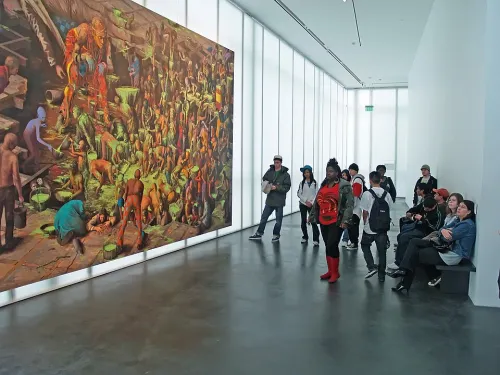
    Museum of Contemporary Art Denver, stop 2 on the self-guided walking tour

    Look at the building first. It was the first museum commission of architect David Adjaye, opened in October 2007, and was designed to minimise the boundary between the city outside and the galleries inside. Large windows look onto the streets, hidden skylights bring daylight into five galleries, and there is a rooftop cafe as well as a shop, library and education spaces in its 27,000 square feet.

    The museum is younger than you might think. In 1996 philanthropist Sue Cannon and a group of volunteers, among them the artist Lawrence Argent, founded Denver's first dedicated home for contemporary art. For seven years it lived in a renovated fish market in Sakura Square. In 2003 developer Mark Falcone and designer Ellen Bruss, both trustees, donated the land in the Platte Valley; 47 architects showed interest, six made the shortlist, and each had to give a public lecture before Adjaye won.

    Is it worth going in? There is no permanent collection, so everything you see is a changing exhibition. If contemporary art is your thing, plan an hour; if not, the building from outside is reason enough to stop. Going inside costs admission.

    Keep Lawrence Argent's name in mind, you will meet his work a little later. Next comes the place where Denver began: 640 m, about 9 minutes, to the river.

    Hours
    Wed–Fri 12:00–19:00, Sat–Sun 10:00–17:00, Mon–Tue closed
    Price
    $18 adult non-resident / $15 resident (free for age 18 and under)
  3. 3

    Confluence Park

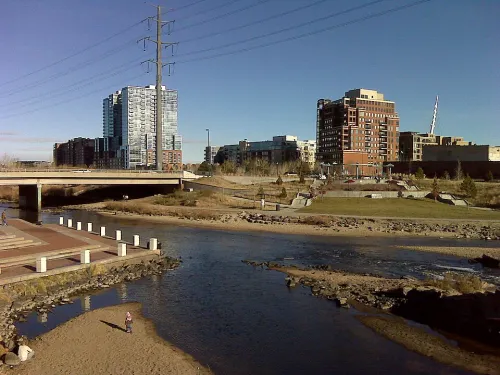
    Confluence Park in Denver, stop 3 on the self-guided walking tour

    Here Cherry Creek flows into the South Platte River. Concrete trails busy with walkers, runners and cyclists run along the water, with grassy patches, river overlooks and benches in between. Two pedestrian bridges cross the two streams, and along the eastern edge of the South Platte a kayak run has been built into the river, right across from the Colorado flagship store of R.E.I.

    Pause for the story that explains the whole city. In May 1858 William Greeneberry Russell's party started looking for gold right at this confluence. They found none here, but about four miles south, at the mouth of Little Dry Creek, they turned up “good diggings”. That discovery set off the Colorado Gold Rush, and the camp that grew up around it became Denver.

    Today the park sits among newer townhouses, apartments and lofts, next to train tracks and Denver's skatepark. Part of the ground once held an Xcel Energy substation, which was moved so the park could grow. From Memorial Day weekend through Labor Day weekend, and on Denver Broncos home game days, the Platte Valley Trolley starts here and runs along the west side of the river.

    From the water you head back into the city the gold rush built: 1290 m, about 18 minutes, to Larimer Square, the street that grew out of that first camp.

    Hours
    Daily 05:00–23:00
    Price
    Free
  4. 4

    Larimer Square

    Larimer Square in Denver, stop 4 on the self-guided walking tour

    You are standing on Denver's oldest surviving commercial block, laid out by William E. Larimer in 1858. Look at the facades: most of these buildings went up in the last three decades of the 19th century, Victorian commercial architecture typical of a western boomtown that was turning into a regional trade centre. During the Pike's Peak gold rush this was the main street, lined with hotels, saloons, shops and offices.

    Then the town moved on. By the early 20th century business had shifted to other parts of downtown, and the Panic of 1893, suburban growth and new shopping habits did the rest. By the middle of the century Larimer Street was considered blighted, buildings were split up or stood half empty, and in the 1950s and 1960s several plans proposed tearing the whole block down for urban renewal.

    That it still stands is largely thanks to one woman. Preservationist Dana Hudkins Crawford began buying and rehabilitating buildings here in the 1960s, at a time when preservation was rare in Denver, and argued for new uses instead of demolition. From 1965 Larimer Square Associates restored the block as a historic and commercial centre, and in 1971 it became the city's first officially designated historic district.

    Today restaurants, shops, offices and entertainment venues fill the old buildings, and the square is open around the clock. Wander the block, then walk 680 m, about 10 minutes, to a much younger and much bluer piece of Denver.

    Hours
    Open 24/7
    Price
    Free
  5. 5

    Blue Bear Sculpture

    Its real title is “I See What You Mean”, but everyone calls it the Big Blue Bear. The 40-foot black bear stands on its hind legs outside the Colorado Convention Center and presses its nose to the glass, peering into the lobby. Walk up close to see the polymer-concrete skin, then step back far enough to get the whole bear and the people inside in one photo.

    The sculptor is Lawrence Argent, one of the volunteers who founded the Museum of Contemporary Art Denver. He chose a bear because the black bear is the only bear species living in the Rocky Mountains today and a symbol of the region for many. The pose came from a newspaper photo of a bear looking through someone's window, which, as he said, resonated with him.

    The colour was an accident. Argent planned natural tones of the region, sandstone for example, but a mockup was printed in blue, and he found it more striking. Installed in 2005 for the Denver Public Art Program at a cost of $424,400, the bear was an immediate hit with the public and the art world alike.

    It is free and always there, so a few minutes are enough. From the bear it is 470 m, about 7 minutes, to Denver's long pedestrian street.

    Local name
    I See What You Mean
    Hours
    Open 24/7
    Price
    Free
  6. 6

    16th Street Mall

    16th Street Mall in Denver, stop 6 on the self-guided walking tour

    Officially it is now simply 16th Street, a pedestrian and transit mall of 1.25 miles (2.0 km) that opened in 1982. Look down before you look at the shops: the granite paving is made of 19-inch squares in charcoal gray, light gray and “Colorado red”, laid out in a diamond pattern inspired by Navajo blankets and the skin of the western diamondback rattlesnake.

    The design comes from I. M. Pei & Partners together with the landscape firm OLIN, and the original 12.5-block stretch is seen as a landmark of late 20th-century design, mixing modernist geometry and lighting with western motifs. It solved a real problem: by the 1970s more than 600 bus trips a day clogged 16th and 17th Streets. The answer was bus transfer stations at Market Street and Broadway, linked by a walking street with a free shuttle, funded by a US$75 million federal grant with a local share from the transit authority.

    In the 1960s the street was lined with cinemas, department stores and banks; today hundreds of shops and restaurants line it, including the Denver Pavilions. The FreeRide shuttle stops at every intersection and runs on to Union Station, handy if your feet need a break.

    Walk a stretch of the mall rather than all of it, then head 750 m, about 12 minutes, to the Civic Center and the first of its museums.

    Hours
    Open 24/7
    Price
    Free
  7. 7

    Denver Art Museum

    Denver Art Museum, stop 7 on the self-guided walking tour

    This is the big one: more than 70,000 works from across the centuries and the world, which makes it one of the largest art museums between the West Coast and Chicago. It is known above all for its American Indian art and for the Western art overseen by The Petrie Institute of Western American Art. From outside, look at the Martin Building, designed in 1971 by the Italian architect Gio Ponti, and at the Frederic C. Hamilton Building by Daniel Libeskind.

    The museum started small. In 1893 the Denver Artists Club was founded; it became the Denver Art Association in 1917, showed its first galleries in the City and County Building and moved into the Chappell House on Logan Street in 1922, before taking the name Denver Art Museum in 1923. When the Kress Foundation offered three collections worth over $2 million on condition of a new building, voters turned down a bond in 1952. The museum kept raising money and opened the South Wing, today's Bach Wing, in 1954, and so received the Kress collections.

    From 2018 a $150 million renovation unified the campus and refreshed Ponti's building, adding new exhibition spaces, two places to eat and a welcome centre. If you only go into one museum on this walk, make it this one and give it two hours; admission is paid.

    Next door, 400 m and about 5 minutes away, a whole museum is devoted to a single painter.

    Hours
    Mon 10:00–17:00, Tue 10:00–20:00, Wed closed, Thu–Sun 10:00–17:00
    Price
    $27 weekdays / $30 weekends & holidays adult non-resident ($22 / $25 CO resident; free for age 18 and under)
  8. 8

    Clyfford Still Museum

    Clyfford Still Museum in Denver, stop 8 on the self-guided walking tour

    Clyfford Still, one of the abstract expressionists, died in 1980 with an unusual will: his entire collection should go to an American city willing to build a permanent museum for his art alone. About 20 cities competed. In August 2004 his widow Patricia chose Denver, after then-Mayor John Hickenlooper visited her home and agreed to the terms.

    The result is remarkable: 3,125 works, 93 percent of everything Still made in his life, plus his complete archives. Among them are roughly 825 paintings on canvas and 2,300 works on paper in pastel, crayon, charcoal, gouache, tempera, graphite and ink. The building by Allied Works Architecture, led by Brad Cloepfil, opened on November 18, 2011 on a plot right beside the Denver Art Museum. Inside are nine galleries, visible painting storage, a conservation lab, two terraces and archive displays.

    Is it for you? If large abstract canvases move you, this is a rare chance to follow one artist's whole career in one place, and an hour is about right. If abstract art leaves you cold, the forecourt and facade are enough. Going inside costs admission.

    From Still's world of colour you walk 530 m, about 8 minutes, into the story of the whole state.

    Hours
    Tue–Sun 10:00–17:00, Mon closed
    Price
    $18 adult non-resident / $15 resident (free for age 17 and under)
  9. 9

    History Colorado Center

    History Colorado Center in Denver, stop 9 on the self-guided walking tour

    This $111 million building at 1200 Broadway opened on April 28, 2012, one block from its predecessor, the Colorado History Museum, which closed in 2010. It is run by History Colorado, formerly the Colorado Historical Society, and tells the history of the state in six permanent exhibits: Living West, Colorado Stories, Denver A-Z, Destination Colorado, Time Machine and Denver Diorama.

    Living West is the one to aim for. Its 7,000 square feet are split into three landscapes, each from a different era, held together by the theme of water. Mesa Verde shows the daily life of the Ancestral Puebloans with dioramas, pottery and tools. The Dust Bowl section puts you inside the Black Sunday storm of the 1930s and the hardship it brought to homesteaders on the plains. The Mountains area looks at wildlife and at how roads and rivers shaped life across the state, with a hands-on water diorama and trees damaged by the mountain pine beetle.

    Every exhibit has hands-on elements, which makes this the best fit on the route if you are travelling with children, and there is plenty for adults too. Allow about an hour and a half; admission is paid.

    Then the scale gets personal: 630 m, about 10 minutes, to the house of a Titanic survivor.

    Hours
    Daily 10:00–17:00
    Price
    $20 adult (free for kids 18 and under & members)
  10. 10

    Molly Brown House Museum

    Molly Brown House Museum in Denver, stop 10 on the self-guided walking tour

    Architect William A. Lang built this house in 1889 for Isaac and Mary Large, mixing Queen Anne and Richardsonian Romanesque, the fashionable styles of the day; locals also call it the House of Lions. When the Sherman Silver Purchase Act was repealed in 1893, the Larges sold. In 1894 James Joseph Brown, known as J.J., bought it for US$30,000, and in 1898 the title passed to his wife Margaret.

    Margaret Brown survived the sinking of the Titanic and was called the “Heroine of the Titanic” for helping fellow survivors; later the world knew her as “The Unsinkable Molly Brown”. She travelled a lot and often rented the house out. In 1902 it even served as the governor's mansion, because she invited the governor's family to stay while their own residence was being remodelled. In 1926 she turned it into a boarding house run by her housekeeper.

    After her death in 1932 the house sold for just $6,000 and went downhill: a rooming house for men, a Jane Addams Hull House settlement, rented rooms. By 1970 demolition loomed, and concerned citizens founded Historic Denver, Inc. to save it. They restored it using paint chip analysis and original photographs from 1910, and it has been a museum since 1971, presenting her life, Victorian Denver and the story of its own rescue.

    Go in if the Titanic or Victorian interiors interest you; the self-guided visit is paid. From here it is 440 m, about 6 minutes, to the gold dome.

    Hours
    Tue–Sun 10:00–17:00 (Thu until 19:00), Mon closed
    Price
    $17.63 non-resident adult / $15.43 CO resident adult self-guided ($19.84-$22.05 guided tour)
  11. 11

    Colorado State Capitol

    Colorado State Capitol in Denver, stop 11 on the self-guided walking tour

    The Capitol at 200 East Colfax Avenue deliberately echoes the United States Capitol. Elijah E. Myers designed it, and it was built in the 1890s from Colorado white granite quarried at Aberdeen near Gunnison. It opened in November 1894, and the General Assembly first met here on January 2, 1895. Today it houses the legislature and the offices of the Governor, the Lieutenant Governor and the State Treasurer.

    Now look up at the dome. Its gold is real gold leaf, first applied in 1908 in memory of the Colorado Gold Rush, the same rush that began with Russell's party at Confluence Park. Inside, the main entrance hall rises 180 feet (55 m) to the top of the dome, about the height of an 18-story building, and going in is free.

    Outside the west entrance, the official elevation of Denver is engraved: “One Mile Above Sea Level”. The mile turned out to be a moving target. In 1969 Colorado State University students resurveyed the elevation and a second marker was set, and a more accurate measurement in 2003 added a third. From the mile-high mark, the sun can be seen setting behind the Rocky Mountains.

    The Capitol also marks the start of the Capitol Hill district and sits slightly higher than the rest of downtown. From here you walk 990 m, about 15 minutes, to the last museum of the loop.

    Hours
    Mon–Fri 07:30–17:00, Sat–Sun closed
    Price
    Free
  12. 12

    American Museum of Western Art

    Behind this door hangs The Anschutz Collection, a formerly private collection that the Anschutz family built up over more than 50 years and opened to the public as a non-profit museum in 2010. Businessman Philip Anschutz, active in oil, real estate and telecommunications, made art his passion; his daughter Sarah Hunt directs the museum.

    The paintings survey the art of the American West from the early 19th century to the present: early expedition painting, Hudson River School and Rocky Mountain School landscapes, narrative painting, early modernism, Regionalism, New Deal art and Abstract Expressionism. Names to look for include George Catlin, Albert Bierstadt, Frederic Remington, Maynard Dixon, Georgia O'Keeffe, Marsden Hartley and Thomas Hart Benton.

    If you liked the Western art at the Denver Art Museum, this is the natural follow-up, and it is the cheapest museum on the loop, with guided tours on offer too. Check before you plan around it, as it is not open every day.

    The final leg is the longest of the route: 1520 m, about 22 minutes, back to Union Station, where the loop closes and the light rail and buses take you onward.

    Hours
    Monday, Wednesday and Friday: 10:00–16:30; last admission 16:00.
    Price
    $5 self-guided ($10 guided tour / $7 seniors, students, veterans)
Walking tour route map of Denver Route loaded
Union StationMuseum of Contemporary Art DenverConfluence ParkLarimer Square+8
All 12 stops are already on the map.
You just press start.
AI Tour Guide

You've read the Denver route. Now walk it with a guide in your ear.

Press start wherever you are, even hundreds of kilometres from Denver, and the guide begins telling its stories right away. In the city, pick any of the 12 stops to start from: it leads you there, then talks with you the whole route, asking, listening, remembering, and shaping the tour around your answers.

12stops 8.8km 2 h 9 minwalking 13languages
▶Start the tour free

Free to start · Runs in your browser · No app, no download

Three ways to split the Denver route

The loop falls neatly into two halves: the old railroad and gold rush town around LoDo, and the cluster of museums around the Civic Center. Pick the half that suits your interest, or walk it all and keep the doors you open to a minimum.

LoDo and the gold rush, half a day

Stops: 1, 2, 3, 4, 5, 6

For a first look at Denver's origins: the station, the river confluence, Larimer Square, the Blue Bear and the pedestrian mall. That is 51 minutes of walking, and the only admission is the Museum of Contemporary Art Denver if you go in. From the 16th Street Mall the free FreeRide shuttle takes you back to Union Station.

Museums and the Capitol, a day for art and history

Stops: 7, 8, 9, 10, 11

For museum lovers: the Denver Art Museum, the Clyfford Still Museum, the History Colorado Center, the Molly Brown House Museum and the Capitol sit so close together that the walking adds up to just 29 minutes. Four of them charge admission, the Capitol is free on weekdays. Choose two or three interiors, not all four.

The whole loop without paid entries

Stops: 1, 2, 3, 4, 5, 6, 7, 8, 9, 10, 11, 12

For walkers on a budget: the full 2 h 9 min of walking, with the museums seen from outside. You still go inside the Great Hall of Union Station and, on a weekday, the Capitol, both free.

How Long Does the Denver Loop Take on Foot?

The walking itself takes 2 h 9 min. Add around 15 minutes each at Union Station, Confluence Park, Larimer Square and the 16th Street Mall, a few minutes for photos at the Blue Bear and half an hour inside the Capitol, and you are out for about 3 h 40 min without any museum.

Each museum changes the picture. The Denver Art Museum easily fills two hours, the smaller houses about an hour each, so the loop with the Denver Art Museum and one smaller museum comes to roughly 6 h 40 min. The LoDo half takes about two hours including its outdoor stops, the museum half as long as the interiors you choose.

Before you set off in Denver

  • Start and finish: Union Station is the recommended start and also the finish, since the route is a loop. Light rail and the underground bus station arrive right there. You can join at any other stop just as well and follow the loop from there.
  • Best day: Not every museum on the route is open every day, and the Capitol interior is not always open either, so check which stops you can go into on the day you choose.
  • Timing: Of the museums, the Museum of Contemporary Art Denver opens latest, while the Capitol and the American Museum of Western Art close earliest, so plan your museum time with that in mind.
  • Costs: Walking, route and map are free. Visiting all six museums as an adult non-resident adds up quickly, which is another good reason to pick your favourites.
Walking tour route map of Denver
AI Tour Guide

Your guide is ready when you reach Union Station

Press start and a voice AI Tour Guide takes it from here: leading the route through Denver, telling the stories, and turning your walk into a real back-and-forth conversation. No app or download is needed; it runs in your browser.

12stops 8.8km 2 h 9 minwalking 13languages
▶Start the tour free

Free to start · Runs in your browser · No app, no download

What the AI Tour Guide adds between LoDo and the Capitol

On this route the AI Tour Guide leads the walk as a conversation: it greets you at Union Station, tells the stories of each place as you arrive and asks what pulls you in, gold rush, architecture or art. If you linger over Clyfford Still, it remembers and draws that thread into the Civic Center; if the Titanic story grabs you, it goes deeper at the Molly Brown House. You can interrupt at any time, for example to ask how Dana Crawford went on after Larimer Square or what Denver looked like when the Capitol's dome was first gilded. You start with 100 free credits; after that you choose this tour all-inclusive for €19.99 with no time limit, or €5 per hour.

A Real Conversation A voice AI Tour Guide greets you, leads the whole route, and tells the stories and facts as you walk, asking what you want to see and keeping a real conversation going. Not a recording you press play on.
Map Navigation Follow the route on the map and walk at your own pace. You choose where to start and when to move to the next stop.
Ask Anything Curious about a building you pass? Ask your AI Tour Guide on the spot and the conversation carries on.
13 Languages Switch language anytime. No separate tour needed.
Start free in your browser

Common Questions About Walking Denver

Do children pay at Denver's museums on this route?

At the Museum of Contemporary Art Denver, the Denver Art Museum and the History Colorado Center, visitors aged 18 and under get in free. At the Clyfford Still Museum free entry applies up to age 17.

Is there a discount for Colorado residents?

Yes, at several stops. Residents pay less at the Museum of Contemporary Art Denver, the Clyfford Still Museum, the Denver Art Museum and the Molly Brown House Museum.

Can I visit the Molly Brown House without joining a guided tour?

Yes. The self-guided visit is the cheaper option; guided tours of the house cost more.

Is the American Museum of Western Art open every day?

No, it is open only on some days of the week, so check before you plan your visit around it. A self-guided visit is cheap, and guided tours are offered too, with reductions for seniors, students and veterans.

Is the tour really free?

Yes. The whole tour is free: the route, the interactive map and the navigation cost you nothing. Only the voice AI Tour Guide is optional and paid: you test it with 100 free credits, then you pay either €5 per hour or €19.99 for this whole tour, with no time limit. Admission to 6 of the 12 stops is not included: Museum of Contemporary Art Denver, Denver Art Museum, Clyfford Still Museum, History Colorado Center, Molly Brown House Museum and American Museum of Western Art charge their own entry fees.

Do I need to download an app?

No. Everything runs in your phone browser. Open the route and start walking, no download and no sign-up required.

Do I need to book the walking tour in advance?

No booking needed. This self-guided tour is available anytime. Open the route in your browser and start walking. The AI Tour Guide works instantly, no app, no reservation required.

What languages is the AI Tour Guide available in?

The AI Tour Guide speaks 13 languages, so you take the tour in your own language and can switch at any time.

Can I skip stops or change the route?

Yes. Skip any stop, spend extra time at places you like, or start the route from any point. It is your walk, you set the pace.
Image credits
▶ Start free in your browser Runs in your browser, no app, no download