Free Walking Tour Chicago: Mag Mile to the Planetarium

From the Gothic crown of the Tribune Tower to the Bean, Nighthawks and the lakefront: eleven stops on foot, ending at America's first planetarium.

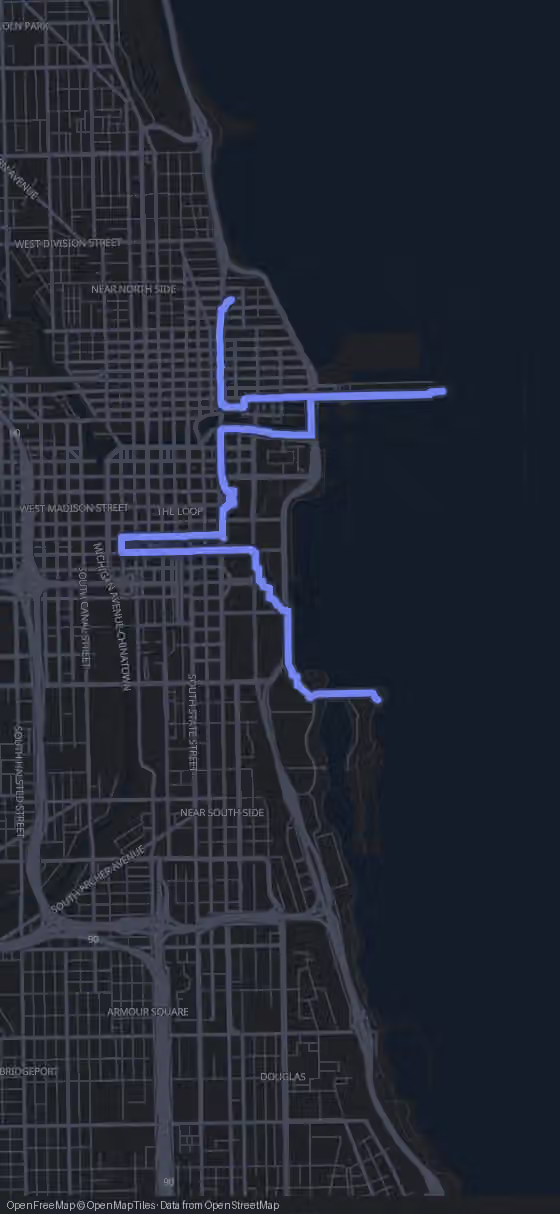
11 Stops 11.8 km ~2 h 47 min walking
Route map for the Chicago walking tour
Stop 1 of 11
530 m·7 min
360 Chicago
Head south along Michigan Avenue toward the Magnificent Mile
Welcome to Chicago. I'm Alex, and architecture here is never content with being just a building.
Try this tour with Alex

This Chicago Walk at a Glance

Eleven stops lead from 360 Chicago at the top of Michigan Avenue to the Adler Planetarium on the lakefront: 11.8 km with 2 h 47 min of pure walking. With short pauses it fills about five and a half hours; with a deck and a museum, a full day.

The Magnificent Mile, the Chicago Riverwalk, Navy Pier, Cloud Gate and Buckingham Fountain cost nothing. You pay for the deck at 360 Chicago or the Willis Tower, the Art Institute of Chicago and the planetarium. The GPS route is free in your browser; the AI Tour Guide is optional.

Open free GPS & optional AI Tour Guide
This short shows highlights of the route. All 11 stops follow below.

The Route

Walking Map of Chicago, from Michigan Avenue to the Lakefront

11 stops 11.8 km 2 h 47 min walking
Tap to load interactive map

The 11 stops along this route

  1. 360 Chicago, stop 1 on the self-guided walking tour
    1360 Chicago
  2. Magnificent Mile in Chicago, stop 2 on the self-guided walking tour
    2Magnificent Mile
  3. Tribune Tower in Chicago, stop 3 on the self-guided walking tour
    3Tribune Tower
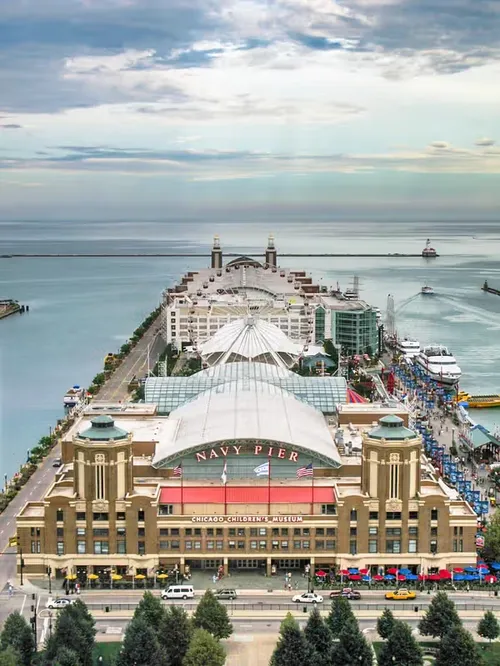
  4. Navy Pier in Chicago, stop 4 on the self-guided walking tour
    4Navy Pier
  5. Chicago Riverwalk, stop 5 on the self-guided walking tour
    5Chicago Riverwalk
  6. Cloud Gate in Chicago, stop 6 on the self-guided walking tour
    6Cloud Gate
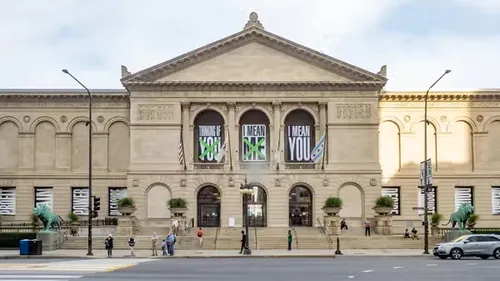
  7. Art Institute of Chicago, stop 7 on the self-guided walking tour
    7Art Institute of Chicago
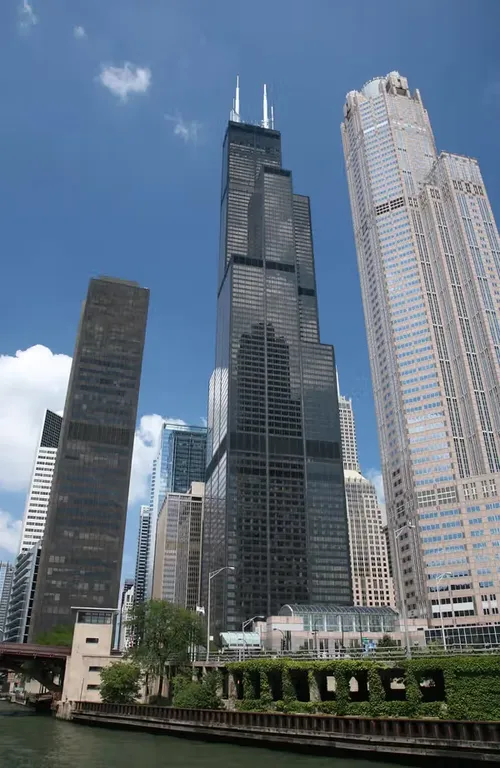
  8. Willis Tower in Chicago, stop 8 on the self-guided walking tour
    8Willis Tower
  9. Buckingham Fountain in Chicago, stop 9 on the self-guided walking tour
    9Buckingham Fountain
  10. Museum Campus in Chicago, stop 10 on the self-guided walking tour
    10Museum Campus
  11. Adler Planetarium in Chicago, stop 11 on the self-guided walking tour
    11Adler Planetarium
  12. That's the full route.

    Walk it with an AI Tour Guide talking you through every one of these streets.

    Start free in your browser
    You made it

Your Chicago Walking Tour, from the Mag Mile to Northerly Island

  1. 1

    360 Chicago

    360 Chicago, stop 1 on the self-guided walking tour

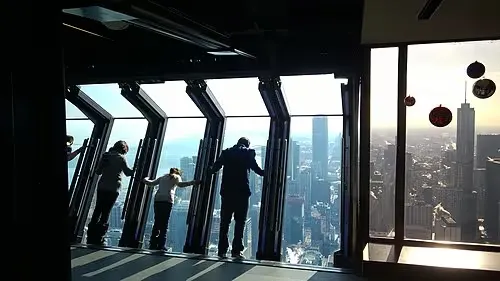
    The walk begins at the top of Michigan Avenue with a decision about money rather than a sight. 360 Chicago, officially the 360 Chicago Observation Deck, sells its view: tickets are not cheap, prices move up and down with the date and time, and the TILT ride on top costs extra again.

    The deck is open well into the evening, so nothing about the walk forces you up there right now. That matters, because Chicago puts two paid observation decks on this route: this one and the Skydeck in the Willis Tower in the Loop, 8.1 km further along on foot. Paying for both means buying the same skyline twice.

    Here is the verdict that saves you the most money today: choose one deck before you spend anything. Go up here if you want the view done early or the TILT ride appeals to you. Save your money for the Skydeck if height is the point, since it is the highest observation deck in the United States. And if you start the walk here without going up, the late closing lets you come back in the evening.

    Michigan Avenue begins right at the door. It is 490 m, about 7 minutes, into the Magnificent Mile.
    Local name
    360 Chicago Observation Deck
    Hours
    Daily 09:00–23:00
    Price
    From 30 USD adult, 19 USD child (3-11)
  2. 2

    Magnificent Mile

    Magnificent Mile in Chicago, stop 2 on the self-guided walking tour

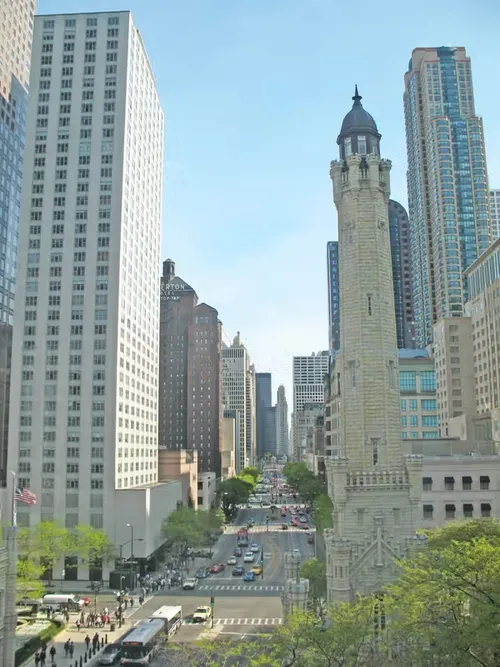
    Here Michigan Avenue becomes the Magnificent Mile, roughly a mile of shops, hotels and towers running from the Chicago River up to Oak Street. Locals shorten it to the Mag Mile. It also works as a border: Streeterville lies on its east side, River North on its west. Landmarks along the avenue include the Chicago Water Tower, the Wrigley Building, the Tribune Tower and the Allerton, Drake and Intercontinental hotels.

    A century ago none of this existed. The street was Pine Street, lined with factories and warehouses near the river and grand mansions and rowhouses farther north. After the Great Chicago Fire of 1871, the city shopped on State Street in the Loop, and crossing the river here was slow: the old swing bridges, the Rush Street Bridge among them, stood open for ships for half the daylight hours.

    Daniel Burnham's 1909 Plan of Chicago imagined a grand boulevard in its place, and the opening of the Michigan Avenue Bridge in 1920 made it happen. Through the 1920s the avenue was rebuilt, and its early buildings kept pushing to new heights. The nickname came later: developer Arthur Rubloff coined “the Magnificent Mile” in 1947, and today the name is a registered trademark of the avenue's business association.

    You need no ticket and no plan here; the avenue is open around the clock and free, so shop or simply look as you go. Keep heading toward the river for 580 m, about 9 minutes, and watch for a Gothic tower with buttresses near its crown.

    Hours
    Open 24/7
    Price
    Free
  3. 3

    Tribune Tower

    Tribune Tower in Chicago, stop 3 on the self-guided walking tour

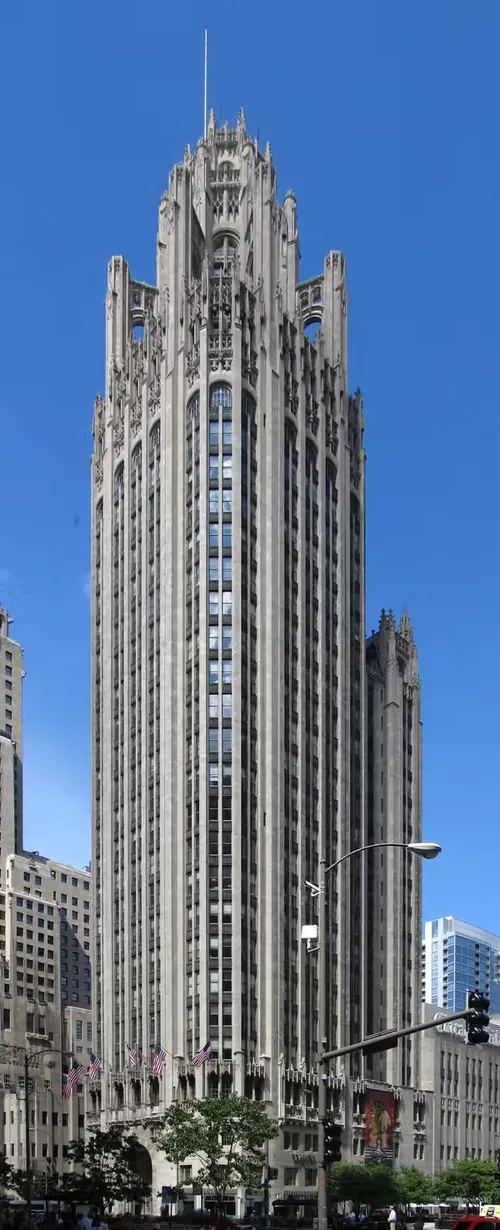
    The Tribune Tower rises 141 m above 435 North Michigan Avenue, 36 floors of neo-Gothic stone with buttresses near the top. It looks medieval, but it grew out of a newspaper publicity stunt that became a landmark event in 20th-century architecture.

    In 1922, for its 75th anniversary, the Chicago Tribune launched an international competition for “the most beautiful and distinctive office building in the world”, with 100,000 dollars in prize money and 50,000 for the winner. More than 260 entries arrived. New York architects John Mead Howells and Raymond Hood won with the design in front of you. Many people thought the best entry came second: the tower by Finnish architect Eliel Saarinen took 20,000 dollars, was preferred by Louis Sullivan and shaped the next generation of skyscrapers, including Hood's own later McGraw-Hill Building and Rockefeller Center. The Gulf Building of 1929 in Houston comes close to Saarinen's unbuilt design.

    The paper had good reason to build solidly: its first Tribune Tower, from 1868, burned in the Great Chicago Fire of 1871. The new tower housed the Tribune and its media companies for decades, WGN Radio broadcast from here until June 18, 2018, and CNN kept its Chicago bureau inside. Since 2018 the building has been converted into luxury residences, work that won a Driehaus Prize for preservation and adaptive reuse in 2023.

    That conversion settles the question of going in: these are private homes, so this is an exterior stop, and it costs nothing. Give the facade a few minutes, then turn toward the lake. Navy Pier is the longest stage so far, 2,150 m or about 30 minutes.

    Price
    Free (exterior)
  4. 4

    Navy Pier

    Navy Pier in Chicago, stop 4 on the self-guided walking tour

    Navy Pier reaches 1,010 m out into Lake Michigan and carries a small town on its back: shops, restaurants, theaters, family attractions, gardens and Polk Bros Park, more than 20 hectares in all. It draws over nine million visitors a year and is Chicago's second most visited tourist attraction. Walking onto the pier is free.

    It opened on July 15, 1916, as Municipal Pier, designed by Charles Sumner Frost along the lines of the same 1909 Burnham Plan behind the Magnificent Mile. Under your feet are 20,000 logs shipped in from Oregon and driven into the lake bed. Its first job was practical: a dock for freighters and passenger ships, with room for expositions and pageants.

    Then history kept borrowing it. In 1918 it served as a jail for draft dodgers. In 1927 it was renamed Navy Pier to honor the naval veterans of the First World War, and in 1941 it became a Navy training center where about 10,000 people worked, trained and lived, with a 2,500-seat theater, a gym, a 12-chair barber shop, tailors, cobblers and a hospital. The training carriers USS Wolverine and USS Sable, based here, qualified 18,000 naval aviators. From 1946 the University of Illinois taught returning servicemen on the pier until it outgrew the space, one of the roots of today's University of Illinois at Chicago.

    Walk out as far as you like, but every metre out is a metre back. The return leg takes you to the water's edge in the city: 2,280 m, about 31 minutes, to the Chicago Riverwalk.

    Hours
    Summer: Sun–Thu 10:00–22:00, Fri 10:00–23:00, Sat 10:00–24:00; outside the summer season opens at 11:00
    Price
    Free
  5. 5

    Chicago Riverwalk

    Chicago Riverwalk, stop 5 on the self-guided walking tour

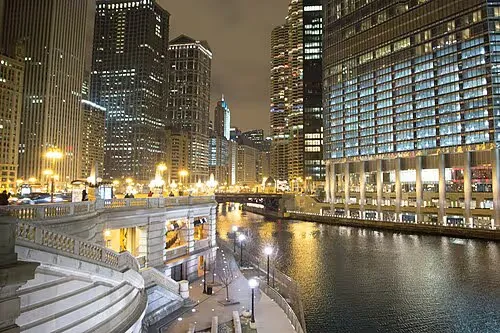
    The Chicago Riverwalk follows the south bank of the river's main branch, from the lake and the Outer Drive Bridge to Wolf Point and Lake Street. Along the water you find cafés, bars, small parks, boat and kayak rentals, tour boat docks and a Vietnam War memorial. Walking it costs nothing.

    It exists because a road moved. When Wacker Drive was rebuilt, the street was deliberately shifted to make room for a promenade, and construction began in 2001. The architects of Skidmore, Owings & Merrill planned it as four districts with their own character: Confluence, where the main, north and south branches of the river meet, which was pushed fifty feet out into the river for park space; Arcade, named for the architectural detailing that separates the river from Wacker Drive; Civic; and Market, the oldest section, between Lake Shore Drive and Michigan Avenue.

    Civic, between Dearborn Street and Michigan Avenue, is the lively one: the boat launches leave from here, and the Chicago Bridgehouse Museum sits at Michigan Avenue and Wacker Drive. If you want to see the city from the water, this is where you would board, though a boat trip adds time beyond this walk.

    Sit by the river for a while, then head into the Loop. Cloud Gate is 990 m away, about 14 minutes.

    Hours
    Daily 06:00–23:00
    Price
    Free
  6. 6

    Cloud Gate

    Cloud Gate in Chicago, stop 6 on the self-guided walking tour

    Cloud Gate is the polished steel shape everyone calls the Bean, the centerpiece of Grainger Plaza in Millennium Park. Its surface reflects and bends the skyline and the clouds overhead, exactly as Anish Kapoor intended: liquid mercury was his inspiration. Walk all the way around it, then go under its 3.7 m high arch to find the omphalos, a concave chamber on the underside that warps and multiplies your reflection.

    The numbers explain the fuss: 10 by 20 by 13 m, about 100 tonnes, and 168 stainless steel plates welded together so that no seam shows. After Kapoor won the design competition, experts were asked whether it could be built at all, and some believed it could not. A workable method was found, but construction fell behind schedule. The sculpture was shown unfinished at the park's grand opening in 2004, hidden again while it was completed, and formally dedicated on May 15, 2006.

    Kapoor first disliked the nickname “The Bean” and later grew fond of it. It is free and a favorite photo stop, so expect to share the reflections with others holding up their phones.

    Continue through Millennium Park to the Art Institute of Chicago, 530 m on, about 7 minutes.

    Hours
    Daily 06:00–23:00
    Price
    Free
  7. 7

    Art Institute of Chicago

    Art Institute of Chicago, stop 7 on the self-guided walking tour

    The Art Institute of Chicago, founded in 1879, stands in Grant Park in a building constructed for the 1893 World's Columbian Exposition. It has grown many times since; Renzo Piano's Modern Wing of 2009 brought it to nearly a million square feet, making it the second largest art museum in the United States after the Metropolitan Museum of Art.

    Inside hang pictures you already know: Georges Seurat's A Sunday on La Grande Jatte, Pablo Picasso's The Old Guitarist, Edward Hopper's Nighthawks and Grant Wood's American Gothic. The permanent collection counts nearly 300,000 works, and more than 30 special exhibitions open each year. The School of the Art Institute is legally part of the same institution, one of the few unified arts institutions left in the United States.

    Is it worth going in? If paintings matter to you at all, yes: this is the one long museum stop of the route. Admission is paid, but younger visitors go free, which makes it an easy family decision. Two hours let you see the famous canvases without rushing.

    From the museum it is 1,080 m, about 16 minutes, through the Loop to the Willis Tower.

    Hours
    Mon 11:00–17:00, Tue closed, Wed 11:00–17:00, Thu 11:00–20:00, Fri–Sun 11:00–17:00
    Price
    32 USD adult, 26 USD senior/student, free under 14
  8. 8

    Willis Tower

    Willis Tower in Chicago, stop 8 on the self-guided walking tour

    The Willis Tower, still called the Sears Tower by most locals, rises 442 m over the Loop. When it opened in 1973 it was the world's tallest building and kept that title for nearly 25 years. Its owners count 110 stories, though standard methods give 108. Behind the black glass and anodized aluminum facade are offices, and at the base a retail complex called the Catalog.

    The design came from architect Bruce Graham and engineer Fazlur Rahman Khan of Skidmore, Owings & Merrill, the firm whose plan later shaped the Riverwalk. Their idea: nine square tubes bundled in a 3×3 grid, seven of them set back at the upper floors. Look up and you can pick out where they end. Sears kept its headquarters in the lower half until 1994; the naming rights went to the Willis Group in a 2009 lease, and United Airlines is now the largest tenant.

    Up top is the Skydeck, the highest observation deck in the United States, with more than 1.7 million visitors a year. Going up costs admission.

    If you skipped 360 Chicago this morning, this is your deck. If you already went up there, keep your money and enjoy the tower from the street.

    From here the route turns to the lake: Buckingham Fountain is 1,720 m away, about 25 minutes.

    Hours
    Summer: daily 09:00–22:00 (Sat from 08:30); in winter until 20:00 on weekdays; last entry 30 min before closing
    Price
    From 32 USD adult (12+), 24 USD youth (3-11), free under 3
  9. 9

    Buckingham Fountain

    Buckingham Fountain in Chicago, stop 9 on the self-guided walking tour

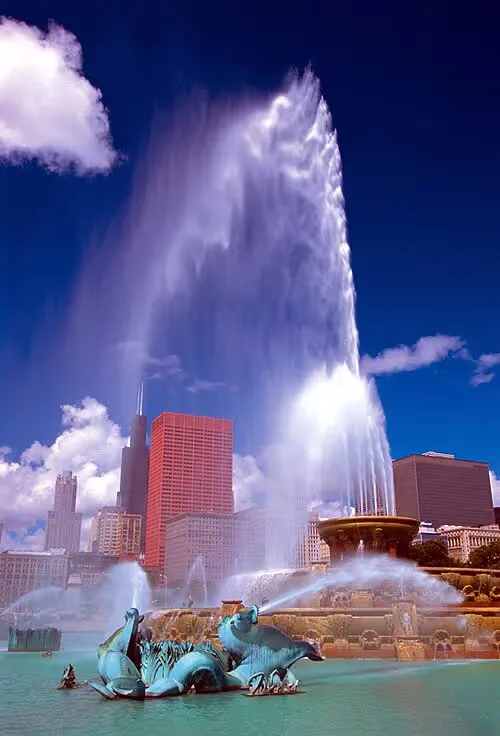
    Buckingham Fountain stands at the center of Grant Park, a rococo wedding cake in stone that has been called Chicago's front door. It represents Lake Michigan: its four pairs of sea horses stand for the four states on the lake's shores, Illinois, Wisconsin, Michigan and Indiana. The model was the Latona Fountain at Versailles.

    Its official name tells the backstory: the Clarence Buckingham Memorial Fountain. Kate Sturges Buckingham gave it to the city in memory of her brother, paid 750,000 dollars to build it and set up a maintenance fund with another 300,000. It was dedicated on August 26, 1927. Edward H. Bennett, co-author of the 1909 Plan of Chicago you met on the Magnificent Mile and at Navy Pier, designed it; the French sculptor Marcel F. Loyau made the statues.

    Timing matters here. Outside winter the fountain puts on regular water shows of about 20 minutes, with colored light shows in the evening. In winter the water is off and the fountain wears festival lights instead. It is free, and if you are a few minutes early for a show, wait for it.

    From the fountain it is 1,300 m, about 18 minutes, to the Museum Campus.

    Hours
    Typically May to mid-October, daily 08:00–23:00 while fountain is open
    Price
    Free
  10. 10

    Museum Campus

    Museum Campus in Chicago, stop 10 on the self-guided walking tour

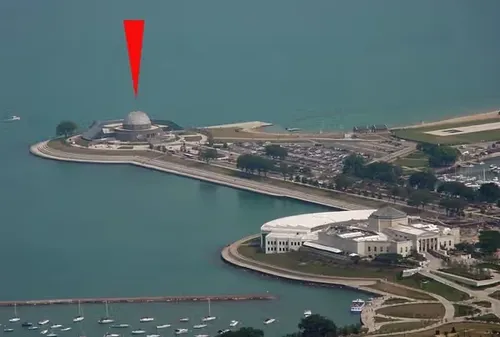
    The Museum Campus is a 23-hectare park on Lake Michigan that gathers five big names: the Adler Planetarium, the Shedd Aquarium, the Field Museum of Natural History, Soldier Field, home of the Chicago Bears, and the Lakeside Center of McCormick Place. The park itself is free.

    It is younger than it looks. The campus opened on June 4, 1998, after the northbound lanes of Lake Shore Drive were moved west of Soldier Field in 1996, freeing 36 acres of land. The aim was to turn the surroundings of the three museums into a green, pedestrian-friendly area, with lawns, jogging paths and walkways where traffic used to run.

    On the way to the planetarium you follow Solidarity Drive, the promenade across the isthmus that links Northerly Island to the mainland. Its median carries bronze monuments: Thaddeus Kościuszko from 1904, moved here from Humboldt Park in 1978; Karel Havlíček Borovský from 1911, moved from Douglass Park in 1983; and a 1973 replica of Bertel Thorvaldsen's statue of Nicholas Copernicus in Warsaw.

    The campus almost changed again: in 2014 George Lucas chose it for his Lucas Museum of Narrative Art, until opposition from the Friends of the Parks ended the plan in 2016. If the Shedd or the Field Museum tempts you, plan it as a separate visit. The Adler Planetarium is 630 m away, about 8 minutes.

    Hours
    Daily 06:00–23:00
    Price
    Free
  11. 11

    Adler Planetarium

    Adler Planetarium in Chicago, stop 11 on the self-guided walking tour

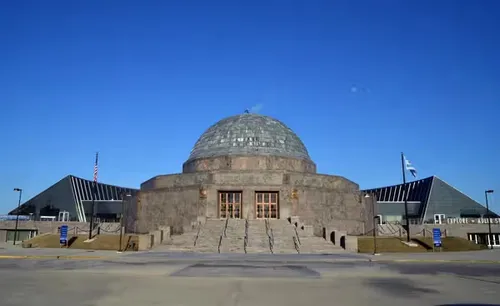
    The walk ends at the Adler Planetarium on the northeastern tip of Northerly Island, the first planetarium in the United States. Its founder, Max Adler, was a former executive of Sears, Roebuck, the company of the tower you passed this afternoon. He had retired to philanthropy when a friend described one of the new planetariums in Germany, and he decided Chicago needed one. It opened on May 12, 1930.

    The technology was brand new then. In 1913 Oskar von Miller of the Deutsches Museum asked Carl Zeiss Works for a machine that could project the night sky onto a dome; Walther Bauersfeld built it, and it debuted in 1923. Architect Ernest A. Grunsfeld Jr. won the gold medal of the Chicago chapter of the American Institute of Architects for the building in 1931, and it has been a National Historic Landmark since 1987. Outside stand sculptures including Henry Moore's Man Enters the Cosmos and John David Mooney's Spiral Galaxy.

    Inside are three theaters, space science exhibitions with the Gemini 12 capsule, a collection of antique scientific instruments and the Doane Observatory, a research-active observatory open to the public. Admission is paid. It is worth it for anyone curious about space and a calm finish for kids after a long walk, but watch the clock: on most days the doors close well before evening.

    Even with the doors shut, the tip of the island by the lake is a fitting place to end the walk.

    Hours
    Thu–Tue 09:00–16:00, Wed 16:00–22:00
    Price
    From 25 USD adult, 13 USD child (3-11)
Walking tour route map of Chicago Route loaded
360 ChicagoMagnificent MileTribune TowerNavy Pier+7
All 11 stops are already on the map.
You just press start.
AI Tour Guide

You know the route now. Walk it with a guide who talks Chicago with you.

Press start wherever you are, even hundreds of kilometres from Chicago, and the guide begins telling its stories right away. In the city, pick any of the 11 stops to start from: it leads you there, then talks with you the whole route, asking, listening, remembering, and shaping the tour around your answers.

11stops 11.8km 2 h 47 minwalking 13languages
▶Start the tour free

Free to start · Runs in your browser · No app, no download

Shorter Ways to Walk Chicago

The route splits cleanly into halves, so you can walk the part that fits your day and keep the rest for another one.

Michigan Avenue and Navy Pier

Stops: 1, 2, 3, 4, 5

For an arrival day or a free morning: the avenue, the Tribune Tower, the pier and the river, with 1 h 17 min of walking. Everything is free; the only possible ticket is the deck at 360 Chicago, if you choose it over the Skydeck.

Art, Skydeck and the Lakefront

Stops: 6, 7, 8, 9, 10, 11

For museum people: Cloud Gate, the Art Institute, the Willis Tower, the fountain and the museums by the lake, with 1 h 14 min of walking. Entry applies at the Art Institute, the Skydeck and the Adler.

The Free Middle Stretch

Stops: 2, 3, 4, 5, 6, 7

For a day without tickets: from the Magnificent Mile past the Tribune Tower and out to Navy Pier, then along the river to Cloud Gate, with 1 h 31 min of walking. It ends at the Art Institute, where you decide on the spot whether to go in.

How Long This Chicago Walk Takes, With and Without Museums

The 11.8 km take 2 h 47 min of pure walking, and the stages are uneven. Out to Navy Pier and back to the river you walk about half an hour each time; from Cloud Gate onward the Loop moves in short hops. With brief pauses everywhere and no ticketed visits, plan around five and a half hours.

Add the Art Institute (about two hours) and one observation deck (about an hour) and it becomes a full day of about eight hours. Start at 10:00 at 360 Chicago and you reach Navy Pier at 11:21, the Art Institute at 13:18 and the Willis Tower at 15:34. Leave the Skydeck at 16:34, arrive at Buckingham Fountain at 16:59, in time for a water show in season, and stand at the Adler Planetarium at 18:00. By then the planetarium is usually closed, so if you want to go inside, make sure it is open that evening.

The northern half from 360 Chicago to the Riverwalk fits into about three hours with time on the pier. The southern half from Cloud Gate to the planetarium takes about five hours with all three ticketed visits. The free middle stretch needs about three hours, five if you go into the Art Institute.

Before You Set Off in Chicago

  • Start and finish: Start at 360 Chicago at the top of Michigan Avenue and finish at the Adler Planetarium on Northerly Island. You can join at any stop; this order is the recommended one.
  • Best day and time: Pick a day when both the Art Institute and the Adler are open for your visit, keeping in mind that the Adler comes last on the route. Start in the morning to fit in the ticketed stops.
  • Costs: Walking costs nothing. A day with one deck, the Art Institute and the Adler adds up per adult, and it comes to about the same whichever deck you choose. Younger visitors get into the Art Institute free.
  • One deck, not two: Decide between 360 Chicago and the Skydeck before you buy anything; both show you the same skyline.
Walking tour route map of Chicago
AI Tour Guide

When you're ready to walk, your guide is too.

Press start and a voice AI Tour Guide takes it from here: leading the route through Chicago, telling the stories, and turning your walk into a real back-and-forth conversation. No app or download is needed; it runs in your browser.

11stops 11.8km 2 h 47 minwalking 13languages
▶Start the tour free

Free to start · Runs in your browser · No app, no download

What the AI Tour Guide Adds Between Michigan Avenue and the Lake

This route is full of threads that run from one place to the next: Burnham's 1909 plan behind the Magnificent Mile, Navy Pier and the fountain, Skidmore, Owings & Merrill at the Riverwalk and the Willis Tower, Sears money in both the tower and the planetarium. The AI Tour Guide leads the walk as a conversation, picks up those threads, asks what grabs you and goes deeper there, whether that is daily life aboard the Navy's training carriers on Lake Michigan or how Kapoor's team finally solved the Bean. You can interrupt whenever you like. You start with 100 free credits; after that, this tour costs €19.99 all-inclusive with no time limit, or €5 per hour.

A Real Conversation A voice AI Tour Guide greets you, leads the whole route, and tells the stories and facts as you walk, asking what you want to see and keeping a real conversation going. Not a recording you press play on.
Map Navigation Follow the route on the map and walk at your own pace. You choose where to start and when to move to the next stop.
Ask Anything Curious about a building you pass? Ask your AI Tour Guide on the spot and the conversation carries on.
13 Languages Switch language anytime. No separate tour needed.
Start free in your browser

Common Questions About Walking Chicago

Can I walk the route in reverse and end at a deck at night?

Yes. Start at the Adler Planetarium in the morning and work your way north past the Art Institute. 360 Chicago stays open well into the evening, so it makes a good evening finish.

Can I visit Navy Pier in the evening?

Yes. In summer it stays open late, longest at the weekend. Outside the summer season it opens later in the day, so plan your visit for the afternoon or evening.

Does the walk work with kids?

Yes, if you plan around the long stretches to and from Navy Pier. The pier's family attractions, the reflections under Cloud Gate, the fountain's water show and the Adler make good anchors, and the Art Institute is free for anyone under 14.

Which other city walks are within reach of Chicago?

The closest is Nashville, about 640 km away. On the East Coast, Washington, D.C. and New York have their own walking routes with the same free GPS navigation.

Is the tour really free?

Yes. The whole tour is free: the route, the interactive map and the navigation cost you nothing. Only the voice AI Tour Guide is optional and paid: you test it with 100 free credits, then you pay either €5 per hour or €19.99 for this whole tour, with no time limit. Admission to 4 of the 11 stops is not included: 360 Chicago, Art Institute of Chicago, Willis Tower and Adler Planetarium charge their own entry fees.

Do I need to download an app?

No. Everything runs in your phone browser. Open the route and start walking, no download and no sign-up required.

Do I need to book the walking tour in advance?

No booking needed. This self-guided tour is available anytime. Open the route in your browser and start walking. The AI Tour Guide works instantly, no app, no reservation required.

What languages is the AI Tour Guide available in?

The AI Tour Guide speaks 13 languages, so you take the tour in your own language and can switch at any time.

Can I skip stops or change the route?

Yes. Skip any stop, spend extra time at places you like, or start the route from any point. It is your walk, you set the pace.
Image credits
▶ Start free in your browser Runs in your browser, no app, no download