Free Walking Tour Los Angeles: Disney Hall to Union Station

Start at Frank Gehry's concert hall, ride a funicular first opened in 1901, eat in a market open since 1917 and finish in Union Station, opened in 1939.

8 Stops 3.8 km ~55 min walking
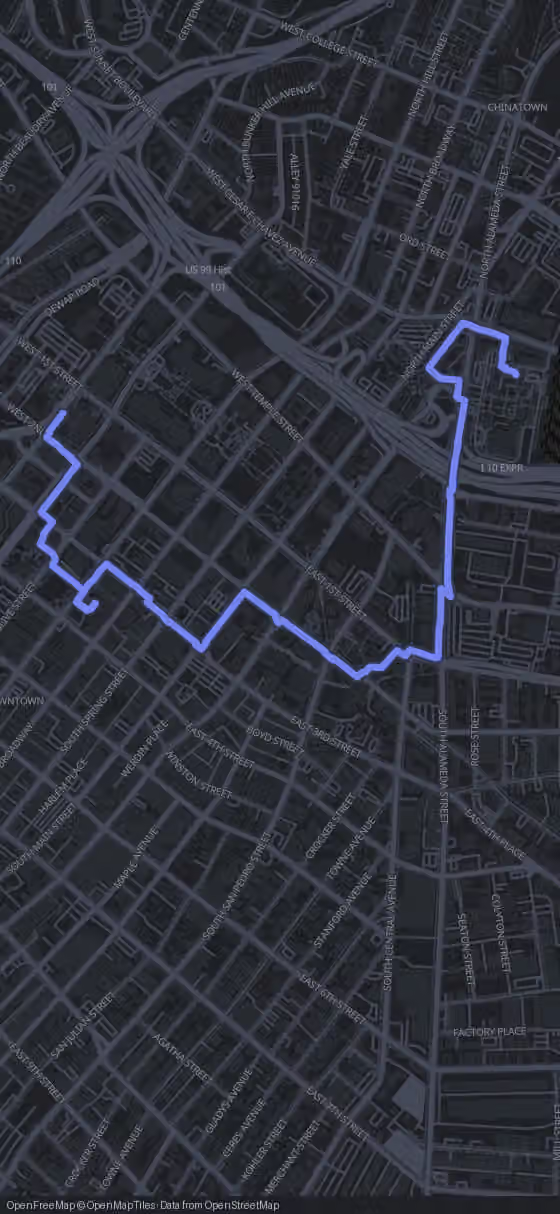
Route map for the Los Angeles walking tour
Stop 1 of 8
140 m·2 min
Walt Disney Concert Hall
Head southwest toward The Broad
Welcome to Los Angeles. I'm Alex, and downtown's plainest facades often hide its most cinematic stories.
Try this tour with Alex

This Downtown Route at a Glance

Eight stops lead from the Walt Disney Concert Hall to Union Station: 3.8 km and 55 minutes of pure walking, or about five hours with a museum visit and lunch.

Nearly everything is free, The Broad's collection included; the only fare is for the Angels Flight Railway. Route, map and GPS navigation run free in your browser, and the AI Tour Guide is optional.

Open free GPS & optional AI Tour Guide
View of Los Angeles

The Route

Walking Map of Los Angeles: Concert Hall to Union Station

8 stops 3.8 km 55 min walking
Tap to load interactive map

The 8 stops along this route

  1. Walt Disney Concert Hall in Los Angeles, stop 1 on the self-guided walking tour
    1Walt Disney Concert Hall
  2. The Broad in Los Angeles, stop 2 on the self-guided walking tour
    2The Broad
  3. Angels Flight Railway in Los Angeles, stop 3 on the self-guided walking tour
    3Angels Flight Railway
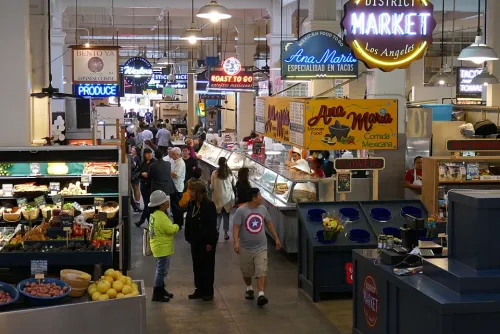
  4. Grand Central Market in Los Angeles, stop 4 on the self-guided walking tour
    4Grand Central Market
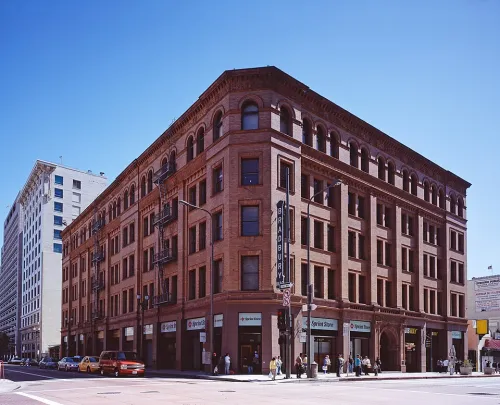
  5. Bradbury Building in Los Angeles, stop 5 on the self-guided walking tour
    5Bradbury Building
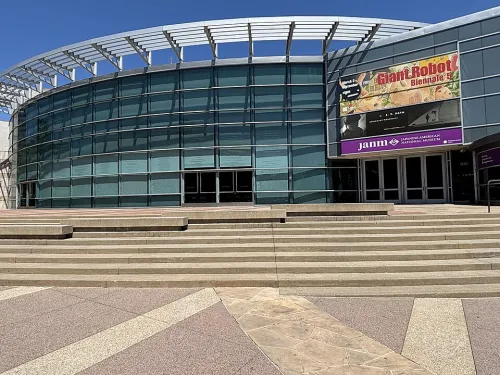
  6. Japanese American National Museum in Los Angeles, stop 6 on the self-guided walking tour
    6Japanese American National Museum
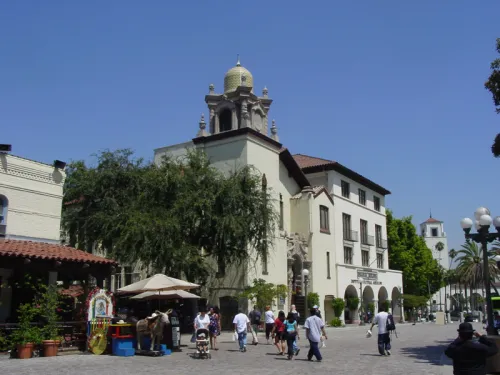
  7. Olvera Street in Los Angeles, stop 7 on the self-guided walking tour
    7Olvera Street
  8. Union Station in Los Angeles, stop 8 on the self-guided walking tour
    8Union Station
  9. That's the full route.

    Walk it with an AI Tour Guide talking you through every one of these streets.

    Start free in your browser
    You made it

The Los Angeles Walking Tour in Eight Stops

  1. 1

    Walt Disney Concert Hall

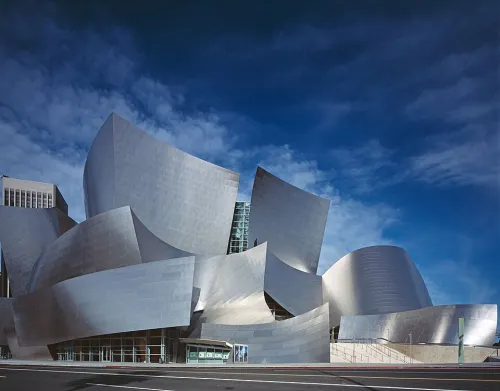
    Walt Disney Concert Hall in Los Angeles, stop 1 on the self-guided walking tour

    Start on Grand Avenue in front of a building that looks nothing like a traditional concert hall. Frank Gehry designed the Walt Disney Concert Hall as the fourth hall of the Los Angeles Music Center, and it opened on 23 October 2003. It is home to the Los Angeles Philharmonic and the Los Angeles Master Chorale, and its 2,265 seats are a compromise between two traditions: the vineyard layout of Hans Scharoun's Berliner Philharmonie and the classic shoebox of the Vienna Musikverein or Boston Symphony Hall.

    The story starts in 1987, when Lillian Disney gave an initial $50 million for a performance venue, a gift to the people of Los Angeles and a tribute to Walt Disney's love of the arts and of the city. Gehry, although this was his hometown, thought he was the least likely choice. He later recalled being told that under no circumstances would Walt Disney's name go on any building he designed. His reputation was for cheap materials used in unconventional ways, hardly what an elegant, high budget hall seemed to need.

    The acoustics, designed by Minoru Nagata and completed under his protégé Yasuhisa Toyota, won as much praise as the architecture, in contrast to the hall's predecessor, the Dorothy Chandler Pavilion.

    Going in is worth it for anyone curious about architecture: the self-guided audio tour and the garden are free, though rehearsals and events can change the schedule. Allow about 45 minutes. If you would rather hear the hall, come back for a concert. Then cross over to The Broad, just 140 m and two minutes away.
    Hours
    Self-guided tours: daily 10:00–15:00 (schedule varies with rehearsals/events); Box Office: daily 10:00–18:00
    Price
    Free (self-guided audio tours & garden); concert tickets vary by performance (from approx. $20)
  2. 2

    The Broad

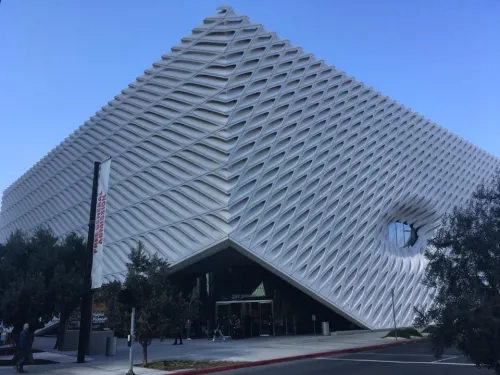
    The Broad in Los Angeles, stop 2 on the self-guided walking tour

    The Broad is a contemporary art museum on Grand Avenue, named for the philanthropists Eli and Edythe Broad, who paid for the $140 million building that houses their collection. It opened on 20 September 2015, and general admission to the permanent collection galleries is free; some exhibitions and events charge separately.

    Downtown was not the obvious home. For two years the Broads looked elsewhere: a corner in Beverly Hills on Wilshire and Santa Monica Boulevards, a 10 acre parcel at West Los Angeles College near Culver City, and a Santa Monica site the city offered to lease for $1 a year for 99 years. In August 2010 Eli Broad chose downtown and agreed to pay $7.7 million for a 99 year lease, money that went toward affordable housing units at The Emerson, the residential tower next door.

    Six firms competed for the design, among them Rem Koolhaas's OMA, Herzog & de Meuron, Christian de Portzamparc and SANAA. The New York studio Diller Scofidio + Renfro won and built roughly 120,000 square feet of galleries, offices and parking garage.

    If contemporary art speaks to you at all, this is the indoor visit to plan the day around: give it about 75 minutes. From here it is 510 m and seven minutes to Angels Flight.

    Hours
    Tue–Wed, Fri 11:00–17:00, Thu 11:00–20:00, Sat–Sun 10:00–18:00, Mon closed
    Price
    Free
  3. 3

    Angels Flight Railway

    Angels Flight Railway in Los Angeles, stop 3 on the self-guided walking tour

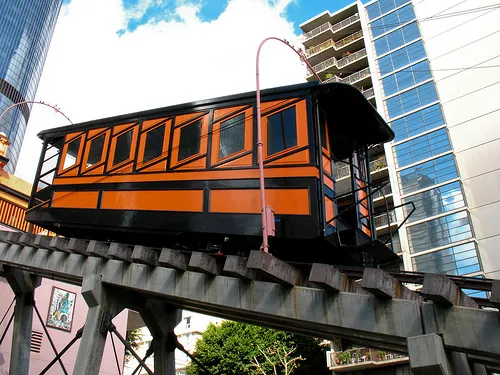
    Two little cars named Olivet and Sinai run in opposite directions on a shared cable, linking California Plaza in the Bunker Hill district with Hill Street. Angels Flight is a narrow gauge funicular: the track is just 298 feet long and climbs 96 feet, so the ride is over almost as soon as you have sat down.

    Its history is far longer than the ride. The first Angels Flight ran from 1901 beside the Third Street Tunnel until 1969, when the site was cleared for redevelopment. The same cars and station pieces returned in 1996, half a block south. A fatal accident shut it down in 2001; it reopened in 2010, closed again in 2011, and after a minor derailment in 2013 investigators found serious safety problems in design and operation.

    It was marketed as a tourist novelty, yet local workers used it daily to get between the Historic Core and Bunker Hill. In 2015 the director of the nearby REDCAT arts center called it an important economic link, and pressure grew to bring it back. It reopened in August 2017 for $1 a ride.

    Riding is the point: the fare is small, and a TAP card makes it cheaper still. Ride it to Hill Street, and Grand Central Market is only 190 m, three minutes, away, the same trip wealthy Bunker Hill shoppers made a century ago.

    Hours
    Daily 06:45–22:00
    Price
    USD 1.50 adult
  4. 4

    Grand Central Market

    Grand Central Market in Los Angeles, stop 4 on the self-guided walking tour

    Grand Central Market has been trading without interruption since October 1917, filling the entire ground floor of the Homer Laughlin Building. It took the place of the Ville de Paris department store and was promoted at the time as “the largest and finest public market on the Pacific Coast.” Back then it served mostly wealthier customers who rode Angels Flight down from Bunker Hill.

    The early “Wonder Market” sold fish, oysters, meat and produce from farms across the Southland, with stalls for eggs and butter, bakeries, delicatessens, candy, flowers and lunch counters. By 1926 its 120 stalls drew about forty thousand customers a day, served by shopkeepers of many nationalities.

    After the Second World War downtown declined, supermarkets and farmers markets opened elsewhere, and the market shrank to 52 stalls by 1968, selling more low cost groceries. In 1978 about half of its 180,000 weekly shoppers were Latino. In 1985 the Beverly Hills attorney Ira Yellin bought it and restored it: he stripped off a tile façade that covered the second floor windows, brought back the Beaux Arts details and added vintage and new neon signs. Look up at the neon as you walk in.

    Today dozens of food vendors draw some 2 million visitors a year, and it is the natural lunch stop of the route. Afterwards, walk 400 m, six minutes, to the Bradbury Building.

    Hours
    Daily 08:00–21:00
    Price
    Free
  5. 5

    Bradbury Building

    Bradbury Building in Los Angeles, stop 5 on the self-guided walking tour

    From outside the Bradbury Building is a modest five floor office block from 1893. Step into the lobby, though, and you stand in a skylit atrium full of open walkways, elevators and ornate ironwork. It has been the backdrop for many films, television shoots and music videos, and it is the city's oldest landmarked building, one of only four office buildings in Los Angeles named a National Historic Landmark.

    It was commissioned by Lewis L. Bradbury, a millionaire who made his fortune in mining, including the Tajo Mine in Sinaloa, Mexico, and later in real estate. In 1892 he hired the local architect Sumner Hunt, then rejected Hunt's finished plans as not grand enough and gave the job to George Wyman, one of Hunt's draftsmen. Wyman had no formal training and was earning $5 a week. Whether he really changed Hunt's design is unclear, so who deserves credit as architect is still debated.

    Bradbury never saw it: he died in 1892, months before the building opened. It was finished in 1894 for $500,000, about three times the original budget of $175,000, and has served as offices for most of its life.

    The lobby is free and the only part open to visitors. Fifteen minutes is enough, and it is a must for anyone who likes architecture or film. Next comes the longest leg: 1,180 m, about 17 minutes, to Little Tokyo.

    Hours
    Mon–Fri 09:00–17:00, Sat–Sun 10:00–14:00 (lobby only)
    Price
    Free (lobby access only)
  6. 6

    Japanese American National Museum

    Japanese American National Museum in Los Angeles, stop 6 on the self-guided walking tour

    In Little Tokyo you reach the Japanese American National Museum. It is currently closed, so this is a stop to look at from outside. The building in front of you is the 85,000 square foot Pavilion, opened in January 1999 and designed under the supervision of the architect Gyo Obata.

    The museum was founded in 1992, when the Japanese American community was organizing to win recognition of the injustices the federal government inflicted on it during the Second World War. Its founding president was Bruce Teruo Kaji, its first executive director Irene Hirano. It first opened in the historic Hompa Hongwanji Buddhist Temple of 1925, a building government officials had used in 1942 to process Japanese Americans for wartime confinement.

    The collection covers more than 130 years of history, back to the first Issei generation of immigrants: artifacts, textiles, art, photographs and oral histories, plus over 100,000 feet of home movies from the 1920s to the 1950s. In 1993 the museum received hundreds of letters children in the internment camps had written to the San Diego librarian Clara Breed. It is a Smithsonian affiliate, and worth a return trip once it reopens.

    From here walk 990 m, about 15 minutes, to Olvera Street and the oldest part of the city.

    Status
    Currently closed
    Reopens
    23 January 2027
    Website
    janm.org ↗
  7. 7

    Olvera Street

    Olvera Street in Los Angeles, stop 7 on the self-guided walking tour

    Olvera Street, known in Spanish as Placita Olvera or Calle Olvera, is a pedestrian street lined with restaurants and vendors, part of the El Pueblo de Los Ángeles Historical Monument. It runs north from the Plaza de Los Ángeles, the oldest plaza in California, which was the center of city life through the Spanish and Mexican eras and into the early American years. Over the years the street has also been called Calle de los Vignes, Vine Street and Wine Street.

    Several of the oldest buildings in Los Angeles stand here, among them the Ávila Adobe, the oldest standing residence in the city. The plaza itself dates from the 1820s and lies about a block from the original 18th century plaza.

    Los Angeles began in 1781, when 11 families, 44 men, women and children, came from Mission San Gabriel Arcángel with a few soldiers to found a pueblo on the Porciúncula River at the Indigenous village of Yaanga. Only two of the settlers were white; 26 had some African ancestry and 16 were Indigenous or mestizo. They named the town El Pueblo de Nuestra Señora Reina de los Ángeles.

    The street is always open and free, while shop and restaurant hours vary; give it around 40 minutes to browse and see the plaza. Union Station lies just west of here, 370 m and five minutes away.

    Hours
    Always accessible (public pedestrian street; merchant and restaurant hours vary)
    Price
    Free
  8. 8

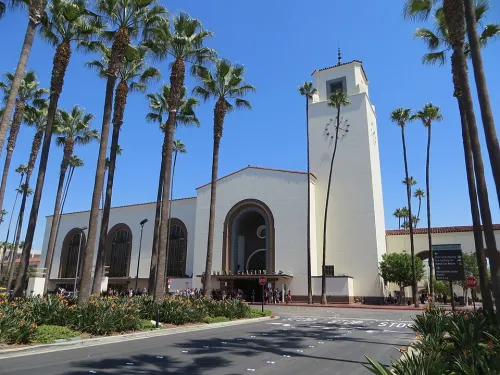
    Union Station

    Union Station in Los Angeles, stop 8 on the self-guided walking tour

    Union Station opened in May 1939 as the Los Angeles Union Passenger Terminal and became known as the “Last of the Great Railway Stations” built in the United States. Its design blends Art Deco, Mission Revival and Streamline Moderne, and it has been on the National Register of Historic Places since 1980. Take your time in the halls: entry is free.

    It took a controversial ballot measure in 1926 to get it built. The goal was to bring the Santa Fe, Southern Pacific and Union Pacific railroads under one roof, replacing La Grande Station, Central Station and Salt Lake Station.

    Today it is the largest passenger rail terminal in the Western United States and serves almost 110,000 passengers a day. Four Amtrak long distance trains start and end here: the Coast Starlight to Seattle, the Southwest Chief and Texas Eagle to Chicago, and the Sunset Limited to New Orleans. The Pacific Surfliner runs frequently to San Diego, a good idea for another day, and to Santa Barbara and San Luis Obispo.

    The station is also the hub of Metrolink and a transfer point for several Metro Rail lines, with dozens of bus lines at the Patsaouras Transit Plaza on its east side. Your walk ends here, right where your onward connections begin.

    Hours
    Daily 04:00–01:00
    Price
    Free
Walking tour route map of Los Angeles Route loaded
Walt Disney Concert HallThe BroadAngels Flight RailwayGrand Central Market+4
All 8 stops are already on the map.
You just press start.
AI Tour Guide

You know the route now. Walk it with a guide in your ear.

Press start wherever you are, even hundreds of kilometres from Los Angeles, and the guide begins telling its stories right away. In the city, pick any of the 8 stops to start from: it leads you there, then talks with you the whole route, asking, listening, remembering, and shaping the tour around your answers.

8stops 3.8km 55 minwalking 13languages
▶Start the tour free

Free to start · Runs in your browser · No app, no download

Shorter Ways to Walk Downtown

The route splits neatly in two at Grand Central Market, so you can walk one half and save the other for another day.

Art and architecture on Grand Avenue

Stops: 1, 2, 3, 4, 5

For architecture and contemporary art lovers with half a day: Gehry's hall, The Broad, the funicular ride, lunch at the market and the Bradbury lobby. Just 18 minutes of walking; the only fare is Angels Flight, and The Broad's collection is free.

From the market to the city's beginnings

Stops: 4, 5, 6, 7, 8

For history fans: start with lunch at the market, then the Bradbury Building, Little Tokyo, the old plaza on Olvera Street and the great hall of Union Station. 43 minutes of walking and no entry fees at all.

How Long the Los Angeles Walk Takes with Visits

The pure walking time is 55 minutes, and most legs are short; the longest are the 17 minutes from the Bradbury Building to Little Tokyo and the 15 minutes on to Olvera Street.

A realistic day looks like this: start at the concert hall at 10:15 and give it 45 minutes, so you reach The Broad at 11:02. After 75 minutes in the galleries and ten minutes for the funicular, you are at the market by 12:37 for lunch. Leave at 13:22, spend a quarter of an hour in the Bradbury lobby, pass the museum in Little Tokyo at 14:00, wander Olvera Street from 14:20 and arrive at Union Station at 15:05. With 25 minutes in the station you finish at 15:30, about five and a quarter hours in all.

The Grand Avenue half takes about three and a half hours with The Broad and lunch, the history half just under three hours.

Before You Set Off from the Concert Hall

  • Start and finish: The Walt Disney Concert Hall is the recommended start, but you can join at any stop. The walk ends at Union Station, the hub for Metro Rail, Metrolink and Amtrak, so getting onward is easy.
  • Best day: Choose your day with care: The Broad and the Bradbury lobby are not open every day for the same length of time.
  • Costs: The route itself is free, as are the concert hall's self-guided audio tour, The Broad's permanent collection, the Bradbury lobby, the market and the station. You only pay for the Angels Flight ride and for anything you eat.
  • Closed for now: The Japanese American National Museum is currently closed; on this walk you see it from outside.
Walking tour route map of Los Angeles
AI Tour Guide

Your guide for downtown is ready when you are.

Press start and a voice AI Tour Guide takes it from here: leading the route through Los Angeles, telling the stories, and turning your walk into a real back-and-forth conversation. No app or download is needed; it runs in your browser.

8stops 3.8km 55 minwalking 13languages
▶Start the tour free

Free to start · Runs in your browser · No app, no download

What the AI Tour Guide Adds between Grand Avenue and El Pueblo

On this route the AI Tour Guide turns the walk into a conversation. It greets you at the concert hall, tells the stories of each place, asks what caught your eye and remembers it, so if you lingered over the Bradbury's ironwork it brings more architecture into the talk later on. Interrupt it whenever you like, for instance to ask what Little Tokyo looked like before 1942 or how the three railroads ran their trains before Union Station existed. You start with 100 free credits; after that you choose between €19.99 all-inclusive for this tour with no time limit, or €5 per hour.

A Real Conversation A voice AI Tour Guide greets you, leads the whole route, and tells the stories and facts as you walk, asking what you want to see and keeping a real conversation going. Not a recording you press play on.
Map Navigation Follow the route on the map and walk at your own pace. You choose where to start and when to move to the next stop.
Ask Anything Curious about a building you pass? Ask your AI Tour Guide on the spot and the conversation carries on.
13 Languages Switch language anytime. No separate tour needed.
Start free in your browser

Common Questions about Downtown

Can I see inside the Walt Disney Concert Hall on a concert day?

Often yes, but the self-guided tour schedule shifts with rehearsals and events. If in doubt, ask at the box office.

Is there a cheaper fare on Angels Flight?

Yes. With a TAP card the ride costs less than the regular fare.

Does the walk work if The Broad is closed?

Mostly. You lose the biggest indoor visit, but the concert hall, the funicular, the market, the Bradbury lobby, Olvera Street and Union Station still make a full walk.

Can I walk the route from Union Station back to the concert hall?

You can start anywhere, but the recommended order fits the opening hours better: the concert hall tours start in the morning, and The Broad opens a little later.

Is the tour really free?

Yes. The whole tour is free: the route, the interactive map and the navigation cost you nothing. Only the voice AI Tour Guide is optional and paid: you test it with 100 free credits, then you pay either €5 per hour or €19.99 for this whole tour, with no time limit.

Do I need to download an app?

No. Everything runs in your phone browser. Open the route and start walking, no download and no sign-up required.

Do I need to book the walking tour in advance?

No booking needed. This self-guided tour is available anytime. Open the route in your browser and start walking. The AI Tour Guide works instantly, no app, no reservation required.

What languages is the AI Tour Guide available in?

The AI Tour Guide speaks 13 languages, so you take the tour in your own language and can switch at any time.

Can I skip stops or change the route?

Yes. Skip any stop, spend extra time at places you like, or start the route from any point. It is your walk, you set the pace.
Image credits
▶ Start free in your browser Runs in your browser, no app, no download