With inside visits, plan a full day. The Embarcadero and the park are free; the carrier, the museums and the zoo charge admission, and the contemporary art museum is closed. Route, map and GPS navigation are free in your browser; the AI Tour Guide is optional.
San Diego Walking Tour Stops, from Carrier Deck to Zoo Gate
1
Embarcadero
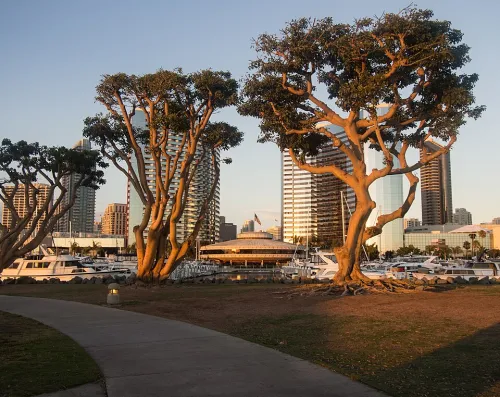
Your walk begins in Embarcadero Marina Park North, a public park that costs nothing to enter. The piece to look for here is Morning, a sculpture by Donal Hord from 1956. It is a quiet, unhurried start before a day full of ships, palaces and paintings.
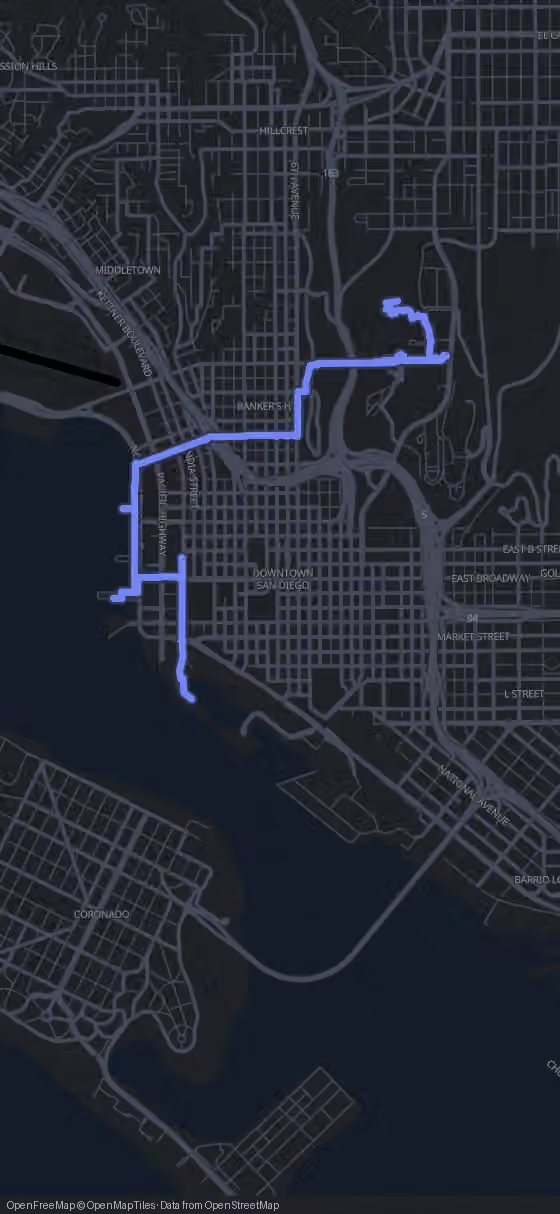
Take a moment to get your bearings and start the free GPS route; the navigation then leads you from stop to stop. The first leg is 1,210 m, about 17 minutes, to the downtown site of the Museum of Contemporary Art San Diego.
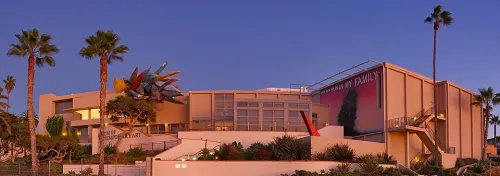
The Museum of Contemporary Art San Diego collects and shows art made from 1950 to the present, and 1100 Kettner Boulevard is one of its two addresses. This downtown site is permanently closed, so you see the building only from the outside; there is no inside visit on this route.
What makes the museum distinctive is its place in a border city. Its mandate is binational, with a focus on artists from both sides of the US and Mexico border and on the art scenes of San Diego and Tijuana. Exhibitions such as Being Here With You / Estando aquí contigo: 42 Artists from San Diego and Tijuana, The Very Large Array and Strange New World: Art and Design from Tijuana took up exactly that theme. In 2023 Celia Álvarez Muñoz and Griselda Rosas showed more than 35 works about their lives in the borderlands, from sculptural installations and textile drawings to embroidery, book projects and photographic series.
The museum's main house stands in La Jolla, in a residence that Irving Gill designed in 1916 for the philanthropist Ellen Browning Scripps. Keep her name in mind: you will meet her again twice in Balboa Park.
From here it is 900 m, about 13 minutes, to the USS Midway Museum.
The USS Midway Museum is an entire aircraft carrier moored at Navy Pier. The Midway served from 1945 to 1992, longer than any other American carrier of the 20th century, and she was the only carrier to serve through the whole Cold War and beyond. About 200,000 sailors lived and worked aboard her over those decades, and her record includes several breakthroughs in naval aviation as well as humanitarian missions.
Retirement brought a second career. From 2001 a restoration facility in Hangar 805 at Naval Air Station North Island prepared the ship, and she opened as a museum on 7 June 2004. By 2012 more than a million visitors a year came aboard, and as of 2015 she was the most popular naval warship museum in the United States. She still serves the Navy in her own way: each year the museum hosts more than 400 active-duty retirements, re-enlistments and changes of command.
Going inside is worth it if aviation, naval history or everyday life at sea interests you. Admission includes a self-guided audio tour narrated by former Midway sailors, covering more than 60 locations: sleeping quarters, engine room, galley, bridge, brig, post office, the pilots' ready rooms, primary flight control and “officers country”. Many of the aircraft on display were built in Southern California, some cockpits are open for you to climb into, and there are flight simulators, a virtual reality flight ride and the holographic Battle of Midway Theater from 2017. The newest arrival, a Grumman C-2 Greyhound, was lifted aboard by crane in June 2023.
Back on the pier, walk 990 m, about 13 minutes, to the Maritime Museum of San Diego. On the way you pass the Star of India, the 1863 centerpiece of the next stop.
Hours
Daily 10:00–17:00 (last admission 16:00)
Price
USD 41 adults at the door / USD 39 online; USD 31 youth (4-12) at the door / USD 29 online (USD 2 online discount); discount ticket for US veterans with ID; free for children 3 and under, active-duty military (with valid ID) and reservists (at the ticket booth)
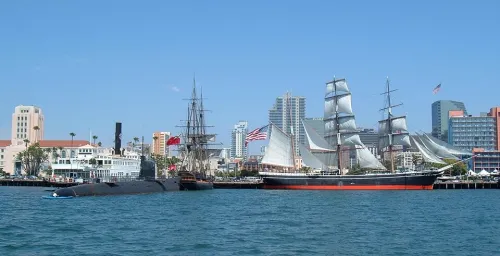
The Maritime Museum of San Diego, founded in 1948, keeps one of the largest collections of historic vessels in the United States. Its centerpiece is the Star of India, an iron barque from 1863. She is the oldest ship still sailing regularly and the oldest iron-hulled merchant ship still afloat, so on her deck you stand on a working piece of the 19th century.
Around her lies a fleet with very different stories. The Berkeley, an 1898 ferryboat from the San Francisco Bay area, holds the museum's library and research archives. The steam yacht Medea of 1904 served in both World Wars, the Pilot of 1914 worked as a harbor pilot boat, and the submarine USS Dolphin was launched in 1968 and decommissioned in 2007. Film fans should look for HMS Surprise, a 1970 replica of a Royal Navy frigate that sailed in Master and Commander: The Far Side of the World and appeared in Pirates of the Caribbean: On Stranger Tides as HMS Providence.
Several replicas reach further back. The Californian, built in 1984 after an 1847 cutter, is the official tall ship of the State of California. America copies the 1851 yacht that won the trophy now called the America's Cup. The San Salvador, which the museum began building in 2011 as a full-sized, fully functional replica of Juan Rodríguez Cabrillo's flagship, recalls the first European ship to visit San Diego Bay, in 1542. A small detail to spot: behind the Berkeley lies an old railroad barge without its tracks, which many visitors take for a floating dock.
Admission covers the ships, and it pays off if you like real decks under your feet and want the Star of India up close. Then comes the longest leg of the route: 3,640 m, about 56 minutes, from the waterfront to Balboa Park.
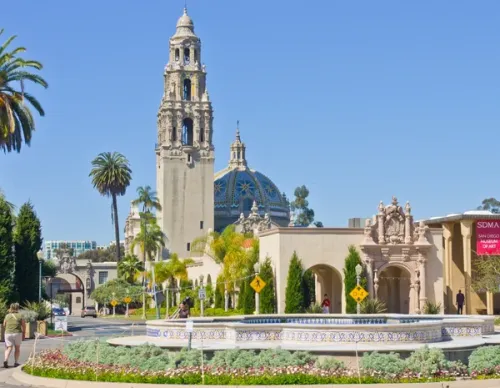
Balboa Park covers 1,200 acres (490 ha), and its land was placed in reserve as early as 1835, which makes it one of the oldest sites in the United States dedicated to public recreation. The grounds are free; inside you find museums, theaters, restaurants and the San Diego Zoo, managed by the city's Parks and Recreation Department.
Much of what you see was shaped by two world's fairs: the Panama-California Exposition of 1915 and 1916 and the California Pacific International Exposition of 1935 and 1936. Both left architectural landmarks behind, and in 1977 the park and its historic exposition buildings were declared a National Historic Landmark and National Historic Landmark District.
Two canyons, Cabrillo Canyon and Florida Canyon, cut the park into three mesas. The Central Mesa holds most of the cultural venues, the Prado, Inspiration Point and the zoo, and that is where the rest of this walk stays. The modern city has taken its share: freeways cover 111 acres once meant as parkland, and since 1948 State Route 163 has run through Cabrillo Canyon and beneath the Cabrillo Bridge.
From here it is 610 m, about 8 minutes, to the Museum of Us; on the way you pass the Timken Museum of Art.
Hours
Open 24/7 (park grounds; individual museums and cultural attractions maintain separate operating hours)
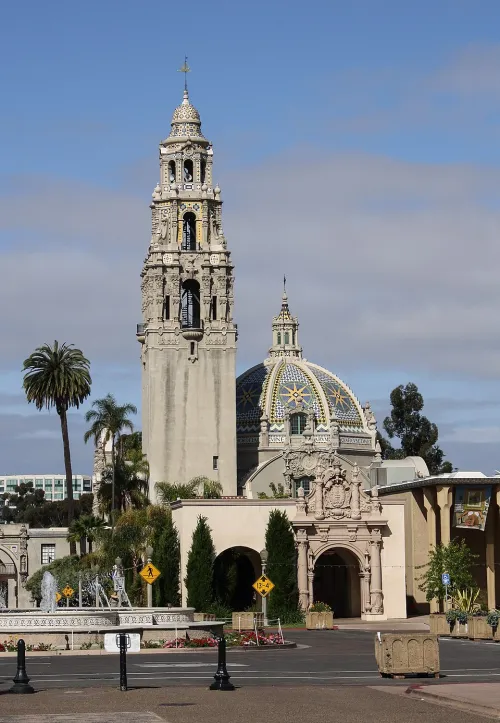
The Museum of Us is an anthropology museum in the landmark buildings of the California Quadrangle, and its story begins with the 1915 exposition held for the opening of the Panama Canal. The fair's central exhibit, “The Story of Man through the Ages,” was assembled under archaeologist Edgar Lee Hewett. He sent expeditions to the American Southwest for pre-Columbian pottery and to Guatemala for objects and reproductions of Maya monuments, while Aleš Hrdlička of the Smithsonian Institution gathered casts and specimens from Africa, Siberia, Alaska and Southeast Asia, along with trepanned skulls from Peru.
When the fair ended, a group of citizens led by George Marston formed the San Diego Museum Association to keep the collection, with Hewett as first director. Later came the Jessop Weapons Collection and a rare group of artifacts from the ancient Egyptian city of Amarna, donated by Ellen Browning Scripps, the patron of the La Jolla house, together with the Egypt Exploration Society.
The names trace the museum's life: Palace of Science during the 1935 and 1936 exposition, when it showed loans such as the Monte Alban artifacts from the Mexican government, then Museum of Man from 1942, with “San Diego” added in 1978, and today the Museum of Us. During World War II the building served as a hospital and the collections went into storage.
Go in if people, cultures and objects interest you more than paintings; the Amarna pieces and the Maya reproductions make good anchors for a first visit. Next you walk 260 m, about 4 minutes, to the San Diego Museum of Art.
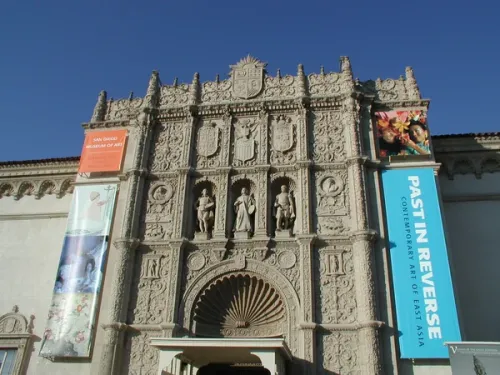
Look at the façade before you go in. The architects William Templeton Johnson and Robert W. Snyder chose a plateresque style to match the buildings of the 1915 exposition, and the heavily ornamented doorway is modeled on one at the University of Salamanca. The Cathedral of Valladolid shaped the exterior as well, and motifs inside come from the Santa Cruz Hospital in Toledo, so you are looking at Spain retold in California. Construction took two years, and the sponsor Appleton S. Bridges gave the finished building to the city.
The museum opened on February 28, 1926 as the Fine Arts Gallery of San Diego and took its present name in 1978. A west wing and a sculpture court doubled its size in 1966, and an east wing followed in 1974. Nearly half a million people visit each year.
The collection runs from 5000 BC to 2012, but its strength is Spanish art: Murillo, Zurbarán, Cotán, Ribera and El Greco. Much of the old master collection came from the sisters Anne, Amy and Irene Putnam, who also backed the first major purchase in 1939, Goya's El Marques de Sofraga, a painting that had never before been shown in public. A portrait by Giovanni Bellini followed the next year, and in 1941 a portrait of the Infanta Margarita of Spain by Diego Velázquez, possibly a study for a larger portrait of her in Vienna. If Spanish painting is your interest, this is the inside visit to choose in the park.
Then walk 350 m, about 5 minutes, to the San Diego Natural History Museum.
Hours
Mon–Tue & Thu–Sat 10:00–17:00, Sun 12:00–17:00, Wed closed
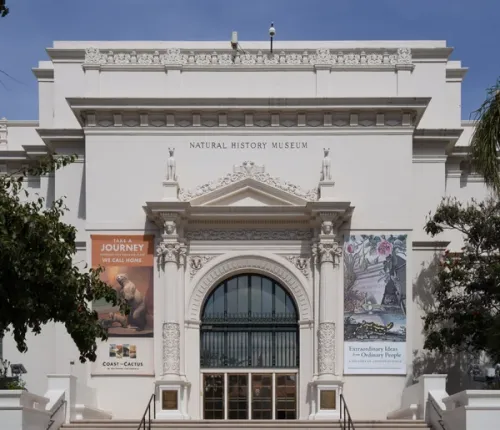
The San Diego Natural History Museum grew out of the San Diego Society of Natural History, founded on October 9, 1874 by George W. Barnes, Daniel Cleveland, Charles Coleman, E. W. Hendrick and O. N. Sanford. It is the oldest scientific institution in Southern California and the second oldest west of the Mississippi.
For years the society was the region's main source of scientific knowledge, and its members did more than collect. They set up a volunteer county weather service in 1875, petitioned in 1885 for what became Torrey Pines State Natural Reserve, pushed for Anza-Borrego Desert State Park and gathered support for the Zoological Society of San Diego, which runs the zoo at the end of this walk.
The first exhibits have a personal story. In 1910 the society hired Kate Stephens, an authority on land and sea mollusks, as curator, and her husband, the mammalogist and ornithologist Frank Stephens, donated more than 2,000 bird and mammal specimens. In June 1912 the couple installed the first exhibits at the Hotel Cecil on Sixth Avenue, open to the public on selected afternoons. The present building was dedicated on January 14, 1933, and an addition in April 2001 doubled the exhibit space.
Go in if you want to understand the nature of the region the society helped protect. The last leg is 1,060 m, about 15 minutes, to the San Diego Zoo.
Hours
Daily 10:00–17:00 (Fridays open until 23:00 for Nat at Night; closed Thanksgiving and Christmas)
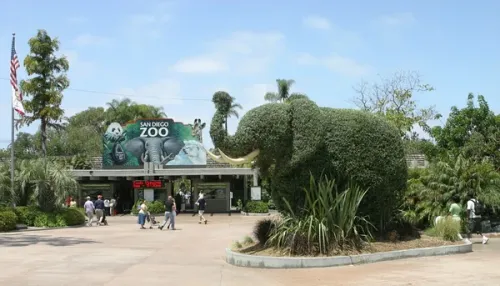
The San Diego Zoo began with exotic animals left behind after the 1915 exposition. Harry M. Wegeforth gathered them, reportedly with the words: “Wouldn't it be wonderful to have a zoo in San Diego? I believe I'll build one.” His Zoological Society of San Diego first met on October 2, 1916, and he remained its president until 1941.
The early years were improvised. A permanent tract in Balboa Park was set aside in August 1921, with the city owning the animals and the zoo caring for them. A menagerie from the defunct Wonderland Amusement Park joined the collection, and Ellen Browning Scripps, met already at the contemporary art museum and the Museum of Us, paid for a fence so the zoo could charge admission and cover its costs. The famous animal collector Frank Buck became director in June 1923 on a three-year contract, clashed with the strong-willed Wegeforth and left after three months.
The zoo became a pioneer of open-air exhibits without cages that recreate natural habitats. Today it sits on 100 acres of land leased from the city and houses over 12,000 animals of more than 680 species and subspecies; it is the most visited zoo in the United States. Its parent organization, the San Diego Zoo Wildlife Alliance, also runs the San Diego Zoo Safari Park.
This is where the route ends. After a day on the carrier and in the museums, the zoo gate makes a fine finish, and a proper visit is better saved for another day. If animals are your priority, skip a museum or two and give the zoo the hours it deserves.
Hours
Daily 09:00–18:00 (seasonal: 09:00–17:00 in winter and low season, up to 09:00–21:00 during the summer Night Zoo)
All 9 stops are already on the map. You just press start.
AI Tour Guide
You know the route now. Walk San Diego with a guide in your ear.
Press start wherever you are, even hundreds of kilometres from San Diego, and the guide begins telling its stories right away. In the city, pick any of the 9 stops to start from: it leads you there, then talks with you the whole route, asking, listening, remembering, and shaping the tour around your answers.
Free to start · Runs in your browser · No app, no download
Shorter San Diego Walks: Waterfront or Balboa Park
The route falls naturally into a waterfront half and a park half, joined by one long walk. If you only have part of a day, pick the half that suits you.
Waterfront and ships
Stops: 1, 2, 3, 4
For aviation and ship fans with half a day. From the Embarcadero past the contemporary art museum to the USS Midway Museum and the Maritime Museum of San Diego: 3,100 m and 43 minutes of walking. Admission is charged on the carrier and at the Maritime Museum.
Balboa Park only
Stops: 5, 6, 7, 8, 9
For museum lovers and families who would rather skip the long walk from the waterfront. From the park grounds to the zoo you walk 2,280 m, about 32 minutes. The park is free; the Museum of Us, the San Diego Museum of Art, the San Diego Natural History Museum and the zoo charge admission, so choose one or two.
How Long the San Diego Tour Takes, Walk and Visits
The 9.0 km take 2 h 10 min of pure walking. Most legs are short, and in Balboa Park the museums sit only a few minutes apart; the one long stretch of nearly an hour links the waterfront and the park.
With inside visits, the full route fills a day: around two hours aboard the USS Midway Museum, about an hour on the ships of the Maritime Museum of San Diego and an hour or so in one Balboa Park museum add up, with the walk, to a good six hours. The San Diego Zoo deserves its own half day, so on a single day treat it as the finish line rather than a full visit.
The waterfront half takes around four hours with both ships. The Balboa Park half takes about two hours with one museum and a stroll through the park, or a full day if you add the zoo properly.
Before You Set Off from the Embarcadero
Start: The recommended start is Embarcadero Marina Park North. You can join at any stop, but the order here is the one that works best.
End: The route ends at the San Diego Zoo in Balboa Park and does not loop back to the start.
Best time: Start in the morning. The carrier, the museums and the zoo keep daytime opening hours, so an early start leaves room for the inside visits you care about.
Admission: The Embarcadero and the Balboa Park grounds are free. The USS Midway Museum, the Maritime Museum of San Diego, the Museum of Us, the San Diego Museum of Art, the San Diego Natural History Museum and the San Diego Zoo charge admission. The Museum of Contemporary Art San Diego is permanently closed at its downtown site.
AI Tour Guide
Your guide for the bay and the park is ready when you are.
Press start and a voice AI Tour Guide takes it from here: leading the route through San Diego, telling the stories, and turning your walk into a real back-and-forth conversation. No app or download is needed; it runs in your browser.
Free to start · Runs in your browser · No app, no download
What the AI Tour Guide Adds Between Carrier and Zoo
On this walk the AI Tour Guide greets you at the Embarcadero, tells the stories of each place as you go and asks what draws you in: naval aviation, old ships, Spanish painting or the people behind the 1915 fair. It remembers your answers and shapes the conversation around them, and you can interrupt anytime, for example to ask how a crew of thousands lived on a carrier at sea or how to read the ornament of a plateresque doorway. You start with 100 free credits; after that you choose this tour all-inclusive for €19.99 with no time limit, or credits at €5 per hour.
A Real Conversation
A voice AI Tour Guide greets you, leads the whole route, and tells the stories and facts as you walk, asking what you want to see and keeping a real conversation going. Not a recording you press play on.
Map Navigation
Follow the route on the map and walk at your own pace. You choose where to start and when to move to the next stop.
Ask Anything
Curious about a building you pass? Ask your AI Tour Guide on the spot and the conversation carries on.
13 Languages
Switch language anytime. No separate tour needed.
Is the USS Midway Museum a good stop with children?
Yes. Besides the cockpits and simulators there is a narrated audio tour made for youngsters, and the museum welcomes about 5,000 children a year in its overnight program and around 50,000 students on field trips.
Where can I see the Museum of Contemporary Art San Diego now?
At its flagship in La Jolla, 700 Prospect St, about 21 km (13.2 miles) from downtown. The oceanfront campus reopened on April 9, 2022 after a four-year expansion led by architect Annabelle Selldorf, which also added a public park.
Can I combine San Diego with Los Angeles?
Los Angeles is about 179 km away, close enough to pair both cities on one trip. The Los Angeles walking tour works the same way, with a free GPS route and an optional AI Tour Guide.
Is the tour really free?
Yes. The whole tour is free: the route, the interactive map and the navigation cost you nothing. Only the voice AI Tour Guide is optional and paid: you test it with 100 free credits, then you pay either €5 per hour or €19.99 for this whole tour, with no time limit. Admission to 6 of the 9 stops is not included: USS Midway Museum, Maritime Museum of San Diego, Museum of Us, San Diego Museum of Art, San Diego Natural History Museum and San Diego Zoo charge their own entry fees.
Do I need to download an app?
No. Everything runs in your phone browser. Open the route and start walking, no download and no sign-up required.
Do I need to book the walking tour in advance?
No booking needed. This self-guided tour is available anytime. Open the route in your browser and start walking. The AI Tour Guide works instantly, no app, no reservation required.
What languages is the AI Tour Guide available in?
The AI Tour Guide speaks 13 languages, so you take the tour in your own language and can switch at any time.
Can I skip stops or change the route?
Yes. Skip any stop, spend extra time at places you like, or start the route from any point. It is your walk, you set the pace.