Free Walking Tour Hanoi: Sword Lake to West Lake

Twelve stops on foot, from the turtle legend of Hoan Kiem Lake through the 36 streets to Confucian courtyards, Ba Dinh Square and the wide shores of West Lake.

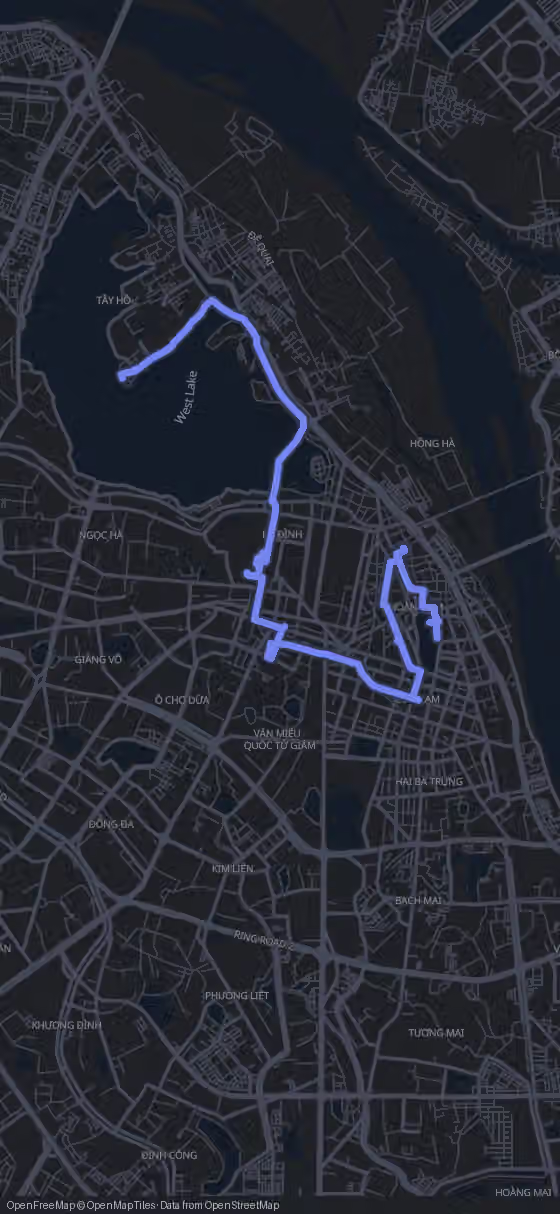
12 Stops 12.8 km ~2 h 55 min walking
Route map for the Hanoi walking tour
Stop 1 of 12
240 m·3 min
Hoan Kiem Lake
Head north along the lakeshore toward Ngoc Son Temple
Xin chào, welcome to Hanoi. I'm Alex, and the city's calm central lake once sheltered a remarkable final resident.
Try this tour with Alex

What This Hanoi Walk Covers

This free walking tour Hanoi route links 12 stops over 12.8 km, from Hoan Kiem Lake to West Lake. Pure walking time is 2 h 55 min; with the temples and museums worth entering, it fills a long day, and many people split it over two.

Dong Xuan Market, St. Joseph Cathedral, Ho Chi Minh Mausoleum, Ba Dinh Square and both lakes cost nothing; two temples, a pagoda and two museums charge small fees in dong. Route, map and GPS navigation run free in your browser; the AI Tour Guide is optional.

Open free GPS & optional AI Tour Guide
View of Hanoi

The Route

Walking Map of Hanoi: Sword Lake, Old Quarter, Ba Dinh

12 stops 12.8 km 2 h 55 min walking
Tap to load interactive map

The 12 stops along this route

  1. Hoan Kiem Lake in Hanoi, stop 1 on the self-guided walking tour
    1Hoan Kiem Lake
  2. Ngoc Son Temple in Hanoi, stop 2 on the self-guided walking tour
    2Ngoc Son Temple
  3. Old Quarter in Hanoi, stop 3 on the self-guided walking tour
    3Old Quarter
  4. Dong Xuan Market in Hanoi, stop 4 on the self-guided walking tour
    4Dong Xuan Market
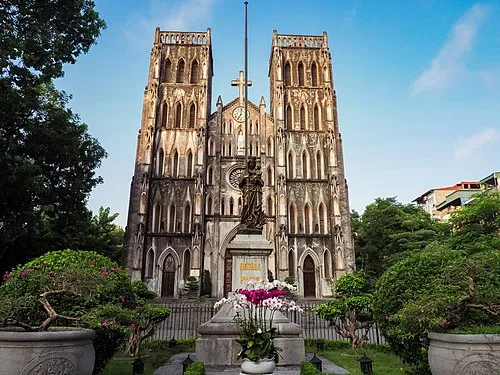
  5. St. Joseph Cathedral in Hanoi, stop 5 on the self-guided walking tour
    5St. Joseph Cathedral
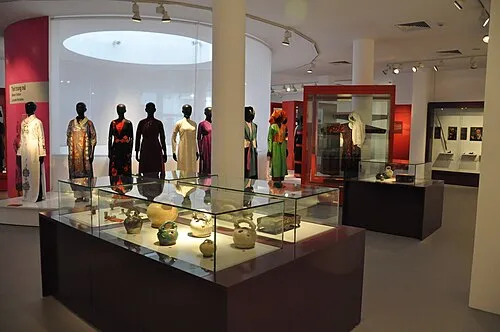
  6. Vietnamese Women's Museum in Hanoi, stop 6 on the self-guided walking tour
    6Vietnamese Women's Museum
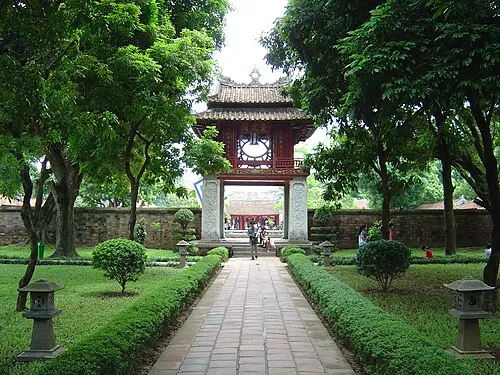
  7. Temple of Literature in Hanoi, stop 7 on the self-guided walking tour
    7Temple of Literature
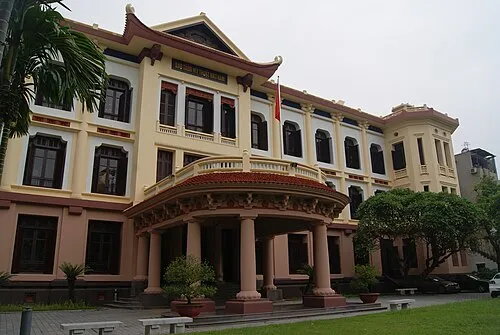
  8. Vietnam National Fine Arts Museum in Hanoi, stop 8 on the self-guided walking tour
    8Vietnam National Fine Arts Museum
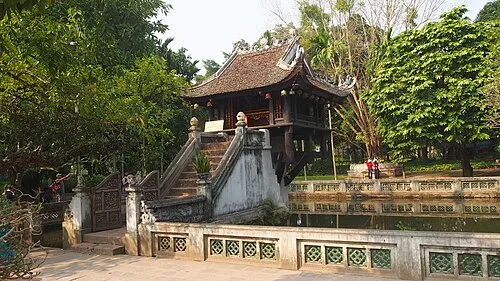
  9. One Pillar Pagoda in Hanoi, stop 9 on the self-guided walking tour
    9One Pillar Pagoda
  10. Ho Chi Minh Mausoleum in Hanoi, stop 10 on the self-guided walking tour
    10Ho Chi Minh Mausoleum
  11. Ba Dinh Square in Hanoi, stop 11 on the self-guided walking tour
    11Ba Dinh Square
  12. West Lake in Hanoi, stop 12 on the self-guided walking tour
    12West Lake
  13. That's the full route.

    Walk it with an AI Tour Guide talking you through every one of these streets.

    Start free in your browser
    You made it

Your Hanoi Walking Tour, Stop by Stop from Lake to Lake

  1. 1

    Hoan Kiem Lake

    Hoan Kiem Lake in Hanoi, stop 1 on the self-guided walking tour

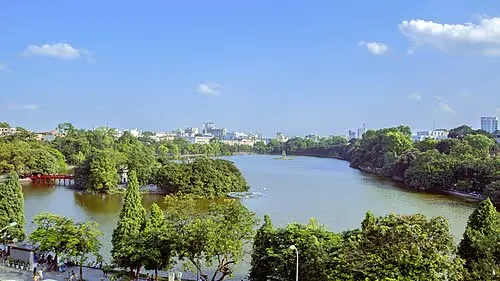
    Begin at the edge of Hoan Kiem Lake, about 12 hectares of green water in the historic centre of Hanoi and still the place where the city's public life gathers. Look out to the small island near the middle: the little Turtle Tower standing on it is tied to the legend that gave the lake its name. Near the northern shore you can make out Jade Islet, home to the temple you visit next.

    The legend goes like this. After defeating Ming China, Emperor Lê Lợi was out boating when a Golden Turtle God, Kim Quy, rose from the water and asked for his magic sword, Heaven's Will. Lợi understood that the sword had only been lent to him by the Dragon King, a local god, for the war against the Ming. He gave it back and renamed the lake Hoàn Kiếm, the Lake of the Returned Sword. Locals still often call it Hồ Gươm, Sword Lake.

    Before that, the lake went by other names: Tả Vọng, then Lục Thủy, Green Water Lake, a fair description of its colour, and Thủy Quân, Mariner's Lake. For years the legend had a living counterpart, as huge soft-shell turtles were sighted here. The last known one was found dead on 19 January 2016. Whether it belonged to Rafetus swinhoei or to a separate species named Rafetus leloi after the emperor is debated; of swinhoei, only three turtles remain.

    The shore is free and open around the clock, so take a slow stretch along the water before crossing to Jade Islet, only 240 m and three minutes away.
    Local name
    Hồ Gươm
    Hours
    Open 24/7
    Price
    Free
  2. 2

    Ngoc Son Temple

    Ngoc Son Temple in Hanoi, stop 2 on the self-guided walking tour

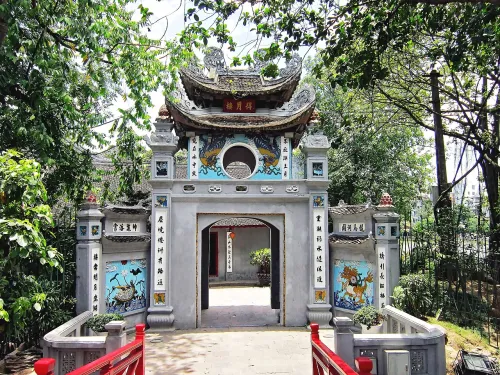
    Ngoc Son Temple, the Temple of the Jade Mountain, sits on Jade Islet and is listed as a special national relic of Vietnam. Three figures are honoured here: Trần Hưng Đạo, the 13th-century commander who threw back the Mongol invasions three times; Văn Xương, the star deity of literature and examinations; and Nguyễn Văn Siêu, the writer and official who had the temple repaired in 1864.

    The site is far older than the buildings you see. When Lý Thái Tổ moved the capital to Thăng Long, a temple called Ngọc Tượng already stood here; the Trần dynasty renamed it Ngọc Sơn and used it to honour those who fell fighting the Mongols. Over time it collapsed. In the 1730s lord Trịnh Giang built the Khánh Thụy palace and heaped up two earth hills on the eastern shore facing the islet. A philanthropist named Tín Trai later founded a pagoda on part of the old palace ground, and because the worship centred on Văn Xương and Trần Hưng Đạo, the pagoda eventually became a temple.

    Keep one detail in mind as you look back over the water: the lake was once many times larger. The street name Cầu Gỗ, wooden bridge, survives from a time when a bridge here carried people over water that has since become city.

    Is the ticket worth it? If you go into only one building around the lake, make it this one: it puts names to the history you just heard on the shore. From here it is 680 m, about nine minutes, into the Old Quarter, passing the Thang Long Water Puppet Theatre.

    Local name
    Đền Ngọc Sơn
    Hours
    Mon–Thu 07:00–19:00, Fri–Sun & holidays 07:00–22:00
    Price
    VND 50,000 standard adult ticket; VND 25,000 reduced (students, seniors 60+, severe disability); free for children under 16 / under 1.3m and special severe disabilities
  3. 3

    Old Quarter

    Old Quarter in Hanoi, stop 3 on the self-guided walking tour

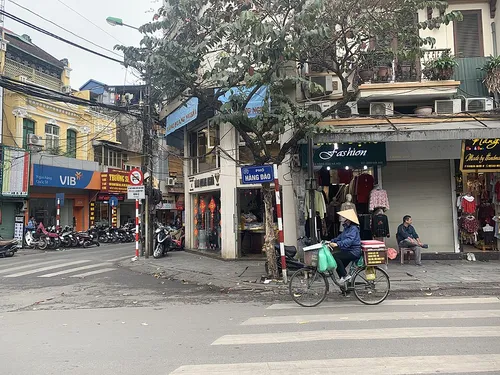
    The Old Quarter is the historic civic core of Hanoi, the residential, workshop and trading district that grew up outside the Imperial Citadel of Thăng Long. Each street once specialised in one trade or craft, which is why the area is also called the 36 streets, after the 36 streets or guilds that made up the old town. Read the street signs as you walk: many begin with Hàng, like Hàng Bông, Hàng Gai or Hàng Đậu, and carry the memory of those guild streets.

    The district took shape under the Lý and Trần dynasties, when people from the surrounding plains moved into the city and settled east of the citadel along the Red River, creating the densest neighbourhood in Hanoi. By the Lê dynasty the scholar Nguyễn Trãi was already describing areas devoted to particular trades, and the quarter was ringed by a defensive wall with several gates.

    It was also much wetter than today. Lakes and marshes, the largest of them Thái Cực lake, were linked with the Tô Lịch River, Hoan Kiem Lake and the Red River; only near the end of the 19th century did these waters become cut off from each other.

    Since a 1995 decision, the official Old Quarter covers about 100 hectares with 76 streets across 10 wards, bounded by Hàng Đậu Street in the north, Phùng Hưng Street in the west and Trần Quang Khải and Trần Nhật Duật streets in the east. The streets themselves are the sight here: wander a while, then follow the route 600 m, about eight minutes, to Dong Xuan Market.

    Local name
    Khu phố cổ Hà Nội
  4. 4

    Dong Xuan Market

    Dong Xuan Market in Hanoi, stop 4 on the self-guided walking tour

    Dong Xuan Market is the largest covered market of Hanoi, a wholesale hall where traders sell everything from clothes and household goods to foodstuffs. Look first at the façade: the five-arch entrance echoes the five domes of the original building, each 19 m high and 25 m wide.

    The French administration built it in 1889, closing the two older Old Quarter markets on Hang Duong and Hang Ma streets to make way for it. It was one of the main new buildings of colonial Hanoi, together with Long Biên Bridge nearby, finished in 1902. The original hall covered about 6,500 m² under a roof of corrugated galvanised iron supplied by the French contractor Paul-François Leyret.

    Two dates mark the market's harder history. On 14 February 1947, as the First Indochina War reached Hanoi, Việt Minh and French forces fought fiercely here; a memorial near the main gate, put up in 2005, recalls the battle. In 1994 a fire nearly destroyed the building and about 4.5 million US dollars' worth of stock. It was partly rebuilt in its original form.

    Entry is free, and even if you buy nothing, a walk through the aisles shows Hanoi trade at work: in the surrounding Đồng Xuân ward, about half of all households make their living from trading. From here the route leads 1,260 m, about 17 minutes, to St. Joseph Cathedral.

    Local name
    Chợ Đồng Xuân
    Hours
    Mon–Thu 06:00–18:00, Fri–Sun 06:00–22:30 (indoor market stalls); exterior surrounding street food open later
    Price
    Free (entry)
  5. 5

    St. Joseph Cathedral

    St. Joseph Cathedral in Hanoi, stop 5 on the self-guided walking tour

    St. Joseph Cathedral rises over a small square on Nhà Chung Street, and the resemblance to Notre Dame de Paris is no accident: this Gothic Revival church was built in its likeness. Work began in 1884, and when it opened in December 1886 it was one of the first structures built by the colonial government of French Indochina. It is the oldest church in Hanoi and is named after Joseph, the patron saint of Vietnam.

    The timing tells its own story. In November 1873 French troops under Lieutenant Francis Garnier, acting in support of the trader Jean Dupuis, captured the Hanoi Citadel; it took another decade of insurgencies before the colonists controlled the city, and only then did the cathedral rise. Today it is the seat of an archdiocese that oversees more than 480 churches and chapels in 113 parishes and serves 400,000 Catholics.

    Getting in works differently from most churches. The main gates generally open only for Mass; at other times you enter through a side door in the diocese compound wall and ring a bell to be let into the cathedral itself. Tourist visits are possible outside Mass times, and admission is free.

    If you are in town on a Sunday, the evening Mass is worth seeing from outside: crowds spill into the street, and prayers and hymns are broadcast onto the plaza for those who cannot fit in. The streets around the cathedral have boutiques and silk shops, good for a slow look before the 840 m, eleven-minute walk to the Vietnamese Women's Museum.

    Local name
    Nhà thờ Lớn Hà Nội
    Hours
    Mon–Sat 08:00–11:00, 14:00–17:00 (visiting hours; outside mass times); Sun closed for tourist visits (worship only)
    Price
    Free admission
  6. 6

    Vietnamese Women's Museum

    Vietnamese Women's Museum in Hanoi, stop 6 on the self-guided walking tour

    The Vietnamese Women's Museum on Ly Thuong Kiet Street is run by the Vietnam Women's Union and works as a gender museum and research centre. It tells the history of the country through the lives of women across Vietnam's 54 ethnic communities, with more than 1,000 objects, photographs and documents.

    Three permanent exhibitions shape the visit: Women in Family, Women in History and Women's Fashion. The family galleries cover domestic life and the arts, the history section the roles women played in the nation's development, and the fashion rooms are the place for anyone interested in dress and textiles. Temporary exhibitions pick up the changes of contemporary Vietnam.

    The museum was officially founded on 10 January 1987, but the idea goes back to 1985 and to Nguyen Thi Dinh, then president of the Women's Union and a renowned leader of the National Liberation Front during the Second Indochina War. It opened to the public in 1995 and was renovated between 2006 and 2010.

    If you want to understand Vietnamese society rather than monuments, this interior is a strong choice and well worth the entry fee; allow around an hour and a quarter. Afterwards comes one of the longer legs, 2,140 m and 29 minutes, to the Temple of Literature.

    Local name
    Bảo tàng Phụ nữ Việt Nam
    Hours
    Daily 08:00–17:00
    Price
    VND 40,000 adult; VND 20,000 students and Vietnam Women's Union members; VND 10,000 children/pupils
  7. 7

    Temple of Literature

    Temple of Literature in Hanoi, stop 7 on the self-guided walking tour

    The Temple of Literature, Văn Miếu, is dedicated to Confucius and was founded in 1070 under Emperor Lý Thánh Tông. In 1076, under Lý Nhân Tông, the Imperial Academy, Quốc Tử Giám, was set up within it: Vietnam's first national university, which educated bureaucrats, nobles, royalty and the rest of the elite until 1779. In 1803 the academy moved to the new Nguyễn capital at Hue.

    As you walk through the pavilions and halls, picture what took place here: offering ceremonies, study sessions and the strict examinations of Đại Việt. Look out for the stelae of doctors among the statues. The old chronicle describes statues of Confucius, his four best disciples Yan Hui, Zengzi, Zisi and Mencius, and the Duke of Zhou, along with 72 painted Confucian scholars; ceremonies were held for them in each of the four seasons, and the crown princes studied here.

    The complex was rebuilt under the Trần dynasty and later ones and restored in 1920, 1954 and 2000, so the styles of several dynasties stand side by side. If you have a 100,000 đồng note in your wallet, turn it over: the temple is on the back. Just before Tết, calligraphers gather outside to write wishes in Chữ Hán, given as gifts or hung at home for special occasions.

    Is the entry fee worth it? For almost everyone, yes; give it about an hour. The Vietnam National Fine Arts Museum is only 590 m, eight minutes, away.

    Local name
    Văn Miếu – Quốc Tử Giám
    Hours
    Daily 08:00–17:00; Night tour Wed, Sat, Sun 18:30–22:00
    Price
    VND 70,000 standard adult ticket; VND 35,000 reduced (Vietnamese students, seniors 60+, severe disability); free for children under 16 and special severe disabilities
  8. 8

    Vietnam National Fine Arts Museum

    Vietnam National Fine Arts Museum in Hanoi, stop 8 on the self-guided walking tour

    The Vietnam National Fine Arts Museum at 66 Nguyễn Thái Học Street faces the back of the Temple of Literature, and the building is part of the story. The French put it up in the 1930s as a boarding house for the daughters of French officials who came to Hanoi from all over Indochina to study. In 1962 the Ministry of Culture had it remodelled, adding decorative details from Vietnamese village communal houses to the Western architecture. The museum opened in 1966 and was enlarged between 1997 and 1999.

    The collection holds more than 18,000 works from prehistory to the present: Stone Age and Iron Age art, sculpture of the Lý and Trần periods, ceramics from the 11th century onward, folk paintings and worship paintings from the mountain regions, and a large modern section in lacquer, silk, paper and oil. Names to look for include Nguyễn Gia Trí, Tô Ngọc Vân, Trần Văn Cẩn, Nguyễn Phan Chánh and Lương Xuân Nhị.

    One honest note: many pieces on display are copies, because the originals were sold or lost. That matters less if your interest is in how Vietnamese art developed over the centuries; if only originals excite you, choose a few rooms rather than the whole building.

    The museum charges admission, and lovers of lacquer and silk painting should plan an hour. Then walk 1,020 m, 14 minutes, to the One Pillar Pagoda.

    Local name
    Bảo tàng Mỹ thuật Việt Nam
    Hours
    Tue–Sun 08:30–17:00, Mon closed
    Price
    VND 40,000 adult; VND 20,000 higher education students; VND 10,000 children aged 6-16; free for children under 6 and people with disabilities
    Website
    vnfam.vn ↗
  9. 9

    One Pillar Pagoda

    One Pillar Pagoda in Hanoi, stop 9 on the self-guided walking tour

    The One Pillar Pagoda is small, and that is the point: a shrine set on a single pillar. Formally it belongs to the Diên Hựu complex, the pagoda of extended blessings, and the famous part is Liên Hoa Đài, the lotus pedestal. Alongside the Hương Temple it is regarded as one of Vietnam's two most iconic temples.

    Its origin is a dream. Emperor Lý Thái Tông, who ruled from 1028 until 1054, was childless and dreamt that the Bodhisattva Avalokiteśvara, seated on a lotus, handed him a baby son. He then married a peasant girl he had met, and the couple had a son. In gratitude, and on the advice of a monk named Thiền Tuệ, he had a pillar raised in the middle of a lotus pond like the one in his dream and the temple built on it in 1049.

    Under the Lý dynasty the monarch came here each year for Vesak, the birthday of the Buddha, held a Buddha-bathing ceremony and then freed a bird, watched by monks and lay people alike. Lý Nhân Tông renovated the temple in 1105 and in 1109 had a bell cast for it, counted among the four great works of the capital at the time. It was far too large and heavy to hang, and since it could not be rung on the ground, it ended up in farmland beside Nhất Trụ Temple in the countryside.

    Foreign visitors pay for entry, and a short visit is enough for most people. The Ho Chi Minh Mausoleum is only 270 m, three minutes, away.

    Local name
    Chùa Một Cột
    Hours
    Daily 07:00–18:00
    Price
    Free for Vietnamese citizens; VND 25,000 for foreign visitors
  10. 10

    Ho Chi Minh Mausoleum

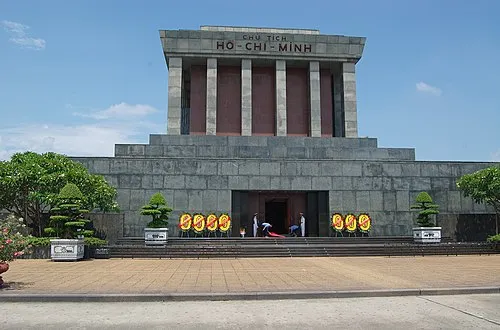
    Ho Chi Minh Mausoleum in Hanoi, stop 10 on the self-guided walking tour

    The Ho Chi Minh Mausoleum is the resting place of the revolutionary leader and president, who chaired the Workers' Party of Vietnam from 1951 until his death in 1969. It stands in the centre of Ba Dinh Square, where he read the Declaration of Independence on 2 September 1945. Construction began on the same date in 1973, and the building was inaugurated on 29 August 1975.

    Its model was Lenin's Mausoleum in Moscow, but look for the Vietnamese touches, such as the sloping roof. The building is 21.6 m high and 41.2 m wide and clad in grey granite. The inscription 'President Ho Chi Minh' across the top is in dark red jade from Cao Bằng, and the door is made of precious wood from the Central Highlands. A banner beside it reads 'Long live the Socialist Republic of Vietnam'. The gardens around it hold nearly 250 species of plants and flowers from different regions of the country.

    Inside, the embalmed body lies in a glass case under dim light in a cool central hall, watched by a military honour guard. Admission is free, but the visiting window is short and falls early in the day.

    Walking the route in order from Hoan Kiem Lake, you arrive after closing; if the interior matters to you, start a morning here instead. Otherwise take in the building from outside and walk on 360 m, five minutes, to the square, with Ngoc Ha Village along the way.

    Local name
    Lăng Chủ tịch Hồ Chí Minh
    Hours
    Tue–Thu, Sat–Sun 07:30–10:30 (summer Apr 1 – Oct 31) / 08:00–11:00 (winter Nov 1 – Mar 31); Sat–Sun extended until 11:00/11:30; Mon and Fri closed (except major national holidays)
    Price
    Free admission
  11. 11

    Ba Dinh Square

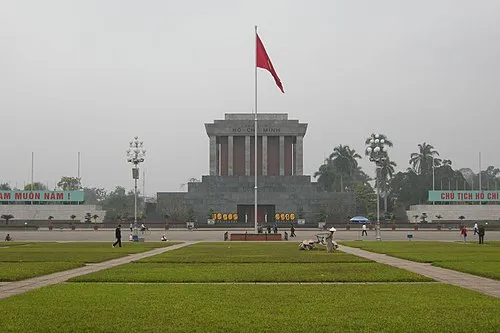
    Ba Dinh Square in Hanoi, stop 11 on the self-guided walking tour

    Ba Dinh Square is the most important square in Vietnam: the stage for parades on major national holidays, the place where the Democratic Republic of Vietnam was proclaimed in 1945, and an everyday spot for Hanoians and visitors to stroll. It measures 320 m by 100 m, with a 30 m flagpole in the middle. Count the lawns: there are 210 grass squares, seven by thirty, divided by paths 1.4 m wide. There used to be 240, until one row was removed for the National Assembly building.

    Long before the square, this ground lay within the Imperial Citadel of Thăng Long. In 1808 Emperor Gia Long had the citadel torn down and a much smaller one built; this spot became the area of its western gate, and in 1831 Minh Mạng renamed the citadel Hanoi. A mound stood here then, Núi Khán, and in the mid-19th century officials paid for a tiled pavilion on top of it, Khán Sơn đình, where men of letters met.

    After taking control of all of Indochina, the French demolished the entire citadel in 1894 except the North Gate, kept as a reminder. They levelled the mound and laid out a small garden, the Puginier park, at the heart of their administrative district for the Indochinese Federation.

    The square is free and open around the clock. From here the last leg is by far the longest: 4,860 m, about 66 minutes on foot, to West Lake. If your legs are done for the day, this is a natural place to finish.

    Local name
    Quảng trường Ba Đình
    Hours
    Open 24/7
    Price
    Free
  12. 12

    West Lake

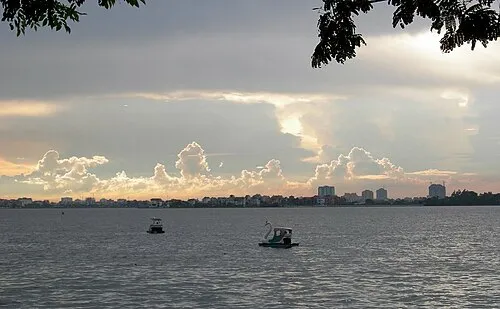
    West Lake in Hanoi, stop 12 on the self-guided walking tour

    West Lake, Hồ Tây, is the largest natural lake in Hanoi: more than 500 hectares with a shoreline of about 14.8 km. It is a horseshoe lake, a remnant of an old course of the Red River, and over the centuries it has carried many names, among them Đầm Xác Cáo, Kim Ngưu, Lãng Bạc and Dâm Đàm.

    In early times the shore was forest of bamboo, lim trees and reeds, home to a few settlers who hunted and fished. The chronicles report that in 1044 the king had a huge cage set up at Dâm Đàm, with a domestic elephant from Champa as bait to lure wild elephants, and came in person to catch them.

    Under the Lý and Trần kings the lake became a retreat, ringed by palaces for rest and leisure; the area of today's Trấn Quốc pagoda was once the Trần dynasty's Hàm Nguyên palace. Kim Liên pagoda is said to stand on the palace of Princess Từ Hoa, daughter of King Lý Thần Tông, who brought court ladies out here to clear land and grow mulberry for silkworms and silk weaving, with the Nghi Tàm estate running the work.

    The lakeshore is free and open around the clock. After a full day across the city, this is the place to slow down, look out over the water and let the walk end.

    Local name
    Hồ Tây
    Hours
    Open 24/7
    Price
    Free
Walking tour route map of Hanoi Route loaded
Hoan Kiem LakeNgoc Son TempleOld QuarterDong Xuan Market+8
All 12 stops are already on the map.
You just press start.
AI Tour Guide

You know the route now. Walk it with a guide in your ear.

Press start wherever you are, even hundreds of kilometres from Hanoi, and the guide begins telling its stories right away. In the city, pick any of the 12 stops to start from: it leads you there, then talks with you the whole route, asking, listening, remembering, and shaping the tour around your answers.

12stops 12.8km 2 h 55 minwalking 13languages
▶Start the tour free

Free to start · Runs in your browser · No app, no download

Three Ways to Split This Hanoi Route

Twelve stops across a whole city rarely fit comfortably into one day, and the mausoleum's short morning opening shapes the plan. Pick the version that matches your time and interests.

Lakeside and Old Quarter

Stops: 1, 2, 3, 4, 5, 6

For a first half day or anyone short on time: 48 minutes of walking from Hoan Kiem Lake to the Vietnamese Women's Museum. Ngoc Son Temple and the museum are the two paid entries; the market and the cathedral are free.

Ba Dinh morning

Stops: 11, 10, 9, 8, 7

For history and politics, and the way to see the mausoleum from inside. Start early at Ba Dinh Square, go into the mausoleum when it opens, then walk the legs in reverse via the One Pillar Pagoda and the Vietnam National Fine Arts Museum to the Temple of Literature: 30 minutes on foot. Paid entries are the pagoda, the Fine Arts Museum and the Temple of Literature. Not on a Monday or Friday.

The full route in one day

Stops: 1, 2, 3, 4, 5, 6, 7, 8, 9, 10, 11, 12

For a long day with stamina: 2 h 55 min of walking, all five paid interiors, ending at West Lake. In this order you reach the mausoleum after it has closed, so you see it from outside.

How Long Does This Hanoi Tour Take on Foot?

The 2 h 55 min of walking are unevenly spread. Around Hoan Kiem Lake and the Old Quarter most legs stay under a quarter of an hour; the walk from the Women's Museum to the Temple of Literature takes 29 minutes, and the final stretch from Ba Dinh Square to West Lake 66 minutes on its own.

Add the interiors that repay the time (about half an hour in Ngoc Son Temple, an hour or more each in the Women's Museum, the Temple of Literature and the Fine Arts Museum) and short pauses everywhere else, and the full route comes to roughly nine and a half hours before any meal break. That is a lot for one day, which is why splitting it works better for most people.

The lakeside and Old Quarter half takes about four and a half hours with its two paid interiors. The Ba Dinh morning takes about four hours, including the mausoleum.

Before You Set Off in Hanoi

  • Start and finish: The recommended start is Hoan Kiem Lake and the finish is West Lake, but you can join at any stop; the GPS navigation guides you from there to the next one.
  • Best days: Pick your day with care: the mausoleum, the Fine Arts Museum and the cathedral each have days without visits, so not every day suits the whole route.
  • Time of day: Set off from Hoan Kiem Lake around 07:30 and, with the suggested pauses, you reach St. Joseph Cathedral around 10:20, comfortably inside its morning visiting window.
  • Entrance fees: Five of the sights charge admission, so budget for several entry tickets if you go inside all of them.
Walking tour route map of Hanoi
AI Tour Guide

Your guide is ready at the lakeshore whenever you are.

Press start and a voice AI Tour Guide takes it from here: leading the route through Hanoi, telling the stories, and turning your walk into a real back-and-forth conversation. No app or download is needed; it runs in your browser.

12stops 12.8km 2 h 55 minwalking 13languages
▶Start the tour free

Free to start · Runs in your browser · No app, no download

What the AI Tour Guide Adds Between Sword Lake and West Lake

History in Hanoi comes in layers: Lý emperors, Confucian scholars, French builders, Ho Chi Minh. The AI Tour Guide greets you at Hoan Kiem Lake and tells the stories of each place as a conversation, asks what you find interesting and remembers it, so by the Temple of Literature it knows whether legends or politics hold you more. You can interrupt at any point, for instance to ask how the imperial examinations actually ran or what daily life was like for the French girls who once boarded in the Fine Arts Museum building. The route stays the same. You start with 100 free credits; after that, choose this tour all-inclusive for €19.99 with no time limit, or credits at €5 per hour.

A Real Conversation A voice AI Tour Guide greets you, leads the whole route, and tells the stories and facts as you walk, asking what you want to see and keeping a real conversation going. Not a recording you press play on.
Map Navigation Follow the route on the map and walk at your own pace. You choose where to start and when to move to the next stop.
Ask Anything Curious about a building you pass? Ask your AI Tour Guide on the spot and the conversation carries on.
13 Languages Switch language anytime. No separate tour needed.
Start free in your browser

Common Questions About Walking Hanoi

Can I visit the Temple of Literature in the evening?

Yes, on some evenings of the week there is a night tour.

Is Dong Xuan Market worth visiting after dark?

It can be. On some evenings the indoor stalls stay open late, and the street food around the outside runs later still.

Do children get in free on this route?

At some stops, yes: children go into Ngoc Son Temple and the Temple of Literature for free, and the Fine Arts Museum lets the youngest in free. The Women's Museum and the Fine Arts Museum charge children a reduced price.

Where can I walk next after Hanoi?

Further south in Vietnam there are walking tours for Hội An and Ho Chi Minh City; across the region, Siem Reap and Bangkok work the same way.

Is the tour really free?

Yes. The whole tour is free: the route, the interactive map and the navigation cost you nothing. Only the voice AI Tour Guide is optional and paid: you test it with 100 free credits, then you pay either €5 per hour or €19.99 for this whole tour, with no time limit.

Do I need to download an app?

No. Everything runs in your phone browser. Open the route and start walking, no download and no sign-up required.

Do I need to book the walking tour in advance?

No booking needed. This self-guided tour is available anytime. Open the route in your browser and start walking. The AI Tour Guide works instantly, no app, no reservation required.

What languages is the AI Tour Guide available in?

The AI Tour Guide speaks 13 languages, so you take the tour in your own language and can switch at any time.

Can I skip stops or change the route?

Yes. Skip any stop, spend extra time at places you like, or start the route from any point. It is your walk, you set the pace.
Image credits
▶ Start free in your browser Runs in your browser, no app, no download