Free Walking Tour Hiroshima: Castle to Peace Park

From a garden begun in 1620 and a rebuilt castle to the A-Bomb Dome and the Peace Park: one walk through Hiroshima before and after 6 August 1945.

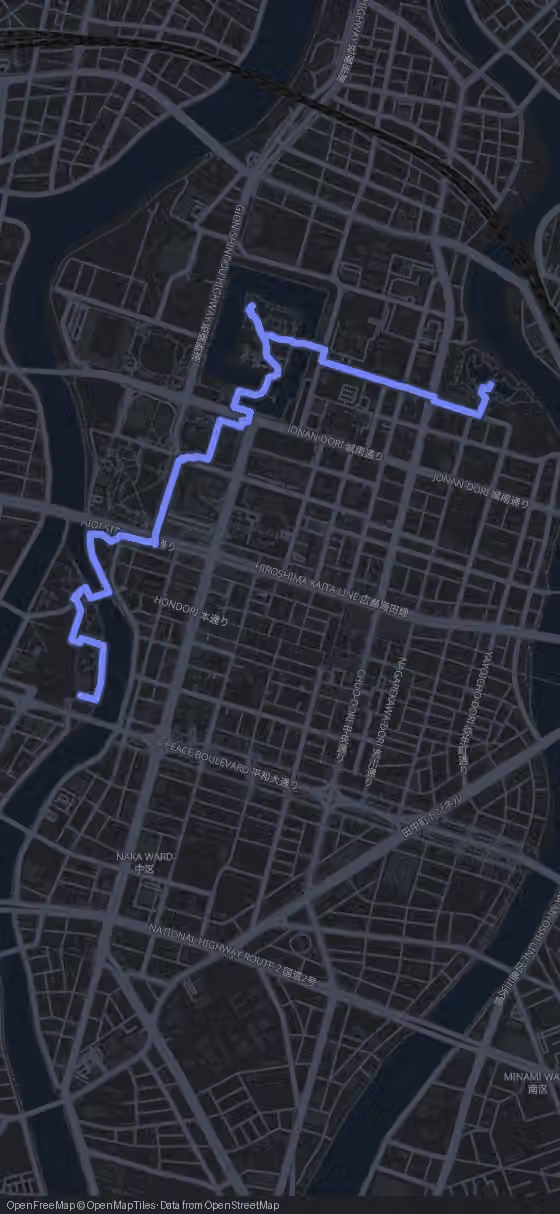
8 Stops 3.4 km ~47 min walking
Route map for the Hiroshima walking tour
Stop 1 of 8
250 m·3 min
Shukkeien Garden
Head north-west toward the Hiroshima Prefectural Art Museum, right next door.
Welcome to Hiroshima. I'm Alex, and our first story begins with a garden rebuilt after total destruction.
Try this tour with Alex

This Hiroshima Walk at a Glance

Eight stops lead from Shukkeien Garden to the Hiroshima Peace Memorial Museum: 3.4 km and 47 minutes of pure walking, about six hours if you go inside wherever it pays off. Hiroshima Castle, the A-Bomb Dome, the Children's Peace Monument and the Cenotaph for A-Bomb Victims cost nothing.

Tickets apply at the garden, the Hiroshima Prefectural Art Museum, the Hiroshima Museum of Art and the Peace Memorial Museum. The GPS route in your browser is free; the AI Tour Guide is optional and tells the stories as you walk.

Open free GPS & optional AI Tour Guide
This short shows highlights of the route. All 8 stops follow below.

The Route

Walking Map of Hiroshima: Garden, Castle and Peace Park

8 stops 3.4 km 47 min walking
Tap to load interactive map

The 8 stops along this route

  1. Shukkeien Garden in Hiroshima, stop 1 on the self-guided walking tour
    1Shukkeien Garden
  2. Hiroshima Prefectural Art Museum, stop 2 on the self-guided walking tour
    2Hiroshima Prefectural Art Museum
  3. Hiroshima Castle, stop 3 on the self-guided walking tour
    3Hiroshima Castle
  4. Hiroshima Museum of Art, stop 4 on the self-guided walking tour
    4Hiroshima Museum of Art
  5. A-Bomb Dome in Hiroshima, stop 5 on the self-guided walking tour
    5A-Bomb Dome
  6. Children's Peace Monument in Hiroshima, stop 6 on the self-guided walking tour
    6Children's Peace Monument
  7. Cenotaph for A-Bomb Victims in Hiroshima, stop 7 on the self-guided walking tour
    7Cenotaph for A-Bomb Victims
  8. Hiroshima Peace Memorial Museum, stop 8 on the self-guided walking tour
    8Hiroshima Peace Memorial Museum
  9. That's the full route.

    Walk it with an AI Tour Guide talking you through every one of these streets.

    Start free in your browser
    You made it

Your Hiroshima Walking Tour, Eight Stops from Garden to Museum

  1. 1

    Shukkeien Garden

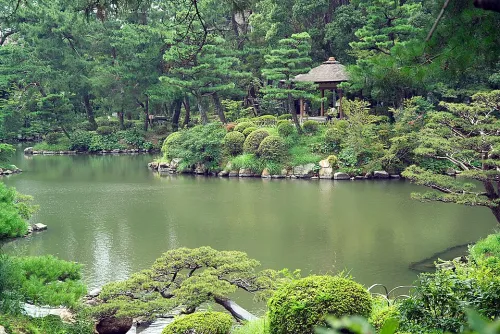
    Shukkeien Garden in Hiroshima, stop 1 on the self-guided walking tour

    Shukkeien means “shrunken landscape”, and that is exactly what you walk through: about 40,000 square metres in which typical Japanese scenery appears in miniature around a single pond, the Takuei. Small pines grow on its islands, carp and turtles live in the water, and the arched Kokō-kyō bridge spans the middle.

    It is a stroll garden laid out as a circuit. You enter in the southwest and soon reach the Seifū-kan, a teahouse in sukiya style; from its shore you can watch the turtles. Walk on clockwise and you pass through a wooded section with the Chōzen-kyo, then a mountain landscape in the north with a rugged coastline, streams running into little bays and the Meigetsu-tei teahouse. In the east rises Mount Kifuku, where the bridge comes ashore, and in the southeast you find a tea garden, rice fields and, in the far corner, an herb garden.

    The story starts with the lords of Hiroshima Castle. In 1619 the daimyo Asano Nagaakira made the castle his residence, and the following year his retainer Ueda Sōko, a tea master, began building the garden as part of the lord's villa. Between 1783 and 1788 Asano Shigeakira had it reshaped by Shimizu Shichirouemon, a garden architect from Kyoto. In 1940 it passed to Hiroshima Prefecture.

    Admission is modest, which makes it an easy yes, especially if you like slow walks and water. Give it about 45 minutes. The Prefectural Art Museum adjoins the garden on its western side and has an entrance from the grounds, just 230 m and 3 minutes away.
    Hours
    Mar 16 – Sep 15: Daily 09:00–18:00 (last entry 17:30); Sep 16 – Mar 15: Daily 09:00–17:00 (last entry 16:30); closed Dec 29-31
    Price
    Garden admission: adult ¥350; university student ¥150; high-school age and younger free.
  2. 2

    Hiroshima Prefectural Art Museum

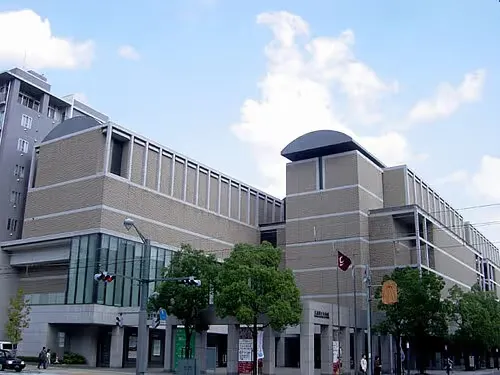
    Hiroshima Prefectural Art Museum, stop 2 on the self-guided walking tour

    The museum opened in September 1968 and was completely renovated in 1996, which gave it its open, modern look. The building treats Shukkeien as its neighbour of honour: from the main hall you look straight out onto the garden's greenery, and in spring onto the cherry blossom.

    Its permanent collection holds more than 4,500 works on almost 20,000 square metres and four floors, shown in a four-year thematic rotation, so what hangs on the walls changes. The collection rests on four pillars: traditional Japanese painting known as nihonga, traditional Asian art objects, and art of the 1920s and of the 1930s. Look out for Salvador Dalí and Isamu Noguchi, and for artists from the region such as Ai Mitsu. The museum is also known for temporary exhibitions on current themes.

    The name to remember is Ikuo Hirayama (1930 to 2009). He was in Hiroshima on 6 August 1945, which makes him a hibakusha, a survivor of the bombing. He became famous for paintings of the Silk Road and of Buddhism, and also for depicting what the bomb did. Works by Okuda Gensō and Kodama Kibo hang here too, along with two large painted canvases of the shrines of Miyajima and Itsukushima.

    Worth it if Japanese painting interests you, or if you want to see a survivor's art before the Peace Park; the museum charges admission. Keep Noguchi's name in mind; he returns at the Cenotaph. From here it is 840 m, about 12 minutes, to the castle.

    Hours
    Tue–Sun 09:00–17:00 (last entry 16:30), Fri 09:00–19:00 (Apr–Sep open until 20:00), Mon closed
    Price
    510 JPY adult, 310 JPY university student, free for high school students and younger & seniors 65+
    Website
    hpam.jp ↗
  3. 3

    Hiroshima Castle

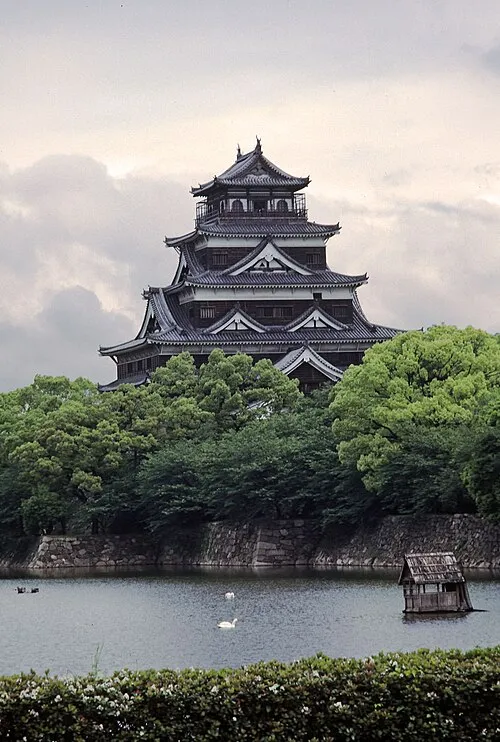
    Hiroshima Castle, stop 3 on the self-guided walking tour

    The keep you see today was rebuilt in 1958 as a replica of the original and now houses a museum of Hiroshima's history before the Second World War; other castle buildings have been reconstructed since. Locals also call it Carp Castle. Much of the original was taken down in the Meiji era, and what remained was largely destroyed by the bombing on 6 August 1945.

    Mōri Terumoto, one of Toyotomi Hideyoshi's council of Five Elders, built the castle between 1589 and 1599 on the delta of the Ōta River. There was no city yet; the area was simply called Gokamura, “five villages”. From 1591 Mōri ruled nine provinces from here, covering much of today's Shimane, Yamaguchi, Tottori, Okayama and Hiroshima Prefectures.

    The castle gave the city its name, because a grander one was wanted. “Hiro” came from Ōe no Hiromoto, an ancestor of the Mōri family, and “Shima” from Fukushima Motonaga, who helped choose the site. Another reading takes Hiroshima simply as “wide island”, after the large islands in the river delta.

    After the battle of Sekigahara in 1600 Mōri had to leave for Hagi, and Fukushima Masanori took over. The new Tokugawa shogunate allowed no castle building without permission from Edo, so when Fukushima repaired the castle after a flood in 1619, he was sent off to Kawanakajima. His successor was Asano Nagaakira, the lord whose tea master had just begun Shukkeien.

    Entry is free, which makes the keep's history museum an easy stop. Then walk 740 m, about 10 minutes, to the Hiroshima Museum of Art.

    Hours
    Apr–Sep: Daily 09:00–17:30 (last entry 17:00); Oct–Mar: Daily 09:00–16:30 (last entry 16:00)
    Price
    Free
  4. 4

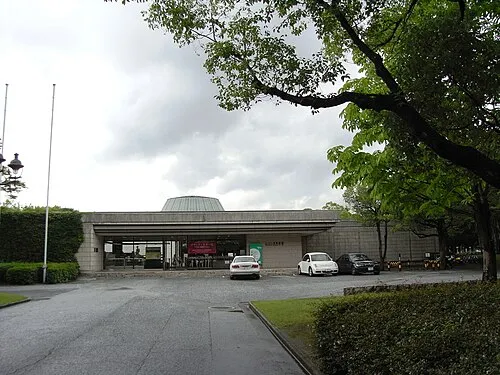
    Hiroshima Museum of Art

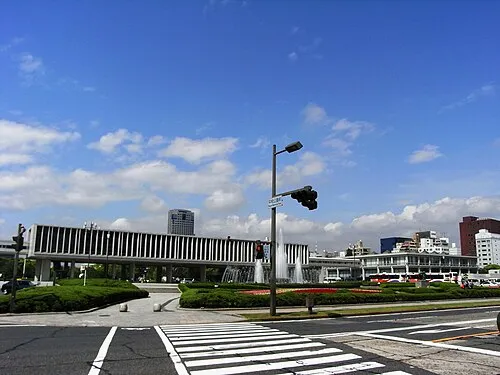
    Hiroshima Museum of Art, stop 4 on the self-guided walking tour

    This museum was born from a gesture of peace. When the Hiroshima Bank marked its hundredth anniversary, thirty years after the bombing, it wanted to give the city a symbol of peace and paid for both the building and the collection. A park in the city centre south of the castle was chosen, and the doors opened on 3 November 1978.

    The main building is a single-storey round structure with a central rotunda, around which four galleries are arranged. It sits in the middle of a rectangular garden; on the north side further galleries are linked to it by an underground passage, and on the south side you find a café, a museum shop and an auditorium.

    The collection covers the 19th and 20th centuries, with French painters at its core, many of them influenced by Japanese art, the movement known as Japonisme. A second focus is Japanese artists who absorbed Western art. The earliest paintings are by Eugène Delacroix, among them L'Arabe au tombeau from 1838 and Soldat à l'épée. Jean-François Millet and Jean-Baptiste Camille Corot represent the Barbizon School.

    This is the dearest ticket on the route, so go in if French painting is your thing and plan about an hour. If not, the round building and its setting are worth a look as you pass. The next leg, 740 m and about 10 minutes, takes you from art to 1945: the A-Bomb Dome.

    Hours
    Daily 09:00–17:00 (last entry 16:30); closed Mondays (except during special exhibitions/national holidays), New Year, and exhibition renewal periods
    Price
    2,500 JPY adult, 1,000 JPY high school/university student, 500 JPY elementary/junior high student
  5. 5

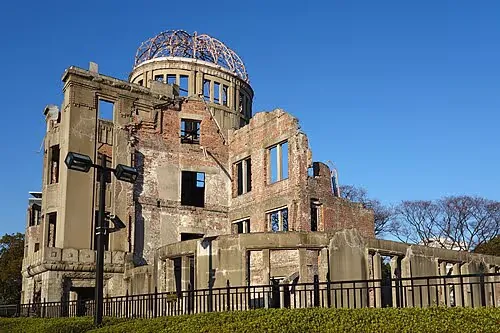
    A-Bomb Dome

    A-Bomb Dome in Hiroshima, stop 5 on the self-guided walking tour

    What stands here is a ruin kept on purpose. The building is permanently preserved in the state the bomb left it, as a reminder of what nuclear weapons do, and as a memorial to the more than 140,000 people killed. It belongs to the Hiroshima Peace Memorial Park and became a UNESCO World Heritage Site in 1996.

    It began as something entirely different. The Czech architect Jan Letzel designed it with a distinctive dome on top; it was completed in April 1915 and opened to the public that August as an exhibition hall for the prefecture's products. Renamed in 1921 and again in 1933, when it became the Hiroshima Prefectural Industrial Promotion Hall, it stood in the busy business district next to the Aioi Bridge and mostly hosted art and educational exhibitions.

    At 8:15 a.m. on 6 August 1945 the first atomic bomb ever used in war fell on Hiroshima, with a force of 15,000 tons of TNT. The city was chosen for its size and density, because conventional bombing had left it largely intact, and because no prisoner of war camp was known there. The Aioi Bridge was the aiming point, easy to recognise and close to the crowded centre. The bomb missed by 240 m and exploded over Shima Hospital; the blast centre lay 150 m horizontally and 600 m vertically from the Dome. The hall was among the few structures in the area that remained standing.

    The Dome is free and open around the clock, so you can take all the time you need. Then follow the path 310 m, about 4 minutes, to the Children's Peace Monument.

    Hours
    Open 24/7
    Price
    Free
  6. 6

    Children's Peace Monument

    Children's Peace Monument in Hiroshima, stop 6 on the self-guided walking tour

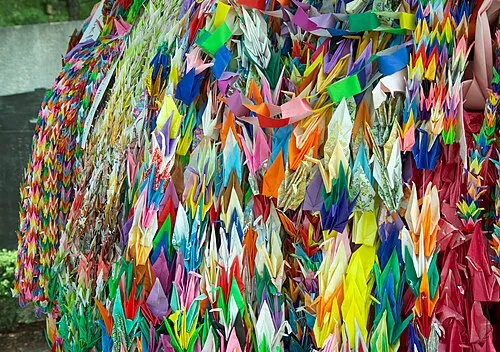
    Look up to the top of the statue: a girl holds a wire crane high above her head. She is Sadako Sasaki, and around the monument you see thousands of folded paper cranes sent from all over the world, by children who want a world without nuclear war.

    Sadako died of leukemia on 25 October 1955, caused by the radiation of the bomb dropped ten years earlier. Japanese tradition says that whoever folds a thousand cranes is granted a wish, and hers was a world without nuclear weapons. The well-known version says she died just short of a thousand. An exhibit in the Peace Memorial Museum told it differently: by the end of August 1955 she had reached her goal and kept on folding. Her wish was not granted.

    The monument remembers her and the thousands of other children killed by the bomb. Schoolchildren across Japan, Sadako's classmates among them, raised the money for it. The artists Kazuo Kikuchi and Kiyoshi Ikebe designed it, and the statue, titled “Atomic Bomb Children”, was unveiled on 5 May 1958, Children's Day in Japan. The cause it stands for gained a new voice on 11 October 2024, when Nihon Hidankyo received the Nobel Peace Prize for its work towards a world free of nuclear weapons and for survivors' testimony.

    The monument is free and always open. From here it is only 150 m, about 2 minutes, to the Cenotaph for A-Bomb Victims.

    Hours
    Open 24/7
    Price
    Free
  7. 7

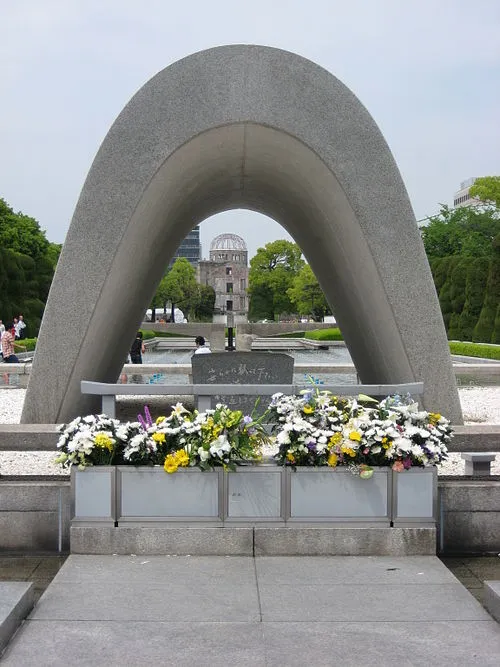
    Cenotaph for A-Bomb Victims

    Cenotaph for A-Bomb Victims in Hiroshima, stop 7 on the self-guided walking tour

    The curved roof is shaped like an ancient clay house, a haniwa, meant to shelter the souls of the victims from rain and dew. In the stone chamber at its centre lies the register of everyone who died as a bomb survivor, Japanese or foreign. Names are added every year at the request of relatives; as of 6 August 2026 it held 353,639. The cenotaph sits on a straight line between the Peace Memorial Museum and the A-Bomb Dome, so stand in front of it and look through.

    Kenzō Tange designed it. The first choice had been a design by Isamu Noguchi, recommended by Tange himself: a huge arch facing the Dome with a large space underground. Opponents, among them Tange's own teacher Kishida Hideto, objected because Noguchi was Japanese American, and Tange reworked the design while keeping Noguchi's idea alive. It was unveiled on 6 August 1952, first in concrete, and rebuilt in granite in 1985.

    The inscription reads, roughly: “Please rest in peace, for we shall not repeat the error.” Professor Saika Tadayoshi, himself a survivor, wrote it at the request of Mayor Hamai Shinzō. Whose error? People argued from the start. In 1952 the mayor said it meant war itself, the ruin of humanity and civilisation; letters to the local paper demanded that it name the United States, and others replied that it was a vow of all humankind. That reading, with humanity as the subject, is the city's view today.

    Over the years the cenotaph has received many visitors who came here for the first time: in 1970 an American prisoner of war killed in the bombing was added to the register, in 1971 Emperor Shōwa and Empress Kōjun paid respects, in 2016 Barack Obama laid flowers as the first sitting US president to visit, and in 2023 the G7 leaders came together. It is free and always open.

    The last leg runs 370 m, about 5 minutes, to the Peace Memorial Museum, past the Flame of Peace.

    Hours
    Open 24/7
    Price
    Free
  8. 8

    Hiroshima Peace Memorial Museum

    Hiroshima Peace Memorial Museum, stop 8 on the self-guided walking tour

    Everything you have seen in the park comes together here. The museum opened in August 1955 and documents the atomic bombing through belongings left by victims, photographs and other material, alongside exhibits on Hiroshima before and after the bombing and on the nuclear age. Kenzō Tange, who also designed the Cenotaph, was the architect of the main building. Between 1955 and 2005, 53 million people came, over a million a year, and school groups from all over Japan make it their first destination in the city.

    A 1994 renovation split the museum into two sections. The East Wing told the history of Hiroshima before the bomb, how the weapon was developed and the decision to use it, how people lived during the war and after, and the efforts for peace since. It included a model of the destroyed city and letters between scientists and leaders of the time on atomic development and its expected results. The West Wing concentrated on the damage the bomb caused.

    The museum describes each object as carrying the grief, anger or pain of a real person, and says Hiroshima's deepest wish is the elimination of all nuclear weapons. Take that seriously when you plan: give yourself an hour and a half and some quiet time afterwards.

    The ticket is inexpensive, and younger visitors pay less or nothing. This is where the route ends.

    Hours
    Mar–Nov: Daily 07:30–19:00 (Aug open until 20:00 / Aug 5-6 until 21:00); Dec–Feb: Daily 07:30–18:00 (last entry 30 min before closing); closed Dec 30-31 and mid-Feb
    Price
    200 JPY adult, 100 JPY high school student / senior (65+), free for junior high school students and younger
Walking tour route map of Hiroshima Route loaded
Shukkeien GardenHiroshima Prefectural Art MuseumHiroshima CastleHiroshima Museum of Art+4
All 8 stops are already on the map.
You just press start.
AI Tour Guide

You've read the route. Now walk it with a guide in your ear.

Press start wherever you are, even hundreds of kilometres from Hiroshima, and the guide begins telling its stories right away. In the city, pick any of the 8 stops to start from: it leads you there, then talks with you the whole route, asking, listening, remembering, and shaping the tour around your answers.

8stops 3.4km 47 minwalking 13languages
▶Start the tour free

Free to start · Runs in your browser · No app, no download

Shorter Ways to Walk Hiroshima

Not everyone has a full day. These three cuts keep the route's logic and let you pick the part of Hiroshima's story that matters most to you.

Peace Park only

Stops: 5, 6, 7, 8

For anyone with a morning or an afternoon who wants the heart of Hiroshima's story. From the A-Bomb Dome to the Peace Memorial Museum you walk just 11 minutes; the only ticket is the museum. Plan around two hours in total.

Garden, art and castle

Stops: 1, 2, 3

For a calmer half day in the older Hiroshima of daimyo and tea masters. Only 15 minutes of walking; tickets for Shukkeien Garden and the Hiroshima Prefectural Art Museum, while Hiroshima Castle is free.

Castle to Peace Museum

Stops: 3, 4, 5, 6, 7, 8

For first-time visitors who want both eras without the garden. Walking adds up to 31 minutes; tickets for the Hiroshima Museum of Art, which you can skip, and the Peace Memorial Museum.

How Long Does This Hiroshima Tour Take, With and Without Museums?

The pure walking time is 47 minutes, and no single leg takes longer than 12. The route runs from the old feudal city around the garden and the castle down to the Peace Park, so the history unfolds in order and ends where it weighs most.

With every interior worth seeing you need a little over six hours: say 45 minutes each for the garden, the Prefectural Art Museum and the castle, an hour in the Museum of Art, a quarter of an hour at each memorial in the Peace Park and an hour and a half in the Peace Memorial Museum. Start at 09:00 and you finish around 15:10. Leave out both art museums and the walk shrinks to roughly four and a half hours.

Before You Set Off in Hiroshima

  • Start: Shukkeien Garden is the recommended starting point, but you can join the route at any stop and follow it from there.
  • Finish: The walk ends at the Hiroshima Peace Memorial Museum, inside the Peace Park.
  • Best day: If the art museums matter to you, pick a day when both are open; they and some other stops close on certain days of the week or year.
  • Best time of day: Start in the morning, once the garden has opened. That gets you to the castle in good time and leaves the Peace Memorial Museum for the end.
  • Costs: The castle and the three Peace Park memorials are free. The four other sites charge admission; students and younger visitors pay less or nothing.
Walking tour route map of Hiroshima
AI Tour Guide

Your guide is ready when you reach the garden gate.

Press start and a voice AI Tour Guide takes it from here: leading the route through Hiroshima, telling the stories, and turning your walk into a real back-and-forth conversation. No app or download is needed; it runs in your browser.

8stops 3.4km 47 minwalking 13languages
▶Start the tour free

Free to start · Runs in your browser · No app, no download

What the AI Tour Guide Adds Between Castle and Peace Park

This route moves from daimyo gardens to the hour that ended the old city, and the AI Tour Guide carries that thread for you as a conversation. It greets you, tells the stories at each place, asks what moves you and shifts its focus: more on the Asano lords, more on the artists, or simply quieter in the Peace Park. Ask it how Jan Letzel came to build in Hiroshima or what the city looked like the year after the bombing, and it picks that up. You start with 100 free credits; after that, choose this tour all-inclusive for €19.99 with no time limit, or €5 per hour.

A Real Conversation A voice AI Tour Guide greets you, leads the whole route, and tells the stories and facts as you walk, asking what you want to see and keeping a real conversation going. Not a recording you press play on.
Map Navigation Follow the route on the map and walk at your own pace. You choose where to start and when to move to the next stop.
Ask Anything Curious about a building you pass? Ask your AI Tour Guide on the spot and the conversation carries on.
13 Languages Switch language anytime. No separate tour needed.
Start free in your browser

Common Questions About Walking Hiroshima

Are all stops open every day?

Not all of them. The Hiroshima Prefectural Art Museum and the Hiroshima Museum of Art each have a regular closing day, so if the two art museums matter to you, choose your day accordingly. Garden, castle and Peace Park make a full walk on their own.

If I only have time for one ticket, which should it be?

The Hiroshima Peace Memorial Museum. The ticket is inexpensive and gives everything you see in the Peace Park its context.

Can I come back to the Peace Park after dark?

Yes. The A-Bomb Dome, the Children's Peace Monument and the Cenotaph for A-Bomb Victims are open around the clock and free.

Are there discounts for students and children?

Yes. University students pay reduced prices at the garden and both art museums, and high-school age and younger visit Shukkeien Garden and the Prefectural Art Museum for free. At the Peace Memorial Museum, junior high students and younger enter free.

Where can I walk next after Hiroshima?

If you travel on through Japan, there are routes for Osaka, Kyoto and Nara, all around 300 km away.

Is the tour really free?

Yes. The whole tour is free: the route, the interactive map and the navigation cost you nothing. Only the voice AI Tour Guide is optional and paid: you test it with 100 free credits, then you pay either €5 per hour or €19.99 for this whole tour, with no time limit. Admission to 4 of the 8 stops is not included: Shukkeien Garden, Hiroshima Prefectural Art Museum, Hiroshima Museum of Art and Hiroshima Peace Memorial Museum charge their own entry fees.

Do I need to download an app?

No. Everything runs in your phone browser. Open the route and start walking, no download and no sign-up required.

Do I need to book the walking tour in advance?

No booking needed. This self-guided tour is available anytime. Open the route in your browser and start walking. The AI Tour Guide works instantly, no app, no reservation required.

What languages is the AI Tour Guide available in?

The AI Tour Guide speaks 13 languages, so you take the tour in your own language and can switch at any time.

Can I skip stops or change the route?

Yes. Skip any stop, spend extra time at places you like, or start the route from any point. It is your walk, you set the pace.
Image credits
▶ Start free in your browser Runs in your browser, no app, no download