The square and the Belvedere are free, the cathedral is free at set times, and both villas charge admission. Route, map and GPS navigation run free in your browser; the AI Tour Guide is optional.
Your Ravello Walking Tour: Five Stops, Two Villas, One Cathedral
1
Piazza Duomo
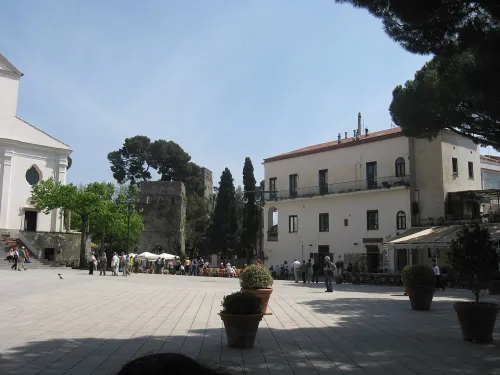
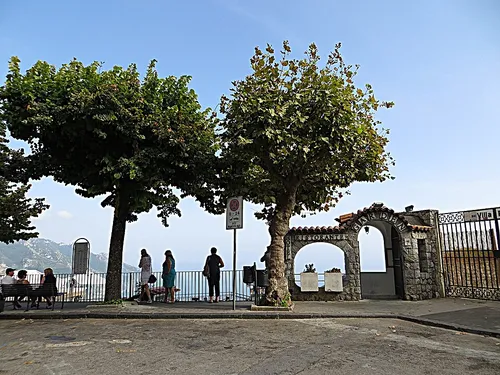
Begin in the square Ravello organizes itself around. Piazza Duomo is open public paving with no gate and nothing to queue for: the cathedral fills one side, and the entrance tower of Villa Rufolo faces it across the stone. Stand still for a moment and the walk's first choice is laid out in front of you, a villa with paid admission on one hand and a church with free visiting times on the other.
There is no interior to do here. Use the square as your compass instead: Ravello's lanes are short, and whenever they start to blur together, coming back here sets you straight again.
Before you move on, look across at the Rufolo gate tower from the middle of the square. Its pointed archway is the first detail of the next stop, about 60 m away and a minute's walk.
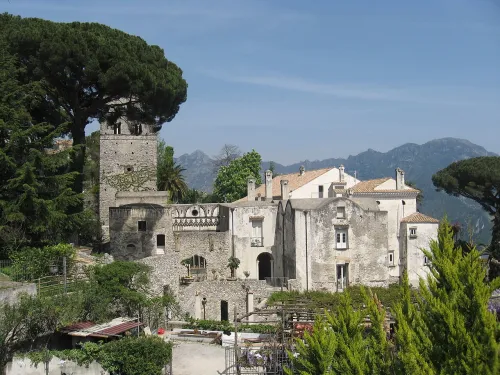
The villa greets you with a massive gate tower right on the cathedral square. You walk in through a pointed arch guarded by two stone crocodile heads, and inside the tower has no floors at all: a ribbed vault rises overhead, the walls are worked in yellow and grey tuff, and four statues in the corners stand for the four seasons. The tower was always ornament and never defence. The same goes for the Torre Maggiore further in, 30 m tall and three storeys high, entered through another pointed portal and decorated on its upper floor with two double windows on each side.
The Rufolo family built all this in the early 13th century. They came from Rome and grew rich with their own ships and banks in Apulia and Sicily, rich enough to host King Robert of Anjou here in the 14th century. Afterwards the house passed through the hands of the Confalone, the Muscettola and the d'Afflitto. In 1851 a Scottish industrialist, Francis Neville Reid, bought it and remodelled it from the ground up; the villa and garden you walk through today are essentially his.
Inside, look for the 18th century courtyard, framed on three sides like a Moorish cloister with pointed arches, arabesques and paired columns. There is also a vaulted chapel and a dining hall carried by low, heavy columns that spans three storeys. The real draw, though, are the gardens laid out in the 19th century.
Richard Wagner walked here in 1880 and found in them the model for Klingsor's magic garden, the setting of the second act of Parsifal; Edvard Grieg and Giuseppe Verdi were taken with the gardens too. If you pay for one ticket in Ravello and music or garden history is what moves you, make it this one. If you mostly want a cliff terrace over the sea, keep your budget for Villa Cimbrone.
Back out on the square, the cathedral is only 90 m away, a minute on foot. Keep the Rufolo name in mind: you will meet it again inside.
Hours
Daily 09:00–19:00; last entry 30 min before closing
Price
8.00 EUR standard, 7.00 EUR groups (15+), 6.00 EUR seniors (over 65) and children (5-12 years)
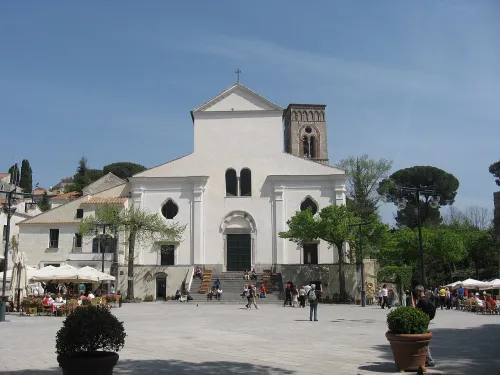
The Duomo di Ravello is dedicated to Santa Maria Assunta and San Pantaleone. It served as the cathedral of Ravello's own diocese from its founding until 1818, when the diocese was abolished; since 1918 it has been a minor basilica and since 1941 a national monument.
Construction began together with the diocese in 1086, pushed by the first bishop, Orso Papice. The builders reused material taken from temples and older buildings in the area, and the result was Romanesque with Moorish touches, laid out much like the abbey of Montecassino. The Moorish-style bell tower followed in the 12th and 13th centuries. Before you go in, look at the bronze doors, installed in 1179.
Inside, the two pulpits tell you who mattered in medieval Ravello. The Epistle ambo dates from 1094 and was commissioned by Costantino Rogadeo. The Gospel ambo of 1272 was paid for by Nicola Rufolo, and in 1279 Matteo Rufolo commissioned the ciborium over the altar from Matteo da Narni: the same family whose villa you have just left. Between the 13th and 17th centuries noble families added their own chapels in the aisles, the atrium, the crypt and the apses.
The chapel of San Pantaleone, the town's patron, has its own story. Bishop Michele Bonsio had the idea in 1617, but work only started as a votive offering after the earthquake that followed the Vesuvius eruption of 1631: begun on 9 December 1632 and finished in June 1633. The ampoule with the saint's blood was moved in only on 16 May 1661. Later in the 17th century Bishop Giuseppe Saggese had the transept restored and the dome rebuilt lower than before.
Going in is worth it for everyone, even briefly, if only for the Rufolo pulpit. Entry is free during the church's open visiting times; in the middle of the day during the main season you go in on the Duomo Museum ticket. From here it is 300 m and 5 min to the Belvedere, and on the way you pass the Museo del Corallo.
Local name
Duomo di Ravello
Hours
Daily 09:00–10:30 & 17:00–20:30 (free access). 1 Apr-31 Oct: 10:30–17:00 entry only via Duomo Museum ticket. Nov–Mar: 09:00–12:00 & 16:30–19:30.
Price
Free entry for church worship; 4.00 EUR full, 3.00 EUR reduced (includes Cathedral & Duomo Museum between 10:30-17:00 from 1 Apr to 31 Oct)
After the square, the villa and the cathedral, this is the stop that asks nothing of you. The Belvedere Principessa di Piemonte is a municipal garden and lookout on Via San Giovanni del Toro, with no gate, no ticket desk and nothing to decide.
If both villa tickets are out of budget today, this is the view you keep. Take your time with it; nobody is waiting for you to move on.
It is also your last sensible pause. The way out to Villa Cimbrone is the longest leg of the route, 1020 m and 15 min, so treat the garden as a breather and arrive at the final gate with something left in your legs.
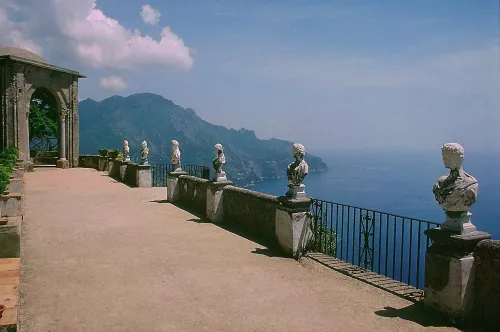
The walk ends on a rocky outcrop once called Cimbronium, which gave the villa its name. Villa Cimbrone is known above all for its belvedere, the Terrazza dell'Infinito, the Terrace of Infinity, and the gardens that lead you out to it.
The history goes back at least to the 11th century, when the noble Accongiogioco family owned the estate. It later passed to the wealthy Fusco, recorded in 1291 as owners of the local church of S. Angelo de Cimbrone, and then became part of the nearby monastery of Santa Chiara; in that period the papal arms of Cardinal Della Rovere were placed over the old entrance gate. After the 17th century the record goes quiet, until in the second half of the 19th century the property turns up with the Amici family of Atrani.
That is the villa the historian Ferdinand Gregorovius saw, and he wrote it up in his travel book of 1861: flowers from all kinds of southern plants, little temples, pavilions, bronze and stone statues. At the very edge of the crag he found the terrace with its enchanting view, ringed by marble statues he called horrible, though he admitted they had a certain appeal from a distance. Looking out over the sea from there, he wrote, you wish you could fly.
What you see today is mostly later. In the early 20th century Ernest William Beckett, later Lord Grimthorpe, rebuilt and extended the villa using architectural pieces salvaged from other parts of Italy and beyond, and he redesigned the gardens at the same time. Little of the original structure is still visible, so read the place as Beckett's collage rather than a medieval house.
The gardens charge admission, and for anyone who came to Ravello for the view they are worth every minute you can give them. This is the end of the route, so there is no next leg to save energy for: walk out to the terrace and stay as long as you like.
Hours
Daily 09:00–20:00 (last admission 19:30)
Price
10.00 EUR regular, reduced rates for groups and children under 12
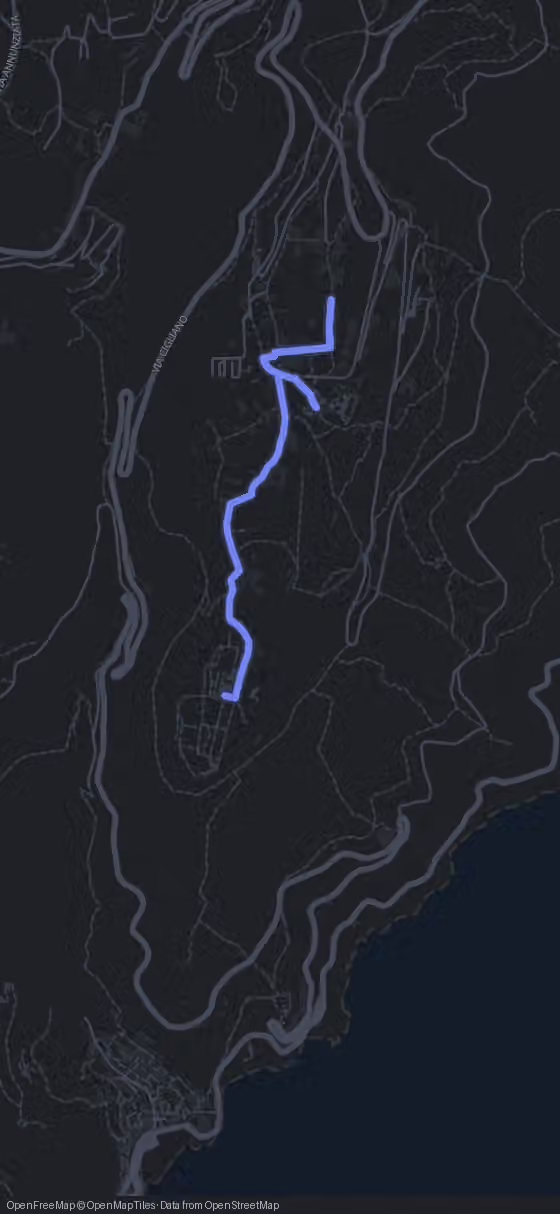
All 5 stops are already on the map. You just press start.
AI Tour Guide
You've read the way through Ravello. Now walk it with a guide in your ear.
Press start wherever you are, even hundreds of kilometres from Ravello, and the guide begins telling its stories right away. In the city, pick any of the 5 stops to start from: it leads you there, then talks with you the whole route, asking, listening, remembering, and shaping the tour around your answers.
Free to start · Runs in your browser · No app, no download
Shorter Ways to Walk Ravello
Not every visit has room for two villa gardens. These three cuts keep the order of the full route and simply leave out what doesn't fit your time or budget.
The free walk: square, cathedral, lookout
Stops: 1, 3, 4
For a tight budget or a short stop in town. You cross the square, look into the cathedral during its free visiting times and finish at the Belvedere, about 7 min of walking in total. No tickets needed if you time the cathedral right; plan about an hour.
Villa Rufolo and the Duomo only
Stops: 1, 2, 3
For music lovers and anyone short on time. Everything sits around Piazza Duomo, so you walk barely 2 min. Villa Rufolo charges admission; the cathedral is free at its open times or entered on the Duomo Museum ticket. Plan about an hour and a half.
Straight to the Terrace of Infinity
Stops: 1, 3, 4, 5
For those who came for the sea view. You pass Villa Rufolo without going in, see the cathedral, rest at the Belvedere and walk on to Villa Cimbrone: the full 22 min of walking, with only the Cimbrone ticket to pay. Plan a little over two hours.
How Long Does This Ravello Tour Take with Both Villas?
The walking itself takes 22 min: two short hops around Piazza Duomo, 5 min to the Belvedere and a 15 min leg out to Villa Cimbrone. What fills the day are the gardens. Give each villa about an hour, the cathedral half an hour and the Belvedere a short breather, and the full route comes to around three hours.
The free walk takes about an hour, the Rufolo and Duomo version about an hour and a half, and the Cimbrone version a little over two hours. The route ends at Villa Cimbrone rather than back at the square, so allow extra time for the way back into the centre.
If Ravello is part of a longer day on the coast, the Amalfi walking tour makes a natural partner.
Before You Set Out from Piazza Duomo
Start: Piazza Duomo is the recommended start, but you can join the route at any stop and pick up from there.
End: Villa Cimbrone, at the far end of the route, not back at the square.
Tickets: Villa Rufolo and Villa Cimbrone both charge admission. Piazza Duomo and the Belvedere are free. The cathedral is free during its morning and evening visiting times; in the middle of the day during the main season you enter on the Duomo Museum ticket.
Timing: If you start early and want the cathedral for free, look into it first and then cross to Villa Rufolo. Both villas stop admitting visitors a little before closing, so don't leave Villa Cimbrone until the very end of the day.
AI Tour Guide
Your guide is ready when you are, right from Piazza Duomo.
Press start and a voice AI Tour Guide takes it from here: leading the route through Ravello, telling the stories, and turning your walk into a real back-and-forth conversation. No app or download is needed; it runs in your browser.
Free to start · Runs in your browser · No app, no download
What the AI Tour Guide Adds Between Rufolo and Cimbrone
This route is really one long story about rich families and the foreigners who fell for their houses, and the AI Tour Guide tells it as a conversation. It greets you on Piazza Duomo, asks whether music, gardens or history pulls you more, remembers your answer and leans into it at each stop; you can interrupt whenever you like. Ask what Klingsor's garden is in Parsifal, what an ambo was actually used for, or who Ernest Beckett was before Ravello. The free GPS navigation leads you from stop to stop either way. You get 100 free credits to start; after that, this tour costs €19.99 all-inclusive with no time limit, or €5 per hour in credits.
A Real Conversation
A voice AI Tour Guide greets you, leads the whole route, and tells the stories and facts as you walk, asking what you want to see and keeping a real conversation going. Not a recording you press play on.
Map Navigation
Follow the route on the map and walk at your own pace. You choose where to start and when to move to the next stop.
Ask Anything
Curious about a building you pass? Ask your AI Tour Guide on the spot and the conversation carries on.
13 Languages
Switch language anytime. No separate tour needed.
Can I visit Villa Cimbrone if I'm not staying there?
Yes. The villa itself is a hotel today, but its gardens, including the Terrace of Infinity, are open to the public with a ticket.
Where is the Duomo Museum?
It is set up in the cathedral's crypt and in a room off the right-hand nave. The museum ticket covers both the museum and the church.
Are there reduced tickets at the two villas?
Yes. Villa Rufolo has reduced rates for groups, seniors and children; Villa Cimbrone for groups and children. You get the exact amounts at each ticket desk.
Is the walk back from Villa Cimbrone part of the 22 minutes?
No. The 22 min cover only the way out from Piazza Duomo to Villa Cimbrone. The return into the centre comes on top.
Is the tour really free?
Yes. The whole tour is free: the route, the interactive map and the navigation cost you nothing. Only the voice AI Tour Guide is optional and paid: you test it with 100 free credits, then you pay either €5 per hour or €19.99 for this whole tour, with no time limit. Admission to 3 of the 5 stops is not included: Villa Rufolo, Ravello Cathedral and Villa Cimbrone charge their own entry fees.
Do I need to download an app?
No. Everything runs in your phone browser. Open the route and start walking, no download and no sign-up required.
Do I need to book the walking tour in advance?
No booking needed. This self-guided tour is available anytime. Open the route in your browser and start walking. The AI Tour Guide works instantly, no app, no reservation required.
What languages is the AI Tour Guide available in?
The AI Tour Guide speaks 13 languages, so you take the tour in your own language and can switch at any time.
Can I skip stops or change the route?
Yes. Skip any stop, spend extra time at places you like, or start the route from any point. It is your walk, you set the pace.