Free Walking Tour Matera: Cistern, Rock Churches, Sassi

Stand on the roof of a hidden cistern, take in the Sassi from above, then walk down to a rock church with frescoes as old as the 12th century.

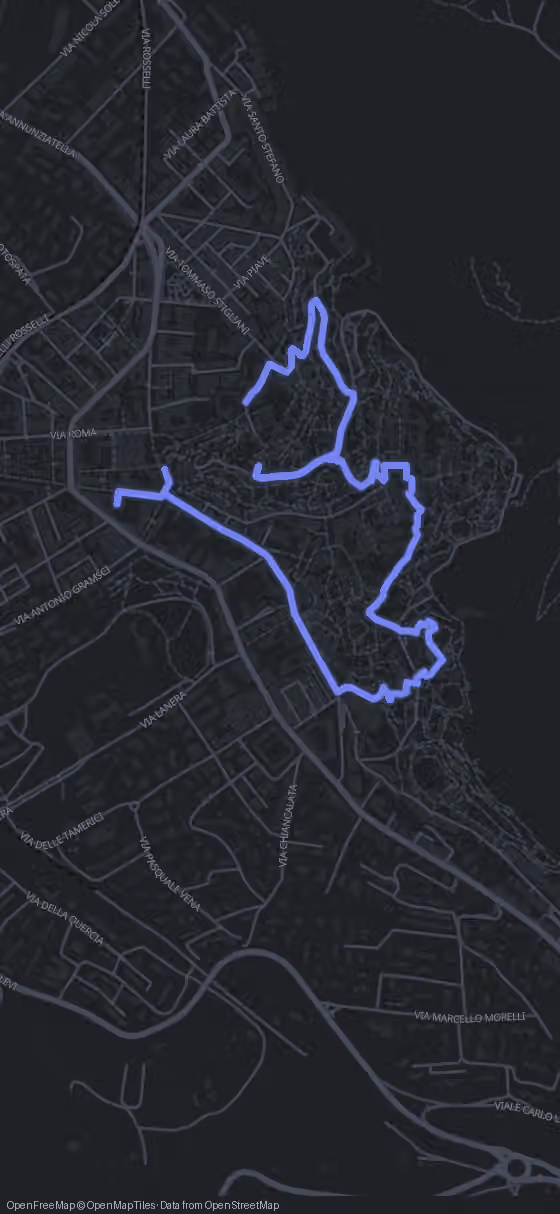
8 Stops 2.7 km ~44 min walking
Route map for the Matera walking tour
Stop 1 of 8
150 m·2 min
Piazza Vittorio Veneto
Head south-west toward Palombaro Lungo
Welcome to Matera. I'm Alex, and our first story begins with a neighbourhood emptied by its own government.
Try this tour with Alex

This Matera Route at a Glance

Eight stops on a 2.7 km line from Piazza Vittorio Veneto to the Church of San Giovanni Battista, dipping into the Sassi di Matera on the way. Pure walking time is 44 minutes; with the interiors worth seeing, plan about three hours.

The squares, the Sassi, Matera Cathedral and the last church are free. The Palombaro Lungo, the Church of Santa Maria de Idris and the Church of San Pietro Barisano charge entry. Map and GPS navigation run free in your browser; the AI Tour Guide is optional.

Open free GPS & optional AI Tour Guide
This short shows highlights of the route. All 8 stops follow below.

The Route

Walking Map of Matera: Plateau, Sassi and Ridge

8 stops 2.7 km 44 min walking
Tap to load interactive map

The 8 stops along this route

  1. Piazza Vittorio Veneto in Matera, stop 1 on the self-guided walking tour
    1Piazza Vittorio Veneto
  2. Palombaro Lungo in Matera, stop 2 on the self-guided walking tour
    2Palombaro Lungo
  3. Belvedere Piazza Giovanni Pascoli in Matera, stop 3 on the self-guided walking tour
    3Belvedere Piazza Giovanni Pascoli
  4. Church of Santa Maria de Idris in Matera, stop 4 on the self-guided walking tour
    4Church of Santa Maria de Idris
  5. Matera Cathedral, stop 5 on the self-guided walking tour
    5Matera Cathedral
  6. Sassi di Matera, stop 6 on the self-guided walking tour
    6Sassi di Matera
  7. Church of San Pietro Barisano in Matera, stop 7 on the self-guided walking tour
    7Church of San Pietro Barisano
  8. Church of San Giovanni Battista in Matera, stop 8 on the self-guided walking tour
    8Church of San Giovanni Battista
  9. That's the full route.

    Walk it with an AI Tour Guide talking you through every one of these streets.

    Start free in your browser
    You made it

Your Matera Walking Tour, Stop by Stop From the Cistern to the Cave Churches

  1. 1

    Piazza Vittorio Veneto

    Piazza Vittorio Veneto in Matera, stop 1 on the self-guided walking tour

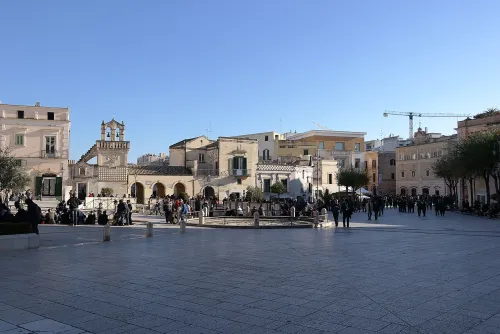
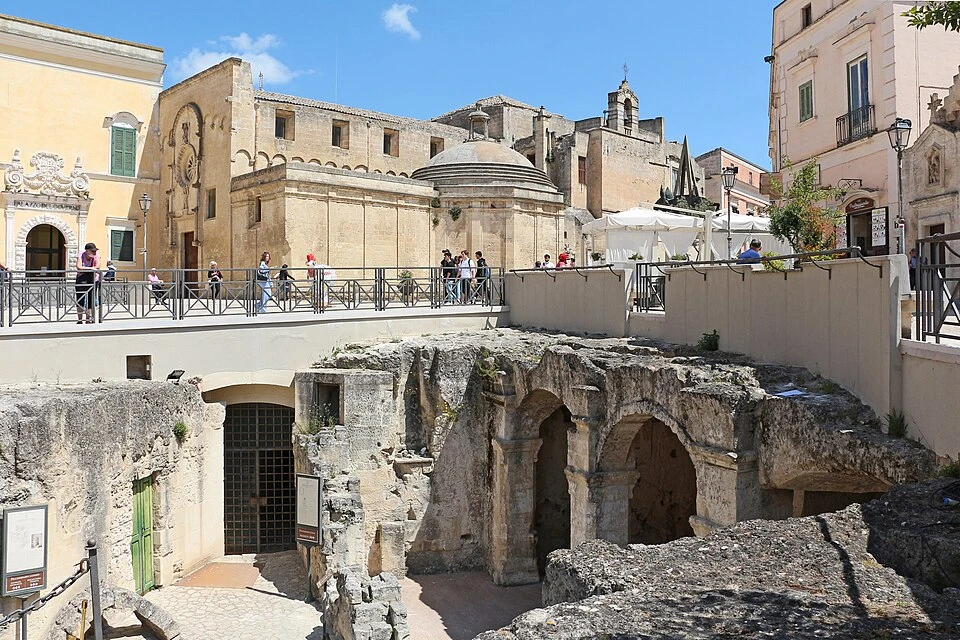
    Stand in the middle of the square and look down at the paving: you are standing on a roof. Under your feet lies the Palombaro Lungo, the largest underground cistern in Matera, where rain and spring water from the hills of La Nera, Lapillo and Macamarda collected. Most cities kept their water in a river. Matera kept it in the rock.

    The square itself is made ground. Earth and rubble were once spread over the clay soil here to firm it up for building, and the piazza became the dividing line between two worlds: the peasant houses of the Sassi below and the town 'al piano', on the level ground, where the middle-class families lived.

    On the evening of 2 July the square plays a completely different role. It's the feast of the Madonna della Bruna: late at night a triumphal papier-mâché cart is hauled up to this piazza so the crowd can tear it to pieces, with fireworks at midnight. Every other day it's simply an open square and the easiest place on this walk to get your bearings.

    From here the route stays on the plateau for the view, drops into the Sassi to the first rock church, climbs back to the cathedral ridge and then continues through the old town. The cistern entrance is 150 m away, two minutes on foot, past Matera Central Market and the Matera Earth Market.
    Hours
    Open 24/7
    Price
    Free
  2. 2

    Palombaro Lungo

    Palombaro Lungo in Matera, stop 2 on the self-guided walking tour

    Now you go beneath the square you just crossed. A self-guided visit of about 15 minutes takes you into the cistern under Piazza Vittorio Veneto. It's one piece of underground Matera: a system of rock cisterns that ran the whole length of the Sassi and kept the people living there supplied with water.

    Cisterns cut into the rock are as old as settlement here, but the Palombaro Lungo grew by linking caves that already existed, after the population rose and the town set about building larger water reserves in the 16th century. The cistern in its finished form dates from 1882, to a design by the engineer Rosi. How old the individual chambers really are is hard to say, because people have lived in Matera's caves since ancient times.

    In 1927 the Apulian Aqueduct reached the city, and the cistern was no longer needed. It was forgotten until 1991, when a group of scholars led by Enzo Viti, a technical draughtsman and expert on underground Matera, rediscovered it and crossed it in a rubber dinghy. That find helped bring the Sassi onto the UNESCO World Heritage list.

    Cheap and only a quarter of an hour, it's an easy yes for almost anyone: it explains how the city above could exist at all on bare rock. Then walk 610 m, about 8 minutes, to the Belvedere Piazza Giovanni Pascoli, passing the National Archaeological Museum Domenico Ridola on the way.

    Hours
    Daily 10:00–13:00 and 15:00–18:00 (self-guided visit of about 15 minutes)
    Price
    3 EUR; minors free; school groups 1.50 EUR
  3. 3

    Belvedere Piazza Giovanni Pascoli

    Belvedere Piazza Giovanni Pascoli in Matera, stop 3 on the self-guided walking tour

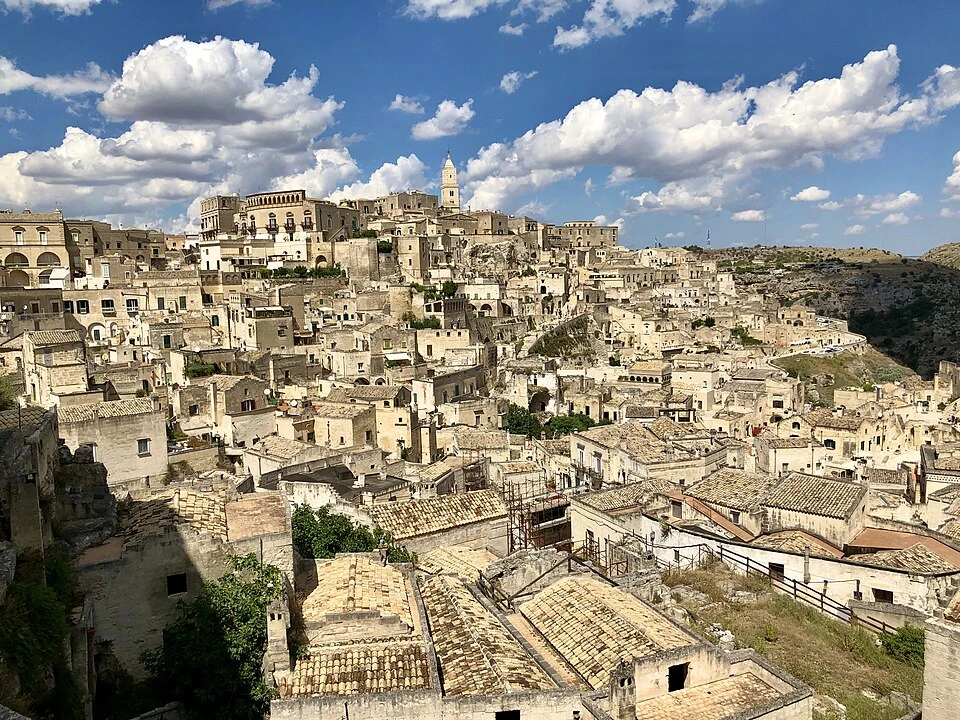
    This is the reward for staying on the plateau so long. From the terrace at Piazza Giovanni Pascoli the Sassi finally read as one thing: a stacked cave city falling away toward the ravine, terraces and rooftops down to the edge of the rock, and across the gap the bare Murgia plateau.

    Hold on to this picture, because it's the map for the descent ahead. The churches, lanes and cave houses you'll walk past in the next hour are all down there in front of you.

    If you're here with a camera, the light photographers want comes in the first two hours after sunrise, which in midsummer means very early. Across the ravine, the Murgia Timone side looks back at the whole Sassi, but that's a separate outing; on foot today, this terrace is your panorama.

    From here it's 320 m, about 6 minutes, down to the Church of Santa Maria de Idris, passing Palazzo Lanfranchi.

    Hours
    Open 24/7
    Price
    Free
  4. 4

    Church of Santa Maria de Idris

    Church of Santa Maria de Idris in Matera, stop 4 on the self-guided walking tour

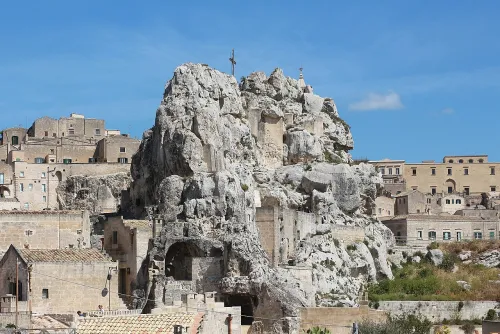
    The church sits high on the Monterrone, a large limestone outcrop rising in the middle of the Sasso Caveoso. From outside you see only a masonry front with a small bell gable beside it; the church itself is carved into the rock. The name Idris comes either from the Greek Odigitria, 'she who shows the way', or from the water that once flowed from this rock.

    Inside, centuries of rebuilding have left nothing of the original structure. The nave is irregular, and many of the frescoes were detached because damp was destroying them; they are kept for restoration by the heritage authority in Matera. On the altar is a 17th-century Madonna and Child in tempera, to the right Saint Eustace, patron of the city, and a roughly painted Crucifixion with the outline of Matera behind it.

    The real reward lies through the tunnel. It links Idris to the rock crypt of San Giovanni in Monterrone, whose frescoes were painted over five centuries. In the passage you meet Saint John the Baptist. Above an altar, in a lunette, a 12th-century Christ Pantocrator blesses in the Latin manner while holding an open Gospel inscribed in Greek, a clear sign of Byzantine influence. Further on stands an unknown monk in habit and hood, perhaps Saint Francis, perhaps Saint Leonard, and opposite him a 14th-century Saint Nicholas in bishop's robes.

    Idris and San Giovanni in Monterrone count as one site on one ticket. A two-church ticket also covers the Church of San Pietro Barisano later on the walk. If you only go inside one rock church today, make it this one, for the crypt. What you shouldn't do is skip both and believe you've seen the Sassi: the carved interiors are what make the descent more than a pretty walk.

    Then it's 460 m, about 9 minutes, back up to Matera Cathedral on the ridge.

    Hours
    Daily 9:30–19:30 (valid from 28 March 2026); closed 25 December and 2 July
    Price
    1 rock church (Madonna de Idris and San Giovanni in Monterrone together count as 1 site): 4.50 EUR (full price); 2 rock churches: 8.00 EUR; 3 rock churches: 10.00 EUR
  5. 5

    Matera Cathedral

    Matera Cathedral, stop 5 on the self-guided walking tour

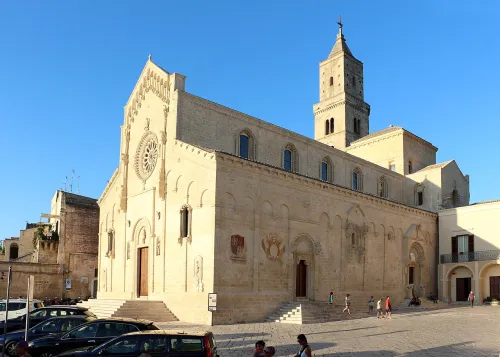
    The cathedral stands on the ridge that forms the highest point of Matera and divides the two Sassi, on the site of the old church of Saint Eustace, the city's protector. Look at the west front: a rose window with sixteen rays and, on the left, the bell tower, 52 m high. The style is Apulian Romanesque.

    Building began in 1203, the year Pope Innocent III raised Matera to an archdiocese together with Acerenza, and was finished in 1270. The name changed over time: Santa Maria di Matera at first, Santa Maria dell'Episcopio by 1318, Santa Maria della Bruna from 1389, when Pope Urban VI, once Archbishop of Matera himself, instituted the feast of the Visitation. Since 1627, under Archbishop Fabrizio Antinori, it has been dedicated to the Madonna della Bruna and Saint Eustace together. That is the same Bruna whose cart meets its end on Piazza Vittorio Veneto.

    Inside you find a Latin cross with three naves, round arches on columns with stone capitals, and a Baroque layer of gilded stucco and frames added in the 17th and 18th centuries over the Romanesque structure. Entry is free, so it's worth going in even on a tight schedule.

    From the ridge it's 400 m, about 7 minutes, down into the Sassi di Matera.

    Hours
    Mon–Sat: 09:00–18:30 | Sun: 9:00–10:30, 12:30–18:30
    Price
    Free
  6. 6

    Sassi di Matera

    Sassi di Matera, stop 6 on the self-guided walking tour

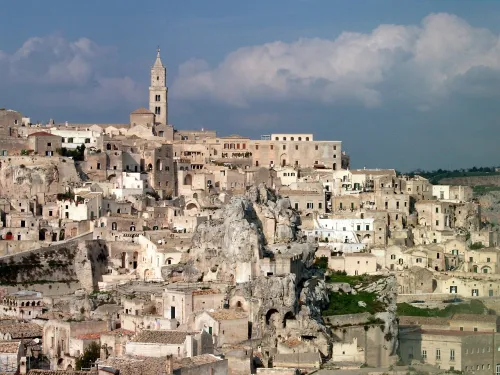
    Now you're in the Sassi proper, the two districts of Sasso Caveoso and Sasso Barisano that make up the old cave town. The houses are dug into the soft calcarenite rock known locally as 'tufo', though it's neither volcanic tuff nor tufa limestone. Watch how the lanes run: in places the street under your feet is the roof of the house below.

    The town grew up on one slope of the ravine carved by the Gravina river, simply called 'la Gravina' here. Sasso comes from the Latin saxum, a rock or great stone. People were living here as early as 7000 BC, and the Sassi are thought to be among the first human settlements in Italy.

    The darker chapter is recent. In the 1950s the Italian government forcibly moved most of the inhabitants into the new modern districts: extreme poverty and malaria made living conditions seem inhuman, an affront to the young Republic of Alcide De Gasperi. Some people stayed regardless, and until the late 1980s the Sassi stood for poverty, with many houses uninhabitable, and some still are.

    Then the turn: in 1993 UNESCO listed the Sassi together with the park of the Rupestrian Churches, and with support from the European Union, the Italian state and UNESCO the districts were brought back to life. Today businesses, pubs and hotels fill caves that once stood empty.

    From here it's 530 m, about 8 minutes, to the Church of San Pietro Barisano, passing the Museum of Rural Life.

    Hours
    Open 24/7
    Price
    Free
  7. 7

    Church of San Pietro Barisano

    Church of San Pietro Barisano in Matera, stop 7 on the self-guided walking tour

    This is the second rock church of the walk, from the same carved world as Santa Maria de Idris. If you bought the two-church ticket there, this is where you use its second half.

    If you settled on a single interior, Idris was the right pick, and keeping this church as an exterior on a tight day is a fair trade. From here it's only 220 m, about 4 minutes, to the Church of San Giovanni Battista.

    Hours
    Daily 10:00–19:00 (valid from 28 March 2026); closed 25 December and 2 July
    Price
    1 rock church: 4.50 EUR (full price); 2 rock churches: 8.00 EUR; 3 rock churches: 10.00 EUR
  8. 8

    Church of San Giovanni Battista

    Church of San Giovanni Battista in Matera, stop 8 on the self-guided walking tour

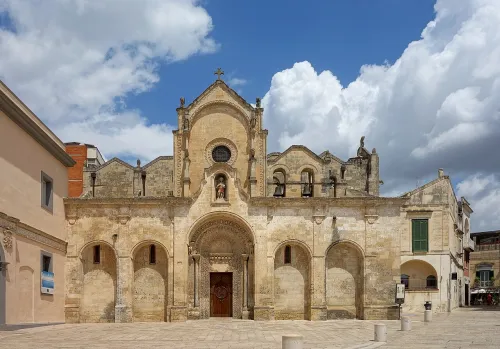
    The last church has a story that starts far from Matera. In 1215, penitents of Santa Maria di Accon arrived here from the Kingdom of Acre. In 1220 they were given the chapel of Santa Maria la Nova, a Benedictine house until 1212, and in 1229 they began this church to replace it, finishing in 1236. Like the cathedral, it's an important example of Apulian Romanesque.

    In 1480, at the time of the Ottoman invasion of Otranto, the nuns abandoned the church, which lay outside the city walls. In 1695 Archbishop Antonio Del Ryos Colmenares, with the nuns' agreement, moved the parish of San Giovanni Battista here from its run-down church in the Sasso Barisano. The sacristy followed in 1701, the Chapel of the Holy Sacrament in 1735.

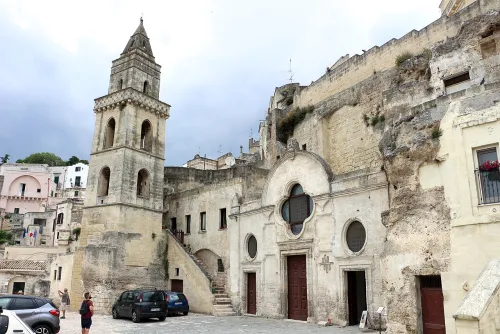
    Look at the façade. Late in the 18th century the three domes over the transept were failing, so they were pulled down and replaced with vaults, and the front was lined with arches to hold the new weight. The original 13th-century portal stayed visible, with a statue of the Baptist above it.

    Inside: a Latin cross, a central nave with 'Lecce vaults' and aisles with cross vaults. In the left aisle a polychrome altar sits below a fresco of Santa Maria la Nova; the Chapel of the Holy Sacrament holds a canvas by the local painter Vito Antonio Conversi, and two sculptures are attributed to the school of Altobello Persio. Entry is free. The church also gives its name to the small piazza in front, a quiet place to end the walk.

    Hours
    Daily: 08:00–22:30
    Price
    Free
Walking tour route map of Matera Route loaded
Piazza Vittorio VenetoPalombaro LungoBelvedere Piazza Giovanni PascoliChurch of Santa Maria de Idris+4
All 8 stops are already on the map.
You just press start.
AI Tour Guide

You've read the way into the Sassi. Now walk it with a guide in your ear.

Press start wherever you are, even hundreds of kilometres from Matera, and the guide begins telling its stories right away. In the city, pick any of the 8 stops to start from: it leads you there, then talks with you the whole route, asking, listening, remembering, and shaping the tour around your answers.

8stops 2.7km 44 minwalking 13languages
▶Start the tour free

Free to start · Runs in your browser · No app, no download

Three Ways to Walk Matera

The route splits neatly at the cathedral, so you can walk it whole or in two halves.

The full route

Stops: 1, 2, 3, 4, 5, 6, 7, 8

For a first day in Matera: 44 minutes of walking, with entry to the Palombaro Lungo and the two-church rock ticket for Idris and San Pietro Barisano.

Cistern, view and Idris

Stops: 1, 2, 3, 4, 5

If you only have a morning: 25 minutes of walking. You pay for the Palombaro Lungo and the single rock-church ticket for Idris with its crypt; the cathedral is free.

Cathedral and the Sassi

Stops: 5, 6, 7, 8

For an afternoon or a second visit: 19 minutes of walking. Only San Pietro Barisano charges entry; the cathedral, the Sassi and the closing church are free.

How Long This Matera Tour Takes With the Cistern and Rock Churches

Pure walking time is 44 minutes for the 2.7 km; the longest leg, 610 m, runs from the cistern to the belvedere. Add a quarter of an hour inside the Palombaro Lungo, time with the frescoes in Idris and its crypt, the cathedral interior and San Pietro Barisano, and you end up at about three hours.

Start at 10:00 and you reach the Palombaro Lungo early, Idris before 11:00, the cathedral around 11:25 and the Church of San Giovanni Battista around 12:40.

The first half on its own, from the piazza to the cathedral, takes about 1 h 45 with visits. The second half, from the cathedral through the Sassi, takes about 1 h 25.

Before You Set Off in Matera

  • Start: Piazza Vittorio Veneto is the recommended start, but you can join the route at any stop.
  • Finish: The walk ends at the Church of San Giovanni Battista. If you like, the GPS navigation in your browser leads you back to Piazza Vittorio Veneto.
  • When to go: Start in the morning or in the afternoon. The Palombaro Lungo, the cathedral and the rock churches are not open around the clock, so plan your stops for when they are.
  • Costs: Walking, map and GPS route are free; only the interiors on the route cost entry. The AI Tour Guide is optional: 100 free credits to start, then either this tour all-inclusive for €19.99 with no time limit, or €5 per hour.
Walking tour route map of Matera
AI Tour Guide

Your guide for the Sassi is ready when you are.

Press start and a voice AI Tour Guide takes it from here: leading the route through Matera, telling the stories, and turning your walk into a real back-and-forth conversation. No app or download is needed; it runs in your browser.

8stops 2.7km 44 minwalking 13languages
▶Start the tour free

Free to start · Runs in your browser · No app, no download

What the AI Tour Guide Adds Below the Plateau

On this route the AI Tour Guide picks up where the text has to stop: what daily life in a single cave room looked like before the 1950s relocation, or what the Madonna della Bruna means to the people who carry her feast every year. It notices which thread holds you, water engineering or fresco saints, and goes deeper there, and you can cut in whenever something catches your eye.

A Real Conversation A voice AI Tour Guide greets you, leads the whole route, and tells the stories and facts as you walk, asking what you want to see and keeping a real conversation going. Not a recording you press play on.
Map Navigation Follow the route on the map and walk at your own pace. You choose where to start and when to move to the next stop.
Ask Anything Curious about a building you pass? Ask your AI Tour Guide on the spot and the conversation carries on.
13 Languages Switch language anytime. No separate tour needed.
Start free in your browser

Common Questions About Walking Matera

Can I reach the Belvedere di Murgia Timone on foot from this route?

Not as part of this walk. It sits across the ravine and looks back at the whole Sassi, but no bus or taxi rank serves it: you drive to the park and walk the last stretch, or make a real hike of it.

Do children pay at the Palombaro Lungo?

No, minors get in free. School groups pay a small fee per person.

Can the rock-church ticket cover more than two churches?

Yes, there is a ticket for three rock churches together. This route uses two, Idris with its crypt and San Pietro Barisano, so a third would be one you add beyond the walk.

Is Matera a good base for day trips?

Alberobello is 54 km away and Bari 56 km; Polignano a Mare lies 63 km off. Each has its own free walking route.

Is the tour really free?

Yes. The whole tour is free: the route, the interactive map and the navigation cost you nothing. Only the voice AI Tour Guide is optional and paid: you test it with 100 free credits, then you pay either €5 per hour or €19.99 for this whole tour, with no time limit. Admission to 3 of the 8 stops is not included: Palombaro Lungo, Church of Santa Maria de Idris and Church of San Pietro Barisano charge their own entry fees.

Do I need to download an app?

No. Everything runs in your phone browser. Open the route and start walking, no download and no sign-up required.

Do I need to book the walking tour in advance?

No booking needed. This self-guided tour is available anytime. Open the route in your browser and start walking. The AI Tour Guide works instantly, no app, no reservation required.

What languages is the AI Tour Guide available in?

The AI Tour Guide speaks 13 languages, so you take the tour in your own language and can switch at any time.

Can I skip stops or change the route?

Yes. Skip any stop, spend extra time at places you like, or start the route from any point. It is your walk, you set the pace.
Image credits
▶ Start free in your browser Runs in your browser, no app, no download