Free Walking Tour Lucerne: Bridges, Lion and Musegg Wall

Two painted wooden bridges, a medieval wall with towers, a dying lion carved in rock and a 115-metre battle panorama, all on one 4.0 km loop.

13 Stops 4.0 km ~58 min walking
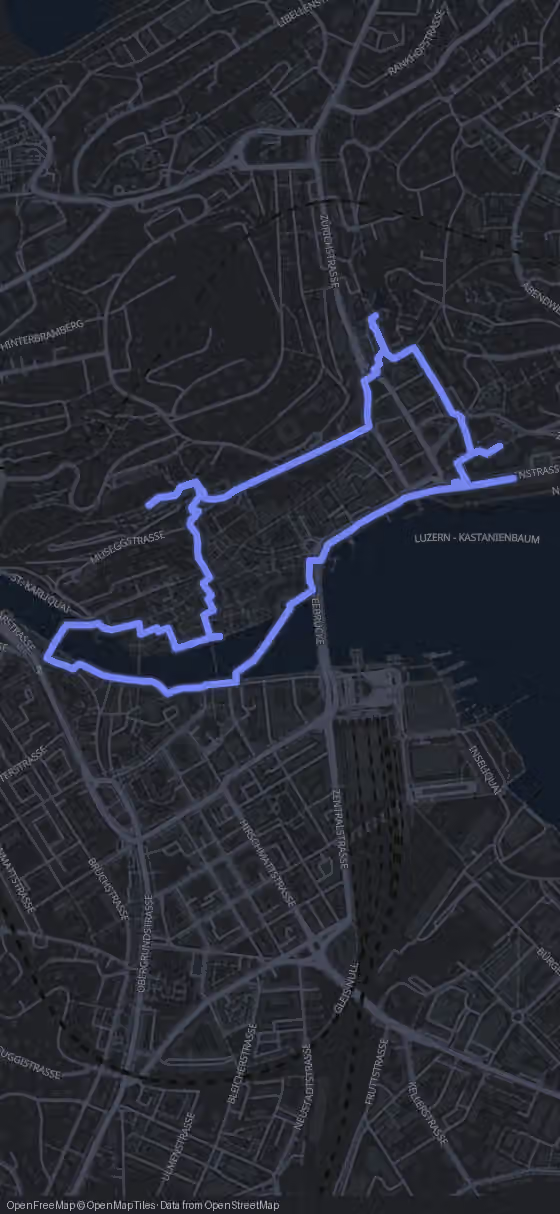
Route map for the Lucerne walking tour
Stop 1 of 13
240 m·3 min
Chapel Bridge
Head south-west across the Reuss toward the Jesuit Church
Welcome to Lucerne. I'm Alex, and our first story begins with a medieval bridge that gives every life the same ending.
Try this tour with Alex

This Lucerne Walk at a Glance

13 stops on a loop that starts and ends at the Chapel Bridge: 4.0 km and 58 minutes of pure walking. With time to look around, plan on about two and a half hours; with two museums, closer to four.

The bridges, churches, the Musegg Wall and the Lion Monument are free. The Historical Museum, the Alpineum and the Bourbaki Panorama charge admission. The GPS route runs free in your browser; the AI Tour Guide is optional.

Open free GPS & optional AI Tour Guide
View of Lucerne

The Route

Walking Map of Lucerne's Old Town Loop

13 stops 4.0 km 58 min walking
Tap to load interactive map

The 13 stops along this route

  1. Chapel Bridge in Lucerne, stop 1 on the self-guided walking tour
    1Chapel Bridge
  2. Jesuit Church in Lucerne, stop 2 on the self-guided walking tour
    2Jesuit Church
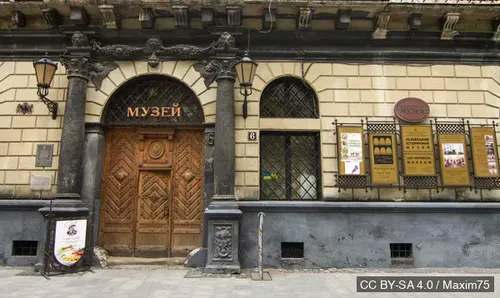
  3. Historical Museum in Lucerne, stop 3 on the self-guided walking tour
    3Historical Museum
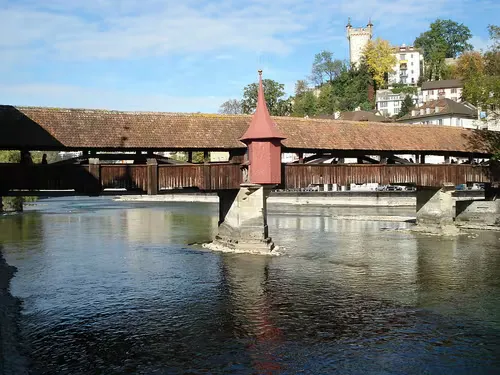
  4. Spreuer Bridge in Lucerne, stop 4 on the self-guided walking tour
    4Spreuer Bridge
  5. Neptune Fountain in Lucerne, stop 5 on the self-guided walking tour
    5Neptune Fountain
  6. Weinmarkt in Lucerne, stop 6 on the self-guided walking tour
    6Weinmarkt
  7. Town Hall in Lucerne, stop 7 on the self-guided walking tour
    7Town Hall
  8. Musegg Wall in Lucerne, stop 8 on the self-guided walking tour
    8Musegg Wall
  9. Alpineum in Lucerne, stop 9 on the self-guided walking tour
    9Alpineum
  10. Lion Monument in Lucerne, stop 10 on the self-guided walking tour
    10Lion Monument
  11. Bourbaki Panorama in Lucerne, stop 11 on the self-guided walking tour
    11Bourbaki Panorama
  12. Church of St. Leodegar in Lucerne, stop 12 on the self-guided walking tour
    12Church of St. Leodegar
  13. Grand Hotel National in Lucerne, stop 13 on the self-guided walking tour
    13Grand Hotel National
  14. That's the full loop.

    Walk it with an AI Tour Guide talking you through every one of these streets.

    Start free in your browser
    You made it

Your Lucerne Walking Tour, from the River to the Lakefront

  1. 1

    Chapel Bridge

    Chapel Bridge in Lucerne, stop 1 on the self-guided walking tour

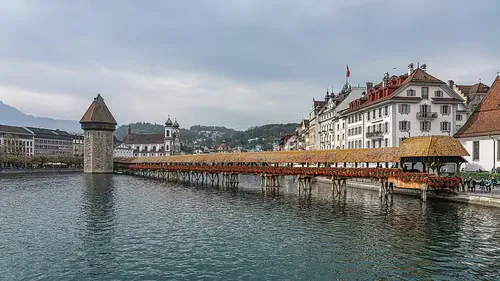
    Begin with Lucerne's emblem. The Chapel Bridge is a covered wooden footbridge that crosses the Reuss on a diagonal, and beside it stands the octagonal Water Tower, 34.5 metres tall from the ground. Walk the bridge slowly and look up into the triangular frames under the roof: they hold painted panels from the 17th century. Some look fresh and some look old, and that contrast tells the bridge's recent story.

    It was built around 1365 as part of the town's fortifications, linking the old town on the right bank with the new town on the left and closing off the town against attack from the lake. It is named after the nearby St. Peter's Chapel. Originally it ran over 270 metres; shortenings and river bank fills over the centuries have cut it to 204.7 metres. It is the oldest covered wooden bridge in Europe and the oldest surviving truss bridge in the world.

    On 18 August 1993 a fire nearly destroyed it and took two thirds of its interior paintings with it. The rebuilt bridge reopened on 14 April 1994, at a cost of CHF 3.4 million. Lucerne once had three wooden pedestrian bridges with painted frames: the Hofbrücke, long gone, this one, and the Spreuer Bridge you will cross shortly.

    The Water Tower is about 30 years older than the bridge. Over the centuries it served as a prison, a torture chamber, a municipal archive and a treasury. Today it is closed to visitors.

    Cross to the left bank and walk 230 metres, about 3 minutes, to the Jesuit Church.
    Local name
    Kappelbrücke
    Hours
    Open 24/7
    Price
    Free
  2. 2

    Jesuit Church

    Jesuit Church in Lucerne, stop 2 on the self-guided walking tour

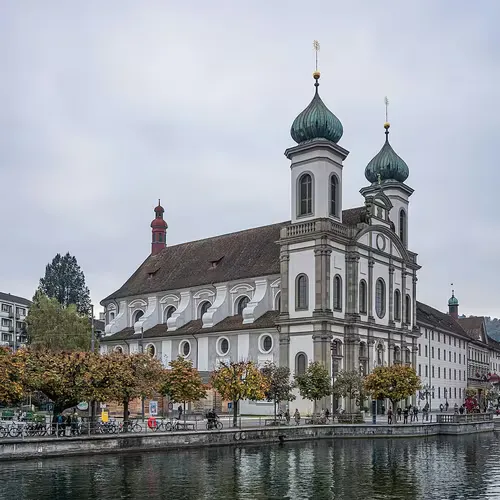
    The Jesuit Church of St. Francis Xavier stands on the left bank of the Reuss, with the Lucerne Theatre opposite and the cantonal government building next door. Read the facade: five bays, two main storeys, Ionic pilasters for the verticals, cornices for the horizontals, and a large segmental gable pulling the middle together. The two towers look as if they belong to the original design, but they were added only in 1893 by Heinrich Viktor von Segesser.

    Built between 1666 and 1677, it was the first large Baroque church in Switzerland. Tobias Lohner, then rector of the Jesuit college, pushed the project. Nobody knows for sure who drew the plans: perhaps a master from Vorarlberg such as Michael Beer or Michael Thumb, perhaps the Jesuit fathers Heinrich Mayer and Christoph Vogler. The shell stood by 1669.

    Go in; it is free and ten minutes are enough. The richness of the interior is the reason the church is listed as a cultural property of national importance. The stucco in the side chapels, designed by Mayer and executed in 1672 and 1673, is the oldest example of the Wessobrunn school in Switzerland. The high altar painting is by Domenico Torriani from Mendrisio, the wall paintings by the brothers Giovanni Antonio and Giuseppe Antonio Torricelli. The latest renovation was finished in January 2017, so everything looks bright.

    From here it is 280 metres, about 4 minutes, to the old arsenal on Pfistergasse, now the Historical Museum.

    Local name
    Jesuitenkirche Luzern
    Hours
    06:30–18:30 (Opens 09:30 Mon & Thu)
    Price
    FREE
  3. 3

    Historical Museum

    Historical Museum in Lucerne, stop 3 on the self-guided walking tour

    The plain, solid building directly on the Reuss was Lucerne's arsenal for the town and canton from 1567 and 1568 until 1983. After three years of conversion it opened as the Historical Museum on 23 May 1986. Next door are the bridgehead of the Spreuer Bridge and the Natural History Museum.

    Its predecessor tells a cautionary tale. Between 1546 and 1549 Italian stonemasons built a stone house here, with weapons on the ground floor and grain on the upper floor. On 16 July 1566, after a heavy flood, it collapsed, and the weight of the grain was blamed. So the rebuild separated arsenal and granary. A great fire in Pfistergasse on 7 April 1691 forced another round of repairs. An arsenal in Lucerne is on record as early as 1430.

    Inside are around 3,000 objects from the history of the town and canton. The star piece is war booty: the mail shirt of Duke Leopold of Habsburg, who fell at the Battle of Sempach. Alongside are everyday objects and traditional costumes from the collection of Angélique Sophie Panchaud de Bottens. If you want one museum about Lucerne itself, this is it, and it is well worth the admission.

    The Spreuer Bridge starts right beside the museum: 120 metres, 2 minutes.

    Local name
    Historisches Museum
    Hours
    Mon: Closed | Tue–Sun: 10:00–17:00
    Price
    CHF 12 adults, CHF 4 children 6-16 years, under 6 free
  4. 4

    Spreuer Bridge

    Spreuer Bridge in Lucerne, stop 4 on the self-guided walking tour

    The Spreuer Bridge is Lucerne's other covered wooden bridge, the third after the Chapel Bridge and the Hofbrücke, which was torn down in the 19th century. It links the Mühlenplatz in the old town with the Kasernenplatz in the new town. Halfway across sits a tiny bridge chapel, Maria auf der Reuss, dedicated to the Mother of God.

    Its name comes from chaff, Spreu in German. In the Middle Ages this was the lowest bridge in town, and only from here were people allowed to throw chaff and leaves into the river. A first bridge from the Mühlenplatz to the mills in the middle of the river stood from the 13th century; the link to the left bank, the bakers' quarter on Pfistergasse, was finished in 1408. The same flood of 1566 that brought down the arsenal destroyed most of the bridge. The southern part was rebuilt with a granary as its bridgehead, the Herrenkeller; the northern part followed in 1591, and in 1803 the carpenter Joseph Ritter gave it a new section with wooden arches. The Mühlenplatz power station stands there today.

    Now look up. In the gables hang 45 of the original 67 painted panels of a Dance of Death, made between 1626 and 1632 under the painter Kaspar Meglinger. It is the most extensive and the most public of all known Dances of Death. Death comes for everyone, from the powerful to the poor. Bottom left you usually see the donor's coat of arms, bottom right his wife's; verses and donors' names run along the black frames, and many faces are portraits of Lucerne citizens. The painters knew Hans Holbein the Younger's images of Death, but their style is already more modern.

    Cross to the Mühlenplatz; the Neptune Fountain is only 100 metres away, a one-minute walk.

    Hours
    Open 24/7
    Price
    Free
  5. 5

    Neptune Fountain

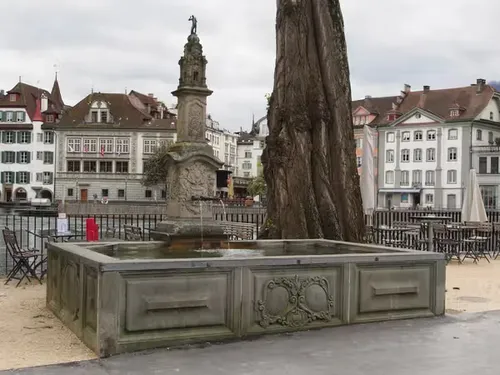
    Neptune Fountain in Lucerne, stop 5 on the self-guided walking tour

    Neptune, god of the sea, honoured with a fountain in a town about as far from any sea as Switzerland gets. That is the joke of the Neptunbrunnen, and it is a good one.

    It is also the smallest stop on the route: a breather between the bridges behind you and the Weinmarkt, 170 metres and 2 minutes ahead.

    Local name
    Neptunbrunnen
    Hours
    24/7
    Price
    FREE
  6. 6

    Weinmarkt

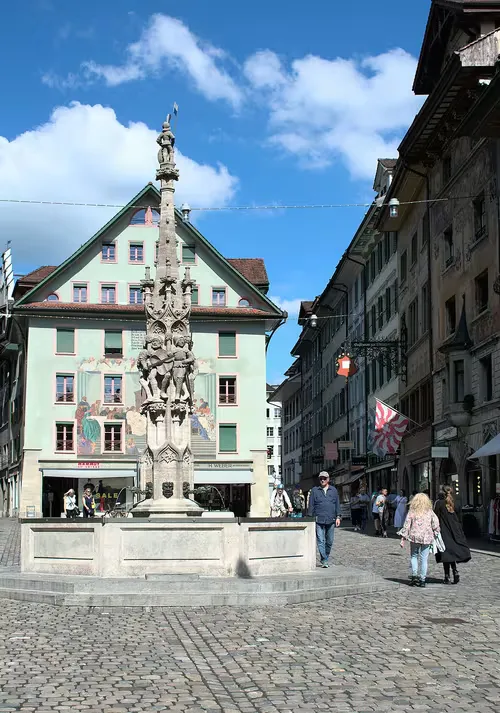
    Weinmarkt in Lucerne, stop 6 on the self-guided walking tour

    The Weinmarkt, the wine market, is an old square in the heart of the old town and a good place to stand still for a moment. In terms of stops, you are roughly halfway round the loop here.

    Take your bearings: after the Town Hall, only 140 metres and 2 minutes on, the route leaves the river for the longer walk up to the Musegg Wall. If you want a break, take it around here before heading on.

    Hours
    Open 24/7
    Price
    Free
  7. 7

    Town Hall

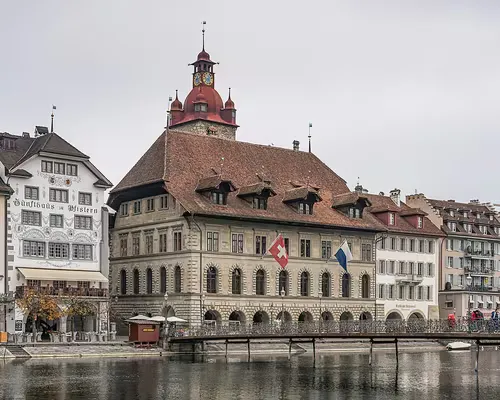
    Town Hall in Lucerne, stop 7 on the self-guided walking tour

    The Town Hall stands on the Kornmarkt and backs onto the Rathausquai along the Reuss. Look at it twice. The front recalls a Milanese palazzo, while the roof is shaped like a Lucerne farmhouse. The architect Anton Isenmann built it between 1602 and 1606 in the Italian Renaissance style, helped by craftsmen from northern Italy, which may explain the mix.

    Find the tower with its red lantern and clock: it served as a watch and lookout tower. Walk through the arcades and the cobbled passages. The Kornschütte exhibition space is inside the building, and the Am Rhyn-Haus right next door is partly connected to it by doors. The Rathaussteg footbridge, named after the Town Hall, crosses the river to the Lucerne Theatre.

    The first council meeting took place here on 24 June 1606. Until 1798 the Great and Small Councils of Lucerne met here, and the city parliament still does today. Weddings are held in the portrait hall. You can see the outside at any time; the interior is only open on guided tours.

    Now comes the longer stretch: 550 metres, about 10 minutes, away from the river to the Musegg Wall.

    Hours
    Exterior accessible 24/7, interior by guided tour only
    Price
    FREE (exterior viewing)
  8. 8

    Musegg Wall

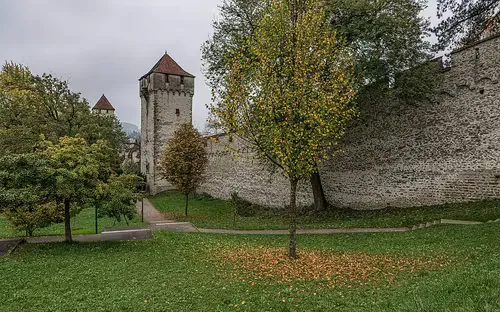
    Musegg Wall in Lucerne, stop 8 on the self-guided walking tour

    The Musegg Wall with its towers runs across the Musegg hill from the Reuss near the Geissmattbrücke to the Kantonsschule Musegg. Together with the Water Tower and the Chapel Bridge it shapes the historic skyline of Lucerne. Walk a section of it, open in season, and the old town lies spread out at your feet.

    Tree-ring dating has shown that construction began by 1370 at the latest, with the Luegisland tower. Work went on, with breaks, deep into the 15th century: the Schirmer tower around 1420, the Zyt tower around 1442. A building account from 1408 was long read as the final bill, but it was only an interim one. And the popular idea that the wall was built because of the Battle of Sempach in 1386 has no basis.

    The best story is why so much else is gone. Between 1833 and 1856 Lucerne tore down most of its fortifications, partly because they blocked the growing traffic, partly because the town assembly of the day thought a town without medieval walls was prettier. The Musegg Wall is what survived that taste.

    From the wall, the route heads back into town: 840 metres, about 12 minutes, to the Alpineum, the longest leg of the loop.

    Local name
    Museggmauer
    Hours
    Daily 08:00–19:00, continuously from 1 April to 1 November
    Price
    Free
  9. 9

    Alpineum

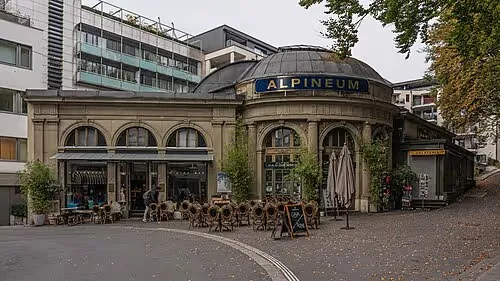
    Alpineum in Lucerne, stop 9 on the self-guided walking tour

    The Alpineum faces the Lion Monument and is a museum and Alpine diorama: five large panoramic paintings of the Swiss Alps, several hundred square metres of canvas in total, painted by Ernst Hodel Senior and his son Ernst Hodel Junior.

    The neoclassical building went up in 1885 and 1886 to designs by the Lucerne architect Othmar Schnyder, originally as a Lion Monument museum telling the story of the storming of the Tuileries on 10 August 1792. Too few visitors came, and that show lasted less than ten years. In 1895 Ernst Hodel Senior bought the building; he had already painted big panoramas of the Rigi and Pilatus. With his son he built up the diorama, which opened as the Alpineum in May 1901.

    Until about 1975 a multilingual porter guided visitors round; since around 1990 you walk through on your own. Reliefs of the mountain regions, model houses, ship and mountain railway models have been added, plus an exhibition on stereoscopic 3D photography from around 1900. The museum stayed in the Hodel family: Daniel E. Hodel ran it until his death in 2026, and it is to pass to a foundation.

    Go in if you are heading into the mountains and want the big picture first. Admission is charged, with reduced tickets for students, seniors, children and pupils. The Lion Monument is just 10 metres away.

    Hours
    09:00–18:00 (Tue–Sun), Closed Mondays
    Price
    CHF 10 (adults), CHF 7 (students/seniors), CHF 5 (children), CHF 3 (pupils)
  10. 10

    Lion Monument

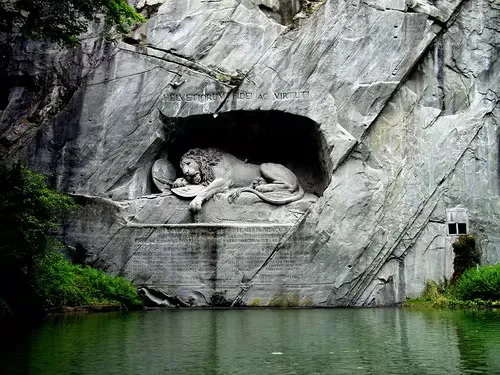
    Lion Monument in Lucerne, stop 10 on the self-guided walking tour

    A mortally wounded lion lies carved into the rock face, a broken spear in its side. Mark Twain called it “the most mournful and moving piece of stone in the world.” Bertel Thorvaldsen designed it, and Lukas Ahorn carved it in 1820 and 1821. About 1.4 million visitors come every year, and since 2006 it has been under federal monument protection.

    The lion stands for the Swiss Guards. From the early 17th century a regiment of Swiss soldiers served in the royal household of France. In 1789 King Louis XVI was forced to move from Versailles to the Tuileries Palace in Paris. On 10 August 1792 revolutionaries stormed the palace. The royal family had already been escorted to the Legislative Assembly, but the guards fought on until their ammunition ran low.

    Half an hour into the fighting, the king wrote a note ordering the Swiss to withdraw to their barracks. It reached them in the middle of the battle and was only obeyed once their position was lost. Around 760 guards died in the fighting or were massacred after surrendering, though later research suggests the number may be too high. About two hundred more died of their wounds in prison or in the September Massacres.

    About a hundred escaped from the Tuileries. The other survivors were a detachment of 300 the king had sent to Normandy a few days earlier to escort grain convoys. Stay a few minutes; the monument is free and open at any hour.

    The Bourbaki Panorama is 120 metres away, a one-minute walk.

    Local name
    Löwendenkmal
    Hours
    Open 24/7
    Price
    Free
  11. 11

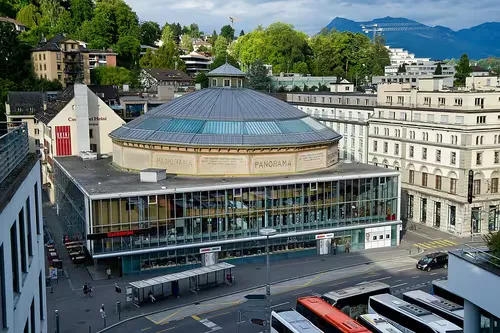
    Bourbaki Panorama

    Bourbaki Panorama in Lucerne, stop 11 on the self-guided walking tour

    Step into the middle of a circular painting 115 metres long and you stand in the snow of February 1871. The Bourbaki Panorama shows the French Armée de l'Est, defeated in the Franco-Prussian War, crossing into neutral Switzerland to be interned. Three-dimensional figures and objects in front of the canvas blur the line between painting and room.

    The army under General Charles-Denis Bourbaki had been beaten at the Battle of the Lisaine in January while trying to relieve the Siege of Belfort. Some 88,000 men marched into Switzerland via Les Verrières, leaving behind 11,000 horses, 1,150 wagons, 285 guns, 7,200 rifles and 64,000 bayonets. Villagers and the Swiss Red Cross cared for the wounded, and after six weeks the men were sent home to France.

    The painter Édouard Castres had been there himself, as a volunteer medic with the army. In 1876 the Belgian Panorama Society commissioned him, hoping the subject would draw visitors from Switzerland and France. Castres and ten other artists painted it; it was shown in Geneva from 1881 and moved to Lucerne in 1889. It has been cut down twice and is now 9.8 metres high, about a third less than originally.

    Worth it if you like history you can stand inside. Admission is charged, with reduced tickets for students, AHV/IV holders and children.

    From here it is 390 metres, about 6 minutes, to the Church of St. Leodegar.

    Hours
    April–October daily 10:00–18:00, November–March daily 10:00–17:00
    Price
    CHF 15, students/AHV/IV 12, children 6–15 7
  12. 12

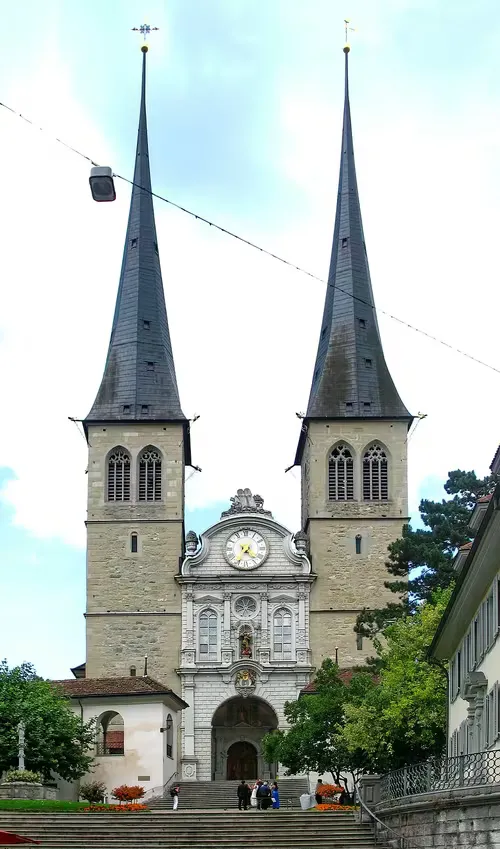
    Church of St. Leodegar

    Church of St. Leodegar in Lucerne, stop 12 on the self-guided walking tour

    The Hofkirche St. Leodegar, as locals call it, is one of Lucerne's landmarks: the main church of the parish of St. Leodegar im Hof and the collegiate church of the canons' chapter. Its twin towers are what you see first.

    It was built between 1633 and 1639, partly on the foundations of a Romanesque basilica that burned down in 1633. That makes it one of the few large churches north of the Alps built during the Thirty Years' War, and one of the largest and artistically most valuable churches of the German late Renaissance.

    The site is far older. In 735 or 736 Alemannic nobles founded a small monastery here dedicated to St. Maurice; around 760 the Monasterium Luciaria is first mentioned in writing. From about 1135 it depended on the abbey of Murbach, which made St. Leodegar its patron. Murbach sold it to the Habsburgs in 1291; by 1433 Lucerne, now part of the Confederation, had won back all rights, and in 1455 the monastery became a chapter of secular canons. Its heyday came in the Counter-Reformation, when the papal nuncio lived in Lucerne and used the Hofkirche as his cathedral.

    Go in: admission is free. Then walk 320 metres, about 4 minutes, down to the lakefront and the Grand Hotel National.

    Local name
    St. Leodegar im Hof
    Hours
    Daily: 07:00–19:00
    Price
    Free
  13. 13

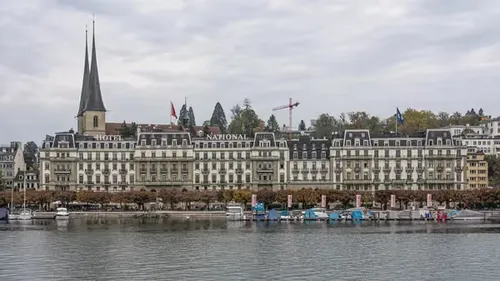
    Grand Hotel National

    Grand Hotel National in Lucerne, stop 13 on the self-guided walking tour

    The Grand Hotel National opened in 1870 on the shore of Lake Lucerne, looking out over the bay and the Alps of Central Switzerland. It is a five-star hotel with 41 rooms and suites, 22 residence suites, four restaurants, a café and a bar, and the building is a listed cultural monument of national importance. Treat it as a stop to look at from the promenade.

    The ground you are standing on was marshland. Until well into the 19th century Lucerne had little to offer overnight guests. Work on reclaiming the land between the town and the Hofkirche began in 1836, followed by the Schweizerhofquai promenade. That made the old Hofbrücke, needed to cross the marsh, unnecessary, which is why Lucerne's third painted bridge disappeared.

    The von Segesser von Brunegg family read the signs early. In 1845 the brothers Eduard, Placidus and Xaver opened the town's first hotel, the Schweizerhof, by the lake for the views. When the railway reached Lucerne in 1859, wealthy foreign visitors began to arrive in numbers. The Segessers sold their hotels, founded a building company with Max Alphons Pfyffer and bought land further along the shore, where the National rose.

    From here it is 710 metres, about 10 minutes, back to the Chapel Bridge, where the loop closes.

    Hours
    24/7 (hotel with reception)
    Price
    Hotel accommodation (room rates vary)
Walking tour route map of Lucerne Route loaded
Chapel BridgeJesuit ChurchHistorical MuseumSpreuer Bridge+9
All 13 stops are already on the map.
You just press start.
AI Tour Guide

You've read the loop. Now walk it with a guide in your ear.

Press start wherever you are, even hundreds of kilometres from Lucerne, and the guide begins telling its stories right away. In the city, pick any of the 13 stops to start from: it leads you there, then talks with you the whole route, asking, listening, remembering, and shaping the tour around your answers.

13stops 4.0km 58 minwalking 13languages
▶Start the tour free

Free to start · Runs in your browser · No app, no download

Shorter Ways to Walk Lucerne

The full loop is the recommended order, but it splits cleanly into a river half and a hill half, and you can walk the whole thing without paying a franc.

Bridges and Old Town in an hour

Stops: 1, 2, 3, 4, 5, 6, 7

For a first evening or a tight schedule: both painted bridges, the Jesuit Church, the Weinmarkt and the Town Hall. Only 14 minutes of walking between the stops, about an hour outdoors. The Historical Museum is the one paid stop on this stretch; going in adds about an hour.

Wall, lion and lakefront

Stops: 8, 9, 10, 11, 12, 13

For a second half day: the Musegg Wall, the Alpineum, the Lion Monument and the Bourbaki Panorama, then the Hofkirche and the lake. 24 minutes of walking between the stops, plus 10 minutes from the Grand Hotel National back to the Chapel Bridge. Admission at the Alpineum and the Bourbaki Panorama.

The full loop without admission

Stops: 1, 2, 4, 5, 6, 7, 8, 10, 12, 13

For a free day: the whole route with every outdoor sight and both churches, skipping the three museums. Same 58 minutes of walking, about two and a half hours in total, and nothing to pay.

How Long This Lucerne Tour Takes, with and without Museums

The first six legs stay tight around the Reuss: from the Chapel Bridge to the Town Hall you cover just 1,040 metres in 14 minutes, crossing the river on both covered bridges. Then the route climbs away from the water: 550 metres to the Musegg Wall and 840 metres on to the Alpineum, the longest leg of the loop at 12 minutes.

After that the Alpineum, the Lion Monument and the Bourbaki Panorama sit within 130 metres of each other, so this cluster is where museum time adds up. The Hofkirche and the lakefront bring you back to the Chapel Bridge in 20 minutes of walking.

Without museums, two and a half hours is comfortable. Allow about an hour for the Historical Museum and roughly 45 minutes each for the Bourbaki Panorama and the Alpineum: with two of them the day runs to about four hours, with all three closer to four and a half.

Before You Start Walking in Lucerne

  • Start and finish: The recommended start is the Chapel Bridge, and the loop brings you back there. You can join at any stop, for example at the Lion Monument if your hotel is up on that side of town, and follow the order from there.
  • Best day and time: If you want the museums, pick a day when the Historical Museum and the Alpineum are both open. Start at the Chapel Bridge around 09:30, take ten minutes on the bridge and a quarter of an hour in the Jesuit Church, and you reach the Historical Museum mid-morning.
  • Musegg Wall season: The Musegg Wall is only open in season. Outside that period, plan to see it from the outside.
  • Costs: The walk itself is free, and so are both bridges, both churches, the squares, the Musegg Wall and the Lion Monument. Only the three museums charge admission. The GPS route costs nothing; the AI Tour Guide starts with 100 free credits, then either €19.99 for this tour all-inclusive with no time limit, or €5 per hour.
Walking tour route map of Lucerne
AI Tour Guide

Your guide is ready at the Chapel Bridge.

Press start and a voice AI Tour Guide takes it from here: leading the route through Lucerne, telling the stories, and turning your walk into a real back-and-forth conversation. No app or download is needed; it runs in your browser.

13stops 4.0km 58 minwalking 13languages
▶Start the tour free

Free to start · Runs in your browser · No app, no download

What the AI Tour Guide Adds on This Loop

Lucerne's stories run into each other: the Swiss Guards of the Lion Monument, the arsenal's war booty from Sempach, the town that tore down its own walls. The AI Tour Guide walks this loop with you as a conversation, notices whether you lean toward the paintings, the fortifications or the battles, and goes deeper there. Ask it how Swiss soldiers came to guard the French king in the first place, or what the Battle of Sempach was actually about, and interrupt whenever something catches your eye.

A Real Conversation A voice AI Tour Guide greets you, leads the whole route, and tells the stories and facts as you walk, asking what you want to see and keeping a real conversation going. Not a recording you press play on.
Map Navigation Follow the route on the map and walk at your own pace. You choose where to start and when to move to the next stop.
Ask Anything Curious about a building you pass? Ask your AI Tour Guide on the spot and the conversation carries on.
13 Languages Switch language anytime. No separate tour needed.
Start free in your browser

Common Questions about Walking Lucerne

Which museum on the loop should I choose if I only have time for one?

For Lucerne itself, the Historical Museum in the old arsenal. For sheer scale, the Bourbaki Panorama, where a 115-metre painting surrounds you. The Alpineum suits anyone curious about the Alps before heading into them.

Can I walk the route in the evening?

Yes, much of it: both bridges, the Neptune Fountain, the Weinmarkt, the outside of the Town Hall and the Lion Monument are open around the clock. The museums, the churches and the Musegg Wall keep daytime hours, so do those parts earlier.

Can I go inside the Water Tower next to the Chapel Bridge?

No. The tower is closed to the public; today it houses a local artillery association and a gift shop.

What makes a good day trip from Lucerne?

Close by, Zug is about 20 km away, and Engelberg takes you into the mountains. For a monastery town, try Einsiedeln; for a bigger city, Zurich.

Is the tour really free?

Yes. The whole tour is free: the route, the interactive map and the navigation cost you nothing. Only the voice AI Tour Guide is optional and paid: you test it with 100 free credits, then you pay either €5 per hour or €19.99 for this whole tour, with no time limit. Admission to 3 of the 13 stops is not included: Historical Museum, Alpineum and Bourbaki Panorama charge their own entry fees.

Do I need to download an app?

No. Everything runs in your phone browser. Open the route and start walking, no download and no sign-up required.

Do I need to book the walking tour in advance?

No booking needed. This self-guided tour is available anytime. Open the route in your browser and start walking. The AI Tour Guide works instantly, no app, no reservation required.

What languages is the AI Tour Guide available in?

The AI Tour Guide speaks 13 languages, so you take the tour in your own language and can switch at any time.

Can I skip stops or change the route?

Yes. Skip any stop, spend extra time at places you like, or start the route from any point. It is your walk, you set the pace.
Image credits
▶ Start free in your browser Runs in your browser, no app, no download