Free Walking Tour Zurich: Old Town, Lake and ETH

From the Landesmuseum over the Roman hill of the Lindenhof to Zwingli's Grossmünster, Chagall's windows and the lakeshore, then on to art, opera and Einstein's university.

14 Stops 5.9 km ~1 h 26 min walking
Route map for the Zurich walking tour
Stop 1 of 14
920 m·12 min
Swiss National Museum
Head south toward Lindenhof
Grüezi, welcome to Zurich. I'm Alex, and its polished surfaces rest on some surprisingly ingenious engineering.
Try this tour with Alex

At a Glance: 14 Stops on 5.9 km

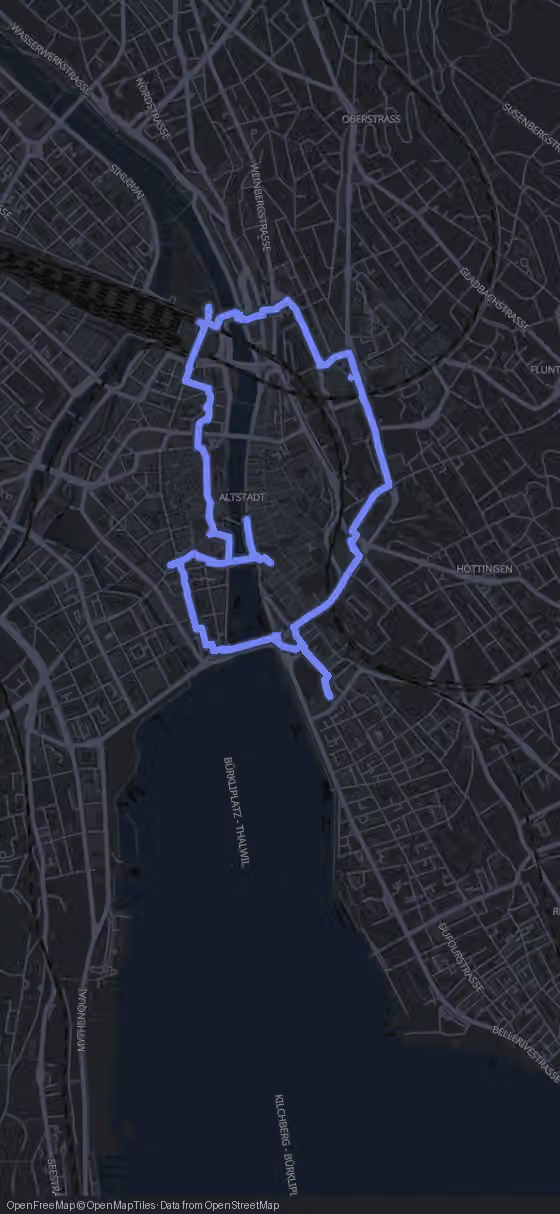
This route links 14 stops, from the Swiss National Museum through the Old Town on both banks of the Limmat to the lake and out to ETH Zurich, ending at Zurich Hauptbahnhof. It covers 5.9 km with 1 h 26 min of pure walking; plan about three hours, a full day with the big museums.

The squares and most churches are free; the large museums charge admission. The route, map and GPS navigation run free in your browser, and the AI Tour Guide is optional.

Open free GPS & optional AI Tour Guide
View of Zurich

The Route

Walking Map of Zurich from the Landesmuseum to the Main Station

14 stops 5.9 km 1 h 26 min walking
Tap to load interactive map

The 14 stops along this route

  1. Swiss National Museum in Zurich, stop 1 on the self-guided walking tour
    1Swiss National Museum
  2. Lindenhof in Zurich, stop 2 on the self-guided walking tour
    2Lindenhof
  3. St. Peter's Church in Zurich, stop 3 on the self-guided walking tour
    3St. Peter's Church
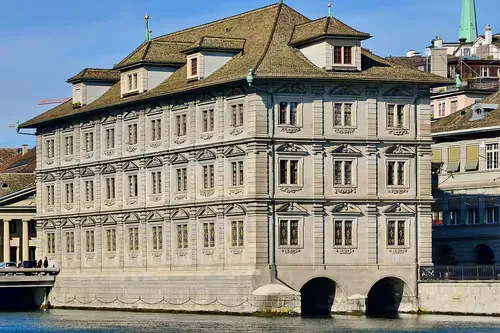
  4. Zurich Town Hall, stop 4 on the self-guided walking tour
    4Zurich Town Hall
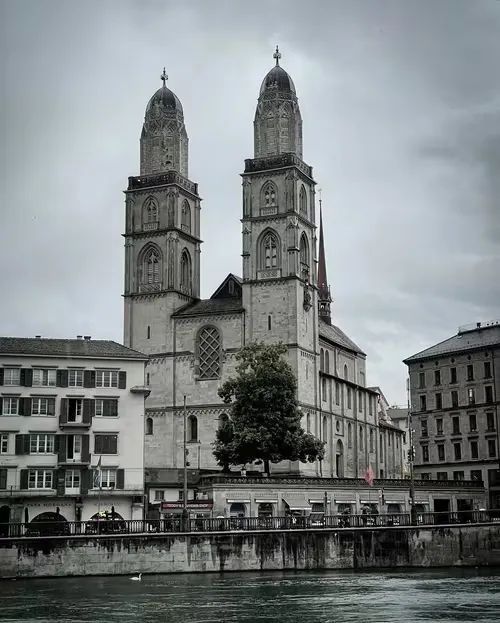
  5. Grossmünster in Zurich, stop 5 on the self-guided walking tour
    5Grossmünster
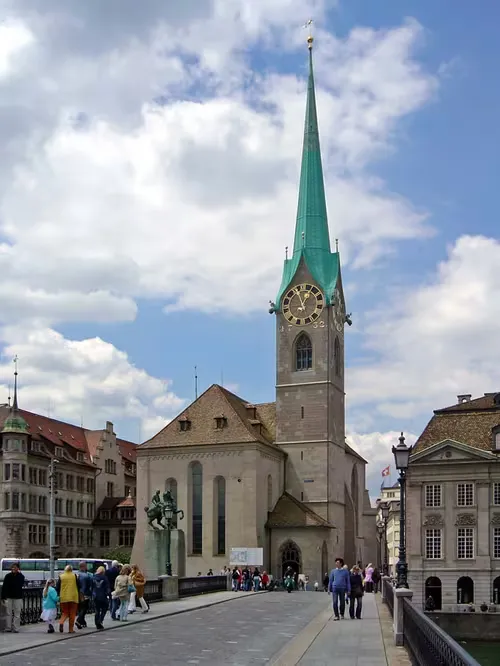
  6. Fraumünster in Zurich, stop 6 on the self-guided walking tour
    6Fraumünster
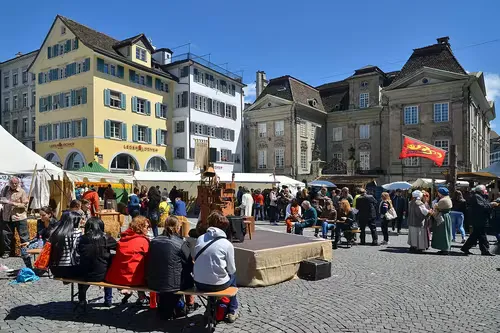
  7. Münsterhof in Zurich, stop 7 on the self-guided walking tour
    7Münsterhof
  8. Paradeplatz in Zurich, stop 8 on the self-guided walking tour
    8Paradeplatz
  9. Bürkliplatz in Zurich, stop 9 on the self-guided walking tour
    9Bürkliplatz
  10. Bellevue in Zurich, stop 10 on the self-guided walking tour
    10Bellevue
  11. Zurich Opera House, stop 11 on the self-guided walking tour
    11Zurich Opera House
  12. Kunsthaus Zürich in Zurich, stop 12 on the self-guided walking tour
    12Kunsthaus Zürich
  13. ETH Zurich, stop 13 on the self-guided walking tour
    13ETH Zurich
  14. Zurich Hauptbahnhof, stop 14 on the self-guided walking tour
    14Zurich Hauptbahnhof
  15. That's the full route.

    Walk it with an AI Tour Guide talking you through every one of these streets.

    Start free in your browser
    You made it

Your Zurich Walking Tour Through Old Town, Lakeshore and University Quarter

  1. 1

    Swiss National Museum

    Swiss National Museum in Zurich, stop 1 on the self-guided walking tour

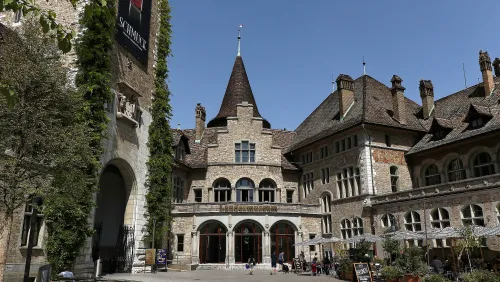
    Your walk begins at the Landesmuseum Zürich, as locals call the Swiss National Museum. It opened in 1898 and is the most visited history museum in Switzerland, which makes it a fitting first stop: before you walk through Zurich's past, you can take in the whole country's in one place.

    The museum almost never happened. After the federal state was founded in 1848, nobody was in a hurry: there was no collection about the young country and no great patriotic movement. In 1880 parliament turned down a first motion by Friedrich Salomon Vögelin, a professor of art history at the federal Polytechnikum, arguing that the cantons already had plenty of collections. Some even claimed that before 1798 there was no Swiss history at all, only the histories of the cantons.

    The mood changed after the national exhibition of 1883, where Vögelin's circle set up a small national museum in a pavilion of old art to show citizens what treasures the country owned, at a time when its heritage was being sold off. In 1884 the federal government bought the finds from the pile dwelling settlement of Auvernier and acquired whole interiors, among them a room from the Rosenburg in Stans, a late Gothic council chamber from the town hall of Mellingen and a ceiling from Arbon. Basel, Bern, Zurich and Lucerne then fought hard over who would host the prestigious new museum.

    Going inside costs admission and pays off if Swiss history interests you and you can spare an hour or two; if you came mainly for streets and churches, keep your time for the Old Town. From here it is 800 m, about 12 minutes on foot, to the Lindenhof, where the story of Zurich itself begins.
    Local name
    Landesmuseum Zürich
    Hours
    Mon: Closed | Tue–Wed: 10:00–17:00 | Thu: 10:00–19:00 | Fri–Sun: 10:00–17:00
    Price
    CHF 13 adults, CHF 10 reduced (AHV/IV/RAV, pupils, students)
  2. 2

    Lindenhof

    Lindenhof in Zurich, stop 2 on the self-guided walking tour

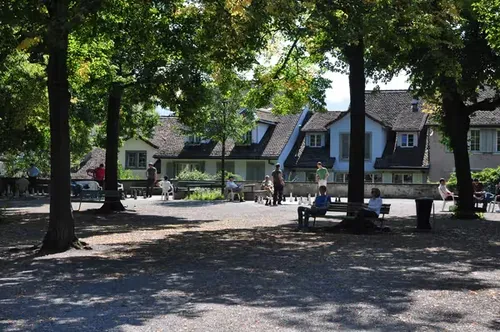
    The Lindenhof, the "linden yard", is a public square on a hilltop in the heart of the Old Town, and the city grew up around this very spot. The hilltop with its prehistoric, Roman and medieval remains is listed as a Swiss heritage site of national significance.

    The hill itself is a gift of the Ice Age: a moraine left behind by the Linth Glacier, rising about 25 metres above the Limmat. Today it is largely flattened, but in early times it was almost surrounded by water. Until the early Middle Ages, the area of today's Münsterhof was a swampy hollow flooded by the Sihl, which made this hill an ideal place for a fortified settlement.

    People used it for a very long time. Bronze Age objects have turned up near the Limmat at the Schipfe, and archaeologists found traces of a Celtic oppidum from the 1st century BC in digs on the Lindenhof and the Rennweg in 1989, 1997, 2004 and 2007. In 15 BC the Roman commanders Drusus and Tiberius brought the land into the empire. Stone buildings stood on and around the hill, part of the small settlement of Turicum on both banks of the Limmat, joined by a Roman bridge near today's Rathausbrücke. Later a Roman and Carolingian imperial palace, the Kaiserpfalz, stood up here.

    So what looks like a simple square is really two thousand years of Zurich layered under your feet. Entry is free, and it is a good place to pause before the churches. The Lindenhof ends to the south near St. Peter's Church, just 260 m and about 4 minutes away.

    Price
    Free
  3. 3

    St. Peter's Church

    St. Peter's Church in Zurich, stop 3 on the self-guided walking tour

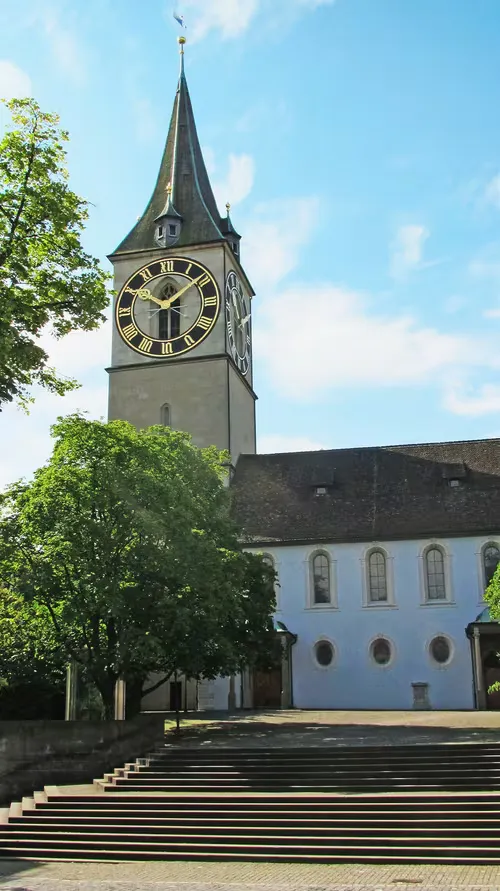
    Look up first: the clock face on the steeple of St. Peter's Church measures 8.7 metres across, the largest church clock face in Europe. Strangely, tower and church do not share an owner. The steeple belonged to the old city republic until the French Revolution and to the city of Zurich since 1803, while the nave belongs to the Reformed parish. The tower had a practical job: from 1340 a fire guard kept watch up there, and the fire watch only ended in 1911.

    This is old ground. The church was built on the site of a temple to Jupiter, and a small church of just 10 by 7 metres stood here as early as the 8th or 9th century. An early Romanesque church followed around 1000, then a late Romanesque one in 1230, parts of which survive. Rudolf Brun, Zurich's first independent mayor, was buried here in 1360. Before the Reformation, St. Peter was the town's only parish church; all the others belonged to monasteries.

    The church you enter today was consecrated in 1706, the first built under Protestant rule. Its first Reformed pastor, Leo Jud, was a friend of Zwingli and helped with the first Zurich translation of the Bible. Later the writer and pastor Johann Kaspar Lavater served here from 1778 to 1801; look for his gravestone set into the church wall.

    Entry is free, so a short look inside fits any schedule. From here it is 450 m, about 6 minutes, down to the river and Zurich Town Hall.

    Hours
    Mon–Fri: 09:00–18:00 | Sat: 09:00–15:00 | Sun: 09:00–16:00
    Price
    Free
  4. 4

    Zurich Town Hall

    Zurich Town Hall, stop 4 on the self-guided walking tour

    Zurich Town Hall stands right in the Limmat, free of any neighbours, and that position was the point. It was built between 1694 and 1698 in the middle of the Old Town as the seat of government of the city republic of Zurich, a role it kept until 1798. The classical forms of the exterior were taken from a pattern book by Joseph Furttenbach, a builder who knew Italy well; inside, the rooms were fitted out in High Baroque.

    The site is much older. A first courthouse, the Richthus, stood here around 1252. In 1397 it gave way to a larger town hall built on an existing vault over the river. Much of the work was done as forced labour, and anyone fined by the city had to work off the fine on the building site. The windows were only glazed a hundred years after completion; until then they were covered with cloths. The new hall was a visible sign of Zurich's growing independence after it joined the Confederation in 1351.

    Since 1803 the building has belonged to the canton and served as the meeting place of the cantonal parliament and the city council. Since February 2023, however, both parliaments meet in a converted church elsewhere, and a planned overhaul has stalled after heritage authorities rejected the project in 2024. Entry is free, but with the building in limbo, enjoy it mainly from the outside and from the riverbank.

    Cross over to the other bank: the Grossmünster is only 220 m away, about 3 minutes.

  5. 5

    Grossmünster

    Grossmünster in Zurich, stop 5 on the self-guided walking tour

    The Grossmünster, the "great minster", is the Romanesque church whose twin towers you have probably seen on every postcard of Zurich. Building started around 1100 and the church was inaugurated around 1220, on the site of a Carolingian church near the banks of the Limmat.

    Its founding legend is a good one. Charlemagne, so the story goes, was riding here when his horse fell to its knees over the graves of Felix, Regula and Exuperantius, Zurich's patron saints, and he ordered a church built on the spot. The legend served a purpose: the rival Fraumünster across the river was founded by Louis the German, Charlemagne's grandson, so a church founded by the grandfather could claim to be the senior one. Throughout the Middle Ages the two monastery churches competed for first place. Archaeologists have indeed found a Roman burial ground here.

    Then came the turning point. From 1520 Huldrych Zwingli preached from this church and launched the Reformation in German-speaking Switzerland. In 1523 he won a series of public debates, and the city authorities broke with the papacy. In 1524 the reformers removed the organ and the religious statues. Mass, Lent, celibacy and church music were all done away with, and Zwingli's successor Heinrich Bullinger continued the work.

    That explains what you notice inside: a strikingly plain interior. For anyone interested in the Reformation, this is a must. Climbing the Karlsturm tower costs admission. Then cross back over the Limmat to the Fraumünster, 240 m and about 3 minutes away.

    Hours
    Church summer (1.3-31.10) 10:00–18:00, winter (1.11-28.2) 10:00–17:00, CLOSED TUESDAYS. Tower summer Mon–Sat 10:00–17:00/Sun 12:00–17:00, winter Mon–Sat 10:00–16:00/Sun 12:00–16:00, last tower ascent 1h before church closing.
    Price
    Tower (Karlsturm): CHF 5 adults, CHF 2 youth 6-16/students, CHF 4 groups of 5+, CHF 1 school classes
  6. 6

    Fraumünster

    Fraumünster in Zurich, stop 6 on the self-guided walking tour

    The Fraumünster, the "women's minster", stands on the remains of an abbey for aristocratic women. Louis the German founded it in 853 for his daughter Hildegard and gave the Benedictine convent the lands of Zurich, Uri and the Albis forest, placing it under his direct protection.

    For centuries the women here effectively ran the city. In 1045 King Henry III granted the convent the right to hold markets, collect tolls and mint coins, which made the abbess the ruler of Zurich. In 1218 Emperor Frederick II made the abbey answerable to no one but himself. The abbess appointed the mayor and often let citizens mint the coins. Elisabeth of Wetzikon was one of the famous abbesses of this powerful era. Their power faded in the 14th century, starting with the guild laws of 1336 introduced by Rudolf Brun, the first mayor not appointed by the abbess.

    The end came quietly: on 30 November 1524 the abbey was dissolved during Zwingli's Reformation, with the support of the last abbess, Katharina von Zimmern. The convent buildings were torn down in 1898 to make room for the new Stadthaus.

    The reason most visitors pay the admission today is in the choir: five large stained glass windows by Marc Chagall, installed in 1970. Each has its own dominant colour and tells a Biblical story. Even if you skip other interiors, this one is worth it for anyone who loves art or colour. Step out onto the Münsterhof, just 40 m and a minute away.

    Hours
    Summer (1.3-31.10) 10:00–18:00, winter (1.11-28.2) 10:00–17:00, last admission 15 min before closing
    Price
    CHF 5 adults (CHF 4 groups of 5+)
  7. 7

    Münsterhof

    Münsterhof in Zurich, stop 7 on the self-guided walking tour

    Münsterhof means "abbey courtyard", named after the Fraumünster in front of you. It is the largest square within the old medieval walls of Zurich and was once the main square and marketplace of the medieval city, on ground that had been a swampy hollow before the Middle Ages.

    Look around at the medieval buildings, several of them guild houses: the Zunfthaus zur Waag, the former Kämbel guild house and the Zunfthaus zur Meisen. The latter is now an art museum holding the porcelain and faience collection of the Swiss National Museum, a neat link back to where you started. These guilds gained their political power through Rudolf Brun's guild laws, the same ones that ended the rule of the abbess.

    At the Münsterbrücke, in front of the Fraumünster, stands an equestrian monument by the sculptor Hermann Haller. The square is part of Zurich's pedestrian zone, so you can wander across it without watching for cars.

    From here it is a short 200 m, about 3 minutes, to Paradeplatz, where Zurich's money lives.

  8. 8

    Paradeplatz

    Paradeplatz in Zurich, stop 8 on the self-guided walking tour

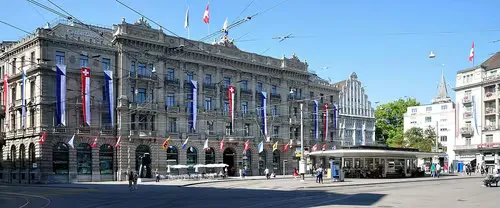
    Paradeplatz on Bahnhofstrasse is considered the most expensive square in the city and has long been a byword for banks and Swiss wealth. Right on the square you find the big bank UBS, the luxury hotel Mandarin Oriental, the Confiserie Sprüngli and the Galerie Gmurzynska, with many other banks close by.

    Its beginnings were far less glamorous. In the 17th century this was the "Säumärt", a market for livestock, pigs among them. In 1819 it was renamed Neumarkt, and about fifty years later it became Paradeplatz, a nod to the city's arsenal nearby. Back then the city walls with the Wollishofer Tor and the Katzenturm ran along here, and outside them lay an open moat called the Fröschengraben.

    In 1838 the Austrian Johannes Baur opened the first and finest hotel for foreign guests at the eastern end, the Hôtel Baur en Ville. Next door the cantonal post office built the Zentralhof, a stagecoach hub designed by Hans Conrad Stadler that contemporaries called unique in Europe. From 1864 Bahnhofstrasse was built, the moat was filled in, and the square had a direct link to the station.

    That pleased the confectioner David Sprüngli, who had moved his business here from the Marktgasse in 1859, wrongly believing that the new station would be built right on Paradeplatz. Walk on 430 m, about 6 minutes, to Bürkliplatz by the lake.

    Price
    Free
  9. 9

    Bürkliplatz

    Bürkliplatz in Zurich, stop 9 on the self-guided walking tour

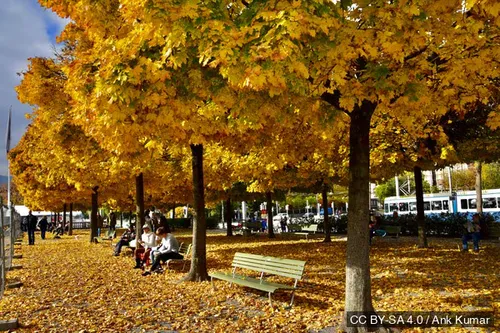
    Bürkliplatz takes its name from Arnold Bürkli and is one of the hubs where the city meets the lake. It belongs to the lakeshore promenades built between 1881 and 1887 and sits right beside the Quaibrücke, where Lake Zurich flows out into the Limmat. The tree-shaded square behind it is called Stadthausanlage.

    There is plenty to spot: the floral clock where the Schanzengraben moat flows out, the Geiser fountain, the historic music pavilion where public concerts are still sometimes held, the building of the Swiss National Bank and the Bauschänzli at the Stadthausquai. At the eastern end of the Bürkliterrasse there is a corner where waterfowl gather for food.

    This is also where the lake boats leave, so if the water tempts you, this is the place to combine your walk with a cruise. On Fridays a well-known market is held here, and on Saturdays a flea market. Nearby is the Arboretum with an aviary and a bird sanctuary.

    Cross the Quaibrücke over the outflow of the lake to Bellevue, 370 m and about 5 minutes away.

    Price
    Free
  10. 10

    Bellevue

    Bellevue in Zurich, stop 10 on the self-guided walking tour

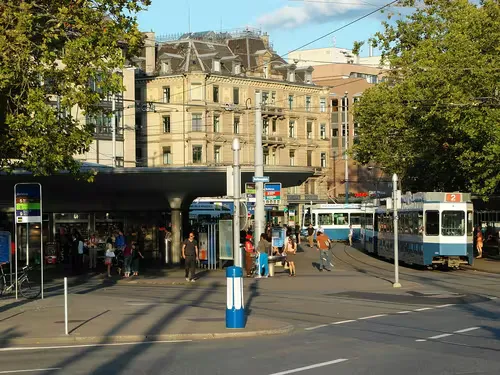
    Bellevue, French for "beautiful sight", was laid out in 1856 and named after the former Grandhotel Bellevue on its north side. Today it is one of Zurich's busiest tram junctions, with the Limmatquai running off along the river and the large Sechseläutenplatz right next to it.

    For a long time Bellevue was more traffic node than square. Only when the neighbouring Sechseläutenplatz was rebuilt in 2013 for public use did the area become a place to linger. Long before any of this, the ground here was swampland between river and lake, and prehistoric pile dwellings from the Neolithic and Bronze Age have been found around this end of the lake.

    Writers and the Zurich bohème used to meet at Café Odeon, and the Kronenhalle restaurant is part of the scene as well. The historic tram stop building is handy for a practical break: it houses two snack bars, a kiosk, a ZüriWC public toilet and a ticket counter for local transport.

    The Zurich Opera House is just 310 m away, about 4 minutes on foot.

  11. 11

    Zurich Opera House

    Zurich Opera House, stop 11 on the self-guided walking tour

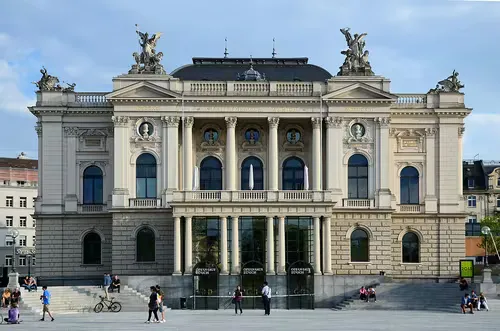
    The Zurich Opera House stands on Sechseläutenplatz with a neoclassical façade of white and grey stone. Look for the busts of Weber, Wagner and Mozart, and alongside them Schiller, Shakespeare and Goethe. It has been home to the Zurich Opera since 1891 and also hosts Ballett Zürich; in 2014 it was named Opera Company of the Year at the International Opera Awards.

    Its predecessor, the Aktientheater of 1834, was Zurich's first permanent theatre and the centre of Richard Wagner's activities during his exile from Germany. When it burned down in 1890, the Viennese architects Fellner and Helmer delivered a new theatre, barely changing a design they had already made for Wiesbaden. It went up in just 16 months, and when it opened in 1891 it was the first opera house in Europe with electric lighting. It took its current name in 1964.

    By the 1970s the building was in poor shape, and some argued it was not worth saving. Its renovation between 1982 and 1984 was preceded by the so-called opera house riots. The rebuilt house reopened with Wagner's Die Meistersinger von Nürnberg and a world premiere.

    Inside, the neo-rococo auditorium seats about 1,100 people; to see it you need a ticket, so it is a stop for the evening rather than the walk. From here, it is 780 m, about 12 minutes, to the Kunsthaus Zürich.

    Local name
    Opernhaus Zürich
  12. 12

    Kunsthaus Zürich

    Kunsthaus Zürich in Zurich, stop 12 on the self-guided walking tour

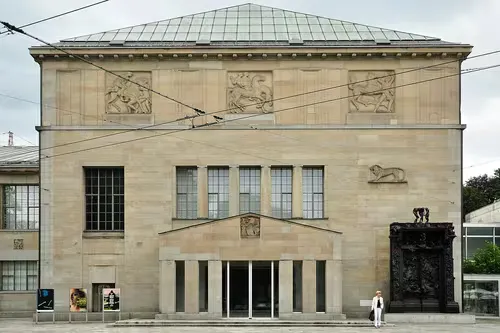
    The Kunsthaus Zürich is the largest art museum in Switzerland, with 11,500 square metres of exhibition space. It lines the Heimplatz together with the Schauspielhaus theatre nearby. What you see is a complex of four buildings: the older Moserbau, Bührlesaal and Müllerbau, plus the extension by Chipperfield Architects that opened in 2021.

    The collection is one of the most important in the country. It holds the largest collection of works by Alberto Giacometti, one of the most significant Dada collections and the most representative group of paintings by Edvard Munch outside Norway. Fittingly, Zurich is where the Dada movement has deep roots, so this is the place to see it.

    The museum is run by the Zürcher Kunstgesellschaft, an association formed in 1896, which also owns the art. Its recent history has not been quiet: when the private collection of the arms manufacturer Emil G. Bührle moved into the new building in October 2021, a heated worldwide debate broke out. The association had to disclose its loan contract and negotiate a new one in 2022.

    Admission is charged, and a proper visit takes time; it pays off for anyone with a feel for modern art. Then walk on 790 m, about 13 minutes, to ETH Zurich.

    Hours
    Mon: Closed | Tue–Wed: 10:00–18:00 | Thu: 10:00–20:00 | Fri–Sun: 10:00–18:00
    Price
    CHF 24 adults (collection + small exhibitions), CHF 31 (with major special exhibition), CHF 36 (all-inclusive, all exhibitions + collection); reduced CHF 17 / 22 / 25
  13. 13

    ETH Zurich

    ETH Zurich, stop 13 on the self-guided walking tour

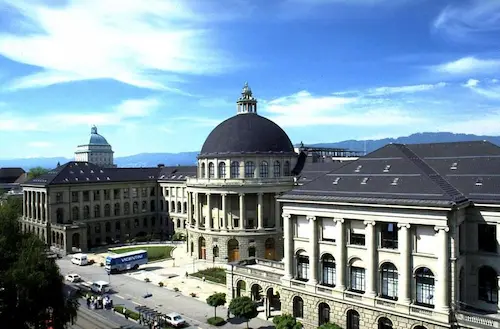
    ETH Zurich, the Swiss Federal Institute of Technology, was founded in 1855 as the federal Polytechnikum. Remember Friedrich Salomon Vögelin from the Landesmuseum? He taught art history at this very school. Its central campus sits at the foot of the Zürichberg; a second campus lies outside the city on the Hönggerberg.

    ETH is one of the most renowned universities in the world and regularly lands at the top of rankings. Twenty-two Nobel laureates are associated with it, among them Albert Einstein. Today around 23,000 students and doctoral candidates are enrolled, and more than 11,000 people work here across 16 departments.

    Unlike most Swiss universities, including the neighbouring University of Zurich, ETH is run by the federal government rather than the canton. Together with its sister school in Lausanne and four research institutes, it forms the ETH Domain, with branches in Basel, Singapore and Heilbronn.

    Entry to the main building is free, so take a look if you are curious about student life in Zurich; just remember it is a working university. The final leg is the longest: 970 m, about 13 minutes, to Zurich Hauptbahnhof.

    Hours
    Mon–Fri: 06:00–22:00 | Sat–Sun: 08:00–17:00
    Website
    ethz.ch ↗
  14. 14

    Zurich Hauptbahnhof

    Zurich Hauptbahnhof, stop 14 on the self-guided walking tour

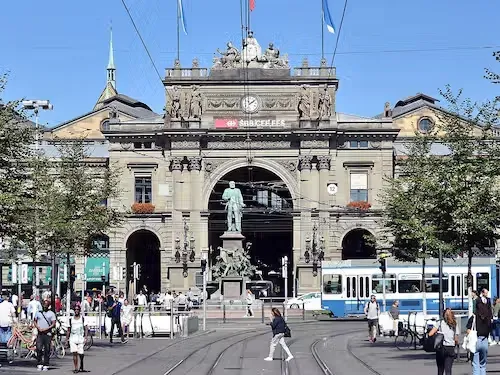
    Zurich Hauptbahnhof, Zurich HB for short, is the largest railway station in Switzerland and one of the busiest in Europe. On an average weekday in 2024 it handled 405,300 passengers and around 3,000 trains, spread over 26 passenger tracks in four separate stations, connected underground by the Shopville shopping passage.

    It is also one of the oldest stations in the country. It opened in 1847 as the terminus of Switzerland's first railway line, from Zurich to Baden. The grand neo-Renaissance hall by Jakob Friedrich Wanner was completed in 1871. Since 1930 the trains have used the adjoining track hall instead, but the old hall still stands, and the station's surface buildings are protected as a cultural asset of national significance.

    Underground, the station kept growing: the Museumstrasse station opened in 1989 for the S-Bahn, the line to the Uetliberg got its own station in 1990, and the Löwenstrasse through station followed in 2014.

    Entry is free, and this is where your walk ends, conveniently placed for a train onward or back to your hotel.

    Price
    Free
    Website
    sbb.ch ↗
Walking tour route map of Zurich Route loaded
Swiss National MuseumLindenhofSt. Peter's ChurchZurich Town Hall+10
All 14 stops are already on the map.
You just press start.
AI Tour Guide

You know the way now. Walk it with a guide in your ear.

Press start wherever you are, even hundreds of kilometres from Zurich, and the guide begins telling its stories right away. In the city, pick any of the 14 stops to start from: it leads you there, then talks with you the whole route, asking, listening, remembering, and shaping the tour around your answers.

14stops 5.9km 1 h 26 minwalking 13languages
▶Start the tour free

Free to start · Runs in your browser · No app, no download

Shorter Ways to Walk the Route

Not every visitor has a whole day. These three cuts of the route keep the stops in the recommended order and work on their own.

Old Town core

Stops: 2, 3, 4, 5, 6, 7, 8

For a first, compact look at medieval Zurich: Lindenhof to Paradeplatz takes 20 minutes of walking. Everything is free except the Fraumünster and the Grossmünster tower, so it suits a short stay or a tight budget.

From the museum to the lake

Stops: 1, 2, 3, 4, 5, 6, 7, 8, 9, 10

For history lovers: the Swiss National Museum, the Old Town churches and the lakeshore as far as Bellevue, with 43 minutes of walking. Admission applies at the Swiss National Museum, the Fraumünster and the Grossmünster tower.

Lake, opera and art

Stops: 9, 10, 11, 12, 13, 14

For an afternoon with culture: from Bürkliplatz past the Opera House to the Kunsthaus Zürich, ETH Zurich and the station, with 47 minutes of walking. Only the Kunsthaus and a performance at the Opera House cost admission.

How Long This Zurich Tour Takes, With and Without Museums

The full route means 1 h 26 min of pure walking. With short visits inside St. Peter's Church, the Grossmünster and the Fraumünster but no large museum, three hours is a realistic pace. Give the Swiss National Museum and the Kunsthaus Zürich about an hour and a half each, and the walk fills a whole day.

The Old Town core needs around an hour and a half including church visits, the walk from the museum to the lake about three hours if you go into the Swiss National Museum, and the stretch from the lake to the station roughly two and a half hours with time in the Kunsthaus.

Before You Set Off from the Landesmuseum

  • Start: The recommended start is the Swiss National Museum. You can also join at any other stop, and the GPS route leads you on from there in the same order.
  • Finish: The walk ends at Zurich Hauptbahnhof, so you can step straight onto a train afterwards.
  • Time of day: Start in the morning if you want to go inside the Swiss National Museum or the Kunsthaus Zürich. If you only plan to look from outside, any daylight hours work.
  • Admission: Lindenhof, St. Peter's Church, Zurich Town Hall, the squares, ETH Zurich and the station are free. The Swiss National Museum, the Fraumünster, the Grossmünster tower, the Kunsthaus Zürich and performances at the Zurich Opera House cost admission.
Walking tour route map of Zurich
AI Tour Guide

Your guide is ready when you reach the Landesmuseum.

Press start and a voice AI Tour Guide takes it from here: leading the route through Zurich, telling the stories, and turning your walk into a real back-and-forth conversation. No app or download is needed; it runs in your browser.

14stops 5.9km 1 h 26 minwalking 13languages
▶Start the tour free

Free to start · Runs in your browser · No app, no download

What the AI Tour Guide Adds Between the Limmat and the Lake

On this route the AI Tour Guide talks with you like a companion: it greets you at the Landesmuseum, tells the stories of each place, asks what you noticed and remembers whether you lean towards Reformation history, Roman Zurich or modern art. Want to know which Biblical story each of the Chagall windows tells, or how Zwingli argued his case in the debates of 1523? Just ask, or interrupt it whenever you like. You start with 100 free credits; after that you choose between this tour all-inclusive for €19.99 with no time limit, or credits at €5 per hour.

A Real Conversation A voice AI Tour Guide greets you, leads the whole route, and tells the stories and facts as you walk, asking what you want to see and keeping a real conversation going. Not a recording you press play on.
Map Navigation Follow the route on the map and walk at your own pace. You choose where to start and when to move to the next stop.
Ask Anything Curious about a building you pass? Ask your AI Tour Guide on the spot and the conversation carries on.
13 Languages Switch language anytime. No separate tour needed.
Start free in your browser

Common Questions About Walking Zurich

Is the Landesmuseum the same as the Swiss National Museum?

Yes. Landesmuseum Zürich is the local name of the museum on this route; until 2009 it was called Schweizerisches Landesmuseum. Swiss National Museum is also the name of the federal umbrella organisation that, since 2010, groups three cultural history museums and a collection centre.

If I only have time for one museum, which should it be?

Choose the Swiss National Museum if you want to understand Switzerland and its history. Choose the Kunsthaus Zürich if you care about art, especially Giacometti, Dada or Munch.

Does the walk work on a rainy day?

Reasonably well. Several stops can be enjoyed indoors: the Swiss National Museum, St. Peter's Church, the Grossmünster, the Fraumünster, the Kunsthaus Zürich and the station hall, so you can shorten the open squares and spend longer inside.

Can I add a boat trip on Lake Zurich?

Yes. At Bürkliplatz the Lake Zurich shipping company ZSG starts its route towards Rapperswil and Schmerikon, and Limmat tour boats stop there on their way to Zürichhorn.

Where can I go for a day trip after the walk?

From Zurich Hauptbahnhof you are well placed for towns like Lucerne, Winterthur, Schaffhausen or Stein am Rhein, each with its own walking route.

Is the tour really free?

Yes. The whole tour is free: the route, the interactive map and the navigation cost you nothing. Only the voice AI Tour Guide is optional and paid: you test it with 100 free credits, then you pay either €5 per hour or €19.99 for this whole tour, with no time limit. Admission to 4 of the 14 stops is not included: Swiss National Museum, Fraumünster, Zurich Opera House and Kunsthaus Zürich charge their own entry fees.

Do I need to download an app?

No. Everything runs in your phone browser. Open the route and start walking, no download and no sign-up required.

Do I need to book the walking tour in advance?

No booking needed. This self-guided tour is available anytime. Open the route in your browser and start walking. The AI Tour Guide works instantly, no app, no reservation required.

What languages is the AI Tour Guide available in?

The AI Tour Guide speaks 13 languages, so you take the tour in your own language and can switch at any time.

Can I skip stops or change the route?

Yes. Skip any stop, spend extra time at places you like, or start the route from any point. It is your walk, you set the pace.
Image credits
▶ Start free in your browser Runs in your browser, no app, no download