Free Walking Tour Zug: Castle, Clock Tower and Lake

A 2.6 km loop from the lakeside theatre past a medieval castle and Viennese Modernism to a clock that still shows the phase of the moon, then back to where you began.

12 Stops 2.6 km ~37 min walking
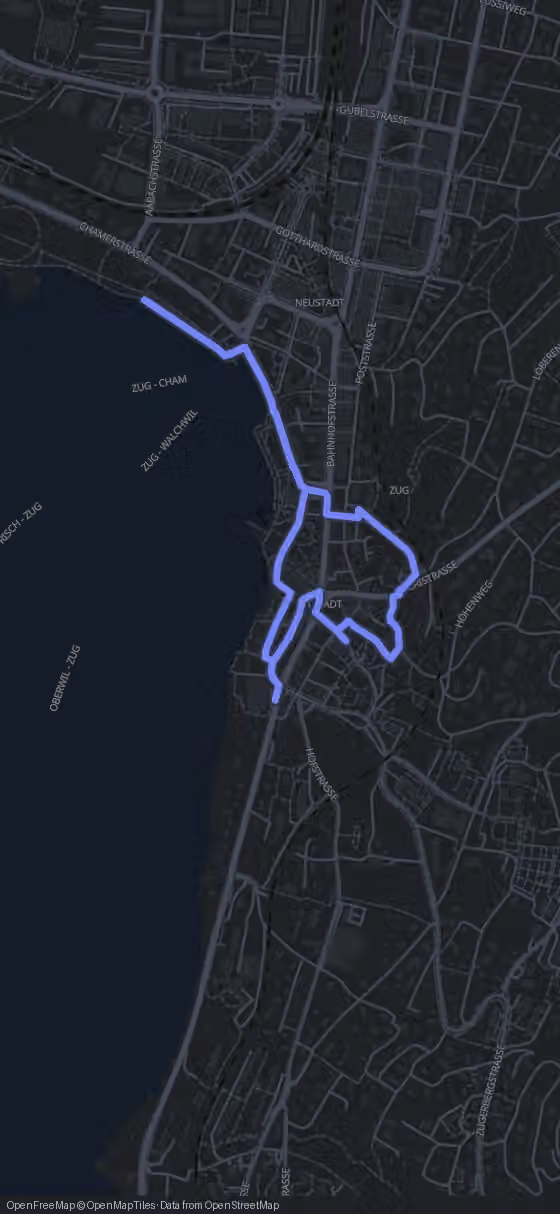
Route map for the Zug walking tour
Stop 1 of 12
230 m·3 min
Theater Casino Zug
Head north along the shore toward the Fischmarkt.
Welcome to Zug. I'm Alex, and this polished lakeside town has built part of its identity around one small summer fruit.
Try this tour with Alex

Zug in One Loop: What to Expect

Twelve stops on a loop that starts and ends at the Theater Casino Zug: 2.6 km and 37 minutes of pure walking, about two hours with time to look, nearer four if you go inside the museums.

The squares, the shore, the memorial, Kirche Sankt Oswald and the Zytturm Clock Tower are free; Kunsthaus Zug and Burg Zug charge entry. The GPS route runs free in your browser and leads you from stop to stop, and the AI Tour Guide is optional.

Open free GPS & optional AI Tour Guide
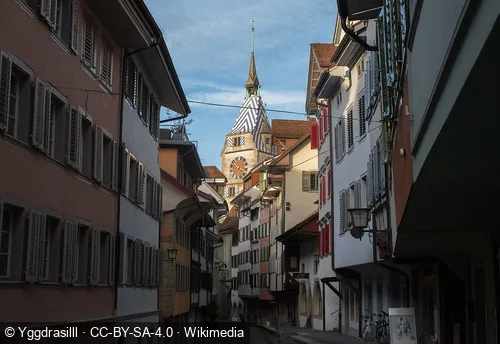
View of Zug

The Route

Walking Map of Zug: Shore, Castle and Old Town

12 stops 2.6 km 37 min walking
Tap to load interactive map

The 12 stops along this route

  1. Theater Casino Zug, stop 1 on the self-guided walking tour
    1Theater Casino Zug
  2. Fischmarkt Zug, stop 2 on the self-guided walking tour
    2Fischmarkt Zug
  3. 3Fasanerie und Voliere
  4. Attentat Zug 2001 Memorial, stop 4 on the self-guided walking tour
    4Attentat Zug 2001 Memorial
  5. 5Alpenquai Zug
  6. 6Kapuzinerturm
  7. Kunsthaus Zug, stop 7 on the self-guided walking tour
    7Kunsthaus Zug
  8. Burg Zug, stop 8 on the self-guided walking tour
    8Burg Zug
  9. Kirche Sankt Oswald in Zug, stop 9 on the self-guided walking tour
    9Kirche Sankt Oswald
  10. 10Lake Zug Promenade
  11. Zytturm Clock Tower in Zug, stop 11 on the self-guided walking tour
    11Zytturm Clock Tower
  12. Zug Old Town, stop 12 on the self-guided walking tour
    12Zug Old Town
  13. That's the full loop.

    Walk it with an AI Tour Guide talking you through every one of these streets.

    Start free in your browser
    You made it

Your Zug Walking Tour, Stop by Stop, from Theatre to Old Town

  1. 1

    Theater Casino Zug

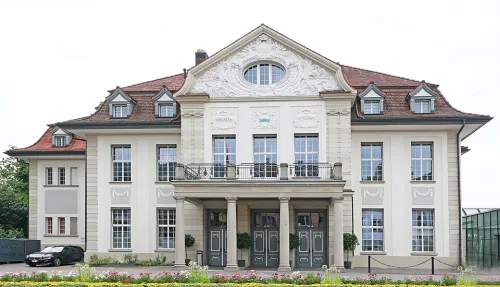
    Theater Casino Zug, stop 1 on the self-guided walking tour

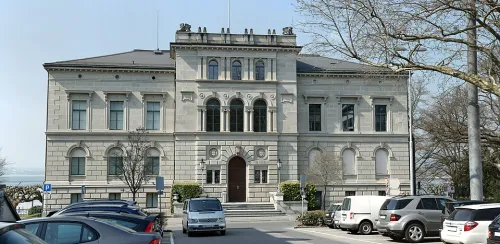
    Start where the old town lets go of the shore. The Theater Casino Zug stands on the southern edge of the historic centre, at Artherstrasse 5, on a bank that falls away towards the water, which is why every room facing west looks out over Lake Zug. Step back far enough to take in the whole building: a lavish piece of Heimatstil with a strong neo-Baroque streak, designed by the Zug architects Keiser and Bracher and regarded as a significant building well beyond the region.

    This is the town's cultural living room. The programme runs from drama, music theatre and classical concerts to world music, dance, comedy, circus and theatre for young audiences. The historic halls also serve as the festive setting for local clubs and private celebrations, and the house runs its own gastronomy.

    Behind the facade, the house has just been through a quiet reorganisation. Until 2025 two bodies ran it: a foundation looked after the building, staff, technology and catering, while the Theater- und Musikgesellschaft Zug chose what went on stage. On 28 September 2025 the city's voters approved dissolving the foundation and handing everything to the society, so the house is moving under a single roof.

    Going inside makes sense when there is a performance you want to see; for the walk, the building and its lake view tell the story. From here it is 240 m, about 3 minutes, to the Fischmarkt.
    Hours
    Advance sales: Mon–Fri 10:00–12:30 & 13:30–17:00; Box office: opens 60 min before show; Webshop: 24/7
    Price
    CHF 15.– to CHF 20.– for youth/students/KulturLegi, variable by performance for general admission
  2. 2

    Fischmarkt Zug

    Fischmarkt Zug, stop 2 on the self-guided walking tour

    The Fischmarkt is a small, car-free square, and its name does the explaining: fish market. The trade once carried on here survives in two words, and today the square is the hinge between the old lanes and the lake, a place nearly every walk through Zug ends up crossing.

    One practical thing to sort out while you are here. The Zytturm Clock Tower, later on the loop, is free to enter, but you need a visitor badge, and this square is where you usually collect it; on some days the pickup point is the Intermezzo instead. If you want to see the tower from inside, take care of the badge now and you will not have to double back.

    The birds are only 90 m on, about a minute's walk.

    Hours
    Open 24/7
  3. 3

    Fasanerie und Voliere

    Where the square runs out towards the water, the birds take over. The pheasantry on the Landsgemeindeplatz dates from 1897, and the Ornithologischer Verein der Stadt Zug, the town's bird club, still looks after the aviaries.

    A public bird collection, outdoors on a lakeside square, kept going for well over a century: that is rarer than it sounds. There is no gate, no ticket and no schedule, so a look costs nothing at any hour.

    If you want the keeper's view, the club runs guided tours on request. For most walkers a few quiet minutes with the birds are exactly right before the next stop, which asks something very different of you. The memorial is 130 m on, about 2 minutes away.

    Hours
    Daily 24/7 (exterior public outdoor aviary cages)
    Price
    Free
  4. 4

    Attentat Zug 2001 Memorial

    Attentat Zug 2001 Memorial, stop 4 on the self-guided walking tour

    Slow down here. This memorial recalls the attack of 27 September 2001, when a gunman walked unchallenged into the parliament building in Zug during a session of the cantonal parliament and opened fire in the chamber. He killed fourteen politicians, three members of the cantonal government and eleven members of the parliament, wounded many others, some of them journalists, and then took his own life.

    The attacker, Friedrich Leibacher, had spent years drawing attention to himself through an excessive stream of legal complaints and seems to have believed himself the victim of a conspiracy. The man he most wanted to hit, government councillor Robert Bisig, was not hurt.

    It was the first attack of its kind in Switzerland. For the canton it was a trauma, and the whole country mourned. Coming only weeks after 11 September in New York, it also caused outrage far beyond Switzerland, and parliaments and organisations around the world sent their condolences.

    Take whatever time you need; the site is free and open at all hours. When you are ready, the route leads 540 m, about 7 minutes, to the Alpenquai, where the lake gives you room again.

    Hours
    Open 24/7
    Price
    Free
  5. 5

    Alpenquai Zug

    After the memorial the route opens out and lets you breathe. The Alpenquai is the lakeside boulevard of Zug, public along its whole length, without gates or charges, and its job on this loop is simple: to make walking easy again, with the water at your side.

    Use it to bank time. The next leg, 820 m and about 13 minutes to the Kapuzinerturm, is the longest single stretch of the whole loop. After that the route turns dense and short-legged, with two museums, a church and a clock tower close together. If you plan to go inside the Kunsthaus or the castle, this is where your schedule gets its slack.

    Hours
    Open 24/7
    Price
    Free
  6. 6

    Kapuzinerturm

    Zug outgrew its first town wall and built a new one, and this tower stood on the new line. The Kapuzinerturm, a fortification tower from 1526, still marks where that wall ran, along the Schanz next to the grounds of the Capuchin monastery.

    Among theatres, churches and museums, this is the loop's one stop of pure military history. It is also known for its Friedensglocke, the peace bell: a tower raised for defence, hung with a bell for peace.

    The interior is closed to the general public and opens only for special occasions and guided tours, so take this stop from outside and do not plan your day around its door. The line of the old wall is what you came to see. The Kunsthaus Zug is 250 m away, about 4 minutes.

    Hours
    Exterior always accessible; interior closed to general public (special occasions / guided tours only)
    Price
    Free (exterior viewing)
  7. 7

    Kunsthaus Zug

    Kunsthaus Zug, stop 7 on the self-guided walking tour

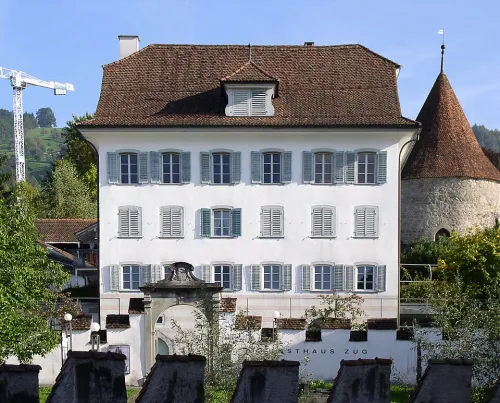
    The Kunsthaus Zug lives in the Hof im Dorf, a complex from the 16th century on the edge of the old town, converted for the museum and its own home since 1990. Old walls outside, modern art inside: that contrast is part of the visit.

    The reason to go in is Vienna. The house holds the most important collection of Viennese Modernism outside Austria, thanks to the Stiftung Sammlung Kamm, set up in 1998 by Christa, Peter and Christine Kamm and lent to the museum on a permanent basis. Its more than 400 works include major groups by Gustav Klimt, Egon Schiele, Oskar Kokoschka, Richard Gerstl, Koloman Moser, Josef Hoffmann, Herbert Boeckl and Fritz Wotruba, alongside Expressionism and Bauhaus. The collection is shown in changing thematic exhibitions, so what hangs on the walls depends on when you come.

    The rest of the holdings lean Swiss: Swiss Surrealism and fantastic art, figurative Swiss sculpture, art from the canton, and large bodies of work by artists such as Roman Signer, Annelies Štrba and Hannah Villiger.

    The institution is young by Swiss standards. The Zuger Kunstgesellschaft, which runs the house and owns the collection, was founded in 1957 and first opened a Kunsthaus in the Altstadthalle in 1977; Matthias Haldemann has directed the museum since 1990.

    Entry is paid. It is worth it if Klimt and Schiele are on your list or you enjoy modern art in a historic setting; allow about an hour. Burg Zug is just 30 m away.

    Hours
    Tue–Fri 12:00–18:00, Sat–Sun 10:00–17:00, Mon closed; last Thu of month open until 20:00
    Price
    CHF 15 regular, CHF 12 reduced (special exhibitions: CHF 18 regular, CHF 15 reduced)
  8. 8

    Burg Zug

    Burg Zug, stop 8 on the self-guided walking tour

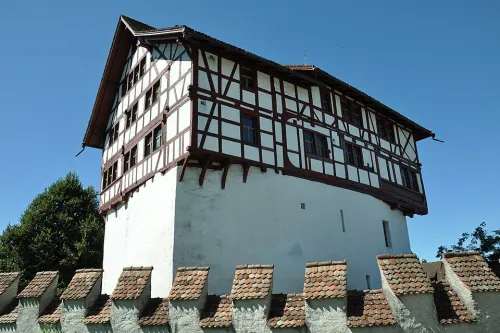
    Thirty metres on, you reach the story with the deepest roots on the loop. Burg Zug is a Swiss heritage site of national significance, and excavations trace it back to a wooden manor house built around the year 1000, on an island between two small streams and ringed by a wooden palisade. The local nobleman held the house and the island while his people built a village along the streams, which were later dammed to stop the flooding.

    Towards the end of the 11th century the manor grew, and a low stone wall went up around it, though every building inside stayed wooden. Tradition says the castle was attacked and damaged in the 12th century. The Kyburgs, who founded the town of Zug around 1200, rebuilt it in stone: a tower 9 by 9 m, its walls 2 m thick on the first storey and thinning as they rise to 16 m.

    When the Kyburg line died out in 1264, the Habsburgs inherited town and castle and added living quarters and buildings between the tower and the town wall. After their defeat at Morgarten in 1315, Zug stayed a Habsburg stronghold inside an increasingly hostile Confederation, even as Zurich, Lucerne and Glarus joined it. When the Confederates invaded, the surrounding villages gave in at once; town and castle held out for a two-week siege before falling, and the undamaged castle became a Confederation castle.

    From outside you can read the tower and its compact layout. Going inside costs entry and is worth it if the medieval story has caught you. Kirche Sankt Oswald is 130 m, about 2 minutes, away.

    Hours
    Tue–Fri 14:00–17:00, Sat–Sun 10:00–17:00, Mon closed
    Price
    CHF 12 adult; group CHF 8
  9. 9

    Kirche Sankt Oswald

    Kirche Sankt Oswald in Zug, stop 9 on the self-guided walking tour

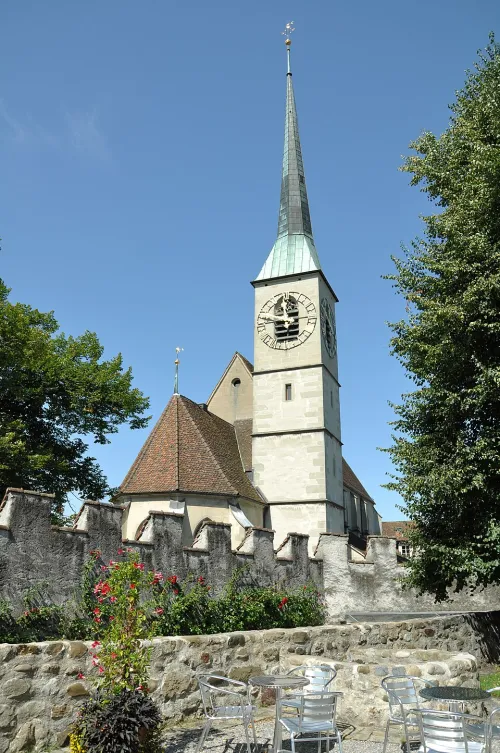
    Kirche Sankt Oswald belongs to the outer old town that grew from 1477, and it is the largest and most important church in Zug's old town. When the town expanded it wanted a new main church and hired Hans Felder, formerly master builder in Lucerne and Zurich. Work began in 1478 on a hall church, which by 1492 had become a three-aisled basilica; the building was completed in 1545 and the spire added in 1558. The result counts among the largest and most representative late Gothic town churches in today's Switzerland.

    Start with the main facade. It is plain overall, which makes the richly decorated double portal stand out: two sweeping gables and five figures of saints under ornate canopies crowned with pinnacles. More saints stand on the buttresses. Look for the Jörgenpforte in the south aisle, whose tympanum holds a valuable relief from the original church showing St George fighting the dragon.

    Inside, which is free, notice the proportions: the nave is unusually wide, the aisles very narrow. Then compare the vaults. The net vault over the nave is simple; the one in the north aisle, built some twenty years later, is virtuoso work. The church is dedicated to Oswald of Northumbria, an early medieval king, keeps some of his relics and celebrates him on 5 August.

    South of the church lies the former town cemetery with the late Gothic Mariahilfkapelle, once an ossuary. The tall spire, together with the Zytturm and the tower of St. Michael, shapes the Zug skyline, and its four bells came from the Rüetschi foundry in Aarau in 1897. The lake promenade is 120 m, about 2 minutes, away; on the way you pass the Chriesimärt Cherry Market.

    Hours
    Daily 09:00–17:00
    Price
    Free
  10. 10

    Lake Zug Promenade

    The shore comes back for a second pass, in a different role. The Alpenquai was the boulevard for stretching your legs; this promenade ties the church, the clock tower and the old lanes to the water. It is free and always open, a good place to stand by the lake for a moment before the old town closes in again. The Zytturm Clock Tower is only 30 m, about a minute, away.

    Hours
    Always open
    Price
    Free
  11. 11

    Zytturm Clock Tower

    Zytturm Clock Tower in Zug, stop 11 on the self-guided walking tour

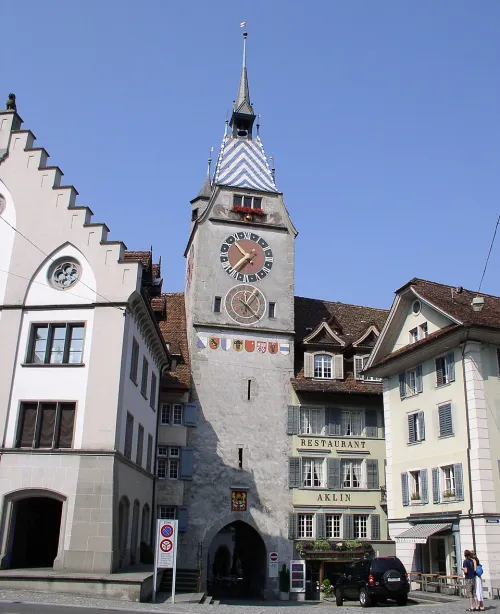
    The Zytturm on Kolinplatz is the landmark of the old town, 52 m tall. Its core dates from the 13th century; it was raised between 1478 and 1480 and took its present form in 1557. The last major renovation came in 1952, and it is listed as being of national and regional significance, together with the town walls and other towers.

    Go round to the east side for the astronomical clock, installed in 1574. Under the main face, the calendar dial has four hands. The arrow shows the day of the week on the inner ring, where each day is represented by its Germanic deity and astrological sign, with Sunday at the top. The crescent moon gives the lunar phase, pointing up at new moon and down at full moon. The sun hand moves through the zodiac on the outer ring, starting with Capricorn for January near the bottom. The hand marked S counts the leap year, Schaltjahr in German, and completes its cycle every four years.

    Above the clock face, a rotating gold and black globe shows the phase of the moon. Underneath the clock hang the coats of arms of the Old Eight Cantons, the Swiss Confederacy as it stood from 1353 to 1481.

    Going inside is free with the visitor badge from the Fischmarkt and worth it if you want more of the tower than its dials. Zug Old Town opens up 100 m on, about a minute away.

    Hours
    Daily 10:00–18:00 (last entry 17:30; badge pickup Tue–Fri 10:00–18:00, Sat 12:00–17:00, Sun at Intermezzo)
    Price
    Free
  12. 12

    Zug Old Town

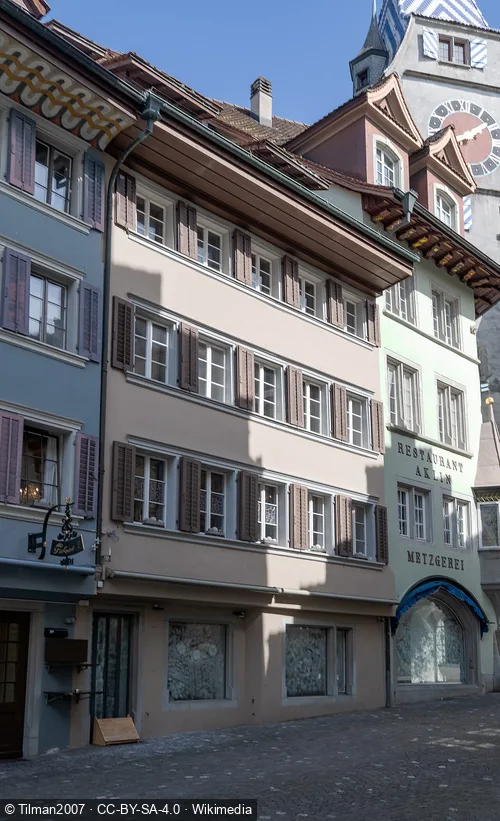
    Zug Old Town, stop 12 on the self-guided walking tour

    The route ends in the thing itself: the lanes and facades of Zug Old Town, open at every hour. By now you have walked both of its ages, the outer town that grew from 1477 around St. Oswald, and the older core the Zytturm was already watching over long before that.

    Let the order go and wander for a while. When you are done, the loop closes on its own: the last leg is 130 m, about 2 minutes, back to the Theater Casino Zug where you started, so there is no return trip to plan.

    Hours
    Open 24/7
    Price
    Free
Walking tour route map of Zug Route loaded
Theater Casino ZugFischmarkt ZugAttentat Zug 2001 MemorialKunsthaus Zug+8
All 12 stops are already on the map.
You just press start.
AI Tour Guide

You know the loop now. Walk it with a guide in your ear.

Press start wherever you are, even hundreds of kilometres from Zug, and the guide begins telling its stories right away. In the city, pick any of the 12 stops to start from: it leads you there, then talks with you the whole route, asking, listening, remembering, and shaping the tour around your answers.

12stops 2.6km 37 minwalking 13languages
▶Start the tour free

Free to start · Runs in your browser · No app, no download

Shorter Ways Through Zug

The loop splits naturally into a lakeside half and a compact old town half, and the whole thing works on a zero budget too.

Old town core with the museums

Stops: 7, 8, 9, 10, 11, 12

For art and medieval history with very little walking: from the Kunsthaus Zug through Burg Zug and Kirche Sankt Oswald to the Zytturm and the lanes. 410 m and 7 minutes on foot, plus 2 minutes back to the Theater Casino. Entry at the Kunsthaus and the castle.

Lakeside and memorial

Stops: 1, 2, 3, 4, 5

For a quiet stretch by the water: the theatre, the Fischmarkt, the birds, the memorial and the Alpenquai. 1,000 m and 13 minutes of walking, all of it free from outside.

The full loop on a zero budget

Stops: 1, 2, 3, 4, 5, 6, 7, 8, 9, 10, 11, 12

For anyone keeping costs at nothing: all twelve stops and 37 minutes of walking, going inside only Kirche Sankt Oswald and the Zytturm, which cost nothing.

How Long Does This Zug Tour Take, With and Without the Museums?

The walking itself is short: 37 minutes for 2.6 km. The longest stretch, 820 m from the Alpenquai to the Kapuzinerturm, makes up about a third of it; everything else is a matter of a few minutes, and from the Kunsthaus to the old town lanes the stops sit almost door to door.

Seen from outside, with a look into the free church and clock tower, the loop takes about two hours. Give the Kunsthaus and Burg Zug about an hour each and you are closer to four. The lakeside half alone is 13 minutes of walking, the old town core about 7.

Before You Set Off in Zug

  • Start and finish: The recommended start is the Theater Casino Zug, and the loop brings you back there. You can join at any stop and keep the same order.
  • When to go: The outdoor stops are open around the clock. If the castle and the Kunsthaus are on your list, check both opening times first; they keep different hours, so pick a part of the day when both are open.
  • What costs entry: Kunsthaus Zug and Burg Zug charge entry, and the Theater Casino is a ticketed venue for performances. Kirche Sankt Oswald is free inside, and so is the Zytturm, with a visitor badge.
Walking tour route map of Zug
AI Tour Guide

Your guide is ready when you reach the lake.

Press start and a voice AI Tour Guide takes it from here: leading the route through Zug, telling the stories, and turning your walk into a real back-and-forth conversation. No app or download is needed; it runs in your browser.

12stops 2.6km 37 minwalking 13languages
▶Start the tour free

Free to start · Runs in your browser · No app, no download

What the AI Tour Guide Adds in Zug

On this loop the AI Tour Guide walks with you as a conversation: it greets you at the theatre, tells the stories of each place, asks what you are curious about and remembers it. If the castle's sieges catch you, it follows the Habsburg thread; if the Kunsthaus does, it might tell you who Richard Gerstl was, or why the builders of the theatre chose Heimatstil. It never changes the route, and you can interrupt whenever you like. You start with 100 free credits; after that, take this tour all-inclusive for €19.99 with no time limit, or pay €5 per hour.

A Real Conversation A voice AI Tour Guide greets you, leads the whole route, and tells the stories and facts as you walk, asking what you want to see and keeping a real conversation going. Not a recording you press play on.
Map Navigation Follow the route on the map and walk at your own pace. You choose where to start and when to move to the next stop.
Ask Anything Curious about a building you pass? Ask your AI Tour Guide on the spot and the conversation carries on.
13 Languages Switch language anytime. No separate tour needed.
Start free in your browser

Common Questions About Walking Zug

Can I go inside the Theater Casino without a show ticket?

The historic halls are used for performances and booked events, so for the hall itself you need a ticket. The house also runs gastronomy, and the facade with the lake behind it is the part that belongs to the walk.

If I only pay for one interior, which should it be?

Choose the Kunsthaus Zug if Klimt, Schiele and Kokoschka mean something to you. Choose Burg Zug if the story of the wooden manor, the Kyburgs and the Habsburg siege is what pulled you in.

Can I combine Zug with another town on the same day?

Yes, the loop is short enough. Lucerne is 20 km away, Zurich 23 km and the monastery town of Einsiedeln 18 km.

Is the tour really free?

Yes. The whole tour is free: the route, the interactive map and the navigation cost you nothing. Only the voice AI Tour Guide is optional and paid: you test it with 100 free credits, then you pay either €5 per hour or €19.99 for this whole tour, with no time limit. Admission to 2 of the 12 stops is not included: Kunsthaus Zug and Burg Zug charge their own entry fees.

Do I need to download an app?

No. Everything runs in your phone browser. Open the route and start walking, no download and no sign-up required.

Do I need to book the walking tour in advance?

No booking needed. This self-guided tour is available anytime. Open the route in your browser and start walking. The AI Tour Guide works instantly, no app, no reservation required.

What languages is the AI Tour Guide available in?

The AI Tour Guide speaks 13 languages, so you take the tour in your own language and can switch at any time.

Can I skip stops or change the route?

Yes. Skip any stop, spend extra time at places you like, or start the route from any point. It is your walk, you set the pace.
Image credits
▶ Start free in your browser Runs in your browser, no app, no download