

Einsiedeln Abbey
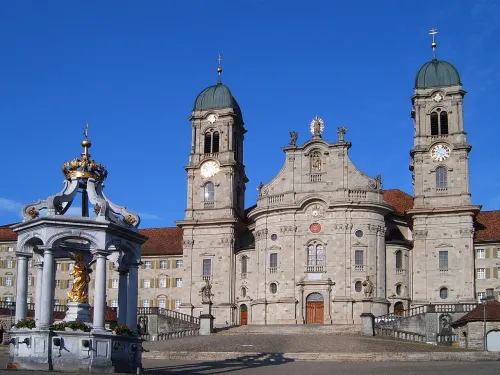
Start where Einsiedeln itself began. The Benedictine abbey ranks among the most important baroque monastic sites in Switzerland and is the country's largest place of pilgrimage, yet it is no museum: a community of around 40 monks still lives and works here. The church and grounds are free.
It all goes back to one man who wanted to be left alone. Meinrad, born in 797 in Sulchen and schooled at the abbey on Reichenau Island, became a monk and priest whose reputation for miracles drew more attention than he liked. In 828 he withdrew into the forest here to live as a hermit. Two robbers murdered him in January 861, and for the next 80 years other hermits kept his cell alive.
In 934 Eberhard, formerly Provost of Strassburg, built an abbey and church on the hermitage site and became the first abbot. Legend says Christ himself consecrated the church in 948 in honour of his mother, and from that story grew a pilgrimage to the Chapel of the Saviour, which over the Middle Ages turned into a Marian one. Its focus today is the Black Madonna in the Chapel of Grace, who draws around 800,000 pilgrims and visitors a year. The chapel opens for personal prayer only at set times outside services, so it is worth saving for your return at the end of the loop.
Power came with the pilgrims. In 965 Emperor Otto I made Gregory, the third abbot, a prince of the Holy Roman Empire, a title his successors held until the empire dissolved in 1806. The abbey still answers to no bishop or diocese, because it is a territorial abbey, and it pays its own way with a private high school, a winery, a sawmill and a restaurant. One former pupil, Ludwig von Flüe, rose in the Swiss Guards in France and played a key role in the Storming of the Bastille.
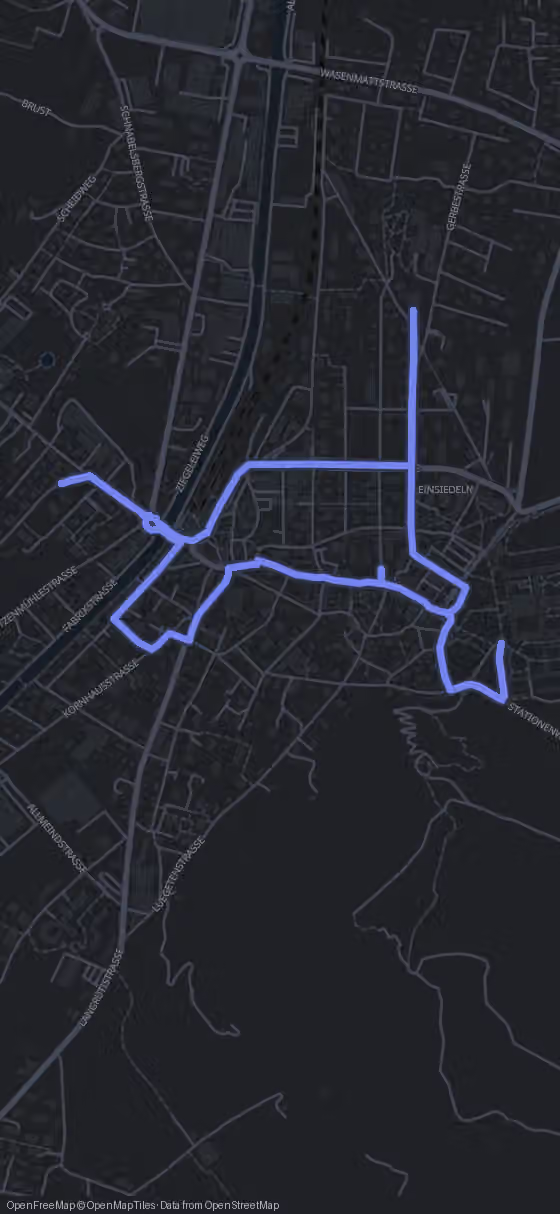
Go inside, whoever you are: this is the reason most people come to Einsiedeln, and it costs nothing. Give it at least 45 minutes, then set off on the longest leg of the loop, 960 m and 13 minutes, to the panorama.