Free Walking Tour Lyon: Fourvière to Bellecour

Start under the golden Virgin on Fourvière hill, slip through a Renaissance traboule in Vieux Lyon and finish on the vast, car-free Place Bellecour.

10 Stops 5.0 km ~1 h 10 min walking
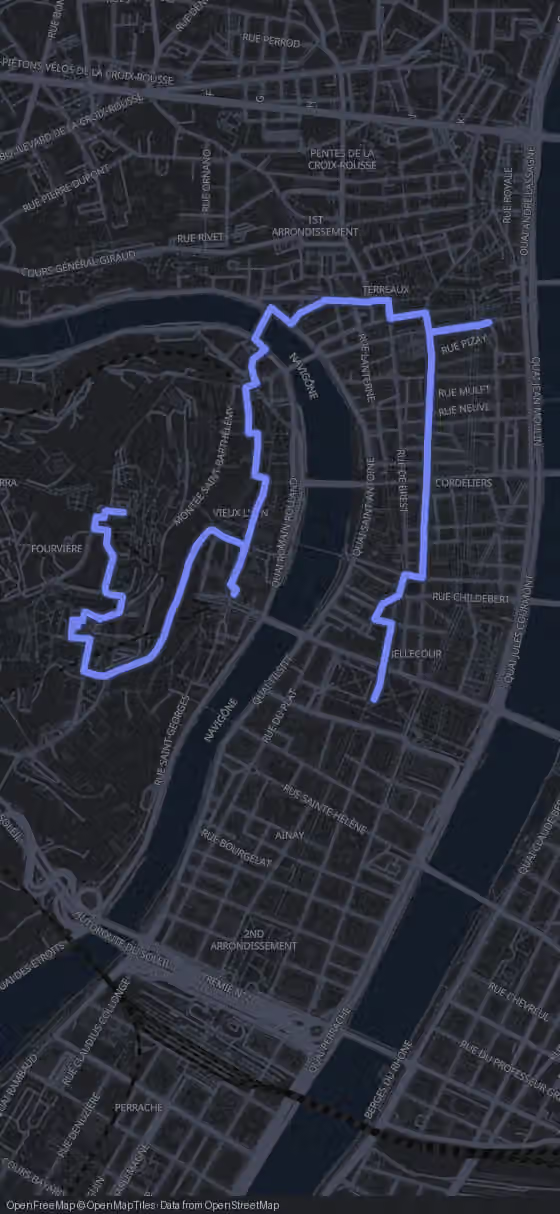
Route map for the Lyon walking tour
Stop 1 of 10
630 m·8 min
Basilica of Notre-Dame de Fourvière
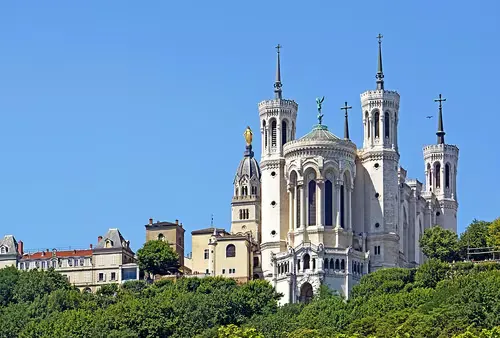
Head south-west and downhill toward the Gallo-Roman Theatre
Bonjour, welcome to Lyon. I'm Alex, and one monumental fountain here was originally meant for another city.
Try this tour with Alex

Lyon on Foot in One Route: What to Expect

Ten stops over 5.0 km, from the Basilica of Notre-Dame de Fourvière on its hill down through Vieux Lyon and across the Saône to Place Bellecour. Pure walking time is 1 h 10 min; with the visits worth making, plan a good five hours plus lunch.

Most stops cost nothing. Only the Gallo-Roman Theatre and the Musée Gadagne charge admission. Route, map and GPS navigation run free in your browser; the AI Tour Guide is optional.

Open free GPS & optional AI Tour Guide
This short shows highlights of the route. All 10 stops follow below.

The Route

Walking Map of Lyon: Fourvière, Vieux Lyon and the Presqu'île

10 stops 5.0 km 1 h 10 min walking
Tap to load interactive map

The 10 stops along this route

  1. Basilica of Notre-Dame de Fourvière in Lyon, stop 1 on the self-guided walking tour
    1Basilica of Notre-Dame de Fourvière
  2. Gallo-Roman Theatre in Lyon, stop 2 on the self-guided walking tour
    2Gallo-Roman Theatre
  3. Lyon Cathedral, stop 3 on the self-guided walking tour
    3Lyon Cathedral
  4. La Longue Traboule in Lyon, stop 4 on the self-guided walking tour
    4La Longue Traboule
  5. Musée Gadagne in Lyon, stop 5 on the self-guided walking tour
    5Musée Gadagne
  6. Fresque des Lyonnais, stop 6 on the self-guided walking tour
    6Fresque des Lyonnais
  7. Place des Terreaux in Lyon, stop 7 on the self-guided walking tour
    7Place des Terreaux
  8. Opéra de Lyon, stop 8 on the self-guided walking tour
    8Opéra de Lyon
  9. Place des Célestins in Lyon, stop 9 on the self-guided walking tour
    9Place des Célestins
  10. Place Bellecour in Lyon, stop 10 on the self-guided walking tour
    10Place Bellecour
  11. That's the full route.

    Walk it with an AI Tour Guide talking you through every one of these streets.

    Start free in your browser
    You made it

Lyon Walking Tour Stop by Stop, from the Basilica to the River

  1. 1

    Basilica of Notre-Dame de Fourvière

    Basilica of Notre-Dame de Fourvière in Lyon, stop 1 on the self-guided walking tour

    You start at the top. The Basilica of Notre-Dame de Fourvière has watched over Lyon from its hill since the end of the 19th century, and it stands roughly where the Roman Forum of Trajan, the Forum vetus, once lay. Before you go in, look for the gilded statue of Mary on the bell tower of the old chapel: Cardinal de Bonald had it raised in the 19th century, and the tower was built higher and stronger to carry it.

    Faith on this spot is far older than the basilica. In the Middle Ages people came here to honour Saint Thomas Becket and soon the Virgin Mary, and from 1630 a chapel, Saint-Thomas, gave that devotion a home. In 1642 the city's aldermen made a vow to keep the plague away, and an annual pilgrimage grew out of it. Two centuries later visitors were so numerous, and Lyon so grateful to have been spared in the war of 1870, that a full basilica was approved; work began in 1872.

    The neo-Byzantine design is by Pierre Bossan, who was too ill to run the site himself and left much of the execution to Louis Sainte-Marie Perrin. The result has always divided opinion, with devoted admirers and fierce critics, so make up your own mind. Unusually, the building belongs to the Commission de Fourvière, not the archdiocese, which kept it out of the 1905 law on church property, helped by the diplomacy of mayor Édouard Herriot. It became part of Lyon's UNESCO World Heritage site in 1998 and a classified historic monument in 2014.

    Entry is free and worth it for everyone; give it about 45 minutes. Beyond the basilica itself, the crypt, the Chapel of the Virgin and the gardens are there to explore. From here it is 640 m, about 9 minutes, down the hillside to the Roman theatre.
    Hours
    Basilica: Mon–Sat 7:00–20:00, Sun 7:00–21:00 | Gardens: 6:30–22:30 | Chapel of the Virgin: 7:00–19:00 | Crypt: 8:30–18:30 | Welcome Pavilion: 10:00–18:00
    Price
    Free
  2. 2

    Gallo-Roman Theatre

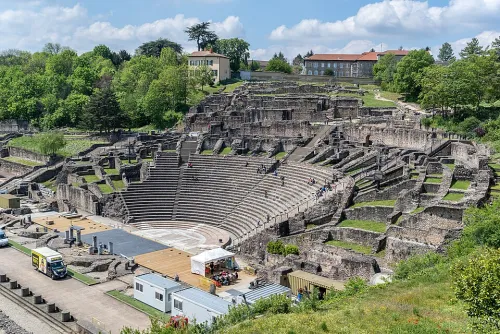
    Gallo-Roman Theatre in Lyon, stop 2 on the self-guided walking tour

    Just beneath the summit, set into the slope of Fourvière, lies the Théâtre antique, the heart of Roman Lugdunum and often called the oldest Roman theatre in France. Its position put it close to the centre of the Roman colony. Together with its neighbours, the Odeon, the so-called sanctuary of Cybele and the Gallo-Roman museum, it forms the archaeological site that stands for ancient Lyon.

    Nobody has a document that dates it. The archaeologists who cleared it, Pierre Wuilleumier and Amable Audin, read its history from building techniques and materials. A first theatre was built against the hillside, two tiers of seating crowned by a false semicircular portico, with room for at most 5,700 people. Later the portico was torn down and its rubble used to prop up new seating, and the enlarged theatre could hold up to 10,000. Fragments of column bases and capitals in that rubble, carved from Provençal limestone, led Audin to push the original date earlier than Wuilleumier had thought.

    After Rome fell the theatre became a quarry, was badly damaged and then vanished completely under the earth in the Middle Ages. It was found by chance at the end of the 19th century and fully excavated and restored from 1933.

    Go in if Roman history speaks to you: sitting on the curved tiers gives you a real sense of the scale. About 45 minutes is enough. From here the route drops 1160 m, about 16 minutes, into Vieux Lyon and the cathedral square.

    Local name
    Théâtre antique de Lyon
    Hours
    Mon: Closed | Tue–Fri: 11:00–18:00 | Sat–Sun: 10:00–18:00
    Price
    8 EUR
  3. 3

    Lyon Cathedral

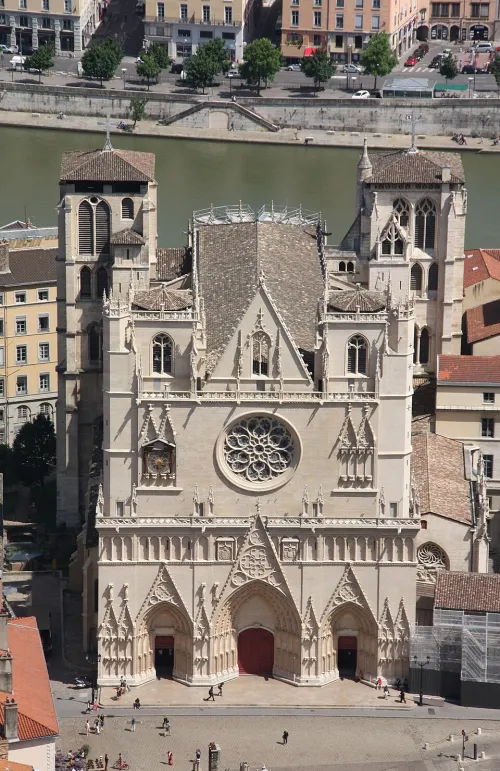
    Lyon Cathedral, stop 3 on the self-guided walking tour

    On Place Saint-Jean stands the Primatiale Saint-Jean, dedicated to Saint John the Baptist and seat of the Archbishop of Lyon. Building began in 1180 on the ruins of a 6th-century church and was only finished in 1476, yet the style looks remarkably consistent for nearly three centuries of work. Hill and cathedral belong together: in 1819 J. M. W. Turner sketched this church from the heights of Fourvière, roughly where you stood an hour ago.

    The roots go back to the 2nd century, when Saint Pothinus and Saint Irenaeus, Lyon's first two bishops, founded a church in what was still a Roman settlement, making Lyon one of the first cities in Gaul with such a building. Bishop Patiens enlarged it in 469; Germanic raids and later Saracen invasions between 725 and 737 left it ruined, and Leidrade, a Bavarian bishop sent by Charlemagne, rebuilt it in the early 9th century.

    The name Primatiale comes from 1079, when Pope Gregory VII made the Archbishop of Lyon Primate of All the Gauls, with authority over the kingdom's leading archbishops. In 1245 the cathedral hosted the First Council of Lyon.

    Entry is free, and 20 minutes inside is time well spent. The next stop is a mere 180 m away, 3 minutes along Rue Saint-Jean.

    Local name
    Primatiale Saint-Jean de Lyon
    Hours
    Mon 14:00–19:00 | Tue–Fri 8:30–19:00 (Wed until 19:30) | Sat 8:30–19:30 | Sun 8:00–19:30
    Price
    Free
  4. 4

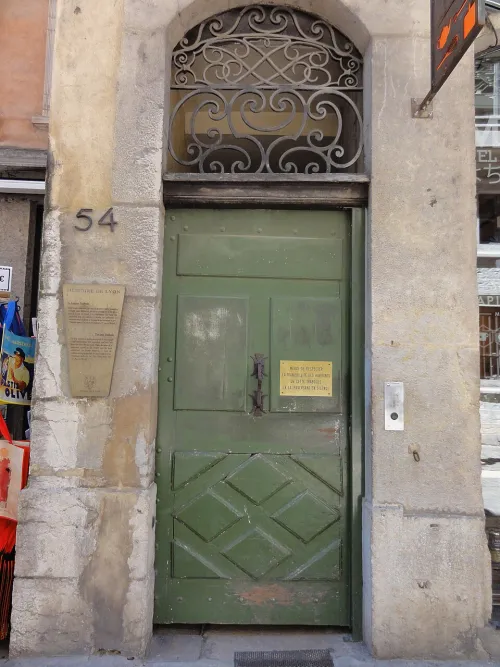
    La Longue Traboule

    La Longue Traboule in Lyon, stop 4 on the self-guided walking tour

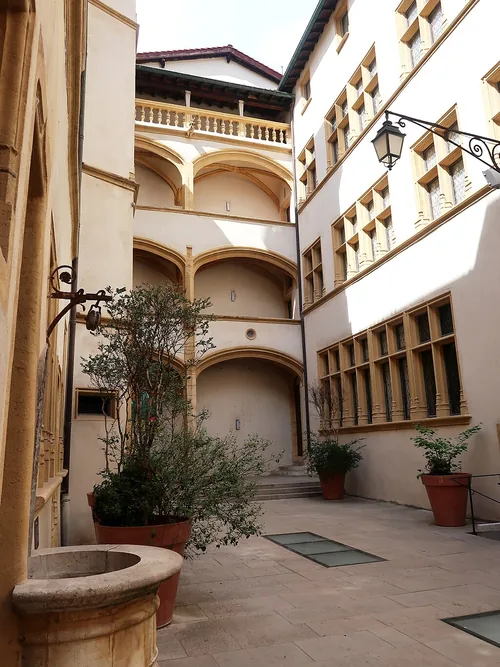
    Behind an ordinary door at 54 Rue Saint-Jean begins one of Lyon's great secrets. La Longue Traboule is a covered Renaissance passage that runs straight through four separate buildings and comes out at 27 Rue du Bœuf. Lyon has around 500 of these hidden corridors, and this is the longest.

    Walk it slowly and notice how you pass from one building to the next, courtyard after courtyard. In the 19th century, silk workers used traboules like this as a direct, sheltered way to carry their delicate fabrics through the city without exposing them to the weather.

    Most traboules are locked, which is why this public one matters: you get the real experience for free, no guided tour needed, and ten minutes are enough.

    Out on Rue du Bœuf, the Musée Gadagne is 300 m and 4 minutes away; on the way through Vieux Lyon you pass the Musée Miniature et Cinéma.

    Hours
    Open all year, daily 07:00–19:00 (20:00 in summer)
    Price
    Free
  5. 5

    Musée Gadagne

    Musée Gadagne in Lyon, stop 5 on the self-guided walking tour

    The Hôtel Gadagne is a Renaissance mansion built between 1511 and 1527 by the Pierrevive brothers and reworked in 1545 by the Gadagne brothers, members of a wealthy Florentine family settled in Lyon. Their fortune was so famous that people said 'riche comme Gadagne', rich as Gadagne. One of them, Thomas the Rich, paid part of the ransom Louise of Savoy needed to free King Francis I after his capture at Pavia in 1525.

    The brothers quarrelled so often that each lived in his own part of the house. Later the mansion was carved up into small lodgings, and the city bought it piece by piece from 1902. After ten years of closure, excavations and a much debated renovation, it reopened on 12 June 2009, almost doubled in size from 3,500 to 6,300 m².

    Today it holds two museums. The Musée d'Histoire de Lyon traces the city from the Middle Ages to the 19th century with 80,000 objects in 30 rooms over four floors: archaeological finds, sculpture, paintings, furniture and pottery. The Musée des Marionnettes du monde is devoted to puppets from around the world, a good reason to come with children.

    If you want to understand how Lyon grew into what you are walking through, this is the stop to buy a ticket for; plan about an hour and a quarter. Then you leave Vieux Lyon behind: 540 m, about 8 minutes, to the giant mural on the Saône.

    Hours
    Wed–Sun 10:30–18:00, closed Mon–Tue
    Price
    8 EUR
  6. 6

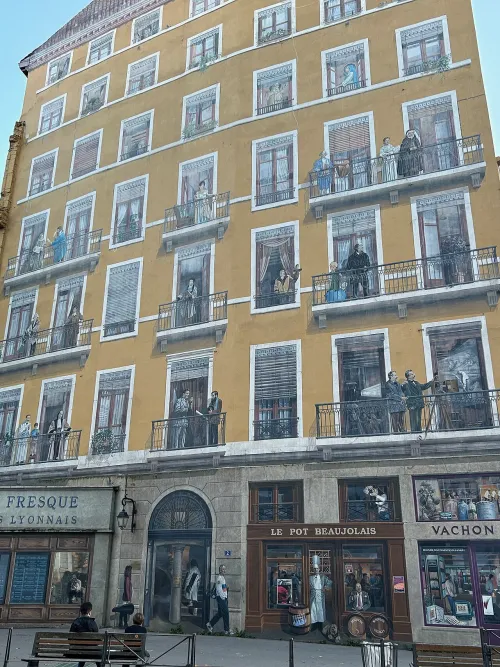
    Fresque des Lyonnais

    Fresque des Lyonnais, stop 6 on the self-guided walking tour

    At the corner of 49 Quai Saint-Vincent and 2 Rue de la Martinière, a windowless façade of 800 m² has become a crowd of famous faces. The Fresque des Lyonnais is a trompe-l'œil showing more than two dozen historic and contemporary figures tied to the city's story, painted in 1994 and 1995 by the muralists of CitéCréation.

    The idea came from Barcelona. For the 1992 Olympics the same artists painted a façade of 30 famous Catalans, among them Gaudí, Miró, Pau Casals and Picasso. Lyon's mayor at the time, Michel Noir, saw its success and asked for something similar here, and the residents of this building agreed to lend their blank wall.

    Choosing the faces took real research: lists from the city's academy and historical societies produced some 250 names, narrowed down to the final selection. The aim was to connect generations and eras and give today's Lyonnais something to identify with. 'Les murs, c'est la peau des habitants', the muralists like to say: the walls are the skin of the people.

    Stand back from the wall and take your time picking out the windows, balconies and figures; it is free and always open. Place des Terreaux is 500 m, 7 minutes, further on.

    Hours
    Open 24/7
    Price
    Free
  7. 7

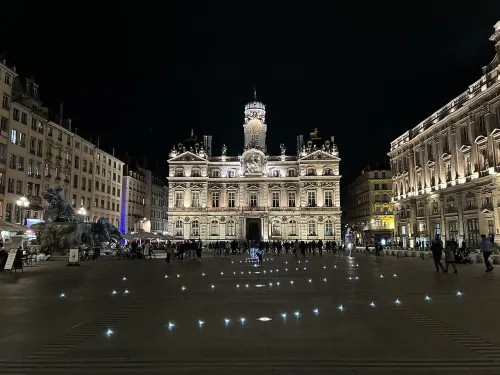
    Place des Terreaux

    Place des Terreaux in Lyon, stop 7 on the self-guided walking tour

    Place des Terreaux sits at the foot of the Croix-Rousse hill on the Presqu'île, the tongue of land between the Rhône and the Saône. The Hôtel de Ville closes the square on the east side, the Palais Saint-Pierre with the Musée des Beaux-Arts on the south, while to the north the houses mark the start of the Croix-Rousse slopes.

    The square grew out of a medieval quarrel. In 1206 Lyon's merchants rose against Archbishop Renaud II de Forez, who was breaking the tax agreements of 1195. To shield the Saint-Nizier district from church power they began a wall at the foot of the hill and a tower guarding the only bridge to Saint-Jean. The archbishop answered with force in 1208, and Pope Innocent III had to broker peace.

    Ironically, Renaud and his successors then finished the burghers' work to defend the city. The new wall ran about 500 m from Saône to Rhône, two metres thick and ten high, with ten towers, a crenellated walkway and two gates with drawbridges, the Porte de la Pêcherie and the Porte de la Lanterne. A 22-metre ditch separated it from a second wall to the north.

    Take ten minutes to walk around the square and look at the two great buildings framing it. The Opéra de Lyon is only 270 m, 4 minutes, away.

    Hours
    Always open
    Price
    Free
  8. 8

    Opéra de Lyon

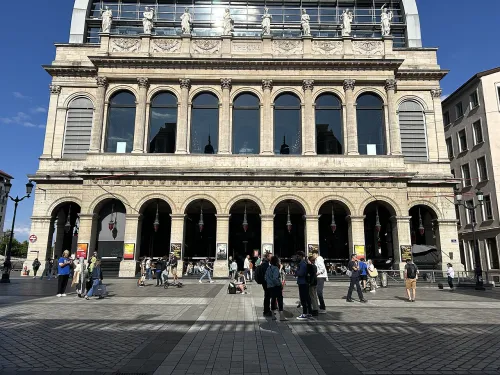
    Opéra de Lyon, stop 8 on the self-guided walking tour

    Facing the Hôtel de Ville on Place de la Comédie, the Opéra de Lyon was long called the Grand Théâtre. The building of 1831 by Antoine-Marie Chenavard and Jean-Marie Pollet was completely restructured and enlarged by Jean Nouvel, begun in 1989 and finished in 1993, a project that won the Équerre d'argent architecture prize that year. Look at how the old façade and Nouvel's addition meet.

    It replaced an earlier Grand Théâtre by Jacques-Germain Soufflot, built on the gardens of the town hall under the supervision of Michelle Poncet, director of Lyon's royal music academy, opened on 30 August 1756 and torn down in 1826. For a long time both buildings shared the same name.

    Today the hall seats 1,100 people for operas, ballets and concerts staged by the Opéra national de Lyon, and the Opera's ballet company is based here.

    Admiring it from outside is free. If you would like to come back for a performance, tickets are sold at the box office. Then comes one of the longer legs, 1130 m and about 16 minutes, to Place des Célestins.

    Hours
    Box office (guichet): Tue–Sat 12:00–18:00
    Price
    Free (exterior)
  9. 9

    Place des Célestins

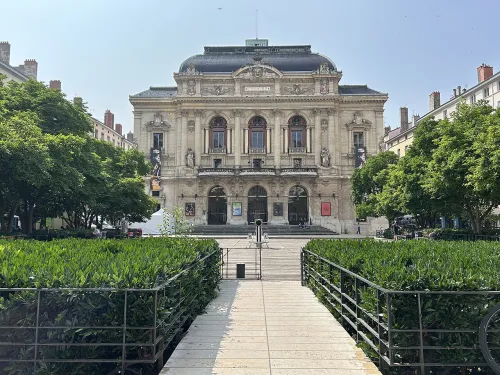
    Place des Célestins in Lyon, stop 9 on the self-guided walking tour

    Place des Célestins in the 2nd arrondissement has had its present shape since the early 19th century, but the name is much older. Before 1307 the land belonged to the Knights Templar, who had a commandery here. After they were driven out, the Celestine monks moved in, from 1407 to 1778, and their monastery survived several fires for almost 400 years. In 1746 Jean-Baptiste Masson gave it a sculpted façade on the Saône side that hid a jumble of older buildings behind.

    In the second half of the 18th century the community shrank by around 40 percent, and the monastery was finally abandoned in 1778. After a long lawsuit, Duke Victor-Amadeus III of Savoy was declared owner and sold the whole site to a Parisian, A. Devouge. He saw a prime location and dreamed of a property venture like the Palais-Royal in Paris, founding a company with two Lyonnais, Jars and Madinier, on 9 June 1785.

    The architect Jean-Antoine Morand took on the plan in 1787, with Jean-François Colson in charge of the theatre. They chose to keep existing buildings and sacrifice the monumental façade and the church; demolition began in 1789, while the developers handed out brochures to attract buyers. The theatre that came out of that project still gives the square its character.

    Ten minutes is plenty here. The finale is close: 290 m, 4 minutes, to Place Bellecour.

    Hours
    Always open
    Price
    Free
  10. 10

    Place Bellecour

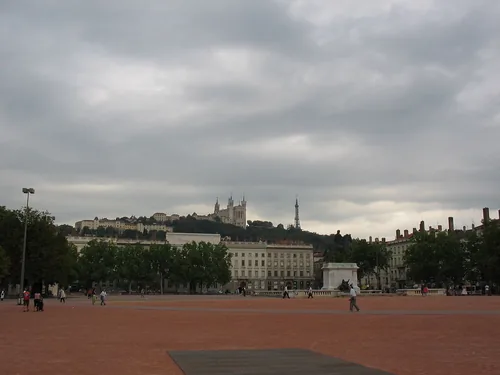
    Place Bellecour in Lyon, stop 10 on the self-guided walking tour

    You finish on a vast open space: Place Bellecour measures 312 by 200 metres, 6.2 hectares, the third largest square in France after the Place des Quinconces in Bordeaux and the Place de la Concorde in Paris, and the largest pedestrian square in Europe. In the middle rides King Louis XIV, an equestrian statue by François-Frédéric Lemot from 1825; at the west end look for Antoine de Saint-Exupéry with his Little Prince.

    This is kilometre zero of Lyon, the point from which all distances in the city are measured. Four major shopping streets start here, and the two pavilions on the square house the tourist office and an art gallery.

    The ground has a long past. In Gallo-Roman times this was an alluvial island, and remains of huts used as warehouses by traders and boatmen, the canabae, have been found here. In the late 12th century the archbishop kept a vineyard on the spot called Bella curtis, the beautiful garden, which gave the square its name.

    Before you leave, look across the Saône: Vieux Lyon and Lyon Cathedral face the square, and Fourvière rises behind them, the whole walk laid out in one view.

    Hours
    Open 24/7
    Price
    Free
Walking tour route map of Lyon Route loaded
Basilica of Notre-Dame de FourvièreGallo-Roman TheatreLyon CathedralLa Longue Traboule+6
All 10 stops are already on the map.
You just press start.
AI Tour Guide

You've read the way through Lyon. Now walk it with a guide in your ear.

Press start wherever you are, even hundreds of kilometres from Lyon, and the guide begins telling its stories right away. In the city, pick any of the 10 stops to start from: it leads you there, then talks with you the whole route, asking, listening, remembering, and shaping the tour around your answers.

10stops 5.0km 1 h 10 minwalking 13languages
▶Start the tour free

Free to start · Runs in your browser · No app, no download

Shorter Ways to Walk Lyon

The route splits neatly into the old town on the west bank and the Presqu'île between the rivers, so you can walk one half today and the other tomorrow.

The full route

Stops: 1, 2, 3, 4, 5, 6, 7, 8, 9, 10

For a first day in Lyon when you want the whole story, Roman to modern. 5.0 km and 1 h 10 min of pure walking; the theatre and the Musée Gadagne are the two paid visits.

Fourvière and Vieux Lyon

Stops: 1, 2, 3, 4, 5

For history lovers with half a day: basilica, Roman theatre, cathedral, traboule and the city history museum. About 2.3 km and 32 minutes of walking; both paid visits sit in this half, so with time inside allow just under four hours.

The Presqu'île in an afternoon

Stops: 6, 7, 8, 9, 10

For a free, easy loop of squares and façades, and the right choice when you would rather skip the paid visits. About 2.2 km and 31 minutes of walking, no admission anywhere, roughly an hour and a half in total.

How Long Does This Lyon Tour Take with the Theatre and Gadagne?

The walk itself takes 1 h 10 min over 5.0 km. The two longer legs are from the Gallo-Roman Theatre down to Lyon Cathedral and from the Opéra de Lyon to Place des Célestins, 16 minutes each; everything in Vieux Lyon is only a few minutes apart.

Realistic time with the visits: about 45 minutes in and around the basilica, 45 minutes in the Roman theatre, 20 minutes in the cathedral and an hour and a quarter in the Musée Gadagne, plus roughly ten minutes at each of the other six stops. That adds up to a little over five hours, before lunch. If you skip the museum and keep the theatre short, you are done in around three and a half hours.

Before You Set Off from Fourvière

  • Start and finish: Start at the Basilica of Notre-Dame de Fourvière so the walk runs downhill into town; you can join at any stop if that suits you better. The tour ends on Place Bellecour, where metro lines A and D stop, and the GPS navigation can lead you back to the start if you want.
  • Getting up the hill: The funicular from Vieux Lyon runs on a normal TCL ticket. In summer expect queues of 20 to 30 minutes between 10:00 and 16:00, so go before 9:30 or after 17:30. Walking is free: about 15 minutes via the Montée Saint-Barthélémy or 25 minutes through the Jardins du Rosaire, a lovely climb in itself. Paying contactless with a bank card caps your fares for the day.
  • Best day: If you want to see inside, plan the walk for a day when both the Roman theatre and the Musée Gadagne are open. On a weekday there is no need to rush the basilica.

Food and Breaks Between Vieux Lyon and the Presqu'île

Lyon takes its food seriously, so plan lunch rather than grabbing the first table you pass. The old town is the place to look, the Presqu'île is the place to eat.

A certified bouchon with the Gnafron plaqueLook for the Gnafron plaque of Les Bouchons Lyonnais or the sticker of Les Authentiques Bouchons Lyonnais. Of the roughly 22 certified addresses, ten are in the 2nd arrondissement and only four in Vieux Lyon. Quenelle, andouillette and saucisson brioché taste more authentic there, for the same price or less. (The Presqu'île, especially the 2nd arrondissement around Place des Célestins and Place Bellecour)
Lunch menus instead of dinnerA lunchtime formule is the classic way to eat well for less. At Le Potager des Halles the lunch menu is a steal, and Le Bistrot du Potager next door is cheaper and just as good. For a splurge, Prairial serves a five-course Confluence lunch for far less than the eight-course dinner menu, same kitchen, same chef.
A carafe of tap waterIn France service, bread and tap water are included. Ask for a carafe of water instead of ordering bottled water out of habit.

Tourist Traps to Avoid in Lyon's Old Town and Beyond

  • Restaurants on Rue Saint-Jean: The street is lined with souvenir shops and restaurants aimed at visitors, and locals will tell you a genuinely good bouchon is rare here. Many trade on the name with higher prices and less traditional cooking. (Rue Saint-Jean in Vieux Lyon, around La Longue Traboule)
  • Hop-on hop-off bus and little train up the hill: The bus reaches the same highlights you walk to here. For the hills, a TCL day ticket with the funicular included is faster and far cheaper; the bus adds commentary and little else.
Walking tour route map of Lyon
AI Tour Guide

Your guide is ready when you reach Fourvière.

Press start and a voice AI Tour Guide takes it from here: leading the route through Lyon, telling the stories, and turning your walk into a real back-and-forth conversation. No app or download is needed; it runs in your browser.

10stops 5.0km 1 h 10 minwalking 13languages
▶Start the tour free

Free to start · Runs in your browser · No app, no download

What the AI Tour Guide Adds Between Fourvière and Bellecour

On this walk the AI Tour Guide welcomes you on the hill and tells the stories of each place as you go, from Bossan's basilica to the Gadagne brothers. It asks what grabs you, remembers it and shapes the rest of the conversation around it, so the Roman layers can take centre stage or the silk workers can. Ask about things this text leaves open, such as who exactly is painted on the Fresque des Lyonnais or what the world puppet collection holds, and interrupt it whenever you like. You start with 100 free credits; after that you choose between this tour all-inclusive for €19.99 with no time limit or €5 per hour.

A Real Conversation A voice AI Tour Guide greets you, leads the whole route, and tells the stories and facts as you walk, asking what you want to see and keeping a real conversation going. Not a recording you press play on.
Map Navigation Follow the route on the map and walk at your own pace. You choose where to start and when to move to the next stop.
Ask Anything Curious about a building you pass? Ask your AI Tour Guide on the spot and the conversation carries on.
13 Languages Switch language anytime. No separate tour needed.
Start free in your browser

Common Questions About Walking Lyon

Is the Lyon City Card worth it for this walk?

Only with a full day of paid visits plus public transport. It includes TCL zones 1 and 2, 26 museums, a guided tour, a river cruise and the rooftop tour of Fourvière. If you buy it, buy online: it is cheaper than on site.

Can I visit other traboules besides La Longue Traboule?

Yes, but most of Lyon's more than 500 traboules are locked. The Croix-Rousse traboules are free to walk too. Guided traboule tours mainly add stories, not access you could not get yourself.

Do Lyon's museums charge admission?

Most do, including the Musée Gadagne and macLYON. On this walk only the Gallo-Roman Theatre and the Musée Gadagne charge admission; the basilica, the cathedral, the traboule and the squares are free.

Can I see the riverbanks by bike after the walk?

Yes. With a Vélo'v day ticket the first 30 minutes of each ride are included, and the cycle paths along the Rhône and Saône are the real highlight. Guided e-bike tours are available too.

Which day trips pair well with Lyon?

Lake towns and wine country are both within reach: Annecy is 102 km away, Geneva 113 km and Beaune in Burgundy 140 km.

Is the tour really free?

Yes. The whole tour is free: the route, the interactive map and the navigation cost you nothing. Only the voice AI Tour Guide is optional and paid: you test it with 100 free credits, then you pay either €5 per hour or €19.99 for this whole tour, with no time limit. Admission to 2 of the 10 stops is not included: Gallo-Roman Theatre and Musée Gadagne charge their own entry fees.

Do I need to download an app?

No. Everything runs in your phone browser. Open the route and start walking, no download and no sign-up required.

Do I need to book the walking tour in advance?

No booking needed. This self-guided tour is available anytime. Open the route in your browser and start walking. The AI Tour Guide works instantly, no app, no reservation required.

What languages is the AI Tour Guide available in?

The AI Tour Guide speaks 13 languages, so you take the tour in your own language and can switch at any time.

Can I skip stops or change the route?

Yes. Skip any stop, spend extra time at places you like, or start the route from any point. It is your walk, you set the pace.
Image credits
▶ Start free in your browser Runs in your browser, no app, no download