Free Walking Tour Turin: Market, Palaces and the Mole

Start among the stalls of Porta Palazzo, walk through Savoy palaces and Egyptian halls, and finish on the panoramic terrace of Monte dei Cappuccini above the Po.

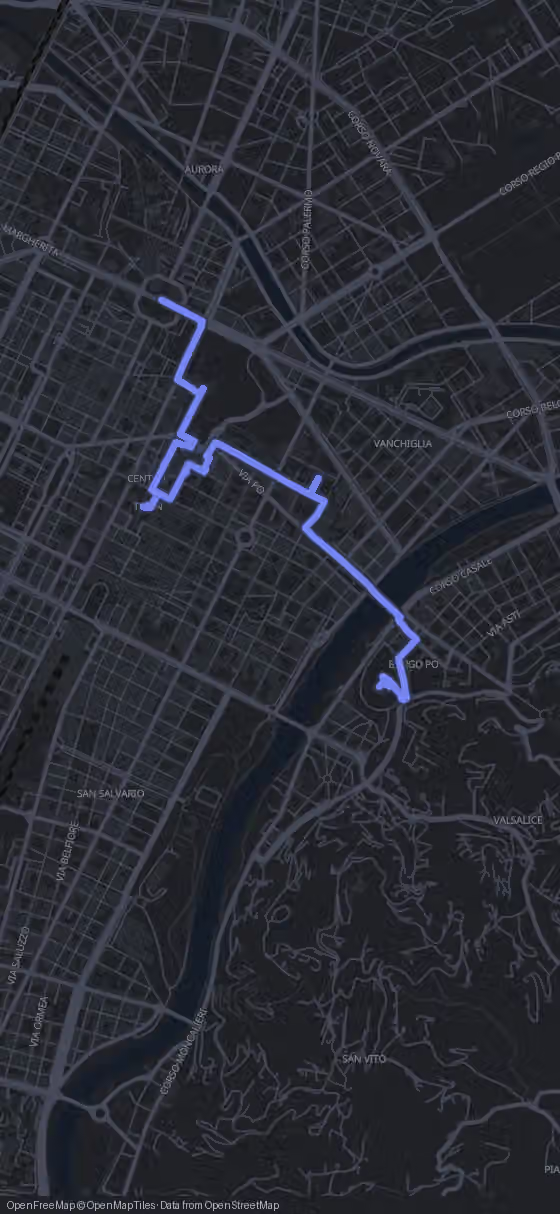
11 Stops 4.7 km ~1 h 7 min walking
Route map for the Turin walking tour
Stop 1 of 11
710 m·9 min
Porta Palazzo Market
Head south-east toward the Royal Palace of Turin
Ciao, welcome to Turin. I'm Alex, and one of the world's great Egyptian collections sits hundreds of kilometres from the Nile.
Try this tour with Alex

This Turin Route at a Glance

This self-guided walk links 11 stops over 4.7 km, from Porta Palazzo Market to the hill of Monte dei Cappuccini by the Po. Pure walking time is 1 h 7 min; with one or two museums inside, plan most of a day.

Free: the market, Piazza Castello, Piazza San Carlo, Galleria Subalpina, Gran Madre di Dio Church and the hill. Ticketed: Royal Palace of Turin, Palazzo Madama, Egyptian Museum, Museum of the Risorgimento and Mole Antonelliana. The GPS route from stop to stop is free in your browser; the AI Tour Guide is optional.

Open free GPS & optional AI Tour Guide
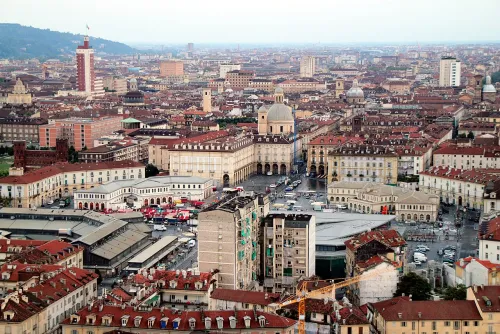
View of Turin

The Route

Walking Map of Turin, from Market to Hilltop

11 stops 4.7 km 1 h 7 min walking
Tap to load interactive map

The 11 stops along this route

  1. Porta Palazzo Market in Turin, stop 1 on the self-guided walking tour
    1Porta Palazzo Market
  2. Royal Palace of Turin, stop 2 on the self-guided walking tour
    2Royal Palace of Turin
  3. Palazzo Madama in Turin, stop 3 on the self-guided walking tour
    3Palazzo Madama
  4. Piazza Castello in Turin, stop 4 on the self-guided walking tour
    4Piazza Castello
  5. Piazza San Carlo in Turin, stop 5 on the self-guided walking tour
    5Piazza San Carlo
  6. Egyptian Museum in Turin, stop 6 on the self-guided walking tour
    6Egyptian Museum
  7. Museum of the Risorgimento in Turin, stop 7 on the self-guided walking tour
    7Museum of the Risorgimento
  8. Galleria Subalpina in Turin, stop 8 on the self-guided walking tour
    8Galleria Subalpina
  9. Mole Antonelliana in Turin, stop 9 on the self-guided walking tour
    9Mole Antonelliana
  10. Gran Madre di Dio Church in Turin, stop 10 on the self-guided walking tour
    10Gran Madre di Dio Church
  11. Monte dei Cappuccini in Turin, stop 11 on the self-guided walking tour
    11Monte dei Cappuccini
  12. That's the full route.

    Walk it with an AI Tour Guide talking you through every one of these streets.

    Start free in your browser
    You made it

Turin Walking Tour Stop by Stop: Roman Gates, Savoy Kings and a Synagogue That Grew Too Tall

  1. 1

    Porta Palazzo Market

    Porta Palazzo Market in Turin, stop 1 on the self-guided walking tour

    Your walk begins in Piazza della Repubblica, the octagonal square at the heart of Porta Palazzo. At 51,300 square metres it is the largest square in Turin and one of the largest in Italy, and it holds what is counted as the biggest open-air market in Europe. Give yourself time to wander the stalls before the sightseeing starts. There is no ticket, and this is the city doing its shopping rather than putting on a show for visitors.

    The name is older than any stall. It comes from the Roman gate that led into the walled castrum of Julia Augusta Taurinorum, founded around 28 AD: the Porta Principalis dextera, later called Palatina, through which you entered the main street, the cardo, today's Via Porta Palatina. Only fragments of the original walls survive. The brick towers still visible today owe much to Alfredo d'Andrade, who studied the original gate and restored it in 1901.

    “Palazzo” probably refers to the Casa del Senato, an early medieval building raised on Roman foundations close to what was the forum, today the area around the city hall. This was the northern edge of the Roman town, where remains of a Roman theatre have also been found. Its southern part grew up around the Duomo, first a Lombard church and later rebuilt in the Renaissance.

    From here it is 710 metres, about 10 minutes, to the Royal Palace of Turin. Keep that Roman gate in mind: the duke who made the palace site his seat valued it partly because he could watch this entrance to the city.
    Hours
    Mon–Fri 07:00–14:00, Sat 07:00–19:00, Sun closed
    Price
    Free
  2. 2

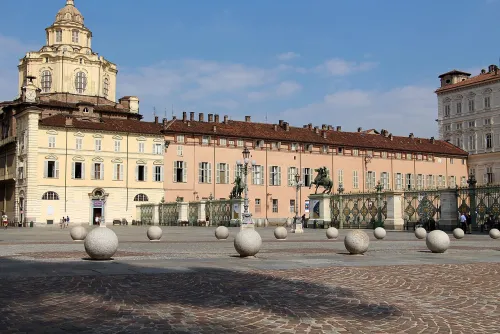
    Royal Palace of Turin

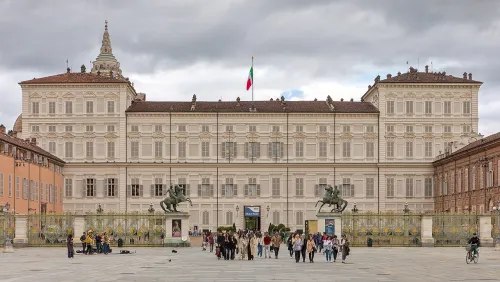
    Royal Palace of Turin, stop 2 on the self-guided walking tour

    This is where the House of Savoy lived and ruled. The complex is bigger than the main building suggests: it also takes in Palazzo Chiablese and the Chapel of the Holy Shroud, built to house the famous Shroud of Turin. Since 1946 it has belonged to the state as a museum, and in 1997 it joined the UNESCO World Heritage list together with 13 other Savoy residences.

    The story of the site starts with a bishop. Emmanuel Philibert, Duke of Savoy, made the old Bishop's Palace his seat in his new capital. It had an open, sunny position near the buildings where the court met, and from it he could keep an eye on two city gates, the Palatine and the Pretoria. The French had captured it in 1536 and used it as the residence of the viceroys appointed by Francis I. Opposite stood the Palazzo Vecchio, whose architecture earned it the mocking nickname “Pasta con Tonno”, pasta with tuna, until a grand Ducal Palace replaced it.

    Emmanuel Philibert expanded the bishop's palace to hold his ever growing collection of art, marbles, furniture and even animals. He died in Turin in August 1580 and left the throne to his son Charles Emmanuel I. The palace you see took shape later: in 1645 the regent Christine Marie of France ordered a new court residence after her son came back from civil war, and the Baroque architect Filippo Juvarra also left his designs here.

    Is it worth the ticket? If Savoy court life, Baroque rooms and the Shroud chapel interest you, yes, and give it a real slice of your day rather than a quick look. If museums aren't your thing, the forecourt and the story carry the stop well enough. Palazzo Madama is 200 metres away, about 3 minutes on foot.

    Local name
    Palazzo Reale di Torino
    Hours
    Tue–Sun 09:00–19:00 (last entry 18:00), Mon closed
    Price
    15 EUR full, 2 EUR reduced (EU citizens 18-25)
  3. 3

    Palazzo Madama

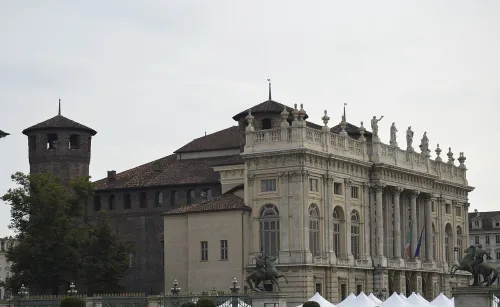
    Palazzo Madama in Turin, stop 3 on the self-guided walking tour

    Palazzo Madama stands in the middle of Piazza Castello, and it plays by its own rules. Together with the Casaforte degli Acaja it forms a complex of its own: a separate palace museum with its own ticket for the permanent collections, while special exhibitions are sometimes priced differently. Don't treat it as a corridor between the palace and the square.

    What makes the building remarkable is what lies under it. Here was the eastern entrance to the Roman castrum, probably the Porta Praetoria, though some historians say the Decumana, which opened onto the decumanus maximus, today's Via Garibaldi. Remains of it are still preserved under the palace. In the Middle Ages the gate was renamed Fibellona. It had two sixteen-sided towers, four arches and walls running along today's Via Accademia delle Scienze towards the Giardini Reali, and it was tested by barbarian invasions and the Lombard duchy before being reinforced again and again.

    Be honest about your appetite here. If the Royal Palace already took your morning, Madama keeps perfectly well for another day. If you skipped the palace, this is a good place to spend your indoor history time instead. Either way, walk around the outside and picture how a Roman gate became a fortress and then a palace.

    The square is all around you: 120 metres, about 2 minutes, takes you to a spot where you can see Piazza Castello as a whole.

    Hours
    Mon, Wed–Sun 10:00–18:00 (last entry 17:00), Tue closed
    Price
    10 EUR full, 8 EUR reduced (EU 18-25, over 65)
  4. 4

    Piazza Castello

    Piazza Castello in Turin, stop 4 on the self-guided walking tour

    Now you are standing in Turin's main square, the heart of the historic centre. Four main streets meet here: pedestrian Via Garibaldi, Via Po, Via Roma and Via Pietro Micca. The square is laid out as a square, with Palazzo Madama in the middle and elegant porticoes, built in different periods, running around the edges.

    Turn slowly and read the perimeter. To the north is the Prefecture building with the Royal Armoury, to the east the Teatro Regio, to the north-west the Real Chiesa di San Lorenzo, to the south-east the Galleria Subalpina, which you'll walk through later, and to the south-west the Torre Littoria. On the west side two noble palaces frame Via Garibaldi; one of them housed the Piedmont regional government before it moved into a skyscraper in Nizza Millefonti.

    To the north-west the square opens into the smaller Piazzetta Reale, lined by Palazzo Chiablese, which leads to the Royal Palace and to the passage towards Piazza San Giovanni and the Duomo. In the Lombard period the Bishop's Palace rose on the west side, where the Royal Palace stands now, and from it you could walk straight into the old church that the Duomo replaced in 1469. The square sits at 239 metres above sea level, worth remembering when you reach the hill at the end.

    From here, follow the Via Roma axis for 550 metres, about 8 minutes, to Piazza San Carlo.

    Hours
    Open 24/7
    Price
    Free
  5. 5

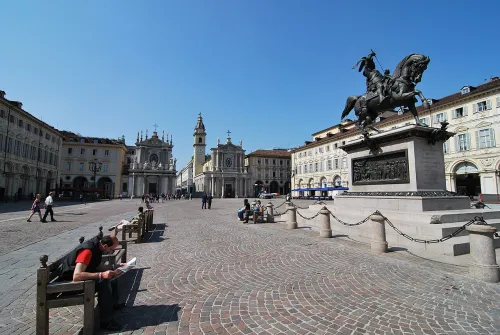
    Piazza San Carlo

    Piazza San Carlo in Turin, stop 5 on the self-guided walking tour

    Locals call Piazza San Carlo “il salotto della città”, the city's living room, and its shape tells you why: a tidy rectangle 168 metres long and 76 metres wide, covering 12,768 square metres and framed by matching façades and porticoes. Its present look dates to the 17th century and a design by Carlo di Castellamonte, enriched in the following century by Benedetto Alfieri.

    In the centre rides Emmanuel Philibert again, the duke you met at the Royal Palace. Carlo Marochetti's monument of 1838 shows him sheathing his sword after the victory at San Quintino. In Piedmontese the statue is simply the Caval ëd Bronz, the bronze horse.

    The palaces around the square carry long family histories. On the long east side stand Palazzo Villa and Palazzo Solaro del Borgo at number 183, a three-storey building designed by Castellamonte for the marchese De Senantes, reworked by Alfieri in 1753 for the Isnardi di Caraglio, sold in 1770 to the Asinari di Bernezzo and resold in 1782 to the Solaro del Borgo. Today it is a hotel and the seat of the Società del Whist. Next to it, at number 197, is Palazzo Giriodi di Monastero Panissera, once owned by the Turinetti di Cambiano.

    The square is free, so take a slow lap under the porticoes. Then it's 240 metres, about 3 minutes, to the Egyptian Museum.

    Hours
    Open 24/7
    Price
    Free
  6. 6

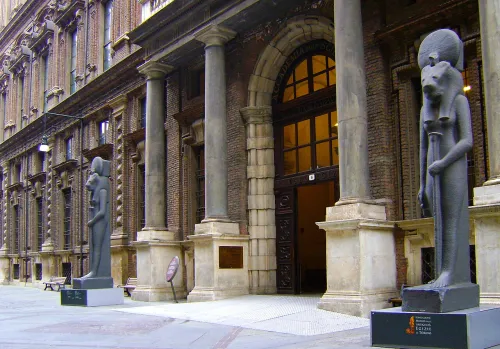
    Egyptian Museum

    Egyptian Museum in Turin, stop 6 on the self-guided walking tour

    The Egyptian Museum is the reason many people come to Turin. With more than 40,000 artefacts it is considered the second most important Egyptological collection in the world after Cairo's, and having been founded in 1824 by King Charles Felix, it is the oldest museum devoted entirely to ancient Egyptian culture. In 2024 it welcomed 1,036,689 visitors, one of the highest figures of any museum in Italy.

    The collection grew out of curiosity. The first Egypt-related object to reach Turin, in 1630, was the Mensa Isiaca, an altar table only imitating Egyptian style, possibly made for a temple of Isis in Rome. It intrigued King Charles Emmanuel III enough that in 1753 he sent the botanist Vitaliano Donati to Egypt, and Donati came back with 300 pieces from Karnak and Coptos, the nucleus of the museum. In 1824 Charles Felix bought the Drovetti collection, 5,268 pieces gathered by the French consul Bernardino Drovetti, including 100 statues, 170 papyri, stelae and mummies. In 1833 more than 1,200 pieces from Giuseppe Sossio followed, and Ernesto Schiaparelli's excavations between 1900 and 1920 filled the gaps.

    Look at the papyri with a story in mind. In 1824 Jean-François Champollion used Turin's huge papyrus collection to test his breakthroughs in reading hieroglyphs, and his stay gave rise to the legend of the vanished “Papiro dei Re”, the papyrus of the kings. It turned up later, but some portions are still missing; in 1950 someone even asked a parapsychologist to locate them, without success.

    If you only go inside one museum on this walk, make it this one, and allow a couple of hours. The Museum of the Risorgimento is just 120 metres on, about 2 minutes.

    Local name
    Museo Egizio di Torino
    Hours
    Mon 09:00–14:00, Tue–Fri 09:00–18:30, Sat 09:00–20:00, Sun 09:00–18:30 (last entry 1 hour before closing)
    Price
    18 EUR full, 15 EUR reduced (over 70, journalists), 3 EUR student (15-18 & university), 1 EUR junior (6-14)
  7. 7

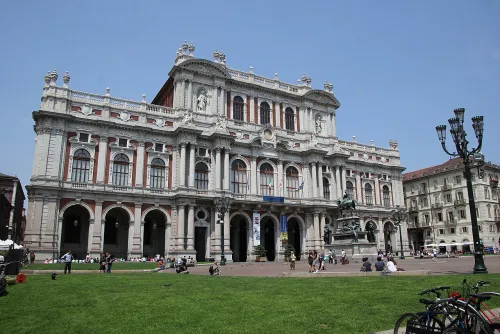
    Museum of the Risorgimento

    Museum of the Risorgimento in Turin, stop 7 on the self-guided walking tour

    The Museum of the Risorgimento fills the noble floor of the historic Palazzo Carignano. Founded in 1878, it is the oldest and largest museum of Italian national history, and the only one officially entitled “national”, a status granted by royal decree on 8 December 1901. Its theme is the Risorgimento, the era in which Italy became one state.

    The objects span a wider period, from the siege of Turin in 1706 to the birth of the Italian Republic in 1946, with the focus on the years from the late 18th century to the First World War. It all began with a gift: on 2 February 1878, at the wish of Umberto I, the belongings of Victor Emmanuel II, the first king of Italy, were donated to the city. They are still in the first room: his helmet, his sword and his medals.

    Look closely at the sword, carried at the battles of Palestro and San Martino in 1859. It has a white ivory grip, and its steel blade is engraved “Viva Carlo Alberto” on one side and “Viva l'Italia” on the other. Among the six medals is a gold one for military valour inscribed “Goito 30 maggio 1848”, and a French silver medal bearing the profile of Napoleon III.

    This ticketed visit suits anyone curious about how Italy was unified. If the Egyptian Museum already used up your energy, carry on and come back another day. The Galleria Subalpina is 180 metres away, about 3 minutes.

    Local name
    Museo nazionale del Risorgimento italiano
    Hours
    Tue–Sun 10:00–18:00 (last entry 17:00), Mon closed
    Price
    12 EUR full, 10 EUR reduced (groups 10+, over 65, military), 6 EUR (20-26 yrs, Unitre), 4 EUR (6-19 yrs)
  8. 8

    Galleria Subalpina

    Galleria Subalpina in Turin, stop 8 on the self-guided walking tour

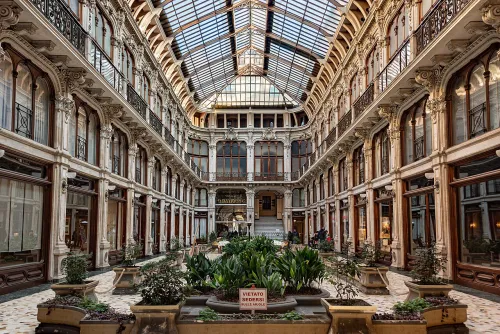
    The Galleria Subalpina is a 19th-century shopping arcade modelled on the Parisian passages and built for the leisure of Turin's middle class, and it's free to walk through. The hall is 50 metres long, 14 wide and about 18 metres high, its height softened by a balcony running around the whole perimeter. The eclectic decoration, mixing Renaissance and Baroque elements, is the work of the sculptor Edoardo Rubino.

    Pietro Carrera designed it in 1873; work began on 25 June that year and it opened on 30 December 1874. It takes its name from the Banca dell'Industria Subalpina, which paid for the construction. It was Turin's second gallery, after the Galleria Natta of 1858, which was demolished in 1931 when Via Roma was rebuilt, and before the Galleria Nazionale and the Galleria Umberto I.

    From the start it held places that became institutions: the Caffè Baratti & Milano and, from 1897, the Caffè Concerto Romano, a regular haunt of the writer Edmondo De Amicis that later became the Nuovo Romano cinema. There were also an antiquarian bookshop, an art gallery and a couple of well-known restaurants. Bombs damaged the arcade in the Second World War; it was rebuilt faithfully to the original drawings, and the large flowerbed now filling the centre follows Carrera's first plan.

    From here it's 770 metres, about 10 minutes, to the Mole Antonelliana.

    Hours
    Daily: 08:00–00:00
    Price
    Free
  9. 9

    Mole Antonelliana

    Mole Antonelliana in Turin, stop 9 on the self-guided walking tour

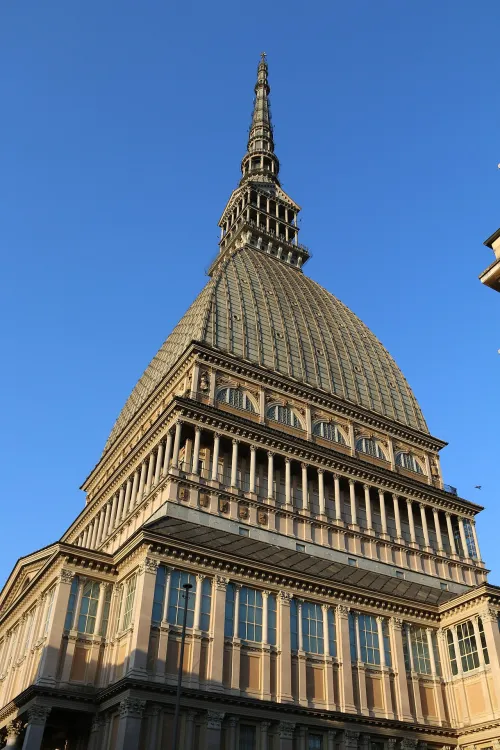
    The Mole Antonelliana is named after its architect, Alessandro Antonelli; a “mole” in Italian is simply a building of monumental size. Construction began in 1863, soon after Italian unification, and was completed in 1889, after Antonelli's death. Today it houses the National Museum of Cinema and is believed to be the tallest museum in the world. You may already carry it in your pocket: it appears on the Italian 2 euro cent coin.

    It was meant to be a synagogue. Turin's Jewish community had enjoyed full civil rights since 1848, and Turin was capital of the new Italian state from 1860 to 1864. Wanting a building worthy of a capital, the community set a budget of 250,000 lire and hired Antonelli, who had just added a 121 metre dome and spire to the Basilica of San Gaudenzio in Novara and promised a synagogue for 280,000 lire.

    Then ambition took over. Antonelli kept modifying the design and pushed the height to 167.5 metres, more than 46 metres above the original dome. Costs and delays grew, work stopped in 1869 under a provisional roof, and with the capital moved to Florence in 1864 the community shrank. In 1876, having spent 692,000 lire on a building still far from finished, it withdrew. The people of Turin, who had watched the structure rise into the sky, demanded that the city take it over, and it did.

    Inside, look up at the Catalan vaults in the ceiling of the ground floor under the atrium, a technique rare in Italy and popular in Spain, where it originated. You can buy a ticket for the cinema museum, for the lift, or both together: film lovers should take the museum, while the lift alone covers the ride up the building.

    The next leg is the longest on the route, 1,070 metres and about 15 minutes, to the Gran Madre di Dio Church. On the way you pass the Accorsi-Ometto Museum, a lesser-known address to note for another visit.

    Hours
    Mon, Wed–Sun 09:00–19:00 (last entry 18:00), Tue closed
    Price
    18 EUR Museum only, 9 EUR Lift only, 23 EUR Museum + Lift (reduced: 16 EUR Museum, 7 EUR Lift, 20 EUR combined)
  10. 10

    Gran Madre di Dio Church

    Gran Madre di Dio Church in Turin, stop 10 on the self-guided walking tour

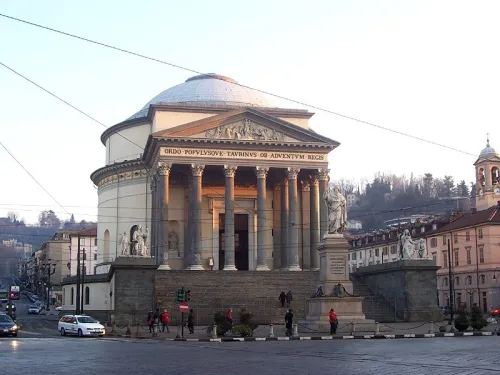
    The Gran Madre di Dio is a neoclassical church dedicated to Mary, Mother of God. It stands on the bank of the Po, facing the Ponte Vittorio Emanuele I, which leads into Piazza Vittorio Veneto. Its design was inspired by the Pantheon in Rome, and entry is free.

    It is a political monument as much as a church. The idea came in 1814, after Napoleon's defeat, to celebrate King Victor Emmanuel I's return to the throne after 16 years in exile. The tympanum spells it out: ORDO POPVLVSQVE TAVRINVS OB ADVENTVM REGIS, “the nobility and the people of Turin for the return of the king”. The planners also wanted the church to close the long vista running from Piazza Castello to the hill, with its own square as a kind of extension of Piazza Vittorio across the river.

    Ferdinando Bonsignore won the design competition. Work began in 1818, paused for nearly a decade, resumed in 1827 under Charles Felix, and the church was inaugurated in 1831 under Charles Albert. Giuseppe Formento contributed, the engineer Virginio Bordino raised the columns of the façade, and the architect Luigi Canina was consulted. Flanking the entrance on two high plinths are Carlo Chelli's statues of Faith, holding a chalice, and Religion.

    Before you go on, turn around and look back along the vista the church was built to close. The last leg climbs the hill: 700 metres in about 13 minutes to Monte dei Cappuccini.

    Hours
    Mon–Sat 08:00–19:00, Sun 08:00–22:00
    Price
    Free
  11. 11

    Monte dei Cappuccini

    Monte dei Cappuccini in Turin, stop 11 on the self-guided walking tour

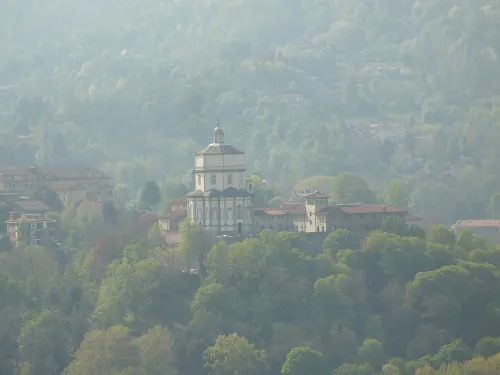
    Your walk ends on Monte dei Cappuccini, a hill 325 metres above sea level, about 200 metres from the bank of the Po in the Borgo Po district. It's free, and the panoramic terrace at the top is where to catch your breath and look back over the city you've just crossed.

    On top stand the convent and the late-Renaissance, Mannerist church of Santa Maria al Monte dei Cappuccini, with Baroque interiors, looked after by the Capuchin friars who gave the hill its name. The south wing of the convent houses the National Mountain Museum Duca degli Abruzzi, entered from the terrace. The hill also holds the national library of the Italian Alpine Club and, rather unexpectedly, an underground nuclear physics laboratory.

    The hill has guarded a crossing of the Po since antiquity. In the 1st century BC the Romans built a small temple to Jupiter on the summit, known from remains found in the 16th century. A simple tower, the Bastita Taurini, went up from the 11th century, and there was a little Romanesque chapel to the Virgin, Santa Maria alla Bastita. From 1204 to 1314 the Knights Templar held it as a fortified post, and recent digs have turned up objects from their time. In 1238 Emperor Frederick II gave the fortification to Tommaso II of Savoy, who made it a true military stronghold, strengthened again and again against sieges.

    This is the finish. If you still have energy, the Mountain Museum is right on the terrace; otherwise simply stay a while and let the walk settle.

    Hours
    Open 24/7
    Price
    Free
Walking tour route map of Turin Route loaded
Porta Palazzo MarketRoyal Palace of TurinPalazzo MadamaPiazza Castello+7
All 11 stops are already on the map.
You just press start.
AI Tour Guide

You've just read the route. Now walk it with a guide in your ear.

Press start wherever you are, even hundreds of kilometres from Turin, and the guide begins telling its stories right away. In the city, pick any of the 11 stops to start from: it leads you there, then talks with you the whole route, asking, listening, remembering, and shaping the tour around your answers.

11stops 4.7km 1 h 7 minwalking 13languages
▶Start the tour free

Free to start · Runs in your browser · No app, no download

Three Ways to Shorten or Split the Walk

You don't have to do it all in one go. Pick the version that fits your time and your appetite for museums.

Outside only, no tickets

Stops: 1, 2, 3, 4, 5, 6, 7, 8, 9, 10, 11

For a first look at the city on a tight budget. You walk the whole route, 4.7 km and 1 h 7 min on foot, and see the palaces and museums from outside. The market, the squares, the Galleria Subalpina, the Gran Madre di Dio Church and the hill cost nothing.

Royal and Egyptian core

Stops: 1, 2, 3, 4, 5, 6, 7, 8

For history and museum lovers. From the market to the Galleria Subalpina it's about 2.1 km and 31 minutes of walking. Four ticketed stops sit on this stretch: the Royal Palace of Turin, Palazzo Madama, the Egyptian Museum and the Museum of the Risorgimento. Choose one or two rather than all four.

Mole, river and hill

Stops: 8, 9, 10, 11

For an afternoon or a second day. From the Galleria Subalpina to Monte dei Cappuccini it's about 2.5 km and 38 minutes of walking, with the longest legs of the route. Only the Mole Antonelliana charges entry.

How Long Does This Turin Tour Take, With and Without Museums?

The walking itself takes 1 h 7 min. The first half is a tight cluster: from the Royal Palace to the Galleria Subalpina most legs take two or three minutes. The longest stretches come at the end, 15 minutes from the Mole to the Gran Madre and 13 minutes up to the hilltop.

Go inside the Royal Palace (about 90 minutes), the Egyptian Museum (two hours) and the Mole (an hour), add half an hour at the market and short pauses at the free stops, and you're looking at around seven hours. Most people pick one of the two big collections and save the other for another day, which brings the walk to about five and a half hours.

Outside only, the full route takes about three hours. The royal and Egyptian core with the palace and the Egyptian Museum inside fills around five hours, and the Mole, river and hill stretch about two and a half.

Before You Set Off in Turin

  • Start: Porta Palazzo Market is the recommended start, but you can join at any stop; the GPS route guides you on from wherever you begin.
  • Finish: Monte dei Cappuccini, on the hill by the Po. The route ends here, not where it began.
  • Time of day: Start in the morning so you catch the market and still have hours for the museums later.
  • Tickets: Five stops charge entry: the Royal Palace of Turin, Palazzo Madama, the Egyptian Museum, the Museum of the Risorgimento and the Mole Antonelliana. Everything else is free.
  • Closing days: The ticketed museums each have a weekly closing day, and not all on the same day, so check the hours of the ones you want before you pick your date.
Walking tour route map of Turin
AI Tour Guide

Your guide is ready when you are, at the market or anywhere along the way

Press start and a voice AI Tour Guide takes it from here: leading the route through Turin, telling the stories, and turning your walk into a real back-and-forth conversation. No app or download is needed; it runs in your browser.

11stops 4.7km 1 h 7 minwalking 13languages
▶Start the tour free

Free to start · Runs in your browser · No app, no download

What the AI Tour Guide Adds Between Palaces and the Po

On this walk one family runs through every stop: Emmanuel Philibert at the Royal Palace and on his bronze horse, Christine Marie's new court, Charles Felix buying Egypt and restarting a church. The AI Tour Guide follows that thread as a conversation. It greets you at the market, tells the stories of each place, asks what you're curious about and remembers it, so by the Mole it knows whether you'd rather hear about architects or kings. Ask why Christine's son was fighting a civil war or what daily life at court was like, and cut in whenever you like. You start with 100 free credits; after that it's €19.99 for this tour all-inclusive with no time limit, or €5 per hour.

A Real Conversation A voice AI Tour Guide greets you, leads the whole route, and tells the stories and facts as you walk, asking what you want to see and keeping a real conversation going. Not a recording you press play on.
Map Navigation Follow the route on the map and walk at your own pace. You choose where to start and when to move to the next stop.
Ask Anything Curious about a building you pass? Ask your AI Tour Guide on the spot and the conversation carries on.
13 Languages Switch language anytime. No separate tour needed.
Start free in your browser

Common Questions About Walking Turin

Can I see the Shroud of Turin on this walk?

The Chapel of the Holy Shroud, built to house it, is part of the Royal Palace complex, so it comes with the palace visit. Ask at the ticket desk what is currently on view in the chapel.

Can I walk the route in reverse?

Yes. The GPS route guides you from any stop. Reversed, you'd start on the hill and finish among the market stalls, so check that the market is still running when you'd arrive.

What should I do if it rains?

Shift the weight indoors: the Egyptian Museum, the Royal Palace and the Mole can each fill hours, and the Galleria Subalpina is a covered arcade. The porticoes around Piazza Castello and Piazza San Carlo give shelter between stops.

Is Turin a good base for day trips?

Yes, several cities with their own walking routes are within reach: Aosta is about 80 km away, Genoa about 122 km and Milan about 125 km.

Is the tour really free?

Yes. The whole tour is free: the route, the interactive map and the navigation cost you nothing. Only the voice AI Tour Guide is optional and paid: you test it with 100 free credits, then you pay either €5 per hour or €19.99 for this whole tour, with no time limit. Admission to 5 of the 11 stops is not included: Royal Palace of Turin, Palazzo Madama, Egyptian Museum, Museum of the Risorgimento and Mole Antonelliana charge their own entry fees.

Do I need to download an app?

No. Everything runs in your phone browser. Open the route and start walking, no download and no sign-up required.

Do I need to book the walking tour in advance?

No booking needed. This self-guided tour is available anytime. Open the route in your browser and start walking. The AI Tour Guide works instantly, no app, no reservation required.

What languages is the AI Tour Guide available in?

The AI Tour Guide speaks 13 languages, so you take the tour in your own language and can switch at any time.

Can I skip stops or change the route?

Yes. Skip any stop, spend extra time at places you like, or start the route from any point. It is your walk, you set the pace.
Image credits
▶ Start free in your browser Runs in your browser, no app, no download