
Free Walking Tour Oslo: Munch to the Opera Roof

Start with Munch in Bjørvika, walk through a medieval fortress, the Nobel Peace Prize hall and Karl Johan, and end on the opera's sloping marble roof.

10 Stops 6.3 km ~1 h 27 min walking
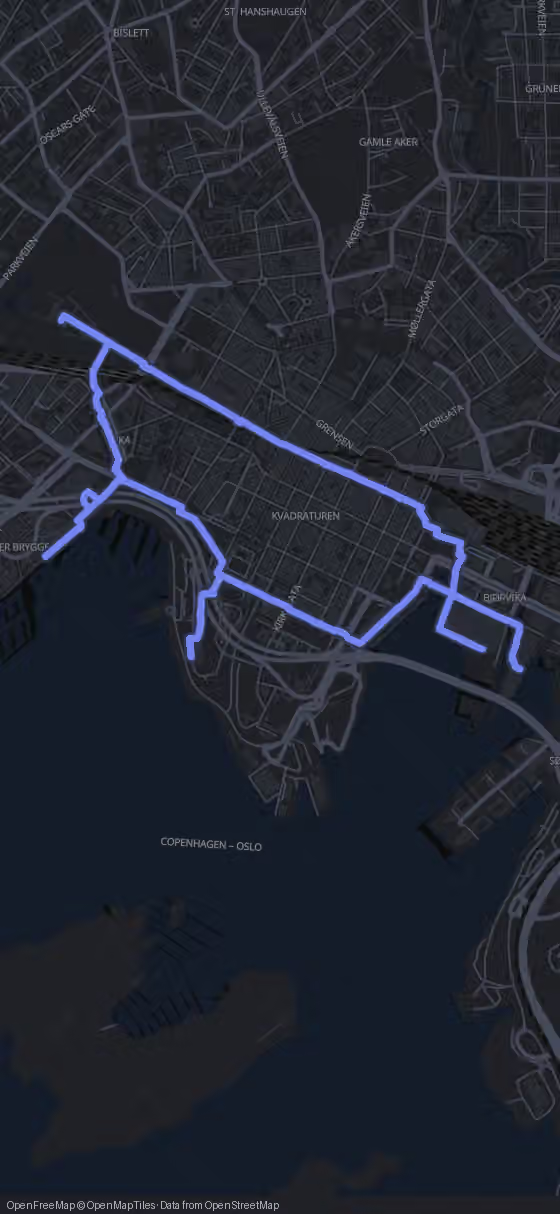
Route map for the Oslo walking tour
Stop 1 of 10
1.8 km·22 min
Munch Museum
Head west along the harbor toward Akershus Fortress.
God dag, welcome to Oslo. I'm Alex, and this city has a habit of turning its art and architecture over to the public.
Try this tour with Alex

This Oslo Route at a Glance

Ten stops over 6.3 km: from the Munch Museum past Akershus Fortress, the harbour at Aker Brygge, the Royal Palace and Karl Johans gate to the Oslo Opera House. Pure walking time is 1 h 27 min; with time at the stops, plan about four and a half hours, more if you go into a museum.

Oslo City Hall, Oslo Cathedral, the fortress grounds and the opera building are free; the Munch Museum, Nobel Peace Center and National Museum charge admission. The GPS route runs free in your browser, and the AI Tour Guide is optional.

Open free GPS & optional AI Tour Guide
This short shows highlights of the route. All 10 stops follow below.

The Route

Walking Map of Oslo, From Munch to the Opera

10 stops 6.3 km 1 h 27 min walking
Tap to load interactive map

The 10 stops along this route

  1. Munch Museum in Oslo, stop 1 on the self-guided walking tour
    1Munch Museum
  2. Akershus Fortress in Oslo, stop 2 on the self-guided walking tour
    2Akershus Fortress
  3. Oslo City Hall, stop 3 on the self-guided walking tour
    3Oslo City Hall
  4. Nobel Peace Center in Oslo, stop 4 on the self-guided walking tour
    4Nobel Peace Center
  5. National Museum in Oslo, stop 5 on the self-guided walking tour
    5National Museum
  6. Aker Brygge in Oslo, stop 6 on the self-guided walking tour
    6Aker Brygge
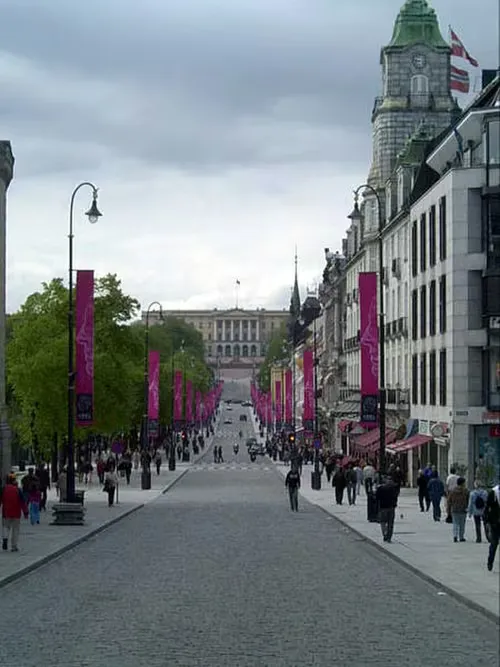
  7. Royal Palace in Oslo, stop 7 on the self-guided walking tour
    7Royal Palace
  8. Karl Johans gate in Oslo, stop 8 on the self-guided walking tour
    8Karl Johans gate
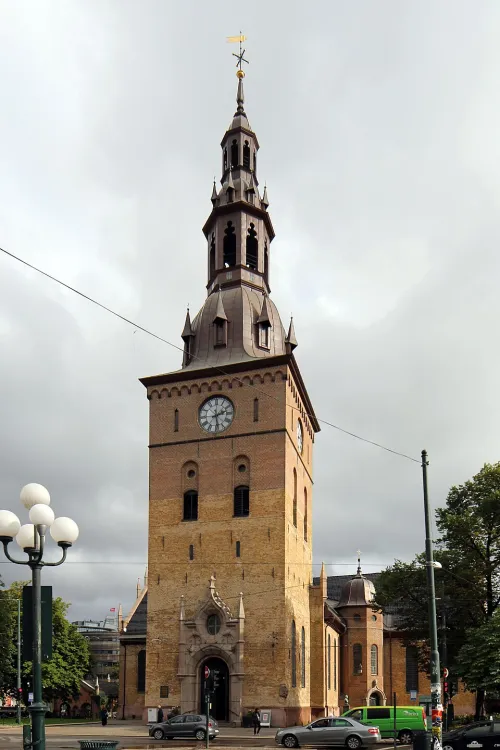
  9. Oslo Cathedral, stop 9 on the self-guided walking tour
    9Oslo Cathedral
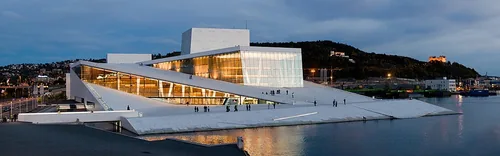
  10. Oslo Opera House, stop 10 on the self-guided walking tour
    10Oslo Opera House
  11. That's the full route.

    Walk it with an AI Tour Guide talking you through every one of these streets.

    Start free in your browser
    You made it

Your Oslo Walking Tour: Ten Stops Along the Fjord and Karl Johan

  1. 1

    Munch Museum

    Munch Museum in Oslo, stop 1 on the self-guided walking tour

    You begin in Bjørvika at MUNCH, as the Munch Museum has been branded since 2020. It is devoted to the life and work of Edvard Munch, and since 2021 it has lived in this new building. Before that it sat at Tøyen, the site chosen for it back in 1951.

    Munch himself took part in early talks about a museum during his lifetime, but it only opened in 1963, a hundred years after his birth. What fills it is his bequest to the municipality of Oslo, one of the world's largest collections of works by a single artist: almost 28,000 artworks and more than 42,000 museum objects. Three more private gifts sit alongside it, the collections of Rolf Stenersen, Amaldus Nielsen and Ludvig O. Ravensberg, together spanning almost a century of art history. In 2025, 775,000 visitors came through the doors.

    Inside, five collection exhibitions run at any time, so you see Munch across his whole range rather than a handful of famous canvases. Look closely at the surfaces: he used materials in untraditional ways and experimented with technique, which gives his pictures their unique look and gives the museum's conservators a constant puzzle. Six or seven temporary shows a year bring in modern and contemporary artists other than Munch, plus music, talks and performances.

    Is it worth the ticket? If Munch is part of why you came to Oslo, yes: give it a good hour or two before you set off. If you mainly want to stand in front of the first version of The Scream, that one belongs to the National Museum later on this walk, and you could save your museum time for it. From here it's 1740 m, about 24 minutes, to Akershus Fortress, and on the way you pass the Resistance Museum.
    Hours
    Sun–Tue 10:00–18:00, Wed–Sat 10:00–21:00
    Price
    280 NOK adult (10:00-18:00), 200 NOK (18:00-21:00 discount), 100 NOK under 25, 0 NOK under 18
    Website
    munch.no ↗
  2. 2

    Akershus Fortress

    Akershus Fortress in Oslo, stop 2 on the self-guided walking tour

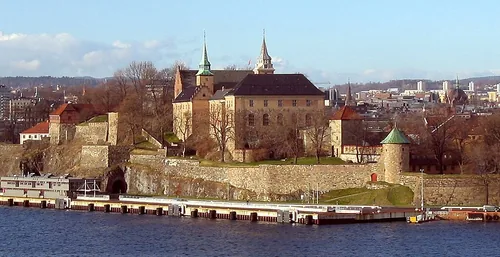
    Akershus Fortress stands on the banks of the Oslofjord, a medieval castle built both to defend the city and to house its kings. The grounds are free to walk, and they're the place to slow down. Keep the water in view: in the Middle Ages most Norwegian trade moved by sea, so the closeness of the fjord was the whole point of the site.

    Nobody knows exactly when building began, but it was most likely in the late 1290s under King Haakon V. The trigger was an attack on Oslo in 1287 by Earl Alv Erlingsson of Sarpsborg, which showed the old defences weren't enough. The castle first shows up in writing in 1300, in a letter from King Haakon to a church in Oslo, which says nothing about how far the work had got.

    Its first test came in 1308, when the Swedish duke Erik Magnusson laid siege; a local Norwegian army broke the siege in battle, an episode Sigrid Undset later wove into In the Wilderness, part of The Master of Hestviken. The fortress came through every siege after that too, mostly by Swedish forces, including Charles XII's in 1716.

    Since then it has served as a military base and a prison, and today it is the temporary office of Norway's prime minister. Its name even spread over the land: Akershus became the name of the fief and later the county that once covered most of Eastern Norway. The fortress museums charge admission; for most walkers, the grounds and walls are enough. Then it's 790 m, 11 minutes, to Oslo City Hall.

    Local name
    Akershus festning
    Hours
    Grounds: main gate daily 06:00–21:00 (May–Sep side gates weekdays 07:00–21:00/weekends 08:00–21:00; Oct–Apr side gates daily 07:00–18:00)
    Price
    Free (grounds); Museums NOK 100-150
  3. 3

    Oslo City Hall

    Oslo City Hall, stop 3 on the self-guided walking tour

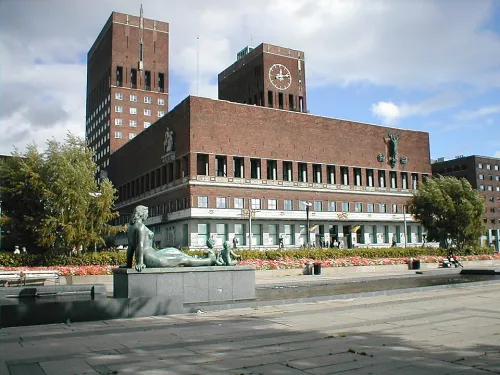
    Oslo City Hall is hard to miss: red brick, two towers of 63 and 66 metres, facing the Oslofjord at the northern edge of Pipervika. Look at the bricks. They're bigger than was usual when the building went up, roughly the size used in the Middle Ages, about 27.5 × 13 × 8.5 cm, made by Hovin Teglverk here in Oslo. The eastern tower carries a carillon of 49 bells.

    Architects Arnstein Arneberg and Magnus Poulsson designed it, and it was built between 1931 and 1950, with a break during the Second World War. It houses the city council and the city administration, and every December it hosts the Nobel Peace Prize ceremony. Entry is free, so go in and see where the prize is presented.

    The road to this building was long. In the Middle Ages several buildings seem to have served as city hall, one of them reportedly with a wine cellar open to the public. Then in 1624 all of old Oslo burned, and King Christian IV ordered the new city built north of Akershus Fortress, with wide streets at right angles. Its first city hall, finished in 1641, still stands at Nedre Slottsgate 1 and is known today as the old City Hall. By 1733 the council had moved to Rådhusgaten 7, and in the 1800s the growing administration spread across town.

    Competitions in 1876 and 1898 for a new hall at Hammersborg came to nothing for lack of money, and architect Oscar Hoff's 1906 idea of building in Pipervika stalled as well, long before this one finally rose. The Nobel Peace Center is only 190 m away, a 3 minute walk.

    Local name
    Oslo rådhus
    Hours
    Daily: 09:00–16:00
    Price
    Free
  4. 4

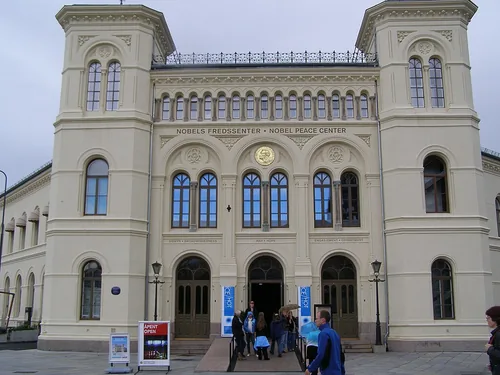
    Nobel Peace Center

    Nobel Peace Center in Oslo, stop 4 on the self-guided walking tour

    The Nobel Peace Center is the museum of the Nobel Peace Prize: after the hall where the prize is presented, this is where you meet the people who received it. It occupies the main building of the former Vestbanen station on Rådhusplassen. The Storting decided to create it in 2000, and it opened in 2005.

    Its task is to share the laureates' ideas and work through exhibitions, events, activities and digital formats, with the aim of inspiring change, large and small, toward a more peaceful world. Since opening it has built an international name for documentary photography, and it has become a forum for public debate on peace, human rights and dialogue. In a normal year it welcomes more than 200,000 visitors, among them several hundred school groups.

    It is run as an independent foundation, funded by state grants (around half the budget), sponsorship and ticket sales. Admission is charged. Go in if the stories behind the prize or strong documentary photography draw you; an hour suits most visitors. If you've already set your museum time aside for Munch, you can skip it without losing the thread of the walk.

    The National Museum is just 80 m away, a one minute walk.

    Local name
    Nobels Fredssenter
    Hours
    Daily 10:00–18:00 (seasonally different, individual days may vary)
    Price
    180 NOK
  5. 5

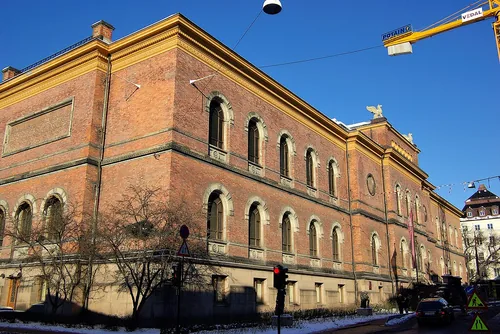
    National Museum

    National Museum in Oslo, stop 5 on the self-guided walking tour

    The National Museum holds the Norwegian state's public collection of art, architecture and design, more than 400,000 works. Among them is the first version of Edvard Munch's The Scream, from 1893, which makes this the place to tie up the Munch thread you started in Bjørvika.

    The museum itself is young. It was created in 2003 by merging five institutions: the Museum of Architecture, the Museum of Industrial Art, the Museum of Decorative Arts and Design, the Museum of Contemporary Art and the National Gallery of Norway. All of them had become too small, so a shared new building was a condition from the start. Earlier competitions for a site at Tullinløkka, in 1972 and 1995, had led nowhere.

    In 2008 the government chose Vestbanen, where the old Oslo West Station once stood. The German firm Kleihues + Schuwerk won the international competition in 2010 with a project called Forum Artis, presented in 2013 at about 5.3 billion kroner. Planned for 2020, the building opened in 2022; the old National Gallery closed in January 2019 and served as storage until the collections moved here.

    Admission is charged. If you're choosing just one museum on this walk and want Norwegian art broadly rather than one artist in depth, this is it; plan at least an hour and a half. Then walk 300 m, about 4 minutes, to Aker Brygge.

    Local name
    Nasjonalmuseet
    Hours
    1 September – 23 December: Tue–Wed 10:00–20:00, Thu–Sun 10:00–17:00, closed Mondays; 1 June – 31 August: also Mondays 10:00–17:00
    Price
    220 NOK; under 25: 100 NOK; students (under 30): 120 NOK; under 18 free
  6. 6

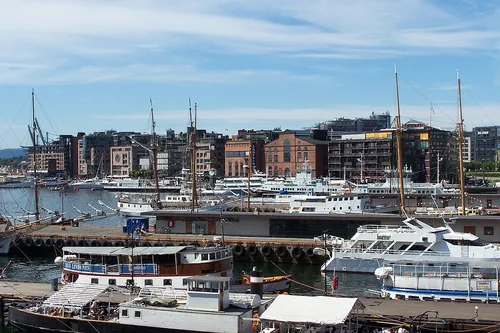
    Aker Brygge

    Aker Brygge in Oslo, stop 6 on the self-guided walking tour

    Aker Brygge is where Oslo comes to eat, shop and stroll by the water, and its promenade is free and always open. With 12 million visitors a year it is one of the most visited places in the city. About 6,000 people work here and around 900 call it home.

    It used to be a working place. The area was called Holmen, an old yard with a little industry, until the Akers Mekaniske Verksted shipyard set up here in 1854. The yard closed in 1982, and the developer Aker Eiendom rebuilt the site in four phases. Some industrial buildings were torn down, but several of the big workshop halls were rebuilt as shopping areas, so part of what you walk through was once shipyard.

    The first phase was finished in 1986, designed by Telje, Torp and Aasen; the last, the Storebrand insurance building facing Munkedamsveien, in 1998. Between 2010 and 2014 a new master plan by Space Group and Ghilardi + Hellsten livened up the parallel streets and cut an inside street right through the main buildings. Shops, restaurants, a cinema and offices share the area today.

    Next comes one of the longer legs: 1090 m, about 17 minutes, to the Royal Palace, so this is a good moment for a break.

    Hours
    Promenade continuously accessible; individual restaurants/shops have their own opening hours
    Price
    Free
  7. 7

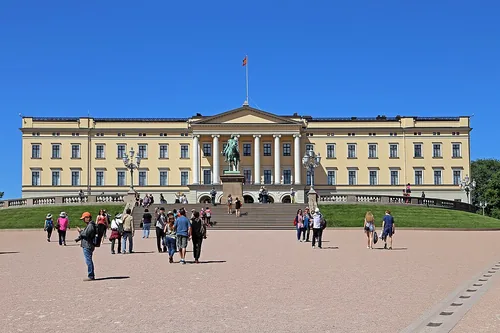
    Royal Palace

    Royal Palace in Oslo, stop 7 on the self-guided walking tour

    The Royal Palace is the official residence of the Norwegian monarch. It stands at the end of Karl Johans gate, with the Palace Square in front and the Palace Park around it. Inside visits are only possible on guided tours during a short summer season; the rest of the year, the square is your view of it.

    It was built in the first half of the 19th century for the French-born Charles XIV John, who reigned as king of Norway and Sweden and is counted in Norway as Charles III John. Until it was finished, royalty stayed at Paléet, a grand townhouse the wealthy merchant Bernt Anker had left to the state in 1805. Charles John picked this site on the western side of Christiania in 1821 and gave the design to Hans Linstow, a Danish-born officer with little experience as an architect.

    Work began in 1824, and on 1 October 1825 the king laid the foundation stone beneath the altar of the future palace chapel. Then the money ran out: costly foundations broke the budget, building stopped in 1827, and the Storting refused more funds in protest against the king's push for a closer union of his two kingdoms.

    Linstow came back in 1833 with a cheaper plan, dropping the projecting wings and adding a third storey instead. Once relations with the king improved, parliament paid, the roof went on in 1836 and the interiors were done in the late 1840s. From the square, walk 850 m, about 11 minutes, along the avenue to Karl Johans gate.

    Local name
    Det kongelige slott
    Hours
    Guided tours 20.06–16.08.2026
  8. 8

    Karl Johans gate

    Karl Johans gate in Oslo, stop 8 on the self-guided walking tour

    Karl Johans gate, simply “Karl Johan” to locals, is the main boulevard of central Oslo. It runs from the Central Station to the Royal Palace and carries the name of the king you just met there, Charles III John, born Jean Bernadotte. From the station to the Storting, the parliament, it is a pedestrian street. Along it stand the cathedral, the National Theatre, the University building and the Grand Hotel with its Grand Café.

    What you walk is really two streets. The eastern part, from the station square to Egertorg, lay inside King Christian IV's city walls and wasn't seen as one street at first; its pieces were called Østre Gade, Kirkebakken and Kirkestredet. The western part was planned by the palace architect Hans Linstow as a sightline and parade avenue. It was built in the 1830s, named Slotsvej, “Palace Road”, in 1840, and renamed after the king when he died in 1852.

    The western stretch grew into a showpiece of state and civic pride, like many 19th century boulevards. Landowners on the north side bought the plots on the south side and gave them to the city on condition that they became a park for students; the National Theatre was later built there. When the Storting went up in the 1860s, the two halves were joined at Egertorg, the street's highest point, yet they kept their different characters: the pedestrian part is mostly shops. The street was reworked again for 2005, the centenary of the end of the union with Sweden.

    Oslo Cathedral is 370 m away, about 5 minutes.

    Hours
    Open 24/7
    Price
    Free
  9. 9

    Oslo Cathedral

    Oslo Cathedral, stop 9 on the self-guided walking tour

    Oslo Cathedral, once called Our Savior's Church, is the main church of the Church of Norway's Diocese of Oslo and the parish church for downtown. The present building went up between 1694 and 1697 on a small rocky outcrop at the eastern end of what later became Stortorvet. Entry is free, and it's worth a quiet look inside.

    It is the city's third cathedral. The first, Hallvards Cathedral, was built by King Sigurd I in the first half of the 12th century about 1.5 km east of here, and for almost 500 years it was Oslo's most important church. When the city moved west after the 1624 fire, a new church was begun in 1632 on the new main square, and Hallvards Cathedral fell into ruin. The second cathedral, Holy Trinity, was built in 1639 and burned down after only 50 years; this one replaced it, probably to a design by the councillor of state Jørgen Wiggers.

    Between 1848 and 1850 the church was rebuilt to a plan by the German-born architect Alexis de Chateauneuf, with Heinrich Ernst Schirmer, also German-born, managing the work. More recently it closed for renovation in August 2006 and reopened with a festive high mass on 18 April 2010.

    The royal family and the government use the cathedral for public events. King Harald V and Queen Sonja married here on 29 August 1968, and Prince Haakon married Mette-Marit Tjessem Høiby here in August 2001. From the cathedral it's 870 m, about 12 minutes, to the last stop, the Oslo Opera House.

    Local name
    Oslo domkirke
    Hours
    Mon, Tue, Wed, Thu, Sat, Sun 10:00–16:00, Fri 16:00–24:00
    Price
    Free
  10. 10

    Oslo Opera House

    Oslo Opera House, stop 10 on the self-guided walking tour

    The Oslo Opera House is home to the Norwegian National Opera and Ballet, set in Bjørvika at the head of the Oslofjord. Its angled surfaces are clad in Carrara marble and white granite, so the building seems to rise out of the water. The roof slopes all the way to ground level and works as a public plaza: walk up it for panoramic views over Oslo. Going into the building is free; guided tours cost extra.

    After a long national debate, parliament decided in 1999 to build a new opera house. The Norwegian firm Snøhetta won the design competition out of 350 entries. Construction started in 2003 and was completed in 2007, ahead of schedule and 300 million NOK under its 4.4 billion NOK budget. It is the largest cultural building constructed in Norway since Nidaros Cathedral was completed around 1300.

    King Harald, Queen Margrethe II of Denmark and Finland's President Tarja Halonen attended the gala opening on 12 April 2008, and 1.3 million people came through the doors in the first year. Awards followed: the culture award at the World Architecture Festival in 2008 and the 2009 European Union Prize for Contemporary Architecture. Inside are 1,100 rooms and a main auditorium with 1,364 seats.

    Before you leave, look at the stage tower: it is clad in white aluminium, designed by Løvaas & Wagle to recall old weaving patterns. This is where the walk ends, back in Bjørvika, the neighbourhood where you started with Munch.

    Local name
    Operahuset
    Hours
    Mon–Sat 11:00–16:00, Sun 12:00–16:00
    Price
    Free (tours NOK 150)
Walking tour route map of Oslo Route loaded
Munch MuseumAkershus FortressOslo City HallNobel Peace Center+6
All 10 stops are already on the map.
You just press start.
AI Tour Guide

You know the route now. Walk it with a guide in your ear.

Press start wherever you are, even hundreds of kilometres from Oslo, and the guide begins telling its stories right away. In the city, pick any of the 10 stops to start from: it leads you there, then talks with you the whole route, asking, listening, remembering, and shaping the tour around your answers.

10stops 6.3km 1 h 27 minwalking 13languages
▶Start the tour free

Free to start · Runs in your browser · No app, no download

Shorter Ways to Walk Oslo

Short on time or only interested in one side of the city? These stretches follow the recommended order and use the same route.

Munch to The Scream

Stops: 1, 2, 3, 4, 5

For art lovers: from Munch's own museum past the fortress and City Hall to the National Museum, which holds the first version of The Scream. 39 minutes of walking. The Munch Museum, Nobel Peace Center and National Museum charge admission; the fortress grounds and Oslo City Hall are free.

The harbour core

Stops: 2, 3, 4, 5, 6

For half a day: fortress, City Hall and the waterfront, with one museum of your choice. 19 minutes of walking. The Nobel Peace Center and National Museum charge admission; everything else on this stretch is free.

Palace to Opera, free all the way

Stops: 7, 8, 9, 10

For a relaxed afternoon without tickets: palace, the main boulevard, the cathedral and the opera roof. 28 minutes of walking. All free, apart from guided tours of the opera.

How Long This Oslo Tour Takes, With and Without Museums

The full route is 6.3 km with 1 h 27 min of pure walking. The longest legs come at the very start and between Aker Brygge and the Royal Palace, while the harbour cluster from Oslo City Hall to Aker Brygge adds up to just 8 minutes of walking, so that's where the day naturally slows down.

With time at the free stops (fortress grounds, City Hall, Aker Brygge, the cathedral and the opera roof) and a look at the museums from outside, plan around four and a half hours. Each major museum you go into adds an hour or two; with both the Munch Museum and the National Museum, the walk fills a full day.

The Munch to The Scream variant takes around five hours with two museums. The harbour core fits into about three and a half hours with one museum. Palace to Opera is done in under two hours.

Before You Set Off From the Munch Museum

  • Start: The Munch Museum in Bjørvika is the recommended start, but you can join at any stop and follow the rest in order.
  • Finish: The walk ends at the Oslo Opera House. If you want to return to the start, the GPS navigation in your browser leads you back from the last stop.
  • Time of day: Start in the morning if you plan to go inside the Munch Museum and the National Museum, so neither visit feels rushed.
  • Tickets: The Munch Museum, the Nobel Peace Center and the National Museum charge admission, as do the museums at Akershus Fortress and guided tours of the Oslo Opera House. The fortress grounds, Oslo City Hall, Aker Brygge, Karl Johans gate and Oslo Cathedral are free.
Walking tour route map of Oslo
AI Tour Guide

Your Oslo guide is ready whenever you are.

Press start and a voice AI Tour Guide takes it from here: leading the route through Oslo, telling the stories, and turning your walk into a real back-and-forth conversation. No app or download is needed; it runs in your browser.

10stops 6.3km 1 h 27 minwalking 13languages
▶Start the tour free

Free to start · Runs in your browser · No app, no download

What the AI Tour Guide Adds on This Oslo Walk

On this route the threads run long: Christian IV's new city, Linstow's palace and avenue, Munch from Bjørvika to the old West Station. The AI Tour Guide carries those threads as a conversation. It greets you at the start, tells each place's story, asks what you're curious about and remembers it, so if you lingered at the fortress it leans into history, and if you stopped at every painting it leans into art. Ask it about the Resistance Museum you pass on the way to the fortress, or about the Storting on Karl Johan, and interrupt it whenever you like.

A Real Conversation A voice AI Tour Guide greets you, leads the whole route, and tells the stories and facts as you walk, asking what you want to see and keeping a real conversation going. Not a recording you press play on.
Map Navigation Follow the route on the map and walk at your own pace. You choose where to start and when to move to the next stop.
Ask Anything Curious about a building you pass? Ask your AI Tour Guide on the spot and the conversation carries on.
13 Languages Switch language anytime. No separate tour needed.
Start free in your browser

Common Questions About Walking Oslo

Which museum should I pick if I only have time for one?

For Munch in depth, the Munch Museum. For Norwegian art, architecture and design broadly, plus the first Scream, the National Museum. For the laureates' stories and documentary photography, the Nobel Peace Center.

Can I take a boat from Aker Brygge?

Yes. Aker Brygge has a ferry terminal with boats to Nesodden, and a small boat harbour as well.

Is there a tram stop along the route?

Aker Brygge has its own tram station, Aker Brygge, which is handy if you want to split the walk there.

Where can I walk next after Oslo?

In Norway, Bergen has its own walking tour. Further afield, try Gothenburg, Stockholm or Copenhagen.

Should I pay by the hour or buy the whole tour?

You start with 100 free credits. After that you choose: this tour all-inclusive for €19.99 with no time limit, or credits at €5 per hour. If you plan a full day with museums and want the guide along throughout, the all-inclusive option is the easier choice; for a short stretch, hourly credits fit well.

Is the tour really free?

Yes. The whole tour is free: the route, the interactive map and the navigation cost you nothing. Only the voice AI Tour Guide is optional and paid: you test it with 100 free credits, then you pay either €5 per hour or €19.99 for this whole tour, with no time limit.

Do I need to download an app?

No. Everything runs in your phone browser. Open the route and start walking, no download and no sign-up required.

Do I need to book the walking tour in advance?

No booking needed. This self-guided tour is available anytime. Open the route in your browser and start walking. The AI Tour Guide works instantly, no app, no reservation required.

What languages is the AI Tour Guide available in?

The AI Tour Guide speaks 13 languages, so you take the tour in your own language and can switch at any time.

Can I skip stops or change the route?

Yes. Skip any stop, spend extra time at places you like, or start the route from any point. It is your walk, you set the pace.
Image credits
▶ Start free in your browser Runs in your browser, no app, no download