Free Walking Tour Gothenburg: Harbour, Haga and Avenyn

Museum ships on the Göta River, a fish market that looks like a church, wooden Haga and a 17th-century fort: Gothenburg in one walk.

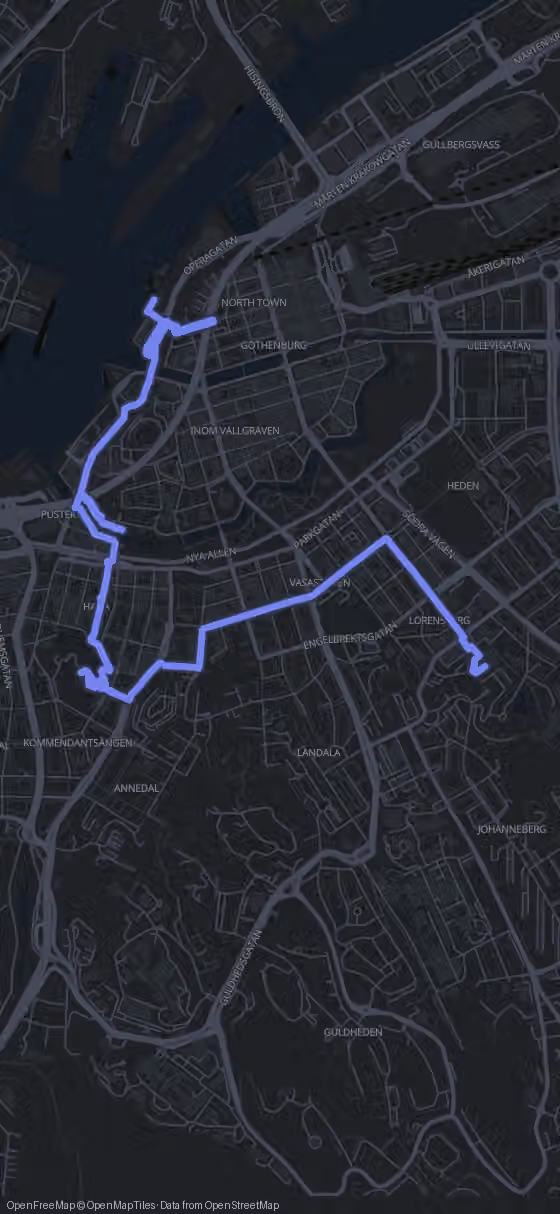
7 Stops 5.6 km ~1 h 22 min walking
Route map for the Gothenburg walking tour
Stop 1 of 7
630 m·8 min
Maritiman Maritime Museum
Head south-east toward Kronhusbodarna Market
Hej, welcome to Gothenburg. I'm Alex, and a red-brick storehouse here once hosted an extraordinary royal occasion.
Try this tour with Alex

Gothenburg on Foot at a Glance

Seven stops lead from the Maritiman Maritime Museum past Kronhusbodarna Market, Feskekörka Fish Market, Haga District and Skansen Kronan to Kungsportsavenyn Avenue and the Gothenburg Museum of Art. You cover 5.6 km with 1 h 22 min of pure walking; with both museums, plan a little under six hours.

Five stops are free; Maritiman and the art museum charge entry. The GPS route in your browser is free, and the optional AI Tour Guide tells the stories as you go.

Open free GPS & optional AI Tour Guide
This short shows highlights of the route. All 7 stops follow below.

The Route

Walking Map of Gothenburg from the River to Götaplatsen

7 stops 5.6 km 1 h 22 min walking
Tap to load interactive map

The 7 stops along this route

  1. Maritiman Maritime Museum in Gothenburg, stop 1 on the self-guided walking tour
    1Maritiman Maritime Museum
  2. Kronhusbodarna Market in Gothenburg, stop 2 on the self-guided walking tour
    2Kronhusbodarna Market
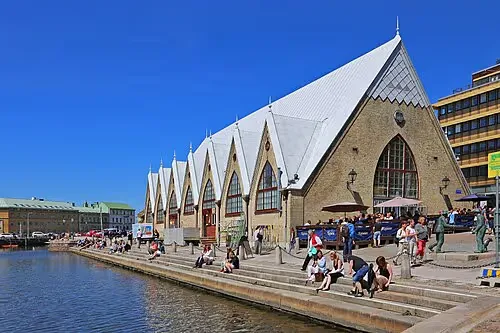
  3. Feskekörka Fish Market in Gothenburg, stop 3 on the self-guided walking tour
    3Feskekörka Fish Market
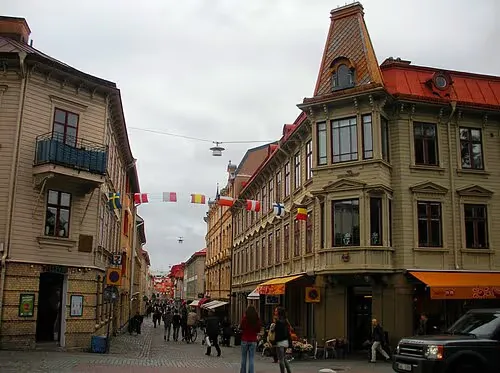
  4. Haga District in Gothenburg, stop 4 on the self-guided walking tour
    4Haga District
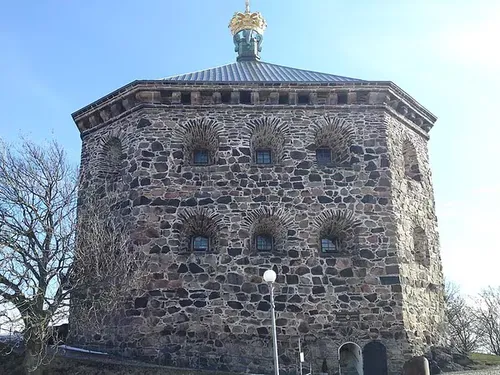
  5. Skansen Kronan in Gothenburg, stop 5 on the self-guided walking tour
    5Skansen Kronan
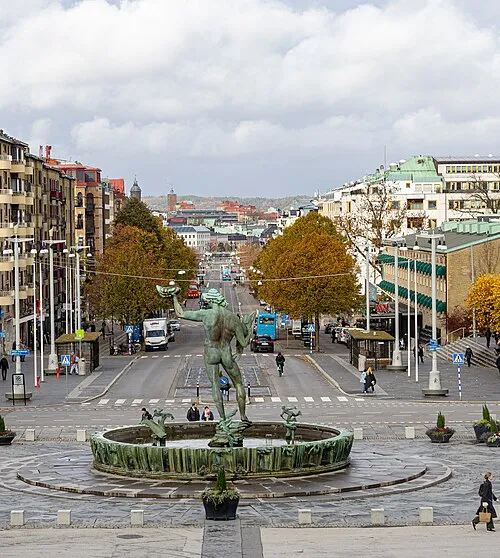
  6. Kungsportsavenyn Avenue in Gothenburg, stop 6 on the self-guided walking tour
    6Kungsportsavenyn Avenue
  7. Gothenburg Museum of Art, stop 7 on the self-guided walking tour
    7Gothenburg Museum of Art
  8. That's the full route.

    Walk it with an AI Tour Guide talking you through every one of these streets.

    Start free in your browser
    You made it

Your Gothenburg Walking Tour, Stop by Stop from Ships to Paintings

  1. 1

    Maritiman Maritime Museum

    Maritiman Maritime Museum in Gothenburg, stop 1 on the self-guided walking tour

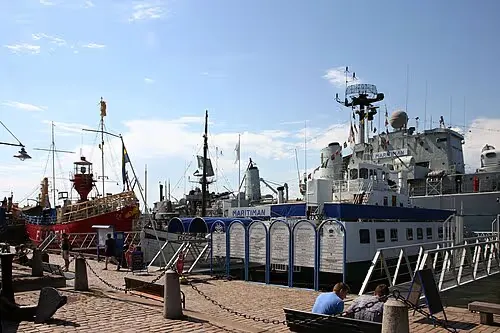
    Start on the water. Maritiman is a museum made of ships: ten historic vessels moored together at Packhuskajen on the Göta River, which makes it the largest floating museum in the world. From the quay you already see hulls, masts and naval grey lined up side by side, and the museum belongs to Sweden's network of military heritage collections.

    The story behind it is about a harbour that suddenly went quiet. For centuries the port of Gothenburg tied Sweden to the world's trade routes, but after the shipbuilding crisis of the 1970s the inner harbour lay empty. A group of enthusiasts saw a chance to save ships of historical interest from the scrapyard and set up the Gothenburg Maritime Centre Foundation in 1985. The early years were a financial struggle; only with support from the city did the museum open to the public, in the summer of 1987 at Lilla Bommen.

    The collection grew, moved to Packhuskajen, and on 20 August 1994 King Carl XVI Gustaf officially opened the new museum. Not every ship is purely for show: HSwMS Kalmarsund is rented out to Chalmers University of Technology.

    Going aboard costs an entry fee. If ships, naval history or travelling with curious kids are your thing, it is worth it; give it about an hour. If you mainly want the city's streets and squares, a look from the quay is enough.

    From the river it is 660 m, about 9 minutes, to Kronhuset and the market around it.
    Hours
    Seasonal: spring/autumn 11:00–17:00; high summer (13 June-31 Aug) 10:00–20:00; Midsummer 10:00–14:00
    Price
    175 SEK adults (programme day) / 150 SEK adults (basic day)
  2. 2

    Kronhusbodarna Market

    Kronhusbodarna Market in Gothenburg, stop 2 on the self-guided walking tour

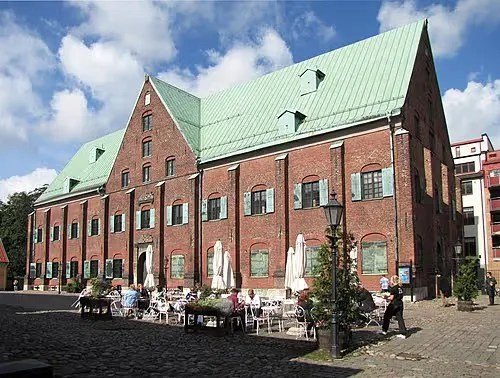
    The big red brick building at the centre here is Kronhuset, and it is far older than it looks at first glance. It went up between 1643 and 1654 in a Dutch-influenced style and is the second oldest secular building in Gothenburg, after the Residence of 1650. The original drawings may have come from the royal architect Simon de la Vallée.

    Its first job was military. Kronhuset was the garrison's arsenal, a store for cannons and other weapons, and it also held grain as a food reserve. Before any of that, the ground was the site of the city's oldest churchyard, so the town's first burials lie close to where you stand.

    On 9 December 1927 ownership passed from the Swedish state to the city of Gothenburg, which wanted the building for a museum. It has been a listed building since 24 October 1968. Visiting is free, so take a slow lap around the brickwork and the courtyard and look at how solid an arsenal from the 1640s had to be.

    Next comes the longest leg of the morning, 1180 m and about 16 minutes, to Feskekörka Fish Market.

    Price
    Free
  3. 3

    Feskekörka Fish Market

    Feskekörka Fish Market in Gothenburg, stop 3 on the self-guided walking tour

    You will recognise it before you read any sign: tall gables, pointed windows, a building that looks like a church. That is exactly why Gothenburgers call it Feskekörka, the fish church in local dialect. Inside, though, the congregation is cod, prawns and herring. The hall opened on 1 November 1874 on filled-in land that once belonged to the city's fortifications, at Fisktorget.

    The fish trade had wandered for two centuries before it got a roof. The oldest selling place was at Lilla Torget, with a large raft moored where Fiskebryggan is; in 1671 the business moved to Stora Bommen and later to the quays of Stora Hamnkanalen. Archipelago fishermen sold straight from their boats, and herring was dumped in great piles in the streets, with a stench people found unbearable. When Gustav Adolfs Torg was turned into a parade square, the trade was moved on 21 May 1849 to Rosenlundskanalen, where the fishing fleet tied up on Wednesdays and Saturdays.

    In 1870 J.J. Ekman proposed a proper fish hall, and four years later this one opened. It has been a listed building since 2013. Since 2021 a single tenant runs both the fish sales and the restaurants inside.

    Entry is free. Half an hour is plenty to walk the fish counters, longer if you sit down to eat in one of the restaurants.

    From here it is 720 m, about 10 minutes, into Haga.

    Hours
    Fish counters: Tue–Thu 10:00–18:00, Fri 10:00–18:30, Sat 10:00–17:00, Sun–Mon closed (the restaurants inside keep longer hours)
    Price
    Free (market entry)
  4. 4

    Haga District

    Haga District in Gothenburg, stop 4 on the self-guided walking tour

    Haga is where Gothenburg slows down: low wooden houses, a 19th-century feel and cafés along the streets. It is easy to forget that this was once a working-class suburb with a rather bad reputation. Today about 4,000 people live here, against 15,000 a century ago, a number that shows how much the district has changed. Haga is also a parish, and by area it is the smallest parish in Sweden.

    Queen Kristina founded Haga in the mid-17th century, making it Gothenburg's first suburb. Because it lay outside the city walls, it came with a harsh condition: the crown could tear it down whenever it needed the land or a siege threatened. In the 1690s that rule was used, and 34 houses were demolished to build a covered causeway from the city walls to the fortress of Skansen Kronan.

    From the 1840s new industries drew workers into Haga, and it became the city's first workers' district, so crowded that by the 1870s more workers' districts had to be built. After the 1920s the population fell, many workplaces closed and Haga became mainly residential. A redevelopment plan from 1962 again meant demolition, and in 1970 the Haga Group formed to save the old architecture. Local pressure slowed the demolitions between 1973 and 1977, and the authorities helped restore buildings already in poor shape.

    Look closely as you walk: the major renovation of the 1980s either restored houses or replaced them with post-modern replicas, so not every old-looking facade is old. Haga is free to wander, and it is the natural place for a coffee break.

    Skansen Kronan sits on the hill above the district, 670 m and about 12 minutes away, uphill for the last part.

    Price
    Free
  5. 5

    Skansen Kronan

    Skansen Kronan in Gothenburg, stop 5 on the self-guided walking tour

    On top of the hill Risåsberget stands Skansen Kronan, the Crown Sconce, a squat round fortress with walls of granite, gneiss and diabase up to five metres thick. When it was built it stood outside the city walls; the growing city later swallowed the hill, and today it belongs to Haga.

    The reason for it lies in the city's founding in 1621. Gothenburg got an impressive ring of fortifications, but military engineers worried that two hills, the Gullberg and the Risåsberg, looked down on the town. An enemy, most likely Danish, could have placed artillery there. So both hilltops got forts, designed by Erik Dahlbergh: Skansen Lejonet, the Lion, on the Gullberg, and the Crown here.

    Work started in 1687, the fort was commissioned in 1698 with 23 guns, and the roof was only finished in 1700. Then nothing happened: Skansen Kronan was never attacked, and its cannons were never fired in anger. Around 1900 it became a military museum, which opened on 23 November 1904 and closed in September 2004, when the collections moved to the Museum of Gothenburg. It has been a listed building since 1935.

    Today the fort is privately owned and used for conferences and private parties, so the visit is about the outside, which is free and open around the clock. Walk around the walls, picture the covered causeway that once ran down to the city, and give it about a quarter of an hour.

    The longest leg follows: 1840 m, about 27 minutes, to Kungsportsavenyn Avenue. On the way you pass the Röhsska Design Museum.

    Hours
    Open 24/7
    Price
    Free (exterior)
  6. 6

    Kungsportsavenyn Avenue

    Kungsportsavenyn Avenue in Gothenburg, stop 6 on the self-guided walking tour

    Kungsportsavenyn, which everyone calls Avenyn, is Gothenburg's grand boulevard. It runs about 840 m through the Lorensberg district, from Kungsportsbron over the old moat, Vallgraven, up to Götaplatsen, where the last stretch rises gently. The art museum at its end is where you are heading.

    Before it was a street this was garden land: plantations and orchards, mostly belonging to the Kristinelund estate. The city bought the land in 1875, though the old estate held on into the 1890s. The idea of a broad avenue appears in the city council's records on 22 April 1865, and the first block built along it, Kalmarehus, went up in 1872 and 1873.

    The name caused a fight. Avenue sounded foreign to many, and in March 1882 the council decided to rename it Kungsportsgatan. A few months later the decision was reversed by a narrow majority, after about thirty well-known residents and landlords on the street wrote in asking for the avenue name back. Their main argument was practical: they did not want to pay all over again to change their addresses.

    Avenyn is free and simply for walking. Take a short pause, look back down the straight line towards the canal, then follow the street 520 m, about 9 minutes, up to Götaplatsen and the Gothenburg Museum of Art.

    Local name
    Kungsportsavenyen
    Price
    Free
  7. 7

    Gothenburg Museum of Art

    Gothenburg Museum of Art, stop 7 on the self-guided walking tour

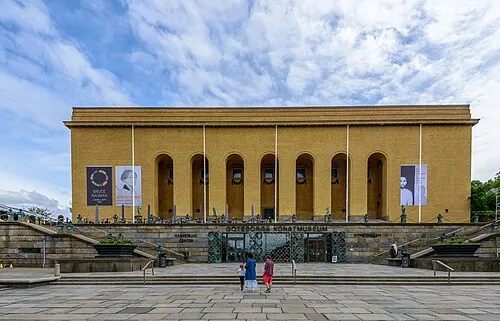
    The yellow brick building closing off Avenyn at Götaplatsen is the Gothenburg Museum of Art. The brick is known as Gothenburg brick because the city uses it so often, and the monumental Neo-Classical design by Sigfrid Ericson was made for the city's 300th anniversary exhibition in 1923. The museum opened in 1925; an eastern extension by Rune Falk followed in the 1960s, and it was expanded again in 1996.

    Inside are more than 70,000 works, mostly Nordic art from the 15th century to today, which makes it the third largest museum in Sweden by number of works. Its roots go back to the Museum of Gothenburg, founded in 1861, and in 2018 it was named Swedish Museum of the Year. About 250,000 people visit each year.

    The heart of the visit is late 19th-century Nordic art, a collection the museum counts among the finest in the world. Head for the Fürstenberg Gallery, richly decorated and named after the art donor Pontus Fürstenberg and his wife Göthilda. Here you find P.S. Krøyer, Carl Larsson, Bruno Liljefors, Edvard Munch and Anders Zorn. Beyond the Nordic rooms there are works by Monet, Picasso and Rembrandt.

    The museum charges entry, and for anyone with even a passing interest in painting it is the best way to end the walk; allow about an hour and a quarter.

    Local name
    Göteborgs konstmuseum
    Hours
    Mon: Closed | Tue: 11:00–18:00 | Wed: 11:00–20:00 | Thu: 11:00–18:00 | Fri–Sun: 11:00–17:00
    Price
    SEK 80
Walking tour route map of Gothenburg Route loaded
Maritiman Maritime MuseumKronhusbodarna MarketFeskekörka Fish MarketHaga District+3
All 7 stops are already on the map.
You just press start.
AI Tour Guide

You've read the route. Now walk it with a guide in your ear.

Press start wherever you are, even hundreds of kilometres from Gothenburg, and the guide begins telling its stories right away. In the city, pick any of the 7 stops to start from: it leads you there, then talks with you the whole route, asking, listening, remembering, and shaping the tour around your answers.

7stops 5.6km 1 h 22 minwalking 13languages
▶Start the tour free

Free to start · Runs in your browser · No app, no download

Shorter Ways to Walk the Route

Not every day has room for six hours. These three cuts keep the stops that belong together.

Old town and Haga for free

Stops: 2, 3, 4, 5

For anyone who wants history without tickets: Kronhuset, the fish hall, Haga's wooden houses and the fort on the hill. 38 minutes of walking, no entry fees at all.

Harbour and fish

Stops: 1, 2, 3

For ship lovers and a morning with food in mind: the museum ships, the old arsenal and Feskekörka. 25 minutes of walking; only Maritiman charges entry.

Haga to the art museum

Stops: 4, 5, 6, 7

For an afternoon that ends among paintings: Haga, Skansen Kronan, Avenyn and the Gothenburg Museum of Art. 48 minutes of walking; only the art museum charges entry.

How Long Does This Gothenburg Tour Take With and Without Museums?

The walking itself takes 1 h 22 min. Add about an hour aboard Maritiman, half an hour in Feskekörka, three quarters of an hour for a slow loop and a coffee in Haga, short pauses at Kronhuset, Skansen Kronan and on Avenyn, and an hour and a quarter in the art museum, and you are out for a little under six hours.

Skip both paid interiors and the walk shrinks to about three hours twenty. The free old town and Haga cut fits into two hours, the harbour version into roughly two and a half with the ships, and the Haga to art museum version into about three hours with the museum.

Before You Set Off in Gothenburg

  • Start and finish: The recommended start is Maritiman on the river; the walk ends at the Gothenburg Museum of Art on Götaplatsen. You can join at any stop.
  • Best day: Choose a day when both the fish counters in Feskekörka and the art museum are open, so you can see the inside of both.
  • Start time: Start at Maritiman in the morning, soon after it opens, to leave enough time for the art museum at the end of the walk.
  • Entry costs: Maritiman and the art museum charge entry. Everything else on the route is free.
Walking tour route map of Gothenburg
AI Tour Guide

Your guide is ready when you are, starting at the quay.

Press start and a voice AI Tour Guide takes it from here: leading the route through Gothenburg, telling the stories, and turning your walk into a real back-and-forth conversation. No app or download is needed; it runs in your browser.

7stops 5.6km 1 h 22 minwalking 13languages
▶Start the tour free

Free to start · Runs in your browser · No app, no download

What the AI Tour Guide Adds From Harbour to Götaplatsen

This route jumps between naval ships, herring trade, workers' housing, fortress building and Nordic painting, and the AI Tour Guide holds those threads together as a conversation. It greets you at the quay, tells the story of each place, asks what caught your eye and remembers it: if Haga's working-class past grabs you, it can follow that thread into the life of the families who once crowded those houses; if you care more for the painters of the Fürstenberg Gallery, it leans that way. You can interrupt any time. 100 free credits get you started; after that you pick €19.99 all-inclusive for this tour with no time limit, or €5 per hour.

A Real Conversation A voice AI Tour Guide greets you, leads the whole route, and tells the stories and facts as you walk, asking what you want to see and keeping a real conversation going. Not a recording you press play on.
Map Navigation Follow the route on the map and walk at your own pace. You choose where to start and when to move to the next stop.
Ask Anything Curious about a building you pass? Ask your AI Tour Guide on the spot and the conversation carries on.
13 Languages Switch language anytime. No separate tour needed.
Start free in your browser

Common Questions Before You Walk

Can I start the walk later in the day?

Yes, but plan around the two museums. If you want to go aboard at Maritiman, start there, and leave enough time for the paintings at the end.

What can I still do on a Monday?

Kronhusbodarna Market, Haga, the outside of Skansen Kronan and Avenyn are free and work any day. The art museum is closed and the fish counters in Feskekörka are shut, though the restaurants inside keep longer hours.

Which other cities make a good trip from Gothenburg?

Copenhagen is about 228 km away and Oslo about 256 km; both have their own walking route. Stockholm is 398 km away.

Is the tour really free?

Yes. The whole tour is free: the route, the interactive map and the navigation cost you nothing. Only the voice AI Tour Guide is optional and paid: you test it with 100 free credits, then you pay either €5 per hour or €19.99 for this whole tour, with no time limit. Admission to 2 of the 7 stops is not included: Maritiman Maritime Museum and Gothenburg Museum of Art charge their own entry fees.

Do I need to download an app?

No. Everything runs in your phone browser. Open the route and start walking, no download and no sign-up required.

Do I need to book the walking tour in advance?

No booking needed. This self-guided tour is available anytime. Open the route in your browser and start walking. The AI Tour Guide works instantly, no app, no reservation required.

What languages is the AI Tour Guide available in?

The AI Tour Guide speaks 13 languages, so you take the tour in your own language and can switch at any time.

Can I skip stops or change the route?

Yes. Skip any stop, spend extra time at places you like, or start the route from any point. It is your walk, you set the pace.
Image credits
▶ Start free in your browser Runs in your browser, no app, no download