Free Walking Tour Flensburg: Gates, Markets and Harbor

From a 1590s brick gate across two medieval market squares to a harbor customs house that once stored rum: Flensburg's story, walked in one day.

10 Stops 6.9 km ~1 h 36 min walking
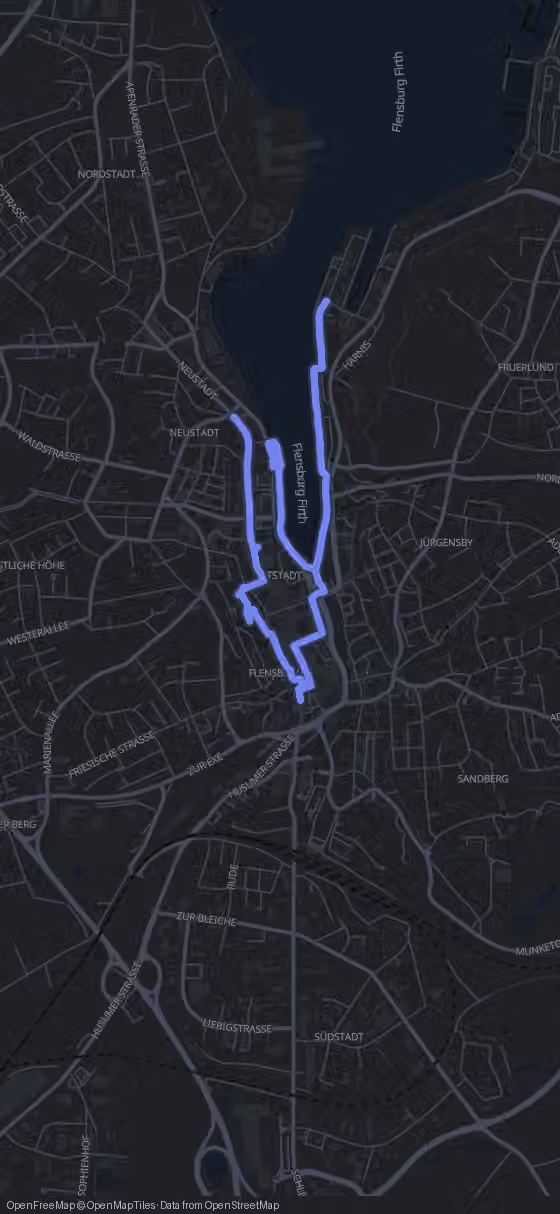
Route map for the Flensburg walking tour
Stop 1 of 10
220 m·3 min
Nordertor
Head south-east toward the Historische Kaufmannshöfe
Welcome to Flensburg. I'm Alex, and our first story begins in courtyards built around the rum trade.
Try this tour with Alex

Your Flensburg Route at a Glance

Ten stops lead from the Nordertor through the old town's two market squares to the harbor, ending at the Flensburg Maritime Museum. The route covers 6.9 km with 1 h 36 min of pure walking; with time inside both big museums, plan on about six hours.

Streets, squares, the harbor and St. Nikolai Church are free. Museumsberg, the Maritime Museum and the Museumswerft charge entry. The GPS route in your browser costs nothing; the AI Tour Guide is optional.

Open free GPS & optional AI Tour Guide
This short shows highlights of the route. All 10 stops follow below.

The Route

Walking Map of Flensburg: Nordertor to the Waterfront

10 stops 6.9 km 1 h 36 min walking
Tap to load interactive map

The 10 stops along this route

  1. Nordertor in Flensburg, stop 1 on the self-guided walking tour
    1Nordertor
  2. Historic Merchant Courtyards in Flensburg, stop 2 on the self-guided walking tour
    2Historic Merchant Courtyards
  3. Nordermarkt in Flensburg, stop 3 on the self-guided walking tour
    3Nordermarkt
  4. Museumsberg in Flensburg, stop 4 on the self-guided walking tour
    4Museumsberg
  5. St. Nikolai Church in Flensburg, stop 5 on the self-guided walking tour
    5St. Nikolai Church
  6. Rote Straße in Flensburg, stop 6 on the self-guided walking tour
    6Rote Straße
  7. Südermarkt in Flensburg, stop 7 on the self-guided walking tour
    7Südermarkt
  8. Flensburg Harbor, stop 8 on the self-guided walking tour
    8Flensburg Harbor
  9. Museumswerft in Flensburg, stop 9 on the self-guided walking tour
    9Museumswerft
  10. Flensburg Maritime Museum, stop 10 on the self-guided walking tour
    10Flensburg Maritime Museum
  11. That's the full route.

    Walk it with an AI Tour Guide talking you through every one of these streets.

    Start free in your browser
    You made it

Your Flensburg Walking Tour Stop by Stop: Gates, Markets, Rum and Boats

  1. 1

    Nordertor

    Nordertor in Flensburg, stop 1 on the self-guided walking tour

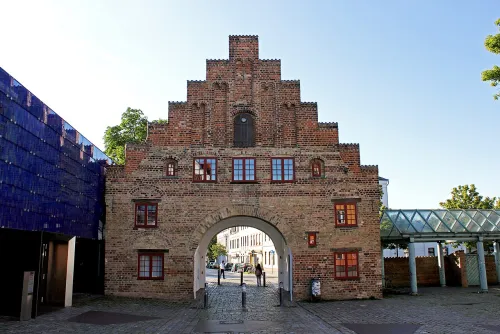
    This red-brick gate with its tiered gables and wide archway is where Flensburg used to end. The Nordertor, Nørreport in Danish, marked the northern edge of town and is now the city's emblem. Walk through the arch and look at its north face: two plaques are mounted there. Nobody has pinned down exactly when it went up; the year given is either 1595 or 1596.

    The town wall grew step by step from 1345 at the latest. An earlier gate, the Norderpforte, stood about 100 m further south at today's Norderstraße 122. Little is known about it, but a town view by Georg Braun and Franz Hogenberg from around 1572 seems to show what it looked like. When the houses of the Ramsharde quarter spread a few hundred metres further north, the town's front door moved with them, and the gate you see now was built.

    Like its predecessor, the Nordertor was a checkpoint: anyone entering or leaving was controlled, and at night the gate was shut. Every road out of Flensburg had one. The Rote Tor guarded the route south, the Friesisches Tor the main road west, the Johannistor the eastern edge and the Kompagnietor the harbor, and the wall was tied into the Duburg fortress, which stood high above the town from 1411. Of those big gates, only the Kompagnietor by the water survives besides this one.

    From the arch, follow Norderstraße into town. The first of its hidden courtyards is 220 m away, about three minutes on foot.
    Hours
    24/7
    Price
    Free
  2. 2

    Historic Merchant Courtyards

    Historic Merchant Courtyards in Flensburg, stop 2 on the self-guided walking tour

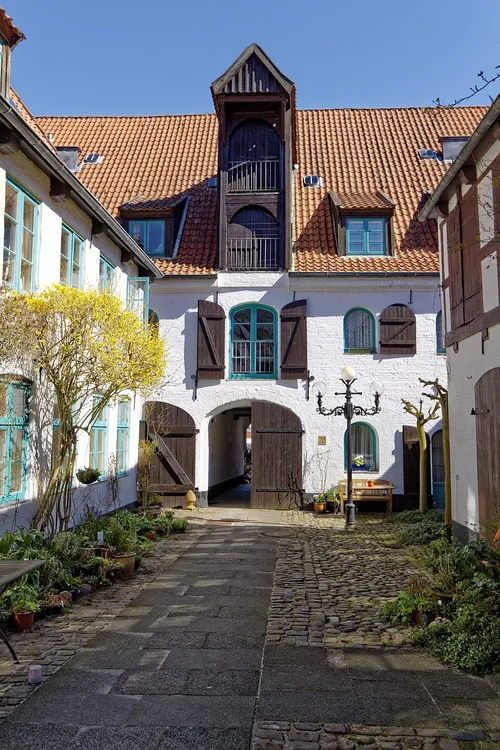
    The merchants of Norderstraße did not keep everything behind the facade. Behind the street front runs a chain of historic courtyard complexes, and today they are public passages: you walk straight in, cross the yards and come out again without having to buy anything.

    The Old Merchant Courtyard at Norderstraße 86 is the best place to begin, and the pattern repeats along the street. The reward here is noticing rather than arriving: a doorway that looks like nothing opens into a yard the street never promised. Look into one courtyard or three; the walk on is short, so lingering costs you little.

    Carry on south along Norderstraße to Nordermarkt, 530 m and about seven minutes away.

    Hours
    24/7
    Price
    Free
  3. 3

    Nordermarkt

    Nordermarkt in Flensburg, stop 3 on the self-guided walking tour

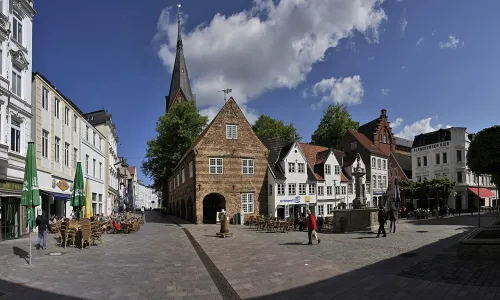
    Nordermarkt, Nørretorv in Danish, is probably the oldest market square in town. It grew up soon after the parish of St. Marien was founded around 1170, one of the settlements Flensburg grew from. Trade was its main business, but justice was done here too, executions included. Look for the Schrangen, the arcaded building from 1595: a chain on its south side served as the pillory. Walk through its arcades and you reach the Marienkirche, whose tower rises over the square.

    The houses around you tell later chapters. In the 19th century the Hotel Rasch stood by the square, and both Hans Christian Andersen and Theodor Fontane stayed there. The brick merchant's house Kaufmannshaus Hansen on the edge of the square dates from 1868/69 and shows how brick fronts came into fashion in those years.

    Nordermarkt also saw the very end of the Second World War. British units occupied Flensburg, and from 13 May 1945 the decrees of the British and American military authorities were posted on large boards here and on Südermarkt, while the last government of the Reich was still sitting in the suburb of Mürwik.

    From here the Große Straße once led on to the Thingplatz and over the Holm to Südermarkt, and below the square lay the Schiffbrückplatz by the harbor, renamed Willy-Brandt-Platz in 1997. Your route climbs instead to Museumsberg: 540 m, about nine minutes.

    Hours
    24/7
    Price
    Free
  4. 4

    Museumsberg

    Museumsberg in Flensburg, stop 4 on the self-guided walking tour

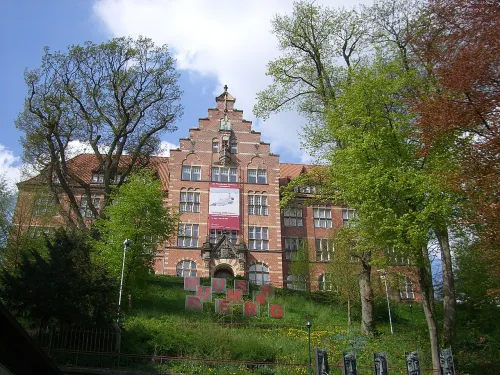
    On a rise above the town theatre, two museum buildings, the Heinrich-Sauermann-Haus and the Hans-Christiansen-Haus, form one ensemble with the Old Cemetery and the Christiansenpark. With 3000 m² of exhibition space, Museumsberg is one of the largest museums in Schleswig-Holstein, covering art and cultural history of the Schleswig region from the 13th to the 20th century plus contemporary art.

    It all started with one craftsman. In 1876 the cabinetmaker and woodcarver Heinrich Sauermann sold his private collection of applied art to the city and became the first director of the new museum. The teaching workshop he founded grew into an applied arts school with a reputation far beyond the region; Emil Nolde studied there and later applied, without success, to run it. School and collection moved together into the building from 1903, still in its Dutch Renaissance style.

    Sauermann never thought of building a painting collection; furniture came first, and his furniture collection is still one of the most extensive of its kind in Germany. Since 1999 the ground floor also houses the Natural Science Museum, and some of its pieces moved to the Ice Age House in the Christiansenpark. While you are inside, look for the Kaakmann, a copper bailiff figure that stood on Südermarkt until the 18th century.

    Go in if furniture, craft and regional art are your thing; give it an hour or more. If not, the setting with park and cemetery is worth the climb on its own. Then head back down to St. Nikolai Church, 540 m and about eight minutes.

    Hours
    Tue–Sun 10:00–17:00, Mon closed
    Price
    10.00 EUR adults day ticket (single ticket one museum); combi ticket all 3 municipal museums 15.00 EUR; reduced severely disabled 6.00 EUR; children/youth under 18, pupils, students, trainees, social pass free
  5. 5

    St. Nikolai Church

    St. Nikolai Church in Flensburg, stop 5 on the self-guided walking tour

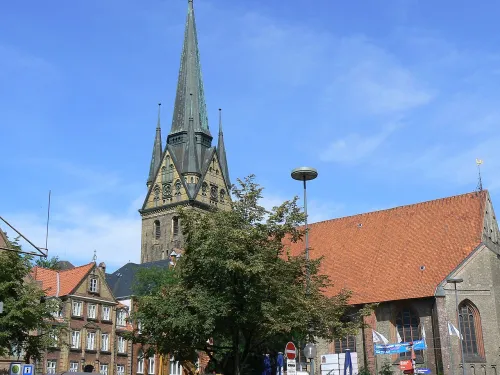
    St. Nikolai, Nikolaikirken in Danish, is one of Flensburg's main churches and anchors Südermarkt, the youngest of the town's four historic settlement cores. Its tower reaches 90 m, the highest in Flensburg and one of the highest in Schleswig-Holstein. The neo-Gothic top you see dates from after 1878, when lightning destroyed the old Gothic spire and melted the bells; three steel bells from Bochum replaced them that same year, and since 1909 a carillon of 17 bells cast in Lübeck has hung there too. Legend says the bells call out 'mayor and council', and the town hall is indeed close by.

    Building began around 1390 and continued eastward from 1440, right over an older church from before 1332. The result is a Gothic hall church 52 m long and 21 m wide, its ridge 40 m up. Inside, six pairs of massive round brick pillars lead your eye to the altar. Watch for the trick: it looks as if a transept crosses the nave before the chancel, but the pillars are simply spaced wider apart there, and the four western bays from the first building phase are shorter than the later ones.

    Notice too how the north side sits up to three metres deep in the ground, and how white the interior is; the paint dates from the 1950s. Since 2018 the church has been part of the European Route of Brick Gothic. Entry is free, so a look inside costs you only a few minutes. From the church, Rote Straße is 190 m away, about three minutes.

    Local name
    Nikolaikirche
    Hours
    Mon–Sun 09:00–18:00
    Price
    Free
  6. 6

    Rote Straße

    Rote Straße in Flensburg, stop 6 on the self-guided walking tour

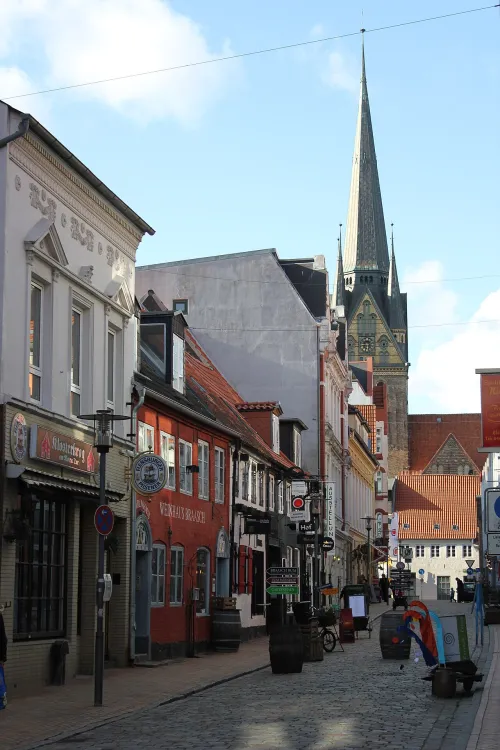
    Rote Straße, Rødegade in Danish, runs from Südermarkt to the Neumarkt and was once the only road out of town to the south. Its name has nothing to do with the colour: it comes from the Rude, a wood that lay beyond the town between the roads to Husum and Schleswig and gave its name to today's Rude district.

    As the entrance from the south and right next to the main market, this was for centuries a street of inns, mostly on its west side. Across the street stood the poorhouse of the Nikolai parish and, from the 16th century, the town's Latin school, and the Franciscan monastery already bordered the street in the Middle Ages. The Rote Tor marked the southern way in and out of town until 1872.

    When through traffic moved elsewhere in the 1920s, Rote Straße became a side street but kept its shops and inns. It also lost a lot: from the 1950s on, buildings came down, and in 1954, when the Töpferstraße was demolished, house no. 21 went with it, one of the oldest and most valuable half-timbered houses in town. Stroll it slowly and look into its side passages, then turn back to Südermarkt, just 170 m and two minutes away.

    Hours
    24/7
    Price
    Free
  7. 7

    Südermarkt

    Südermarkt in Flensburg, stop 7 on the self-guided walking tour

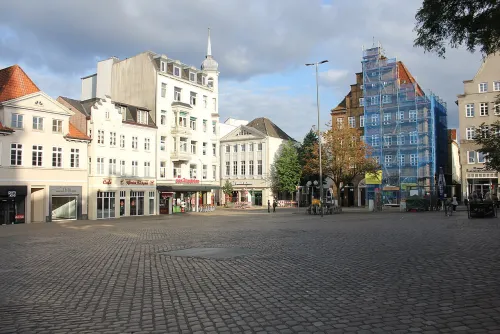
    Südermarkt, Søndertorv in Danish, is the second of Flensburg's two main squares. It took shape after the parish of St. Nikolai was founded around 1200, beside an old long-distance road from Frisia to Angeln; the Angelburger Straße to the east and the Friesische Straße to the west still follow that line along the south side of the square. Its angular outline was fixed once the first, smaller Nikolai church stood here before 1332.

    On 3 May 1485 a fire destroyed the southern part of town, the square included, and the church was rebuilt and enlarged the same year. In the southwest corner, look for the Nikolai-Apotheke, built around 1490 and now the oldest secular building in Flensburg. A fountain with a square basin and four spouts stood on the square from the early 17th century into the 19th.

    In the 18th century oxen were sold at the Ochsenmarkt, while horses changed hands here, and the copper Kaakmann you may have met on Museumsberg watched over the square. At the northeast corner a short lane called Katsund once led down to the Holm; at the end of the 19th century it was absorbed into the Holm and the houses on its west side were pulled down.

    Now comes the first long stretch: 2280 m to Flensburg Harbor, about 31 minutes on foot.

    Hours
    24/7
    Price
    Free
  8. 8

    Flensburg Harbor

    Flensburg Harbor, stop 8 on the self-guided walking tour

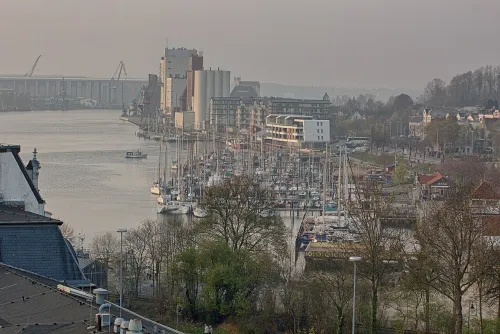
    Flensburg exists because of this water. The harbor, Flensborg Havn in Danish, lies at the very end of the Flensburg Förde, and closeness to the sea was the economic reason the town was founded in the 12th century. People speak of the west side, the east side and the Hafenspitze, the tip of the harbor; around it the inner city, Jürgensby and the Volkspark make up Flensburg's skyline.

    The tip has wandered. In the Middle Ages the harbor reached much further south, with a mill pond behind it, but silting and landfill pushed the tip north bit by bit. Parts of the harbor were fortified, and the Kompagnietor still stands from that time. In 1412 Queen Margaret I, who ruled Denmark, Norway and Sweden, is said to have died of the plague on board in this harbor; her sarcophagus is in Roskilde Cathedral.

    After the decline of the Knudsgilde and the Hanseatic League, Flensburg rose to become the largest trading town in the Danish realm, with around 200 ships. In the late 18th century its merchants joined the West Indies trade, and that is where Flensburg's rum tradition began. In the 18th and 19th centuries whaling and sealing voyages to Greenland set out from here, and since the 19th century the harbor has also served visitors.

    Take your time along the water, then set off on the second long leg: 2380 m to the Museumswerft, about 32 minutes.

    Local name
    Flensburger Hafen
    Hours
    24/7
    Price
    Free
  9. 9

    Museumswerft

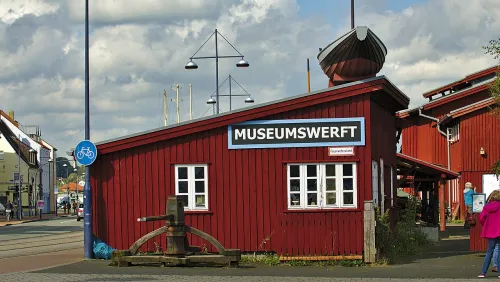
    Museumswerft in Flensburg, stop 9 on the self-guided walking tour

    At the Museumswerft, the museum shipyard at Schiffbrücke 43, boats are not just displayed, they are built. Shipwrights construct and restore sailing and working boats of the kind seen on the Baltic one or two centuries ago, showing what everyday life in an old shipyard looked like. Courses teach the old tools, and again and again young people build their own boats here as a project.

    The yard was founded on this spot in 1996, moved several times until 2001 and then returned to where it started. It runs as a non-profit company with the help of a supporters' association. Entry is cheap, so it is an easy add-on even if you are short on time: watch the work in progress, smell the wood and ask what is on the slipway.

    The Maritime Museum is right next door, 60 m and one minute away.

    Hours
    Mon–Sun 10:00–18:00
    Price
    2 EUR
  10. 10

    Flensburg Maritime Museum

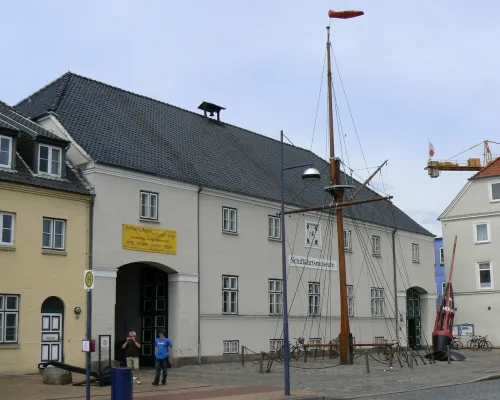
    Flensburg Maritime Museum, stop 10 on the self-guided walking tour

    The Flensburg Maritime Museum sits in the former customs packing house at Schiffbrücke, built in 1842/43 to plans by the Danish royal building inspector Meyer. Until 1972 Flensburg merchants stored goods here under customs seal, and rum was one of the main products. The state handed the building to the city in 1979, and after restoration the museum opened in 1984 as a highlight of the town's 700th anniversary.

    After two years of complete renovation it reopened in March 2012 with a new exhibition that now fills three parts: the packing house itself, the customs office yard with the West Indies trade, the Butterfahrt and the Flensburg shipyard, and a new building in the courtyard about technology and life on board over the last 100 years. Ship portraits, models and nautical instruments spread over two floors, along with objects from the Greenland voyages.

    Look down at the cast-iron columns carrying the lowest storage floor. They were made in Georg Dittmann's foundry, Flensburg's first, opened in 1842 in the Neustadt just north of the Nordertor, so the end of your walk quietly points back to its beginning. The museum itself grew out of the Museumsberg collections, which closes the second loop of the day.

    If you came for the rum and the sea, this is the inside visit to choose; give it an hour or more. Here the route ends.

    Local name
    Flensburger Schifffahrtsmuseum
    Hours
    Tue–Sun 10:00–17:00, Mon closed
    Price
    10 EUR single ticket adults (one museum); combi ticket all 3 municipal museums 15 EUR; severely disabled from 50% 6 EUR; children/youth under 18, pupils over 18, students, trainees, social pass free
Walking tour route map of Flensburg Route loaded
NordertorHistoric Merchant CourtyardsNordermarktMuseumsberg+6
All 10 stops are already on the map.
You just press start.
AI Tour Guide

You know the route now. Walk it with a guide who talks you through Flensburg.

Press start wherever you are, even hundreds of kilometres from Flensburg, and the guide begins telling its stories right away. In the city, pick any of the 10 stops to start from: it leads you there, then talks with you the whole route, asking, listening, remembering, and shaping the tour around your answers.

10stops 6.9km 1 h 36 minwalking 13languages
▶Start the tour free

Free to start · Runs in your browser · No app, no download

Shorter Ways to Walk Flensburg

The full route splits naturally into an old town walk and a harbor walk, so you can do one, the other, or both on different days.

Old town only

Stops: 1, 2, 3, 4, 5, 6, 7

For anyone with half a day: gate, courtyards, both market squares, St. Nikolai Church and Rote Straße, ending on Südermarkt. 32 minutes of walking. Everything is free; Museumsberg is the one optional entry.

Harbor and ships

Stops: 8, 9, 10

For maritime fans or a rainy afternoon: start at the harbor, walk on to the Museumswerft and step next door into the Maritime Museum. 33 minutes of walking, with entry at the Museumswerft and the Maritime Museum.

Quick northern loop

Stops: 1, 2, 3

For a first hour in town: Nordertor, the courtyards of Norderstraße and Nordermarkt, all free, with just 10 minutes of walking between them.

How Long Does This Flensburg Tour Take, With and Without Museums?

The walking itself adds up to 1 h 36 min, and most of it falls on the two long legs to and along the harbor (31 and 32 minutes). The old town stretch from the Nordertor to Südermarkt is compact: 32 minutes of walking in total.

A realistic day with an hour and a quarter in Museumsberg, the same in the Maritime Museum and shorter pauses everywhere else takes about six hours. Start at the Nordertor around 9:30 and you reach Museumsberg around 10:25; you arrive at the Maritime Museum shortly after 14:15 and step out around 15:30. Skip the inside of both big museums and the route takes about three and a half hours.

Before You Set Off in Flensburg

  • Start and finish: Start at the Nordertor for the recommended order, though you can join at any stop. The route ends at the Flensburg Maritime Museum.
  • Best day: Pick a day when both Museumsberg and the Maritime Museum are open, and start early so you have enough time inside each.
  • Budget: Outdoors everything is free. Museumsberg, the Maritime Museum and the Museumswerft charge entry; if you visit both municipal museums, the combi ticket saves you money.
  • Navigation: The free GPS navigation in your browser leads you from stop to stop; the AI Tour Guide can join whenever you like.
Walking tour route map of Flensburg
AI Tour Guide

Your guide is waiting at the Nordertor

Press start and a voice AI Tour Guide takes it from here: leading the route through Flensburg, telling the stories, and turning your walk into a real back-and-forth conversation. No app or download is needed; it runs in your browser.

10stops 6.9km 1 h 36 minwalking 13languages
▶Start the tour free

Free to start · Runs in your browser · No app, no download

What the AI Tour Guide Adds Between Gate and Harbor

On this route the stories reach from a Danish queen dying in the harbor to rum stored under customs seal. The AI Tour Guide leads the walk as a conversation: it greets you at the Nordertor, tells each place's story, asks what catches your interest and follows that thread, whether you lean toward the merchants of Norderstraße, the whalers bound for Greenland or the furniture collection on Museumsberg. Wonder who else stayed at the Hotel Rasch, or what life inside a bonded warehouse looked like day to day? Just ask, and interrupt it whenever you want.

A Real Conversation A voice AI Tour Guide greets you, leads the whole route, and tells the stories and facts as you walk, asking what you want to see and keeping a real conversation going. Not a recording you press play on.
Map Navigation Follow the route on the map and walk at your own pace. You choose where to start and when to move to the next stop.
Ask Anything Curious about a building you pass? Ask your AI Tour Guide on the spot and the conversation carries on.
13 Languages Switch language anytime. No separate tour needed.
Start free in your browser

Common Questions Before You Walk Flensburg

Is the combi ticket worth it?

If you go into both Museumsberg and the Maritime Museum, yes: the combi ticket for the three municipal museums costs less than two single tickets. Young visitors, pupils, students, trainees and social pass holders get in free, and severely disabled visitors pay a reduced rate.

How do I get back to the Nordertor from the Maritime Museum?

The route ends at the harbor, but the GPS navigation in your browser can lead you from the last stop back to the start if you want to close the loop.

What is the Phänomenta next to the Nordertor?

The Phänomenta Flensburg is a museum right at the starting point. It is not a stop on this walk, so ask at its desk about entry if you want to add it.

Are there similar walks near Flensburg?

Yes. Husum is 43 km away and Kiel 69 km, both easy day trips, and Copenhagen makes a good comparison if you want to see the other side of Flensburg's Danish past.

Is the tour really free?

Yes. The whole tour is free: the route, the interactive map and the navigation cost you nothing. Only the voice AI Tour Guide is optional and paid: you test it with 100 free credits, then you pay either €5 per hour or €19.99 for this whole tour, with no time limit. Admission to 3 of the 10 stops is not included: Museumsberg, Museumswerft and Flensburg Maritime Museum charge their own entry fees.

Do I need to download an app?

No. Everything runs in your phone browser. Open the route and start walking, no download and no sign-up required.

Do I need to book the walking tour in advance?

No booking needed. This self-guided tour is available anytime. Open the route in your browser and start walking. The AI Tour Guide works instantly, no app, no reservation required.

What languages is the AI Tour Guide available in?

The AI Tour Guide speaks 13 languages, so you take the tour in your own language and can switch at any time.

Can I skip stops or change the route?

Yes. Skip any stop, spend extra time at places you like, or start the route from any point. It is your walk, you set the pace.
Image credits
▶ Start free in your browser Runs in your browser, no app, no download