Free Walking Tour Stockholm: City Hall to Skansen

From the City Hall of the Nobel festivities through Gamla Stan's royal churches to the Vasa warship and Skansen: ten stops, 5.8 km on foot.

10 Stops 5.8 km ~1 h 21 min walking
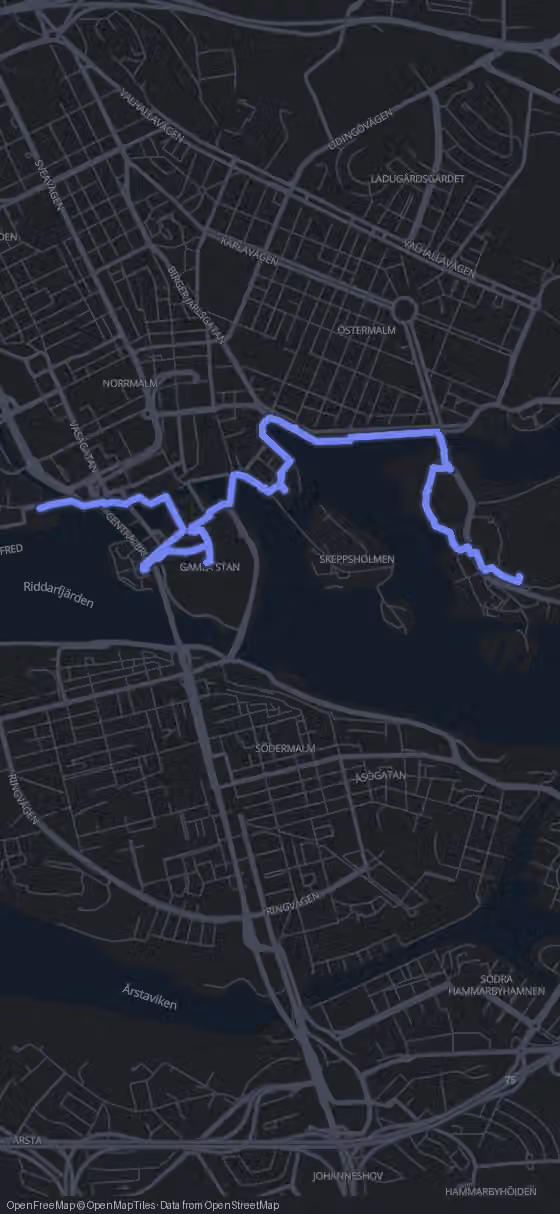
Route map for the Stockholm walking tour
Stop 1 of 10
880 m·11 min
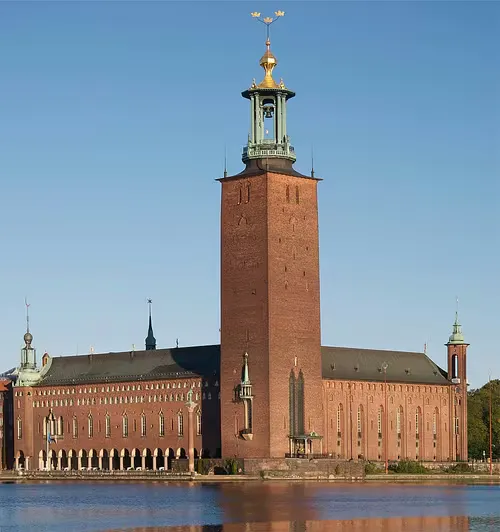
Stockholm City Hall
Head east toward the Riksdag Building
Hej, welcome to Stockholm. I'm Alex, and some of its greatest landmarks exist because disaster did not get the final word.
Try this tour with Alex

This Route at a Glance

Ten stops lead from Stockholm City Hall through Gamla Stan to Skansen on Djurgården: 5.8 km and 1 h 21 min of pure walking. Seen from outside with short pauses, that is about three hours; with the Vasa Museum and one more interior, plan a full day.

The guided tours of the Riksdag Building and the square at Stortorget & Nobel Prize Museum are free. Riddarholmen Church, Stockholm Cathedral, the Royal Palace, National Museum, Nordic Museum, the City Hall tour and Skansen charge admission. The GPS route is free in your browser; the AI Tour Guide is optional.

Open free GPS & optional AI Tour Guide
This short shows highlights of the route. All 10 stops follow below.

The Route

Walking Map of Stockholm from Kungsholmen to Djurgården

10 stops 5.8 km 1 h 21 min walking
Tap to load interactive map

The 10 stops along this route

  1. Stockholm City Hall, stop 1 on the self-guided walking tour
    1Stockholm City Hall
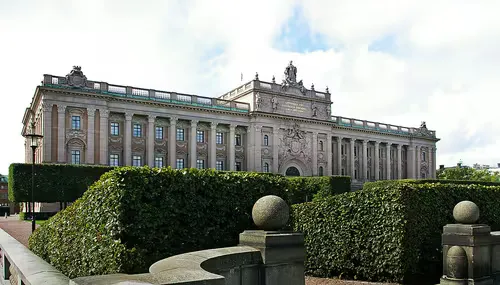
  2. Riksdag Building in Stockholm, stop 2 on the self-guided walking tour
    2Riksdag Building
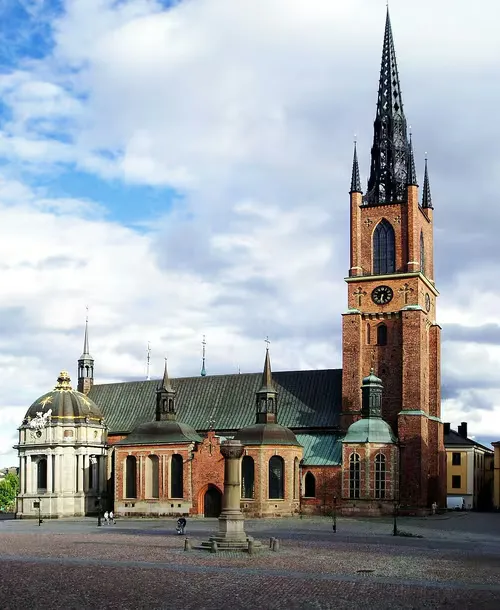
  3. Riddarholmen Church in Stockholm, stop 3 on the self-guided walking tour
    3Riddarholmen Church
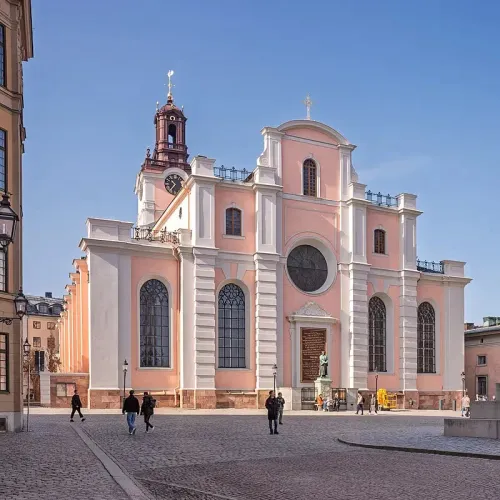
  4. Stockholm Cathedral, stop 4 on the self-guided walking tour
    4Stockholm Cathedral
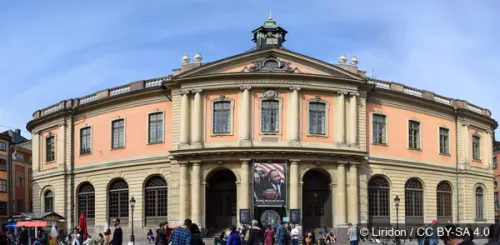
  5. Stortorget & Nobel Prize Museum in Stockholm, stop 5 on the self-guided walking tour
    5Stortorget & Nobel Prize Museum
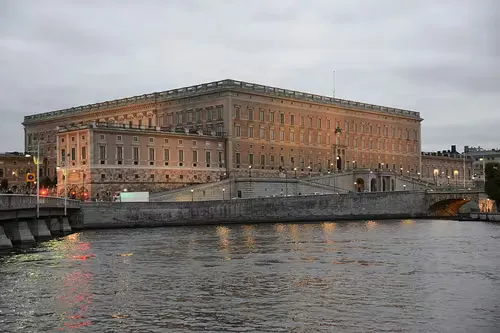
  6. Royal Palace in Stockholm, stop 6 on the self-guided walking tour
    6Royal Palace
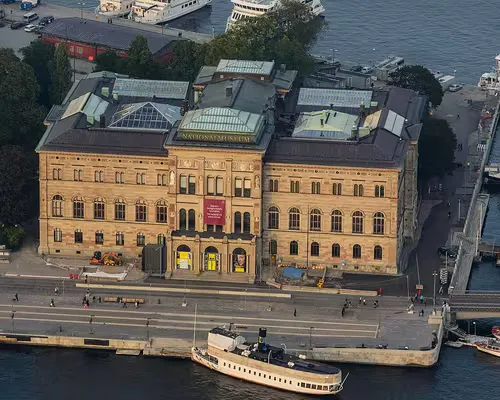
  7. National Museum in Stockholm, stop 7 on the self-guided walking tour
    7National Museum
  8. Nordic Museum in Stockholm, stop 8 on the self-guided walking tour
    8Nordic Museum
  9. Vasa Museum in Stockholm, stop 9 on the self-guided walking tour
    9Vasa Museum
  10. Skansen in Stockholm, stop 10 on the self-guided walking tour
    10Skansen
  11. That's the full route.

    Walk it with an AI Tour Guide talking you through every one of these streets.

    Start free in your browser
    You made it

Stop by Stop on Your Stockholm Walking Tour

  1. 1

    Stockholm City Hall

    Stockholm City Hall, stop 1 on the self-guided walking tour

    Start at the water's edge on Kungsholmen, where Stockholm City Hall rises in dark red brick beside Lake Mälaren, crowned by its 106 metre tower. The city council decided in 1908 to build a municipal hall with banqueting rooms on this plot, after an earlier plan for a new courthouse came to nothing. The architect Ragnar Östberg needed 15 years to finish it, and it opened on Midsummer Eve, 23 June 1923, four hundred years after Gustav Vasa entered Stockholm.

    Look at the arcades along the water and the tall tower: Östberg is said to have had the Doge's Palace and the campanile of St Mark's in Venice in mind. He blended Italian Renaissance, Nordic Gothic and Islamic art into a style of his own, and the specially made dark red brick was central to it. More than a million bricks were shaped by hand and almost seven million by machine. The project has been called the last true building lodge in Sweden, and it ranks among the country's leading works of National Romanticism.

    When it opened, the public and Östberg's fellow architects greeted it with ovations, though some critics found it old-fashioned. A long list of artists decorated it, among them Prince Eugen, Carl Eldh, Einar Forseth and the furniture designer Carl Malmsten. It became Östberg's masterpiece, and since 2025 it has been part of Sweden's cultural canon.

    This is a working building: the city council meets here and the city's commissioners have their offices inside. Its best-known rooms are the Blue Hall, the Golden Hall and the Prince's Gallery, and the building is famous as the setting for the annual Nobel festivities. You see them on a paid guided tour, which is worth it if the Nobel connection or decorative art appeals to you.

    From here it is 880 metres, about 12 minutes, to the Riksdag Building: from the city's government to the nation's parliament.
    Local name
    Stockholms stadshus
    Price
    Guided tour 150 SEK; seniors and students 130 SEK; ages 7–18 60 SEK; ages 0–6 free
  2. 2

    Riksdag Building

    Riksdag Building in Stockholm, stop 2 on the self-guided walking tour

    The Riksdag Building stands on Helgeandsholmen, the Island of the Holy Spirit, just north of the Royal Palace. In 1888 this island was chosen for Sweden's new parliament. At the time it was crowded with small, run-down buildings, and the brief called for something grand and monumental, which was not easy on a tight plot surrounded by water.

    The commission went to Aron Johansson, even though he had not won the architectural competition. The building also had to house the Swedish central bank, the Riksbank. An early design from 1894 even had a dome, which was never built. To make the ground hold, workers removed 37,000 cubic metres of soil and drove in more than 9,000 oak piles. King Oscar II laid the foundation stone on 13 May 1897, the parliament was inaugurated on 12 January 1905, and the bank wing followed a year later.

    Few buildings in Stockholm have been argued over so passionately. The neo-Baroque style already looked dated to the architects of the new century, and many found the building far too massive. Costs nearly doubled, partly because the Opera and the grand boulevard Strandvägen were going up at the same time, which made materials and craftsmen scarce. Take a close look at the facade: it is built of Swedish stone, several granites, a limestone and sandstones, while the vestibule uses marble from Gropptorp near Katrineholm.

    The guided tours in English and Swedish are free, which makes this an easy interior to fit in if you are curious how Swedish democracy works from the inside; check the current tour times at the entrance.

    Riddarholmen Church is 410 metres away, about 6 minutes on foot.

    Local name
    Riksdagshuset
    Hours
    Summer, weekdays: tours at 11:00, 11:30, 12:00, 13:00, 13:30, 14:00, 14:30, 15:00, 15:30
    Price
    Free (guided tours in English and Swedish)
  3. 3

    Riddarholmen Church

    Riddarholmen Church in Stockholm, stop 3 on the self-guided walking tour

    Look up at the tall west tower of Riddarholmen Church: its openwork spire is made of cast iron. The church itself is red brick Gothic, a three-aisled basilica with a narrow, long choir. Around it, burial chapels have been added over the centuries. The Caroline chapel with its rococo roof stands out most, and the Renaissance style of the others contrasts with the church's original brick Gothic.

    The story begins with the Franciscans, the Greyfriars, whose monastery was founded here in 1270 thanks to a donation from King Magnus Ladulås. The church was consecrated around 1292, when the king himself was buried in it. That makes it the oldest preserved building in Stockholm, with the oldest brick walls above ground, and the only medieval monastery church left in the city. After Gustav Vasa's seizure of church property and the Reformation, it became a Lutheran parish church.

    Its fame today comes from the dead. With the funeral of Gustav II Adolf in 1634, the old tradition of royal burials here was revived. Every Swedish ruler from him to Gustaf V lies in this church, with the single exception of Queen Christina: 15 monarchs, divided among the Gustavian, Caroline and Bernadotte chapels. In front of the high altar are two medieval graves, by tradition those of Magnus Ladulås and Karl Knutsson, which brings the count to 17 rulers. Five further chapels were built by noble families in the 17th century, and the church also serves the Order of the Seraphim.

    Inside, the tombs dominate, but look up as well: medieval wall paintings survive in the vaults. Entry costs admission, and it pays off if royal history draws you; otherwise the chapels already tell a lot from outside.

    From here it is 370 metres, about 6 minutes, to Stockholm Cathedral.

    Local name
    Riddarholmskyrkan
    Hours
    approx. 10:00–17:00 (seasonal)
    Price
    65 SEK, students 45 SEK, children 7–17 30 SEK
  4. 4

    Stockholm Cathedral

    Stockholm Cathedral, stop 4 on the self-guided walking tour

    Stockholm Cathedral is known locally as Storkyrkan, the Great Church, and also as the Church of Saint Nicholas. It sits at the highest point of Gamla Stan, wedged between the Stock Exchange Building and the Royal Palace. It was dedicated to Saint Nicholas in 1306, though building probably began in the 13th century. For a long time it was the only parish church of Stockholm, built at the very centre of the medieval city.

    From outside it looks uniformly Baroque, the result of extensive changes in the 18th century. Step inside and the medieval church appears: a hall church with a vaulted ceiling carried by brick pillars, still largely late medieval in character.

    Much of Swedish history happened here. During the Reformation, Mass was celebrated in Swedish for the first time in this church. For centuries it was the coronation church, and since the Diocese of Stockholm was created in 1942 it has been the seat of the bishop. Military victories and national tragedies have been marked here, Crown Princess Victoria married Daniel Westling here in 2010, and the funerals of writers such as Astrid Lindgren and Sara Danius took place under these vaults.

    Two works make the admission worthwhile, and an audio guide is included. The late medieval sculpture of Saint George and the Dragon is the centrepiece, and Vädersolstavlan, the Sun Dog Painting, shows one of the earliest images of Stockholm. If you only go inside one church on this route and care more about art than royal tombs, choose this one.

    The next stop is only 150 metres, about 2 minutes, away; the short walk leads through the lanes of Gamla Stan, the old town, to its main square.

    Local name
    Storkyrkan
    Hours
    1 Jun-13 Sep: daily 9:00–18:00 (current season); 1 Jan-31 May and 14 Sep-31 Dec: daily 9:30–17:00
    Price
    120 SEK adults, 90 SEK seniors, under 18 free (incl. audio guide)
  5. 5

    Stortorget & Nobel Prize Museum

    Stortorget & Nobel Prize Museum in Stockholm, stop 5 on the self-guided walking tour

    Stortorget is the old main square of Stockholm, and you can wander it freely at any time. On its north side stands the former Stock Exchange Building, which today holds three institutions: the Nobel Prize Museum, the Swedish Academy and the Nobel Library.

    The museum opened in spring 2001 for the 100th anniversary of the Nobel Prize and took its current name in 2019, when Erika Lanner became director. It tells the story of the prize, of its founder Alfred Nobel, born in 1833 and died in 1896, and of the laureates. The permanent display is built around objects donated by laureates themselves, each paired with a personal life story, and exhibitions have featured figures such as Marie Curie, Nelson Mandela and Winston Churchill.

    The museum likes creative formats. One example is Sketches of Science, a photo exhibition of 42 laureates, each pictured with their own sketch of their discovery; it has travelled as far as Dubai and Singapore. Beyond exhibitions there are films, theatre and debates on science, plus a bistro.

    Entry costs admission. It is worth it if you enjoy science and the people behind big ideas; if not, the square and the facade are enough. Even then the shop is fun to browse: one popular item is Alfred Nobel's gold medal in dark fair trade chocolate, another is a Swedish dynamite sweet flavoured with jalapeño.

    The Royal Palace is 160 metres away, about 2 minutes on foot.

    Local name
    Nobelprismuseet
    Hours
    Stortorget: continuously accessible. Nobel Prize Museum: Mon–Thu 10:00–19:00, Fri 10:00–21:00, Sat–Sun 10:00–19:00
    Price
    SEK 160 adult; SEK 120 student; SEK 120 senior
  6. 6

    Royal Palace

    Royal Palace in Stockholm, stop 6 on the self-guided walking tour

    The Royal Palace is the official residence of the Swedish monarch, and fortifications have stood on this spot by the Norrström since the Middle Ages. For centuries this was the castle of Tre Kronor, Three Crowns, until a fire destroyed it completely on 7 May 1697.

    Nicodemus Tessin the Younger designed the new palace, but war intervened. The Great Northern War drained Sweden's resources, and in 1709 work stopped entirely; it only resumed in 1727, six years after the war ended. Tessin died a year later, and Carl Hårleman finished the building and designed many of its original rococo interiors. King Adolf Fredrik and Queen Lovisa Ulrika could not move in until 1754, and some interior work went on into the 1770s. Since then there has been no major rebuilding, only new furnishings, modernisations and changes in facade colour.

    The scale is hard to grasp from outside: the palace has 1,430 rooms, 660 of them with windows. Besides the royal apartments it holds state and banqueting suites, the Hall of State, the Royal Chapel, Gustav III's Museum of Antiquities, the Treasury with the regalia, the Royal Armoury and Museum Tre Kronor, which shows cellar vaults of the old castle.

    Entry costs admission. Choose the Treasury if crowns and regalia appeal to you, Museum Tre Kronor if you want to stand in what survives of the medieval castle.

    From here it is 930 metres, about 13 minutes, to the National Museum, and there is a link: the collection began life in this very palace.

    Local name
    Stockholms slott
    Price
    220–240 SEK, students 200–220 SEK, children 7–17 110–120 SEK, under 7 free
  7. 7

    National Museum

    National Museum in Stockholm, stop 7 on the self-guided walking tour

    The National Museum on Blasieholmen is Sweden's largest art museum. The building was designed for this purpose by the German architect Friedrich August Stüler and completed in 1866.

    The museum itself is older. It goes back to 28 June 1792, when the Royal Museum was founded; it opened in 1794 in the north wing of the Royal Palace, which you have just seen. That makes it one of the oldest art museums in Europe. Like many national galleries, much of the collection grew out of generations of royal collecting that later passed to the state; you can even see works that once belonged to Gustav Vasa.

    Around 700,000 objects belong to the museum: painting, sculpture and works on paper from about the 16th to the 20th century, plus applied art and design from the 16th century to today. Its reach goes beyond this building, too: the Swedish State Portrait Collection, for example, hangs at Gripsholm Castle.

    Entry costs admission, though anyone under 20 gets in free. It suits art lovers who want a calm hour away from the palaces; if your time is short, save your energy for Djurgården.

    Now comes the longest leg of the route: 1,750 metres, about 24 minutes, out to the Nordic Museum on Djurgården.

    Hours
    Mon: Closed | Tue–Wed: 11:00–17:00 | Thu: 11:00–20:00 | Fri–Sun: 11:00–17:00
    Price
    160 SEK regular, last 60 minutes before closing 80 SEK, under 20 free, Thursday evening (17:00-20:00) free
  8. 8

    Nordic Museum

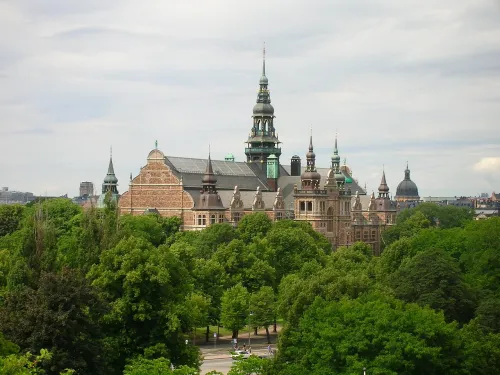
    Nordic Museum in Stockholm, stop 8 on the self-guided walking tour

    The Nordic Museum greets you on Djurgården with a building that looks more Danish than Swedish. Isak Gustaf Clason took its style from Dutch-influenced Danish Renaissance architecture such as Frederiksborg Palace. It was completed in 1907 after 19 years of construction, and even so it is unfinished: it was meant to be a national monument three times its actual size, and for the Stockholm Exhibition of 1897 only half of it stood.

    Behind it is one man, Artur Hazelius. In 1873 he began the Scandinavian Ethnographic Collection, renamed the Nordic Museum in 1880. He bought or was given furniture, clothes and toys from all over Sweden and the other Nordic countries, focusing on peasant culture; his successors later added objects from bourgeois and urban life.

    Money was a struggle. The government did not fund the project at first, but support grew: by 1898 the society promoting the museum had 4,525 members. The Riksdag granted money in 1891 and doubled it in 1900, the year before Hazelius died. Skansen, his other creation, belonged to this museum until the two became independent in 1963.

    Inside, the museum covers Swedish cultural history from 1520 to the present. Entry costs admission; it is worth it if everyday life interests you more than kings and battles.

    The Vasa Museum is just 350 metres away, about 5 minutes on foot.

    Local name
    Nordiska museet
    Hours
    approx. 10:00–17:00 (seasonal)
    Price
    170 SEK adults, 0-75 SEK children (tiered)
  9. 9

    Vasa Museum

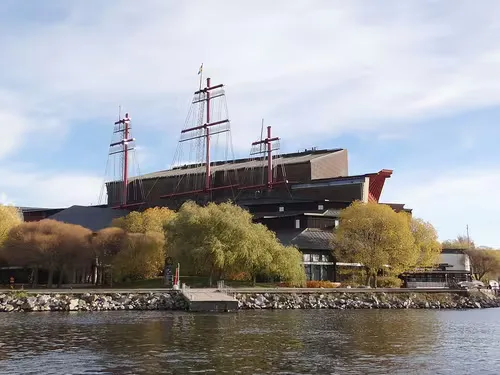
    Vasa Museum in Stockholm, stop 9 on the self-guided walking tour

    The Vasa Museum holds the only almost fully intact 17th-century ship ever salvaged: the 64-gun warship Vasa, which sank on her maiden voyage in 1628. Inside the main hall the ship fills your view, surrounded by exhibits on the archaeological finds and on Sweden in the early 17th century.

    Look closely at the wood. The ship has been fitted with the lower sections of all three masts, a new bowsprit and winter rigging, and missing or badly damaged parts were replaced. These new parts are neither treated nor painted, so they stand out clearly against the original timber, darkened by more than three centuries under water.

    Before this building existed, the ship spent its first years ashore in a temporary hall called Wasavarvet, the Vasa Shipyard. From 1961, and for more than two decades, it was treated there with polyethylene glycol, and visitors could only look from two levels, never more than 5 metres away. In 1981 the government decided on a permanent museum; 384 architects entered the competition, and Marianne Dahlbäck and Göran Månsson won with a design called Ask, the box.

    The new museum was built on and around the dry dock of the old naval yard. Prince Bertil opened the works on 2 November 1987, and that December Vasa was towed into the flooded dock. In summer 1989, 228,000 people visited the half-finished site, and the museum officially opened on 15 June 1990. By early 2025 more than 45 million people had seen the ship, and in 2024 alone the museum counted 1,353,453 visitors.

    Entry costs admission, under-18s go free, and if you pick only one interior on this route, make it this one. From here it is 830 metres, about 12 minutes, to Skansen.

    Hours
    Daily 08:30–18:00
    Price
    240 SEK adults, under 18 free, combi ticket with Vrak Museum 359 SEK
  10. 10

    Skansen

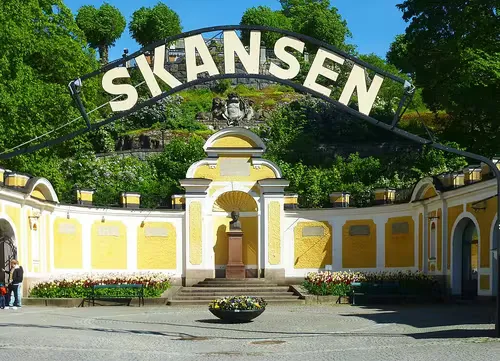
    Skansen in Stockholm, stop 10 on the self-guided walking tour

    Skansen sits on the hill that dominates Djurgården, and it is the oldest open-air museum and zoo in Sweden. Artur Hazelius, founder of the Nordic Museum, opened it on 11 October 1891 to show how people lived in the different parts of Sweden before industrialisation. It was the second open-air museum in the world, and its name became a generic term for such museums, especially in Central and Eastern Europe.

    Hazelius acted out of worry. In the 19th century rural life was giving way fast to industrial society, and many feared that old customs and trades would vanish. After travelling widely, he bought around 150 houses from all over the country, plus one building from Telemark in Norway, and had them shipped piece by piece and rebuilt here. Only three buildings are not original; he had them carefully copied from examples he had found.

    All the buildings are open to visitors, from Skogaholm Manor, built in 1680, to the 16th-century farmhouses from Älvros. The grounds cover about 300,000 square metres and include a full replica of a typical 19th-century town, where craftspeople in traditional dress work as tanners, shoemakers, silversmiths, bakers and glassblowers. Skansen draws more than 1.3 million visitors a year, and the objects inside its houses still belong to the Nordic Museum.

    Skansen charges admission, children up to 15 enter free, and it rewards an unhurried afternoon, especially with kids. This is where the route ends: you started with Stockholm's power and splendour, and you finish with the everyday Sweden that Hazelius set out to save.

    Hours
    Jun 1-Aug 30: Daily 10:00–18:00 | Jun 23-Aug 11: Tue 10:00–20:00 | Aug 31-Sep 27: Daily 10:00–17:00 | Sep 28-Jan 10: Mon–Fri 10:00–15:00, Sat–Sun 10:00–16:00 | Oct 24-Nov 1: Daily 10:00–16:00 | Oct 24: Daily 15:00–19:00 | Oct 28-Oct 31: Daily 15:00–19:00 | Nov 27-Dec 20: Mon–Thu 10:00–15:00, Fri–Sat 10:00–17:00, Sun 10:00–16:00 | Dec 24: Daily 10:00–14:00 | Dec 31: Daily 10:00–16:00 and 20:00–24:00
    Price
    Adult price varies by season and is lowest online; children aged 0–15 free (complimentary ticket)
Walking tour route map of Stockholm Route loaded
Stockholm City HallRiksdag BuildingRiddarholmen ChurchStockholm Cathedral+6
All 10 stops are already on the map.
You just press start.
AI Tour Guide

You've read the route. Now walk it with a guide in your ear.

Press start wherever you are, even hundreds of kilometres from Stockholm, and the guide begins telling its stories right away. In the city, pick any of the 10 stops to start from: it leads you there, then talks with you the whole route, asking, listening, remembering, and shaping the tour around your answers.

10stops 5.8km 1 h 21 minwalking 13languages
▶Start the tour free

Free to start · Runs in your browser · No app, no download

Shorter Ways to Walk Stockholm

Not everyone has a whole day. These cuts follow the same order and keep the walking short.

Parliament, churches and palace

Stops: 1, 2, 3, 4, 5, 6

For first-time visitors with half a day. From City Hall across to the Riksdag and through Gamla Stan to the Royal Palace: 28 minutes of walking in total. The Riksdag tours and Stortorget are free; the City Hall tour, Riddarholmen Church, Stockholm Cathedral, the Nobel Prize Museum and the Royal Palace charge admission.

Gamla Stan in an hour

Stops: 3, 4, 5, 6

For a short window between other plans. Riddarholmen Church, the cathedral, the old square and the palace lie close together: just 10 minutes of walking. Stortorget is free to wander; the churches, the Nobel Prize Museum and the palace charge admission.

Djurgården museum afternoon

Stops: 8, 9, 10

For families and museum lovers. The Nordic Museum, the Vasa Museum and Skansen sit on the same island, 17 minutes of walking apart in total. All three charge admission, but children enter the Vasa Museum and Skansen free.

How Long This Stockholm Tour Takes on Foot

The full route covers 5.8 km with 1 h 21 min of pure walking. The longest leg is the 24 minutes from the National Museum out to Djurgården; most of the rest is short hops through the old town.

If you look at everything from outside and pause briefly at each stop, count on about three hours. Add the Vasa Museum, which deserves at least an hour, plus one more interior such as the Royal Palace or the City Hall tour, and the walk becomes a full day.

The half-day cut from City Hall to the Royal Palace takes about two hours from outside, the Gamla Stan loop about one. The Djurgården trio is short on walking but long on visiting: with the Vasa Museum and Skansen inside, it easily fills an afternoon.

Before You Set Off from City Hall

  • Start: Stockholm City Hall on Kungsholmen is the recommended start, but you can join the route at any stop.
  • End: Skansen on Djurgården, after 5.8 km.
  • Time of day: Start in the morning. The museums at the Djurgården end need time, and hours change with the season, so check each stop's current hours on the day.
  • Admission: Free: Stortorget and the Riksdag Building's guided tours. Admission: the City Hall tour, Riddarholmen Church, Stockholm Cathedral, Nobel Prize Museum, Royal Palace, National Museum, Nordic Museum, Vasa Museum and Skansen.
Walking tour route map of Stockholm
AI Tour Guide

Your guide is ready when you are, from City Hall to Skansen.

Press start and a voice AI Tour Guide takes it from here: leading the route through Stockholm, telling the stories, and turning your walk into a real back-and-forth conversation. No app or download is needed; it runs in your browser.

10stops 5.8km 1 h 21 minwalking 13languages
▶Start the tour free

Free to start · Runs in your browser · No app, no download

What the AI Tour Guide Adds Between Palace and Warship

This route moves through seven centuries, from a Franciscan church to a parliament argued over for decades. The AI Tour Guide walks it with you as a conversation: it greets you at City Hall, tells the stories at each place, asks what you noticed and remembers whether kings, architects or shipwrecks interest you most. You can interrupt any time, for instance to ask why Queen Christina was not buried with the other monarchs, or what daily life looked like aboard a 17th-century warship. Start with 100 free credits; after that, choose this tour all-inclusive for €19.99 with no time limit, or credits at €5 per hour.

A Real Conversation A voice AI Tour Guide greets you, leads the whole route, and tells the stories and facts as you walk, asking what you want to see and keeping a real conversation going. Not a recording you press play on.
Map Navigation Follow the route on the map and walk at your own pace. You choose where to start and when to move to the next stop.
Ask Anything Curious about a building you pass? Ask your AI Tour Guide on the spot and the conversation carries on.
13 Languages Switch language anytime. No separate tour needed.
Start free in your browser

Common Questions Before You Walk

Can I see inside Stockholm City Hall without a guided tour?

Interior visits run as guided tours, which charge admission. The waterfront and the exterior with its tower are free to walk around.

Which stops are free for children?

Children under 18 enter the Vasa Museum and Stockholm Cathedral free, under-16s get into Skansen free, and the National Museum is free for anyone under 20.

Which interior should I choose if I only have time for one?

The Vasa Museum, if you want something you cannot see anywhere else: an almost intact 17th-century warship. If royal history matters more to you, choose the Royal Palace with its Treasury and the cellar vaults of the old castle.

Is there a similar free route in other Baltic cities?

Yes. If you travel on, there are free GPS routes for Gothenburg and across the Baltic Sea for Tallinn.

Is the tour really free?

Yes. The whole tour is free: the route, the interactive map and the navigation cost you nothing. Only the voice AI Tour Guide is optional and paid: you test it with 100 free credits, then you pay either €5 per hour or €19.99 for this whole tour, with no time limit. Admission to 8 of the 10 stops is not included: Riddarholmen Church, Stockholm Cathedral, Stortorget & Nobel Prize Museum, Royal Palace, National Museum, Nordic Museum, Vasa Museum and Skansen charge their own entry fees.

Do I need to download an app?

No. Everything runs in your phone browser. Open the route and start walking, no download and no sign-up required.

Do I need to book the walking tour in advance?

No booking needed. This self-guided tour is available anytime. Open the route in your browser and start walking. The AI Tour Guide works instantly, no app, no reservation required.

What languages is the AI Tour Guide available in?

The AI Tour Guide speaks 13 languages, so you take the tour in your own language and can switch at any time.

Can I skip stops or change the route?

Yes. Skip any stop, spend extra time at places you like, or start the route from any point. It is your walk, you set the pace.
Image credits
▶ Start free in your browser Runs in your browser, no app, no download