Free Walking Tour Pontresina: Frescoes, Tower, Val Roseg

A 3.9 km loop from a 17th-century Engadine house to medieval frescoes, a ruined tower and the edge of car-free Val Roseg, with the Bernina massif in view.

7 Stops 3.9 km ~58 min walking
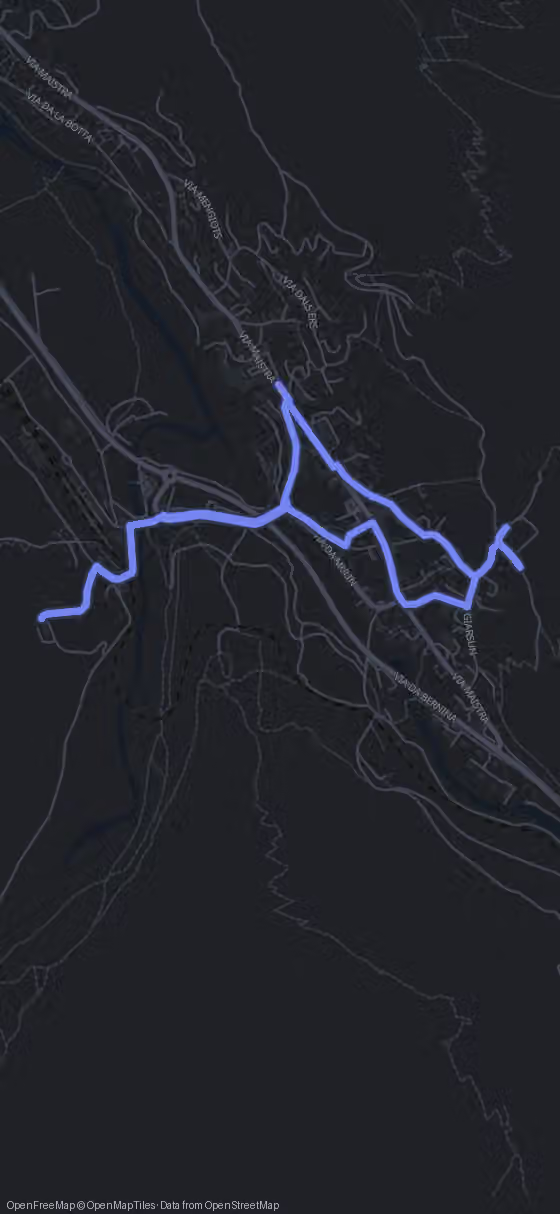
Route map for the Pontresina walking tour
Stop 1 of 7
440 m·6 min
Museum Alpin
Head east from the Museum Alpin up the lane toward Sta. Maria.
Welcome to Pontresina. I'm Alex, and one modest Alpine church here hides a painted world few walkers expect.
Try this tour with Alex

The Route at a Glance

Seven stops on a 3.9 km loop that starts and ends at the Museum Alpin: up to Sta. Maria and the Burgturm Spaniola, back to San Niculò and the Chünetta Viewpoint, out to the Val Roseg (gateway) and home via San Spiert. Pure walking time is 58 min; with visits, plan about two and a half hours, or three and a half with an hour in the museum.

Only the museum charges admission; the churches, the tower, the bench and the valley are free. Route, map and GPS navigation run free in your browser, and the AI Tour Guide is optional.

Open free GPS & optional AI Tour Guide
View of Pontresina

The Route

Walking Map of Pontresina: The 3.9 km Loop

7 stops 3.9 km 58 min walking
Tap to load interactive map

The 7 stops along this route

  1. Museum Alpin in Pontresina, stop 1 on the self-guided walking tour
    1Museum Alpin
  2. Sta. Maria in Pontresina, stop 2 on the self-guided walking tour
    2Sta. Maria
  3. Burgturm Spaniola in Pontresina, stop 3 on the self-guided walking tour
    3Burgturm Spaniola
  4. San Niculò in Pontresina, stop 4 on the self-guided walking tour
    4San Niculò
  5. 5Chünetta Viewpoint
  6. Val Roseg (gateway) in Pontresina, stop 6 on the self-guided walking tour
    6Val Roseg (gateway)
  7. San Spiert in Pontresina, stop 7 on the self-guided walking tour
    7San Spiert
  8. That's the full loop.

    Walk it with an AI Tour Guide talking you through every one of these streets.

    Start free in your browser
    You made it

Your Pontresina Walking Tour, From Engadine House to Mountain Valley

  1. 1

    Museum Alpin

    Museum Alpin in Pontresina, stop 1 on the self-guided walking tour

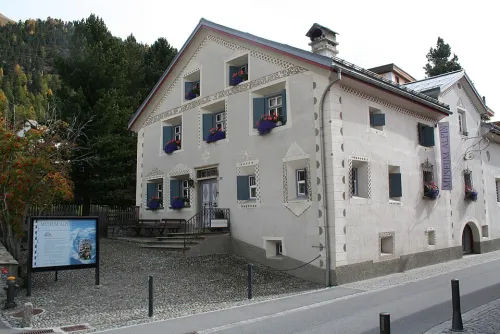
    You start in the Chesa Delnon on Via Maistra, an Engadine house from the 17th century. Before you even go in, the building is the first exhibit: the museum it holds is about exactly this kind of house and the life people led in it. The name is Romansh, in the local Puter idiom, and simply means alpine museum.

    Inside, the permanent rooms cover a lot of ground for a village museum. One shows the traditional Engadine house from the inside. Another holds a complete hut of the Swiss Alpine Club, SAC, with its full inventory, so you can see what mountaineers found when they reached a shelter. There are rooms on the history of hunting in Graubünden, on the minerals of the Engadine and on the mining that once went on in the region. The animals and plants of Val Bernina and the Upper Engadine are presented with multimedia displays.

    Special exhibitions often turn to tourism, which shaped the Upper Engadine more than almost anything else, and to the cultural changes it brought. Keep that thread in mind: you will meet it again at the graves of the hotelier families at Sta. Maria.

    The museum is the only stop on the loop that charges admission. It is worth it if you want context before heading toward the mountains, or if you are walking with children who like to look at real objects. If you only have a short time, you can skip it and come back at the end, since the loop returns to this door.

    From here it is 480 m, about 10 minutes, up to Sta. Maria above the village.
    Hours
    Summer (Jun – mid Oct): Mon–Sat 15:30–18:00, Sun closed; Winter (mid Dec – mid Apr): Tue–Sat 15:30–18:00
    Price
    CHF 9 adults, CHF 3 children (6-16), under 6 free, CHF 22 family
  2. 2

    Sta. Maria

    Sta. Maria in Pontresina, stop 2 on the self-guided walking tour

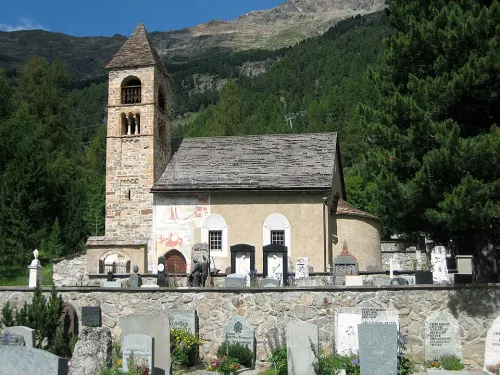
    Sta. Maria stands above Pontresina, close to the old tower you will reach next. It belongs to the municipality rather than a parish and is used today for funerals and weddings. What makes it famous is inside: frescoes from the 12th and 15th centuries that run without a break across all four walls. In the choir, Christ appears as Pantocrator, his hand raised in a greeting of peace.

    The church has a bigger place in history than its size suggests. It was the church of the parish in the Upper Engadine where the Reformation first took hold. Until 1640 it served as the village's parish church; then San Niculò took over that role. Sta. Maria is also one of a chain of churches along the old mule track from the Rhine valley to Italy and the Po plain, together with San Romerio near Brusio, San Pietro near Poschiavo and Santa Perpetua in Tirano.

    Take time for the cemetery around it, enlarged several times over the years. Here lie mountain guides, among them the hunter and guide Gian Marchet Colani. Look out for the often elaborate graves of the hotelier families that built Pontresina's tourism: Enderlin, Gredig, Klainguti, Saratz, Stiffler and Stoppany.

    Entry is free, but the church opens only at set times. If you are here when the door is open, go in: the frescoes are the main reason to make the climb. If it is shut, the cemetery alone is worth the walk.

    The tower is only 120 m away, a two-minute walk.

    Hours
    Jun 8 – Jul 19, 2026: Mon/Wed/Fri 15:30–17:30; Jul 22 – Oct 23, 2026: Mon–Fri 15:30–17:30
    Price
    Free
  3. 3

    Burgturm Spaniola

    Burgturm Spaniola in Pontresina, stop 3 on the self-guided walking tour

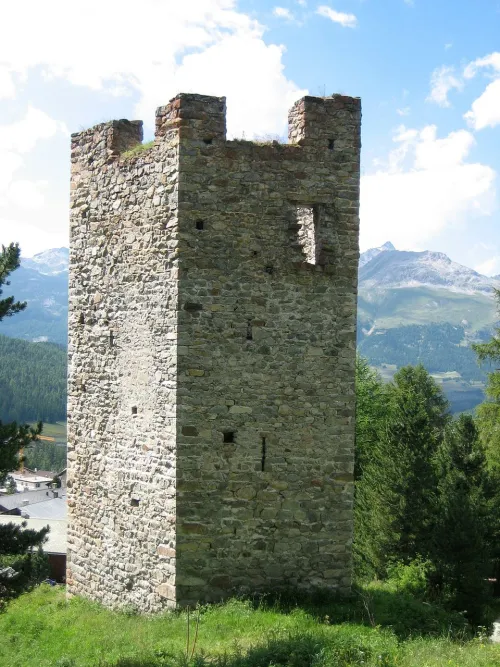
    The Burgturm Spaniola is the ruin of a mighty keep with an almost regular five-sided plan, and it is in good shape. Walk around it and read the wall: on the valley side, to the southwest, a round-arched entrance sits high up at second-floor level. It was reached by a covered wooden gallery, and you can still see the beam holes and the stone corbels that carried it. Narrow slits light the second and third floors, a square window the fourth. On the northeast side, more corbels mark where a latrine projected from the wall, draining down to its foot.

    Originally the tower had four floors, probably topped with a pyramid roof shaped to its plan. A ring wall once stood about 5 m away, but its traces are now hard to make out in the ground. Nobody knows where the name Spaniola comes from; it is fairly recent. Around 1740 the writer Nicolin Sererhard noted that the tower bore the name of the village.

    It was built around 1200, though no documents survive from then. It was most likely the seat of the lords of Pontresina, recorded between 1244 and 1307 and then the most important family of the Upper Engadine. In 1244 they fell out with the Bishop of Chur and lost their office of chancellor; the tower was wrecked the same year and repaired in 1261. They seem to have held their own, because in 1294 they pledged the chancellorship to Andreas Planta. The line probably ended with Symon of Pontresina, whose fief, the tithe of Pontresina and Celerina, passed to the Murell family.

    By the 15th century the tower was abandoned, and around 1550 Ulrich Campell described it as a ruin. Work to secure it was carried out in 1934 and 1994. It is free and always accessible.

    From here it is 880 m, about 12 minutes, back into the village to San Niculò.

    Hours
    Always accessible
    Price
    Free
  4. 4

    San Niculò

    San Niculò in Pontresina, stop 4 on the self-guided walking tour

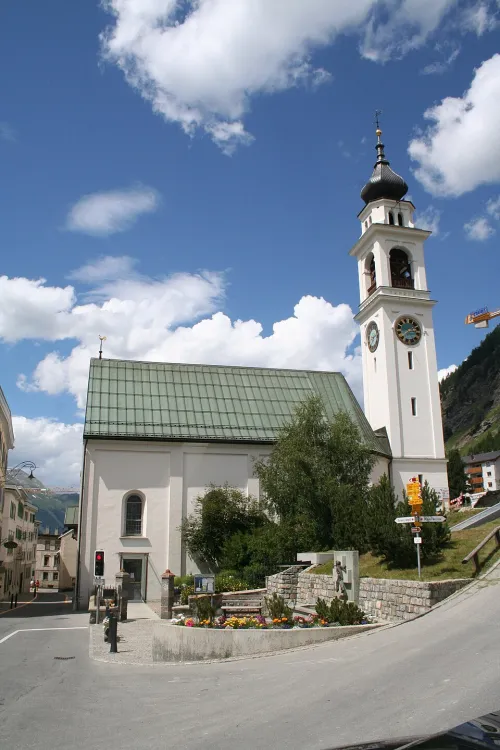
    San Niculò is Pontresina's Reformed village church and a protected monument of the canton. It stands in the Laret quarter, on the site of a pre-Reformation chapel dedicated to St Nicholas, and was built in 1640 following proposals by Gaudenz von Planta. That is the year it took over as parish church from Sta. Maria.

    Look at the tower first, because it has moved. It used to stand on the north side of the nave. In 1887 the architect Jakob Ragaz moved it to the end of the choir in its old form, with the octagonal top and the onion dome of 1720. The weather vane carries 1887, the year of the move. The clock went in in 1845, and the roofs date from 1720/21, after the village fire of 1718 had destroyed them.

    The church itself is a Baroque hall with a saddle roof and a polygonal choir, its walls divided by flat pilaster strips. On the south side you count five round-arched windows, three in the nave and two in the choir. The west portal is closed today because it opens straight onto the main road, but study its door: it dates from 1820/30, with some carvings still from 1640, flanked by columns that carry a triangular pediment with an obelisk in the middle. The golden rooster sits on the west gable.

    Shortly after it was finished, San Niculò served as the model for the Bel Taimpel church in Celerina. The two share plan, proportions and wall layout; here the whole choir sits under a half dome, and the acanthus ornament of Celerina is missing. Inside it was renovated in 1958, when the organ gallery was built, and again in 1976 and 1997. Entry is free, and a short look inside fits easily into the walk.

    The next stop is only 40 m away, one minute on foot.

    Hours
    Daily 08:30–18:30
    Price
    Free
  5. 5

    Chünetta Viewpoint

    This is the shortest hop of the tour and the stop that gives you the mountains. It is a public bench on the walking path with the Bernina massif in front of it: no fence, no fee, no closing time. Sit down for a few minutes before you decide anything else.

    The Bernina group is where the next stop leads. On its northern slope, at the far end of Val Roseg, lies the Roseg glacier. This bench is a good place to decide how much of the valley you want today: just the gateway, or a longer walk or ride further in.

    From here it is 1,090 m, about 15 minutes, to the gateway of Val Roseg. This leg runs along the Roseg Valley itself, so the landscape changes around you as you go.

    Hours
    Always accessible
    Price
    Free
  6. 6

    Val Roseg (gateway)

    Val Roseg (gateway) in Pontresina, stop 6 on the self-guided walking tour

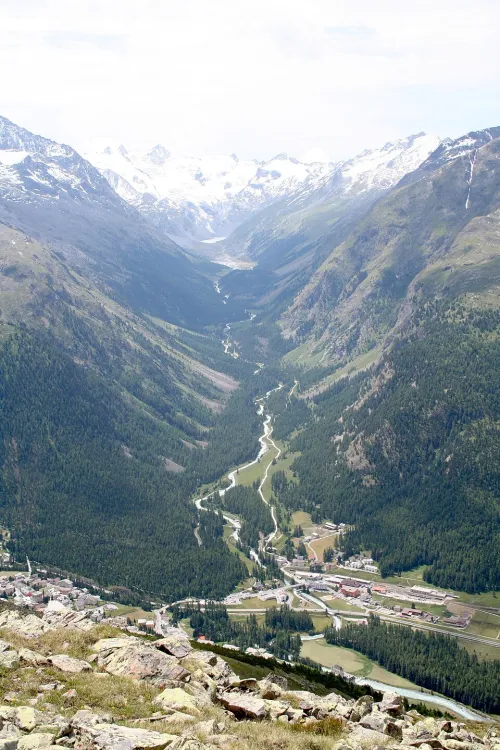
    Val Roseg is a high side valley of Val Bernina, about 12 km long, with the Ova da Roseg running through it. Most of it belongs to Samedan, only a small northern part to Pontresina. It is largely untouched and car-free, used gently for hiking and cross-country skiing. Its floor climbs from 1,770 m at the Pontresina end to 2,160 m at Lej da Vadret, a lake 1.5 km long. At the very back lies the Roseg glacier on the northern slope of the Bernina group, with Piz Roseg to the east.

    Two alpine pastures lie along the way, Alp Prüma and Alp Seguonda, which simply mean first and second alp. At 1,999 m stands the hotel and restaurant Roseg Gletscher, from where a mountain trail crosses the Fuorcla Surlej back into the Engadine. Higher still, at 2,610 m above Lej da Vadret, is the Coaz hut of the Swiss Alpine Club. If the SAC hut in the Museum Alpin caught your interest, this is the real thing; in summer hikers reach it in about three hours from the middle station of the Corvatsch cable car over the Fuorcla Surlej.

    The valley also shows how alive these mountains are. At 06:56 on 14 April 2024, a rockslide broke away from Piz Scerscen at about 3,600 m. An estimated eight to nine million cubic metres of rock, scree, snow and ice came down, and the debris spread over about 5.5 km, down to 2,050 m.

    Walking or cycling into the valley is free. If you want to go further without the effort, a horse-drawn omnibus runs from Pontresina to Hotel Roseg Gletscher in season for a fare. For this loop, a look into the valley is enough; if you have the whole day, this is where to spend it.

    From the gateway it is 1,090 m, about 17 minutes, back to San Spiert.

    Hours
    Open 24/7 (car-free alpine side valley; freely accessible on foot or by bike year-round). The horse-drawn omnibus into the valley runs daily to a published timetable in the summer and winter seasons.
    Price
    Free to enter and hike; optional horse-drawn omnibus Pontresina–Hotel Roseg Gletscher CHF 25 one way / CHF 37 return (children 4–12 CHF 12.50 / 18.50)
  7. 7

    San Spiert

    San Spiert in Pontresina, stop 7 on the self-guided walking tour

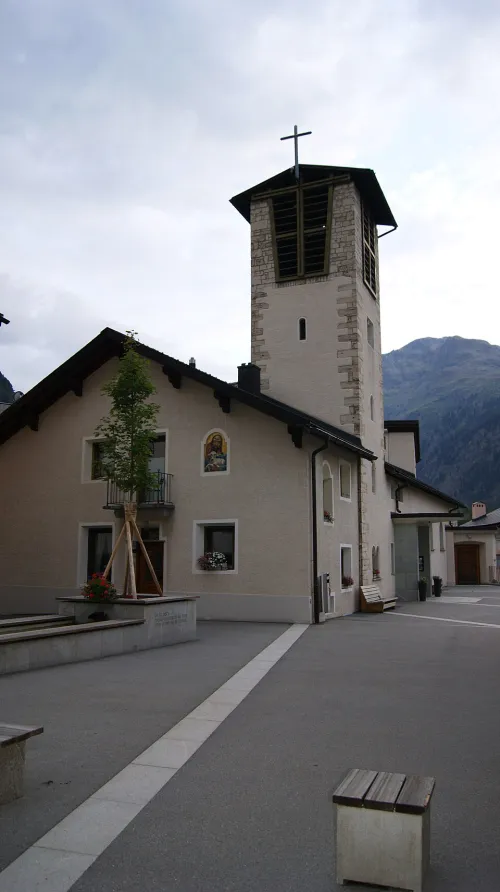
    San Spiert is the Catholic Church of the Holy Spirit, set a little back from Via Maistra in the old quarter of the same name. Its story starts long before the building. Christianity is said to have reached the Engadine from northern Italy in the 10th century, and in 1485 the Tempesta family built a chapel to the Holy Spirit here at their own expense, with the bishop's permission.

    That chapel is gone, but not without a trace. In 1941 remains of it were found in the cellars of the Haus Aebli, and a Latin inscription on the house front still recalls it, beginning with 1485 and the words of the priest Johannes Tempesta Maurici of Pontresina, in honour of the Holy Spirit. Look for it on the facade.

    The Reformation came to Pontresina in 1549, and for centuries there was no Catholic worship. Services returned from 1891; from 1893 a priest came over regularly from St. Moritz to celebrate Mass in the community hall of the school, and from 1908 there was religious instruction again. In January 1923 the parish bought the Restaurant-Casino Tais, with restaurant, casino hall and a stable underneath, for 115,000 francs. The hall became a church with 100 seats, consecrated on 15 July 1927; the restaurant became the rectory, and a quasi-Romanesque tower was set between the two.

    A parish library followed in 1930 and the parish hall under the church in 1944. In July 1955 work began on an extension: a large choir lengthened the nave, with the Brother Klaus chapel added on the right and a sacristy on the left. Entry is free, and it is worth a short look to see how a casino hall turned into a church.

    From here it is only 150 m, two minutes, back to the Museum Alpin, where the loop closes.

    Hours
    Daily 09:00–17:00
    Price
    Free
Walking tour route map of Pontresina Route loaded
Museum AlpinSta. MariaBurgturm SpaniolaSan Niculò+3
All 7 stops are already on the map.
You just press start.
AI Tour Guide

You've read the route. Now walk Pontresina with a guide in your ear.

Press start wherever you are, even hundreds of kilometres from Pontresina, and the guide begins telling its stories right away. In the city, pick any of the 7 stops to start from: it leads you there, then talks with you the whole route, asking, listening, remembering, and shaping the tour around your answers.

7stops 3.9km 58 minwalking 13languages
▶Start the tour free

Free to start · Runs in your browser · No app, no download

Shorter Ways to Walk Pontresina

The full loop is easy to cut in two: a village half with the frescoes and the tower, and a mountain half that heads toward Val Roseg. Or stretch it by riding deeper into the valley.

Village, frescoes and tower

Stops: 1, 2, 3, 4, 5

For anyone who cares most about history and art. From the Museum Alpin up to Sta. Maria and the Burgturm Spaniola, then back to San Niculò and the Chünetta bench: 1,520 m and 25 minutes of walking. The museum is the only stop with admission. You finish on the bench and walk back into the village at your own pace.

The mountain half, all free

Stops: 4, 5, 6, 7

For walkers who want the landscape more than the interiors. San Niculò, the Chünetta bench, the gateway to Val Roseg and San Spiert: 2,220 m and 33 minutes of walking, with no admission anywhere.

Full loop plus a ride into Val Roseg

Stops: 1, 2, 3, 4, 5, 6, 7

For a full day. Walk the whole loop, 58 minutes on foot, and at the valley gateway add the horse-drawn omnibus to Hotel Roseg Gletscher, which runs in season and costs a fare; hiking in is free. How long you stay in the valley is up to you.

How Long Does the Pontresina Loop Take?

Walking alone takes 58 minutes over 3.9 km. Add short stops at the churches, the tower, the bench and the valley gateway, and you are out for about two and a half hours. An hour inside the Museum Alpin brings the day to about three and a half.

The village half takes about an hour and a half with its stops, or two and a half if you add the museum. The free mountain half also comes to about an hour and a half. If you take the omnibus into Val Roseg, the valley sets the pace and the loop becomes a day out.

Before You Set Off in Pontresina

  • Start and finish: The recommended start is the Museum Alpin on Via Maistra, and the loop brings you back to its door. You can join at any stop, though.
  • Timing the museum: The Museum Alpin keeps limited opening hours, so check them before you go. Because the loop ends where it starts, you can go in at the beginning or at the end, whichever fits.
  • Frescoes at Sta. Maria: The church opens only at set times. If the frescoes are the reason you came, plan the first part of the walk around them.
  • What costs money: Only the Museum Alpin charges admission. The optional horse-drawn omnibus into Val Roseg has a fare; walking into the valley is free.
Walking tour route map of Pontresina
AI Tour Guide

Your guide for Pontresina is ready when you are.

Press start and a voice AI Tour Guide takes it from here: leading the route through Pontresina, telling the stories, and turning your walk into a real back-and-forth conversation. No app or download is needed; it runs in your browser.

7stops 3.9km 58 minwalking 13languages
▶Start the tour free

Free to start · Runs in your browser · No app, no download

What the AI Tour Guide Adds on This Loop

On this loop the AI Tour Guide talks you through it like a conversation: it greets you at the museum door, tells the stories of the lords of Pontresina or the hotelier families while you stand among their graves, asks what you want more of and remembers it at the next stop. Wonder which peaks you are looking at from the Chünetta bench, or what the Romansh names along the way mean? Just ask, and interrupt it whenever you like. You start with 100 free credits; after that, unlock this tour all-inclusive for €19.99 with no time limit, or use credits at €5 per hour.

A Real Conversation A voice AI Tour Guide greets you, leads the whole route, and tells the stories and facts as you walk, asking what you want to see and keeping a real conversation going. Not a recording you press play on.
Map Navigation Follow the route on the map and walk at your own pace. You choose where to start and when to move to the next stop.
Ask Anything Curious about a building you pass? Ask your AI Tour Guide on the spot and the conversation carries on.
13 Languages Switch language anytime. No separate tour needed.
Start free in your browser

Common Questions

Can I walk further into Val Roseg than the gateway?

Yes. The valley is car-free and open on foot or by bike all year. Hotel Roseg Gletscher lies at 1,999 m, and in season a horse-drawn omnibus runs there from Pontresina for a fare.

Is the Museum Alpin a good stop with children?

It works well for curious kids: a fully furnished SAC hut, minerals, hunting history and multimedia displays on the animals and plants of the valley. There are reduced tickets for children, a family ticket, and the youngest go free.

Can I see the frescoes in Sta. Maria at any time?

No, the interior opens only at set times. Outside those hours you can still walk the cemetery with the guides' and hoteliers' graves and carry on to the tower, which is always accessible.

Which other towns nearby have a walking tour?

In Graubünden, Davos and Chur both have free self-guided routes; across the border, Como makes a very different kind of day.

Is the tour really free?

Yes. The whole tour is free: the route, the interactive map and the navigation cost you nothing. Only the voice AI Tour Guide is optional and paid: you test it with 100 free credits, then you pay either €5 per hour or €19.99 for this whole tour, with no time limit. Admission to one of the 7 stops is not included: Museum Alpin charges its own entry fee.

Do I need to download an app?

No. Everything runs in your phone browser. Open the route and start walking, no download and no sign-up required.

Do I need to book the walking tour in advance?

No booking needed. This self-guided tour is available anytime. Open the route in your browser and start walking. The AI Tour Guide works instantly, no app, no reservation required.

What languages is the AI Tour Guide available in?

The AI Tour Guide speaks 13 languages, so you take the tour in your own language and can switch at any time.

Can I skip stops or change the route?

Yes. Skip any stop, spend extra time at places you like, or start the route from any point. It is your walk, you set the pace.
Image credits
▶ Start free in your browser Runs in your browser, no app, no download