Free Walking Tour St. Gallen: Abbey, Old Town, Three Ponds

From the market square past oriel windows and the Abbey Library, up to the Three Ponds and back between the city's two great churches, all on one free 4.9 km loop.

14 Stops 4.9 km ~1 h 19 min walking
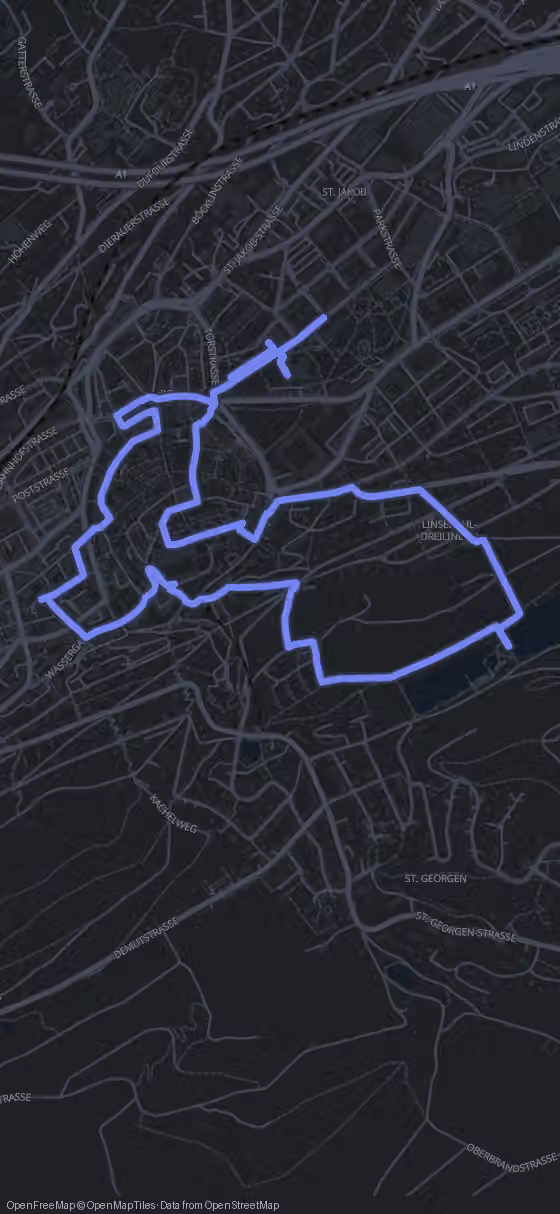
Route map for the St. Gallen walking tour
Stop 1 of 14
150 m·2 min
Marktplatz Farmers Market
Head east toward the Vadian Monument.
Grüezi, welcome to St. Gallen. I'm Alex, and the ornate windows overhead reveal how textile merchants displayed their success.
Try this tour with Alex

The Loop at a Glance

Fourteen stops on a closed loop of 4.9 km that starts and ends at the Marktplatz Farmers Market, with 1 h 19 min of pure walking. It crosses the old town and abbey quarter, climbs to the Three Ponds and returns past churches, concert hall and museums. Plan about three and a half hours.

Streets, churches and ponds are free. The Abbey Library of St. Gallen, the Textile Museum St. Gallen and the Art Museum St. Gallen charge entry; the Mühleggbahn Funicular needs a ticket. Route, map and GPS navigation are free in your browser; the AI Tour Guide is optional.

Open free GPS & optional AI Tour Guide
View of St. Gallen

The Route

Walking Map of St. Gallen: Market, Abbey and Three Ponds

14 stops 4.9 km 1 h 19 min walking
Tap to load interactive map

The 14 stops along this route

  1. 1Marktplatz Farmers Market
  2. Vadian Monument in St. Gallen, stop 2 on the self-guided walking tour
    2Vadian Monument
  3. Old Town Oriel Windows in St. Gallen, stop 3 on the self-guided walking tour
    3Old Town Oriel Windows
  4. Textile Museum St. Gallen, stop 4 on the self-guided walking tour
    4Textile Museum St. Gallen
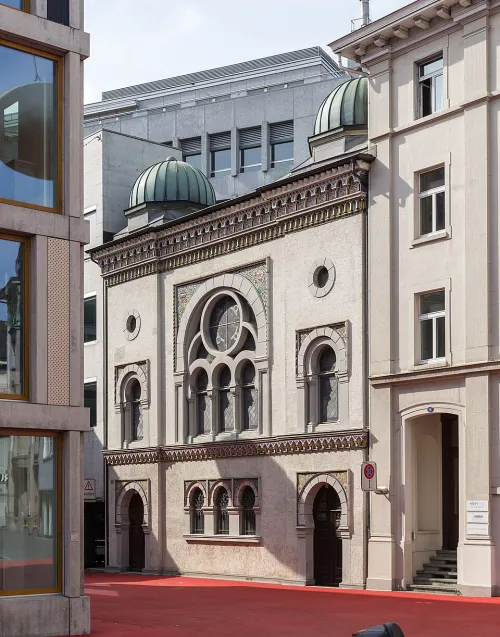
  5. Synagogue St. Gallen, stop 5 on the self-guided walking tour
    5Synagogue St. Gallen
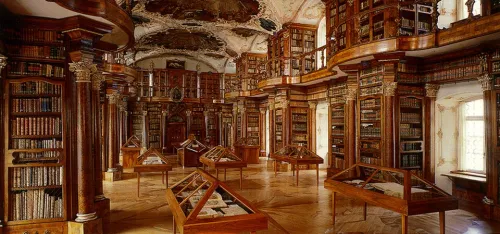
  6. Abbey Library of St. Gallen, stop 6 on the self-guided walking tour
    6Abbey Library of St. Gallen
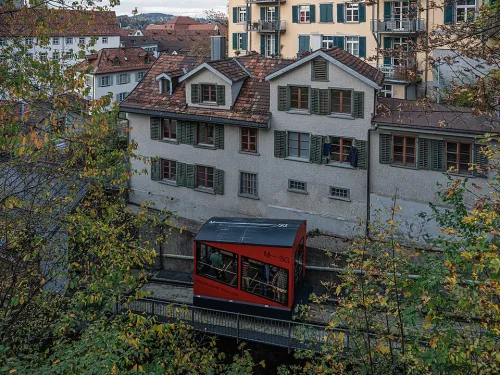
  7. Mühleggbahn Funicular in St. Gallen, stop 7 on the self-guided walking tour
    7Mühleggbahn Funicular
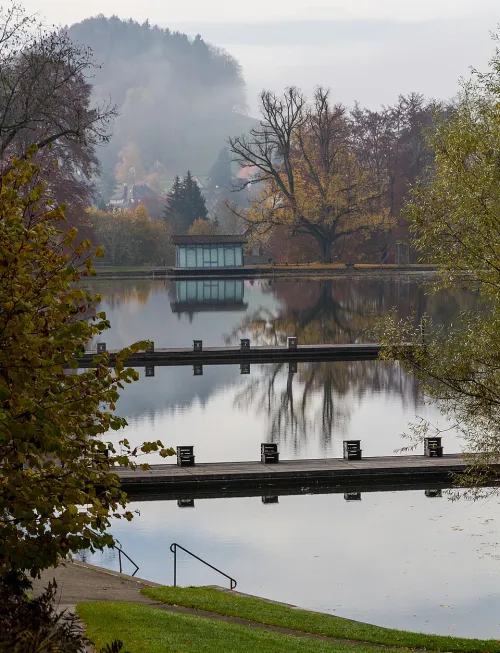
  8. Three Ponds in St. Gallen, stop 8 on the self-guided walking tour
    8Three Ponds
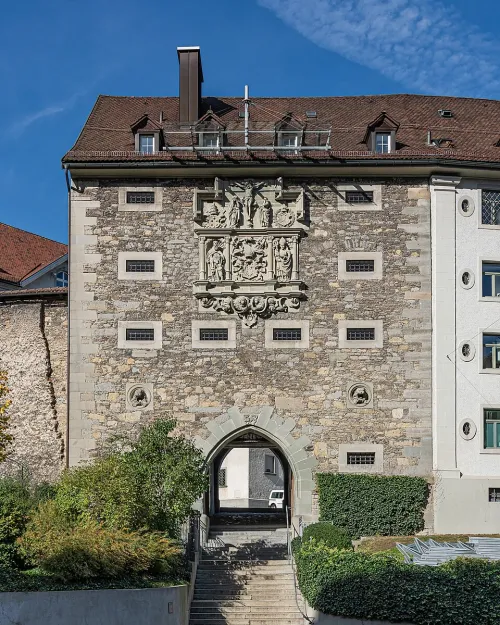
  9. Karlstor in St. Gallen, stop 9 on the self-guided walking tour
    9Karlstor
  10. Cathedral of St. Gallen, stop 10 on the self-guided walking tour
    10Cathedral of St. Gallen
  11. St. Laurenzen Church in St. Gallen, stop 11 on the self-guided walking tour
    11St. Laurenzen Church
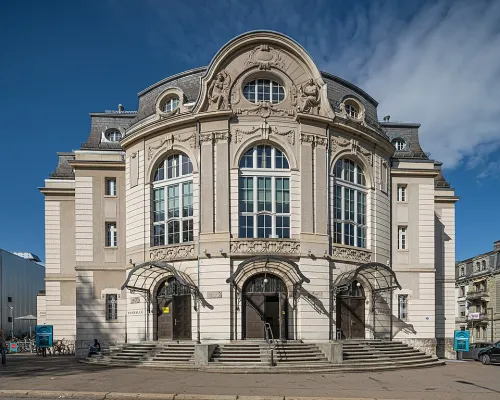
  12. Tonhalle St. Gallen, stop 12 on the self-guided walking tour
    12Tonhalle St. Gallen
  13. Stadttheater St. Gallen, stop 13 on the self-guided walking tour
    13Stadttheater St. Gallen
  14. Art Museum St. Gallen, stop 14 on the self-guided walking tour
    14Art Museum St. Gallen
  15. That's the full loop.

    Walk it with an AI Tour Guide talking you through every one of these streets.

    Start free in your browser
    You made it

Your St. Gallen Walking Tour, from Market Square to Museum Quarter

  1. 1

    Marktplatz Farmers Market

    Start where the city feeds itself. The Marktplatz is a working market, not a stage set: stalls sell cheese, bread, flowers and produce, and the day of the week decides what you walk into. On some mornings the weekly market joins the daily stalls, and in season the farmers market adds regional produce and packs up early. If the produce is the point, come early.

    Two practical notes before you set off. Whatever you buy here, you carry: the loop climbs all the way to the Three Ponds before it comes home. And this square is also your finish line, because the route is a closed circle that ends exactly where it begins. The Vadian Monument is only 160 m away, about two minutes on foot.

    Hours
    Daily market Mon–Fri 08:00–18:00, Sat 08:00–17:00; weekly market Wed 08:00–13:00, Sat 08:00–15:00; farmers market (Apr–Nov) Fri 07:00–13:00
    Price
    Free entry; vendors sell produce, cheese, bread, flowers
  2. 2

    Vadian Monument

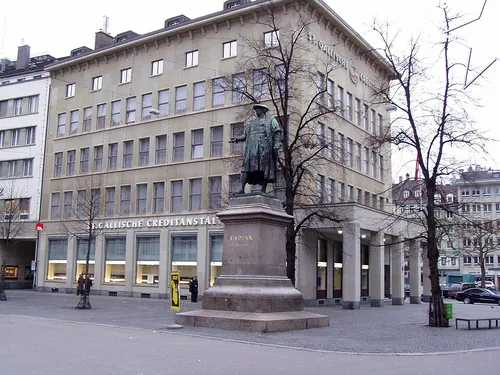
    Vadian Monument in St. Gallen, stop 2 on the self-guided walking tour

    Two minutes in, the walk hands you a key you will need again later. The freestanding monument in the pedestrian zone honors Joachim von Watt, called Vadian, the man who pushed the Reformation through in St. Gallen in 1526. The city took the new faith; the abbey inside the very same walls stayed the center of the Catholic prince-abbey's lands.

    Keep him in mind. That split runs through almost everything you will see today: the Textile Museum stands on Vadianstrasse, the Karlstor was built because the abbot needed his own way out of a Reformed city, and near the end of the loop the Catholic cathedral and the Reformed St. Laurenzen stand almost side by side. From here it is 120 m, about two minutes, into the lanes of the Old Town Oriel Windows.

    Hours
    Always open
    Price
    Free
  3. 3

    Old Town Oriel Windows

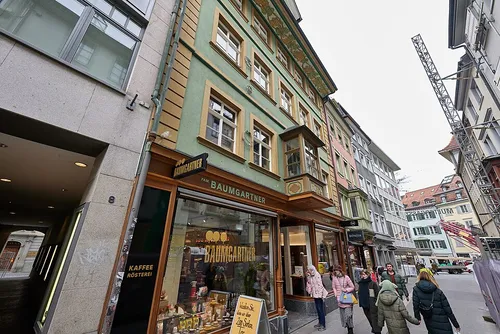
    Old Town Oriel Windows in St. Gallen, stop 3 on the self-guided walking tour

    This stop is a zone, not a point. The route threads the old town lanes where the facades compete over the shop windows, Spisergasse, Kugelgasse, Gallusstrasse and Schmiedgasse, and the bay windows are the competition: oriels pushing out over the lane, decorated like display cases. The reward hangs a floor or two over normal eye level, so walk slowly with your chin up.

    This is also the loop's bad weather card. No gate, no ticket, no closing time, and the lanes lose nothing under an umbrella. The GPS route cuts through the middle, but every side alley adds more windows, and if one facade stops you, stop. Nothing here sits behind glass.

    From the lanes it is 260 m, about four minutes, to the red-brick palace of the Textile Museum on Vadianstrasse.

    Hours
    Open 24/7 (outdoor self-guided walking route through historic old town)
    Price
    Free
  4. 4

    Textile Museum St. Gallen

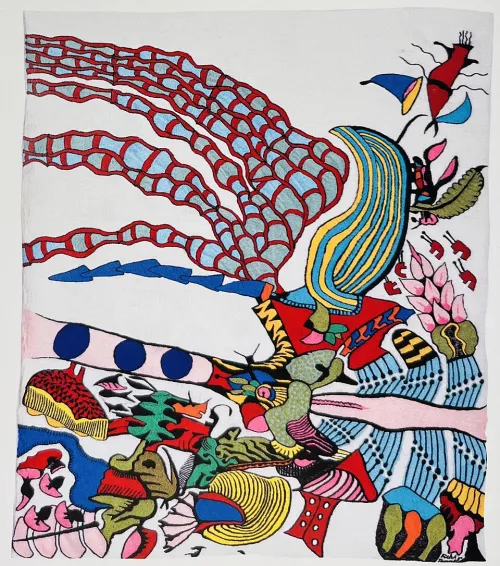
    Textile Museum St. Gallen, stop 4 on the self-guided walking tour

    The building gets the first word. Opened in 1886 on the former Seidenhof site on Vadianstrasse, it was nicknamed the Palazzo Rosso for its red brick facade. Later decades were not kind to the look: an extra floor went on in 1956 because the collection kept growing, and in 1962 the facade received a grey coat of paint, an intervention as drastic as the new storey.

    The museum grew out of the city's trade. Inspired by the world exhibitions, the merchants' directorate began collecting textile samples for the regional industry in 1863, and in 1878 it founded an Industry and Trade Museum. The house held the textile library, a drawing school and, from 1890, an embroidery school. Private collections and company archives followed, adding historic textiles that manufacturers had once used as models for their own production. Since 1982 it has carried the name Textile Museum.

    Inside you find historic embroidery, handmade lace, non-European textiles, historic fabrics and costumes from several centuries. Entry costs a fee, and it is worth it if you want to understand the fine work that made St. Gallen rich; if you only have a morning, the Abbey Library is the stronger priority. The Synagogue is just 180 m away, about two minutes.

    Local name
    Textilmuseum St. Gallen
    Hours
    Tue–Sun 10:00–17:00 (closed 24-25 Dec); Textile Library Wed 12:00–17:00
    Price
    CHF 12 adults, CHF 9 groups (10+), CHF 5 students/apprentices (up to 26), CHF 5 KulturLegi, CHF 5 children/youth (up to 18; free if accompanied by family members or school classes from SG/AR)
  5. 5

    Synagogue St. Gallen

    Synagogue St. Gallen, stop 5 on the self-guided walking tour

    Look for the horseshoe arches. The synagogue in the station quarter on Frongartenstrasse was built in 1880 and 1881 in a Moorish-Byzantine style by the Zurich architects Chiodera and Tschudy and consecrated on 21 September 1881. The street facade has two storeys divided by a cornice: a tracery window in the center of the upper floor flanked by two windows, and below, the two entrances under horseshoe arches with three small joined windows between them. Behind it, a square plan carries a central dome framed by four corner domes, room for 250 worshippers.

    Its story begins with a law. Only after the cantonal parliament replaced restrictive laws with freer ones in 1863 could a Jewish community form in the city, and on 17 September 1863 it was founded. Its first prayer room lay in the rear courtyard of the Haus zum Stein on the Bohl, a house demolished in 1931. From the 1880s a second community of Jews from Eastern Europe grew up, founded officially in 1917 as Adass Jisroel with its own synagogue on Kapellenstrasse. The two merged in 1952 and the smaller synagogue was given up and torn down.

    Services are held on Shabbat and Jewish holidays; visits inside and guided tours are possible by prior arrangement, so on the walk you see it from the street. On to the Abbey Library: 440 m, about six minutes.

    Local name
    Synagoge
    Hours
    Services on Shabbat and Jewish holidays; visits and guided tours by prior arrangement
    Price
    Free
  6. 6

    Abbey Library of St. Gallen

    Abbey Library of St. Gallen, stop 6 on the self-guided walking tour

    If you go inside one place today, make it this one. Over the entrance door a Greek inscription, ΨΥΧΗΣ ΙΑΤΡΕΙΟΝ, promises a healing place for the soul. Behind it waits the Rococo hall built by Peter Thumb between 1758 and 1767, the same architect who designed the cathedral you reach later.

    The library was founded by Saint Othmar, founder of the abbey, and it survived the fire of 937 that destroyed the abbey itself. Its collection is the oldest in Switzerland and one of the oldest monastic libraries in the world: almost 160,000 volumes, 1,650 books printed before 1500 and 2,100 manuscripts from the 8th to the 15th century, among them Irish, Carolingian and Ottonian work. Manuscript B of the Nibelungenlied is kept here. Together with the abbey, the library has been a UNESCO World Heritage Site since 1983.

    Inside, look at the glass cases. Each is crowned by a carved cherub hinting at what lies on the shelves underneath; over the astronomy books, a cherub peers through a telescope. And there is one guest no one expects in a monastery library: the mummy of Shep-en-Isis.

    Entry costs a fee and the visit is worth it for nearly everyone, book lover or not. The funicular's valley station is only 150 m away, about two minutes.

    Local name
    Stiftsbibliothek St. Gallen
    Hours
    Oct–Jun: Mon–Sun 10:00–17:00; Jul–Sep: Mon–Sun 10:00–18:00 (last admission 15 min before closing; closed 09-23 Nov 2026, 24-25 Dec 2026, 26 Apr 2027)
    Price
    CHF 18 adults, CHF 12 students/apprentices/youth, CHF 16 groups (10+ adults), CHF 10 groups (10+ students/youth), CHF 5 KulturLegi

    Website
    stibi.ch ↗
  7. 7

    Mühleggbahn Funicular

    Mühleggbahn Funicular in St. Gallen, stop 7 on the self-guided walking tour

    Tradition says this is where St. Gallen began. The hermit Gallus, who gave the city its name, is said to have had his cell in the Steinach gorge, right around today's funicular. In 1997 an art project put the word Bangor on the valley station, after the Irish monastery from which Columban's mission, Gallus among them, set out for the continent. It confused so many riders that the lettering came off again in 2011.

    The line itself is a small engineering story. It opened in 1893 as a water-ballast funicular, was rebuilt as a rack railway in 1950 and as an inclined lift in 1975. Today a single cabin runs fully automatically every five minutes; if it is not waiting, you call it with a button like an elevator. Most of the 316 m line runs in a tunnel, and in about 90 seconds the cabin climbs 69 m with up to 38 passengers. Going down, the drive even feeds energy back into the grid.

    A ride needs a short-trip ticket; Ostwind passes are valid. From the upper station a short walk brings you to a path with views over the whole city. The route counts the leg to the Three Ponds as 1010 m, about 20 minutes.

    Hours
    Daily 05:40–00:50 (automated on-demand funicular; monthly maintenance last Monday of the month 08:00–11:30)
    Price
    CHF 2.50 single adult short-trip (Kurzstrecke); CHF 2.30 children, dogs, or Half-Fare (Halbtax) cardholders; Ostwind transit passes valid
  8. 8

    Three Ponds

    Three Ponds in St. Gallen, stop 8 on the self-guided walking tour

    Up here the city steps back. Drei Weieren, also called Dreilinden after a former farmstead, is a recreation area of five artificial ponds on the slopes of the Freudenberg. In summer they serve as open-air baths, in winter occasionally for skating. The park and paths are free and always open; the community bath at the Mannenweiher is free, the family bath charges entry.
    They were built for work, not for swimming. Around 1610 the city authorities had the first three dug to secure the water supply, above all for the linen trade with its bleaching fields, and as a reserve in case of fire. A fourth, the Nellusweiher, followed in 1658, and was filled in by unemployed workers in 1920 and 1921 during the great embroidery crisis; its place is now the lawn by the Frauenweiher. The Mannenweiher came in 1713, later with a little pond house.

    The names tell of strict separation. When bathing began in the early 18th century, there was a ponds for men, one for boys and one for women, as the rules of the day demanded. The women's pond was once the Chrüzweiher, named after a boundary stone carved with crosses that marked the border between the city republic and the prince-abbey. Take a break by the water, then head down to Karlstor: 950 m, about 17 minutes.

    Local name
    Drei Weihern
    Hours
    Open 24/7 (park grounds and paths always accessible; swimming facilities open seasonally early May to mid Sep 09:00–19:00)
    Price
    Free park and recreation area; Gemeinschaftsbad Dreilinden (Mannenweiher) free; Familienbad Dreilinden CHF 5.50 adults / CHF 2.80 children (CHF 4.00 / CHF 2.00 after 17:30)
  9. 9

    Karlstor

    Karlstor in St. Gallen, stop 9 on the self-guided walking tour

    This is the last city gate left from St. Gallen's medieval wall, and it exists because of a feud. Once the city gained its independence in the 14th century, city and abbot fought again and again. Abbot Ulrich Rösch already demanded his own gate and failed. After Vadian brought in the Reformation in 1526, it got worse: abbey and city shared the same walls, and the prince-abbot had to pass through the city's gates to reach his own lands. Both sides complained about each other at every opportunity.

    Only in 1566, with Swiss confederate mediators, did they settle it in the Treaty of Wil. Abbot Otmar Kunz won the right to break his own gate through the wall, with a drawbridge and an outer ward. The same treaty rebuilt the gate in the dividing wall between abbey and city with two doors and two locks: the abbot and the mayor each kept one key. In return, the abbot gave up all rights over the city for good.

    Construction began the following year, and the gate was built in 1569 and 1570 in the southeastern section of the wall. The drawbridge never came; a narrow causeway with a wooden bridge crossed the Steinach, which still ran open here. The cathedral is 200 m away, about three minutes.

    Hours
    Always open
    Price
    Free
  10. 10

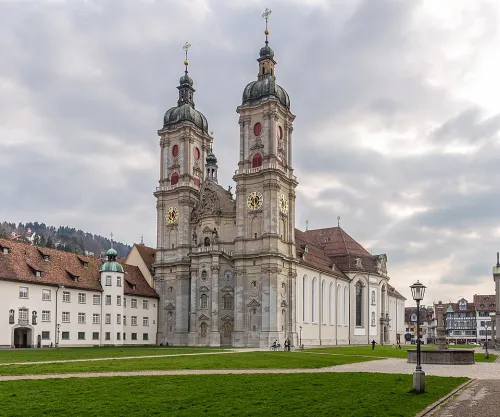
    Cathedral of St. Gallen

    Cathedral of St. Gallen, stop 10 on the self-guided walking tour

    You are standing on the spot where it all started. The Irish monk Gall built his hermitage here in 612 and was buried in his cell around 650; his tomb now lies under the high altar in the crypt from between 837 and 839. In 719 Otmar, the brotherhood's first abbot, turned the cell into the Abbey of St. Gall, and his remains rest in the St. Otmar crypt at the west end, alongside former bishops.

    The church you see was begun in 1755 by Prince-Abbot Cölestin Gugger von Staudach and completed in 1767 to designs by Peter Thumb, who also built the Abbey Library. It counts among the last great sacred buildings of the Baroque and is part of the UNESCO World Heritage Site. The interior was restored to its original state between 1962 and 1967. Look up at the frescoes, painted mostly by Josef Wannenmacher.

    Then listen. The church holds the most complete set of historic bells in Switzerland, nine in the two towers, most cast by founders around Lake Constance. At the south altar hangs a bell Gall is said to have brought from Ireland himself, one of the three oldest surviving bells in Europe. After the canton dissolved the abbey in 1805 it became a parish church and in 1847 a cathedral.

    Entry is free and donations are welcome. St. Laurenzen is 140 m away, about two minutes.

    Local name
    Stiftskirche St. Gallen
    Hours
    Mon–Tue 06:30–18:30 (in summer to 19:00); Wed–Sat 07:00–18:30 (in summer to 19:00); Sun 07:30–20:30 (no sightseeing during services or Sunday morning)
    Price
    Free; donations appreciated
  11. 11

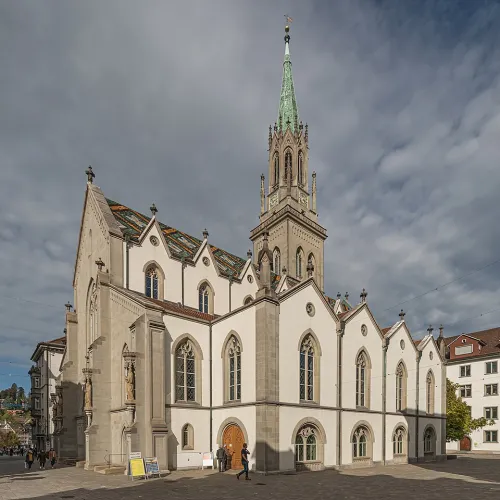
    St. Laurenzen Church

    St. Laurenzen Church in St. Gallen, stop 11 on the self-guided walking tour

    Two minutes from the Catholic cathedral stands the Reformed counterweight. St. Laurenzen, dedicated to the martyr Lawrence of Rome, is the city's Reformed parish church, and for centuries it was the political, religious and social center of the city republic. Even today it is the assembly hall of the city's local citizens, and it is protected as a monument of national importance.

    Its first predecessor dates to the mid 12th century, and by 1235 it was a parish church, still under the abbey: its priests had to join the solemn services in the minster and the processions. In 1359 the abbey absorbed it outright. The city fought its way back step by step. An agreement in 1413 gave the council the right to nominate the pastor, leaving the abbot only the formalities; the Treaty of Bischofszell in 1509 confirmed it. Shortly before the Reformation nine priests served here.

    Seen after the cathedral, the contrast is the point: one church built by abbots, one claimed by citizens. Entry is free. From here the route leaves the old town for the Tonhalle, 490 m, about six minutes.

    Hours
    Mon–Sat 09:30–16:00/18:00 (closing at 16:00 in winter / 18:00 in summer; open around services on Sunday)
    Price
    Free
  12. 12

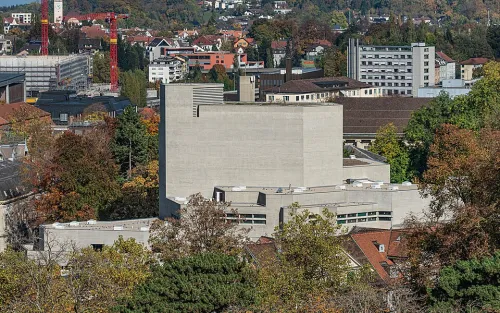
    Tonhalle St. Gallen

    Tonhalle St. Gallen, stop 12 on the self-guided walking tour

    Embroidery money built this hall. In the boom years of St. Gallen embroidery at the end of the 19th century the city grew fast, and the library hall of the cantonal school, where concerts had been held, felt too small. A first attempt in 1883 failed; only a pledge of 150,000 francs from the textile manufacturer Colonel Kirchhofer in 1899 got things moving. Building started in 1906 on the Brühl, where the old town meets the museum quarter.

    The architect, Julius Kunkler, had played first violin in the orchestra for eleven years. His design mixes the Neo-Baroque typical of concert halls of the time with Art Nouveau touches, but the bones were radical: a reinforced concrete frame by the engineer Robert Maillart, clad in rendered brick.

    It opened on 4 December 1909 with Beethoven's Ninth Symphony, followed by a week of choir concerts, a banquet and Berlioz. Today the St. Gallen Symphony Orchestra plays here. Inside you get only with a concert ticket or a booked tour, so on the walk enjoy the facade. The theater stands right opposite, 100 m away.

    Hours
    Box office Mon–Fri 14:00–18:30 and 1 hour before performances; hall interior accessible during concerts, events, and booked guided tours
    Price
    Performance tickets vary by program (Tonhallekonzerte CHF 25-100; Mittagskonzert CHF 30-60; After Work CHF 20; Meisterzyklus CHF 25-85; guided group tour CHF 200/group)
  13. 13

    Stadttheater St. Gallen

    Stadttheater St. Gallen, stop 13 on the self-guided walking tour

    The company across the street is considered the oldest existing professional theater in Switzerland, with opera, operetta, musical, drama, dance and children's theater under one roof. Its prehistory reaches back to the monks Tutilo and Notker Balbulus, who staged lay theater around the year 900. After that the church, dominant in the monastery town, kept theater out for centuries.

    In spring 1801 a touring troupe asked the city for permission to play and was refused. They staged a Kotzebue play in a wooden shed in St. Fiden, then were allowed into the prince-abbot's coach house outside the city limits, built in 1795. On 14 October 1801 the first St. Gallen theater premiered there, and that coach house between the Karlstor and the Spisertor remained the stage until 1856. In 1805 Karl Müller-Friedberg, the new canton's first Landammann, laid the foundation for a professional company.

    In 1857 a new building by Johann Christoph Kunkler opened on the Bohl with Mozart's Don Giovanni; more than a century later, in January 1968, its curtain fell for the last time after Millöcker's Der Bettelstudent. The interior opens only for performances and scheduled tours. The Art Museum is 190 m away, about two minutes.

    Hours
    Box office Mon–Fri 14:00–18:30 and 1 hour before performances; theater interior accessible during performances and scheduled guided tours
    Price
    Performance tickets vary by genre and seat category (Grosses Haus plays CHF 25-75, opera CHF 50-115, musicals CHF 65-145; public guided tour or group tours CHF 200/group)
  14. 14

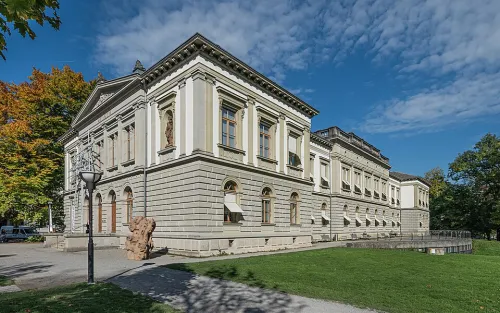
    Art Museum St. Gallen

    Art Museum St. Gallen, stop 14 on the self-guided walking tour

    The city's collections began with a crocodile. In 1623 a stuffed Nile crocodile was given to the city and placed in the city library; skeletons, fossils, herbaria, old medical instruments, coins, stained glass, busts and portraits of mayors followed. By the 19th century donations had grown so large that a museum building became unavoidable. After failed plans for the Obstmarkt and the old arsenal on the Bohl, five institutions joined forces in 1867, and the present building opened in 1877.

    Today the Art Museum shows paintings and sculpture from the late Middle Ages to the present, with a focus on Dutch painting of the 17th century, 19th century art from Switzerland, Germany and France, Appenzell peasant painting and international modernism, plus changing exhibitions.

    Entry costs a fee, free for under 18s. It is worth it if you have an hour left and an interest in painting; the Appenzell peasant painting is a local touch you will not find in every museum. From here 560 m, about eight minutes, take you back to the Marktplatz, where the loop closes.

    Local name
    Kunstmuseum St. Gallen
    Hours
    Tue–Sun 10:00–17:00, Thu 10:00–20:00, Mon closed
    Price
    CHF 12 adults, CHF 10 seniors (AHV/IV) / groups (8+), CHF 6 students, CHF 5 KulturLegi; free for children and youth under 18
Walking tour route map of St. Gallen Route loaded
Vadian MonumentOld Town Oriel WindowsTextile Museum St. GallenSynagogue St. Gallen+10
All 14 stops are already on the map.
You just press start.
AI Tour Guide

You know the way now. Walk it with a guide in your ear.

Press start wherever you are, even hundreds of kilometres from St. Gallen, and the guide begins telling its stories right away. In the city, pick any of the 14 stops to start from: it leads you there, then talks with you the whole route, asking, listening, remembering, and shaping the tour around your answers.

14stops 4.9km 1 h 19 minwalking 13languages
▶Start the tour free

Free to start · Runs in your browser · No app, no download

Shorter Ways to Walk St. Gallen

Short on time or only here for one theme? These three pieces of the loop work on their own.

Old town and Abbey Library

Stops: 1, 2, 3, 4, 5, 6

For a first morning in town and anyone who mainly wants the library. About 16 minutes of walking from the market square to the Abbey Library; entry at the Textile Museum and the Abbey Library, everything else free.

Up to the ponds and back through Karlstor

Stops: 6, 7, 8, 9, 10

For walkers who want green space and a view more than museums. About 42 minutes of walking from the Abbey Library via the funicular and the Three Ponds to the cathedral; the funicular ride needs a ticket, the ponds and the cathedral are free.

Cathedral, churches and museum quarter

Stops: 10, 11, 12, 13, 14

For an afternoon with art and music. About 19 minutes of walking from the cathedral to the Art Museum and back to the market square; the two churches are free, the Art Museum charges entry, and the concert hall and theater open inside only with a ticket or a booked tour.

How Long This St. Gallen Loop Takes, With and Without Museums

The loop is 4.9 km with 1 h 19 min of pure walking. Most of the old town legs take two to six minutes; the real effort sits in the middle, where the leg from the funicular to the Three Ponds takes about 20 minutes and the way back down to Karlstor about 17.

With time inside the Abbey Library, the cathedral and St. Laurenzen and a pause at the ponds, about three and a half hours is realistic. Add the Textile Museum and the Art Museum and you are looking at roughly five and a half hours, a full day with a lunch break. The old town and library variant fits into a morning, the pond variant into about an hour and a half with a short rest at the water.

If you have a second day, Appenzell is 11 km away, and Lake Constance towns like Lindau and Constance are within easy reach.

Before You Set Off in St. Gallen

  • Start and finish: Recommended start is the Marktplatz Farmers Market, and the loop ends there too. You can join at any stop; the order given is simply the one that flows best.
  • Time of day: Morning suits the market, which is busiest early, so it makes a lively start to the loop.
  • What costs money: The Abbey Library, the Textile Museum and the Art Museum charge entry, the Art Museum is free for under 18s. The funicular needs a short-trip ticket. The Tonhalle and the theater open inside only for performances or booked tours.
  • Shopping: Whatever you buy at the market you carry all the way up to the Three Ponds and back, so pick light.
Walking tour route map of St. Gallen
AI Tour Guide

Your guide is waiting at the market square.

Press start and a voice AI Tour Guide takes it from here: leading the route through St. Gallen, telling the stories, and turning your walk into a real back-and-forth conversation. No app or download is needed; it runs in your browser.

14stops 4.9km 1 h 19 minwalking 13languages
▶Start the tour free

Free to start · Runs in your browser · No app, no download

What the AI Tour Guide Adds Between Abbey and Ponds

This loop is one long argument between an abbey and a city, told in libraries, gates, ponds and churches. The AI Tour Guide walks it with you as a conversation: it greets you at the market, tells the stories as you reach each place, asks what caught your eye and remembers it, so the abbey quarter sounds different for a book lover than for someone who came for the hills. Ask it what life was like for the embroiderers in the boom years, or how the abbot and the mayor shared one key, and interrupt whenever a side street tempts you.

A Real Conversation A voice AI Tour Guide greets you, leads the whole route, and tells the stories and facts as you walk, asking what you want to see and keeping a real conversation going. Not a recording you press play on.
Map Navigation Follow the route on the map and walk at your own pace. You choose where to start and when to move to the next stop.
Ask Anything Curious about a building you pass? Ask your AI Tour Guide on the spot and the conversation carries on.
13 Languages Switch language anytime. No separate tour needed.
Start free in your browser

Common Questions Before You Walk

Can I go inside the Synagogue St. Gallen?

Only by prior arrangement, for a visit or a guided tour. Services take place on Shabbat and Jewish holidays. On the walk itself you see the Moorish-Byzantine facade from the street.

Can I swim at the Three Ponds?

In the summer season the ponds work as open-air baths. The community bath at the Mannenweiher is free, the family bath charges entry. In summer, in good weather, the so-called Bäderbus also runs from the station via Marktplatz to the entrance of the Frauenweiher.

Does my regional transit pass cover the Mühleggbahn?

Yes, Ostwind passes are valid. Otherwise you need a short-trip ticket. The cabin runs automatically; if it is not in the station, press the button to call it like an elevator.

Can I look at the Abbey Library manuscripts without going there?

Yes. More than 900 manuscripts from the Abbey Library are digitized and freely available through the e-codices project, a good way to prepare or to revisit what you saw in the cases.

Is the tour really free?

Yes. The whole tour is free: the route, the interactive map and the navigation cost you nothing. Only the voice AI Tour Guide is optional and paid: you test it with 100 free credits, then you pay either €5 per hour or €19.99 for this whole tour, with no time limit. Admission to 3 of the 14 stops is not included: Textile Museum St. Gallen, Abbey Library of St. Gallen and Art Museum St. Gallen charge their own entry fees.

Do I need to download an app?

No. Everything runs in your phone browser. Open the route and start walking, no download and no sign-up required.

Do I need to book the walking tour in advance?

No booking needed. This self-guided tour is available anytime. Open the route in your browser and start walking. The AI Tour Guide works instantly, no app, no reservation required.

What languages is the AI Tour Guide available in?

The AI Tour Guide speaks 13 languages, so you take the tour in your own language and can switch at any time.

Can I skip stops or change the route?

Yes. Skip any stop, spend extra time at places you like, or start the route from any point. It is your walk, you set the pace.
Image credits
▶ Start free in your browser Runs in your browser, no app, no download