Free Walking Tour Punta Arenas: Plaza, Strait and Cemetery

Eleven stops from Magellan in bronze to the Strait, the Salesian museum, a cemetery of pioneer chapels and a hilltop view over the city. Free GPS route included.

11 Stops 6.0 km ~1 h 27 min walking
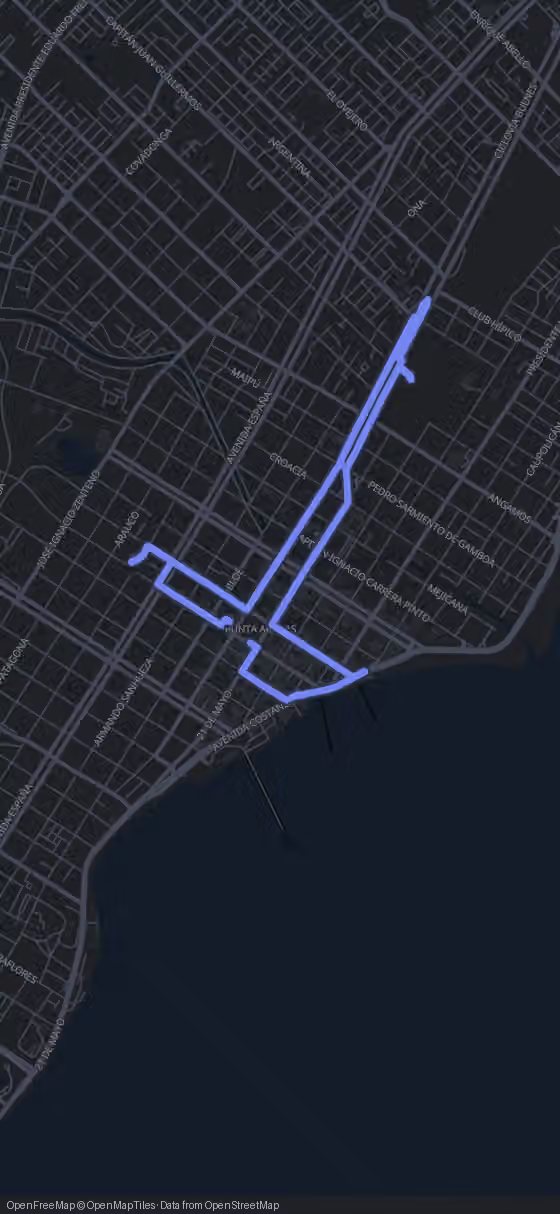
Route map for the Punta Arenas walking tour
Stop 1 of 11
180 m·2 min
Plaza Muñoz Gamero
Head south toward the Museo de la Inmigración Croata
Welcome to Punta Arenas. I'm Alex, and the surnames on these streets tell a story that began across an ocean.
Try this tour with Alex

What This Punta Arenas Walk Covers

This route links 11 stops from Plaza Muñoz Gamero to the Catedral de Punta Arenas: 6.0 km and 1 h 27 min of pure walking, about six hours with the museums you choose. The free GPS route in your browser leads you from stop to stop.

Most stops are free, including the Museo de la Inmigración Croata. Admission applies at the Museo Naval y Marítimo, the Museo Salesiano Maggiorino Borgatello, the Cementerio Municipal and the Palacio Sara Braun; the Museo Regional de Magallanes is currently closed. The AI Tour Guide is optional and tells the stories as a conversation.

Open free GPS & optional AI Tour Guide
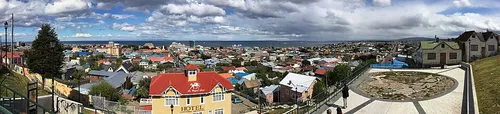
View of Punta Arenas

The Route

Walking Map of Punta Arenas: Plaza to Cathedral

11 stops 6.0 km 1 h 27 min walking
Tap to load interactive map

The 11 stops along this route

  1. Plaza Muñoz Gamero in Punta Arenas, stop 1 on the self-guided walking tour
    1Plaza Muñoz Gamero
  2. 2Museo de la Inmigración Croata
  3. Costanera del Estrecho de Magallanes in Punta Arenas, stop 3 on the self-guided walking tour
    3Costanera del Estrecho de Magallanes
  4. Museo Naval y Marítimo in Punta Arenas, stop 4 on the self-guided walking tour
    4Museo Naval y Marítimo
  5. Museo Regional de Magallanes in Punta Arenas, stop 5 on the self-guided walking tour
    5Museo Regional de Magallanes
  6. Museo Salesiano Maggiorino Borgatello in Punta Arenas, stop 6 on the self-guided walking tour
    6Museo Salesiano Maggiorino Borgatello
  7. Monumento al Ovejero in Punta Arenas, stop 7 on the self-guided walking tour
    7Monumento al Ovejero
  8. Cementerio Municipal in Punta Arenas, stop 8 on the self-guided walking tour
    8Cementerio Municipal
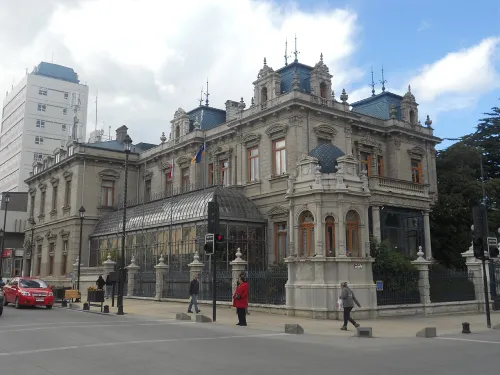
  9. Palacio Sara Braun in Punta Arenas, stop 9 on the self-guided walking tour
    9Palacio Sara Braun
  10. Cerro de la Cruz in Punta Arenas, stop 10 on the self-guided walking tour
    10Cerro de la Cruz
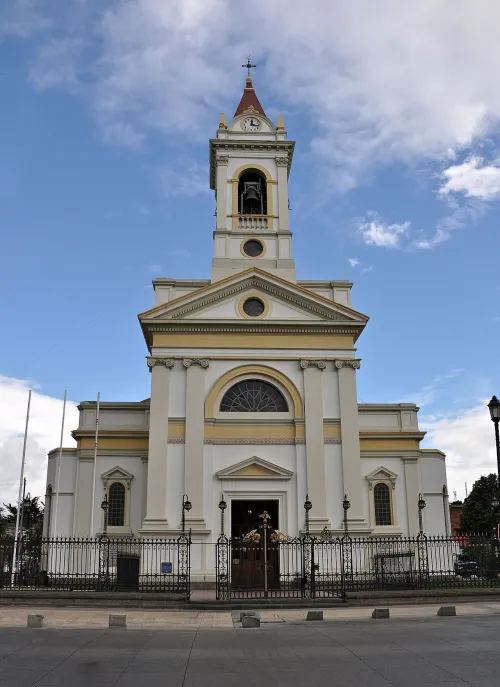
  11. Catedral de Punta Arenas, stop 11 on the self-guided walking tour
    11Catedral de Punta Arenas
  12. That's the full route.

    Walk it with an AI Tour Guide talking you through every one of these streets.

    Start free in your browser
    You made it

Your Punta Arenas Walking Tour, Stop by Stop, from Magellan to the Cathedral

  1. 1

    Plaza Muñoz Gamero

    Plaza Muñoz Gamero in Punta Arenas, stop 1 on the self-guided walking tour

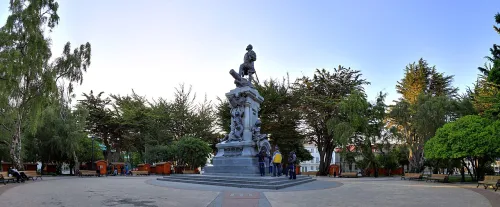
    Start where the city started. Plaza Muñoz Gamero, also called the Plaza de Armas, is the old main square of Punta Arenas, open at all hours and free. At its centre stands Hernando de Magallanes in bronze, unveiled in 1920: the navigator who gave his name to the strait you will reach in a few minutes and to the whole region. Since 1991 the square has been protected as a Zona Típica by the national monuments council.

    It did not begin as a showpiece. When the settlement was laid out, a large space was set aside as a square called Plaza Esmeralda, and for about twenty years it stayed on the margins: an empty lot where loose animals grazed and a few children played. Punta Arenas was then a military and penal colony, and in August 1851 its governor, Benjamín Muñoz Gamero, drew the first plan of the town.

    That same year it went badly wrong. On the night of 24 November 1851, Lieutenant Miguel José Cambiazo, who was serving a sentence here, was freed by the guard and, with the whole garrison behind him, took the barracks and the square. In the Cambiaso Mutiny he burned several buildings and killed the governor from behind after he had resisted.

    The town recovered under Governor Oscar Viel, when the population tripled and Punta Arenas became a free port. Viel drew the first planning grid, blocks of 100 m separated by streets 20 m wide, and renamed the square after the murdered governor. Read the street signs around it: José Nogueira and Fagnano are names you will meet again at the palace and the cathedral. The Museo de la Inmigración Croata is just 180 m away, a 2 min walk.
    Hours
    Open 24/7
    Price
    Free
  2. 2

    Museo de la Inmigración Croata

    The Museo de la Inmigración Croata sits inside the rooms of the Club Croata de Punta Arenas, and it is free for everyone. The club, founded in 1915, has been the organising heart of the Croatian community in the region. Its heritage, together with that of the Sociedad Croata de Socorros Mutuos, the community's mutual aid society, forms the core of the collection.

    Inside you find photographs, documents, personal belongings and records of the first Croatian families who settled in Magallanes. The display is arranged by theme and moves between individual family stories and the institutions that carried the migration. Its aim is to keep alive the memory of a community that arrived as an ethnic and linguistic minority, and to show what it gave to the social and economic life of the city and how it found its place in local culture.

    Is it worth going in? Yes, whenever the doors are open: it costs nothing, and it puts faces and names to the immigrant story that runs through the whole route, all the way to the family chapels in the cemetery and the palace built by a Baltic family. The museum keeps limited hours, so check them for your day.

    From the club it is 580 m, about 8 min, to the water.

    Local name
    Museo de la Inmigración Croata en Magallanes
    Hours
    Mon–Fri 15:00–19:30; closed on the public holidays listed by the Chilean museum registry.
    Price
    Free
  3. 3

    Costanera del Estrecho de Magallanes

    Costanera del Estrecho de Magallanes in Punta Arenas, stop 3 on the self-guided walking tour

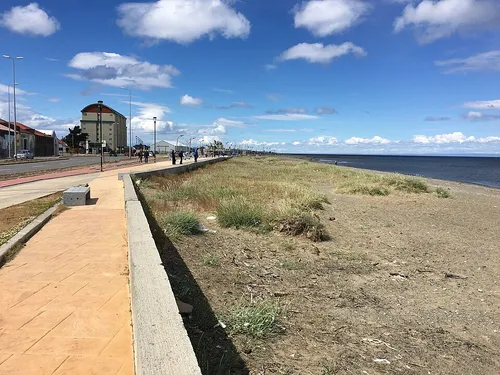
    Here the streets stop and the water starts. The Costanera del Estrecho de Magallanes is a public promenade right on the strait, open at all hours, with no gate and no ticket, and the water beside you carries the name of the man in bronze you left on the plaza.

    After the square and the club, this is the first wide picture of the route. Give it a real pause at the rail rather than a quick photo. The plaza, the statue, the club: all of it is a human arrangement sitting on the edge of this water, and the museums ahead each explain, in their own way, how that arrangement came about. Let the order of things settle for a minute.

    Practically, this is a stop that cannot be closed and cannot cost anything. That changes now: next comes a museum with admission, then one that is currently closed. The Museo Naval y Marítimo is 280 m away, about 4 min.

    Hours
    Open 24/7
    Price
    Free
  4. 4

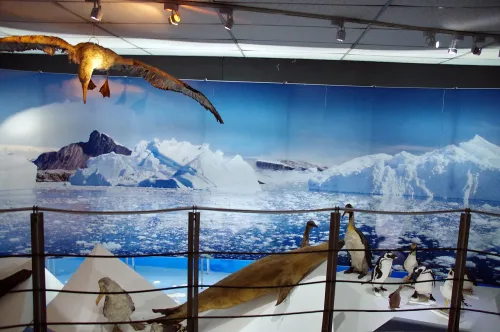
    Museo Naval y Marítimo

    Museo Naval y Marítimo in Punta Arenas, stop 4 on the self-guided walking tour

    The Museo Naval y Marítimo is run by the Chilean navy, the Armada de Chile, which keeps its collection on Pedro Montt and sets its own visiting terms. It charges admission, and its hours follow the navy's rhythm rather than a tourist's, so know them before you arrive.

    Decide before you go in. If the strait got its hooks into you, this is the route's only naval interior: the story of the water told from inside a building. If your day allows exactly one paid museum, save it for the Museo Salesiano Maggiorino Borgatello, whose collection covers the whole region rather than one branch of its history.

    Either way the next leg is short: 280 m, about 4 min, to the Museo Regional de Magallanes.

    Local name
    Museo Naval de Punta Arenas
    Hours
    Tue–Fri 10:00–12:00, 13:00–16:00, Sat 10:00–15:00, Sun–Mon closed
    Price
    CLP 1200 adult; CLP 600 senior; CLP 600 child
  5. 5

    Museo Regional de Magallanes

    Museo Regional de Magallanes in Punta Arenas, stop 5 on the self-guided walking tour

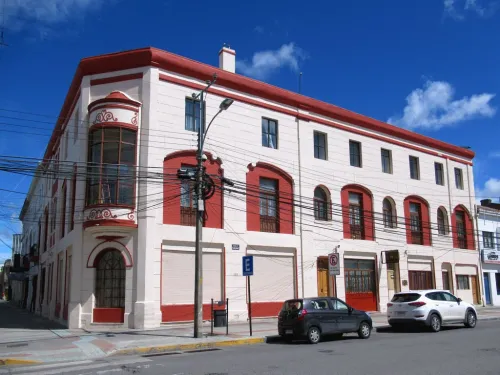
    The Museo Regional de Magallanes is currently closed, so this is a stop for the outside. Look at the house itself: it was built in 1903 as the residence of Mauricio Braun and Josefina Menéndez, two family names you will find again on the chapels of the cemetery, and it was declared a National Monument in 1974.

    How it became a museum is a family story too. Enrique Campos Menéndez, then director of the national service for libraries, archives and museums, negotiated the donation of the family palace to the state. In return, public money paid for a full rehabilitation, and the state took on the duty to honour the family's memory by turning the house into a museum. It was founded in 1982, took over the collections of the Museo de la Patagonia, founded in 1969, and became a lasting tribute to his grandfather José María Menéndez and his uncle Mauricio Braun.

    When it is open, around 1800 objects tell the story of Magallanes and of Punta Arenas from the discovery of the strait in the 16th century to the early 20th: rooms of European furniture from Neoclassical to Art Nouveau, a history section, and the service level with the kitchen, bathrooms and servants' rooms. The museum has also been criticised for saying nothing about the genocide of the Indigenous peoples in which the owners of the mansion took part. Keep that silence in mind; the next museum takes up the story.

    From here it is 810 m, about 12 min, to the Museo Salesiano Maggiorino Borgatello.

    Status
    Currently closed
  6. 6

    Museo Salesiano Maggiorino Borgatello

    Museo Salesiano Maggiorino Borgatello in Punta Arenas, stop 6 on the self-guided walking tour

    The Museo Salesiano Maggiorino Borgatello opened on 18 September 1893, which makes it the third-oldest museum in Chile. It stands on Avenida Bulnes, attached to the church of María Auxiliadora, and on the green in front you see a monument to Manuel Bulnes Prieto, president of Chile from 1841 to 1851.

    Its collection is bound up with a dark chapter. From the mid 1880s, sheep farmers who had seized large parts of northern Tierra del Fuego as pasture carried out a genocide against the Selk'nam who lived there. To stop the killing, the Salesian fathers offered the landowners to deport the Indigenous people to their mission stations on Isla Dawson and near Río Grande instead. Without meaning to, they sped up the end of the Selk'nam: diseases brought by Europeans, such as smallpox and tuberculosis, turned the missions into death traps.

    The Salesians took the Selk'nam's cultural identity from them, and yet they were also the Europeans who came to them with the most goodwill and gained real insight into their culture. Their ethnographic collection, together with the natural history collection of curator Ángel Benove, became the foundation of the museum, first housed in the old Colegio San José with Padre Maggiorino Borgatello as its first director. In 1929 it moved into a building designed by Padre Juan Bernabé, and in 1980 scientists from the Instituto de la Patagonia of the Universidad de Magallanes reorganised the collections.

    Today it covers history, ethnography, flora and fauna, paleontology and the industry of the Magellan region. It charges admission, and if you pick only one paid museum, make it this one and give it well over an hour. The Monumento al Ovejero stands on the same avenue, 770 m away, about 11 min.

    Hours
    Tue–Sat 10:00–12:30, 14:00–17:30, Sun–Mon closed
    Price
    CLP 7.000 adult / USD 7 (CLP 6.000 nationals, CLP 5.000 / USD 5 seniors 60+, CLP 3.000 / USD 3 university students, CLP 1.000 / USD 1 teens 13-17, children under 12 free)
  7. 7

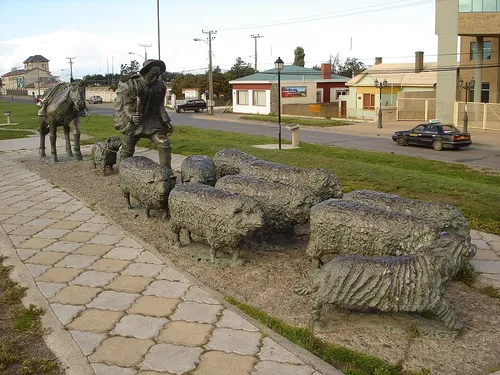
    Monumento al Ovejero

    Monumento al Ovejero in Punta Arenas, stop 7 on the self-guided walking tour

    In the central strip of Avenida Bulnes stands the Monumento al Ovejero, a group of twelve life-size figures. The shepherd leans into the wind of the pampas, the reins of his horse in one hand and in the other a whip to drive his sheep. It is free and open at all hours, so take the time to look at each figure.

    The idea came from General Ramón Cañas Montalva, and Francisco Campos Torreblanca donated the work. Its first version, in granite, was unveiled in 1944 in the presence of President Juan Antonio Ríos. On 1 April 1962 the present bronze took its place, made to last, and the granite original went as a gift from Punta Arenas to Coyhaique, capital of the neighbouring Aysén region, where it stands where the lanes of Avenida Baquedano divide, at the northern edge of that city.

    Right after the Salesian museum, the monument reads differently. This is the sheep economy whose expansion onto Tierra del Fuego you just heard about, cast by the city in heroic bronze, and the same wool built the fortunes behind the chapels and the palace still to come. Hold both pictures together.

    The Cementerio Municipal is 420 m on, about 6 min.

    Hours
    Open 24/7
    Price
    Free
  8. 8

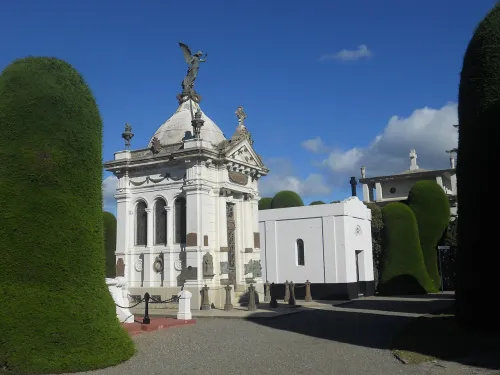
    Cementerio Municipal

    Cementerio Municipal in Punta Arenas, stop 8 on the self-guided walking tour

    The Cementerio Municipal, also known as the Sara Braun cemetery, covers four hectares, with its main entrance on Avenida Bulnes. It opened on 9 April 1894 under Governor Manuel Señoret, replacing an older burial ground that lay where Plaza Lautaro is today. The land was donated by the pioneer Sara Braun, and in 1919 the engineer Fortunato Circutti designed the gates and walls that enclose it. It has been a National Monument since 2012; it reached capacity long ago and has largely been replaced by a newer cemetery further north, but it keeps its standing as a monument cemetery.

    Walk the paths of the family chapels: Menéndez-Behety, Braun Hamburger, Blanchard, Greenshields, Kusanovic, Menéndez-Montes. The Menéndez-Behety family founded several companies and acquired huge tracts of land in Chilean Patagonia, and here, in stone, you see how that era's elite wanted to be remembered.

    Look for two very different graves as well. Antonio Soto, one of the leaders of the Patagonia Rebelde labour uprising in Argentina, is buried here, and so is Charles Amherst Milward, the British sailor who inspired Bruce Chatwin's travel classic In Patagonia.

    The cemetery has its legends too. The best known says that when Sara Braun paid for the entrance, she asked for one thing in return: after her death, the central gate was to be closed forever. Foreign visitors pay admission, and an hour here is well spent for anyone who likes stories told through names and stone.

    Then comes the longest leg of the route: 1350 m, about 19 min, back to the centre and the Palacio Sara Braun.

    Hours
    Mon–Sun 08:00–19:00 (Sep 1 to Apr 30); Mon–Sun 09:00–18:00 (winter until Aug 31)
    Price
    CLP 5.000 foreign tourists, CLP 3.000 Chilean tourists
  9. 9

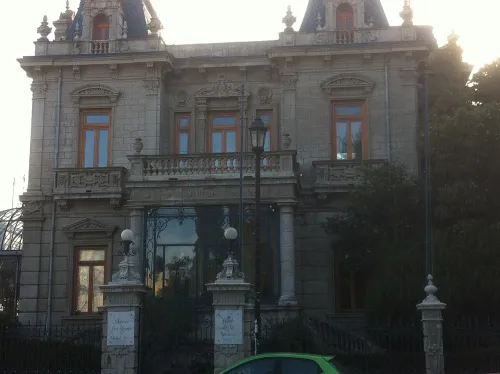
    Palacio Sara Braun

    Palacio Sara Braun in Punta Arenas, stop 9 on the self-guided walking tour

    The Palacio Sara Braun faces Plaza Muñoz Gamero, so the walk comes back to where it began. It was built between 1895 and 1905 to designs by the French architect Numa Mayer, who followed the taste of late 19th century Paris. Its exuberance stood in sharp contrast to the plain houses of the town at the time, and it has been a historic monument since 1981.

    The Braun family, Elías Braun, his wife Sofía Hamburger and their children Sara and Moritz, later Mauricio, arrived in Punta Arenas in 1873 under President José Joaquín Pérez's policy of encouraging European immigration. They came from Talsen in Courland, then part of the Russian Empire and today in Latvia. They belonged to the Baltic German community, the elite of that region, but as Jews they were exposed to the pogroms in Russian territory, so they left for the Americas.

    In 1887 Sara married José Nogueira, a Portuguese entrepreneur whose fortune came from shipping, sea lion hunting and sheep farming; he was one of the pioneers of sheep ranching and went on to found the Sociedad Explotadora de Tierra del Fuego. When he died of tuberculosis in 1893, Sara took over the great inheritance and spent part of it on this house. The street named after him runs along the plaza.

    After Sara's death in 1955 the mansion passed to her nephews, who sold much of the furniture, and in 1956 it was bought by the Club de la Unión. A visit costs admission and is worth it if the family story has drawn you in. From here it is 630 m, about 11 min, up to the Cerro de la Cruz.

    Hours
    Mon: 10:00–12:45 | Tue–Sat: 10:00–12:45, 15:30–19:00 | Sun: Closed
    Price
    1000 pesos
  10. 10

    Cerro de la Cruz

    Cerro de la Cruz in Punta Arenas, stop 10 on the self-guided walking tour

    Cerro de la Cruz is a free public viewpoint, open at all hours, looking out over Punta Arenas with the Strait of Magellan in the frame. After a day of close-up detail, plaque by plaque and door by door, it all fits into one view: the city laid out below you, the water beyond, and the geography that every museum on the route has tried to explain indoors.

    Spend real time here. It is the easiest stop to shortchange once your legs are tired, and it asks nothing of you: a hill, a view, no ticket, no schedule.

    When the view has done its work, it is 720 m, about 10 min, down to the Catedral de Punta Arenas.

    Hours
    Open 24/7
    Price
    Free
  11. 11

    Catedral de Punta Arenas

    Catedral de Punta Arenas, stop 11 on the self-guided walking tour

    The Catedral de Punta Arenas, also known as the parish of the Sagrado Corazón de Jesús, is an Ionic-style building with a Renaissance tower, entrusted to the Salesians, the same order behind the museum on Avenida Bulnes. Its roots go back to the strait itself: on a Sunday in November 1520, Pedro de Valderrama, chaplain of Magellan's flagship Trinidad, celebrated the first Mass on what would become Chilean soil, and in 1584 the first two churches went up on the shore.

    The first church on the square, designed by the Salesian Padre Juan Bernabé, measured 30 m long, 10 m wide and 9 m high, with a slender tower of 22 m, and a fire destroyed it completely. Afterwards Monseñor Fagnano, the name on one of the plaza's streets, proposed a new church, again on Bernabé's plans. Building began on 28 December 1892, and the church became a landmark in the region because it used brick.

    Look closely inside: what seems solid is mostly wood. The columns that divide the nave from the aisles are big round trunks of lenga on stone and cement foundations, cased in battens, and the barrel-vaulted ceiling is timber boarding finished with plaster that imitates the solidity of concrete. The basilica-style interior, with three Romanesque naves and Corinthian columns, is 46 m long, 18 m wide and 30.60 m high. The bell tower went up in 1898 and measures 30 m to the cross.

    Entry is free, and the doors open around services, so keep your voice down if a Mass is on. This is where the walk ends.

    Hours
    Open daily around mass times (Mon–Sat 19:00; Mon–Fri also 07:30; Sun 10:00, 12:15 and 19:00)
    Price
    Free (tower visits require registration)
Walking tour route map of Punta Arenas Route loaded
Plaza Muñoz GameroCostanera del Estrecho de MagallanesMuseo Naval y MarítimoMuseo Regional de Magallanes+7
All 11 stops are already on the map.
You just press start.
AI Tour Guide

You've read the route. Now walk Punta Arenas with a guide in your ear.

Press start wherever you are, even hundreds of kilometres from Punta Arenas, and the guide begins telling its stories right away. In the city, pick any of the 11 stops to start from: it leads you there, then talks with you the whole route, asking, listening, remembering, and shaping the tour around your answers.

11stops 6.0km 1 h 27 minwalking 13languages
▶Start the tour free

Free to start · Runs in your browser · No app, no download

Shorter Ways to Walk Punta Arenas

Not every day has room for six hours. These versions keep the order of the route and cut it to what matters to you.

The whole route, free stops only

Stops: 1, 2, 3, 4, 5, 6, 7, 8, 9, 10, 11

For walkers on a budget who want the full picture: all eleven stops, 1 h 27 min of walking, with the paid places seen from outside. You still go inside the Croatian immigration museum and the cathedral, both free. Plan about three and a half hours.

Plaza and waterfront

Stops: 1, 2, 3, 4, 5

For a short first look at the city: the square, the Croatian club, the strait and two museums, 18 min of walking in all. The Croatian museum is free, the naval museum charges admission, and the regional museum is currently closed. About two hours with both interiors.

Avenida Bulnes and the cemetery

Stops: 6, 7, 8

For anyone drawn to the Selk'nam story and the pioneer families: the Salesian museum, the shepherd monument and the cemetery, 17 min of walking. The museum and the cemetery charge admission, the monument is free. With both interiors, close to three hours.

How Long the Punta Arenas Tour Takes, With and Without Museums

The pure walking time is 1 h 27 min over 6.0 km. Most legs take a few minutes; the long one is the 19 min walk from the cemetery back to the centre.

If you go into the Museo Salesiano Maggiorino Borgatello, the cemetery, the Croatian and naval museums and the palace, plan about six hours, more with a lunch break. Keeping to free stops and exteriors brings the day down to about three and a half hours; the plaza and waterfront version takes about two hours, the Avenida Bulnes version close to three.

Before You Set Out in Punta Arenas

  • Start: Plaza Muñoz Gamero is the recommended start. You can join at any stop, but the route works best in its recommended order.
  • Finish: The walk ends at the Catedral de Punta Arenas.
  • Timing: Give yourself a full day if you want the interiors. Each museum keeps its own hours, so check them for your day before you set out.
  • Admission: Bring money for the entries you choose: the naval museum, the Salesian museum, the cemetery and the palace charge admission.
Walking tour route map of Punta Arenas
AI Tour Guide

Your Punta Arenas guide is ready when you are.

Press start and a voice AI Tour Guide takes it from here: leading the route through Punta Arenas, telling the stories, and turning your walk into a real back-and-forth conversation. No app or download is needed; it runs in your browser.

11stops 6.0km 1 h 27 minwalking 13languages
▶Start the tour free

Free to start · Runs in your browser · No app, no download

What the AI Tour Guide Adds on This Route

On this walk the same few families keep turning up: Braun, Menéndez, Nogueira, on a street sign, a closed mansion, a cemetery chapel and a palace. The AI Tour Guide can follow that thread with you, or stay with the Selk'nam if that is what grips you, and it notices what you care about and adjusts the conversation. Ask it about the Patagonia Rebelde uprising behind Antonio Soto's grave, or about what Bruce Chatwin found in Charles Milward's story. The first 100 credits are free; after that you choose between this tour all-inclusive for €19.99 with no time limit, or €5 per hour.

A Real Conversation A voice AI Tour Guide greets you, leads the whole route, and tells the stories and facts as you walk, asking what you want to see and keeping a real conversation going. Not a recording you press play on.
Map Navigation Follow the route on the map and walk at your own pace. You choose where to start and when to move to the next stop.
Ask Anything Curious about a building you pass? Ask your AI Tour Guide on the spot and the conversation carries on.
13 Languages Switch language anytime. No separate tour needed.
Start free in your browser

Common Questions About Walking Punta Arenas

Can I go up the cathedral tower?

Tower visits at the Catedral de Punta Arenas require registration, so ask at the church before you plan on it.

Do Chilean visitors pay the same at the cemetery?

No. The Cementerio Municipal charges foreign tourists a higher rate than Chilean tourists.

How do I get back to the plaza at the end?

On request, the GPS navigation in your browser leads you from the cathedral back to Plaza Muñoz Gamero.

Can I combine Punta Arenas with Ushuaia?

Ushuaia lies about 250 km away and has its own walking route: Ushuaia walking tour.

Is the tour really free?

Yes. The whole tour is free: the route, the interactive map and the navigation cost you nothing. Only the voice AI Tour Guide is optional and paid: you test it with 100 free credits, then you pay either €5 per hour or €19.99 for this whole tour, with no time limit. Admission to 4 of the 11 stops is not included: Museo Naval y Marítimo, Museo Salesiano Maggiorino Borgatello, Cementerio Municipal and Palacio Sara Braun charge their own entry fees.

Do I need to download an app?

No. Everything runs in your phone browser. Open the route and start walking, no download and no sign-up required.

Do I need to book the walking tour in advance?

No booking needed. This self-guided tour is available anytime. Open the route in your browser and start walking. The AI Tour Guide works instantly, no app, no reservation required.

What languages is the AI Tour Guide available in?

The AI Tour Guide speaks 13 languages, so you take the tour in your own language and can switch at any time.

Can I skip stops or change the route?

Yes. Skip any stop, spend extra time at places you like, or start the route from any point. It is your walk, you set the pace.
Image credits
▶ Start free in your browser Runs in your browser, no app, no download