Free Walking Tour Viña del Mar: Palaces, Park and Pier

From the founder's square past nitrate-era palaces and a real moai to the flower clock, a seaside castle and an iron pier from 1895.

11 Stops 7.0 km ~1 h 39 min walking
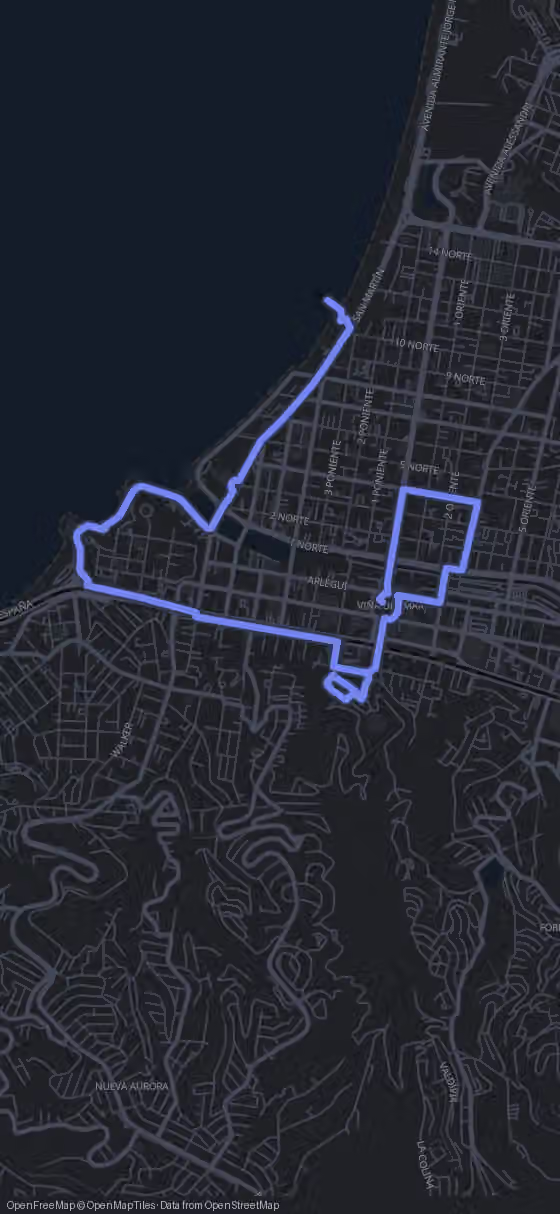
Route map for the Viña del Mar walking tour
Stop 1 of 11
530 m·7 min
Plaza Vergara
Head north up Avenida Libertad toward Palacio Carrasco
Hola, welcome to Viña del Mar. I'm Alex, and this resort city keeps a piece of Rapa Nui far from its island home.
Try this tour with Alex

What This Walk Covers

The route links 11 stops, starting at Plaza Vergara and ending on the Muelle Vergara: 7.0 km and 1 h 39 min of pure walking, close to five hours with the museum visits. It runs through the garden city's palaces, into the park and then along the shore.

Most stops are free. The Museo de Arqueología e Historia Francisco Fonck and the Casino Municipal de Viña del Mar charge admission; Palacio Carrasco and Castillo Wulff are currently closed, so you see them from outside. The GPS route runs free in your browser, and the AI Tour Guide is optional.

Open free GPS & optional AI Tour Guide
View of Viña del Mar

The Route

Walking Map of Viña del Mar's Garden City and Coast

11 stops 7.0 km 1 h 39 min walking
Tap to load interactive map

The 11 stops along this route

  1. Plaza Vergara in Viña del Mar, stop 1 on the self-guided walking tour
    1Plaza Vergara
  2. Palacio Carrasco in Viña del Mar, stop 2 on the self-guided walking tour
    2Palacio Carrasco
  3. Museo de Arqueología e Historia Francisco Fonck in Viña del Mar, stop 3 on the self-guided walking tour
    3Museo de Arqueología e Historia Francisco Fonck
  4. Palacio Rioja in Viña del Mar, stop 4 on the self-guided walking tour
    4Palacio Rioja
  5. Teatro Municipal de Viña del Mar, stop 5 on the self-guided walking tour
    5Teatro Municipal de Viña del Mar
  6. Quinta Vergara in Viña del Mar, stop 6 on the self-guided walking tour
    6Quinta Vergara
  7. Palacio Vergara in Viña del Mar, stop 7 on the self-guided walking tour
    7Palacio Vergara
  8. Reloj de Flores in Viña del Mar, stop 8 on the self-guided walking tour
    8Reloj de Flores
  9. Castillo Wulff in Viña del Mar, stop 9 on the self-guided walking tour
    9Castillo Wulff
  10. Casino Municipal de Viña del Mar, stop 10 on the self-guided walking tour
    10Casino Municipal de Viña del Mar
  11. Muelle Vergara in Viña del Mar, stop 11 on the self-guided walking tour
    11Muelle Vergara
  12. That's the full route.

    Walk it with an AI Tour Guide talking you through every one of these streets.

    Start free in your browser
    You made it

Viña del Mar Walking Tour Stop by Stop, from Plaza Vergara to the Sea

  1. 1

    Plaza Vergara

    Plaza Vergara in Viña del Mar, stop 1 on the self-guided walking tour

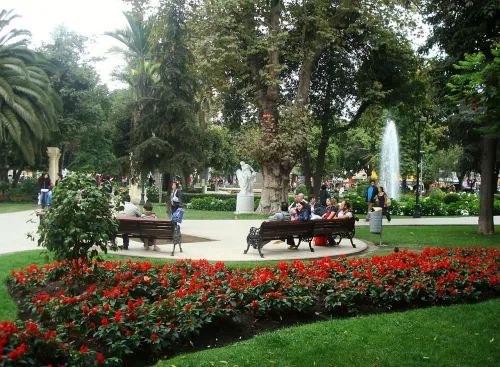
    Begin in the main square of Viña del Mar, which locals often simply call the plaza de Viña. It lies where Avenida Libertad continues across its bridge, between Arlegui and Valparaíso streets. In the centre stands the monument to José Francisco Vergara, the man who founded the city, set up here in 1996. Look around for two sculptures, La Quimera and El Eco: they arrived in 1930, when the square was completely remodelled and paved with tiles.

    Vergara himself handed this ground to the city. The town plan and the authorising decree of 29 December 1874 named it Plaza de Sucre and placed it right in the roadway of Avenida Libertad. For years it was little more than a vacant lot. Work to beautify it only started after the municipality was created in 1879, and even then it stalled, because a retaining wall had to be built against the Marga Marga estuary. Vergara's solution was practical: he sold the neighbouring plots on condition that the buyers built the wall, and that is how the square took shape.

    There is a twist in the name, too. Early in the twentieth century this square swapped names with the one just to the south, which had been Plaza José Francisco Vergara. So the old Plaza Sucre became Plaza Vergara, and the other way round. Keep the founder in mind: his family, his land and his name will follow you all the way to the sea.

    From here walk 530 m, about 8 minutes, along Avenida Libertad to Palacio Carrasco.
    Hours
    24/7
    Price
    Free
  2. 2

    Palacio Carrasco

    Palacio Carrasco in Viña del Mar, stop 2 on the self-guided walking tour

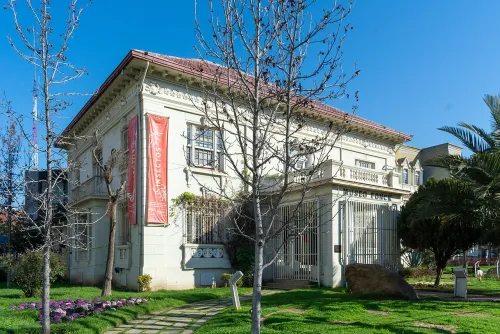
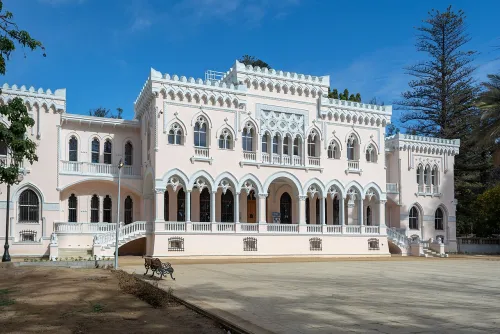
    Palacio Carrasco is currently closed, so this is a stop for the facade, the surrounding park and the sculpture in front: La Defensa, a work by Auguste Rodin. Together with its park and the Rodin, the building was declared a national Historic Monument in 1986.

    It was built as a home for Emilio Carrasco, a leading nitrate businessman. He bought the plot on Avenida Libertad in 1903 and in 1912 hired Alfredo Azancot, a French architect based in Valparaíso, to design and build it. Construction dragged on, and Carrasco died in 1923 without seeing the house finished; it was completed at the end of that same year. His heirs sold it in 1924 to a group of local businessmen.

    On the last day of 1930 the mayor, Manuel Ossa, bought the palace for the municipality, and for four decades it served as the town hall, until 1971. The earthquakes of 1965 and 1971 damaged it so badly that demolition was seriously considered. Instead, since 1977 it has housed the city's cultural centre, the Benjamín Vicuña Mackenna municipal library and the historical archive.

    Your next stop sits right behind it: the Museo Fonck is just 150 m away, about 2 minutes on foot.

    Status
    Currently closed
  3. 3

    Museo de Arqueología e Historia Francisco Fonck

    Museo de Arqueología e Historia Francisco Fonck in Viña del Mar, stop 3 on the self-guided walking tour

    You will know the Museo Fonck by the figure at its entrance: an original moai, a stone statue brought from Easter Island in 1951. Together with Hoa Hakananai'a in the British Museum in London, it is one of the few moai standing outside the island, so take a moment with it even if you skip the inside.

    The museum opened on 25 November 1937 and is named after Francisco Fonck, a German physician, explorer and politician who settled in Chile and made his name exploring the country's south. After the 1985 earthquake it moved into a new building at the back of Palacio Carrasco, on the corner of 4 Norte and 1 Oriente.

    Inside, the Rapa Nui collection was expanded after the move and is considered one of the most complete of its kind, giving a real picture of the island's culture and civilisation. Further rooms present early cultures from the north, centre and south of Chile, among them the Atacameños, the Mapuche and the Diaguitas.

    This is one of the two paid stops on the walk, and it earns its place if you are curious about Chile before the Spanish, or if a trip to Hanga Roa on Easter Island is on your list. Plan around 45 minutes. Then walk 320 m, about 4 minutes, to Palacio Rioja.

    Local name
    Museo Fonck
    Hours
    Mon 10:00–14:00 and 15:00–18:00; Tue–Sat 10:00–18:00; Sun and public holidays 10:00–14:00
    Price
    CLP 4.500 adults, CLP 1.000 children (5-14 years), free on the first Sunday of each month for national visitors and residents with Chilean ID
  4. 4

    Palacio Rioja

    Palacio Rioja in Viña del Mar, stop 4 on the self-guided walking tour

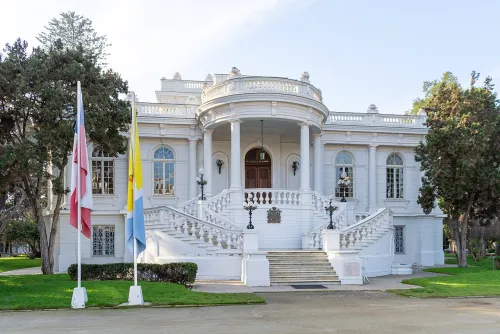
    Palacio Rioja stands in the middle of its own park and is free to enter, which makes it an easy yes. Since 1979 it has been the city's Museum of Decorative Arts, and together with its park it was declared a Historic Monument in 1985.

    The ground once belonged to the Quinta San Francisco of José Francisco Vergara and his wife Mercedes Álvarez; their main house stood here until the 1906 earthquake destroyed it. In 1907 the Spanish-born businessman Fernando Rioja Medel bought the land and moved his household from Valparaíso to Viña del Mar. In 1909 he commissioned the palace from Alfredo Azancot, the same architect who built Palacio Carrasco, and surrounded it with a large park planted with species from many parts of the world.

    The municipality bought the property in 1956 for cultural events and ceremonies, and from 1971 it was the mayor's seat until 1978. The 2010 earthquake left structural damage and the palace closed; restoration of the building, its artworks and furniture began in 2014, and it reopened on 13 May 2016.

    Inside you walk through the world of Chile's early twentieth century aristocracy: furniture, textiles and decorations, with Empire-style pieces, exact replicas of Napoleonic furniture, fine wall textiles and ornaments. Give it about half an hour. Then head back towards the centre, 820 m and 11 minutes, to the Teatro Municipal de Viña del Mar.

    Hours
    Tue–Sun 10:00–17:30, Mon closed
    Price
    Free
  5. 5

    Teatro Municipal de Viña del Mar

    Teatro Municipal de Viña del Mar, stop 5 on the self-guided walking tour

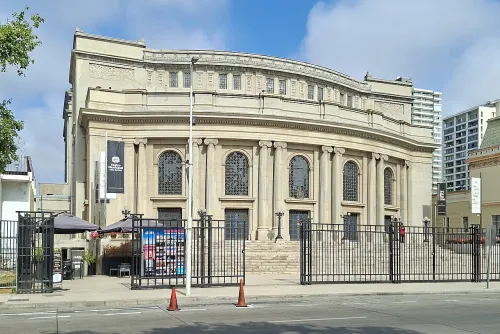
    The Teatro Municipal faces Plaza Vergara, so you are back where the walk began. Take in the front first: a historicist building of reinforced concrete with brick and stone masonry, entered through Ionic columns. It was declared a Historic Monument in 2009.

    The idea goes back to 1889, when Mercedes Álvarez, the founder's wife, donated the land for a monumental theatre. It took decades to happen: the architects Renato Schiavon and Aquiles Landoff built it between 1925 and 1930. On 11 October 1930 President Carlos Ibáñez del Campo and the mayor Manuel Ossa Saint-Marie opened it with a performance by the Compañía Lírica Italiana, followed by Massenet's opera Thaïs. That autumn was a busy one for the same mayor, who bought Palacio Carrasco for the city before the year was out.

    The 2010 earthquake damaged the theatre and it closed to the public. Funds for a full restoration were approved in 2015, and the doors reopened on 1 December 2023.

    You can go in without a show ticket: heritage visits to the Sala de Fumadores museum space are free, and guided tours need prior registration. Performances are ticketed separately. From here it is 590 m, about 9 minutes, to the gates of the Quinta Vergara.

    Hours
    Tue–Fri 10:00–14:00 for free heritage visits (visitas libres mediadas in the Sala de Fumadores museum space); guided tours Tue–Fri 11:00 (prior registration required); box office/info Tue–Wed 10:00–14:00, Thu–Fri 10:00–14:00 & 15:30–17:00; show times vary by cartelera
    Price
    Free for heritage visits (visitas patrimoniales / visitas libres mediadas); event and performance ticket prices vary by show
  6. 6

    Quinta Vergara

    Quinta Vergara in Viña del Mar, stop 6 on the self-guided walking tour

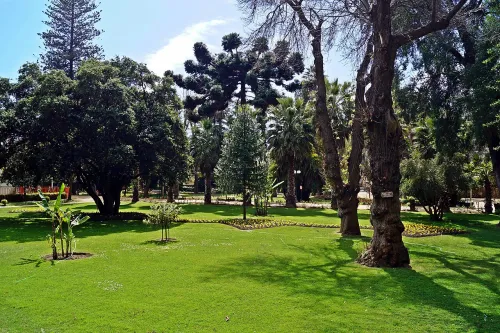
    The Quinta Vergara is a free public park, and it was once the founder's home ground. Walk slowly and look at the trees: exotic species from Asia, Australia and California were planted here in the nineteenth century, when the estate was still the Hacienda de las Siete Hermanas, for the pleasure of its owners. The municipality bought the park and its palace in 1941 and opened them to the public.

    Among the sculptures in the gardens, look for the bust of Gabriela Mistral. The artist Nina Anguita made and donated it to mark the Nobel Prize the poet received in 1945.

    The park is also home to the amphitheatre of the Festival Internacional de la Canción de Viña del Mar. After the success of the first festival in February 1960, the city decided on a sturdier stage. Architect Hernando López designed it in 1963, and the civil builder Juan Pinto Delgado put it up: a wooden stage crowned by an acoustic shell that projected the sound to the audience and shielded the performers from Viña's cold nights. The shell became an icon of the festival.

    Palacio Vergara stands inside the park, 230 m and about 3 minutes away.

    Hours
    Daily 07:00–18:00
    Price
    Free
  7. 7

    Palacio Vergara

    Palacio Vergara in Viña del Mar, stop 7 on the self-guided walking tour

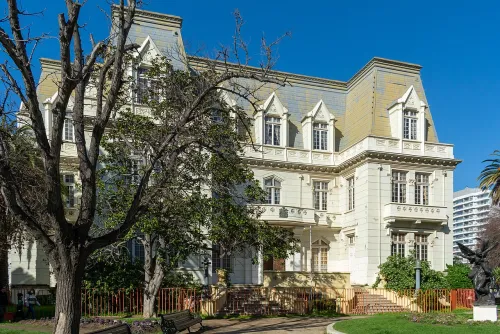
    Look up at the facade first. Palacio Vergara was modelled on the Ca' d'Oro in Venice, and its Venetian neo-Gothic style shows in the pointed arches and the balustrades. It became a Historic Monument in 2008.

    After the 1906 earthquake brought down the family mansion, Blanca Vergara had this new house built on the old foundations by the architects Ettore and Alejandro Petri. It opened in 1910. Most of the furniture was bought directly in Europe, and the styles inside range across rococo, Louis XVI and Empire.

    When the city bought the park and palace in 1941, the building became the Museum and School of Fine Arts, and Blanca Vergara's oil paintings were donated with the sale: 60 works by European artists formed the core of the collection. The 2010 earthquake hit the structure hard; repairs ran from 2015 to 2020, and the palace reopened on 22 December 2021.

    Entry is free, and it is worth half an hour: salons with plaster mouldings and walls lined with tapestries embroidered in gold and silk. If you saw Palacio Rioja, compare the two, since both show how the city's elite lived a century ago. Now comes the longest leg of the walk, 1,910 m and 27 minutes, down to the Reloj de Flores.

    Hours
    Tue–Sun 10:00–17:30, Mon closed
    Price
    Free
  8. 8

    Reloj de Flores

    Reloj de Flores in Viña del Mar, stop 8 on the self-guided walking tour

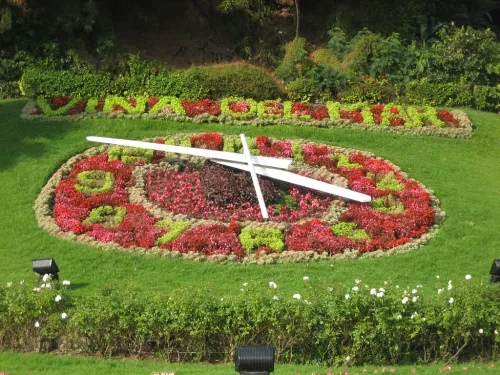
    The flower clock lies at the foot of Cerro Castillo, opposite the Caleta Abarca beach. Its face is a garden, and its hands are made of wood.

    The city bought it in 1962 as part of a plan to dress Viña del Mar up as one of the host cities of that year's football World Cup. The original mechanism came from the Favag factory in Neuchâtel, Switzerland.

    The clock has had a rough life since. After vandals damaged the mechanism, it was replaced on 5 September 2013 by new GPS-controlled machinery, meant to reset itself if tampered with. It was made by Relojes Olvera III Generación of Zacatlán in Puebla, Mexico, and installed by Esteban Becerra and Martin Guerrero, with digital chimes and melodies that change with the seasons and on special days. Then, on 19 May 2017 at around 1:45 in the morning, a storm set off a landslide and a tree fell onto the clock and destroyed it. Within a week the gardens and floral structure were rebuilt; only the motor and the wooden hands were missing, sent anew from Mexico. The repaired clock started running again on 29 June.

    From here walk 610 m, about 8 minutes, to Castillo Wulff, passing the Castillo Ross along the way.

    Hours
    24/7
    Price
    Free
  9. 9

    Castillo Wulff

    Castillo Wulff in Viña del Mar, stop 9 on the self-guided walking tour

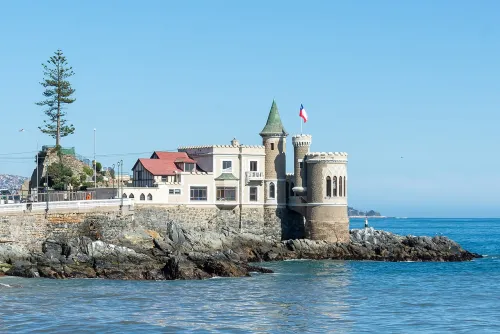
    Castillo Wulff is currently closed, so you enjoy it from outside, right on the shore at Avenida La Marina 37, between the mouth of the Marga Marga estuary and the Caleta Abarca beach. Look for the round tower joined to the main house by a medieval-style bridge.

    Gustavo Wulff, a German-born businessman and philanthropist, arrived in Chile in 1881 and wanted a house by the sea. Building on the shoreline needed a special law, which the state granted him in 1904. The house went up in 1905 and 1906: two storeys in a German-French style inspired by an old mansion in Liechtenstein, on stone foundations and clad in wood, with three towers carrying two large terraces each.

    In the late 1910s the architect Alberto Cruz Montt remodelled it and clad it in stone, and in 1920 the circular tower and its bridge were added and the windows enlarged. After Wulff died in 1946, the new owner, Esperanza de Artaza Matta, removed two of the three towers, widened the main entrance and added a stone structure in English style. So what you see is a house rebuilt three times.

    The municipality bought it in 1959 and a year later lent it to the Chilean Navy for its Naval and Maritime Museum. Since 2005 it has housed the city's heritage office, and it has been a national Historic Monument since 1995. Next, 710 m and about 10 minutes to the casino.

    Status
    Currently closed
  10. 10

    Casino Municipal de Viña del Mar

    Casino Municipal de Viña del Mar, stop 10 on the self-guided walking tour

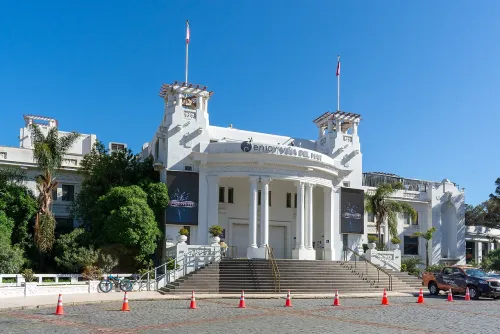
    The city owns its casino, though it trades as Enjoy Viña del Mar, with the company Enjoy holding the concession. The idea dates from 1914, when Alberto Mackenna, the intendant of Valparaíso, argued that a casino would boost Viña del Mar. It gained momentum in 1928, after a roulette opened at the Recreo resort, and got its final push in 1930 under President Carlos Ibáñez del Campo, as part of a set of works to develop the city.

    It opened on 31 December 1930, the closing act of the same year that brought the Teatro Municipal and the town hall in Palacio Carrasco. In 2000 the city council declared it a place of historical and architectural interest, and the Hotel del Mar opened alongside it in 2003.

    The gaming rooms charge admission, so for most walkers the building from outside is enough. The last leg is 1,170 m, about 16 minutes, to the Muelle Vergara.

    Hours
    Mon–Wed & Holidays 12:00–04:00; Thu 12:00–24:00; Fri–Sat & Eves of Holidays 24 hours (continuous); Sun 12:00–04:00
    Price
    CLP 4.300 general admission (SCJ statutory entrance fee ~0,07 UTM); Enjoy Club promotional rates may apply (e.g. CLP 2.000 during specific hours)
    Website
    enjoy.cl ↗
  11. 11

    Muelle Vergara

    Muelle Vergara in Viña del Mar, stop 11 on the self-guided walking tour

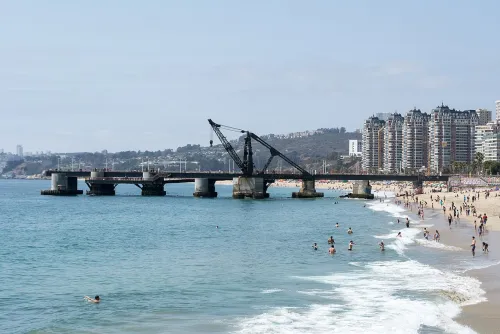
    Finish on the Muelle Vergara, a free pier that began as hard industry. Its trademark is the crane: a Derrick crane with a lifting capacity of 62 tonnes, built in 1914 by Joseph Booth and Bros in Leeds, England, and used on the construction of the port of Valparaíso before it was mounted here in 1937.

    The pier was the idea of the Irish capitalist Eduardo Sandiford, who obtained the permits and maritime concession. With the Vergara family he formed the Compañía de Muelles y Bodegas de la Población Vergara, which hired Lever, Murphy & Co. in 1893. Lever first laid 5 km of railway to the site; the pier itself went up from February 1894, using more than 900 tonnes of iron, and opened in March 1895 after inspection by Domingo Víctor Santa María, then director of public works.

    Its job was unloading coal and raw sugar. The Navy stored coal for its ships here, and the Viña del Mar sugar refinery, CRAV, needed more than 16 tonnes of coal a day, so it ended up as a major shareholder, ran its own wagons and boats and repaired the pier twice. Later the COIA warehouses and the Aconcagua dairy union used it too.

    As industry declined it was abandoned in the 1960s, then turned into a promenade and a platform for tourism and small businesses. Walk out to the crane and you close the loop with the founder: the square, the park and this pier all carry his name. If you have another day, the Valparaíso walking tour takes you to the port this crane helped build.

    Hours
    Daily 10:00–20:00 (winter / standard schedule); extended to 08:00–23:00 during summer season (up to March 15)
    Price
    Free
Walking tour route map of Viña del Mar Route loaded
Plaza VergaraPalacio CarrascoMuseo de Arqueología e Historia Francisco FonckPalacio Rioja+7
All 11 stops are already on the map.
You just press start.
AI Tour Guide

You've read the route. Now walk it from palace to pier with a guide in your ear.

Press start wherever you are, even hundreds of kilometres from Viña del Mar, and the guide begins telling its stories right away. In the city, pick any of the 11 stops to start from: it leads you there, then talks with you the whole route, asking, listening, remembering, and shaping the tour around your answers.

11stops 7.0km 1 h 39 minwalking 13languages
▶Start the tour free

Free to start · Runs in your browser · No app, no download

Shorter Ways to Walk Viña del Mar

The long leg between Palacio Vergara and the Reloj de Flores splits the route naturally into an inland half and a coastal half.

Palaces and park

Stops: 1, 2, 3, 4, 5, 6, 7

For anyone who cares about interiors and history. From Plaza Vergara to Palacio Vergara is 2.6 km and 37 minutes of walking. Only the Museo Fonck charges admission; Palacio Rioja, the theatre's heritage visits, the park and Palacio Vergara are free. With the interiors, plan a little over three hours.

Along the shore

Stops: 8, 9, 10, 11

For a relaxed afternoon by the sea. From the Reloj de Flores to the Muelle Vergara is about 2.5 km and 34 minutes of walking, roughly an hour with stops. Castillo Wulff is closed, so the only admission on this stretch is the casino, and only if you go inside.

How Long Does This Viña del Mar Tour Take with the Museums?

The order starts inland, where the founding family and the nitrate fortunes built their palaces, then takes the longest leg, 1,910 m and 27 minutes, down to the coast and finishes on the old industrial pier. Pure walking adds up to 1 h 39 min.

Add about 45 minutes for the Museo Fonck, half an hour each inside Palacio Rioja and Palacio Vergara, some 20 minutes for the theatre's heritage rooms and as much for the park, plus short pauses at the other stops, and you land close to five hours. If you only look from outside, about two and a half hours is enough.

Before You Set Off in Viña del Mar

  • Start and finish: The recommended start is Plaza Vergara and the walk ends on the Muelle Vergara, but you can join at any stop and follow the order from there.
  • Time of day: Make it a daytime walk so the museums and the Quinta Vergara park are open when you reach them; check current opening times before you leave.
  • Admission: The Museo Fonck and the casino charge admission. Palacio Rioja, Palacio Vergara, the park and the theatre's heritage visits are free; guided theatre tours need prior registration.
  • Route on your phone: Open the free GPS route in your browser; it leads you from stop to stop, and you can switch on the AI Tour Guide whenever you like.
Walking tour route map of Viña del Mar
AI Tour Guide

Your guide is ready when you are, from the square to the sea.

Press start and a voice AI Tour Guide takes it from here: leading the route through Viña del Mar, telling the stories, and turning your walk into a real back-and-forth conversation. No app or download is needed; it runs in your browser.

11stops 7.0km 1 h 39 minwalking 13languages
▶Start the tour free

Free to start · Runs in your browser · No app, no download

What the AI Tour Guide Adds on This Route

Three families, two architects and five earthquakes run through this walk, and the AI Tour Guide ties those threads together as a conversation while you move. It fills the 27 minutes from the park to the coast with stories, notices whether you lean towards the palaces or the industrial past and steers the talk that way, and you can interrupt at any time, say to ask who Gabriela Mistral was or what the Song Festival means to Chileans. You start with 100 free credits; after that, choose this tour all-inclusive for €19.99 with no time limit, or credits at €5 per hour.

A Real Conversation A voice AI Tour Guide greets you, leads the whole route, and tells the stories and facts as you walk, asking what you want to see and keeping a real conversation going. Not a recording you press play on.
Map Navigation Follow the route on the map and walk at your own pace. You choose where to start and when to move to the next stop.
Ask Anything Curious about a building you pass? Ask your AI Tour Guide on the spot and the conversation carries on.
13 Languages Switch language anytime. No separate tour needed.
Start free in your browser

Common Questions about Walking Viña del Mar

Why is so much in Viña del Mar named Vergara?

José Francisco Vergara founded the city and gave it the land for its main square. His family's estate became the Quinta Vergara park, his daughter Blanca built Palacio Vergara, and the family co-founded the company that built the pier in the Población Vergara district.

Why have so many of these buildings only recently reopened?

Earthquakes. The 1906 quake destroyed the Vergara mansions, those of 1965 and 1971 nearly led to Palacio Carrasco's demolition, 1985 moved the Museo Fonck, and 2010 closed Palacio Rioja, Palacio Vergara and the Teatro Municipal for years of restoration.

Can I combine this walk with Valparaíso?

Valparaíso is only 7 km away and has its own free route: the Valparaíso walking tour. Doing both with museum visits makes a very long day; walking Viña del Mar from outside only leaves more room.

Is the tour really free?

Yes. The whole tour is free: the route, the interactive map and the navigation cost you nothing. Only the voice AI Tour Guide is optional and paid: you test it with 100 free credits, then you pay either €5 per hour or €19.99 for this whole tour, with no time limit. Admission to 2 of the 11 stops is not included: Museo de Arqueología e Historia Francisco Fonck and Casino Municipal de Viña del Mar charge their own entry fees.

Do I need to download an app?

No. Everything runs in your phone browser. Open the route and start walking, no download and no sign-up required.

Do I need to book the walking tour in advance?

No booking needed. This self-guided tour is available anytime. Open the route in your browser and start walking. The AI Tour Guide works instantly, no app, no reservation required.

What languages is the AI Tour Guide available in?

The AI Tour Guide speaks 13 languages, so you take the tour in your own language and can switch at any time.

Can I skip stops or change the route?

Yes. Skip any stop, spend extra time at places you like, or start the route from any point. It is your walk, you set the pace.
Image credits
▶ Start free in your browser Runs in your browser, no app, no download