Free Walking Tour Hanga Roa: Moai, Church and Sea Cave

Begin among the moai of Ahu Tahai, pass a church carved with birdman figures and finish in a sea cave painted with sacred terns, all on foot.

4 Stops 5.7 km ~1 h 19 min walking
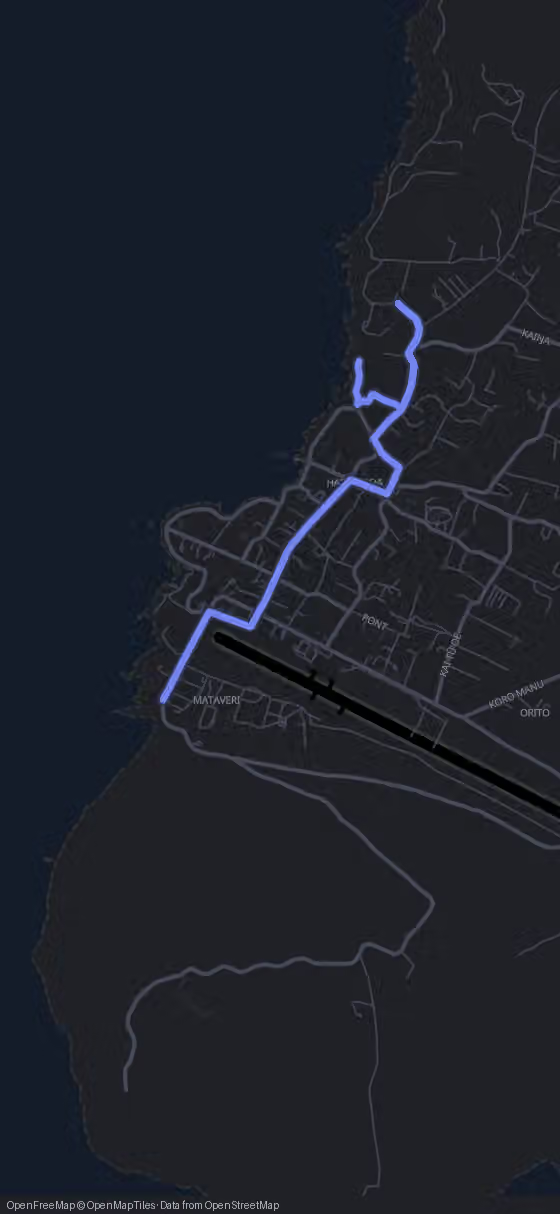
Route map for the Hanga Roa walking tour
Stop 1 of 4
1.5 km·19 min
Ahu Tahai
Head north-east along the coast toward the Museo Antropológico Sebastián Englert
Iorana, welcome to Hanga Roa. I'm Alex, and the eyes of one moai tell a careful story of loss and restoration.
Try this tour with Alex

Hanga Roa on Foot at a Glance

Four stops lead from Ahu Tahai through town past the Museo Antropológico Sebastián Englert and the Iglesia de la Santa Cruz to the sea cave Ana Kai Tangata. The route covers 5.7 km and 1 h 19 min of pure walking; plan about three hours in total.

Only Ahu Tahai needs the Rapa Nui National Park ticket. The church and the cave are free, and the museum is currently closed. Route, map and GPS navigation in your browser cost nothing; the AI Tour Guide is optional.

Open free GPS & optional AI Tour Guide
View of Hanga Roa

The Route

Walking Map of Hanga Roa from Tahai to the Sea Cave

4 stops 5.7 km 1 h 19 min walking
Tap to load interactive map

The 4 stops along this route

  1. Ahu Tahai in Hanga Roa, stop 1 on the self-guided walking tour
    1Ahu Tahai
  2. Museo Antropológico Sebastián Englert in Hanga Roa, stop 2 on the self-guided walking tour
    2Museo Antropológico Sebastián Englert
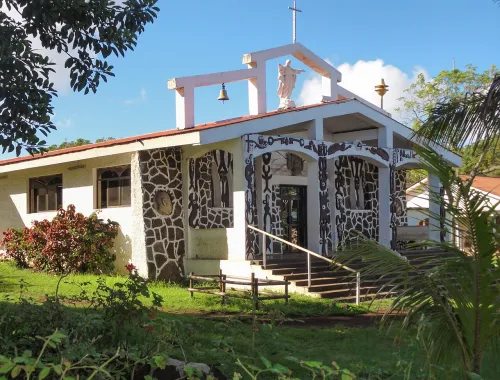
  3. Iglesia de la Santa Cruz in Hanga Roa, stop 3 on the self-guided walking tour
    3Iglesia de la Santa Cruz
  4. Ana Kai Tangata in Hanga Roa, stop 4 on the self-guided walking tour
    4Ana Kai Tangata
  5. That's the full route.

    Walk it with an AI Tour Guide talking you through every one of these streets.

    Start free in your browser
    You made it

Your Hanga Roa Walking Tour: Moai, Mission and Birdman Art

  1. 1

    Ahu Tahai

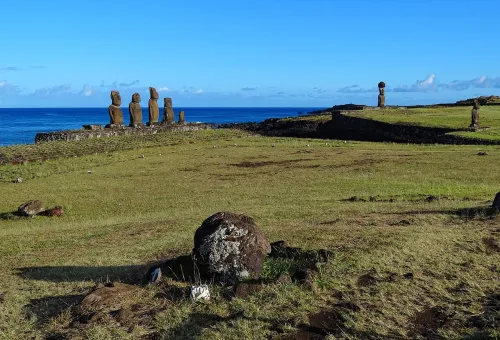
    Ahu Tahai in Hanga Roa, stop 1 on the self-guided walking tour

    Ahu Tahai is really three ceremonial platforms in a row, a complex just north of Hanga Roa and part of the UNESCO-listed Rapa Nui National Park. From north to south you meet Ko Te Riku, Tahai and Vai Ure. Ko Te Riku is the one that stops most people: its single moai was restored with its original elements and is the only one displayed on the island with eyes of white coral and a pukao of red volcanic stone.

    The middle platform, Tahai, also carries just one moai, 4.5 metres tall, yet it matters more than its size suggests: it is considered the oldest ahu on the whole island. Its name means "where the sun hides" in Rapa Nui. Vai Ure, "dark water", lines up five moai beside the coast, and because of the way it faces, the sunset appears behind the figures, which draws many visitors in the evening.

    Look beyond the statues. Around the platforms lie the ruins of an old village with boat-shaped houses, the hare moa, and a stone ramp running down to the sea. You will also find the grave of William and Emily Mulloy. The American archaeologist restored Vai Ure in 1974, and in the distance you can make out two restored platforms at Hanga Kio'e, a project he began in 1972. Tahai is not a museum piece either: it still hosts ceremonies such as the crowning during Tapati.

    This is the one stop on the walk that needs the national park ticket, and it earns it: three platforms, coral eyes and a village layout in one compact area of about 250 square metres. From here it is 1530 m, about 22 minutes, into town to the museum, whose library carries Mulloy's name.
    Hours
    Daily 09:00–21:00
    Price
    95000 CLP foreign adult, 38000 CLP foreign child (7-12) / 40000 CLP national adult, 20000 CLP national child (covers all Rapa Nui National Park sites, 10-day ticket); free under 7
  2. 2

    Museo Antropológico Sebastián Englert

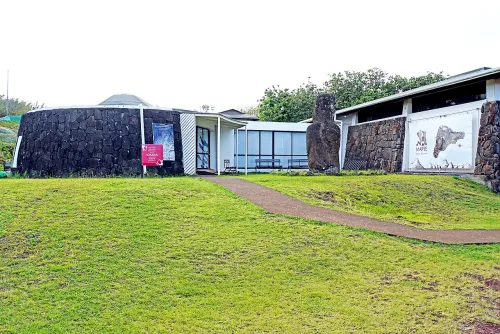
    Museo Antropológico Sebastián Englert in Hanga Roa, stop 2 on the self-guided walking tour

    The Museo Antropológico Sebastián Englert is currently closed, so this is a short stop outside. Still, it explains much of what you see on the island. Founded in 1973, it is named after the Bavarian Capuchin missionary Sebastian Englert, who recorded the language and culture of Rapa Nui. The objects he gathered during that work became the foundation of the collection, which today is run by Chile's National Service of Cultural Heritage.

    What the building holds is remarkable: about 15,000 objects, including the only female moai and one of the coral eyes once set into a moai, the same kind you just saw at Ko Te Riku. There are obsidian tools, wooden statuettes, ancient fish hooks, displays of rongorongo glyphs, a photographic collection and archives of traditional music. Even the natural history side has its surprises, such as two vertebrae of a blue whale.

    The museum also houses the William Mulloy Library, a large collection of scientific writing about the island, named after the archaeologist buried at Tahai. Many important Rapa Nui objects, however, ended up far from here, a legacy of colonial extraction and foreign research: the University of Wyoming Art Museum alone holds 180 small sculptures in volcanic rock, stone and wood assembled by Mulloy.

    From here you walk 1620 m, about 22 minutes, to the church that Englert himself served as its first priest. On the way you pass the Mercado Artesanal de Hanga Roa, the town's craft market.

    Local name
    Museo Antropológico Padre Sebastián Englert
    Status
    Currently closed
  3. 3

    Iglesia de la Santa Cruz

    Iglesia de la Santa Cruz in Hanga Roa, stop 3 on the self-guided walking tour

    The Iglesia de la Santa Cruz on Te Pito Te Henua Street is the Catholic church of Hanga Roa, set in gardens. The parish was founded in December 1937 thanks to the efforts of Sebastian Englert, who became its first priest, and it still belongs to the Diocese of Valparaíso on the mainland.

    Start with the façade, because it tells the whole story of the building. A horizontal band shows Christian symbols: the tablets of the Ten Commandments, the keys to heaven, angels. The columns, though, carry island figures: the birdman Tangata manu, fish and the manutara bird. Remember that bird; you will meet it again at the end of the walk.

    Inside, the church is simple, and the details reward a slow look. Near the entrance stand Archangel Michael and Saint Francis of Assisi. The upper part of the baptismal font is decorated with rongorongo symbols. On the left, the Sacred Heart shows Jesus with a face like a moai kavakava and a reimiro, the crescent-shaped ornament, on his chest; nearby stands a tabernacle carved from a tree trunk. Above the main altar hangs a cross of volcanic stone, its Christ wearing a headdress of shells and bones, and to the right stands Our Lady of Rapa Nui.

    The church is open daily and free, so it is worth half an hour for anyone, and essential if you are curious how island tradition and Catholic faith came together. If you can, hear a service: the mass is in Spanish, but the hymns are sung in Rapa Nui. Then comes the longest leg, 2550 m and about 35 minutes, out to the sea cave near Mataveri.

    Hours
    Mon–Fri around 19:00 (mass); Sun 09:00 & 11:00 (mass); open daily for visiting
    Price
    Free
  4. 4

    Ana Kai Tangata

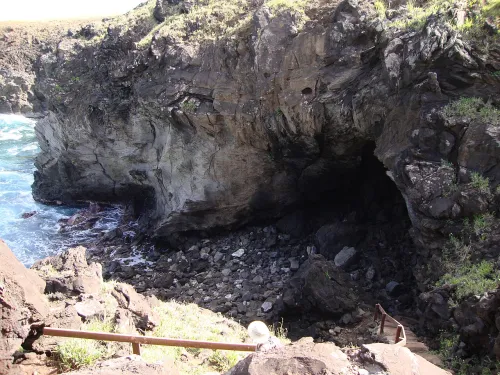
    Ana Kai Tangata in Hanga Roa, stop 4 on the self-guided walking tour

    Ana Kai Tangata is a sea cave carved out of volcanic rock by the ocean, and it opens straight onto the incoming surf. It is 10 metres high, 5 metres wide and 15 metres deep, its floor covered with irregular boulders and its domed ceiling carrying sound surprisingly well. It is one of the most visited caves on the island, and entry is free during daylight.

    Look up. The paintings in red, white and black mostly show the manutara, the sooty tern, the bird held sacred by followers of the Tangata manu cult, the same one carved on the church columns. You will also spot boats, both Polynesian canoes and European ships, which islanders may have seen as messengers from another world. The pigments were made from plants and minerals from the area around Ahu Vinapu, mixed with shark oil. Look for the taheta, a basin dug into the rock that may have been used to prepare the colours. Water leaking from above and salt from the sea are slowly fading the images, so see them while you can.

    The name is usually translated as "Cave of the Cannibals", but the meaning is unclear. Ana means cave and tangata means man, yet kai can be read several ways: archaeologist Georgia Lee suggested "cave where men eat", "cave where men are eaten" or "cave that eats men". Legends tell of defeated warriors fleeing into caves where the victors caught and ate them, and of feasts in the birdman era. Bones of animals and people, and needles made from human bone, were reportedly found here, along with a carved ceremonial skull, but there is no firm evidence of cannibalism.

    This is where the walk ends: from the oldest ahu to a cave where the birdman's sacred bird still hangs on the ceiling.

    Hours
    Daylight hours
    Price
    Free (open-access site within Rapa Nui; no separate ticket)
Walking tour route map of Hanga Roa Route loaded
Ahu TahaiMuseo Antropológico Sebastián EnglertIglesia de la Santa CruzAna Kai Tangata
All 4 stops are already on the map.
You just press start.
AI Tour Guide

You know the way from Tahai to the cave. Now walk it with a guide in your ear.

Press start wherever you are, even hundreds of kilometres from Hanga Roa, and the guide begins telling its stories right away. In the city, pick any of the 4 stops to start from: it leads you there, then talks with you the whole route, asking, listening, remembering, and shaping the tour around your answers.

4stops 5.7km 1 h 19 minwalking 13languages
▶Start the tour free

Free to start · Runs in your browser · No app, no download

Shorter Ways Through Hanga Roa

Not every day on Rapa Nui has room for the full walk. These versions keep the stops that matter most to you.

The full route

Stops: 1, 2, 3, 4

For a first morning on the island: moai, mission history, church carvings and cave paintings in one line. 1 h 19 min of walking; the national park ticket is needed for Ahu Tahai only.

Without a park ticket

Stops: 2, 3, 4

For anyone who hasn't bought the national park ticket yet or plans to see the moai on another day. Starting at the museum, you walk 57 minutes, and every stop is free: the museum from outside, the church and the cave open to all.

Moai and town

Stops: 1, 2, 3

For a shorter outing that skips the long last leg to the coast. 44 minutes of walking from Ahu Tahai to the church; only Tahai requires the park ticket.

How Long Does This Hanga Roa Tour Take, Tahai to Ana Kai Tangata?

The pure walking time is 1 h 19 min, and the last leg to the cave is the longest at 35 minutes. Give Ahu Tahai about 45 minutes, pause briefly outside the museum, allow half an hour for the church and 20 minutes in the cave, and you are out for about three hours.

A sample morning: leave Ahu Tahai at 09:45, pass the museum at 10:07, reach the church at 10:39 and the cave at 11:44, finishing around 12:05. The ticket-free version from the museum takes about an hour and three quarters with the same pauses, while Tahai to the church alone fits into roughly two hours.

Before You Set Off from Ahu Tahai

  • Start and finish: The recommended start is Ahu Tahai, north of the town centre; the walk ends at Ana Kai Tangata. You can join the route at any stop.
  • Day and time: The cave is best visited in daylight, so a morning start works well. On a Sunday, an early start at Tahai brings you to the church just before the late morning mass.
  • Costs: Ahu Tahai requires the Rapa Nui National Park ticket, which costs Chilean adults less than foreign visitors. The church and Ana Kai Tangata are free.
Walking tour route map of Hanga Roa
AI Tour Guide

Your guide is waiting at Tahai whenever you are.

Press start and a voice AI Tour Guide takes it from here: leading the route through Hanga Roa, telling the stories, and turning your walk into a real back-and-forth conversation. No app or download is needed; it runs in your browser.

4stops 5.7km 1 h 19 minwalking 13languages
▶Start the tour free

Free to start · Runs in your browser · No app, no download

What the AI Tour Guide Adds Between Moai and Cave

This walk is held together by a few threads: Englert the missionary, Mulloy the archaeologist and the manutara bird that turns up on church columns and on a cave ceiling. The AI Tour Guide follows those threads in conversation, telling the stories at each place, asking what caught your eye and picking up where your curiosity leads; you can interrupt it at any time. Ask it how the birdman competition actually worked or what is known about reading rongorongo. You start with 100 free credits; after that, choose this tour all-inclusive for €19.99 with no time limit, or €5 per hour.

A Real Conversation A voice AI Tour Guide greets you, leads the whole route, and tells the stories and facts as you walk, asking what you want to see and keeping a real conversation going. Not a recording you press play on.
Map Navigation Follow the route on the map and walk at your own pace. You choose where to start and when to move to the next stop.
Ask Anything Curious about a building you pass? Ask your AI Tour Guide on the spot and the conversation carries on.
13 Languages Switch language anytime. No separate tour needed.
Start free in your browser

Common Questions About Walking Hanga Roa

Is my park ticket from Ahu Tahai valid at other sites too?

Yes. The ticket covers all Rapa Nui National Park sites and is valid for 10 days, so Tahai is a good place to start using it.

Do children need a park ticket?

Older children need their own ticket at a reduced price, and Chilean children pay less than foreign children. The youngest children enter free.

Can visitors attend mass at the Iglesia de la Santa Cruz?

Yes, both locals and visitors come. Mass is held on weekday evenings and on Sunday mornings. It is said in Spanish, while the hymns are sung in Rapa Nui.

Can the sea at Ana Kai Tangata reach into the cave?

The cave opens straight onto the surf, but it lies above the high tide line, which is why it can be visited. Watch your footing on the boulders that cover the floor.

Is the tour really free?

Yes. The whole tour is free: the route, the interactive map and the navigation cost you nothing. Only the voice AI Tour Guide is optional and paid: you test it with 100 free credits, then you pay either €5 per hour or €19.99 for this whole tour, with no time limit. Admission to one of the 4 stops is not included: Ahu Tahai charges its own entry fee.

Do I need to download an app?

No. Everything runs in your phone browser. Open the route and start walking, no download and no sign-up required.

Do I need to book the walking tour in advance?

No booking needed. This self-guided tour is available anytime. Open the route in your browser and start walking. The AI Tour Guide works instantly, no app, no reservation required.

What languages is the AI Tour Guide available in?

The AI Tour Guide speaks 13 languages, so you take the tour in your own language and can switch at any time.

Can I skip stops or change the route?

Yes. Skip any stop, spend extra time at places you like, or start the route from any point. It is your walk, you set the pace.
Image credits
▶ Start free in your browser Runs in your browser, no app, no download