Free Walking Tour Valparaíso: Port, Hills and Neruda

From the harbour square up a funicular from 1901, across Cerro Alegre and Cerro Concepción, through open-air murals to Neruda's house and back down to the plan.

11 Stops 6.0 km ~1 h 36 min walking
Route map for the Valparaíso walking tour
Stop 1 of 11
180 m·2 min
Plaza Sotomayor
Head north-east toward Muelle Prat and the passenger pier
Hola, welcome to Valparaíso. I'm Alex, and this steep port learned to move uphill in creaking wooden boxes.
Try this tour with Alex

The Route at a Glance

Eleven stops lead from Plaza Sotomayor at the port to Plaza Aníbal Pinto in the plan, climbing Cerro Alegre, Cerro Concepción and Cerro Bellavista on the way. The route is 6.0 km with 1 h 36 min of pure walking; plan on about three hours, more with museum visits.

The squares, viewpoints, Iglesia de la Matriz del Salvador and the Museo a Cielo Abierto are free. Palacio Baburizza and La Sebastiana charge admission, Ascensor El Peral and Ascensor Concepción a fare. Route, map and GPS navigation run free in your browser; the AI Tour Guide is optional.

Open free GPS & optional AI Tour Guide
View of Valparaíso

The Route

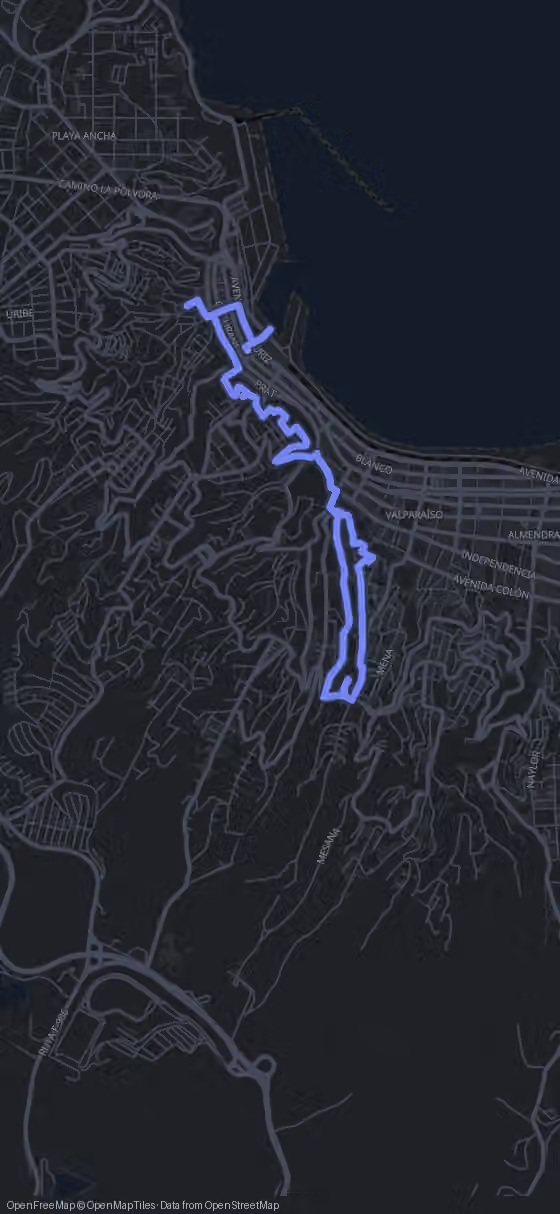
Walking Map of Valparaíso, Harbour to Hilltops

11 stops 6.0 km 1 h 36 min walking
Tap to load interactive map

The 11 stops along this route

  1. Plaza Sotomayor in Valparaíso, stop 1 on the self-guided walking tour
    1Plaza Sotomayor
  2. Muelle Prat in Valparaíso, stop 2 on the self-guided walking tour
    2Muelle Prat
  3. Iglesia de la Matriz del Salvador in Valparaíso, stop 3 on the self-guided walking tour
    3Iglesia de la Matriz del Salvador
  4. Ascensor El Peral in Valparaíso, stop 4 on the self-guided walking tour
    4Ascensor El Peral
  5. Palacio Baburizza in Valparaíso, stop 5 on the self-guided walking tour
    5Palacio Baburizza
  6. 6Paseo Gervasoni
  7. Ascensor Concepción in Valparaíso, stop 7 on the self-guided walking tour
    7Ascensor Concepción
  8. Paseo Atkinson in Valparaíso, stop 8 on the self-guided walking tour
    8Paseo Atkinson
  9. Museo a Cielo Abierto in Valparaíso, stop 9 on the self-guided walking tour
    9Museo a Cielo Abierto
  10. La Sebastiana in Valparaíso, stop 10 on the self-guided walking tour
    10La Sebastiana
  11. Plaza Aníbal Pinto in Valparaíso, stop 11 on the self-guided walking tour
    11Plaza Aníbal Pinto
  12. That's the full route.

    Walk it with an AI Tour Guide talking you through every one of these streets.

    Start free in your browser
    You made it

Your Valparaíso Walking Tour, from the Quay to Neruda's House

  1. 1

    Plaza Sotomayor

    Plaza Sotomayor in Valparaíso, stop 1 on the self-guided walking tour

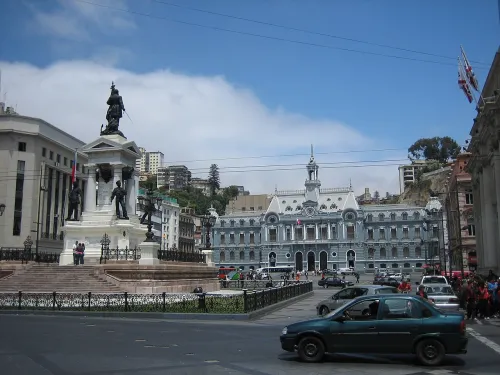
    You start in the most important civic square of Valparaíso, named after Rafael Sotomayor. Your eye goes first to the monument at its centre: it honours the Chilean sailors who fell in the Battle of Iquique and the Battle of Punta Gruesa. Around you, buildings fill entire block fronts, and the square's trapezoid shape plays with perspective, so the former Intendencia at its head looks grander the further back you stand.

    That building once housed the Intendencia de Valparaíso and is now the headquarters of the Chilean Navy. Turn to the northeastern side and you see two near-identical towers that frame a kind of gateway from the city to the port. The building used by the shipping company CSAV and the seat of the National Council of Culture and the Arts also face the square, which, together with its buildings, was declared a Zona Típica on 23 January 1979.

    The square has had many names: Plaza de la Aduana, Plaza del Palacio, Plaza Intendencia. Everything here stands on land won from the sea. Before that it was an open esplanade where dirty water trickled down the San Agustín gorge, and customs work happened in a large house near Cerro Cordillera.

    The best story lies under your feet. On 10 June 1825 a storm snapped the cables of the frigate Valdivia and drove her onto the beach that was here then. The authorities filled the wreck with sand and used it as the base for Valparaíso's first wharf for passengers and light cargo. The modern quay is just 180 m away, a 3 minute walk to Muelle Prat.
    Hours
    24/7
    Price
    Free
  2. 2

    Muelle Prat

    Muelle Prat in Valparaíso, stop 2 on the self-guided walking tour

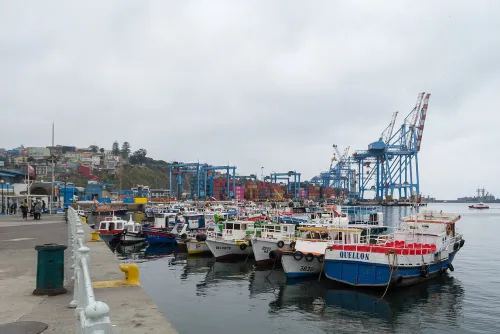
    Muelle Prat has served the port since 1850. It sits west of Plaza Sotomayor, opposite the Estación Puerto, and it is the best spot in the plan to watch the port at work: cranes, ships, the whole working bay in front of you. Entry to the quay is free.

    This is also where the launches leave for sightseeing trips around the bay, so if you want to see the hills from the water, this is your chance. Along the pedestrian promenade you find a craft fair and restaurants.

    Look out for the replica of the caravel Santiaguillo. On the original, the navigator Juan de Saavedra sailed from Callao to bring supplies to the conquistador Diego de Almagro, a reminder of how early this bay mattered to the Spanish.

    From here it is 660 m, about 11 minutes, through the Barrio Puerto with its cobbled streets to the oldest church site in the city.

    Hours
    Daily approx. 10:00–19:00
    Price
    Free admission
  3. 3

    Iglesia de la Matriz del Salvador

    Iglesia de la Matriz del Salvador in Valparaíso, stop 3 on the self-guided walking tour

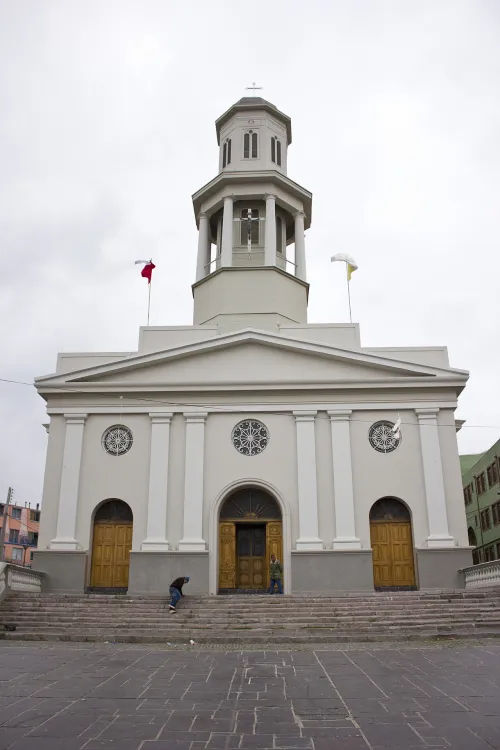
    You are in the heart of the Barrio Puerto, among cobbled streets and old houses, in front of the church that marks the very beginning of religious life in Valparaíso. It has been a National Monument of Chile since 1971.

    In 1559 the Bishop of Santiago, Rodrigo Marmolejo, founded the first chapel here, little more than a hut. As the settlement grew, one order after another used it: Augustinians in 1627, Franciscans in 1664, the Mercedarians in 1715, the Sacred Hearts congregation in 1834 and the Jesuits in 1850. In 1578 Sir Francis Drake is said to have sacked the port and carried off the chapel's treasures, including a silver chalice, and pirates returned during the 17th and 18th centuries.

    Earthquakes did even more damage. Three churches rose on this site after the first chapel. The quake of November 1822 left the building a ruin for over a decade; only in 1837 did priest José Antonio Riobío begin to rebuild it stone by stone, finishing in 1842. That fourth church is the one you see. In 1868 it even served, unusually, as a polling station.

    The church follows a basilica plan with three naves. The main facade has a classical composition, eight columns surround the body of the building, and the interior walls carry paintings. Entry is free, but the doors open mainly around Mass, so on many walks you will see it from outside.

    Next you head back towards Plaza Sotomayor: 760 m, about 12 minutes, passing Ascensor Cordillera on the way to the lower station of Ascensor El Peral on Plaza de Justicia.

    Hours
    Tue–Sat around 19:00 (Mass), Sun 09:30 & 12:00 (Mass)
    Price
    Free admission
  4. 4

    Ascensor El Peral

    Ascensor El Peral in Valparaíso, stop 4 on the self-guided walking tour

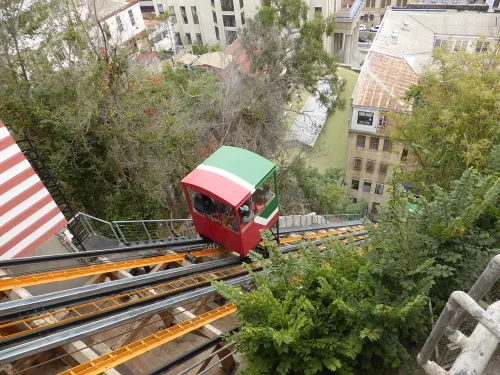
    Valparaíso has 16 funiculars, and Ascensor El Peral is the one that lifts you onto Cerro Alegre. Its lower station stands on Plaza de Justicia, facing Plaza Sotomayor; the upper one sits on Paseo Yugoslavo. It opened on 7 December 1901, built by Fernando Edwards and Juan Naylor, and was the first in the city to run on a steam engine.

    The numbers explain the thrill of the ride: a 55 m track at a slope of 45.2 degrees, climbing 39 m. It began with the Sociedad Ascensor Cerro Alegre and later passed to the municipality. Like Ascensor Concepción and Ascensor Reina Victoria, it carried the foreign communities who lived on Cerro Alegre and Cerro Concepción down to the plan and back.

    It has had its troubles. In 2012 an engine fault stopped it for about a month and a half, and both stations were refreshed during the repair. It closed on 1 June 2015 for a full restoration and reopened in September 2016, now with an exhibition room at the top. It has been a National Monument since 1998.

    The ride costs a fare and is worth it for anyone: it is the easy way up and part of the city's history. At the top you step out facing the entrance facade of Palacio Baburizza, just 90 m, 2 minutes away.

    Hours
    Daily 07:00–21:30
    Price
    200 CLP standard / 1,000 CLP foreign tourists
  5. 5

    Palacio Baburizza

    Palacio Baburizza in Valparaíso, stop 5 on the self-guided walking tour

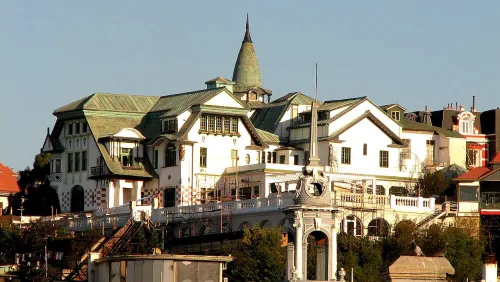
    This Art Nouveau mansion on Paseo Yugoslavo was built in 1916 by two Italian architects, Arnaldo Barison and Renato Schiavon. Both had trained in Trieste and Vienna and arrived in Valparaíso soon after the devastating earthquake of 1906, when the city was rebuilding fast. Their model was Austrian Jugendstil, and the house looks like something you would expect in central Europe, around Prague or in southern Germany.

    It was commissioned by Ottorino Zanelli, an emigrant from the province of Savona who came to Chile with his brothers and a cousin. They started by supplying food and goods to the company stores of Tarapacá, and in 1882 bought the Aguas Blancas nitrate works in Antofagasta. Zanelli bought this plot in 1914, but he died the same year the house was finished and never really lived in it.

    In 1925 his widow sold it to Pascual Baburizza, a Croatian businessman who had also made his fortune in the nitrate north, and the house still carries his name. Since 1971 it has housed the Municipal Museum of Fine Arts of Valparaíso, and it became a Historic Monument eight years later.

    Going inside costs admission. It is worth it if you like painting or want to see how the nitrate fortunes lived; if not, the facade alone tells the story. From here a 320 m, 6 minute walk takes you off Cerro Alegre and onto Cerro Concepción.

    Hours
    Tue–Sun 10:00–18:00, Mon closed
    Price
    4,000 CLP general adult, 6,000 CLP foreign visitors, 1,500 CLP students & seniors (65+), free for children under 12 and persons with disability credential
  6. 6

    Paseo Gervasoni

    You are now on Cerro Concepción, the second of the three hills on this walk, and Paseo Gervasoni is a promenade made for looking out over the city. It is a public viewpoint and free.

    This is also where the upper station of Ascensor Concepción arrives, so the promenade has been a meeting point between hill and plan since the 1880s. Take a pause here: after the climb from the port you have earned it.

    The next two stops are close. The funicular station is only 20 m away, about a minute.

    Hours
    24/7
    Price
    Free
  7. 7

    Ascensor Concepción

    Ascensor Concepción in Valparaíso, stop 7 on the self-guided walking tour

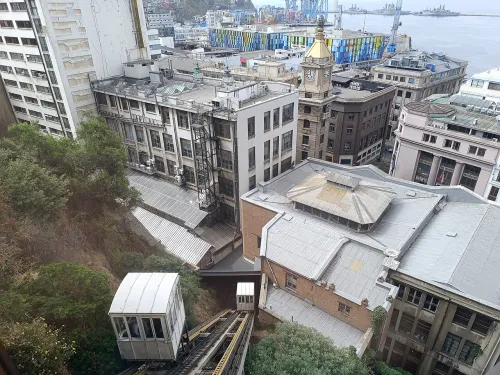
    This is the oldest funicular in Valparaíso, the second oldest in Ibero-America and the first in the Southern Hemisphere. A company was founded in 1882 specifically to build it for the residents of Cerro Concepción, and the city authorities opened it on 1 December 1883.

    In the beginning two wooden cabins ran with a water counterweight, powered by steam from a boiler. Over the years it switched to electric drive and the wooden cabins were replaced with metal ones. Each holds seven people. The track is 69 m long, rests directly on the hillside at a slope of 46 degrees and climbs to 47 m above sea level.

    In 2012 the government of Sebastián Piñera bought it together with nine other private funiculars and handed them to the municipality to preserve. Restoration by the Ministry of Public Works began on 5 December 2016 and finished on 3 April 2019.

    The lower station hides in Pasaje Elías, a narrow gap between buildings opposite the Reloj Turri clock on calle Prat. Riding down and back up costs a fare and is optional, since you are already at the top. Then continue 240 m, about 4 minutes, through the streets of Cerro Concepción to Paseo Atkinson.

    Hours
    Daily 07:00–21:30
    Price
    300 CLP
  8. 8

    Paseo Atkinson

    Paseo Atkinson in Valparaíso, stop 8 on the self-guided walking tour

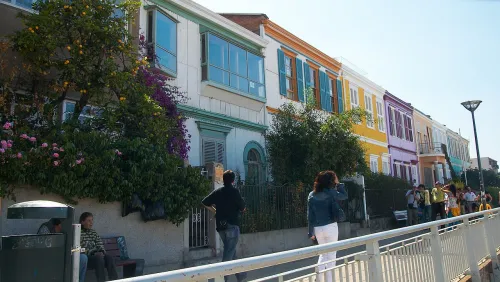
    Locally known as Paseo Mirador Atkinson, this pedestrian promenade gives you a panorama over the flat plan of Valparaíso and straight out to the Pacific. It is free, and it is one of the places where the city's immigrant history is easiest to read.

    The land once belonged to the British engineer Joshua Waddington. From 1825 he sold small plots to newly arrived British and German immigrants. The steep ground and cliffs made the area unattractive to locals, but the newcomers built their first quintas here, houses with large yards for gardens and orchards, and laid out the paths that linked the hill to the plan. The German Benevolent Society of Valparaíso bought land for a school. There are even hints that Spanish criollos played chueca, a game similar to field hockey, on this spot in the 18th century.

    The name honours Juan Atkinson McFarlan, a Chilean-British shipbuilder who was behind the row of Victorian-style houses built here in 1886. Those colourful houses still stand: each has its own small front garden and a plain, classical facade. Between 1908 and 1945 the Esmeralda funicular connected this promenade with the plan.

    Now comes the longest stretch so far: 1220 m, about 19 minutes, across to Cerro Bellavista and its open-air murals.

    Local name
    Paseo Mirador Atkinson
    Hours
    24/7
    Price
    Free
  9. 9

    Museo a Cielo Abierto

    Museo a Cielo Abierto in Valparaíso, stop 9 on the self-guided walking tour

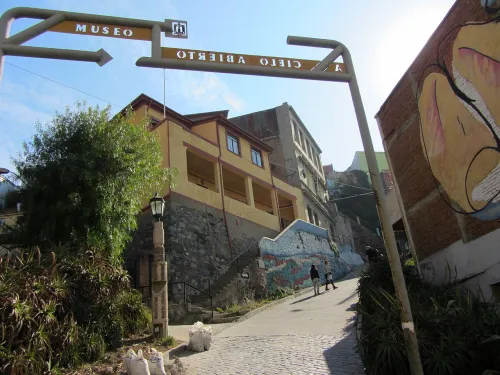
    This museum has no doors and no tickets. It consists of 20 murals in very different styles painted on the slopes of Cerro Bellavista, and it was a pioneering project in Chile when it opened in 1992. Among the artists are names known worldwide, such as Roberto Matta and Mario Carreño. Walk slowly and look at house sides and retaining walls; that is where the works are.

    The idea goes back to 1969, when students of the Art Institute of the Catholic University of Valparaíso, led by their teacher Francisco Méndez Labbé, began painting large murals on the walls of houses here. By 1973 there were around sixty murals in different parts of the city.

    In early 1973 Nemesio Antúnez, then director of the Museum of Fine Arts in Santiago, was approached with the idea of inviting painters to create a mural route through the hills. The military coup of 11 September 1973 put the project on hold. It was only realised in 1991, through an agreement between the university and the municipality, directed by Méndez Labbé and his colleague Israel Fraiman, the first curator.

    Why Bellavista? It is central, close to Plaza Victoria, and full of large retaining walls and blank house sides: a curator once put it as telling each painter to pick whichever canvas they liked. Ascensor Espíritu Santo reaches the middle of the route, and the neighbourhood mixes people of very different backgrounds. From the murals it is 950 m, about 18 minutes, to La Sebastiana.

    Hours
    24/7
    Price
    Free
  10. 10

    La Sebastiana

    La Sebastiana in Valparaíso, stop 10 on the self-guided walking tour

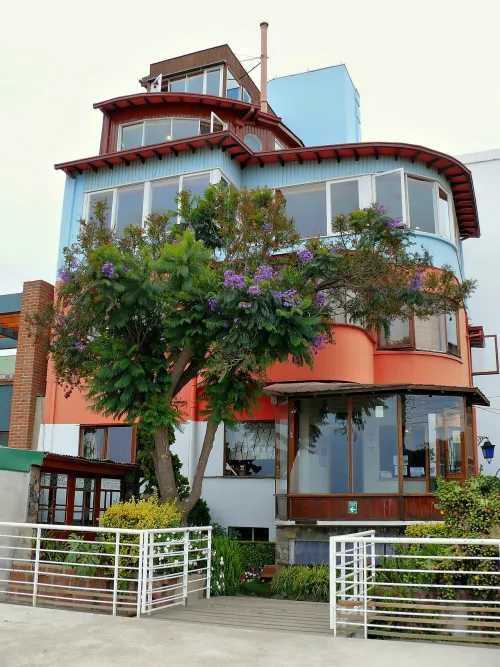
    La Sebastiana is one of the three houses Pablo Neruda owned, alongside La Chascona in Santiago de Chile and his house at Isla Negra. Like the others it is now a museum run by the Fundación Neruda, and it is known for its construction and its view over the bay.

    The house was started by the Spanish builder Sebastián Collado Mauri, who also created the Teatro Mauri and meant to spend his last years here. He died with the house half finished, and his family, unsure what to do with it, sold it to Neruda in 1959. The poet had been looking for a house in Valparaíso that seemed to float in the air yet stood firmly on the ground, and he fell for this one because it gave him both privacy and easy access.

    Of its four floors, Neruda persuaded friends, Francisco Velasco and the artist María Martner, to buy the lower two. Martner made many works for his houses, including a mural here based on a map of Patagonia the poet owned. The house was inaugurated on 18 September 1961 with a big party on Chile's Independence Day. Neruda liked to see in the New Year here, and he welcomed his last year, 1973, in this house.

    Going inside costs admission. For Neruda readers and anyone curious how a poet furnished his life, it is the highlight of the route; if the interior does not tempt you, the outside and the setting still repay the climb. From here it is 1550 m, about 21 minutes, back down to the plan and Plaza Aníbal Pinto.

    Hours
    Tue–Sun 10:00–18:00 (Mar–Dec) / Tue–Sun 10:00–19:00 (Jan–Feb), Mon closed
    Price
    11,000 CLP general admission, 4,500 CLP reduced (students under 17, accredited Chilean students & seniors 60+ resident in Chile); special 4,500 CLP general rate on July Tuesdays
  11. 11

    Plaza Aníbal Pinto

    Plaza Aníbal Pinto in Valparaíso, stop 11 on the self-guided walking tour

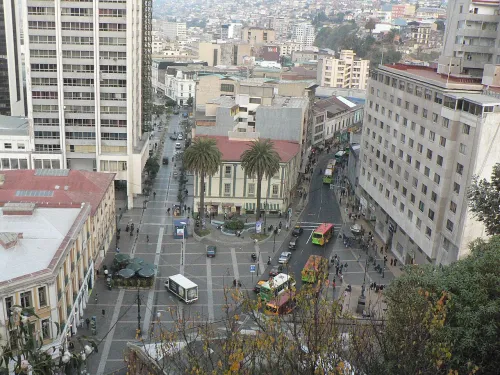
    You finish where the hills meet the plan. Plaza Aníbal Pinto sits at the junction of calle Esmeralda, coming from the port, and Cumming and Almirante Montt, coming down from Cerro Alegre; calle Condell and the partly pedestrian O'Higgins start here. It is a hub linking the plan with Cerro Alegre, Concepción, Cárcel and Panteón. In the square you find the Neptune Fountain and a statue of Carlos Condell, and around it buildings such as the Edificio Cooperativa Vitalicia and the old Café Riquet.

    Like Plaza Sotomayor, this square stands on land reclaimed from the sea in the 19th century. Until the late 18th century the plan was just a narrow shore between hills and water, reaching only to today's calle Serrano. The first landfills, paid for by the booming trade in wheat and later minerals, filled the stretch between Iglesia de la Matriz del Salvador and Muelle Prat, the same ground you crossed at the start.

    For a long time a huge rocky outcrop, the Peñón del Cabo, cut the Barrio Puerto off from El Almendral, then an open plain with farms and workshops. To get round it, people climbed up the Quebrada de El Almendro, today calle Urriola, which divides Cerro Alegre from Cerro Concepción, and came back down the Quebrada de Elías, today calle Cumming, right into this square.

    In 1832 the rock was blasted away. The old Calle del Cabo became calle Esmeralda, filled with shops, shipping firms and Ascensor Concepción. The square was declared a Zona Típica in 1976, during the Pinochet dictatorship, and its limits were extended in 1989 and 1994. It is a fitting end: you have walked across the whole story of how Valparaíso grew out of the sea and up its hills.

    Hours
    24/7
    Price
    Free
Walking tour route map of Valparaíso Route loaded
Plaza SotomayorMuelle PratIglesia de la Matriz del SalvadorAscensor El Peral+7
All 11 stops are already on the map.
You just press start.
AI Tour Guide

You know the route now. Walk it with a guide in your ear.

Press start wherever you are, even hundreds of kilometres from Valparaíso, and the guide begins telling its stories right away. In the city, pick any of the 11 stops to start from: it leads you there, then talks with you the whole route, asking, listening, remembering, and shaping the tour around your answers.

11stops 6.0km 1 h 36 minwalking 13languages
▶Start the tour free

Free to start · Runs in your browser · No app, no download

Shorter Ways Through Valparaíso

Not every day has room for all eleven stops. The route splits naturally into a port and first-hills half and a murals and Neruda half.

Port, Cerro Alegre and Cerro Concepción

Stops: 1, 2, 3, 4, 5, 6, 7, 8

For a morning or a short first visit. You see the harbour, the old church, ride Ascensor El Peral and finish among the Victorian houses of Paseo Atkinson. The legs add up to 39 minutes of walking. The funicular ride costs a fare; Palacio Baburizza charges admission if you go inside, and riding Ascensor Concepción is optional.

Murals, Neruda and the plan

Stops: 6, 7, 8, 9, 10, 11

For anyone who mainly wants street art and the poet. Ride Ascensor Concepción up from calle Prat and you step out on Paseo Gervasoni, then follow the route over Cerro Bellavista down to Plaza Aníbal Pinto. The legs add up to 63 minutes of walking. You pay the funicular fare and admission at La Sebastiana.

How Long This Valparaíso Tour Takes, With and Without the Museums

The pure walking time is 1 h 36 min. With ten minutes or so at each free stop and both funicular stations, the full route fills about three hours. Add roughly three quarters of an hour for the art inside Palacio Baburizza and an hour for La Sebastiana, and you are looking at about four and a half hours.

The order is built around the climb: the flat port first, then Ascensor El Peral lifts you onto Cerro Alegre, so most of the height is gained without effort. The longest legs come at the end, across Cerro Bellavista and back down to the plan. The port and first-hills variant takes about an hour and a half, or two hours with Palacio Baburizza; the murals and Neruda variant about two and a half hours including La Sebastiana.

Before You Set Off from Plaza Sotomayor

  • Start: Plaza Sotomayor is the recommended start, and the western terminus of the Valparaíso Metro is close by. You can join at any stop; the order of the tour is the recommended one.
  • End: Plaza Aníbal Pinto in the plan. If you want to return to Plaza Sotomayor, the GPS navigation in your browser guides you back.
  • Time of day: Start in the morning if you want time inside Palacio Baburizza and La Sebastiana, and check that both houses are open on the day you walk. Iglesia de la Matriz del Salvador opens mainly around Mass.
  • What costs money: Four places charge: the fares for Ascensor El Peral and Ascensor Concepción, and admission at Palacio Baburizza and La Sebastiana. Everything else on the route is free.
Walking tour route map of Valparaíso
AI Tour Guide

Your guide is ready when you reach Plaza Sotomayor.

Press start and a voice AI Tour Guide takes it from here: leading the route through Valparaíso, telling the stories, and turning your walk into a real back-and-forth conversation. No app or download is needed; it runs in your browser.

11stops 6.0km 1 h 36 minwalking 13languages
▶Start the tour free

Free to start · Runs in your browser · No app, no download

What the AI Tour Guide Adds in the Hills

On this route the stories sit in walls, cabins and front gardens, and the AI Tour Guide talks you through them as you go. Stand in front of one of the twenty murals on Cerro Bellavista and ask who painted it and what it shows, or ask at La Sebastiana which Neruda poems came out of Valparaíso; the guide picks up what interests you and shapes the rest of the walk around it. You start with 100 free credits; after that choose this tour all-inclusive for €19.99 with no time limit, or credits at €5 per hour.

A Real Conversation A voice AI Tour Guide greets you, leads the whole route, and tells the stories and facts as you walk, asking what you want to see and keeping a real conversation going. Not a recording you press play on.
Map Navigation Follow the route on the map and walk at your own pace. You choose where to start and when to move to the next stop.
Ask Anything Curious about a building you pass? Ask your AI Tour Guide on the spot and the conversation carries on.
13 Languages Switch language anytime. No separate tour needed.
Start free in your browser

Common Questions Before You Climb the Hills

Do I have to ride both funiculars?

Ascensor El Peral is how the route gets you from Plaza de Justicia up to Cerro Alegre. At Ascensor Concepción you arrive at the upper station on foot, so riding down to calle Prat and back up is optional.

Is Paseo Atkinson the same as Paseo Mirador Atkinson?

Yes. Paseo Mirador Atkinson is the local name you will see on signs and maps; it is the same promenade and viewpoint on Cerro Concepción.

Can I combine Valparaíso with Viña del Mar?

Viña del Mar is only 7 km away and makes an easy second day. It has its own route: walking tour of Viña del Mar.

Which hills does the walk cover?

Three: Cerro Alegre, where Palacio Baburizza stands, Cerro Concepción with its two promenades, and Cerro Bellavista with the murals and La Sebastiana. Between them you come back through the plan only at the very end.

Is the tour really free?

Yes. The whole tour is free: the route, the interactive map and the navigation cost you nothing. Only the voice AI Tour Guide is optional and paid: you test it with 100 free credits, then you pay either €5 per hour or €19.99 for this whole tour, with no time limit. Admission to 2 of the 11 stops is not included: Palacio Baburizza and La Sebastiana charge their own entry fees.

Do I need to download an app?

No. Everything runs in your phone browser. Open the route and start walking, no download and no sign-up required.

Do I need to book the walking tour in advance?

No booking needed. This self-guided tour is available anytime. Open the route in your browser and start walking. The AI Tour Guide works instantly, no app, no reservation required.

What languages is the AI Tour Guide available in?

The AI Tour Guide speaks 13 languages, so you take the tour in your own language and can switch at any time.

Can I skip stops or change the route?

Yes. Skip any stop, spend extra time at places you like, or start the route from any point. It is your walk, you set the pace.
Image credits
▶ Start free in your browser Runs in your browser, no app, no download