Plan around three hours with the museum, under two without it. Only the museum charges admission; everything else is free. The GPS route runs free in your browser, and the AI Tour Guide is optional.
Your Sorrento walking tour, from Piazza Tasso to Via San Cesareo
1
Piazza Tasso
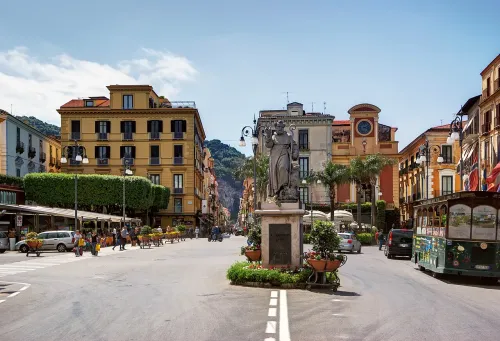
Start in Piazza Tasso, the central square of Sorrento and the hinge of this whole walk. It is named after the 16th-century poet Torquato Tasso, and you will meet his family name again within a couple of minutes, at the gorge just around the corner.
Look for the yellow-painted Baroque façade of the Carmelite church del Carmine. It is easy to walk past on the way to somewhere else, but if the door is open, step inside: the church holds a painting by Onofrio Avellino showing the Virgin Mary with Saint Simon Stock and a group of angels. A few minutes are enough, and it costs nothing to look.
On the square stands a statue of Saint Antoninus of Sorrento, a good landmark if you are meeting someone here. Notice too where Via San Cesareo leaves the square to the west. That pedestrian lane is where the walk finishes, so today you simply note it and keep it for the end, when you will come back toward this square along it.
From here it is only 140 m, about 2 minutes, to the Vallone dei Mulini. The change is sudden: one moment you are on the busiest square in town, the next you are looking into a deep green cleft in the rock.
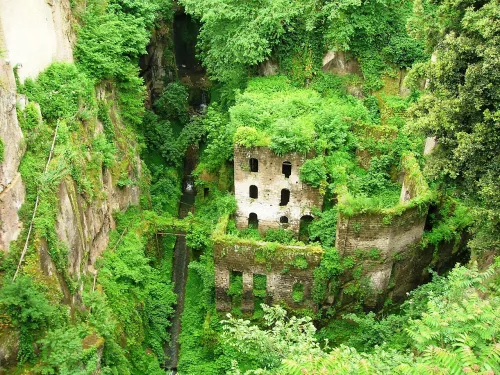
The Vallone dei Mulini, the Valley of the Mills, takes its name from a mill that once ground wheat at the bottom of the gorge. What you see is a narrow, deep cut in the rock, and its story begins long before Sorrento existed.
About 35,000 years ago a violent eruption of the Campi Flegrei buried the whole stretch from Punta Scutolo to Capo di Sorrento under volcanic debris. Two small spring-fed streams, the Casarlano and the Sant'Antonino, meet just before the valley begins, and over time they carved this steep gorge as they searched for a way down to the sea. Sorrento was once crossed by three such valleys, joined together in Roman times. This was the heart of the system; one valley ended at Marina Grande, another, planted with citrus trees, ran inland into the hills. Those two have largely disappeared, filled in to make room for roads and buildings.
In the 16th century the land belonged to the Tasso family, then passed to the Correales. In the 17th century Onofrio Correale built a harbour at the mouth of the valley, today's Marina Piccola. The spot was once called Capo Cervo or Capo di Cerere, after a Roman temple to Ceres that landslides destroyed in 1580 and 1604.
Down on the valley floor the stream drove a mill that ground wheat for the people of Sorrento, a sawmill working cherry, olive and walnut wood for local craftsmen, and a public wash-house. Their ruins are still visible. The walls of the gorge were very likely quarried for tufa blocks to build the town, and the caves left behind were turned into wells to collect water.
Next comes the Correale di Terranova Museum, 700 m and about 10 minutes away. On the way you pass I Giardini di Cataldo, and you are heading to the very family that once owned this gorge.
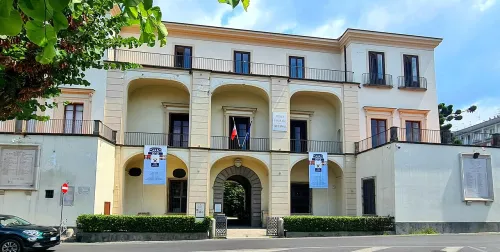
The Correale di Terranova Museum is an archaeological museum, picture gallery and art collection in one, housed in an 18th-century villa the counts of Terranova used as their summer residence, also known as Villa della Rota. Before you go in, look at the façade: two side wings project forward, and between them rise two rows of arches, one above the other, each with three bays on banded pillars. The keystone of the round-arched entrance carries the Correale coat of arms.
The museum exists because of two brothers, Pompeo and Alfredo Correale, counts of Terranova. Neither ever married, and they wrote in their will that the art their family had gathered over the years must not be scattered: it should become a museum in one of their villas. The Correale di Terranova foundation was set up in 1902 and the museum inaugurated in 1924, yet disputes kept it closed for a long time. It only opened to the public in 1989.
Inside are 24 rooms on three levels, plus an attic for temporary exhibitions. The collection covers 17th-century furniture, paintings across five centuries, archaeological finds and porcelain, mostly from the Capodimonte school. On the ground floor, the founders' room shows their portraits and a 19th-century family tree. The rooms on Sorrento's history follow: Louis XV chairs and tables, a 1910 writing desk that doubles as a lectern, a chessboard and dressing table by Giuseppe Gargiulo, and boxes and caskets decorated with wood inlay showing scenes of everyday life. Most of these were donated by Silvio Salvatore Gargiulo in 1937.
This is the one stop with admission, and it repays an hour or more if you enjoy decorative arts and local craftsmanship. If museums are not your thing, the façade and the brothers' story are enough. Then walk 920 m, about 12 minutes, the longest leg of the route, to the Cloister of San Francesco.
Hours
Tue–Sat 09:30–17:30, Sun and public holidays 09:00–14:00, Mon closed
Price
15 EUR adults, 10 EUR groups (min 25 pax), 7.50 EUR students (11-25) / FAI / Campania Artecard, 5 EUR school groups, free under 10
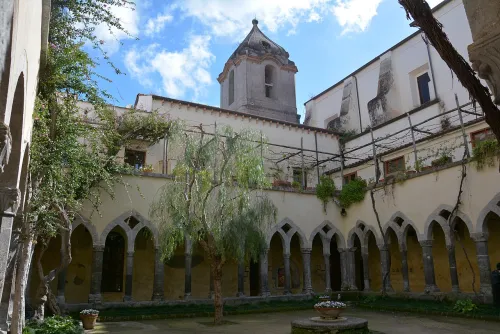
The Cloister of San Francesco is the quiet heart of this walk, and entry is free. The Franciscans built it in the 14th century on the remains of a 7th-century monastery, together with the adjoining convent and the church of San Francesco.
Stand in one of the porticoes and look around the square courtyard with its central garden. The tufa arches are not all alike: on two sides they are simple round arches, while on the other two they interlace to form paired windows topped by a small lunette, in an Arab-influenced style. Then look at the capitals of the columns. On the north side they carry the coat of arms of the Sersale family, one of the noble houses you will meet again at Sedile Dominova; on the south and east sides they are Byzantine in style, carved with floral motifs.
The cloister was reworked in the 15th century, and not only for prayer. Sorrento ran part of its civic life from here: town meetings were held inside, and the seal of the municipal records was kept within these walls. The old refectory still opens onto the courtyard. The whole complex was restored at the start of the 20th century.
The cloister occasionally closes for private ceremonies and weddings, so if the gate is shut, carry on and try again later. From here it is 360 m, about 6 minutes, to Sorrento Cathedral.
Local name
Chiostro di San Francesco
Hours
Daily 09:00–19:00 (approx. daytime; seasonal variation and occasional closures for private ceremonies/weddings)
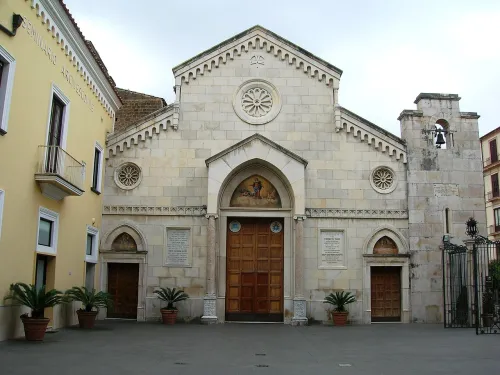
Sorrento Cathedral, dedicated to the apostles Philip and James, is the seat of the archdiocese of Sorrento and Castellammare di Stabia and still a working parish church. Entry is free. It faces the bishop's square and stands on the remains of an ancient Greek temple.
The façade is the youngest part. A violent whirlwind damaged the whole building, and in 1924 the front was completely rebuilt in neo-Gothic style. An entablature divides it in two. Below are three entrances: the main one dates from the 16th century and is framed by two pink marble columns taken from ancient pagan temples, carrying a pointed arch that works as a canopy. Above the doors, three frescoed lunettes show the Virgin of the Assumption in the centre and Saints Philip and James on either side.
The story behind it is long. Sorrento's first cathedral stood where the cemetery is today; in the 10th century it moved inside the town walls, to the church of Santi Felice e Baccolo, while a new one was built. That church was consecrated on 16 March 1113 by Cardinal Riccardo de Albano. Bishop Domizio Falangola enlarged it in 1450 and Cardinal Francesco Remolines in 1505. After the Turkish invasion of 1558 it was rebuilt entirely in 1573 under Bishop Giulio Pavese, and works in the early 18th century under Bishops Didaco Petra and Filippo Anastasio gave the interior its Baroque look.
Step inside even briefly: all of the paintings were restored in 1936, and the contrast between the Gothic front and the Baroque interior tells the building's history at a glance. Sedile Dominova is only 120 m, about 2 minutes, away.
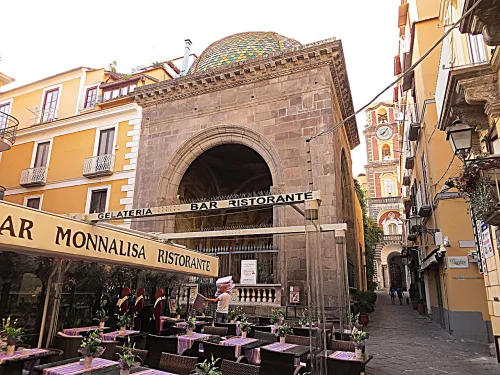
Sedile Dominova is a small square hall open on two sides through round arches of grey piperno stone, resting on columns with Byzantine capitals. Entry is free, and because it is open you can see much of it straight from the street. Look up at the walls and the underside of the dome: they are painted with trompe-l'oeil architecture that seems to recede like stage scenery, with cherubs and garlands added in. The frescoes date from the 18th century.
The hall was born of a brawl. In 1319 the nobles who governed Sorrento met at the Sedile di Porta, near today's Piazza Tasso at the start of Via San Cesareo. Their quarrels grew so fierce that weapons were drawn, once in the courtyard of the Mastrogiudice family's house, and Bishop Ruggero had to step in to calm things down. Afterwards the noble families of western Sorrento, among them the Mastrogiudice, the Sersale and the Vulcano, left and built their own seat on Via San Cesareo, then the town's main street lined with noble palaces. They called it Domus Nova, the new house: Dominova.
High up you can spot two 14th-century tufa coats of arms, one showing a Sorrento emblem that differs from the official one, the other the lilies of the Angevins. On the Via San Cesareo side the marble balustrade survives. For five centuries the nobles met here; in 1877 the hall became the seat of the workers' mutual aid society, as an inscription inside records. It has been restored several times without changing its character, most recently in 2019, though over the centuries its medieval look gave way to a Renaissance one.
The little square in front is still called schizzariello, after a fountain where women once fetched water. Via San Cesareo is just 30 m, about 1 minute, away.
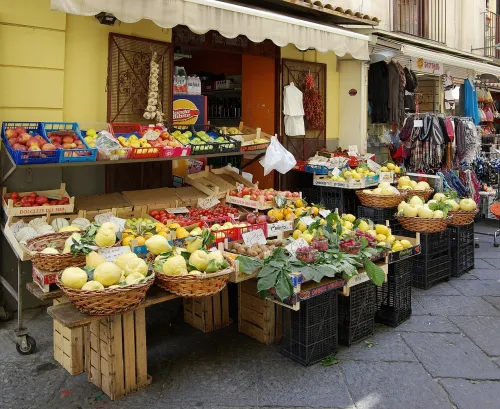
The last stop is a street. Via San Cesareo is the old town's pedestrian shopping lane, the same street the nobles of Dominova chose because it was then the main road of Sorrento. Resist treating it as a corridor back to the square: at the right hour it is the town at its most commercial and its most itself at the same time.
Shop with the clock. Shops aimed at visitors stay open all day, while the ones with a local clientele close for a long midday break, even in summer. In the morning the coach groups fill the lane; toward evening it feels like a different street, which is why an afternoon start for this walk pays off here.
The season changes the shop windows. In June and July lemon season fills them with lemons, limoncello and lemon pastries, the moment of the year for edible souvenirs. In winter the lane gets a second life: the lights go up in late November and stay until 6 January, and a nativity trail winds through the old town.
The lane leads back into Piazza Tasso, so you end the walk close to where you began. If you want to return to the exact start, the GPS navigation guides you there.
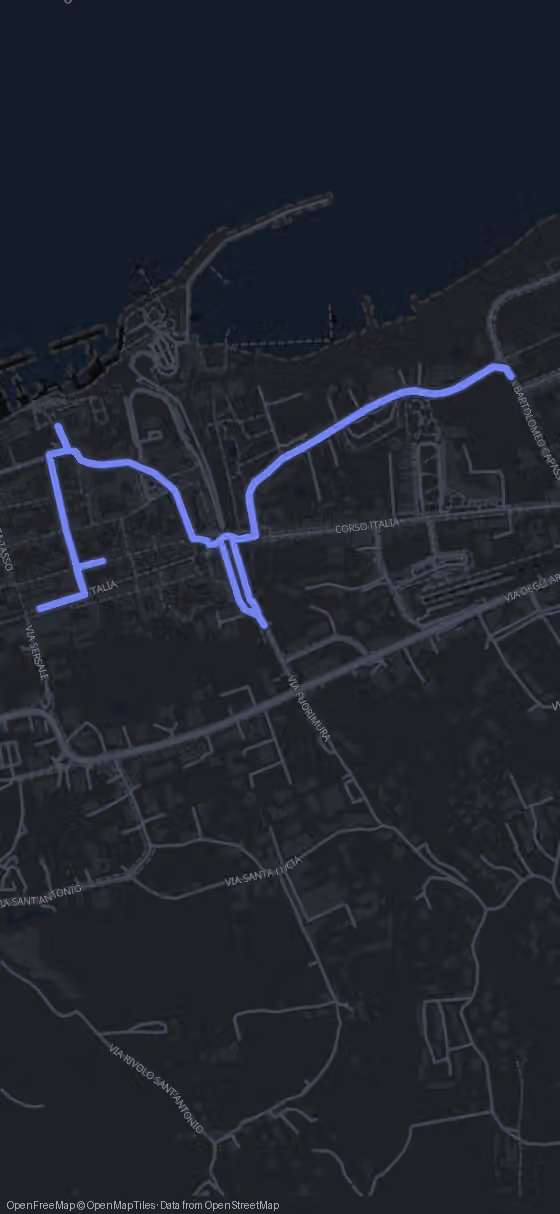
All 7 stops are already on the map. You just press start.
AI Tour Guide
You've read the Sorrento route. Now walk it with a guide in your ear.
Press start wherever you are, even hundreds of kilometres from Sorrento, and the guide begins telling its stories right away. In the city, pick any of the 7 stops to start from: it leads you there, then talks with you the whole route, asking, listening, remembering, and shaping the tour around your answers.
Free to start · Runs in your browser · No app, no download
Shorter ways to walk Sorrento
Not every day has room for the full route. These two cuts keep the stops that belong together.
Old town core, all free
Stops: 4, 5, 6, 7
For anyone with an hour to spare or who would rather skip museums. The Cloister of San Francesco, Sorrento Cathedral, Sedile Dominova and Via San Cesareo sit close together: 9 minutes of walking in total, and none of them charges admission.
Gorge and museum
Stops: 1, 2, 3
For art and history lovers. Piazza Tasso, the Vallone dei Mulini and the Correale di Terranova Museum take 12 minutes of walking; the museum is the only stop here with admission, and it is where most of your time goes. Around an hour and a half covers it.
How long the Sorrento tour takes, with and without the museum
The legs are short: the longest runs 920 m from the Correale di Terranova Museum to the Cloister of San Francesco, while the last three together come to barely 150 m. With an hour or more inside the museum, plan on around three hours in total. Leave the museum for another day and the rest fits comfortably into under two hours, because the cloister, the cathedral and the Sedile are free and quick to take in.
The old town core on its own takes about an hour; the gorge and museum combination about an hour and a half.
Before you set off in Sorrento
Start and finish: Piazza Tasso is the recommended start, but you can join at any stop. The walk ends on Via San Cesareo, the lane that leads back into Piazza Tasso; the GPS navigation can guide you back to the start if you want.
Time of day: An afternoon start brings you to Via San Cesareo toward evening, when the coach groups have gone. Check today's hours for the museum and the cathedral before you set out.
Admission: Only the Correale di Terranova Museum charges admission. The square, the gorge, the cloister, the cathedral, the Sedile and the lane are all free.
Day trips from Sorrento after the walk
Out in the morning, back by night. Every route here fits in one full day.
Press start and a voice AI Tour Guide takes it from here: leading the route through Sorrento, telling the stories, and turning your walk into a real back-and-forth conversation. No app or download is needed; it runs in your browser.
Free to start · Runs in your browser · No app, no download
What the AI Tour Guide adds on Sorrento's streets
On this route the same families keep turning up: the Tassos, the Correales, the Sersales. The AI Tour Guide picks up those threads as you walk, tells you the stories behind each place, asks what you'd like to hear more about and remembers it. Wondering who Saint Antoninus was, or what makes Capodimonte porcelain special? Just ask, interrupt whenever you like, and the conversation follows you.
A Real Conversation
A voice AI Tour Guide greets you, leads the whole route, and tells the stories and facts as you walk, asking what you want to see and keeping a real conversation going. Not a recording you press play on.
Map Navigation
Follow the route on the map and walk at your own pace. You choose where to start and when to move to the next stop.
Ask Anything
Curious about a building you pass? Ask your AI Tour Guide on the spot and the conversation carries on.
13 Languages
Switch language anytime. No separate tour needed.
A sedile was the seat of the town's noble government, an open hall where the families who ran Sorrento met to decide its affairs. Sedile Dominova is the one you can still see.
Is there a thread connecting the stops?
Yes, the noble families. The Tassos and later the Correales owned the Vallone dei Mulini, the Correale brothers left their art to the town, and the Sersale coat of arms appears both in the cloister and among the founders of the Sedile.
Where can I go after Sorrento?
The coast and islands are close: walk Positano, Amalfi or Capri next, or head for the city tour of Naples.
Is the tour really free?
Yes. The whole tour is free: the route, the interactive map and the navigation cost you nothing. Only the voice AI Tour Guide is optional and paid: you test it with 100 free credits, then you pay either €5 per hour or €19.99 for this whole tour, with no time limit. Admission to one of the 7 stops is not included: Correale di Terranova Museum charges its own entry fee.
Do I need to download an app?
No. Everything runs in your phone browser. Open the route and start walking, no download and no sign-up required.
Do I need to book the walking tour in advance?
No booking needed. This self-guided tour is available anytime. Open the route in your browser and start walking. The AI Tour Guide works instantly, no app, no reservation required.
What languages is the AI Tour Guide available in?
The AI Tour Guide speaks 13 languages, so you take the tour in your own language and can switch at any time.
Can I skip stops or change the route?
Yes. Skip any stop, spend extra time at places you like, or start the route from any point. It is your walk, you set the pace.