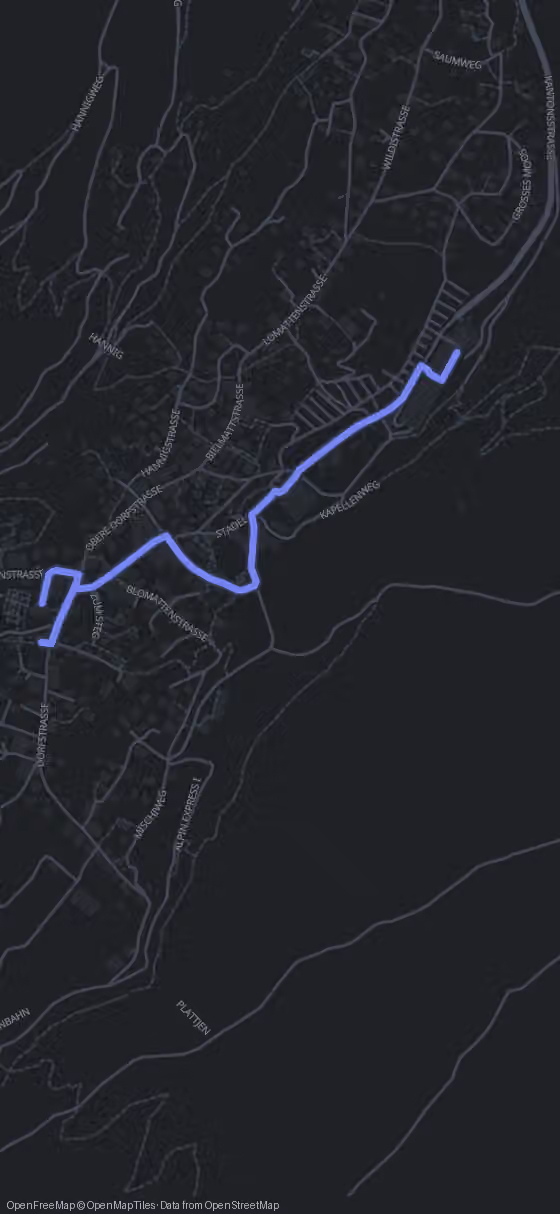


Saas-Fee Parish Church
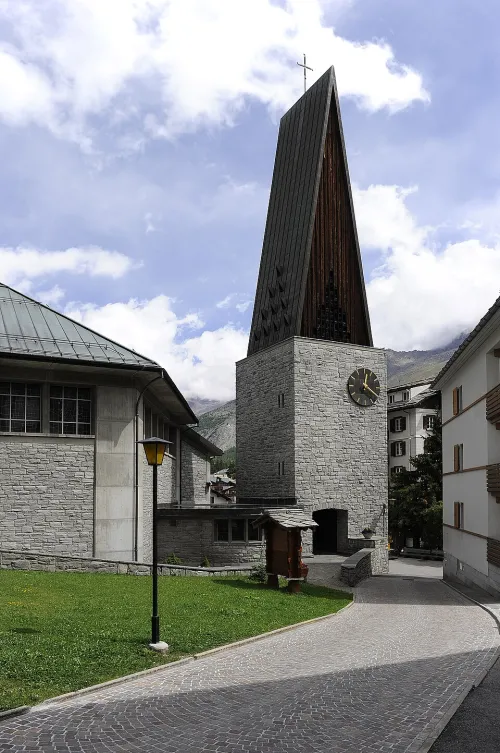
Start where Saas-Fee has prayed for almost five centuries. The first chapel on this spot went up in 1535, and what you see today is the fourth building: a church on a hexagonal plan, with its bell tower standing apart beside it. That tower holds five bells. The architect David Casetti built it after the previous church, from 1894, was taken down in November 1959 because it had become too small and needed too many repairs. Bishop François-Nestor Adam consecrated the new church on 10 September 1963.
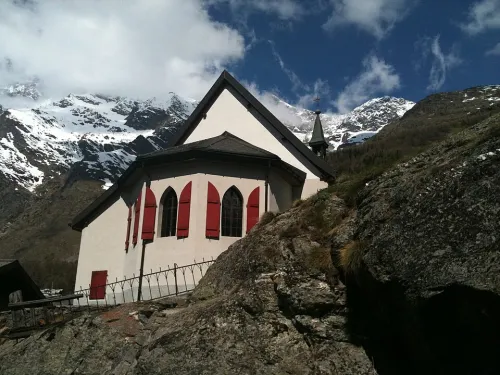
The earlier layers trace the village's growth. In 1666 a larger chapel dedicated to St Theodul replaced the first one, and in 1746 it gained a tower with an onion-shaped top. An organ is recorded from 1754, bells from 1781. Saas-Fee only became a parish of its own on 8 October 1893, and the new parish built bigger again the following year.
Go in; it is free, and the interior is the reason to come. Behind the altar a large Greek cross shows Christ as victor wearing the crown of thorns, with red cubes beneath it standing for his love pouring out. The motif returns at the tabernacle, which is wrapped in a lattice of interlocking stylised crosses; crystals of different sizes in it stand for the good works that lead closer to Christ. Cross and tabernacle form one work, conceived and made by Wilhelm Polders of Kevelaer.
Then look at the light. Paul Monnier designed the coloured choir windows, made at the Atelier Chiara in Lausanne. The 24 windows along both sides of the nave are by the Valais artist Anne-Marie Duarte-Ebener and draw on the Beatitudes and other passages of the Sermon on the Mount. Local artist Werner Zurbriggen made the Stations of the Cross in multicoloured mosaic stone and the glass in the baptismal chapel. The floor is Gotthard granite, the pews are Canadian pine, and the organ has 26 stops on two manuals and pedal.
Give it about twenty minutes, longer if stained glass is your thing. The Saas Museum is 220 m away, about 3 minutes on foot.