

Jackson Square
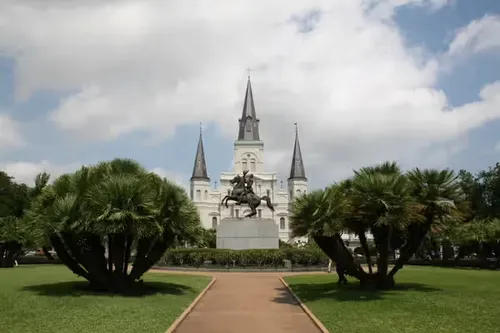
You start where New Orleans itself started. Under the French this was the Place d'Armes, the weapons square, and under Spanish rule the Plaza de Armas, both names for a military parade ground. Today it is a park roughly the size of a city block, and in the middle Andrew Jackson rears up on horseback. Clark Mills' equestrian statue went up in 1856, a recasting of his statue of Jackson in Washington, D.C., honoring the man credited with winning the Battle of New Orleans in 1815 who later became the seventh president of the United States.
Look at the details around you, because much of it is original. The iron fences, the walkways, the benches and the Parisian-style planting go back to 1851 and the design of Micaela Almonester, Baroness de Pontalba. She also built the Pontalba Buildings that flank the square on two sides, so one woman shaped most of what frames your view here. The park layout itself is credited to architect Louis H. Pilié.
Then find the flagpole. It recalls 1803, when Louisiana passed in ceremonial transfers from Spain to France and, weeks later, from France to the United States under the Louisiana Purchase. That handover is why the square became a National Historic Landmark in 1960, and in 2012 it was named one of the Great Public Spaces in the United States. The church and the Cabildo, the old town hall, are Spanish rebuilds after the Great New Orleans Fire of 1788; the church became a cathedral in 1793.
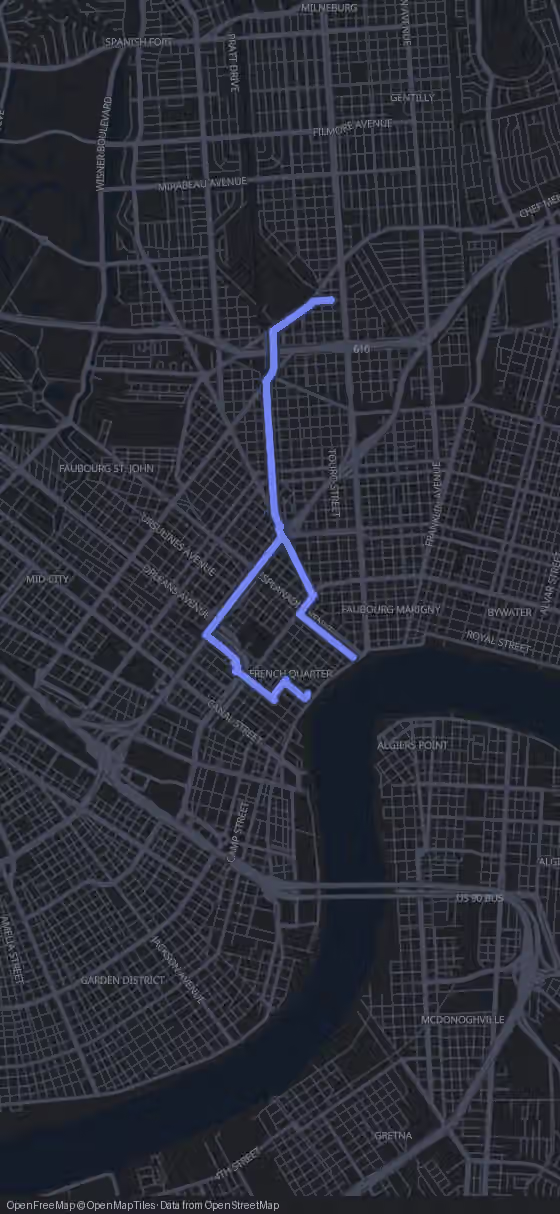
The traffic-free calm is newer than it looks: Chartres, St. Peter and St. Ann streets were closed to cars only in 1971, after the WPA had already freshened facades and gardens in the 1930s. The square is free. From here it is 380 m, 5 min, through the heart of the French Quarter to Bourbon Street.