Free Walking Tour Neuchâtel: Lake, Castle and Old Town

Eleven stops on one loop: from the lakeside park up to the castle and the Collégiale, through the old town and its museums, and back to the water for a swim.

11 Stops 4.6 km ~1 h 5 min walking
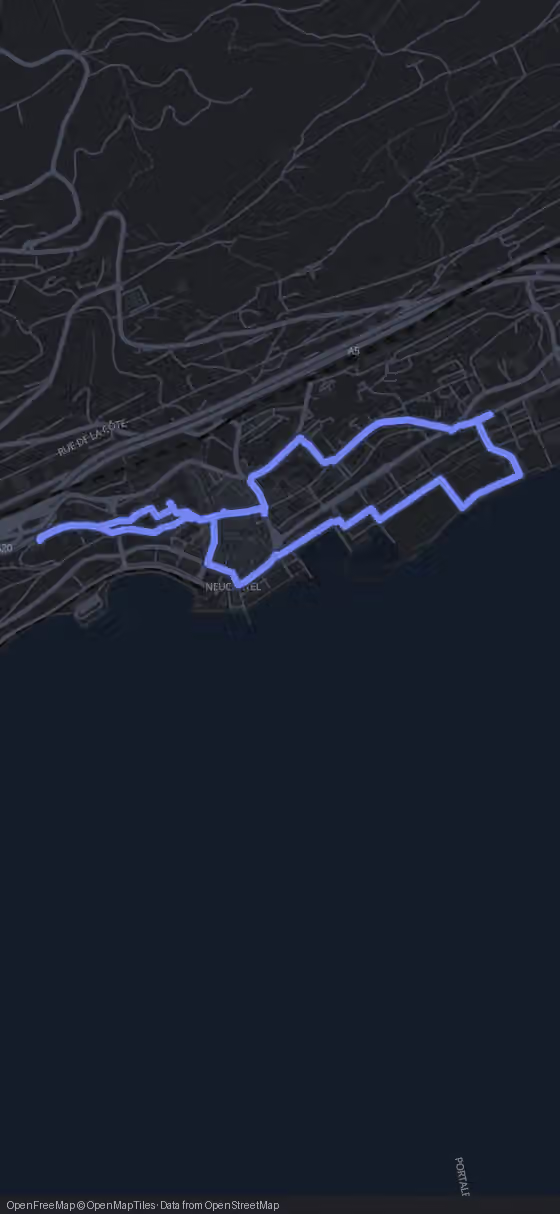
Route map for the Neuchâtel walking tour
Stop 1 of 11
410 m·5 min
Parc des Jeunes-Rives
Head north from the lakefront toward Église Notre-Dame
Welcome to Neuchâtel. I'm Alex, and this lakeside city once made clockwork figures seem almost human.
Try this tour with Alex

Neuchâtel on Foot: The Loop in Brief

This loop has 11 stops and starts and ends at Parc des Jeunes-Rives on the lake. It covers 4.6 km with 1 h 5 min of pure walking; with the churches inside and short pauses, plan about two and a half hours, more for each museum you enter.

The squares, the fountain, the castle courtyard and the churches are free. Admission is charged at the Museum of Natural History, the Musée d'Ethnographie (MEN), the Museum of Art and History, the Tour des Prisons and the guided tours of the Château de Neuchâtel. The GPS route is free in your browser; the AI Tour Guide is optional.

Open free GPS & optional AI Tour Guide
This short shows highlights of the route. All 11 stops follow below.

The Route

Walking Map of Neuchâtel's Lake and Old Town Loop

11 stops 4.6 km 1 h 5 min walking
Tap to load interactive map

The 11 stops along this route

  1. 1Parc des Jeunes-Rives
  2. Église Notre-Dame in Neuchâtel, stop 2 on the self-guided walking tour
    2Église Notre-Dame
  3. Museum of Natural History in Neuchâtel, stop 3 on the self-guided walking tour
    3Museum of Natural History
  4. Hôtel de Ville in Neuchâtel, stop 4 on the self-guided walking tour
    4Hôtel de Ville
  5. Fountain of Justice in Neuchâtel, stop 5 on the self-guided walking tour
    5Fountain of Justice
  6. Château de Neuchâtel, stop 6 on the self-guided walking tour
    6Château de Neuchâtel
  7. Collégiale de Neuchâtel, stop 7 on the self-guided walking tour
    7Collégiale de Neuchâtel
  8. Musée d'Ethnographie (MEN) in Neuchâtel, stop 8 on the self-guided walking tour
    8Musée d'Ethnographie (MEN)
  9. Tour des Prisons in Neuchâtel, stop 9 on the self-guided walking tour
    9Tour des Prisons
  10. 10Place des Halles
  11. Museum of Art and History in Neuchâtel, stop 11 on the self-guided walking tour
    11Museum of Art and History
  12. That's the full loop.

    Walk it with an AI Tour Guide talking you through every one of these streets.

    Start free in your browser
    You made it

Your Neuchâtel Walking Tour, Stop by Stop from Lake to Castle

  1. 1

    Parc des Jeunes-Rives

    Start where the city meets the water. Parc des Jeunes-Rives is a public lakeside park with a beach and open lawns, free and never closed, and it holds both ends of this walk: after ten more stops and the final leg back, you stand here again. That is the quiet advantage of a loop. Nothing to retrace, no return trip to plan, and the lake waiting at the finish as the reward for the walking.

    Know one thing before you settle in: the park is in the middle of a makeover. Sector 2 of Jeunes-Rives is being redeveloped until summer 2027, while the main park areas stay open during the works. The walk itself is unaffected, but if you pictured an untouched beach, adjust that picture now rather than on the last leg.

    You can swim here before you set off, or save the water for the end and let it pull you round the whole circuit. Then turn inland: the first leg to the Église Notre-Dame is 410 m, about 6 minutes on foot.
    Hours
    Open 24/7
    Price
    Free
  2. 2

    Église Notre-Dame

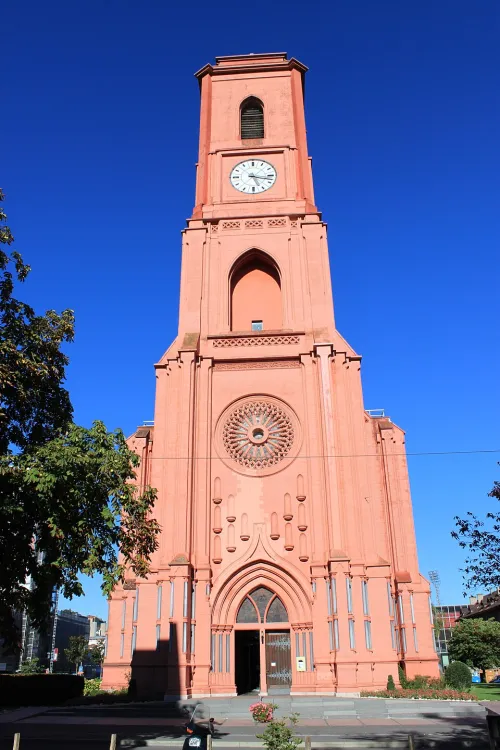
    Église Notre-Dame in Neuchâtel, stop 2 on the self-guided walking tour

    Locals call it the église rouge, the red church. Its official name is the Basilique Notre-Dame de l'Assomption, a large Catholic church built between 1897 and 1906. Look at how it is put together: it does not chase the single, pure style the 19th century loved, but sets neo-medieval references side by side with construction methods that were thoroughly modern for their day.

    The building is also a statement. The Reformation abolished Catholic worship in Neuchâtel in 1530, and Mass was only celebrated again in 1806, in the Collégiale on the castle hill, where you will stand later on this walk. In 1827 and 1828 the town's Catholics built a first chapel in the Maladière quarter, near the Pourtalès hospital, and between 1850 and 1870 they added a presbytery, a hospital and a school in the east of town to hold their community together.

    Despite extensions, the chapel soon grew too small. A monumental church was the answer, and it marked a turning point: proof of a community that had gained weight, found its place in a mainly Reformed society and lived with its neighbours in a tolerance that had grown on both sides.

    Entry is free, so step inside for a few minutes if the doors are open. Then comes the longest leg of the loop: 970 m, about 14 minutes, to the Museum of Natural History.

    Local name
    Basilique Notre-Dame de l'Assomption
    Hours
    Mon–Sat 08:00–18:00, Sun 08:00–19:00
    Price
    Free
  3. 3

    Museum of Natural History

    Museum of Natural History in Neuchâtel, stop 3 on the self-guided walking tour

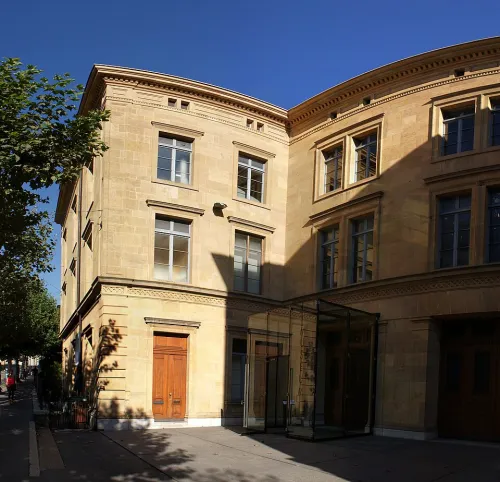
    The Museum of Natural History lives in a building with a past of its own: the former girls' college designed by Rychner and completed in 1853. Inside, the permanent exhibition shows most of Switzerland's mammals and birds in their natural settings, and the bird dioramas come with sound, so you hear the habitats as well as see them.

    The collection is older than the house. In 1795 General Charles-Daniel de Meuron gave his natural history cabinet to the city. In 1815 the merchant Paul-Louis-Auguste Coulon and Baron Albert de Büren planned a real museum in the Hôtel DuPeyrou, but the banker Denis de Rougemont de Löwenberg bought the mansion and the plan collapsed. Only in 1837 did a permanent museum open, in the Collège latin, driven by Louis Agassiz and Coulon's son Louis, who became its first curator.

    That same year the museum bought a large part of Agassiz's collections, and in 1840 Coulon senior donated everything he had: fish, shells and a herbarium of 15,000 plants. Agassiz left for the United States in 1846, but the museum kept growing; by Louis Coulon's death in 1894 it was known across Switzerland for one of the country's richest bird collections. A year later it took over the alpine animals of the bankrupt Société du Musée alpestre, a collection that began with 153 animals bought from Major Isidore Challandes.

    Admission is charged. Go in if you travel with children or love wildlife; the sound dioramas make it more than a hall of glass cases. If time is short, keep walking: the Hôtel de Ville is only 170 m away, about 2 minutes.

    Local name
    Muséum d'histoire naturelle de Neuchâtel
    Hours
    Tue–Sun 10:00–18:00, Mon closed
    Price
    CHF 12 adults, CHF 8 Neuchatel residents, CHF 4 reduced (students, apprentices, AVS/AI, unemployed), free under 16
  4. 4

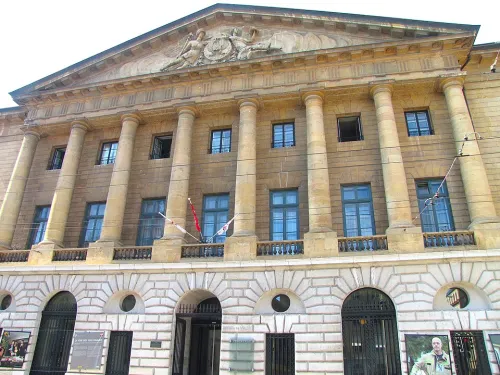
    Hôtel de Ville

    Hôtel de Ville in Neuchâtel, stop 4 on the self-guided walking tour

    The Hôtel de Ville is Neuchâtel's town hall and has housed the town's legislative and executive authorities from the start. The style is neoclassical: it borrows from the codes of Antiquity and also looks to the Italian Renaissance. The architect was the Frenchman Pierre-Adrien Pâris, draughtsman to the Chamber and Cabinet of King Louis XVI.

    Its predecessor had a stranger setting. The first town hall, built in the mid 15th century, stood as a bridge over the river Seyon until a flood destroyed it in 1579. It was rebuilt on the same spot, but by the mid 18th century the threat of floods and Enlightenment ideas about how a town should be planned pushed the authorities to look for something new. The old building was turned over to minor public uses and finally demolished in 1860.

    The money came from David de Pury, a banker and merchant of Neuchâtel origin who made his fortune in Lisbon and decided during his lifetime to pay for works that would beautify his home town. Renowned architects such as Paul-Antoine Pisoni and Claude-Nicolas Ledoux submitted designs, but these were judged too lavish for the town's needs. The council accepted Pâris's plans on 12 January 1784, and the first stone was laid on 3 July that year, on the site of the old hospital, where the old town met the new faubourg. De Pury did not live to see it finished, and the project opened a great phase of growth for the city.

    You can look at the façade at any time; the interior opens only on guided tours booked on request for groups, so most walkers stay outside. From here it is 160 m, about 2 minutes, to the Fountain of Justice.

    Hours
    Exterior view always accessible; interior access only via guided tour on request on weekdays
    Price
    CHF 85 per group (guided tours on request, max 20 people); audioguide free via swissais.ch
  5. 5

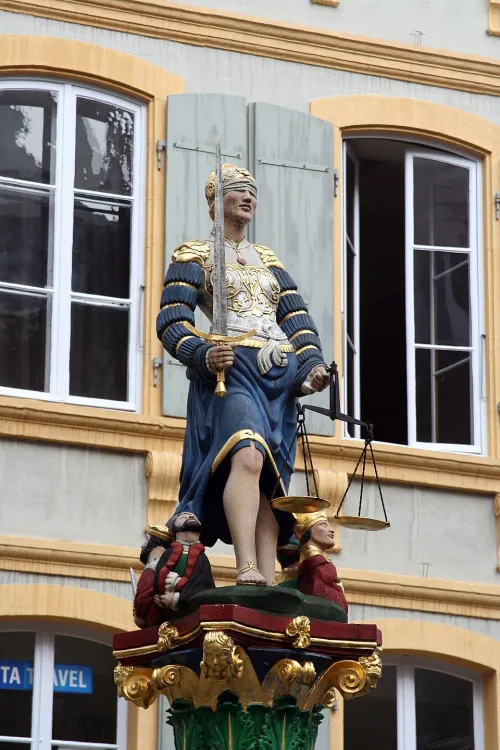
    Fountain of Justice

    Fountain of Justice in Neuchâtel, stop 5 on the self-guided walking tour

    The Fountain of Justice stands on the Croix-du-Marché: an octagonal basin topped by a statue of Justice. Read her like a picture puzzle. She is a young woman caught mid-stride, blindfolded for impartiality, a sword in her right hand for punishment, scales in her left for fairness, and one bare knee for clemency.

    Now look at her feet. Four figures crouch there in submission, each standing for a form of government in the 16th century: the Pope, the Emperor, the Grand Turk and an avoyer, the chief magistrate. Together they carry the idea of a justice that applies to everyone and of respect for the law.

    Laurent Perroud of Cressier carved the fountain between 1545 and 1547. The Bruder brothers of Neuchâtel restored it in 1880, and its last renovation took place in 2018. It counts as an important example of Renaissance art in Switzerland, is protected as a historic monument and has become one of the city's best known symbols. The statue on the column is not the original, though: that is kept in the Museum of Art and History, the last stop before you return to the lake.

    From the fountain, the route heads up to the castle hill: 230 m, about 4 minutes, to the Château de Neuchâtel.

    Hours
    Open 24/7
    Price
    Free
  6. 6

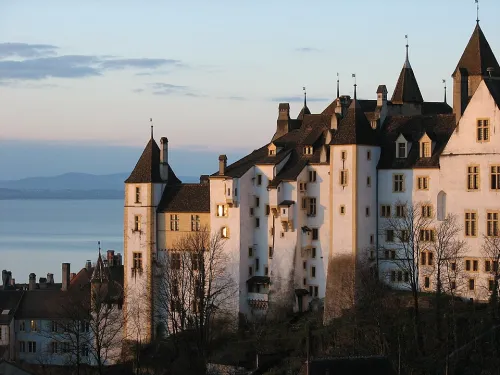
    Château de Neuchâtel

    Château de Neuchâtel, stop 6 on the self-guided walking tour

    The Château de Neuchâtel sits on a rocky spur between the lake and the river Seyon, which today runs covered, high over the town that grew up around it. This castle gave the city its name. It is recorded as Novum Castellum and later Novum Castrum, the 'new castle'; 16th century scholars wrote Neocomum, Old French made it Nuefchastel or Neufchastel, and from that came Neuchâtel. In German it became Neuenburg.

    Its story reads like a tour of European dynasties. It was a residence of the Kingdom of Burgundy, and in 1011 King Rudolph III of Burgundy gave it to his wife Irmingard. From 1033 it belonged to the Counts of Fenis, relatives of the Burgundians, whose line became the Counts of Neuchâtel and held it until their male line died out in 1373. The Counts of Fribourg followed, then in 1457 the Margraves of Hachberg-Sausenberg. Margrave Philipp's daughter Johanna married Louis of Orléans in 1504 and brought the county to the house of Orléans-Longueville, which could not stop the Reformation that Guillaume Farel introduced.

    At the end of the 16th century Marie de Bourbon united the county with the lordship of Valangin. In 1707 the people of Neuchâtel offered their principality to King Frederick I of Prussia. In 1806 Prussia ceded the town to Napoleon, who gave it to his marshal Louis-Alexandre Berthier. On 12 September 1814 Neuchâtel became the 21st canton of the Swiss Confederation, and yet it remained a Prussian principality at the same time: a canton and a principality at once.

    The courtyard is free to enter. The interior is shown only on guided tours, which run seasonally and charge admission; if one fits your timing, it is the way to see more than walls. The Collégiale de Neuchâtel is right next door, 50 m and a minute away.

    Hours
    Courtyard open daily; guided tours 1 Apr-31 May Sat–Sun and public holidays 14:00, 15:00, 16:00, 17:00; 1 Jun-30 Sep Tue–Sun 14:00, 15:00, 16:00, 17:00
    Price
    CHF 5 per person (age 16+), children under 16 free; courtyard free
    Website
    ne.ch ↗
  7. 7

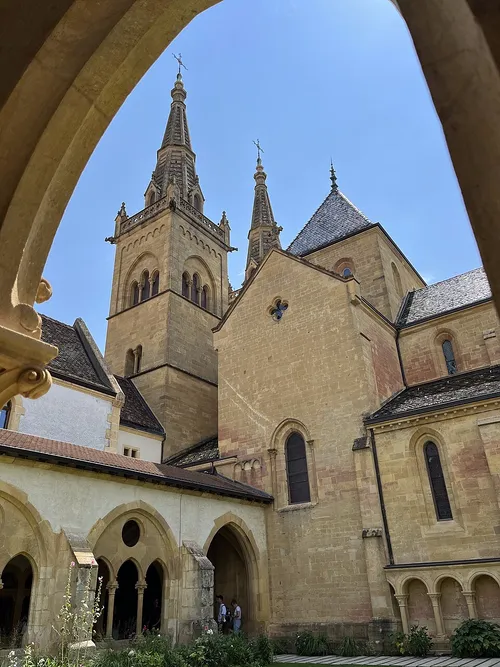
    Collégiale de Neuchâtel

    Collégiale de Neuchâtel, stop 7 on the self-guided walking tour

    The Collégiale de Neuchâtel stands beside the castle: a three-aisled basilica with twin towers, a prominent crossing tower with its own windows and a roof of coloured tiles. Once a collegiate church dedicated to the Virgin Mary, it now serves the Reformed church, while the building itself belongs to the city. In the churchyard stands a statue of the reformer Guillaume Farel, the man behind the Reformation you just heard about at the castle.

    Building began around 1190 in the Romanesque style; the upper and western parts are Gothic, and so is the cloister on the north side, which survives. Look closely at the 'twin' towers: the south tower dates from the second half of the 13th century, while the north tower was only added during the restoration that began in 1867 and ended in 1870. The architecture is sober and does without the crockets, pinnacles and gables typical of Gothic, yet the sculpture is of high quality.

    Inside, head for the choir. The cenotaph of the Counts of Neuchâtel is listed as a cultural property of national importance and is considered the most important funerary monument in Switzerland. The church owes its present look to the restoration led from 1867 by Léo Châtelain under the supervision of church architect Ferdinand Stadler; the latest restoration, begun in 2008 and finished in spring 2022, took that state as its guideline. Remember Châtelain's name: you will meet his work twice more on this loop.

    There are two organs: a Walcker instrument from 1870 with 45 registers on three manuals, currently not in use, and the large organ built in 1996 by the Manufacture d'orgues St-Martin to a design by Guy Bovet, with 41 registers on four manuals. Concerts take place here. Entry is free, and if you only go into one church on this walk, make it this one. Then walk 500 m, about 8 minutes, to the Musée d'Ethnographie (MEN).

    Hours
    Daily 09:00–20:00 (1 Apr – 30 Sep), daily 09:00–17:00 (1 Oct – 31 Mar)
    Price
    Free
  8. 8

    Musée d'Ethnographie (MEN)

    Musée d'Ethnographie (MEN) in Neuchâtel, stop 8 on the self-guided walking tour

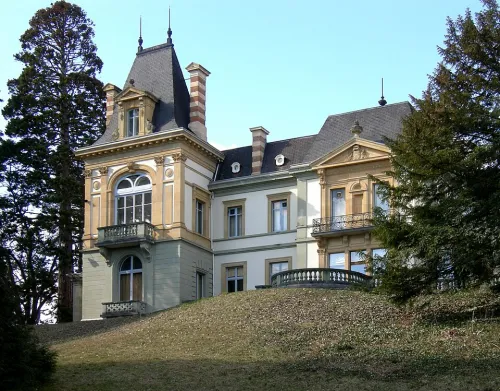
    The Musée d'Ethnographie (MEN) occupies a villa on the Saint-Nicolas hill. In 1902 James-Ferdinand de Pury left it to the city on one condition: that it become an ethnographic museum. Léo Châtelain, who had designed the villa, converted it, and the museum opened on 14 July 1904.

    Its roots go back further, to the cabinet General Charles-Daniel de Meuron gave the city in 1795, which held two hundred ethnographic pieces from Oceania, Asia and Africa. Through the 19th century these objects were mixed with what later became the natural history and art collections, moved from place to place and always short of room. After 1904 the collection grew through gifts from Neuchâtel travellers, merchants, scholars and missionaries and through targeted purchases; today it counts 50,000 objects, about half of them from Africa.

    What made the MEN well known is the way it exhibits. In the 1980s Jacques Hainard launched the 'museology of rupture', exhibitions that question what objects mean and what role a museum plays in society. Renovation works ran from 2015, first on the historic villa and then on the temporary exhibitions building, and ended in 2020. Since 2017 the reference exhibition, L'impermanence des choses, has been built around the museum's own collections. Look out for the unexpected: diplomatic gifts to Switzerland, such as dolls in the traditional costumes of peoples of the Soviet Union, and a sizeable collection of mass-produced industrial objects.

    Admission is charged. Go in if you like museums that make you think rather than simply display; skip it if you would rather stay outdoors. The Tour des Prisons is 420 m away, about 5 minutes.

    Hours
    Tue–Sun 10:00–17:00, Mon closed; free admission on Wednesdays
    Price
    CHF 12 adults, CHF 8 Neuchatel residents, CHF 4 reduced (students, apprentices, AVS/AI, unemployed), free under 16; free admission on Wednesdays
    Website
    men.ch ↗
  9. 9

    Tour des Prisons

    Tour des Prisons in Neuchâtel, stop 9 on the self-guided walking tour

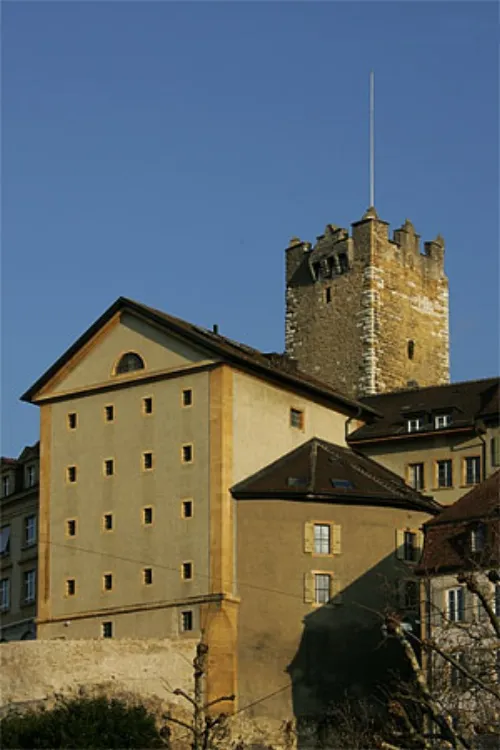
    The Tour des Prisons is one of the oldest buildings still standing in Neuchâtel. Its base goes back to around the 10th century, south of the castle; in the 13th and 14th centuries it was raised in stages and built into the town's defences, and in the 13th century it housed one of the town gates.

    As the name says, it was also a prison, from the Middle Ages and for several centuries: debtors, common criminals and, at different times, political prisoners. One inmate left a rare voice behind. The Italian humanist Benedetto da Piglio, held here in 1415, wrote an account of his captivity, a contemporary witness to what imprisonment meant at the time.

    Tree-ring dating has shown that the oak cells are original and date from the 17th century, precise down to the season the trees were felled; the fir fittings and some floors were redone in the early 19th century. On 21 May 2015 a fire broke out at the top of the tower and badly damaged the beams and the wooden fittings of the upper floors. The tower had been a museum until then and went through a long renovation.

    Today you can visit again for a fee, but only on limited, seasonal opening times, so check before you count on going in. From outside it is one of the loop's good photo spots either way. Then it is 400 m, about 5 minutes, to Place des Halles.

    Hours
    Wed, Sat, Sun 10:00–16:00 (Apr–Oct)
    Price
    CHF 5 per person
    Website
    j3l.ch ↗
  10. 10

    Place des Halles

    After the tower, the route brings you to the old town's living room. Place des Halles is the central market square, framed by historic buildings and restaurants. Unlike much of this loop, it keeps no hours and sells no tickets: public space, open around the clock, nothing to book.

    This is the natural place to eat. The restaurants around the square come late in the loop, with the tower behind you and only the art museum still ahead, which makes it the obvious refuelling point. Which kitchen you choose is up to you; walk once round the square and let your own eyes decide.

    From here it is 660 m, about 9 minutes, to the Museum of Art and History.

    Hours
    Open 24/7
    Price
    Free
  11. 11

    Museum of Art and History

    Museum of Art and History in Neuchâtel, stop 11 on the self-guided walking tour

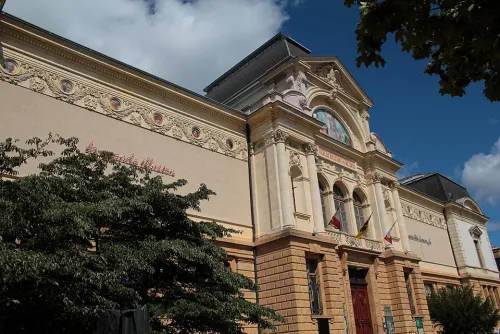
    At the Museum of Art and History, Léo Châtelain's name turns up a third time: he built the house between 1881 and 1887. Its collections cover fine arts, history, applied arts and coins and medals, and this is where the original statue from the Fountain of Justice is kept.

    Here the de Meuron thread comes full circle. The core of the city's collections goes back to General Charles Daniel de Meuron's cabinet of curiosities, given to Neuchâtel around 1795; he had gathered ethnographic, natural history and historical objects on campaigns while serving various colonial powers. In 1816 Maximilien de Meuron, an artist and patron from an aristocratic Neuchâtel family, donated two paintings, View of Ancient Rome and View of Modern Rome. They became the first works in the city's painting collection.

    In the 1830s coins, medals, instruments, clothing and weapons moved into rooms of the newly built Latin College, and in 1840 a small painting museum opened there. In 1842 Maximilien de Meuron founded the Société des Amis des Arts, which held regular exhibitions for Neuchâtel artists, from 1864 in the new Léopold-Robert Galleries. In the 1870s the idea of a painting museum grew into something larger: two museums under one roof, one for fine arts and one for history.

    Admission is charged. Choose it if you want art, local history and the original Justice; if your energy is spent, take in the building from outside and move on. The final leg back to Parc des Jeunes-Rives is 620 m, about 8 minutes, and the lake is waiting if you saved your swim.

    Local name
    Musée d'Art et d'Histoire de Neuchâtel
    Hours
    Tue–Sun 11:00–18:00, Mon closed; free admission on Wednesdays
    Price
    CHF 12 adults, CHF 8 Neuchatel residents, CHF 4 reduced (students, AVS, unemployed, military, groups 10+), free under 16; free admission on Wednesdays
    Website
    mahn.ch ↗
Walking tour route map of Neuchâtel Route loaded
Église Notre-DameMuseum of Natural HistoryHôtel de VilleFountain of Justice+7
All 11 stops are already on the map.
You just press start.
AI Tour Guide

You just read the Neuchâtel loop. Now walk it with a guide in your ear.

Press start wherever you are, even hundreds of kilometres from Neuchâtel, and the guide begins telling its stories right away. In the city, pick any of the 11 stops to start from: it leads you there, then talks with you the whole route, asking, listening, remembering, and shaping the tour around your answers.

11stops 4.6km 1 h 5 minwalking 13languages
▶Start the tour free

Free to start · Runs in your browser · No app, no download

Three Ways to Shape Your Neuchâtel Walk

The loop works best as a whole, but it bends easily to your time, your budget and how much you want to see indoors.

The free loop

Stops: 1, 2, 3, 4, 5, 6, 7, 8, 9, 10, 11

For anyone who wants the whole circuit without buying a ticket. Walking time is 1 h 5 min; go inside the Église Notre-Dame and the Collégiale and into the castle courtyard, all free, and see the museums, the Hôtel de Ville and the Tour des Prisons from outside.

Old town core

Stops: 4, 5, 6, 7, 8, 9, 10

For a short visit. From the Hôtel de Ville to Place des Halles is 1.76 km, about 25 minutes of walking, with the fountain, the castle and the Collégiale at its heart. You only pay if you add the MEN, the Tour des Prisons or a castle tour.

Museum day

Stops: 1, 2, 3, 4, 5, 6, 7, 8, 9, 10, 11

For a day with time to spare. The same 1 h 5 min of walking, with admission at the Museum of Natural History, the MEN and the Museum of Art and History, three collections that all grew from the same 18th century cabinet.

How Long Does This Neuchâtel Tour Take, Museums Included?

Pure walking time is 1 h 5 min over 4.6 km, split into short legs: all but one take under 10 minutes, and the longest, from Église Notre-Dame to the Museum of Natural History, takes 14.

Realistically, plan about two and a half hours for the full loop with time inside the Église Notre-Dame and the Collégiale, a look at the castle courtyard and a pause at Place des Halles. That is the free loop. Each museum you enter adds roughly an hour, so the museum day fills most of a day.

The old town core needs about an hour and a half with the Collégiale inside, and longer if you add the MEN or the castle tour.

Before You Leave the Lakeshore

  • Start and finish: Parc des Jeunes-Rives on the lake; the loop ends where it began. The order here is the recommended one, but you can join at any stop and the free GPS route leads you on from stop to stop.
  • Time of day: Walk in the daytime and pick a day when the museums are open if you want to go inside one. The park, the fountain and the squares are open around the clock.
  • What to pack: Swimwear, if you want the lake at the start or as the reward at the end.
Walking tour route map of Neuchâtel
AI Tour Guide

Your guide is ready when you reach the lake.

Press start and a voice AI Tour Guide takes it from here: leading the route through Neuchâtel, telling the stories, and turning your walk into a real back-and-forth conversation. No app or download is needed; it runs in your browser.

11stops 4.6km 1 h 5 minwalking 13languages
▶Start the tour free

Free to start · Runs in your browser · No app, no download

Following Neuchâtel's Threads with the AI Tour Guide

This loop is full of threads: one general's cabinet split into three museums, Léo Châtelain's name turning up again and again, the Reformation tying the castle, Farel and the red church together. The AI Tour Guide follows those threads with you as a conversation, notices which ones catch your interest and goes deeper there, for example into how Neuchâtel's double life as Swiss canton and Prussian principality came to an end. You can interrupt at any moment, and the route stays as it is. You start with 100 free credits; after that, take this tour all-inclusive for €19.99 with no time limit, or credits at €5 per hour.

A Real Conversation A voice AI Tour Guide greets you, leads the whole route, and tells the stories and facts as you walk, asking what you want to see and keeping a real conversation going. Not a recording you press play on.
Map Navigation Follow the route on the map and walk at your own pace. You choose where to start and when to move to the next stop.
Ask Anything Curious about a building you pass? Ask your AI Tour Guide on the spot and the conversation carries on.
13 Languages Switch language anytime. No separate tour needed.
Start free in your browser

Common Questions About Neuchâtel's Loop

I only have time for one museum. Which should it be?

With children or a love of wildlife, the Museum of Natural History and its sound dioramas. For exhibitions that question what objects mean, the MEN. For paintings, local history and the original Justice statue, the Museum of Art and History.

Why does Neuchâtel have two churches named after Notre-Dame?

The Collégiale was built as a collegiate church dedicated to the Virgin Mary and became a Reformed church after the Reformation of 1530. The Église Notre-Dame is the Catholic basilica of the Assumption, built at the turn of the 20th century when the Catholic community needed a large church of its own.

Which nearby towns can I explore on another day?

La Chaux-de-Fonds is 15 km away and Murten 16 km; Biel/Bienne and Bern are a little further. Each has its own free walking route.

Is the tour really free?

Yes. The whole tour is free: the route, the interactive map and the navigation cost you nothing. Only the voice AI Tour Guide is optional and paid: you test it with 100 free credits, then you pay either €5 per hour or €19.99 for this whole tour, with no time limit. Admission to 5 of the 11 stops is not included: Museum of Natural History, Château de Neuchâtel, Musée d'Ethnographie (MEN), Tour des Prisons and Museum of Art and History charge their own entry fees.

Do I need to download an app?

No. Everything runs in your phone browser. Open the route and start walking, no download and no sign-up required.

Do I need to book the walking tour in advance?

No booking needed. This self-guided tour is available anytime. Open the route in your browser and start walking. The AI Tour Guide works instantly, no app, no reservation required.

What languages is the AI Tour Guide available in?

The AI Tour Guide speaks 13 languages, so you take the tour in your own language and can switch at any time.

Can I skip stops or change the route?

Yes. Skip any stop, spend extra time at places you like, or start the route from any point. It is your walk, you set the pace.
Image credits
▶ Start free in your browser Runs in your browser, no app, no download