Free Walking Tour Steyr: Old Town, Rivers and Castle

Gothic houses on a lens-shaped square, two rivers meeting under a castle and a pilgrimage church that grew from a spruce tree. Nine stops, one walk.

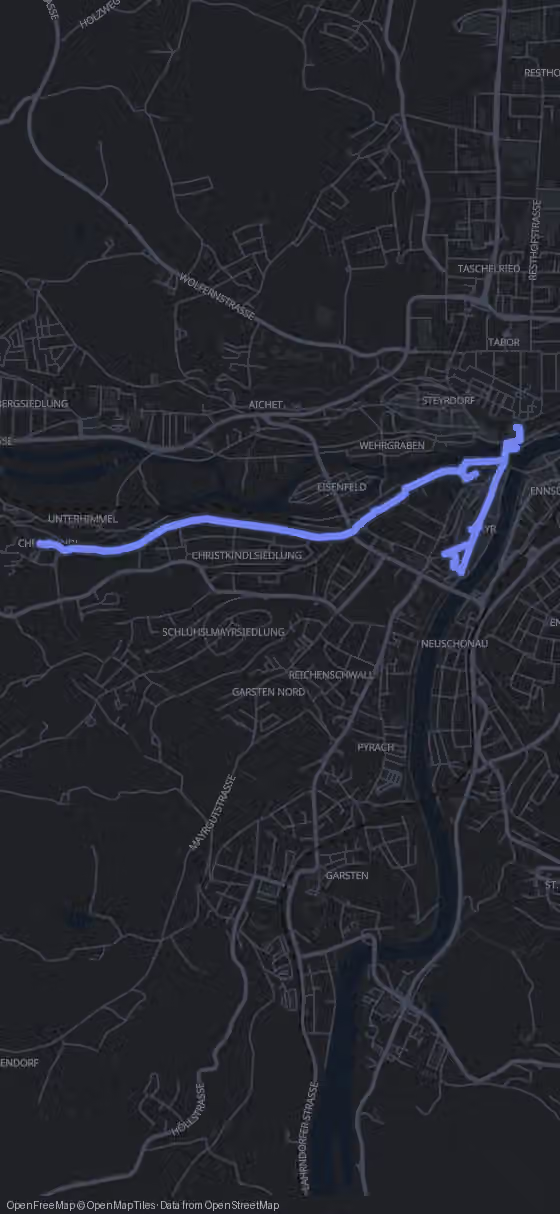
9 Stops 7.1 km ~1 h 41 min walking
Route map for the Steyr walking tour
Stop 1 of 9
250 m·3 min
Stadtplatz
Head south-west toward the Stadtpfarrkirche Steyr
Grüß Gott, welcome to Steyr. I'm Alex, and the city's most famous house owes its nickname to a badly drawn animal.
Try this tour with Alex

Steyr in One Walk: What to Expect

Nine stops on 7.1 km, from the Stadtplatz to Schloss Lamberg. Stadtpfarrkirche Steyr, Stadtmuseum Steyr, the Bummerlhaus, the Enge Gasse, the Confluence of the Steyr and Enns Rivers and the Michaelerkirche lie close together; then a long walk leads out to the Christkindlkirche. Pure walking time is 1 h 41 min, about 3.5 hours in all.

Everything is free except the Stadtmuseum Steyr and the crib exhibition at Christkindl, which charge entry. Route, map and GPS navigation are free in your browser; the AI Tour Guide is optional.

Open free GPS & optional AI Tour Guide
View of Steyr

The Route

Walking Map of Steyr: Square, Rivers and Christkindl

9 stops 7.1 km 1 h 41 min walking
Tap to load interactive map

The 9 stops along this route

  1. Stadtplatz in Steyr, stop 1 on the self-guided walking tour
    1Stadtplatz
  2. Stadtpfarrkirche Steyr, stop 2 on the self-guided walking tour
    2Stadtpfarrkirche Steyr
  3. Stadtmuseum Steyr, stop 3 on the self-guided walking tour
    3Stadtmuseum Steyr
  4. Bummerlhaus in Steyr, stop 4 on the self-guided walking tour
    4Bummerlhaus
  5. Enge Gasse in Steyr, stop 5 on the self-guided walking tour
    5Enge Gasse
  6. Confluence of the Steyr and Enns Rivers, stop 6 on the self-guided walking tour
    6Confluence of the Steyr and Enns Rivers
  7. Michaelerkirche in Steyr, stop 7 on the self-guided walking tour
    7Michaelerkirche
  8. Christkindlkirche in Steyr, stop 8 on the self-guided walking tour
    8Christkindlkirche
  9. Schloss Lamberg in Steyr, stop 9 on the self-guided walking tour
    9Schloss Lamberg
  10. That's the full route.

    Walk it with an AI Tour Guide talking you through every one of these streets.

    Start free in your browser
    You made it

Your Steyr Walking Tour, Stop by Stop, from Square to Castle

  1. 1

    Stadtplatz

    Stadtplatz in Steyr, stop 1 on the self-guided walking tour

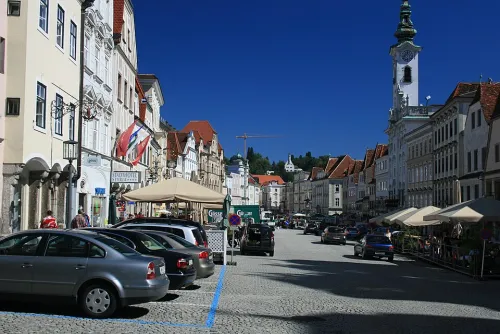
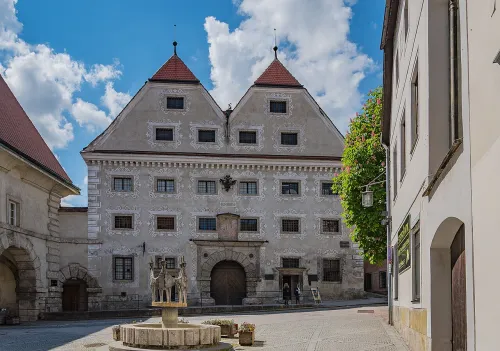
    Stand anywhere on the Stadtplatz and look along its length: the square swells in the middle and narrows at both ends, a lens shape that probably follows an old road and the lie of the land. To the north it closes at the Enge, to the south at Pfarrgasse and the Grünmarkt. It counts among the best-preserved old town ensembles in the German-speaking world, and it is free and open at any hour, so give it time.

    The square goes back to the middle of the 13th century, when two older settlements, one around the castle then called Stirapurc and one around the parish church, grew into a single town. The plots are still medieval, and many houses have Gothic cores behind later baroque fronts. The Sternhaus at No. 12 shows the trick: a rococo facade with the five senses, but Gothic corbels and a Gothic portal give away its age. Its left half was destroyed in the Second World War and rebuilt faithfully; the late Gothic neighbour at No. 14, Café Stark, was lost in a bombing raid on 24 February 1944.

    Keep looking around. The Meditzhaus at No. 9 wears a baroque face but hides a Renaissance arcaded courtyard. The rococo town hall was designed by Johann Gotthard Hayberger, begun in 1765 and completed in 1778. The youngest building is the neo-Gothic Sparkasse at No. 20/22 from 1900, for which two older houses, the Reichlhaus among them, were pulled down. The Leopoldibrunnen fountain has stood here since 1683, and at the southern end the Marienkirche shows a baroque Counter-Reformation front, with the late Gothic vault of its congregation chapel kept from an earlier building.

    Music lovers should find No. 16, the Schuberthaus. Franz Schubert came to Steyr in 1819, 1823 and 1825; the first two times he lodged in the Stalzerhaus at No. 34, the last time here, and a plaque from 1890 remembers him. The oldest house on the square gets its own moment later. For now, walk 260 m, about 4 minutes, to the parish church.
    Hours
    Open 24/7
    Price
    Free
  2. 2

    Stadtpfarrkirche Steyr

    Stadtpfarrkirche Steyr, stop 2 on the self-guided walking tour

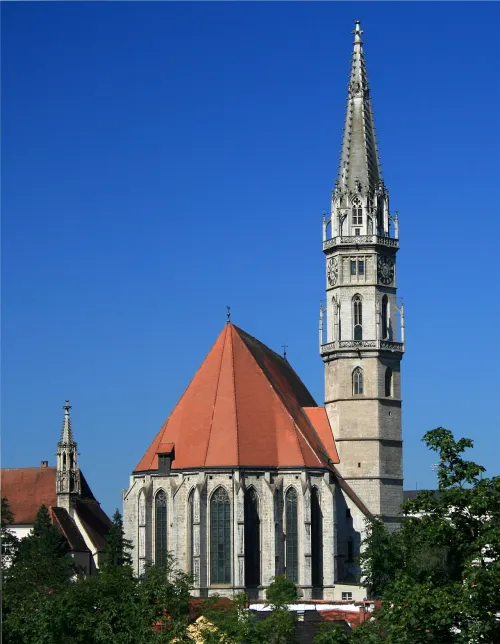
    The Stadtpfarrkirche Steyr, dedicated to St Giles and St Coloman, is a Gothic church of the 15th century and the most important church building in town. Entry is free, so go inside even if you only have a few minutes; the choir is where the great rebuilding started.

    The story of a church on this spot reaches back to around 1100. It is first named in 1275, in the middle of a property dispute, and was damaged in a town fire in 1303. Around 1300 the chapel of ease was raised to a parish church, as the town chronicler Valentin Preuenhueber recorded.

    In the 15th century Steyr grew rich and its congregation grew fast, so the town decided on a complete rebuild. In 1443 it hired Hans Puchsbaum, master builder of St Stephen's Cathedral in Vienna, who finished the shell of the choir. After his death his successor Laurenz Spenning took over from 1456, vaulted the choir and added a tower that had not been part of the original plan. The nave brought trouble: in 1482 the builder Mert Kranschach was accused of embezzling funds, and the work passed to Wolfgang Tenk, head of the masons' lodge at Admont, and after his death in 1513 to Hans Schwettichauer.

    Then came disaster. In 1522, in the 79th year after work on the choir had begun, the unfinished nave, already prepared for its vault, burned down in the great town fire. Keep that long, interrupted building history in mind as you look up. From here it is 200 m, about 3 minutes, to the town museum on the Grünmarkt.

    Hours
    Daily 08:00–18:00 (and during church services)
    Price
    Free
  3. 3

    Stadtmuseum Steyr

    Stadtmuseum Steyr, stop 3 on the self-guided walking tour

    The Stadtmuseum Steyr fills two buildings: the Innerberger Stadel and the neighbouring Neutor. The Stadel is the one to notice, a big storehouse whose wide storage rooms still tell you what it was built for. Both buildings were renovated for the Upper Austrian state exhibition in 2021, and the museum got a new concept at the same time.

    In the 16th and 17th centuries Steyr was the hub of the iron trade north of the Styrian Erzberg, the ore mountain. The miners and smelters there needed food, so early in the 17th century the town built this granary to store it. In 1628 the Innerberger Hauptgewerkschaft, the iron company that gave the building its name, bought it, and for almost 300 years it served as a storehouse.

    In 1908 it came back to the town, which planned to demolish it for a new post office. Among those who stopped that was the heir to the throne, Franz Ferdinand, then head of the imperial commission for the care of monuments. In 1913 the empty building became the town's Heimathaus, and on 25 July 1913 the museum opened here.

    The collection is older than the building. After a large exhibition in 1884 the town council bought its cultural history objects, citizens founded a society of antiquity friends three years later, and the museum officially opened in the town hall on 31 May 1895 before moving to the industrial hall that is now the Stadttheater. The museum charges entry; it is worth an hour if you want to understand where Steyr's wealth came from. Then walk 260 m, about 4 minutes, back to the square and its oldest house.

    Hours
    Wed–Sat 10:00–17:00, Sun and public holidays 10:00–16:00, Mon–Tue closed
    Price
    7 EUR adults, 5 EUR reduced, 14 EUR family, 1 EUR school pupils
    Website
    steyr.at ↗
  4. 4

    Bummerlhaus

    Bummerlhaus in Steyr, stop 4 on the self-guided walking tour

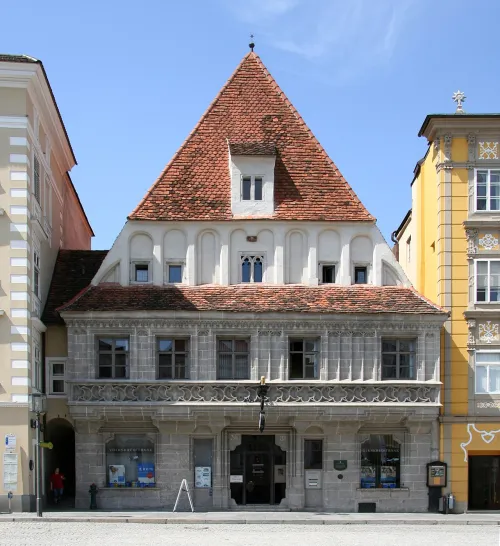
    The Bummerlhaus at Stadtplatz 32 is the oldest house on the square and the landmark of Steyr. Its Gothic appearance from the 1490s has survived largely intact; look for the year 1497 on the facade, which points to the rebuilding of the front house. You see it from the square, free and at any hour.

    The name is a joke that stuck. The house was once the inn of the Golden Lion, and the lion on its sign was painted so clumsily that the people of Steyr mocked it as a Bummerl, a little dog. The core of the building probably dates from the 13th century, although it is first recorded only in 1450.

    Its owners read like a who's who of the town. Around 1450 it belonged to Mert Pandorffer, steward and rent master of the lordship of Steyr; his son Wolfgang sold it in 1473 for 1000 guilders to the rich merchant Georg Prandtstetter, who probably gave the house its present basic form. The chronicler Preuenhueber even mentions a chapel inside. Hanns Prandtstetter inherited it in 1490 and was mayor of Steyr in 1521, the year he died. Later Wolf Händl von Ramingdorf, another long-serving mayor, appears as owner in the tax books of 1567 and 1596.

    Until the Thirty Years' War the owners were councillors and merchants trading in iron and steel, grain and goods from Venice. In 1651 Stefan Grafhaider bought what was then called a dilapidated house; he was baker, innkeeper, holder of the salt office, and owner of a brewery and a forge for musket barrels. His heirs sold it in 1687 to Daniel Edtinger, who kept it until 1748. Next comes a 380 m walk, about 5 minutes, to the Enge Gasse, passing Steyr's weekly market and the Blumauerhaus on the way.

    Hours
    Open 24/7
    Price
    Free
  5. 5

    Enge Gasse

    Enge Gasse in Steyr, stop 5 on the self-guided walking tour

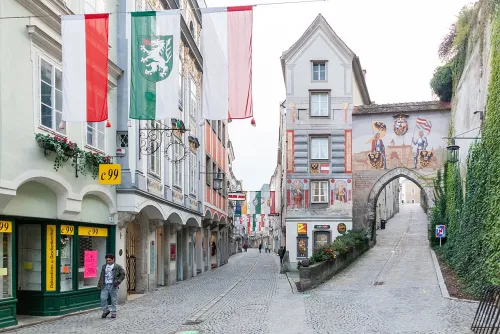
    The Enge Gasse is a narrow pedestrian shopping street that leads out of the Stadtplatz towards Zwischenbrücken and the water, and its narrowness is the whole charm. Walk it slowly and notice how the wide square suddenly squeezes into a lane.

    This is the shopping stretch of the route, so if you need anything before the riverside half begins, this is the place. After the next stop the walk turns to water, churches and a castle. The confluence is 200 m away, about 3 minutes.

    Hours
    Open 24/7
    Price
    Free
  6. 6

    Confluence of the Steyr and Enns Rivers

    Confluence of the Steyr and Enns Rivers, stop 6 on the self-guided walking tour

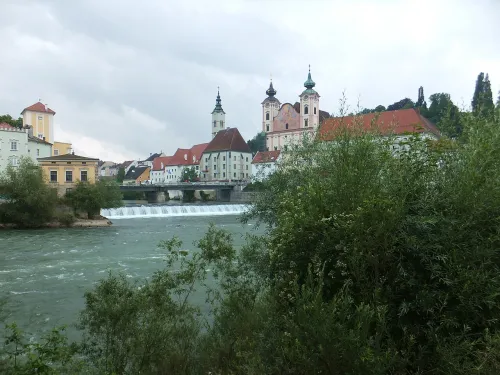
    Here the Steyr pushes into the Enns, and the town you have just walked through grew up around this meeting of two rivers. A public riverbank path runs along the water and never closes, so there is no ticket and no timing to think about. Let the walk breathe for a moment.

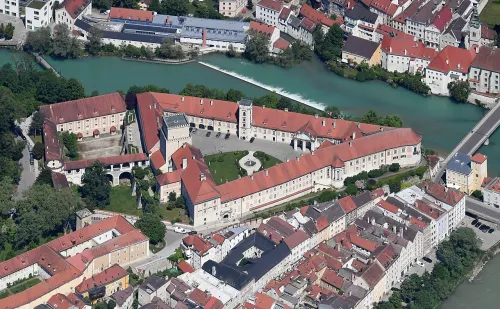
    Look up. On the high terrace over the junction stands Schloss Lamberg, where the route ends, and the twin towers of the Michaelerkirche crown the slope on its raised site at the mouth of the Steyr. Both shape the townscape you are looking at.

    The river in front of you was once a border. Around 976 the Steyr marked the line between the March of Styria and the March of Austria: the old town and the castle lay on the Styrian side, while Steyrdorf, north of the lower Steyr, belonged to Austria. Only a treaty of 3 April 1254 between Ottokar II of Bohemia and Béla IV of Hungary moved the border away and ended that frontier role.

    From here it is 240 m, about 4 minutes, into Steyrdorf and up to the Michaelerkirche, passing the Austrian Christmas Museum and the Tabor viewpoint behind the church.

    Local name
    Steyrmündung
    Hours
    Open 24/7
    Price
    Free
  7. 7

    Michaelerkirche

    Michaelerkirche in Steyr, stop 7 on the self-guided walking tour

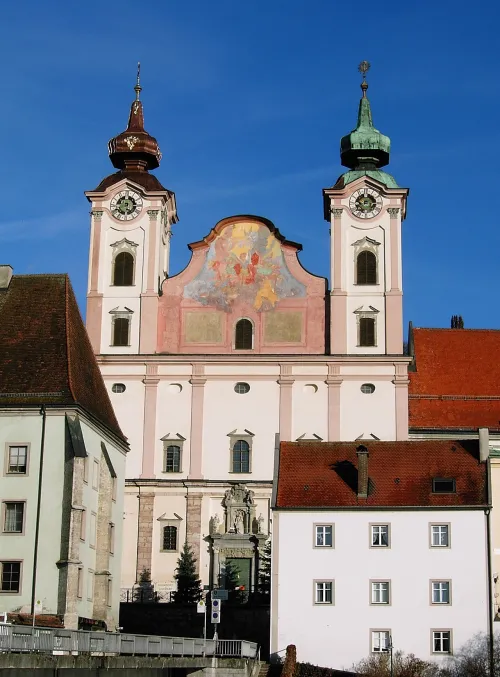
    The Michaelerkirche, a former Jesuit church in Steyrdorf, stands high at the mouth of the Steyr and is a protected monument. Before you go in, look up at the gable: Franz Xaver Gürtler, who also painted the high altar picture, covered it with a Fall of the Angels. The towers you see were raised in the late 1760s, a job finished in 1770.

    The Jesuits came to Austria in 1551, called in by Ferdinand I, and opened grammar and Latin schools in the larger towns, because teaching the young mattered to them as much as pastoral care. In Steyr they found strong backers in the burgrave Siegismund von Lamberg and Anton Spindler, abbot of Garsten, and set up a residence.

    In 1630 Emperor Ferdinand II ordered the town to hand over eleven houses near the Bürgerspital for a church and college. The order took them over in 1632 and started teaching straight away; in 1634 the houses were torn down to make room. The church was consecrated in 1648 by Ulrich Grappler von Trappenburg, auxiliary bishop of Passau, and the two towers were completed in 1677. Barely finished, the Jesuits began a six-class grammar school in 1678, and lessons started there two years later.

    Entry is free, but the doors generally open for services, so if you find them shut, the gable and the setting still make the stop. Now comes the longest leg of the day: 2990 m, about 43 minutes, out to the pilgrimage church of Christkindl.

    Hours
    Open during services
    Price
    Free
  8. 8

    Christkindlkirche

    Christkindlkirche in Steyr, stop 8 on the self-guided walking tour

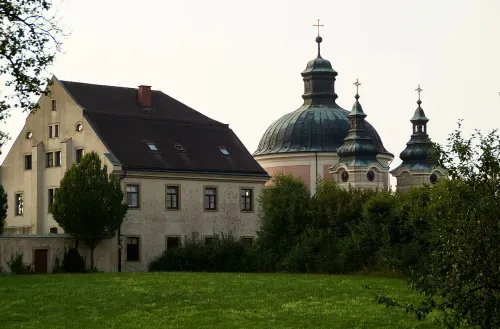
    The Christkindlkirche is a baroque pilgrimage church whose architect, Carlo Antonio Carlone, took the Pantheon in Rome, Santa Maria Rotonda, as his model, and you can see it in the round, domed form. The church is named after a wax figure of the Christ Child in the high altar; its official name is Zum göttlichen Christuskind, and locals also call it Christkindl unterm Himmel, after the old name of this hill, Wald Underm Himel, the wood beneath heaven.

    It all began with one man's illness. Ferdinand Sertl, choirmaster and tower keeper, moved here from Melk in 1691 and is said to have suffered from epilepsy. Hoping for a cure, he prayed before a picture of the Holy Family that he hung on a spruce tree on this hill, then still thick forest outside the town gates. He heard that a lame choir sister, Maria Elisabetha Parangin, had prayed in 1648 before a wax Christ Child and soon after could walk.

    Sertl asked the Celestine nuns for such a figure, prayed before it and, so the story goes, was healed. Word spread fast, and the tree with the wax figure became a popular place of prayer. A farmer from neighbouring St. Ulrich, grateful for his own child's recovery, built a wooden chapel around the spruce trunk. As the crowds grew, Abbot Anselm I of Garsten had a hermitage set up and later a church built; work on the present church began in 1702.

    The church itself is free, and a crib exhibition alongside charges entry. Outside the Christmas season the interior is not open to walk-in visitors, so on most days of the year this is a stop for the building and its story. From here it is 2580 m, about 35 minutes, back to Schloss Lamberg.

    Local name
    Wallfahrtskirche Christkindl
    Hours
    Advent through 6 January: Tue–Fri 13:00–16:30, Sat–Sun and holidays 10:00–16:30, Mon closed; rest of year (7 Jan until Advent): by appointment for groups only (min 10 pers)
    Price
    Free (church); Crib exhibition: 7 EUR adults, 1.50 EUR children (6-14), 2.50 EUR youth (15-18), 6 EUR seniors/students, 12 EUR family (combined ticket)
  9. 9

    Schloss Lamberg

    Schloss Lamberg in Steyr, stop 9 on the self-guided walking tour

    Schloss Lamberg sits on the high terrace over the confluence of the Steyr and the Enns, where the walk ends. It grew out of the Styraburg, the castle that gave its name to the town of Steyr and to the whole province of Styria. Its present name comes from the Counts of Lamberg, who owned it from 1666 until 1938.

    The Styraburg was built early in the 10th century and is first recorded in 985. It belonged to the Otakars, the counts of the Traungau; in 1079 it became the residence of Otakar II. Through the Georgenberg Pact of 1192 it passed to the Babenbergers and later to the Habsburgs. It stood at a crossing of important routes, and its strategic position is the reason the town grew below it.

    In 1727 a fire destroyed the complex, and Johann Michael Prunner rebuilt it. Around 1750 the estate belonging to the castle was the largest in Upper Austria. During the Coalition Wars of 1800, 1805 and 1809 the castle was badly damaged, and the Römerturm got its distinctive battlemented platform after the town fire of 1824.

    A darker chapter followed in the 20th century. After the February fighting of 1934, with nowhere else to hold them, the castle stables briefly served as a prison for some 800 people, most of them members of the Social Democrats' Schutzbund. On 17 February 1934 the trials against the insurgents began in the district court building on the Stadtplatz, where your walk started.

    The courtyard and grounds are free and open at any hour. The staterooms and the library can only be seen on a guided tour by appointment, worth arranging ahead if baroque interiors are your thing; otherwise the courtyard and the view over the rivers are a fitting end to the route.

    Hours
    Courtyard open 24/7; Staterooms and library accessible only via guided tours by appointment
    Price
    Free (courtyard and grounds); Guided state room tours by appointment
Walking tour route map of Steyr Route loaded
StadtplatzStadtpfarrkirche SteyrStadtmuseum SteyrBummerlhaus+5
All 9 stops are already on the map.
You just press start.
AI Tour Guide

You've read the Steyr route. Now walk it with a guide in your ear.

Press start wherever you are, even hundreds of kilometres from Steyr, and the guide begins telling its stories right away. In the city, pick any of the 9 stops to start from: it leads you there, then talks with you the whole route, asking, listening, remembering, and shaping the tour around your answers.

9stops 7.1km 1 h 41 minwalking 13languages
▶Start the tour free

Free to start · Runs in your browser · No app, no download

Shorter Ways Through Steyr

The route splits naturally at the Michaelerkirche, where the compact old town ends and the long walk out to Christkindl begins.

Old town and rivers

Stops: 1, 2, 3, 4, 5, 6, 7

For a half day or a first look at Steyr. About 1.5 km and 23 minutes of pure walking, from the Stadtplatz to the Michaelerkirche. The Stadtmuseum Steyr is the only stop with an entry fee; the rest is free.

Christkindl and the castle

Stops: 7, 8, 9

For a second outing, or if you already know the square. From the Michaelerkirche out to the Christkindlkirche and back to Schloss Lamberg: about 5.6 km and 1 h 18 min of walking. The church and the castle courtyard are free; the crib exhibition at Christkindl charges entry.

The full route

Stops: 1, 2, 3, 4, 5, 6, 7, 8, 9

For a full day with time for the stories. All nine stops on 7.1 km and 1 h 41 min of pure walking, with entry fees only at the Stadtmuseum Steyr and the Christkindl crib exhibition.

How Long Does This Steyr Tour Take on Foot?

Pure walking time for the whole route is 1 h 41 min. Add time on the square, a look inside the parish church and pauses at the other stops, and you are at about 3 h 20 min; with a proper hour in the Stadtmuseum Steyr it becomes roughly 4 h 20 min.

The old town section covers six short legs of three to five minutes each. Without the museum it takes about one and a half hours, with it about two and a half. The second half is two long legs, 43 and 35 minutes, and with time at Christkindl and in the castle courtyard it fills about two hours.

Before You Set Off in Steyr

  • Start and finish: The recommended start is the Stadtplatz, but you can join at any stop. The route ends at Schloss Lamberg, on the high terrace over the confluence.
  • Time of day: Start in the morning if you want the full route: with the museum you need more than four hours, and the long legs come at the end.
  • What costs entry: The Stadtmuseum Steyr and the crib exhibition at Christkindl charge entry. Both parish churches, the Michaelerkirche and the castle courtyard are free; the staterooms of Schloss Lamberg can only be seen on a guided tour by appointment.
  • Doors to check: Check the museum's opening days before you go. The Michaelerkirche generally opens for services, and the Christkindlkirche only welcomes walk-in visitors in the Christmas season.
Walking tour route map of Steyr
AI Tour Guide

Your guide for Steyr is ready when you are.

Press start and a voice AI Tour Guide takes it from here: leading the route through Steyr, telling the stories, and turning your walk into a real back-and-forth conversation. No app or download is needed; it runs in your browser.

9stops 7.1km 1 h 41 minwalking 13languages
▶Start the tour free

Free to start · Runs in your browser · No app, no download

What the AI Tour Guide Adds in Steyr

Steyr's story is iron, faith and borders, and the AI Tour Guide tells it as a conversation while you walk: it greets you on the Stadtplatz, notices whether Schubert, the Jesuits or the castle's counts grab you, and goes deeper there. Ask it what Steyr's merchants actually brought back from Venice, how a family like the Lambergs ran the largest estate in Upper Austria, or what life in a Jesuit school was like, and interrupt whenever you like. On the long walk out to Christkindl it keeps you company with the stories in between.

A Real Conversation A voice AI Tour Guide greets you, leads the whole route, and tells the stories and facts as you walk, asking what you want to see and keeping a real conversation going. Not a recording you press play on.
Map Navigation Follow the route on the map and walk at your own pace. You choose where to start and when to move to the next stop.
Ask Anything Curious about a building you pass? Ask your AI Tour Guide on the spot and the conversation carries on.
13 Languages Switch language anytime. No separate tour needed.
Start free in your browser

Common Questions About Walking Steyr

Why does a Gothic town have so many baroque churches?

Steyr had been a centre of the Protestant faith. During the Catholic Counter-Reformation three baroque monastery churches went up between 1635 and 1681: the Michaelerkirche, the Dominikanerkirche and the church of the Celestine nuns. The baroque style became the visible sign of that renewal.

Can I combine Steyr with another town on the same day?

Yes. Linz is 31 km away and Wels 32 km, so either works for a second walk if you keep to the old town section here.

Is the Christkindlkirche worth the walk outside the Christmas season?

For the building and its story, yes: the round, Pantheon-inspired church is striking from outside. Inside, outside the Advent and Christmas season, it only opens to groups by appointment, so if the interior matters to you, plan your visit for December.

Does the walk end back in the old town?

Almost. Schloss Lamberg sits on the high terrace over the confluence you passed earlier, so the end of the walk brings you back above the heart of Steyr.

Is the tour really free?

Yes. The whole tour is free: the route, the interactive map and the navigation cost you nothing. Only the voice AI Tour Guide is optional and paid: you test it with 100 free credits, then you pay either €5 per hour or €19.99 for this whole tour, with no time limit. Admission to one of the 9 stops is not included: Stadtmuseum Steyr charges its own entry fee.

Do I need to download an app?

No. Everything runs in your phone browser. Open the route and start walking, no download and no sign-up required.

Do I need to book the walking tour in advance?

No booking needed. This self-guided tour is available anytime. Open the route in your browser and start walking. The AI Tour Guide works instantly, no app, no reservation required.

What languages is the AI Tour Guide available in?

The AI Tour Guide speaks 13 languages, so you take the tour in your own language and can switch at any time.

Can I skip stops or change the route?

Yes. Skip any stop, spend extra time at places you like, or start the route from any point. It is your walk, you set the pace.
Image credits
▶ Start free in your browser Runs in your browser, no app, no download