

Pilgrimage Church of St. Wolfgang
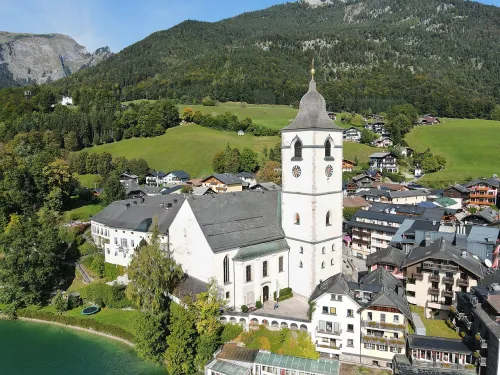
Start where the village itself started. The massive church stands on a rock right at the northeast shore of the Wolfgangsee and shapes the whole picture of St. Wolfgang. Before you go in, look at the doorways: three late Romanesque portals survived the fire of 1429 that destroyed the church before this one, so you walk through openings older than the building around them.
Tradition says Saint Wolfgang of Regensburg built a church of St. John here in 976. The first written record dates from 1183, when the church belonged to the monastery parish of Mondsee, and a stone church is documented in 1291. Pilgrims kept coming, so a Romanesque church grew beside the old one and was enlarged again and again, last by Ulrich the Mason in 1413. After the fire, Abbot Simon Reuchlin of Mondsee ordered a new, rather short church with two naves, and placed its high altar exactly where Wolfgang had prayed. That part is today's western end, which is why its two naves are of unequal width.
To care for the pilgrims, Mondsee sent a small community of monks, who got their own prayer room attached to the wider nave, separated from the pilgrims by a rood screen. At the end of the 17th century Abbot Cölestin Colb had that screen torn down, and suddenly the view opened onto the Pacher altar. In place of the old pilgrims' altar, Thomas Schwanthaler built a large double altar; its left side now keeps the relics of Saint Wolfgang and the miraculous statue. Look at the wrought iron grille around it: it traces the outline of the Romanesque church that burned. In 1713 Wolfgang's cell was wrapped in a rococo chapel and joined to the church.
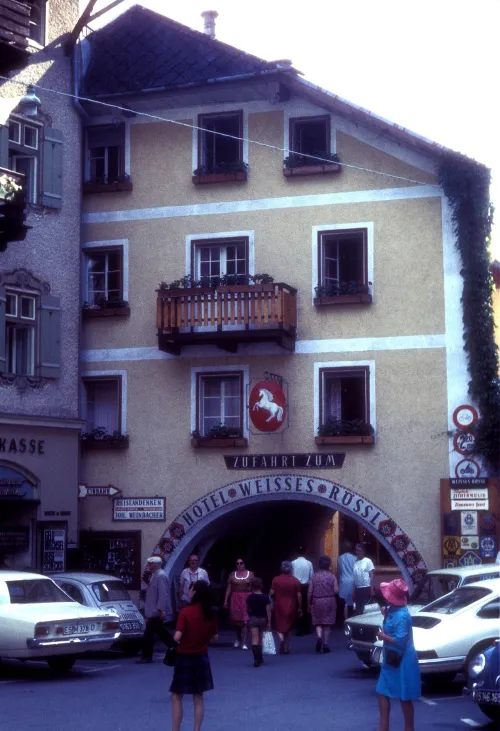
Inside you stand in a wide Gothic hall, still largely late Gothic in style. Entry is free, so go in, whether you come for faith, art or simply the story of a place that pilgrims have been walking to for centuries. Then step back out: the Hotel Weisses Rössl is only 140 m away, two minutes on foot.