Free Walking Tour Linz: Castle to Pöstlingberg

Castle hill, old town, Danube, Pöstlingberg: nine stops from a church first recorded in 799 to the Museum of the Future, walked at your own pace.

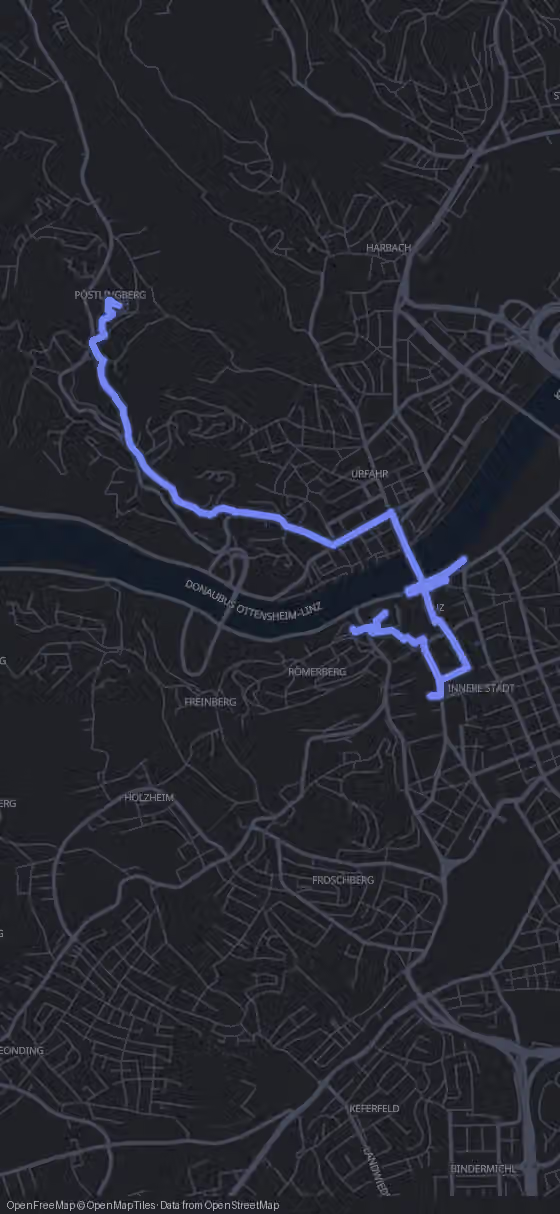
9 Stops 7.2 km ~1 h 54 min walking
Route map for the Linz walking tour
Stop 1 of 9
300 m·4 min
Linz Castle (Schlossmuseum)
Head south-west toward St. Martin's Church
Grüß dich, welcome to Linz. I'm Alex, and the city's great cathedral was deliberately stopped short.
Try this tour with Alex

This Route at a Glance

Nine stops lead from Linz Castle (Schlossmuseum) through the old town and across the Danube up to Pöstlingberg: 7.2 km and 1 h 54 min of pure walking, a little over four hours with short visits, around six with two museums.

St. Martin's Church, the Landhaus, the New Cathedral (Mariendom), the Ursuline Church, the Hauptplatz and Pöstlingberg are free; Linz Castle, the Lentos Art Museum and the Ars Electronica Center charge admission. The GPS route and map are free in your browser, the AI Tour Guide is optional.

Open free GPS & optional AI Tour Guide
View of Linz

The Route

Linz Walking Map: Castle Hill to Pöstlingberg

9 stops 7.2 km 1 h 54 min walking
Tap to load interactive map

The 9 stops along this route

  1. Linz Castle (Schlossmuseum), stop 1 on the self-guided walking tour
    1Linz Castle (Schlossmuseum)
  2. St. Martin's Church in Linz, stop 2 on the self-guided walking tour
    2St. Martin's Church
  3. Landhaus in Linz, stop 3 on the self-guided walking tour
    3Landhaus
  4. New Cathedral (Mariendom) in Linz, stop 4 on the self-guided walking tour
    4New Cathedral (Mariendom)
  5. Ursuline Church in Linz, stop 5 on the self-guided walking tour
    5Ursuline Church
  6. Hauptplatz in Linz, stop 6 on the self-guided walking tour
    6Hauptplatz
  7. Lentos Art Museum in Linz, stop 7 on the self-guided walking tour
    7Lentos Art Museum
  8. Ars Electronica Center in Linz, stop 8 on the self-guided walking tour
    8Ars Electronica Center
  9. Pöstlingberg in Linz, stop 9 on the self-guided walking tour
    9Pöstlingberg
  10. That's the full route.

    Walk it with an AI Tour Guide talking you through every one of these streets.

    Start free in your browser
    You made it

The Linz Walking Tour, One Stop at a Time

  1. 1

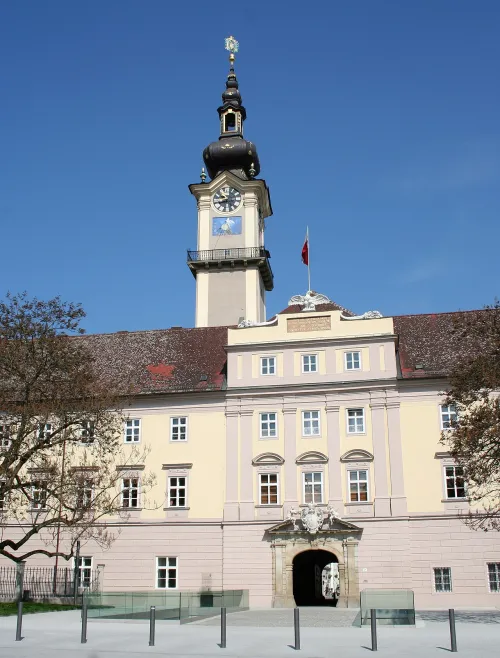
    Linz Castle (Schlossmuseum)

    Linz Castle (Schlossmuseum), stop 1 on the self-guided walking tour

    Begin high above the old town, where Linz Castle sits on its hill directly over the Danube. The site is older than the city itself: the Roman fort of Lentia stood here, and the castle's first written mention dates to 20 June 799. Look out for the Frederick Gate, a survivor from the years when Emperor Frederick III turned the castle into a palace in 1477 and made it his residence from 1489 to 1493.

    The family story carries on inside these walls. Frederick's grandson, the future Emperor Ferdinand I, had the palace enlarged and lavishly furnished for his bride Anne of Bohemia and Hungary after their wedding in Linz, and two of their children were born here. Their daughter Catherine came back after separating from the Polish king Sigismund II Augustus and lived here with her household from 1567 until her death in 1572.

    What you see today is largely the work of Emperor Rudolf II, who had the old palace pulled down and rebuilt from 1600 to plans by Anton de Moys, an architect from Antwerp: a massive four-storey block around two inner courtyards, plus the Rudolf Gate of 1604. In 1626 rebellious peasants besieged it, and from 1644 to 1646 Emperor Ferdinand III and his court waited out a plague in Vienna here.

    The Schlossmuseum charges admission. If history pulls you more than modern art or technology, this is the ticket to buy today. Then walk 300 m, about 4 minutes, to St. Martin's Church, which shares the castle's oldest date.
    Hours
    Mon: Closed | Tue–Sun: 10:00–18:00
    Price
    6.50 EUR
  2. 2

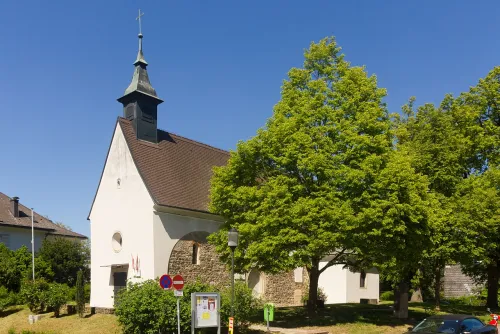
    St. Martin's Church

    St. Martin's Church in Linz, stop 2 on the self-guided walking tour

    This plain little church is easy to walk past, and that would be a pity. St. Martin's Church was long celebrated as the oldest surviving church in Austria. Newer research no longer supports the claim, with the Ruprechtskirche in Vienna and St. Ulrich in Thaur near Innsbruck as rival candidates, but its paper trail is remarkable all the same.

    It starts with a request. In 799 the Bavarian prefect Gerold the Younger, charged with leading the campaign against the Avars, wanted the use of this church for life. He asked his brother-in-law, King Charles, to put in a word with Bishop Waldrich of Passau, and on 20 June 799 the deed was drawn up. Its oldest copy, from the 9th century, is kept in the Bavarian State Archives in Munich. Gerold did not enjoy it for long: he died on 1 September of that same year.

    Over the centuries the church was reshaped again and again, rebuilt in Gothic style in the 15th century. In 1589 the west wall was taken down to its foundations and rebuilt, and the south entrance, in use since 799, gave way to a west portal. History was not always kind: during the War of the Austrian Succession, French and Bavarian occupiers used it as a horse stable in 1742, and from 1810 to 1832 it served as a military depot. The older Carolingian building beneath was excavated in 1978, and since 2016 this has been the parish church of Linz-Mitte.

    Entry is free, so if the door is open, go in for a few quiet minutes; it suits anyone who likes history plain rather than grand. From here it is 560 m, about 8 minutes, to the Landhaus.

    Local name
    Martinskirche
    Price
    Free
  3. 3

    Landhaus

    Landhaus in Linz, stop 3 on the self-guided walking tour

    The Landhaus is where Upper Austria is governed: the seat of the provincial parliament, built in several stages between 1568 and 1658. Before you go on, look up at the tower. It went up in 1568, was raised in 1637 and received its Baroque copper cap in 1801. Below the clock faces, a sundial is divided into four fields with sgraffito pictures by Fritz Fröhlich.

    The Upper Austrian Estates bought the plot in 1563. A Minorite monastery stood on it, and they had most of it torn down; its church, the Minoritenkirche, still survives. Christoph and Hans Canaval designed and built the new office and assembly house, with the stonemasons Caspar Toretto and Peter Guet.

    In the 16th century the building became the centre of the province's economic and cultural life. From 1574 to 1629 it housed the Protestant provincial school, which drew famous scholars. Johannes Kepler taught here for 14 years and praised its library. In 1626 peasants led by Stefan Fadinger besieged the Landhaus without success, but a few years later the Counter-Reformation won, the Protestant Estates lost their power and the school had to close.

    Baroque and Rococo artists then reshaped the Renaissance building, yet most of their finest work was lost in the great fire of 1800, which started at Linz Castle. Library, archive and picture gallery were destroyed. Looking costs nothing; from here it is 490 m, about 7 minutes, to the New Cathedral.

    Price
    Free
  4. 4

    New Cathedral (Mariendom)

    New Cathedral (Mariendom) in Linz, stop 4 on the self-guided walking tour

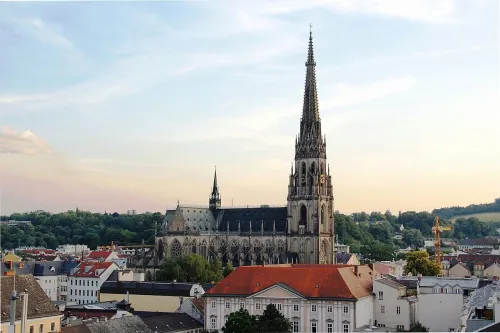
    The New Cathedral is the largest church building in Austria: 130 metres long, with 5,170 square metres of floor and room for 20,000 people. It is not the tallest, though, and the reason is political. A higher spire was planned, but in Austria-Hungary no building could rise above the south tower of St. Stephen's in Vienna, so the Mariendom stops at 134.6 metres, two metres short.

    Bishop Franz-Josef Rudigier began the planning in 1855. When the first stone was laid on 1 May 1862, Anton Bruckner's festive cantata Preiset den Herrn was performed, and Bishop Johannes Maria Gföllner consecrated the finished building in 1924. The plans came from Vincenz Statz, master builder of the Archdiocese of Cologne, in French High Gothic style.

    Inside, give the stained glass your time. The most famous window, the Linz Window, tells the history of the city, and other windows show portraits of the people who paid for the building. Some windows, mainly on the south side, were damaged in the Second World War and were replaced with modern art rather than restored, so you can compare the two styles. In the crypt there is a nativity scene with figures by S. Osterrieder and Bishop Rudigier's regalia; the great Rudigier organ was built in 1968 by the Danish firm Marcussen & Søn.

    Entry is free, and half an hour is enough for the windows and the crypt. Then walk 410 m, about 6 minutes, to the Ursuline Church.

    Hours
    Mon–Sat 8:00–19:00, Sun and holiday 8:00–19:15; visits not possible during services/events
    Price
    Free
  5. 5

    Ursuline Church

    Ursuline Church in Linz, stop 5 on the self-guided walking tour

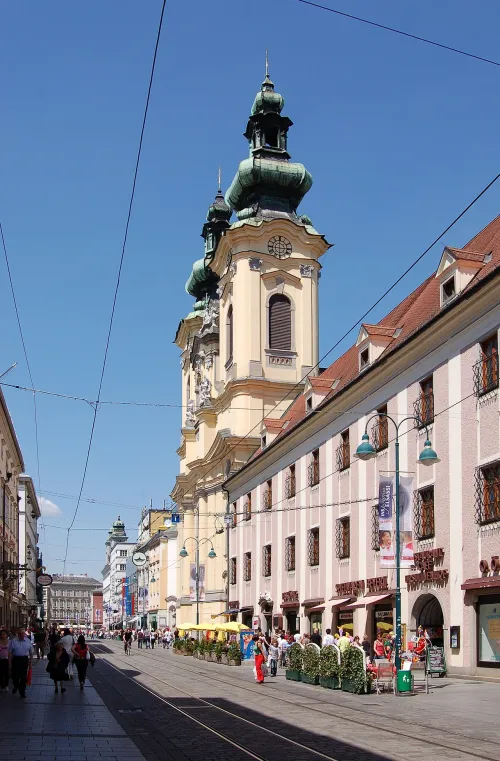
    On the Landstraße two towers and a late Baroque façade mark the Ursuline Church, dedicated to the Archangel Michael. Read the front before you go in: the central axis with the portal and the larger window curves outward, while the side axes curve inward, which gives the façade its typical late Baroque movement. Saints Anthony of Padua and Florian flank the main portal, a three-metre statue of the Immaculata stands in the gable between two angels, and a cross with two kneeling angels crowns it all.

    The Ursulines came from Vienna, started teaching and built a chapel on this spot in 1680. The present church went up in two phases between 1736 and 1772 and was consecrated in 1757. Johann Haslinger led the work until his death in 1741, and the stonemason Michael Herstorfer probably completed the towers. The former convent next to it is today the Ursulinenhof cultural centre.

    Inside, the single nave has three tall altar niches on each side. The high altar, designed by Johann Matthias Krinner, was donated in 1738 by the abbot of Heiligenkreuz Abbey and set up in 1741. Because the Upper Austrian Estates gave 3,000 guilders towards it, the provincial coat of arms sits above the altarpiece. That painting is by Martino Altomonte and shows Michael at the centre, with Gabriel, Raphael and Uriel; many of the side altarpieces are by his son Bartolomeo. Look out for the fine wrought iron work too.

    The church is free to enter, so ten minutes inside fit into any walk. From here it is 470 m, about 6 minutes, to the Hauptplatz.

    Hours
    Daily 8:00–19:00
    Price
    Free
  6. 6

    Hauptplatz

    Hauptplatz in Linz, stop 6 on the self-guided walking tour

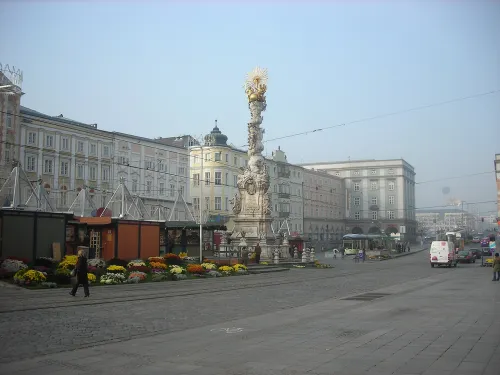
    The Hauptplatz is the heart of Linz and, at 13,140 square metres, one of the largest enclosed squares in Austria: 219 metres long and 60 wide. Only a street and the buildings at the bridgehead separate it from the Danube. It became a pedestrian zone in October 2024, so you can stand in the middle and take in its full size.

    Its proportions were no accident. When the city's extension was surveyed in 1207, the walls, the square and the parish church were staked out together, and the square was laid out around 1230 in a ratio of one to three. Fairs were held here from the start, which made the land around it expensive. Look at the houses: their façades are narrow, and the buildings stretch a long way back.

    The square's names tell Austrian history in brief. It was An dem Markt in 1338, later Am Platz and Großer Platz, and Hauptplatz from the early 19th century. In 1873 it was renamed after Emperor Franz Joseph, after 12 November 1918 it honoured the founding of the First Republic, in 1934 it went back to Franz Joseph, after the Anschluss it bore Hitler's name, and since 1945 it has been the Hauptplatz again.

    Crowds were always part of it. Legend has it that the Losenstein tournament was fought here on 25 May 1521, for the wedding of Archduke Ferdinand and Anne of Hungary, the couple from Linz Castle. Until 1716 the pillory stood here, and executions were carried out beside it.

    From here it is 690 m, about 10 minutes, to the Lentos Art Museum; on the way you pass the Upper Austria Literature Museum.

    Hours
    Open 24/7
    Price
    Free
  7. 7

    Lentos Art Museum

    Lentos Art Museum in Linz, stop 7 on the self-guided walking tour

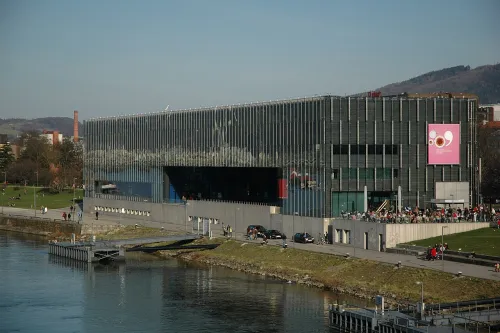
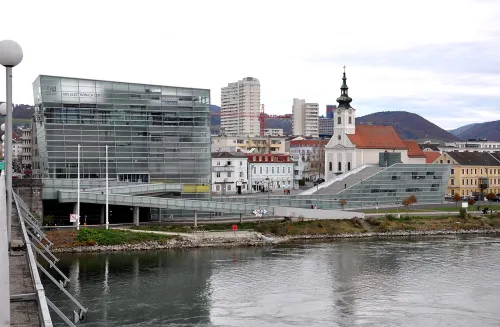
    Right on the Danube, between the Nibelungen Bridge and the Brucknerhaus, the Lentos is a long glass box designed by the Zurich firm Weber & Hofer. At 130 metres it matches the length of the Mariendom, with about 8,000 square metres of floor space. It opened in May 2003 as the successor to the city's Neue Galerie.

    The collection began with a single dealer. After the Second World War, 120 works from the Berlin art dealer Wolfgang Gurlitt, including paintings and graphics by Klimt, Schiele, Kokoschka, Nolde, Corinth and Pechstein, became the foundation of the Neue Galerie. In 1953 Linz made it a city museum with its own exhibitions and purchases.

    Today the collection holds around 1,500 paintings, sculptures and objects, more than 10,000 works on paper and about 850 photographs, among them important pieces by Alexander Rodchenko and Man Ray. The display tries to restore the chronological order of movements and styles, starting in the 19th century with Caspar David Friedrich and Johann Baptist Reiter and running through Gabriele Münter, Valie Export and Herbert Bayer.

    The Lentos charges admission. If you love Austrian modernism, give it an hour; otherwise the building from the river is reason enough to pause. Then walk 640 m, about 9 minutes, across to the Ars Electronica Center in Urfahr.

    Local name
    Lentos Kunstmuseum Linz
    Hours
    Mon: Closed | Tue–Wed: 10:00–18:00 | Thu: 10:00–20:00 | Fri–Sun: 10:00–18:00
    Price
    12 EUR, reduced 11 EUR or 6 EUR
  8. 8

    Ars Electronica Center

    Ars Electronica Center in Linz, stop 8 on the self-guided walking tour

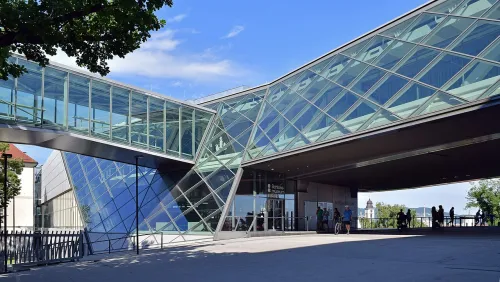
    The Ars Electronica Center calls itself the Museum of the Future. It opened in Urfahr in 1996 with a simple goal: to let people experience the technologies of coming generations today. Its exhibitions weave together art, science and technology, from biotechnology and genetics to neuroscience, robotics, prosthetics and media art, and all of them ask how people can deal with the world around them.

    This is not a museum for looking at things behind glass. You are meant to interact with the installations, and the exhibitions change constantly. The highlight is Deep Space 8K, where wall and floor projections, each 16 by 9 metres, combine with laser tracking and 3D animation to show images from medicine, geology or astronomy in 8K resolution.

    Behind the exhibitions sits the Futurelab, a studio and laboratory that has worked on art, technology and society since 1996, on topics such as artificial intelligence, robotics, media architecture and swarm intelligence. The Prix Ars Electronica for computer art is awarded here every year, and the Ars Electronica Festival, held since 1979, is the leading festival of digital art worldwide.

    The centre charges admission, and if you like to try things rather than read labels, plan an hour and a half. Then comes the longest leg: 3,630 m and about 65 minutes uphill to Pöstlingberg.

    Hours
    Mon: Closed | Tue–Sun: 10:00–17:00
    Price
    14 EUR adults (full price), 12 EUR reduced
  9. 9

    Pöstlingberg

    Pöstlingberg in Linz, stop 9 on the self-guided walking tour

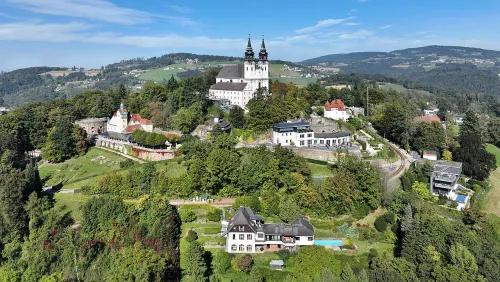
    The walk ends on Pöstlingberg, a 539-metre hill on the left bank of the Danube and one of the city's favourite outings. Up here you find the viewing platform over Linz, the Baroque pilgrimage church, the Grottenbahn and the Pöstlingbergbahn, and the whole area is free and open at any hour. Today it is also one of the city's most exclusive residential districts.

    Its story as a holy place began in 1716, when Franz Obermayr, a lay brother of the Capuchin friary in Urfahr, fixed a Pietà by the Linz sculptor Ignaz Jobst to the weather cross on the hill. By 1720 pilgrims were coming and a wooden chapel was built, replaced by one with a stone base in 1730/31. Work on the pilgrimage church started in 1742, and it was consecrated on 9 December 1748. In 1964 it was raised to a minor basilica.

    Fire struck twice. Lightning set the roof ablaze on 17 May 1919, but the interior was spared. On 31 May 1963 a soldering lamp started a blaze that destroyed the roof and both towers, which were rebuilt. Donations are still funding its restoration.

    Enjoy the view knowing it was not always there. When day trippers began coming at the end of the 18th century, the summit was still wooded and the church hidden among the trees, so people looked out from the lower slopes. Pilgrims had somewhere to rest even earlier: an inn is recorded from 1747, the forerunner of today's Kirchenwirt.

    Hours
    Open 24/7
    Price
    Free
Walking tour route map of Linz Route loaded
Linz Castle (Schlossmuseum)St. Martin's ChurchLandhausNew Cathedral (Mariendom)+5
All 9 stops are already on the map.
You just press start.
AI Tour Guide

You've read the route. Now walk it with a guide in your ear.

Press start wherever you are, even hundreds of kilometres from Linz, and the guide begins telling its stories right away. In the city, pick any of the 9 stops to start from: it leads you there, then talks with you the whole route, asking, listening, remembering, and shaping the tour around your answers.

9stops 7.2km 1 h 54 minwalking 13languages
▶Start the tour free

Free to start · Runs in your browser · No app, no download

Shorter Ways Through Linz

Not every day has room for the full walk and the climb. These three cuts keep the route's logic and simply leave out one end.

Old town and churches

Stops: 1, 2, 3, 4, 5, 6

For a morning or a first look at Linz: from the castle through the old town to the Hauptplatz, 2.2 km and 31 minutes of walking. The only admission is the castle museum, and only if you go in; with it and a look inside every church, plan roughly three hours.

Linz without the climb

Stops: 1, 2, 3, 4, 5, 6, 7, 8

For anyone who wants the museums rather than the view: stop at the Ars Electronica Center and skip the final leg. That leaves 3.6 km and 50 minutes of walking, with admission at the castle, the Lentos and the Ars Electronica Center if you go inside.

Danube and hill

Stops: 6, 7, 8, 9

For a second day or an afternoon: from the Hauptplatz along the river, over to the Ars Electronica Center and up to Pöstlingberg. About 5 km and 1 h 24 min of walking, most of it on the climb; admission only at the Lentos and the Ars Electronica Center.

How Long the Linz Tour Takes, With and Without Museums

The walking time is uneven: the eight stops in town follow each other within 50 minutes on foot, while the final leg up Pöstlingberg takes 65 minutes on its own. Keep to the free stops and the outsides of the museums and you are done in about four and a quarter hours, including half an hour in the Mariendom and time on the hill.

With the two visits that reward the most time, it becomes a full day of about six hours: castle museum on arrival at 10:00, leaving at 11:00; the Mariendom around 11:45; the Hauptplatz around 12:35; the Ars Electronica Center from 13:20, leaving at 14:50; Pöstlingberg at about 15:55. Swap the Ars Electronica Center for the Lentos if paintings interest you more than technology; the timing barely changes.

Before You Set Off in Linz

  • Start: Linz Castle (Schlossmuseum) is the recommended start, ideally in the morning once the museum is open. You can join the route at any stop.
  • Finish: Pöstlingberg, on the far side of the Danube. Walk back, or look into the Pöstlingbergbahn, one of the hill's own attractions; check times and fares on the spot.
  • Best day: Pick a day when Linz Castle, the Lentos and the Ars Electronica Center are open. Set off in the morning so you reach the Ars Electronica Center with time to spare before it closes.
  • Costs: The walk, the churches, the Landhaus, the Hauptplatz and Pöstlingberg cost nothing; only the three museums charge admission.
Walking tour route map of Linz
AI Tour Guide

Your guide starts whenever you do.

Press start and a voice AI Tour Guide takes it from here: leading the route through Linz, telling the stories, and turning your walk into a real back-and-forth conversation. No app or download is needed; it runs in your browser.

9stops 7.2km 1 h 54 minwalking 13languages
▶Start the tour free

Free to start · Runs in your browser · No app, no download

What the AI Tour Guide Adds in Linz

This route jumps between centuries: a Carolingian charter, imperial weddings, a parliament, a museum of the future. The AI Tour Guide greets you at the castle, tells the stories as you walk, asks what caught your interest and shifts the weight of the conversation, so a Kepler fan hears more about the Protestant school and a tech fan more about the Futurelab. Ask it what the peasants of 1626 were actually fighting for, or how Bruckner was tied to Linz beyond one cantata, and interrupt whenever you like. You start with 100 free credits; after that, choose this tour all-inclusive for €19.99 with no time limit, or credits at €5 per hour.

A Real Conversation A voice AI Tour Guide greets you, leads the whole route, and tells the stories and facts as you walk, asking what you want to see and keeping a real conversation going. Not a recording you press play on.
Map Navigation Follow the route on the map and walk at your own pace. You choose where to start and when to move to the next stop.
Ask Anything Curious about a building you pass? Ask your AI Tour Guide on the spot and the conversation carries on.
13 Languages Switch language anytime. No separate tour needed.
Start free in your browser

Common Questions About Walking Linz

Can I visit the Mariendom during Mass?

No. Visits are not possible during services and events, so if one is under way, see the outside and the windows from the square first and come back once it has finished.

Which stop works best with children?

The Ars Electronica Center. It sets out to make future technologies tangible for every age, and touching and trying the installations is explicitly encouraged.

Is it worth coming back to the Danube after dark?

For the Lentos, yes: its glass façade is lit up at night, so the building looks quite different from the riverbank in the evening than it does during the day.

What makes a good day trip from Linz?

For more Upper Austrian old towns, try Steyr or Wels. Following the Danube, Passau lies upstream and Melk downstream, and across the Czech border Český Krumlov is within reach.

Is the tour really free?

Yes. The whole tour is free: the route, the interactive map and the navigation cost you nothing. Only the voice AI Tour Guide is optional and paid: you test it with 100 free credits, then you pay either €5 per hour or €19.99 for this whole tour, with no time limit. Admission to 3 of the 9 stops is not included: Linz Castle (Schlossmuseum), Lentos Art Museum and Ars Electronica Center charge their own entry fees.

Do I need to download an app?

No. Everything runs in your phone browser. Open the route and start walking, no download and no sign-up required.

Do I need to book the walking tour in advance?

No booking needed. This self-guided tour is available anytime. Open the route in your browser and start walking. The AI Tour Guide works instantly, no app, no reservation required.

What languages is the AI Tour Guide available in?

The AI Tour Guide speaks 13 languages, so you take the tour in your own language and can switch at any time.

Can I skip stops or change the route?

Yes. Skip any stop, spend extra time at places you like, or start the route from any point. It is your walk, you set the pace.
Image credits
▶ Start free in your browser Runs in your browser, no app, no download