Free Walking Tour Hallstatt: Lake, Skulls and Salt

From the square where the ferry lands to a chapel of painted skulls and into the salt mine, this route follows the salt that built Hallstatt.

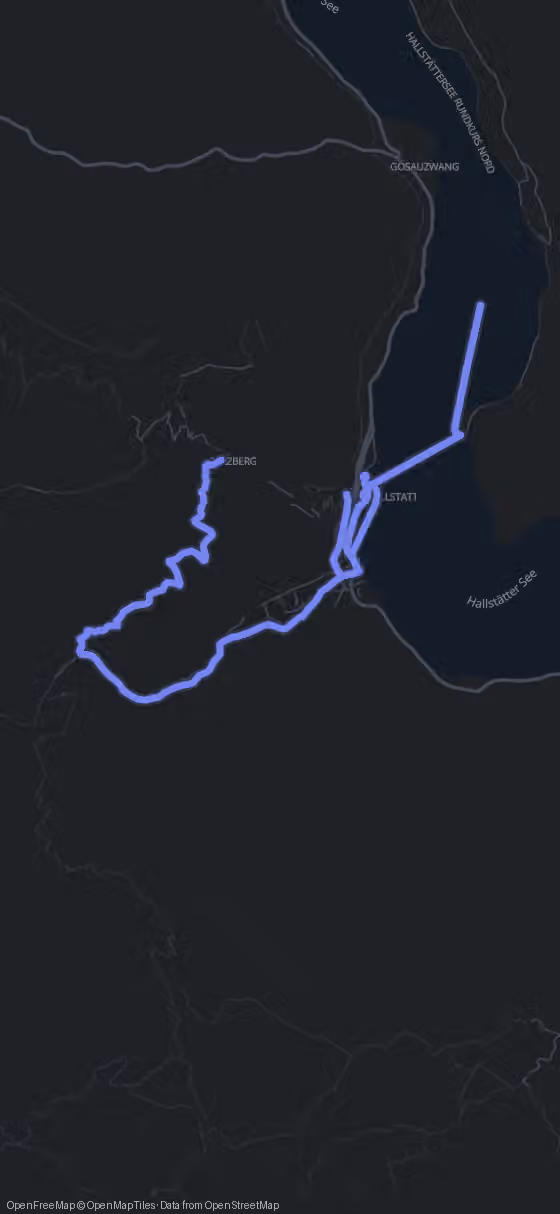
7 Stops 16.2 km ~3 h 38 min walking
Route map for the Hallstatt walking tour
Stop 1 of 7
80 m·1 min
Hallstatt Market Square
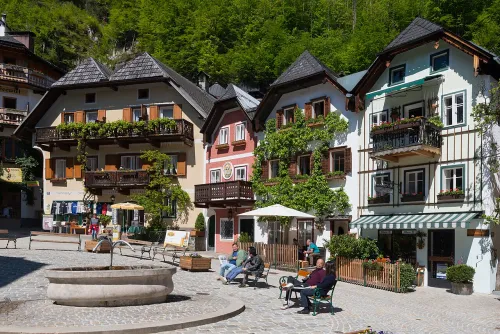
Head south from the square toward Museum Hallstatt
Servus, welcome to Hallstatt. I’m Alex, and this tiny lakeside village gave its name to an age of European history.
Try this tour with Alex

This Route at a Glance

Seven stops lead from Hallstatt Market Square via Museum Hallstatt, Mühlbach Waterfall, Hallstatt Parish Church, Hallstatt Ossuary and Lake Hallstatt to Hallstatt Salt Mine: 16.2 km and 3 h 38 min of pure walking, most of it on the final leg. With visits, plan a full day.

The square, the waterfall, the church and the lake are free; the museum, the ossuary and the mine charge admission. The GPS route runs free in your browser, and the optional AI Tour Guide tells the stories as you walk.

Open free GPS & optional AI Tour Guide
View of Hallstatt

The Route

Walking Map of Hallstatt, from Ferry Square to Salt Mine

7 stops 16.2 km 3 h 38 min walking
Tap to load interactive map

The 7 stops along this route

  1. Hallstatt Market Square, stop 1 on the self-guided walking tour
    1Hallstatt Market Square
  2. Museum Hallstatt, stop 2 on the self-guided walking tour
    2Museum Hallstatt
  3. Mühlbach Waterfall in Hallstatt, stop 3 on the self-guided walking tour
    3Mühlbach Waterfall
  4. Hallstatt Parish Church, stop 4 on the self-guided walking tour
    4Hallstatt Parish Church
  5. Hallstatt Ossuary, stop 5 on the self-guided walking tour
    5Hallstatt Ossuary
  6. Lake Hallstatt, stop 6 on the self-guided walking tour
    6Lake Hallstatt
  7. Hallstatt Salt Mine, stop 7 on the self-guided walking tour
    7Hallstatt Salt Mine
  8. That's the full route.

    Walk it with an AI Tour Guide talking you through every one of these streets.

    Start free in your browser
    You made it

Your Hallstatt Walking Tour, Stop by Stop along the Salt Story

  1. 1

    Hallstatt Market Square

    Hallstatt Market Square, stop 1 on the self-guided walking tour

    Start in the one place where Hallstatt opens up. The market square is the centre of a village built on a narrow ledge between cliff and lake, and it is where the ferry from the train station across the water lands. Many visitors arrive here within their first minute in Hallstatt, so take a moment to look around before the crowd decides your pace for you.

    Cars are kept out of the village streets during the day, which is why the square feels like a living room rather than a junction. Use it to plan your day: the square is quiet before 09:00, the day-trip buses from Salzburg and Bad Ischl start rolling in around 09:30, and most of their passengers have left again by 16:30. The hours outside that window belong to you.

    In between, the square carries the village's public life. On some summer evenings there are free open-air brass concerts, and on 8 December the square hosts a one-day Christmas market, the only one Hallstatt has.

    Your first leg is the shortest on the route. The museum sits one lane back from the square, up Badergraben: 80 m, about a minute. If the Hallstatt Weekly Market is set up when you pass, take a look before you go.
    Hours
    Open 24/7
    Price
    Free
  2. 2

    Museum Hallstatt

    Museum Hallstatt, stop 2 on the self-guided walking tour

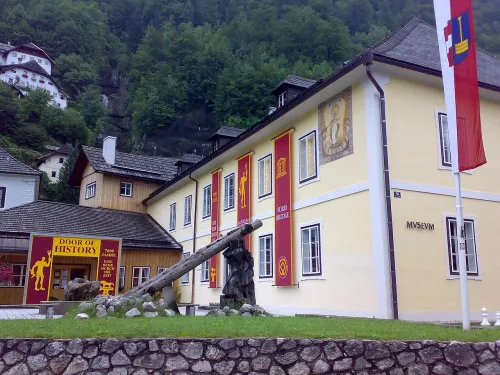
    This is where the salt story gets its depth. Since 2002 the museum has occupied the former parsonage, and its collection comes from the local salt mines and the Iron Age cemeteries near them. Those graves made Hallstatt the type site for a whole era of European prehistory, the Hallstatt culture. Together with the salt mines and the Dachstein Ice Cave, the museum is part of a UNESCO World Heritage Site.

    The finds began in 1846 with Johann Georg Ramsauer, the Bergmeister, or official, of the Habsburg salt mines. Between 1846 and 1867 he excavated the cemeteries around the mines with remarkable care, helped by a mining assistant, Isodor Engl. Engl kept digging between 1871 and 1878 for the museum in Linz, so many early finds ended up there, and from 1889 excavations with the Vienna Naturhistorisches Museum sent many of the most important pieces to the capital. Engl himself became curator in Hallstatt in 1895.

    The strangest journey belongs to the graves opened in 1907 by Marie, Duchess of Mecklenburg-Schwerin, a leading figure in Iron Age studies, who excavated 40 graves with the backing of two emperors. After the First World War the Serbian government confiscated her collection; in 1934 it was sold in the United States, and the Hallstatt finds went to the Peabody Museum in Cambridge, Massachusetts. When the museum moved into the parsonage, many objects came back from Vienna to rejoin the local holdings.

    Going in is worth the admission if you plan to visit the mine: an hour here turns the tunnels into a story about people. From here the route takes its first proper walk, 1,810 m and 31 minutes to the waterfall, past the Archaeological Excavation at Dachsteinsport Janu, a fitting aside right after the museum.

    Hours
    May–Sep daily 10:00–18:00; Oct daily 10:00–16:00; Nov–Mar daily 11:00–16:00; Apr daily 10:00–16:00 (admission until 60 min before closing)
    Price
    12 EUR adults, 11 EUR seniors (60+), 9 EUR youths (15-18) / students, 8 EUR children (6-14), 25 EUR family ticket
  3. 3

    Mühlbach Waterfall

    Mühlbach Waterfall in Hallstatt, stop 3 on the self-guided walking tour

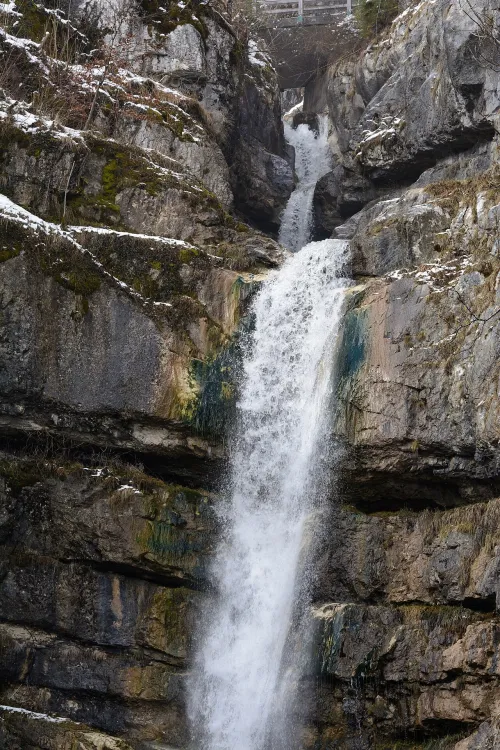
    The Mühlbach comes down above the village in several cascades, and there is no gate, no ticket and no closing time. You see it from the village itself and from a viewing bridge on the public trail.

    Look at the stream with the village in mind, because the Mühlbach built the ground under your feet. Over thousands of years it piled up a cone of debris rising up to 17 m above the lake, and the old core of Hallstatt was built on that cone. The houses you have just walked past stand on what this water carried down.

    Timing decides how dramatic it looks. The fall runs hardest between April and June, when the winter above the valley is melting. Outside those months, treat it as a free, always-open breather between two heavier stops: you have just left a museum full of graves, and you are walking towards a chapel full of bones.

    From the waterfall it is 1,930 m and 29 minutes to the parish church.

    Local name
    Mühlbachwasserfall
    Hours
    Open 24/7
    Price
    Free
  4. 4

    Hallstatt Parish Church

    Hallstatt Parish Church, stop 4 on the self-guided walking tour

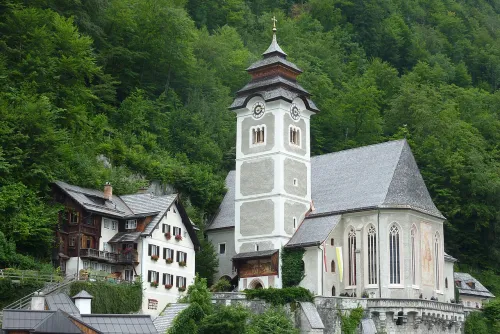
    The Catholic parish church, dedicated to the Assumption and also called Maria am Berg, stands on a steep rock above the village. Its oldest part is the tower: it survives from the first church, built by 1150 at the latest. In 1320 a larger Romanesque church was consecrated here by Hermann, auxiliary bishop of Passau, and in the late Gothic period work began on the church you see now, whose interior was finished in 1505. After the great fire of 1750 the old tower got its Baroque cap.

    You enter through the large south portal of 1519. Look up before you go in: the two frescoes above it are by an unknown master of the Danube School. In the porch hangs a crucifixion group from around 1500, probably by the same master as the high altar.

    Inside, a two-aisled hall ends in a double choir, split by an octagonal central pillar. Restorations in 1966/67 and 2002 tried to bring back the look of around 1500. The two winged altars in the choir catch the eye first. The neo-Gothic cross altar was designed by the architect Hermann von Riewel and made in three years by teachers and students of the Hallstatt woodcarving school, during the regothicisation between 1888 and 1895.

    The best story is in the confession chapel on the north side. Its winged altar, painted in oil on a gold ground, once stood in the miners' chapel on the Salzberg. When a Baroque altar replaced it, miners hid it to save it from being burned and later gave it to the church; it was restored between 1963 and 1965. Entry is free; give it twenty minutes. The ossuary is next door, 100 m and two minutes away.

    Local name
    Katholische Pfarrkirche Hallstatt
    Hours
    Daily 09:00–17:00
    Price
    Free admission
  5. 5

    Hallstatt Ossuary

    Hallstatt Ossuary, stop 5 on the self-guided walking tour

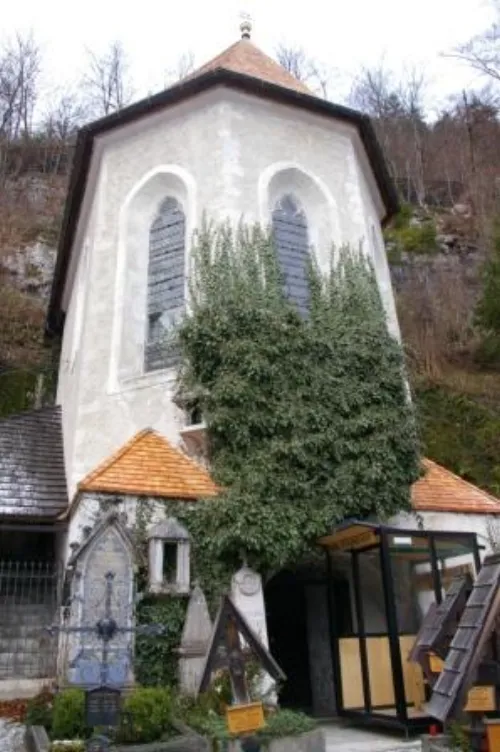
    In St Michael's Chapel next to the church sits the Beinhaus, and it is why many people make the climb at all: around 1,200 painted skulls, by the local count, arranged in a room about the size of a double garage. It is a small space you will not forget.

    Read it as an answer to Hallstatt's oldest problem, which is space. The village sits on a ledge between cliff and lake, with no spare land anywhere, not even for graves. This chapel is where that scarcity became visible, generation after generation. Seen that way, the room stops being macabre and becomes the village's memory, kept within reach of its church.

    Practical details decide how good your visit is. The ossuary only opens seasonally; outside the season it is closed, and you see the chapel from outside only. Admission is cheap, but cash only. The room is so small that group tours fill it between 10:30 and 14:00 in peak summer; arrive early in the day or after 16:00 and you will have it almost to yourself.

    From the chapel the route heads down to the water: 2,440 m to the lake, about 12 minutes on the route.

    Local name
    Karner, Michaelskapelle
    Hours
    May–Sep daily 10:00–18:00
    Price
    2.00 EUR adults, 0.50 EUR children (6-15 years) / school pupils
  6. 6

    Lake Hallstatt

    Lake Hallstatt, stop 6 on the self-guided walking tour

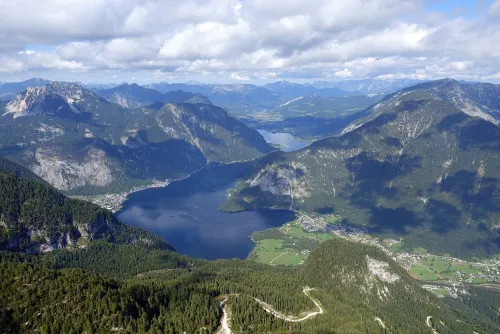
    The Hallstätter See is the reason the village looks the way it does. It lies at 508 m at the northern foot of the Dachstein massif, cut into the mountains like a fjord: 7.5 km long, no more than 1.4 km wide, on average 65 m deep. Hallstatt sits on the west shore and owns most of the shoreline and the water.

    Stand at the shore and read the mountains around you. To the south rise the Hirlatz at 1,985 m and the Krippenstein at 2,108 m, dropping steeply to the water; to the west run the outliers of the Plassen, to the east the Sarstein at 1,975 m. Obertraun lies to the southeast on the plain built by the Koppentraun, Bad Goisern at the lake's outlet to the north.

    The lake belongs to the Austrian Federal Forests, and the Traun flows through it on its way to the Danube. Together with the inner Salzkammergut it is part of the UNESCO World Heritage cultural landscape of Hallstatt, Dachstein and the Salzkammergut. Take twenty minutes here: it is free, open at all hours, and the last calm before the longest leg.

    Now comes the big one: 9,860 m and 142 minutes to the salt mine. Work out your timing here at the shore so you reach the mine well before the last tour of the day. Along the way you pass the starting point for the Boat Ride on Lake Hallstatt, tempting if you have time to spare.

    Local name
    Hallstätter See
    Hours
    Open 24/7
    Price
    Free
  7. 7

    Hallstatt Salt Mine

    Hallstatt Salt Mine, stop 7 on the self-guided walking tour

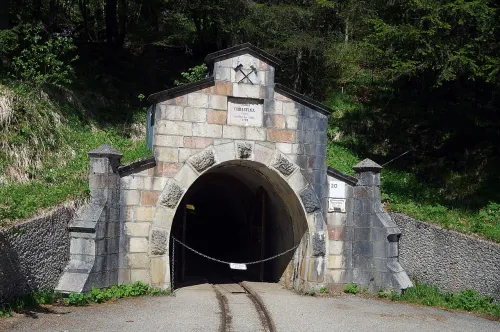
    This is what the whole route was walking towards. The museum called it the oldest salt mine in the world and put a number on it, 7,000 years; the square and the church showed you the village that grew around it. Here you go inside the reason Hallstatt exists.

    The mine and its Salzbergbahn funicular were closed for renovation from autumn 2025 until summer 2026, so anything you read or saved before then is out of date. Tours are running again, and the funicular keeps running after the last tour.

    Tickets come in three forms. Since you arrive on foot, the mine tour without the funicular is the natural choice. If you would rather ride back down, take the mine tour with funicular return, which costs more; the funicular return is also sold on its own.

    Going in is the point of the long walk: after the Iron Age graves in the museum and the miners' altar in the church, the tunnels close the circle. If you only have energy for one paid visit on this route, make it this one.

    Local name
    Salzbergwerk Hallstatt
    Hours
    Salt mine tour: 29 Aug – 24 Oct 2026 daily 09:30–16:30 (last tour start), 25 Oct 2026 – 6 Jan 2027 daily 09:30–15:00; Salzbergbahn funicular: 29 Aug – 24 Oct 2026 daily 09:00–18:00, 25 Oct 2026 – 6 Jan 2027 daily 09:00–16:30
    Price
    49.00 EUR adults (salt mine incl. funicular return), 33.00 EUR adults (salt mine tour only without funicular), 29.00 EUR adults (funicular return only)
Walking tour route map of Hallstatt Route loaded
Hallstatt Market SquareMuseum HallstattMühlbach WaterfallHallstatt Parish Church+3
All 7 stops are already on the map.
You just press start.
AI Tour Guide

You just read the route from the square to the mine. Now walk it with a guide in your ear.

Press start wherever you are, even hundreds of kilometres from Hallstatt, and the guide begins telling its stories right away. In the city, pick any of the 7 stops to start from: it leads you there, then talks with you the whole route, asking, listening, remembering, and shaping the tour around your answers.

7stops 16.2km 3 h 38 minwalking 13languages
▶Start the tour free

Free to start · Runs in your browser · No app, no download

Shorter Ways Through Hallstatt

The full route is a long day because of the walk out to the mine. If you have less time or less energy, these cuts follow the same order and use the same legs.

Village and lakeshore without the mine

Stops: 1, 2, 3, 4, 5, 6

For anyone who wants the museum, the church and the skulls but not the long final leg. About 6.4 km and 75 minutes of pure walking. Admission only for the museum and, in season, the ossuary; the rest is free.

Church, skulls and lake in one hour

Stops: 4, 5, 6

For a short visit between a ferry and a bus. Just 14 minutes of walking, so most of the hour goes into looking. The church is free, the ossuary costs a coin or two in season, the lake costs nothing.

The whole salt story

Stops: 1, 2, 3, 4, 5, 6, 7

For anyone ready for a full day on foot: 16.2 km and 3 h 38 min of pure walking, ending inside the mine. Admission for the museum, the ossuary in season and the mine tour.

How Long Does This Hallstatt Tour Take with Museum and Mine?

The pure walking time is 3 h 38 min, and 142 minutes of that is the last leg from the lake to the salt mine. Everything before it sits close together: the museum is a minute from the square, the ossuary two minutes from the church.

A realistic full day: start at the square at 10:00, spend an hour in the museum, leave at 11:01 and reach the waterfall at 11:32. Ten minutes there, then the church at 12:11; twenty minutes inside, the ossuary at 12:33, the lake at 13:00 after fifteen minutes with the skulls. After twenty minutes at the shore you set off at 13:20 and reach the mine at 15:42 for a late-afternoon tour. That is close to six hours before the mine tour itself. In peak summer this plan puts you in the ossuary at its busiest; it is a short visit either way.

Later in the year the last mine tour starts earlier, so you need to leave the lake sooner: skip the museum interior or keep it for another day. The village and lakeshore variant takes about 75 minutes of walking plus around two hours of visits; the short church, skulls and lake loop fits into an hour.

Before You Set Off from the Market Square

  • Start and finish: The recommended start is Hallstatt Market Square, where the ferry from the train station lands; the route ends at Hallstatt Salt Mine. You can join at any stop, but the order shown is the one that tells the story best.
  • Best day and time: Start early to beat the bus crowds, and work back from the last mine tour so the long final leg does not catch you out. The ossuary only opens seasonally.
  • Costs: Square, waterfall, church and lake are free. The museum, the ossuary and the mine charge admission, and the funicular return adds to the mine ticket. Keep coins for the ossuary, which takes cash only.
  • Free route and guide: Map and GPS navigation from stop to stop run free in your browser. The AI Tour Guide is optional: 100 free credits to start, then either this tour all-inclusive for €19.99 with no time limit or €5 per hour.
Walking tour route map of Hallstatt
AI Tour Guide

Your guide is ready when you reach the market square.

Press start and a voice AI Tour Guide takes it from here: leading the route through Hallstatt, telling the stories, and turning your walk into a real back-and-forth conversation. No app or download is needed; it runs in your browser.

7stops 16.2km 3 h 38 minwalking 13languages
▶Start the tour free

Free to start · Runs in your browser · No app, no download

What the AI Tour Guide Adds Between Salt and Skulls

The written route gives you dates and names; the AI Tour Guide turns them into a conversation as you walk. It greets you on the square, tells the story of each place, asks what caught your eye and remembers it, so if the Iron Age graves grabbed you in the museum, the long walk to the mine becomes a talk about the people who worked it. You can interrupt any time to ask what the Hallstatt culture looked like beyond the salt, or how the miners' altar travelled down from the mountain.

A Real Conversation A voice AI Tour Guide greets you, leads the whole route, and tells the stories and facts as you walk, asking what you want to see and keeping a real conversation going. Not a recording you press play on.
Map Navigation Follow the route on the map and walk at your own pace. You choose where to start and when to move to the next stop.
Ask Anything Curious about a building you pass? Ask your AI Tour Guide on the spot and the conversation carries on.
13 Languages Switch language anytime. No separate tour needed.
Start free in your browser

Common Questions About Hallstatt on Foot

Are there discounts for children and families?

Yes. The museum has reduced tickets for children, youths, students and seniors, plus a family ticket, and children and school pupils pay less in the ossuary. For the mine, ask about child fares at the ticket desk.

Can I ride down instead of walking back from the mine?

Yes, the Salzbergbahn funicular keeps running after the last mine tour. A funicular return is also sold on its own; for a ride down only, ask at the ticket desk.

Does the route work in winter?

Partly. The square, the waterfall, the church and the lake stay open, the museum keeps shorter winter hours, and the mine runs for part of the winter. The ossuary is closed outside its season, so you see the chapel from outside.

Which towns pair well with Hallstatt?

Bad Ischl and St. Wolfgang are close by and make easy second days, and Salzburg is the classic base. Each has its own free walking route.

Is the tour really free?

Yes. The whole tour is free: the route, the interactive map and the navigation cost you nothing. Only the voice AI Tour Guide is optional and paid: you test it with 100 free credits, then you pay either €5 per hour or €19.99 for this whole tour, with no time limit. Admission to 3 of the 7 stops is not included: Museum Hallstatt, Hallstatt Ossuary and Hallstatt Salt Mine charge their own entry fees.

Do I need to download an app?

No. Everything runs in your phone browser. Open the route and start walking, no download and no sign-up required.

Do I need to book the walking tour in advance?

No booking needed. This self-guided tour is available anytime. Open the route in your browser and start walking. The AI Tour Guide works instantly, no app, no reservation required.

What languages is the AI Tour Guide available in?

The AI Tour Guide speaks 13 languages, so you take the tour in your own language and can switch at any time.

Can I skip stops or change the route?

Yes. Skip any stop, spend extra time at places you like, or start the route from any point. It is your walk, you set the pace.
Image credits
▶ Start free in your browser Runs in your browser, no app, no download