

Ledererturm
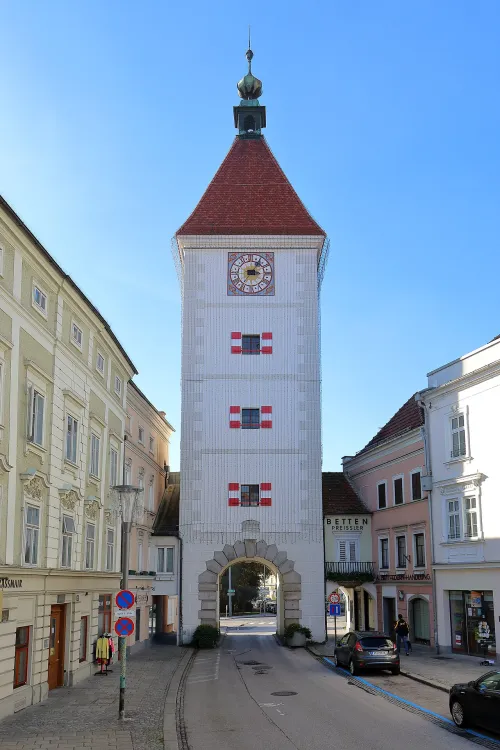
Stand in front of the Ledererturm and look up: 37.7 metres of tower on an almost square plan, four storeys high. On the first three floors you can count two windows each, one facing west and one facing east. The top floor has none of that pattern because it holds the clockwork. Then look at the keystone of the gate arch, where the year 1618 is carved. That date tells you when the tower got the shape you see today.
It is the last tower of the medieval town fortifications of Wels and today the town's best-known sight. Its name comes from the Lederer, the leather workers who lived in the Middle Ages in what are now Fabrikstraße and Schwimmschulgasse. The tower first appears in the records on 24 July 1326, and not for anything heroic: two Wels householders settled a court dispute over where their rainwater should drain. Bills for building and roof repairs survive from 1474, 1483, 1486 and 1491.
In 1610 fighting with the soldiers from Passau left the tower so damaged that it threatened to collapse. The Linz master mason Marx Martin Spaz rebuilt it in a project that began in 1616 and finished in 1619. A town fire in 1771 destroyed its onion dome, and the pyramid roof you see now replaced it. A mechanical clock went into the top floor in 1892 and was modernised in 1996.
The tower nearly vanished like its brothers. The Traunturm fell in 1842, the Fischerturm in 1870 and the Schmidtturm in 1875, all for the sake of traffic. When a demolition request was filed in 1904, residents and people with an eye for art protested, and subsidies from the education ministry and the district authority saved it. Every gate you walk through in Wels now is this one.
Pass through the arch and you are already on the square: the Stadtplatz Wels starts 80 m, about a minute, away.