Free Walking Tour Berlin: From the Wall to the Alex

Walk 9.8 km through a century of Berlin, from the preserved Wall strip on Bernauer Straße past the Reichstag and Brandenburg Gate to the TV Tower.

13 Stops 9.8 km ~2 h 16 min walking
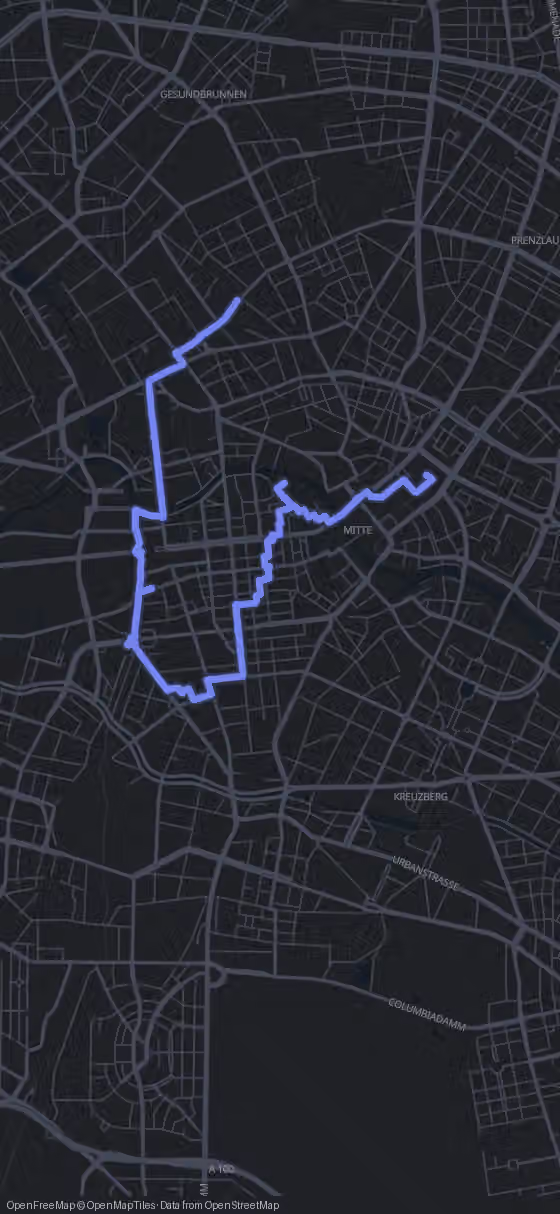
Route map for the Berlin walking tour
Stop 1 of 13
2.7 km·34 min
Berlin Wall Memorial
Head south-west toward the Reichstag Building
Willkommen to Berlin. I'm Alex, and this city has a talent for making its rulers' grand symbols turn against them.
Try this tour with Alex

What This Berlin Walk Covers

13 stops on foot, from the Berlin Wall Memorial on Bernauer Straße to Alexanderplatz: 9.8 km and 2 h 16 min of pure walking. With time at the memorials and two of the free exhibitions, plan around seven hours plus lunch.

Ten stops cost nothing. Museum Island, Berlin Cathedral and Berlin TV Tower charge entry. Route, map and GPS navigation are free in your browser; the AI Tour Guide is optional.

Open free GPS & optional AI Tour Guide
This short shows highlights of the route. All 13 stops follow below.

The Route

Walking Map of Berlin: Bernauer Straße to Alexanderplatz

13 stops 9.8 km 2 h 16 min walking
Tap to load interactive map

The 13 stops along this route

  1. Berlin Wall Memorial, stop 1 on the self-guided walking tour
    1Berlin Wall Memorial
  2. Reichstag Building in Berlin, stop 2 on the self-guided walking tour
    2Reichstag Building
  3. Brandenburg Gate in Berlin, stop 3 on the self-guided walking tour
    3Brandenburg Gate
  4. Memorial to the Murdered Jews of Europe in Berlin, stop 4 on the self-guided walking tour
    4Memorial to the Murdered Jews of Europe
  5. Potsdamer Platz in Berlin, stop 5 on the self-guided walking tour
    5Potsdamer Platz
  6. Topography of Terror in Berlin, stop 6 on the self-guided walking tour
    6Topography of Terror
  7. Checkpoint Charlie in Berlin, stop 7 on the self-guided walking tour
    7Checkpoint Charlie
  8. Gendarmenmarkt in Berlin, stop 8 on the self-guided walking tour
    8Gendarmenmarkt
  9. Bebelplatz in Berlin, stop 9 on the self-guided walking tour
    9Bebelplatz
  10. Museum Island in Berlin, stop 10 on the self-guided walking tour
    10Museum Island
  11. Berlin Cathedral, stop 11 on the self-guided walking tour
    11Berlin Cathedral
  12. Berlin TV Tower, stop 12 on the self-guided walking tour
    12Berlin TV Tower
  13. Alexanderplatz in Berlin, stop 13 on the self-guided walking tour
    13Alexanderplatz
  14. That's the full route.

    Walk it with an AI Tour Guide talking you through every one of these streets.

    Start free in your browser
    You made it

The Berlin Walking Tour Stop by Stop, from the Wall to the Alex

  1. 1

    Berlin Wall Memorial

    Berlin Wall Memorial, stop 1 on the self-guided walking tour

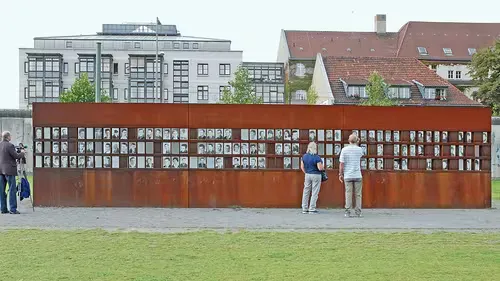
    Start where the division of Berlin is easiest to grasp: Bernauer Straße at the corner of Ackerstraße. The Berlin Wall Memorial runs along the former border strip, and where the Wall itself has gone, steel markers in the ground trace its line. Follow them and you are walking exactly where the border ran. Along the way you pass the Chapel of Reconciliation, the window of remembrance and, at the corner of Gartenstraße, the visitor centre.

    The heart of the site is a 60-metre section kept as it stood when the Wall fell. Read it from the west: a wall of L-shaped concrete elements, a strip of sand, the lit patrol road called the Kolonnenweg, a signal fence, the inner wall and a watchtower. You cannot walk into it; stainless steel closes off both ends. Looking in from outside is exactly the experience the strip was built for: nobody was meant to cross it.

    The federal government and the State of Berlin created the memorial in 1998, designed by the architects Kohlhoff & Kohlhoff for 2.2 million marks. It has since grown into a whole memorial landscape, organised around four themes: the Wall and the death strip, the destruction of the city, the building of the Wall, and what happened at it.

    The outdoor grounds are free, and so is the Documentation Centre. Give the outdoor section about 45 minutes, a little longer if you want the Documentation Centre's context before the rest of the day.

    Then comes the longest leg of the route: 2,610 metres, about 36 minutes, from the old border strip to the seat of the reunified parliament.
    Local name
    Gedenkstätte Berliner Mauer
    Hours
    Outdoor grounds: Mon–Sun 08:00–22:00; Visitor & Documentation Center: Tue–Sun 10:00–18:00, Mon closed
    Price
    Free
  2. 2

    Reichstag Building

    Reichstag Building in Berlin, stop 2 on the self-guided walking tour

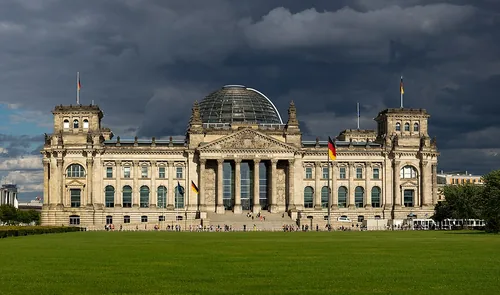
    The Neo-Renaissance block on Platz der Republik is the seat of the Bundestag, Germany's parliament, and the place where the Federal Convention meets to elect the German president. Paul Wallot designed it, and it was built between 1884 and 1894. On top sits the glass dome you can walk into, placed right above the plenary chamber; the idea came from the artist and architect Gottfried Böhm.

    The building's story is the story of German democracy breaking and returning. It housed the parliament of the German Empire and then of the Weimar Republic. In 1933 a fire badly damaged it, an event that helped the Nazi regime entrench itself. The Nazi Reichstag moved to the nearby Kroll Opera House and never came back. In the Battle of Berlin the building's symbolism made it a key target for the Red Army.

    After the war it stood in West Berlin, so neither German state could use it as a parliament. It was partly restored in the 1950s and used for exhibitions. Between 1995 and 1999 Norman Foster redesigned it for permanent use by the parliament of reunified Germany, and on 19 April 1999 the keys went to Bundestag president Wolfgang Thierse. One detail to remember: the word Reichstag, which goes back to the Holy Roman Empire, has not been used for a German parliament since the Second World War.

    The visit is free. If you have the time, the dome is worth it for anyone curious about how a parliament can literally sit under the public's feet; if not, it stays open late, so an evening return is easy. From here it is only 340 metres, about 5 minutes, to the Brandenburg Gate.

    Local name
    Reichstagsgebäude
    Hours
    Daily 08:00–24:00 (last entry 22:00)
    Price
    Free
  3. 3

    Brandenburg Gate

    Brandenburg Gate in Berlin, stop 3 on the self-guided walking tour

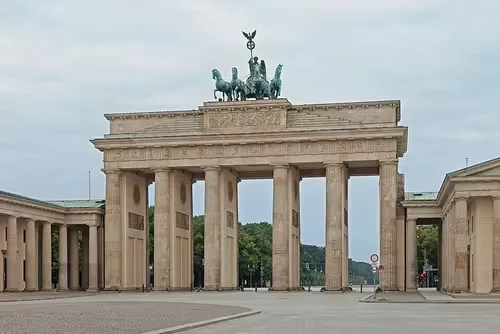
    The Brandenburg Gate is Berlin's best-known landmark and a German national symbol. King Friedrich Wilhelm II of Prussia had it built between 1789 and 1793 as the grand finish to the boulevard Unter den Linden, to designs by Carl Gotthard Langhans. On top stands the Quadriga, the four-horse chariot designed by the sculptor Johann Gottfried Schadow.

    Look at the columns and you see a shift in taste: the gate turns from Roman to Greek models and marks the start of classicism as Prussia's state architecture. It is also the only survivor of what were, in the end, 18 Berlin city gates. Walk through it to see both sides: Pariser Platz on one side, and the square named Platz des 18. März on the other, with the green of the Großer Tiergarten beyond.

    The gate's meaning changed with every era. Until the Second World War it stood above all for the end of Napoleon's rule between 1813 and 1815. During the Cold War it stood in the Soviet sector, directly on the border between East and West Berlin, where the Warsaw Pact and NATO faced each other at the most delicate point of their shared border. Since 1990 it has stood for overcoming the division of Germany and Europe.

    War damage was repaired by 1958, and a restoration of almost two years by the Stiftung Denkmalschutz Berlin was finished in 2002. It is open around the clock and free, so come back at night if you want it quieter. The Memorial to the Murdered Jews of Europe lies one block away: 550 metres, about 7 minutes.

    Hours
    Open 24/7
    Price
    Free
  4. 4

    Memorial to the Murdered Jews of Europe

    Memorial to the Murdered Jews of Europe in Berlin, stop 4 on the self-guided walking tour

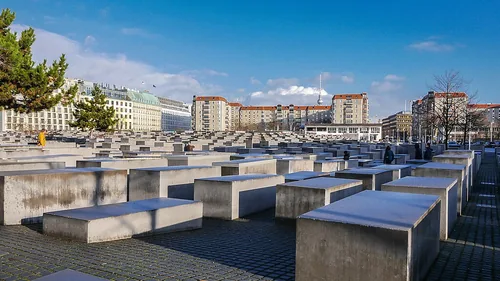
    From the edge, the memorial looks like a field of grey blocks. Walk in, and it changes. Peter Eisenman designed 2,711 concrete stelae on a sloping site of 1.9 hectares, laid out in a grid of 54 rows one way and 87 the other, set slightly askew. Some stelae barely reach your ankle at 0.2 metres, the tallest rise to 4.7 metres, and as the ground sinks, the city noise drops away. Go in alone if you can and let the paths separate you from your group for a moment.

    The original plan called for nearly 4,000 slabs; after recalculation, 2,711 were what could legally fit. Construction began on 1 April 2003 and was finished on 15 December 2004, at a cost of about €25 million. The memorial was inaugurated on 10 May 2005, 60 years after the end of the war in Europe, and opened to the public two days later.

    The ground has its own history. The memorial sits on the former death strip of the Berlin Wall, and during the Third Reich part of this area held Joseph Goebbels' city villa, with the Reich Chancellery and the Führerbunker not far away.

    The Field of Stelae is open around the clock. The underground Information Centre holds the names of about 3 million Jewish victims of the Holocaust, provided by Yad Vashem in Israel. It is free, and it is what gives the abstract field above its human faces; plan about 45 minutes. Potsdamer Platz is 620 metres, about 9 minutes, away.

    Local name
    Denkmal für die ermordeten Juden Europas
    Hours
    Field of Stelae: open 24/7; Information Centre: Tue–Sun 10:00–18:00 (last entry 17:15), Mon closed
    Price
    Free
  5. 5

    Potsdamer Platz

    Potsdamer Platz in Berlin, stop 5 on the self-guided walking tour

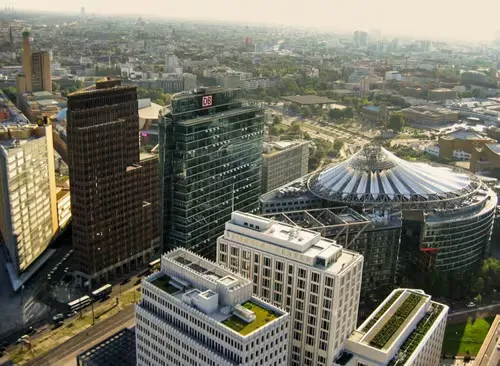
    Today's glass and steel towers stand on what was a wasteland for almost three decades. After 1990 the area was rebuilt along its historic street lines by a line-up of international architects, including David Chipperfield, Giorgio Grassi, Helmut Jahn, Hans Kollhoff, Rafael Moneo, Arata Isozaki, Renzo Piano and Richard Rogers. It counts as one of the most important building projects of the 1990s.

    The square began at a city gate, the Potsdam Gate of 1734. From the late 18th century the road to Potsdam started here, and in 1831 the square got its current name. With its long-distance station, underground station, trams and buses, it became one of the busiest squares in Europe until the end of the Second World War. That is why it got one of the first traffic lights on the continent in 1924, mounted on a traffic tower.

    In the first four decades of the 20th century, the square and its streets were a meeting point for Berlin's political, social and cultural scene. After the war it became a three-way corner of the Soviet, British and American sectors. From August 1961 the Wall ran straight across it.

    On the early morning of 12 November 1989, three days after the Wall opened, a piece of it was cleared away here and a temporary crossing point set up. The square is free and open around the clock; ten minutes of looking around is enough unless you want a break. The Topography of Terror is 840 metres, about 12 minutes, on.

    Hours
    Open 24/7
    Price
    Free
  6. 6

    Topography of Terror

    Topography of Terror in Berlin, stop 6 on the self-guided walking tour

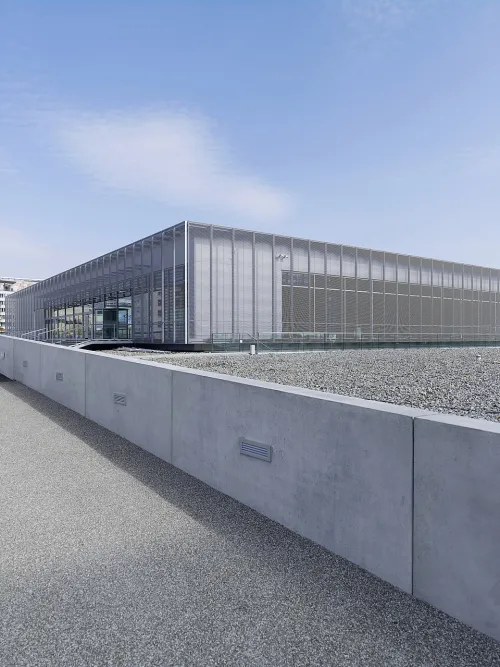
    This open site on Niederkirchnerstraße, once Prinz-Albrecht-Straße, was the control centre of Nazi terror. Between 1933 and 1945 the buildings here housed the SS Reich Security Main Office and the headquarters of the Gestapo, the SD, the Security Police and the Einsatzgruppen. Allied bombs largely destroyed them in early 1945, and the ruins were demolished after the war.

    Look along the street for a stretch of the Berlin Wall. The border between the American and Soviet sectors followed this street, and from 1961 to 1989 the Wall ran along its south side. Here it was never torn down. The section next to the site is the longest surviving piece of the outer wall, the side West Berliners actually saw; the longer East Side Gallery was part of the inner wall.

    The site was rediscovered in 1987, when the first exhibitions took place for Berlin's 750th anniversary. The cellar of the Gestapo headquarters, where many political prisoners were tortured and murdered, was found and excavated, and an open-air exhibition grew up under a protective canopy. A design by Peter Zumthor for a permanent museum was chosen in the 1990s, but money ran out after the concrete core was built; it stood unfinished for nearly a decade until it was demolished in 2004 and a new building begun.

    Entry is free. If you want to understand who ran the terror, not only who suffered it, give it about 45 minutes. Checkpoint Charlie is 790 metres, about 11 minutes, away.

    Local name
    Topographie des Terrors
    Hours
    Daily 10:00–20:00
    Price
    Free
  7. 7

    Checkpoint Charlie

    Checkpoint Charlie in Berlin, stop 7 on the self-guided walking tour

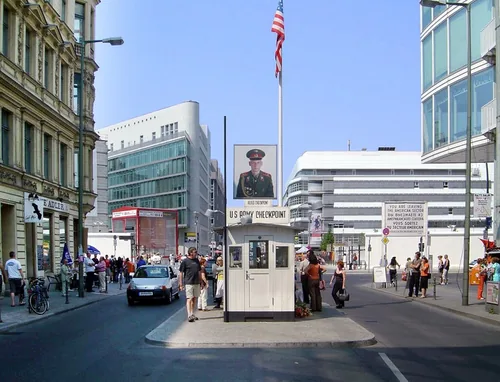
    Checkpoint Charlie was the Western name for the best-known crossing point between East and West Berlin, and it became a symbol of the Cold War itself. The guard house you see today is not the original: the American guard house was moved to the Allied Museum in the Dahlem neighbourhood.

    The reason for the Wall is written in numbers. Between 1949 and 1961 more than two and a half million East Germans fled to the West: 144,000 in 1959, 199,000 in 1960 and 207,000 in just the first seven months of 1961. They were often young and well trained: engineers, doctors, teachers, skilled workers. East German leader Walter Ulbricht pushed Moscow until it allowed the Wall in 1961 to stop the drain.

    Here the Cold War almost turned hot: in the Berlin Crisis of 1961, Soviet and American tanks briefly faced each other at this crossing. On 26 June 1963, President John F. Kennedy came here and looked from a platform over the Wall into East Berlin, on the same day he gave his Ich bin ein Berliner speech.

    The site is free and open around the clock. Ten minutes is enough; the story matters more than what is left to see. From here it is 860 metres, about 12 minutes, to Gendarmenmarkt.

    Hours
    Open 24/7
    Price
    Free
  8. 8

    Gendarmenmarkt

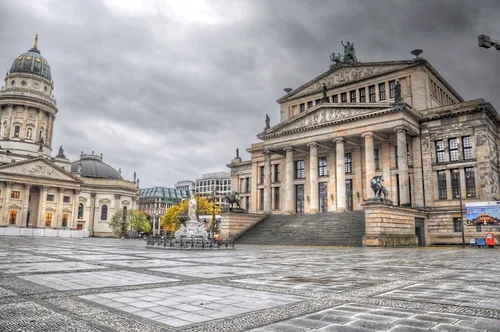
    Gendarmenmarkt in Berlin, stop 8 on the self-guided walking tour

    After Checkpoint Charlie, Gendarmenmarkt feels like a different city. Three grand buildings frame the square: the French Church, the German Church and, between them, the concert hall, with a monumental statue of the poet Friedrich Schiller in front. Johann Arnold Nering laid out the square in 1688 as a market for the new Friedrichstadt quarter; Georg Christian Unger reshaped it in 1773. The name comes from the Gendarmen, a Prussian cuirassier regiment that kept its stables here until that year.

    Neither church was ever a cathedral, despite the German name Dom. Here the word refers to the domed towers, which Carl von Gontard added to both in 1785, a legacy of the French-speaking Frederick the Great. The French Church is the older one, built by the Huguenot community between 1701 and 1705 and modelled on their destroyed church in Charenton-Saint-Maurice in France. Today it has a viewing platform, a restaurant and a Huguenot museum.

    The pentagonal German Church opposite belonged to the Lutheran community, designed by Martin Grünberg and built in 1708 by Giovanni Simonetti. Fire destroyed it completely in 1945; it was rebuilt after reunification, finished in 1993 and reopened in 1996 as a museum of German history. The Konzerthaus is the youngest building here, built by Karl Friedrich Schinkel in 1821 as a theatre.

    Nearly every building on the square was badly damaged or destroyed in the war, and all have been restored. The square is free and open around the clock. Bebelplatz is 500 metres, about 7 minutes, on.

    Hours
    Open 24/7
    Price
    Free
  9. 9

    Bebelplatz

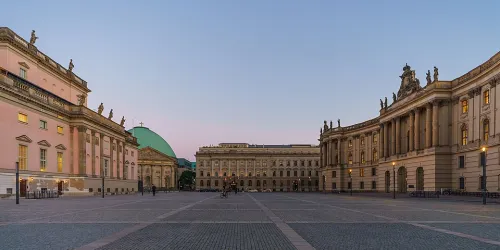
    Bebelplatz in Berlin, stop 9 on the self-guided walking tour

    Bebelplatz is the open square beside the State Opera, which it wraps around; that is why Berliners long called it Opernplatz. After the Second World War it was renamed after August Bebel, one of the founders of the Social Democratic Party in the 19th century. Turn around and you can read the square's frame: the Prinzessinnenpalais, the Old Library and the Old Palace, and St. Hedwig's Cathedral, the first Catholic church built in Prussia after the Reformation.

    The square shows a king's plan that did not work out. Frederick the Great wanted a much larger Forum Fridericianum here, but his distant cousin, the Margrave of Brandenburg-Schwedt, refused to sell his palace for demolition. The king had to plan around the house and scale everything down. In return, he made his cousin give up his garden and some outbuildings, and the Royal Library rose right behind the margrave's house. Laid out between 1741 and 1743, the slightly cramped square has survived almost unchanged.

    On the nearby stretch of Unter den Linden, look for the trees that are missing. The old Baroque city fortifications ran here, and on the stretch toward the Berlin Palace there are still no linden trees; the avenue starts where it once began, outside the fortress walls.

    The square is free and open around the clock. Museum Island is 790 metres, about 11 minutes, away.

    Hours
    Open 24/7
    Price
    Free
  10. 10

    Museum Island

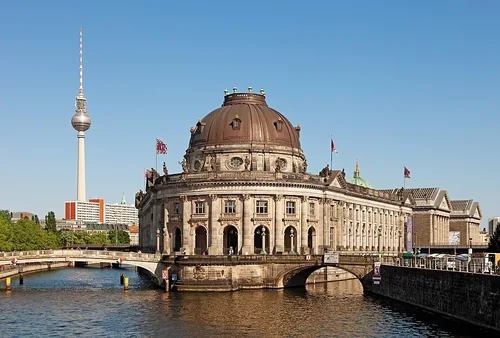
    Museum Island in Berlin, stop 10 on the self-guided walking tour

    The northern tip of the Spree island holds five museums built between 1830 and 1930 to plans by five architects: the Altes Museum, the Neues Museum, the Alte Nationalgalerie, the Bode-Museum and the Pergamon Museum. In 1999 the ensemble became a UNESCO World Heritage Site as a record of how the museum itself developed as an idea in the 19th and 20th centuries. The Berlin Cathedral and the open Lustgarten park are on the island too, and across the water stands the German Historical Museum.

    Two buildings tell the story best. The Altes Museum opened on 3 August 1830 as the Royal Museum, built under Karl Friedrich Schinkel, and was renamed in 1841. The Neues Museum, finished in 1859 to plans by Schinkel's student Friedrich August Stüler, was destroyed in the war; David Chipperfield rebuilt it for the Egyptian Museum, and it reopened in 2009. In 2019 the James Simon Gallery, by a sixth architect, opened as the new visitor centre.

    Walking around the island is free at any hour. The museums charge entry, and the Museum Island ticket pays off as soon as you see two museums the same day. Staying three days with three museums in mind, for example adding the Berlinische Galerie, the Museumspass Berlin beats single tickets. Special exhibitions can cost extra on top.

    On the long route, one museum is realistic at most; art and archaeology fans are better off saving the island for its own day. The Berlin Cathedral is 660 metres, about 9 minutes, from here.

    Local name
    Museumsinsel
    Hours
    Outdoor grounds: open 24/7; Museums: Tue–Sun 10:00–18:00, Mon closed
    Price
    24 EUR full, 12 EUR reduced
  11. 11

    Berlin Cathedral

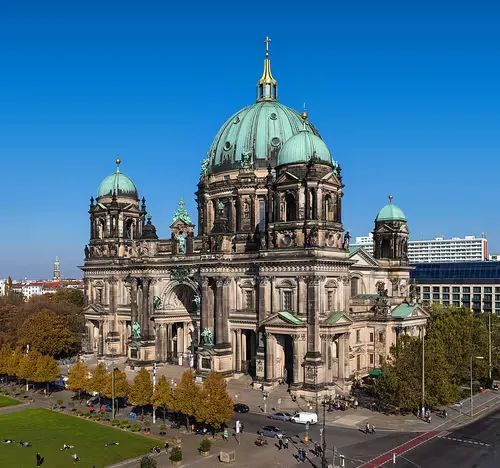
    Berlin Cathedral, stop 11 on the self-guided walking tour

    The huge domed church at the Lustgarten is the largest Protestant church in Germany and the burial place of the Hohenzollern dynasty. Emperor William II had it built between 1894 and 1905 to plans by Julius Raschdorff, in a mix of Renaissance and Baroque Revival. Its roots go back to the chapel of the Berlin Palace; since the 15th century several buildings have housed the church on this site.

    Despite its name, it has never been a cathedral in the strict sense, because no bishop has ever had his seat here. The German word Dom simply means a collegiate church. Today the building has three parts: the large Sermon Church in the centre, the smaller Baptismal and Matrimonial Church on the south side, and the Hohenzollern crypt, which takes up almost the entire basement. A fourth part, the Memorial Church on the north side, was demolished by the East German authorities in 1975.

    Allied bombing damaged the church in the Second World War, and its original interior was restored by 2002. It is still used for services, state ceremonies and concerts.

    The Cathedral charges entry. Go in if you want the full sweep of imperial pomp and the royal crypt; give it about 45 minutes. If you are short on time, the exterior alone tells you a lot. The TV Tower is 760 metres, about 11 minutes, away.

    Local name
    Berliner Dom
    Hours
    Mon–Sat 09:00–18:00, Sun 12:00–18:00; last entry 60 min before closing
    Price
    15 EUR full, 12 EUR reduced
  12. 12

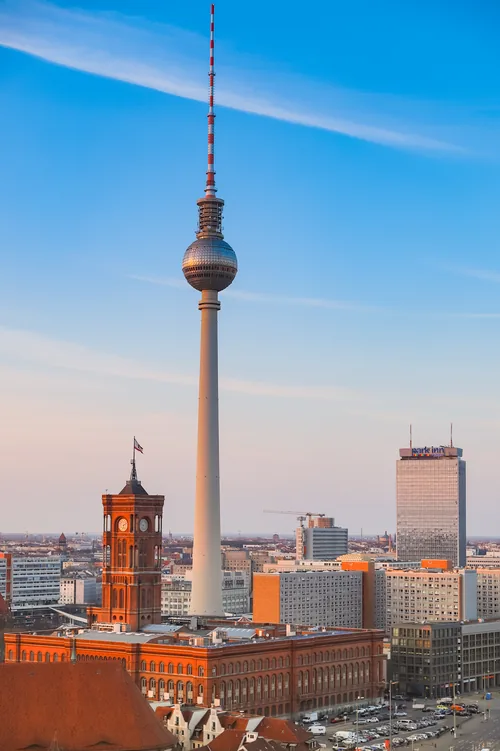
    Berlin TV Tower

    Berlin TV Tower, stop 12 on the self-guided walking tour

    At 368 metres, the Berlin TV Tower is the tallest structure in Germany. When it was finished in 1969 it was the second-tallest TV tower in the world. The postal service of the GDR built it between 1965 and 1969 on the site of the demolished Marienviertel quarter, and it opened on 3 October 1969. Internally it went by the plain name Fernmeldeturm 32.

    Its meaning changed with the city. It began as a political symbol of East Germany and became, after reunification, a symbol of the whole of Berlin. Film opening scenes use it alongside the Brandenburg Gate and the Reichstag to say Berlin at a glance, and it has been a listed monument since 1979. More than a million people visit it every year.

    Up in the sphere, the viewing floor with a bar sits at 203 metres, and a revolving restaurant turns at 207 metres. Tickets are not cheap, but they are worth it if you really want to be up in the sphere and see the whole city from the top.

    If what you want is a skyline view with the TV Tower in the picture, the Panoramapunkt is a cheaper alternative: a lift takes you to an open viewing platform at about 100 metres, a different experience from the closed sphere. Alexanderplatz is just 500 metres, about 7 minutes, on.

    Local name
    Berliner Fernsehturm
    Hours
    Daily 09:00–23:00; closed Nov 23
    Price
    From 27.50 EUR
  13. 13

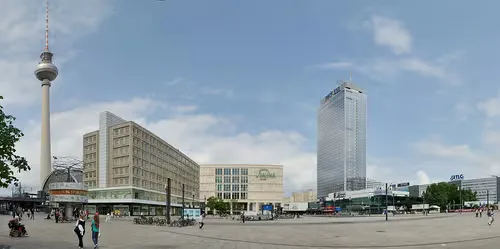
    Alexanderplatz

    Alexanderplatz in Berlin, stop 13 on the self-guided walking tour

    The walk ends at the Alex, as Berliners call Alexanderplatz. The square goes back to the space in front of the King's Gate and got its name in 1805 after the Russian Tsar Alexander I. Allied air raids badly damaged it and the buildings around it in the Second World War.

    What you see today is mostly East Berlin planning. In the 1960s the city administration redesigned the entire area, sparing only the Alexanderhaus and the Berolinahaus, and turned a busy roundabout into a pedestrian zone of about eight hectares, four times the old size. The Interhotel Stadt Berlin and the Centrum department store went up by 1970; they live on as the Park Inn and Galeria Kaufhof.

    The Alex is still a crowd magnet: in 2009 more than 360,000 people crossed it every day, making it the fourth-busiest square in Europe. One common mix-up: the park with the Neptune Fountain, St. Mary's Church and the Red Town Hall, behind the S-Bahn station, is not part of Alexanderplatz.

    From here the S-Bahn and U-Bahn stations take you onward. If you want to go back to Museum Island, the U5 gets you there; a Kurzstrecke short-trip ticket for up to three stations is cheaper than a regular single.

    Hours
    Open 24/7
    Price
    Free
Walking tour route map of Berlin Route loaded
Berlin Wall MemorialReichstag BuildingBrandenburg GateMemorial to the Murdered Jews of Europe+9
All 13 stops are already on the map.
You just press start.
AI Tour Guide

You know the route now. Walk it with a guide talking you through Berlin.

Press start wherever you are, even hundreds of kilometres from Berlin, and the guide begins telling its stories right away. In the city, pick any of the 13 stops to start from: it leads you there, then talks with you the whole route, asking, listening, remembering, and shaping the tour around your answers.

13stops 9.8km 2 h 16 minwalking 13languages
▶Start the tour free

Free to start · Runs in your browser · No app, no download

Shorter Ways to Walk This Berlin Route

The full route fills a day. Each of these cuts is a clean section of the same route, so the GPS navigation guides you just the same.

Skip the long opening leg

Stops: 2, 3, 4, 5, 6, 7, 8, 9, 10, 11, 12, 13

For a shorter day, or if you would rather see the Wall at the Topography of Terror than on Bernauer Straße. Starting at the Reichstag Building cuts the 36-minute first leg and leaves 7.2 km, about 1 h 40 min of walking. All three paid sights stay on the route.

Wall, dictatorship and division

Stops: 1, 2, 3, 4, 5, 6, 7

For history readers, or day one of a two-day plan. From the Berlin Wall Memorial to Checkpoint Charlie: 5.8 km and 1 h 20 min on foot, and every stop and exhibition on it is free.

Prussian Berlin and the East

Stops: 8, 9, 10, 11, 12, 13

For a relaxed afternoon or day two: Gendarmenmarkt to Alexanderplatz is only 3.2 km and 45 minutes of walking, which leaves time for the museums. Museum Island, the Cathedral and the TV Tower are all on this half.

How Long Does This Berlin Tour Take on Foot?

Pure walking time is 2 h 16 min over 9.8 km. If you only look from outside, you are done in about four hours. The realistic day includes the Wall Memorial grounds, about 45 minutes each in the Holocaust memorial's Information Centre and the Topography of Terror, and a Cathedral visit: around seven hours plus lunch.

The one fixed point is reaching the Cathedral before its last entry. Start at the Berlin Wall Memorial at 10:00, take a 45-minute lunch, and you reach the Cathedral around 16:15 and Alexanderplatz around 17:30. The TV Tower stays open well into the evening, so going up at the end of the day works.

With the same visits, skipping the opening leg makes a day of a little under six hours. Split over two days, the Wall and dictatorship half takes about four hours; the eastern half takes about two and a half, plus whatever time you give a museum or the TV Tower.

Before You Set Off in Berlin

  • Start and finish: The recommended start is the Berlin Wall Memorial on Bernauer Straße at the corner of Ackerstraße; the walk ends at Alexanderplatz, so it is a one-way route, not a loop. You can join at any stop, but this order tells the story best.
  • Best days: Any day works for the outdoor stops. The Wall Memorial's Documentation Centre, the Holocaust memorial's Information Centre and the Museum Island museums each have a weekly closing day, and the Cathedral opens later on some days, so plan your date around the indoor visits you care about.
  • Costs: The walk and ten of the stops cost nothing. You only pay entry at three sights: Museum Island, the Cathedral and the TV Tower.

Food and Breaks Along the Berlin Route

A day this long needs a lunch plan. Currywurst is the obvious Berlin snack, but where you buy it changes the price, and a cheap beer is easy to find once the walking is done.

Curry 36 on MehringdammA long-running Kreuzberg snack bar where currywurst with fries costs noticeably less than at the checkpoint. Not worth a special trip across town; fit it in when part of your Berlin stay takes you to Kreuzberg anyway.
Späti beerBerlin's corner shops, the Spätis, sell cheap beer. Good for a park bench or canal-side break you were planning anyway, though not a replacement for an evening in a pub.
Kachel-Eck in Prenzlauer BergFor a proper pub evening after the walk: a table and draught beer, with Schultheiss or the house beer by the half litre.

Berlin Tourist Traps to Avoid on This Walk

  • Currywurst at Charlie's Beach: Currywurst and fries here are on the pricey side: you pay for the beach-bar setting at the checkpoint. If you simply want currywurst and fries, buy it elsewhere. (At Checkpoint Charlie)
Walking tour route map of Berlin
AI Tour Guide

Your guide is ready when you are, at the Wall or at the Alex.

Press start and a voice AI Tour Guide takes it from here: leading the route through Berlin, telling the stories, and turning your walk into a real back-and-forth conversation. No app or download is needed; it runs in your browser.

13stops 9.8km 2 h 16 minwalking 13languages
▶Start the tour free

Free to start · Runs in your browser · No app, no download

What the AI Tour Guide Adds Between the Wall and the Alex

On this route the Nazi years, the divided city and Prussian Berlin overlap at almost every corner, and the AI Tour Guide ties them together as a conversation. It greets you on Bernauer Straße, tells the stories of each place, asks whether the Wall or the older city pulls you in more and remembers your answer at the next stop. Bring it questions the route text leaves open, such as what everyday life was like for families in the houses along the border, and interrupt whenever you like. You start with 100 free credits; after that you pay €19.99 for this tour with no time limit, or €5 per hour.

A Real Conversation A voice AI Tour Guide greets you, leads the whole route, and tells the stories and facts as you walk, asking what you want to see and keeping a real conversation going. Not a recording you press play on.
Map Navigation Follow the route on the map and walk at your own pace. You choose where to start and when to move to the next stop.
Ask Anything Curious about a building you pass? Ask your AI Tour Guide on the spot and the conversation carries on.
13 Languages Switch language anytime. No separate tour needed.
Start free in your browser

Common Questions About Walking Berlin

Can I see the Pergamon Museum on this walk?

No. The Pergamon Museum is currently closed, and a first part will reopen before the rest. The separate panorama exhibition is not a substitute for the museum itself.

Is there still a free museum Sunday in Berlin?

No. The last general museum Sunday took place on 1 December 2024, so plan to pay regular admission for Museum Island.

Is the Berlin WelcomeCard worth it for this tour?

Only if you will really use the discounts. The 48-hour AB WelcomeCard costs more than two consecutive AB 24-hour tickets, and since most stops here are free, the card only pays off if the partner discounts you actually use cover the difference.

Which public transport ticket do I need for a day in Berlin?

Zones AB cover the city. The AB 24-hour ticket runs for 24 hours from validation and beats single tickets from the third ride. For four rides spread over your stay, the 4-trip ticket is cheaper. You only need ABC for BER airport or trips like Potsdam. Four or five people travelling together save with a small-group day ticket.

Do children need their own transport tickets?

Often not. One adult AB day ticket lets you take up to three children along, and young children ride free anyway.

Is the tour really free?

Yes. The whole tour is free: the route, the interactive map and the navigation cost you nothing. Only the voice AI Tour Guide is optional and paid: you test it with 100 free credits, then you pay either €5 per hour or €19.99 for this whole tour, with no time limit. Admission to 3 of the 13 stops is not included: Museum Island, Berlin Cathedral and Berlin TV Tower charge their own entry fees.

Do I need to download an app?

No. Everything runs in your phone browser. Open the route and start walking, no download and no sign-up required.

Do I need to book the walking tour in advance?

No booking needed. This self-guided tour is available anytime. Open the route in your browser and start walking. The AI Tour Guide works instantly, no app, no reservation required.

What languages is the AI Tour Guide available in?

The AI Tour Guide speaks 13 languages, so you take the tour in your own language and can switch at any time.

Can I skip stops or change the route?

Yes. Skip any stop, spend extra time at places you like, or start the route from any point. It is your walk, you set the pace.
Image credits
▶ Start free in your browser Runs in your browser, no app, no download