Free Walking Tour Tübingen: Castle Hill to the Neckar

Nine stops, 2.8 km: from the market square up the Schlossberg past Goethe's garden house, then down to the river where Hölderlin lived for 36 years.

9 Stops 2.8 km ~41 min walking
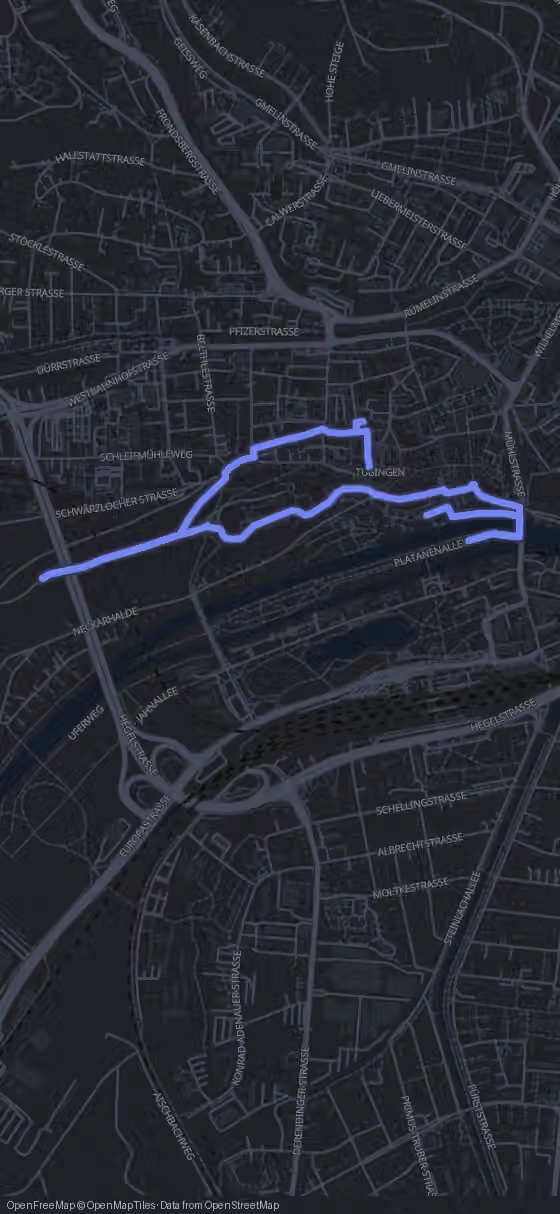
Route map for the Tübingen walking tour
Stop 1 of 9
140 m·2 min
Marktplatz
Head north across the square to the Kornhaus
Welcome to Tübingen. I'm Alex, and one yellow tower by the Neckar became a poet's final refuge.
Try this tour with Alex

The route at a glance

This free walking tour of Tübingen links 9 stops over 2.8 km, from the Marktplatz up to Schloss Hohentübingen and back down to the Neckarfront. Pure walking time is 41 min; with a few interiors, plan on about 2¾ hours.

Everything outdoors is free, and so are the Kornhaus and the Hölderlinturm; the museum in the castle and the tower of the Stiftskirche charge entry. Route, map and GPS navigation run free in your browser, and the AI Tour Guide is an optional extra.

Open free GPS & optional AI Tour Guide
View of Tübingen

The Route

Walking Map of Tübingen: Old Town, Castle Hill and River

9 stops 2.8 km 41 min walking
Tap to load interactive map

The 9 stops along this route

  1. Marktplatz in Tübingen, stop 1 on the self-guided walking tour
    1Marktplatz
  2. Kornhaus in Tübingen, stop 2 on the self-guided walking tour
    2Kornhaus
  3. Goethehäuschen in Tübingen, stop 3 on the self-guided walking tour
    3Goethehäuschen
  4. Schloss Hohentübingen, stop 4 on the self-guided walking tour
    4Schloss Hohentübingen
  5. Alte Aula in Tübingen, stop 5 on the self-guided walking tour
    5Alte Aula
  6. Stiftskirche in Tübingen, stop 6 on the self-guided walking tour
    6Stiftskirche
  7. Platanenallee / Neckarinsel in Tübingen, stop 7 on the self-guided walking tour
    7Platanenallee / Neckarinsel
  8. Hölderlinturm in Tübingen, stop 8 on the self-guided walking tour
    8Hölderlinturm
  9. Neckarfront in Tübingen, stop 9 on the self-guided walking tour
    9Neckarfront
  10. That's the full route.

    Walk it with an AI Tour Guide talking you through every one of these streets.

    Start free in your browser
    You made it

Your Tübingen Walking Tour in Nine Stops

  1. 1

    Marktplatz

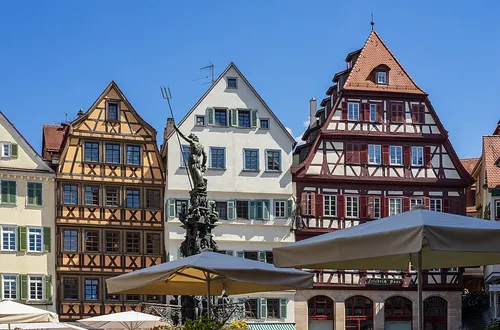
    Marktplatz in Tübingen, stop 1 on the self-guided walking tour

    You start in the middle of things. The Marktplatz is the historic market square of Tübingen's old town, a pedestrian zone with no gate, no ticket and no queue, just the town arranged around you. That is exactly why it works as the anchor for the whole walk.

    Take a moment to fix the shape of the route in your head, because it makes the lanes far less of a puzzle. First one stop deeper into the old town, then up the Schlossberg to a garden house and a castle, then back down through the university quarter to the church, and finally out to the river.

    The Rathaus looks onto the square, which is also home to the Wochenmarkt. From here it is only 140 m, about 2 minutes, to the Kornhaus.

    Hours
    24/7
    Price
    Free
  2. 2

    Kornhaus

    Kornhaus in Tübingen, stop 2 on the self-guided walking tour

    The Kornhaus began life as a granary, and its growth is part of its story. In 1453 the town set up a roofed trading floor for grain beside the Ammer canal. A cross wing followed in 1512, and the two houses were raised by a storey in 1564 and 1607.

    The upper floor was the town's party room, used for festivities, dances and theatre. Students put on plays here, and so did travelling actors. Martin Crusius recorded two student productions: Susanna by Sixtus Birck, and a rhymed Doctor Faustus by an unknown author, printed in Tübingen by Alexander Hock in 1588 and staged the same year. Also in 1588 a troupe led by Andreas Rhot from Sachsa played a tragedy of the Rich Man and Lazarus, and in 1596 an English company performed love comedies with Duke Friedrich himself in the audience.

    Later lives followed one after another. From the 18th century part of the building served as a school, first for boys, then for girls, then as a Realschule, while the grain market held on until it finally moved out in 1892. The fire brigade took over the ground floor, and later the Red Cross.

    Between 1985 and 1991 archaeologists dug here and building historians studied the fabric. The architect Johannes Manderscheid from Rottenburg then converted it with respect for what survived and without reconstructing what was lost. Since 1991 it has housed the Stadtmuseum Tübingen.

    Entry is free, so step in if you want the town's story before you head up the hill. Then the route turns uphill: 870 m, about 14 minutes, up the Schlossberg to the Goethehäuschen.

    Hours
    Wed–Sun 11:00–17:00, Mon–Tue closed
    Price
    Free
  3. 3

    Goethehäuschen

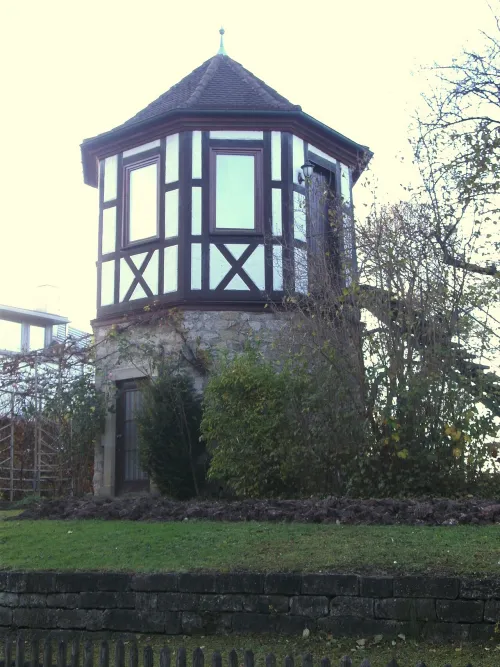
    Goethehäuschen in Tübingen, stop 3 on the self-guided walking tour

    Up on the ridge of the Schlossberg, west of the old town and the castle, stands a small octagonal garden house. Its everyday name comes from a single afternoon: on 7 September 1797 Goethe came past on a walk while visiting his publisher, Johann Friedrich Cotta, in Tübingen.

    At that time the house belonged to Christian Gottlieb Gmelin, professor of chemistry and pharmacy and an apothecary. In 1870 an innkeeper bought it and crowned it with battlements, which disappeared again in the first half of the 20th century.

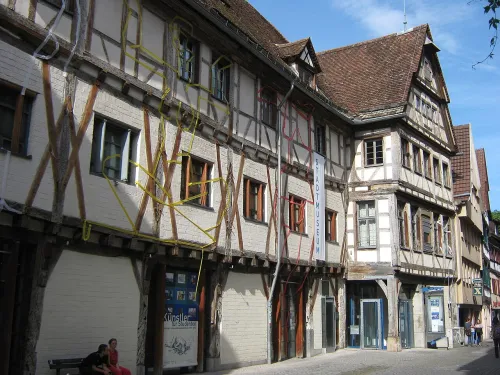
    In 1957 the town bought the plot to save it from planned redevelopment and restored the house in 1961, changing it substantially. The half-timbering you see now was exposed then, although older records show the house did not look like that before. Today it is a listed monument.

    You see it from the outside; the interior opens only for readings and cultural events, and a new cultural use is planned. From here it is 570 m, about 8 minutes, along the hill to Schloss Hohentübingen.

    Hours
    Exterior viewable 24/7 (interior accessible for cultural events/readings only)
    Price
    Free
  4. 4

    Schloss Hohentübingen

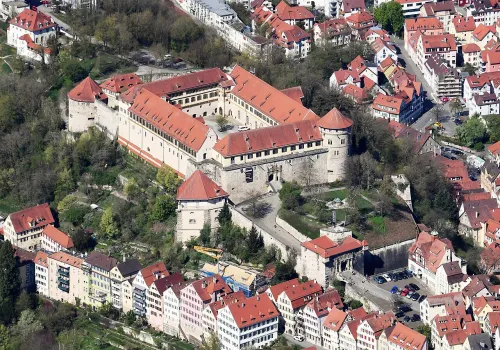
    Schloss Hohentübingen, stop 4 on the self-guided walking tour

    Schloss Hohentübingen sits on a spur of rock right in the heart of the town, together with its Protestant castle church. A medieval castle rose here from the 11th century, probably around 1037. At first it was ringed only by wooden palisades; the stone walls came in the 12th and 13th centuries.

    The castle enters the written record with a siege. In 1078 King Henry IV besieged a castle called Duwingen during the Investiture Controversy, and a chronicle from Trier notes that Archbishop Udo of Trier died during that siege. The Counts of Tübingen appear in 1081 and were raised to Counts Palatine by King Conrad III in 1149.

    Debt ended their rule: in 1342 they sold town and castle to the Counts of Württemberg, later dukes, who used Hohentübingen as a residence alongside Stuttgart and Urach. Little is known of the earlier castle's appearance beyond its chapel, consecrated in 1178 and older than the first Romanesque church on the site of the Stiftskirche. In the 16th century the old castle was replaced by a new building, a mix of fortress and early modern palace, reusing the old outer walls.

    The grounds are free and worth a wander. The Museum Alte Kulturen inside charges entry and is a good use of an hour if ancient cultures are your thing. From here the route drops 380 m, about 5 minutes, into the university quarter to the Alte Aula.

    Hours
    Castle grounds daily 07:00–20:00; Museum Alte Kulturen Wed–Sun 10:00–17:00, Thu 10:00–19:00, Mon–Tue closed
    Price
    Castle grounds free; Museum Alte Kulturen adults 5 EUR, reduced 3 EUR, family 12 EUR, Tübingen students free
  5. 5

    Alte Aula

    Alte Aula in Tübingen, stop 5 on the self-guided walking tour

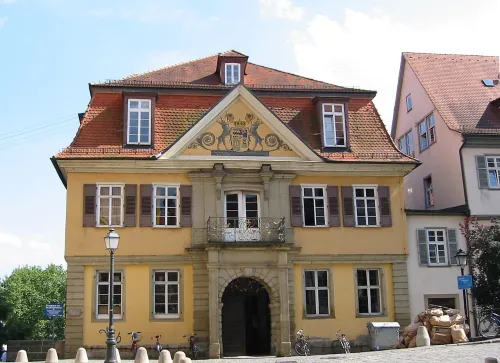
    At Münzgasse 30 stands the Alte Aula, the old main building of Eberhard Karls University. It was probably built in 1547 on the remains of two earlier buildings: one from 1477, the founding year of the university, and a younger one that burned down in 1534.

    Look up at the side facing the Münzgasse. That is the show front, with the ducal coat of arms set in a triangular gable on the mansard roof. It dates from a makeover for the university's 300th anniversary in 1777, when Duke Carl Eugen of Württemberg had his court architect Reinhard Ferdinand Heinrich Fischer rebuild and extend the building. The renewed Aula Nova was the duke's anniversary gift to his university.

    Until 1819 the lower floors housed the university library, which then moved into rooms at the castle you have just left. The building remained the university's main seat until the Neue Aula was completed in 1845.

    Today it is a protected monument still used by the university, mainly for its Institute of Education. The interior opens only for university events and guided visits, so this is a stop for the facade. The Stiftskirche is just 70 m away, a minute's walk.

    Hours
    Exterior viewable 24/7; interior access only during scheduled university events, academic use, or guided tours
    Price
    Free
  6. 6

    Stiftskirche

    Stiftskirche in Tübingen, stop 6 on the self-guided walking tour

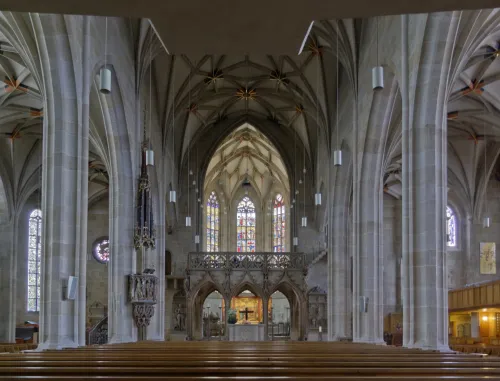
    The Stiftskirche of St. George took its present form between 1470 and 1490 under Count Eberhard im Bart. Two events drove the building: the canons' chapter moved here from Sindelfingen, and the count founded the university. Peter von Koblenz and Hans Augsteindreyer are named as the master builders of this late Gothic hall church, still the town's Protestant parish church.

    The oldest part is the bell tower, begun in 1411. Keep an eye on it: you will see it again from the river, rising over the rooftops of the Neckarfront.

    Two churches stood here before. During renovations in 1962 and 1964, excavations led by Urs Boeck uncovered both Romanesque predecessors. The older one, probably from the 11th century, was a three-aisled basilica. In the middle of its choir, right under the altar, lay a walled sarcophagus holding what looked like a three-legged person. The extra leg soon turned out to belong to an earlier, incomplete burial, but by then the legend of the three-legged Utz had already settled into local talk.

    A chapel on this spot is first recorded in 1188 and became Tübingen's parish church in 1191. The church is free and worth a short look inside; the tower charges entry and opens only at set times. From here it is 350 m, about 5 minutes, down to the river and the Platanenallee on the Neckarinsel.

    Hours
    Daily 09:00–17:00 (Easter to Thanksgiving / Erntedankfest); rest of year daily 09:00–16:00. Tower and choir usually Sat–Sun 13:00–17:00 (weather permitting)
    Price
    Church free; tower 2 EUR full (groups/tower climb), choir/special access may vary
  7. 7

    Platanenallee / Neckarinsel

    Platanenallee / Neckarinsel in Tübingen, stop 7 on the self-guided walking tour

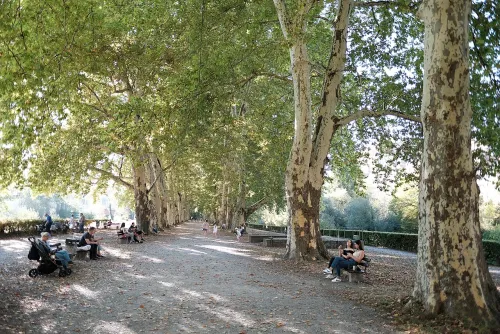
    The Platanenallee runs along the Neckarinsel, parallel to the old town's river front, from the Eberhardsbrücke to the Silcher monument, where the path continues into the little wood called the Seufzerwäldchen. The huge old plane trees make it a place for strolling and a game of boules, and it gives you a view straight across to the Neckarfront. In summer people sit in the grass and watch the punts, the rowers, the swans and the ducks.

    At nearly 200 years old, this is the oldest surviving plane tree avenue in Germany. At one point there were plans to fell the trees as supposedly past their age limit and replace them. After protests the town chose special care instead: look closely and you will spot discreet steel cables linking some of the widest trees so they steady one another.

    For a long time guides told visitors that the town's last executioner, Johann Georg Friedrich Belthle, planted the avenue. He died in 1824, though, and a tree-ring study commissioned from the University of Hohenheim showed that the trees germinated between 1822 and 1824 and were planted in 1828. The local paper ran the result on 25 May 2013 under a headline calling the avenue the young venerable one, with the verdict that the executioner story was wrong. An engraving from 1832 already shows the young trees.

    Towards the east, near a spot called the Nadelöhr, stands a pigeon tower where eggs are taken from the nests to keep numbers down. From the eastern end you get a clear view and a good photo of the Hölderlinturm, which is 330 m, about 5 minutes, away.

    Hours
    24/7
    Price
    Free
  8. 8

    Hölderlinturm

    Hölderlinturm in Tübingen, stop 8 on the self-guided walking tour

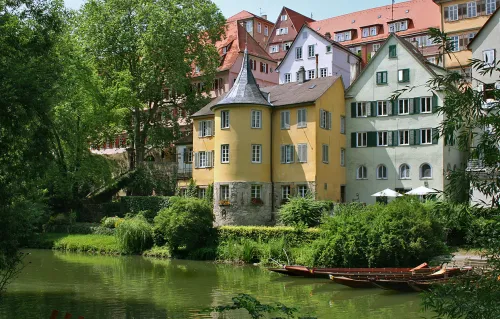
    This tower on the river front was home to the poet Friedrich Hölderlin for the last 36 years of his life, from 3 May 1807 until his death in 1843. The building goes back to the 13th century, and its stone base is part of the medieval town wall that once ran along the Neckar.

    On 15 September 1806 his family had him committed to the clinic of the physician Johann Autenrieth. He was released in May 1807 with a diagnosis of incurable illness and at most three years to live. At about the same time a 34-year-old master carpenter, Ernst Friedrich Zimmer, bought the house. Zimmer later wrote that he visited Hölderlin in the clinic and felt deeply sorry that such a beautiful and splendid mind should perish, and that Autenrieth, seeing nothing more to be done, suggested he take the poet into his home.

    Hölderlin moved in the day after his release and lived on the first floor. In these years he often signed his writing as Scardanelli. Students came over from the nearby Tübinger Stift, the very school he had once attended. One visit by Eduard Mörike and Wilhelm Waiblinger later found its way into a 1914 short story by Hermann Hesse.

    Entry is free, and anyone who knows a few Hölderlin lines should go in; even without that, the story of the carpenter who took in a poet given three years makes the visit worthwhile. The Neckarfront begins just 80 m away, a minute on foot.

    Hours
    Thu–Mon 11:00–17:00, Tue–Wed closed
    Price
    Free
  9. 9

    Neckarfront

    Neckarfront in Tübingen, stop 9 on the self-guided walking tour

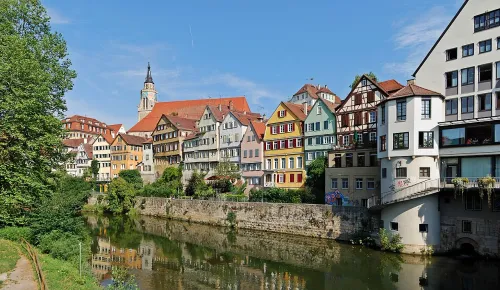
    You finish at the picture Tübingen is known for. The Neckarfront is a row of tall, gabled houses lining the river from the Eberhardsbrücke upstream to the Hölderlinturm, where the punts tie up. On the river side the houses sit on what is left of the old town wall, and the tower of the Stiftskirche rises over the whole ensemble.

    Behind the houses, away from the water, run the Neckargasse and the Bursagasse; the Zimmertheater Tübingen is at Bursagasse 16. Further upstream the Alte Burse and the Evangelisches Stift follow, then a closed row of houses along the Neckarhalde, all crowned by Schloss Hohentübingen, where you stood a little earlier.

    A footpath runs along the front between the Eberhardsbrücke and the Hölderlinturm, edged on the river side by a massive wall. In summer its top is a favourite meeting spot for students.

    For the full view, look back across from the Eberhardsbrücke or the Platanenallee opposite, which is why the island came first. If you want to return to the start, the browser navigation will guide you back to the Marktplatz.

    Hours
    24/7
    Price
    Free
Walking tour route map of Tübingen Route loaded
MarktplatzKornhausGoethehäuschenSchloss Hohentübingen+5
All 9 stops are already on the map.
You just press start.
AI Tour Guide

You know the way now. Walk it with a guide in your ear.

Press start wherever you are, even hundreds of kilometres from Tübingen, and the guide begins telling its stories right away. In the city, pick any of the 9 stops to start from: it leads you there, then talks with you the whole route, asking, listening, remembering, and shaping the tour around your answers.

9stops 2.8km 41 minwalking 13languages
▶Start the tour free

Free to start · Runs in your browser · No app, no download

Shorter ways to walk Tübingen

Short on time or legs? The route splits neatly into a hill half and a river half.

Hill and castle

Stops: 1, 2, 3, 4

For anyone who wants the views and the oldest layers of the town. From the Marktplatz past the Kornhaus and the Goethehäuschen to Schloss Hohentübingen: 1,580 m and 24 minutes of walking, including the climb. The Kornhaus and the castle grounds are free; only the Museum Alte Kulturen charges entry.

Church and river

Stops: 6, 7, 8, 9

For a relaxed walk with no climbing, ideal if you care most about the classic river view and Hölderlin. From the Stiftskirche across the Platanenallee to the Hölderlinturm and along the Neckarfront: 760 m and 11 minutes of walking. The church and the Hölderlinturm are free; only the church tower costs entry.

The full round with interiors

Stops: 1, 2, 3, 4, 5, 6, 7, 8, 9

For a whole day out with a real interest in history. All nine stops, 41 minutes of walking, plus time inside the Kornhaus, the Museum Alte Kulturen, the Stiftskirche and the Hölderlinturm. Entry is charged only at the castle museum and the church tower.

How Long This Tübingen Walk Really Takes

The walking itself adds up to 41 minutes over 2.8 km. The only real effort comes early, on the 870 m from the Kornhaus up the Schlossberg to the Goethehäuschen; after the castle everything runs downhill or flat towards the river.

With short stops outdoors and visits to the Kornhaus, the castle grounds, the Stiftskirche and the Hölderlinturm, the full round takes about 2¾ hours. Add an hour in the Museum Alte Kulturen and you are closer to 3¾ hours.

The hill half on its own takes about 1½ hours with the Kornhaus and the castle grounds. The church and river half is done in just over an hour, including time inside the Stiftskirche and the Hölderlinturm.

Before you set off from the Marktplatz

  • Start and finish: The recommended start is the Marktplatz, but you can join at any stop. The walk ends at the Neckarfront, and the browser navigation will guide you back to the Marktplatz if you like.
  • When to go: Walk in the daytime so the Kornhaus, the Hölderlinturm and the castle museum are open; each keeps its own closing days, so check them before you pick your day. The church tower opens only at set times.
  • Entry fees: Only the Museum Alte Kulturen in the castle and the tower of the Stiftskirche charge entry. The Kornhaus, the Hölderlinturm, the church itself and all the outdoor stops are free.
  • Outside only: The Goethehäuschen and the Alte Aula are seen from the outside; their interiors open only for events.
Walking tour route map of Tübingen
AI Tour Guide

Your guide for Tübingen is ready when you are

Press start and a voice AI Tour Guide takes it from here: leading the route through Tübingen, telling the stories, and turning your walk into a real back-and-forth conversation. No app or download is needed; it runs in your browser.

9stops 2.8km 41 minwalking 13languages
▶Start the tour free

Free to start · Runs in your browser · No app, no download

What the AI Tour Guide adds on this route

The AI Tour Guide walks this round with you as a conversation: it greets you at the Marktplatz, tells the stories of each place, asks what caught your eye and remembers it, so a literature fan hears more about Hölderlin and Mörike while a history buff gets the sieges and dukes. You can cut in at any moment and ask what the text leaves open, say who Martin Crusius was or what the poems signed Scardanelli are about. It keeps to the route and speaks 13 languages.

A Real Conversation A voice AI Tour Guide greets you, leads the whole route, and tells the stories and facts as you walk, asking what you want to see and keeping a real conversation going. Not a recording you press play on.
Map Navigation Follow the route on the map and walk at your own pace. You choose where to start and when to move to the next stop.
Ask Anything Curious about a building you pass? Ask your AI Tour Guide on the spot and the conversation carries on.
13 Languages Switch language anytime. No separate tour needed.
Start free in your browser

Questions Visitors Ask About Tübingen

Which stops suit literature lovers?

Three in particular: the Hölderlinturm, where the poet spent his last 36 years; the Goethehäuschen, named after Goethe's walk in 1797; and the Kornhaus, where a rhymed Doctor Faustus was performed in 1588.

How hilly is the walk?

There is one real climb, from the Kornhaus up the Schlossberg to the Goethehäuschen and on to the castle. If you would rather skip it, walk the church and river half, which stays flat.

Can I see Tübingen castle without paying?

Yes. The castle grounds are free to walk around; only the Museum Alte Kulturen inside charges entry.

Can I combine Tübingen with another city?

Easily. Stuttgart is about 30 km away and has its own free walking route, and Esslingen is a similar distance if you prefer another old town.

Is the tour really free?

Yes. The whole tour is free: the route, the interactive map and the navigation cost you nothing. Only the voice AI Tour Guide is optional and paid: you test it with 100 free credits, then you pay either €5 per hour or €19.99 for this whole tour, with no time limit.

Do I need to download an app?

No. Everything runs in your phone browser. Open the route and start walking, no download and no sign-up required.

Do I need to book the walking tour in advance?

No booking needed. This self-guided tour is available anytime. Open the route in your browser and start walking. The AI Tour Guide works instantly, no app, no reservation required.

What languages is the AI Tour Guide available in?

The AI Tour Guide speaks 13 languages, so you take the tour in your own language and can switch at any time.

Can I skip stops or change the route?

Yes. Skip any stop, spend extra time at places you like, or start the route from any point. It is your walk, you set the pace.
Image credits
▶ Start free in your browser Runs in your browser, no app, no download