Free Walking Tour Stuttgart: Palaces, Park and Loriot

Royal palaces, a cube of glass bricks, James Stirling's museum and a bronze pug on a hillside square: Stuttgart's centre in one walk.

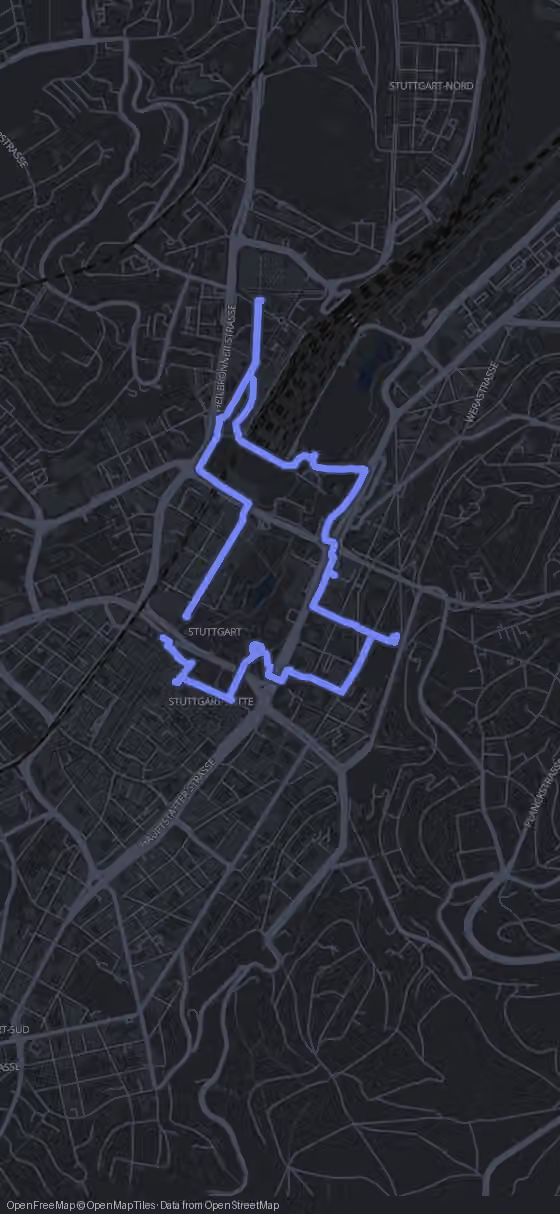
11 Stops 5.6 km ~1 h 20 min walking
Route map for the Stuttgart walking tour
Stop 1 of 11
150 m·2 min
Schlossplatz
Head north-east toward Königstraße
Welcome to Stuttgart. I'm Alex, and beneath the palaces and glass cubes, this city still keeps its medieval starting point.
Try this tour with Alex

Your Route through Stuttgart at a Glance

Eleven stops lead from the Schlossplatz along the Königstraße to the Stadtbibliothek am Mailänder Platz, through the Schlossgarten to the Staatsgalerie Stuttgart, to the Eugensplatz and back via the Neues Schloss, the Markthalle Stuttgart, the Stiftskirche and the Altes Schloss to the Kunstmuseum Stuttgart. That is 5.6 km and 1 h 20 min of pure walking, about three hours in all, around six with museums and lunch.

Most of it is free. The Staatsgalerie charges admission, the Altes Schloss only for special exhibitions, and the Kunstmuseum is currently closed. Route, map and GPS navigation are free in your browser; the AI Tour Guide is optional.

Open free GPS & optional AI Tour Guide
View of Stuttgart

The Route

Walking Map of Stuttgart's Royal Centre

11 stops 5.6 km 1 h 20 min walking
Tap to load interactive map

The 11 stops along this route

  1. Schlossplatz in Stuttgart, stop 1 on the self-guided walking tour
    1Schlossplatz
  2. Königstraße in Stuttgart, stop 2 on the self-guided walking tour
    2Königstraße
  3. Stadtbibliothek am Mailänder Platz in Stuttgart, stop 3 on the self-guided walking tour
    3Stadtbibliothek am Mailänder Platz
  4. Schlossgarten in Stuttgart, stop 4 on the self-guided walking tour
    4Schlossgarten
  5. Staatsgalerie Stuttgart, stop 5 on the self-guided walking tour
    5Staatsgalerie Stuttgart
  6. Eugensplatz in Stuttgart, stop 6 on the self-guided walking tour
    6Eugensplatz
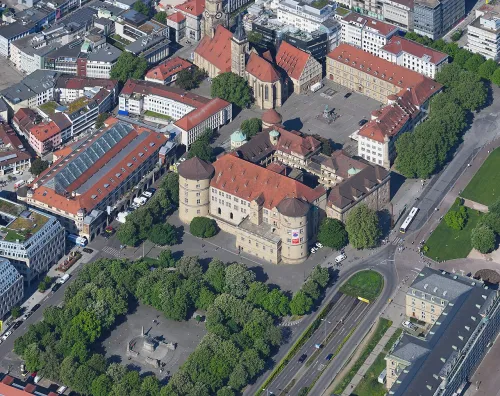
  7. Neues Schloss in Stuttgart, stop 7 on the self-guided walking tour
    7Neues Schloss
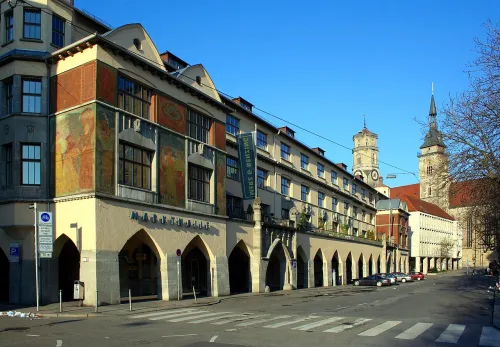
  8. Markthalle Stuttgart, stop 8 on the self-guided walking tour
    8Markthalle Stuttgart
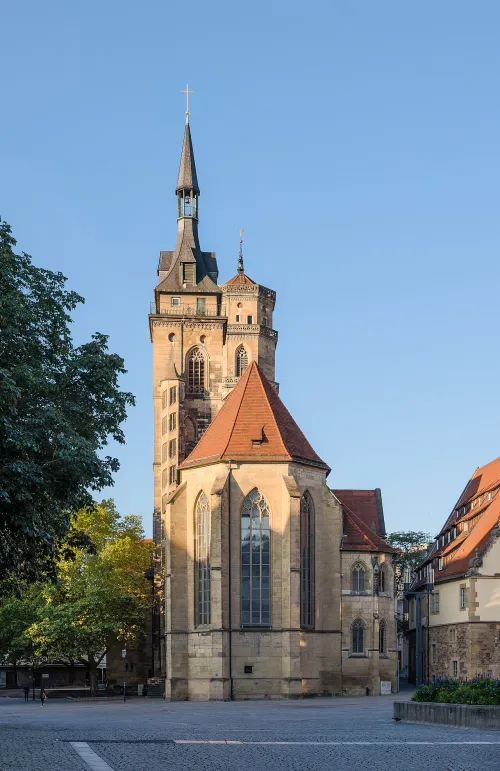
  9. Stiftskirche in Stuttgart, stop 9 on the self-guided walking tour
    9Stiftskirche
  10. Altes Schloss in Stuttgart, stop 10 on the self-guided walking tour
    10Altes Schloss
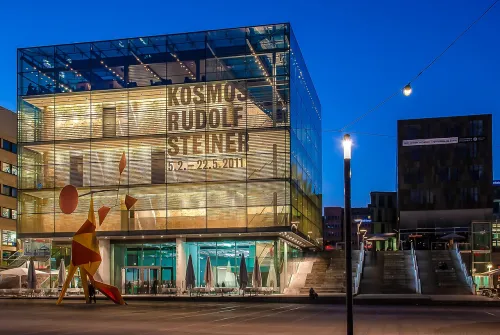
  11. Kunstmuseum Stuttgart, stop 11 on the self-guided walking tour
    11Kunstmuseum Stuttgart
  12. That's the full route.

    Walk it with an AI Tour Guide talking you through every one of these streets.

    Start free in your browser
    You made it

Stuttgart Walking Tour Stops, from Schlossplatz to Kunstmuseum

  1. 1

    Schlossplatz

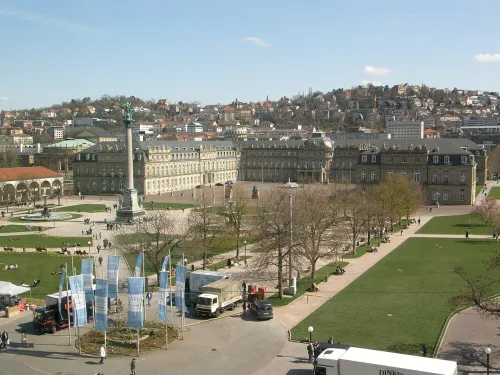
    Schlossplatz in Stuttgart, stop 1 on the self-guided walking tour

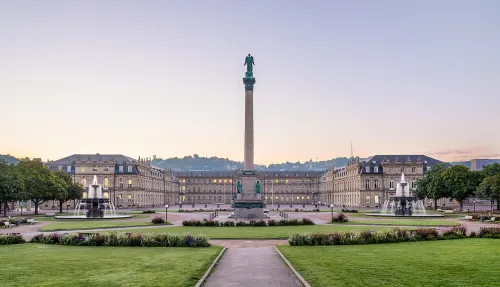
    Stand in the middle of the Schlossplatz and you are on the largest square in central Stuttgart. It is the forecourt of the Neues Schloss, whose Baroque wings frame one side, and the Jubiläumssäule column and the Königsbau also belong to the scene. Take a slow turn on the spot: almost every place on this walk is linked to this square in some way.

    The square works as the hinge of the city centre. It splits the 1.2 kilometre long Königstraße, Stuttgart's main pedestrian street, into a lower half running towards the Hauptbahnhof and an upper half towards Rotebühlplatz. Along one side runs the Planie, calm here, which carries on past the Karlsplatz to the Charlottenplatz. Footpaths lead off into the Oberer Schlossgarten with the Eckensee lake and the opera house, and to the Akademiegarten behind the palace and the Landtag building. Next to the Kunstmuseum, the Kleiner Schlossplatz joins on.

    A detail that surprises even locals: many of the straight axes of the inner city do not line up with the points of the compass, and that goes for the palace facades and the edges of this square too. If your sense of direction feels slightly off here, that is why.

    Under your feet lies the underground Stadtbahn stop Schlossplatz, and the bus stop of the same name is the central departure point for every night bus in the city, useful if your evening runs late. You will come back to this square at the end of the walk. For now, it is only 150 m and 2 minutes to the Königstraße.

    Hours
    Always open
    Price
    Free
  2. 2

    Königstraße

    Königstraße in Stuttgart, stop 2 on the self-guided walking tour

    The Königstraße is Stuttgart's main shopping street, 1.2 kilometres of pedestrian zone and one of the busiest in Germany. In a 2014 count it came third in the country, with 12,795 passers-by an hour. Ninety-three percent of the shops belong to chains, so if you are not here to shop, look past the shop windows: the street itself is far older than its storefronts.

    The upper section, between the Bolzstraße and the Wilhelmsbau, began as a ditch. In the high Middle Ages the Großer Graben ran here along the city wall of Stuttgart's oldest core. A few buildings stood by it as early as the 15th century, among them the Sick'sche Haus, owned in 1403 by Antonia Visconti and probably used as the garden house of a pleasure garden.

    When Count Ulrich, nicknamed 'the Beloved', extended the town around the Hospitalkirche after 1450, the old ditch became a street, and the first town houses went up along it. Because it was so wide, it became one of Stuttgart's favoured addresses in the 16th century, with buildings for the Württemberg court. The last survivor of that era is the right-hand part of the Neue Kanzlei, whose lower storey was built in 1551 by the Württemberg chancellor Ambrosius Volland.

    The street got its royal name later. Duke Friedrich II, king from 1806, set out to turn Stuttgart into the royal residence of his enlarged realm, and the Königstraße grew with that ambition. From here comes the longest leg of the tour: 1370 m, about 19 minutes, out of the old centre to the Europaviertel and its library.

    Hours
    Always open
    Price
    Free
  3. 3

    Stadtbibliothek am Mailänder Platz

    Stadtbibliothek am Mailänder Platz in Stuttgart, stop 3 on the self-guided walking tour

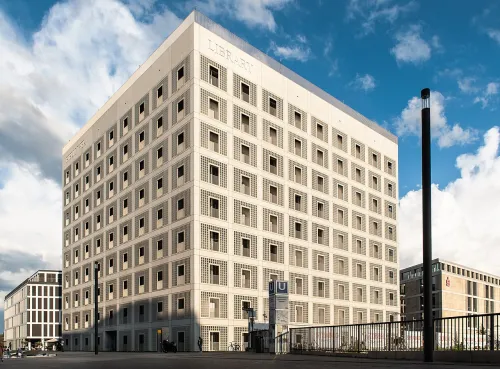
    After the busy shopping street, the Stadtbibliothek am Mailänder Platz feels like a deliberate pause. It is a plain cube, 44 metres long on each side of its square plan and 40 metres high, with nine floors above ground and two below. Look closely at the facade: a precast concrete frame filled with glass bricks, giving the whole block its calm, grid-like skin. There is no single front door; entrances open on all four sides.

    The building came out of an international competition that the architect Eun Young Yi won in 1999. Construction started in 2010 and ended on 24 October 2011. Yi wanted a static monolith that would give the new quarter a point of rest and orientation. For him the layered section stands for the veiling of the human being: what matters is hidden in layers, and the building reveals itself as you move from the outside in.

    The library is part of the Stuttgart 21 masterplan and has become a landmark for the Europaviertel. It is the central branch of a system with 17 district libraries and two bookmobiles, was named national Library of the Year in 2013, and welcomes almost two million visitors a year. Before the move, the central library spent 1965 to 2011 in the Wilhelmspalais, the residence built for the Württemberg king by Giovanni Salucci; you will meet that palace again at the end of the walk.

    Going in is free, and it is worth it if you enjoy architecture: walking from the closed outer shell into the interior is exactly the experience Yi designed. From here it is 1070 m, about 14 minutes, to the green of the Schlossgarten.

    Local name
    Stadtbibliothek Stuttgart
    Hours
    Mon–Sat: 09:00–19:00 | Sun: Closed
    Price
    Free (admission and visit free; annual lending card for adults 20 EUR )
  4. 4

    Schlossgarten

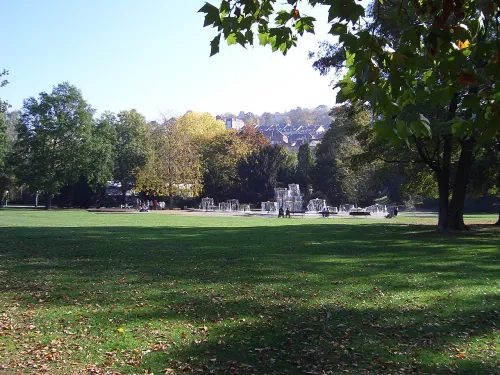
    Schlossgarten in Stuttgart, stop 4 on the self-guided walking tour

    The Schlossgarten is about 600 years old and covers 64 hectares. It starts at the Neues Schloss in the city centre and follows the former course of the Nesenbach, a stream that now runs in pipes underground, all the way to the Neckar. Officially it has three parts, separated by roads that footbridges cross.

    The Upper Schlossgarten runs from the palace to the Schillerstraße. Around the Eckensee stand the opera and drama houses of the Staatstheater, the Kunsthalle, the Eberhardsgruppe sculpture, the Landtag building and the Schicksalsbrunnen fountain. The Middle Schlossgarten, beyond the Ferdinand-Leitner-Steg, holds the Carl-Zeiss-Planetarium, the ruin of the Neues Lusthaus and the Anlagensee lake, along with part of the construction site of the new main station.

    What you see is younger than it looks. For the federal garden show of 1961, the historic layout of the upper and middle sections was largely destroyed; for the 1977 show, the lower part was restored with more care. Since 1987 there have been efforts to bring back the classicist design of the court architect Nikolaus Friedrich Thouret, with its oval lake and park avenue, and Stuttgart 21 will reshape parts of the park again.

    The park is free and open around the clock, so linger as long as you like. Then it is 680 m, about 11 minutes, to the Staatsgalerie.

    Hours
    Open 24/7
    Price
    Free
  5. 5

    Staatsgalerie Stuttgart

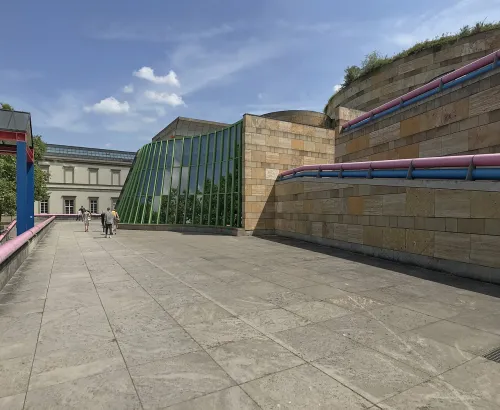
    Staatsgalerie Stuttgart, stop 5 on the self-guided walking tour

    The Staatsgalerie Stuttgart is really two buildings side by side. The classicist Alte Staatsgalerie opened in 1843 and also housed the Royal Art School. Severely damaged in the Second World War, it was rebuilt between 1945 and 1947 and reopened in 1958. Inside hang Old German paintings from 1300, Italian and Dutch masters, German Baroque and the romantics and impressionists of the 19th century.

    Next door stands the reason architects travel here. The Neue Staatsgalerie by James Stirling opened on 9 March 1984 and was controversial from day one. It turned a provincial gallery into one of Europe's leading museums. Look at how Stirling plays with tradition: the galleries wrap around three sides of a central rotunda, a plan borrowed from Schinkel's Altes Museum in Berlin, yet the front refuses to be symmetrical and the entrance is set at an angle.

    The modern building holds 20th century art from Pablo Picasso to Oskar Schlemmer, Joan Miró and Joseph Beuys. Entry costs money, and it is the one museum visit on this route that is worth planning around if you care about art: allow about an hour and a half. If you are short on time, walk around the outside of Stirling's building instead; the architecture alone tells you a lot.

    Next comes a quieter corner of the city: 590 m, about 10 minutes, to the Eugensplatz on the slope above the centre.

    Hours
    Mon: Closed | Tue–Wed: 10:00–17:00 | Thu: 10:00–20:00 | Fri–Sun: 10:00–17:00
    Price
    11 EUR, reduced 9 EUR; free on Wednesdays
  6. 6

    Eugensplatz

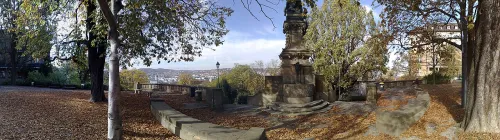
    Eugensplatz in Stuttgart, stop 6 on the self-guided walking tour

    The Eugensplatz is small, but its position on the slope above the city centre gives you a fine view over central Stuttgart. Take a moment to pick out what you have already seen and where you are heading. The square is named after Wilhelm Eugen von Württemberg, a staff officer of the Württemberg army.

    The centrepiece is the Galateabrunnen, a fountain that has stood here since 1890 and counts among the most splendid in the city. It is the kind of place locals come to sit for a while, and it is free and open at any hour.

    Then look for the tall limestone column, about three metres high, put up in 2013. It honours Loriot, the humorist, who lived near the Eugensplatz between 1938 and 1941. Citizens later paid for a bronze pug to join the column, a nod to his famous line: 'A life without a pug is possible, but pointless.' It is a surprisingly tender monument, and a favourite photo stop.

    A Stadtbahn stop also bears the name of the square. From here the walk heads back towards the palace: 910 m, about 12 minutes, to the Neues Schloss.

    Hours
    Open 24/7
    Price
    Free
  7. 7

    Neues Schloss

    Neues Schloss in Stuttgart, stop 7 on the self-guided walking tour

    Back on the Schlossplatz, now look properly at the Neues Schloss. It is an 18th century Baroque palace and one of the last large city palaces built in southern Germany, once the residence of the kings of Württemberg. Today it houses government ministries, which is why there are no public visits inside; tours are only possible by special arrangement. The exterior and the square are free to enjoy.

    The palace exists because of a teenager's ambition. When Duke Karl Alexander died in 1737, his son Carl Eugen was only nine years old. While officials ran the duchy, the boy was sent to be educated at the court of Frederick the Great of Prussia. In 1744, at sixteen, he came of age and returned to Stuttgart wanting a residence fitting his dignity and his large household.

    He even threatened to move the capital out of Stuttgart to Ludwigsburg Palace. The Württemberg Diet, which had already lost the capital to the smaller, unfortified Ludwigsburg for decades, pushed hard to bring the seat of power back, since that meant pride, political weight and money for the city. So Carl Eugen built here, on the Schlossplatz. Leopoldo Retti, Philippe de La Guêpière, Reinhard Heinrich Ferdinand Fischer and Nikolaus Friedrich Thouret all left their mark on the design.

    Bombing in the Second World War left the palace a mere shell, and only in 1957 was the decision made to rebuild it. From here it is 400 m, about 6 minutes, to the Markthalle.

    Price
    Free (exterior and Schlossplatz; no public interior visits)
  8. 8

    Markthalle Stuttgart

    Markthalle Stuttgart, stop 8 on the self-guided walking tour

    The Markthalle Stuttgart opened in 1914 at Dorotheenstraße 4 and is today an upmarket food market. Step inside and look up: the hall is 60 metres long and 25 metres wide without a single supporting column. On the ground floor, stalls fill 3500 of its 6800 square metres; in 2010 there were 37 of them. There are restaurants in the hall and along the Sporerstraße, which makes this the natural place on the route to eat. Entry is free.

    Stuttgart's trade has deep roots here. From 1450 the town's first fixed market sat in the count's manor house on today's Marktplatz. Even before that house was demolished in 1820, trading moved to the Dorotheenplatz, which no longer exists, and to the Karlsplatz, while the Alter Marstall served as granary and weighing house.

    In 1864 King Wilhelm I gave his capital a market hall modelled on Les Halles in Paris, so that, in his words, the wives and daughters of the wine growers could sell their produce 'protected from the hardships of the weather'. Georg von Morlok, architect and railway engineer, built it of cast iron and glass on this very plot. It opened on 27 December 1864, half a year after the king's death, and turned out too small from the start. Almost fifty years passed before Martin Elsässer's larger hall solved the problem.

    The Stiftskirche is only 130 m away, about 2 minutes.

    Hours
    Mon–Fri: 07:30–18:30 | Sat: 07:00–17:00 | Sun: Closed
    Price
    Free
  9. 9

    Stiftskirche

    Stiftskirche in Stuttgart, stop 9 on the self-guided walking tour

    The Stiftskirche is the main church of the Protestant Church in Württemberg and the parish church of the city centre. Entry is free, and it is well worth going in. Its story runs deep: researchers found traces of a small Romanesque church from the 10th and 11th centuries inside today's outline. In 1240 a stately three-naved church with two towers followed, probably built by the Counts of Württemberg, who were living in the nearby castle by then.

    In the south tower chapel lies a double tomb from the late 13th century for Count Ulrich I and his second wife, Agnes of Silesia-Liegnitz, both of whom died in 1265. When Stuttgart became the rulers' residence, they added a Gothic chancel between 1321 and 1347, and Ulrich V a Late Gothic nave in the second half of the 15th century. The pulpit dates from 1500; it was painted at first and gilded only in the 19th century.

    Inside, look for the row of small statues on the north wall of the chancel: from 1574, every Count of Württemberg since Ulrich I was given one. The Reformation reached Württemberg in 1534, the images and altars were removed, and the reformer Johannes Brenz was buried under the chancel in 1570. A burial vault added in 1608 holds all the rulers until 1677. Queen Catherine Pavlovna of Russia lay here after her death in 1819, until her remains were moved in 1824 to a mausoleum on the Württemberg hill.

    Bombing raids in 1944 damaged the church heavily. Outside, the Altes Schloss is just 110 m away, a one-minute walk.

    Hours
    Daily: 10:00–16:00
    Price
    Free
  10. 10

    Altes Schloss

    Altes Schloss in Stuttgart, stop 10 on the self-guided walking tour

    Together with the Stiftskirche, the Altes Schloss shapes the Schillerplatz, and with the Markthalle and the ministries in the Neues Schloss nearby, you are standing in Stuttgart's historic heart. From its beginnings around 1200 until the 18th century, this was a water castle, and it still has the solid look of a fortress. Today the whole building is a museum, while the palace church inside still holds services.

    What lies underneath is the real story. Excavations up to 2005 under the southern part, the so-called Dürnitz, found settlement remains reaching back to the 8th century and the ruins of an earlier castle. That first castle probably dates from the Staufer period, the late 12th or early 13th century: a double outer wall, two ditches and part of its interior buildings, partly timber-framed, have been traced for almost 30 metres.

    Its full size will probably never be known, because later works disturbed the ground of the courtyard and the old moat towards the Karlsplatz. What is clear is that a flood badly damaged this first castle, probably in the later 13th century, and the castle you see grew from what came after.

    The permanent collections are free, and an hour inside is a good investment on a museum day; special exhibitions cost extra. Then it is 190 m, about 3 minutes, to the last stop.

    Hours
    Tue–Sun 11:00–17:00, Mon closed
    Price
    Permanent collections free; special exhibitions approx. 10 EUR, reduced 6 EUR
  11. 11

    Kunstmuseum Stuttgart

    Kunstmuseum Stuttgart, stop 11 on the self-guided walking tour

    The walk ends where it began, at the corner of the Schlossplatz and the Königstraße, in front of the Kunstmuseum Stuttgart. The museum is currently closed, so this is a view from outside, and the building is made for that. By day it reads as a glass cube that mirrors its surroundings; at night the lit walls of Dietfurt limestone from the Altmühl valley show through, irregular slabs with coloured mineral streaks. During exhibitions, huge words in grey and red foil cover the glass and change with every show.

    The Berlin architects Hascher and Jehle designed the 5000 square metres of gallery space, which opened in March 2005 as successor to the Galerie der Stadt Stuttgart. It shows the city's collection from the 19th century to contemporary art, and art critics named it Museum of the Year 2021.

    The site carries an old argument. Until 1963 the ruin of the Kronprinzenpalais stood here, damaged in an air raid in 1944. It was the counterpart to the Wilhelmspalais at the other end of the Planie, the former home of the city library. In 1951 the architect Paul Bonatz warned that tearing it down would cost the west side of the square half its face; when the cube was designed, the critic Dankwart Guratzsch replied in 1999 that it would not get that face back now either.

    After the demolition, the Planie became a six-lane road with tunnels for cars and trams, and in 1968 the Kleiner Schlossplatz was built so pedestrians could cross more easily; it never really caught on. Stand here, look across the square to the Neues Schloss, and decide for yourself.

    Status
    Currently closed
Walking tour route map of Stuttgart Route loaded
SchlossplatzKönigstraßeStadtbibliothek am Mailänder PlatzSchlossgarten+7
All 11 stops are already on the map.
You just press start.
AI Tour Guide

You know the route now. Walk it with a guide in your ear.

Press start wherever you are, even hundreds of kilometres from Stuttgart, and the guide begins telling its stories right away. In the city, pick any of the 11 stops to start from: it leads you there, then talks with you the whole route, asking, listening, remembering, and shaping the tour around your answers.

11stops 5.6km 1 h 20 minwalking 13languages
▶Start the tour free

Free to start · Runs in your browser · No app, no download

Shorter Ways to Walk Stuttgart

Not everyone has a full day. These two cuts of the route keep its strongest parts and drop the long legs.

Old centre in under an hour

Stops: 7, 8, 9, 10, 11

For a short visit or a lunch break: from the Neues Schloss to the Markthalle Stuttgart, the Stiftskirche, the Altes Schloss and the Kunstmuseum Stuttgart. Just 830 m and 12 minutes of walking, all within a few hundred metres of the Schlossplatz. Everything is free apart from special exhibitions in the Altes Schloss; the Kunstmuseum is seen from outside while it is closed.

Modern Stuttgart and the park

Stops: 1, 2, 3, 4, 5

For architecture fans: from the Schlossplatz along the Königstraße to the library cube, through the Schlossgarten to the Staatsgalerie. 3.3 km and 46 minutes of walking. Only the Staatsgalerie charges admission, so plan its visit as the finale of this half.

How Long the Stuttgart Tour Takes, with and without Museums

The walking itself takes 1 h 20 min. Two legs carry most of the distance: the 1370 m from the Königstraße to the library (19 minutes) and the 1070 m on to the Schlossgarten (14 minutes). After the Eugensplatz the stops close up, and the last five lie within 830 m of each other.

With short looks at every stop you need about three hours. If you go inside the Staatsgalerie (allow about an hour and a half), browse the free collections in the Altes Schloss (about an hour) and eat at the Markthalle, plan around six hours. The old centre variant takes under an hour without museums; the modern half takes about an hour and three quarters before you enter the Staatsgalerie.

Before You Set Off from Schlossplatz

  • Start and finish: The recommended start is the Schlossplatz, but you can join at any stop. The tour ends at the Kunstmuseum Stuttgart, right on the edge of the same square, and the GPS navigation can lead you back to the start if you want.
  • Getting there: The underground Stadtbahn stop Schlossplatz lies directly under the square, and the bus stop of the same name is served by several city bus lines.
  • Time of day: Start in the morning on a day when the museums are open if you want to go inside the Staatsgalerie and the Altes Schloss; check their opening hours before you plan the day.
  • What costs money: Only the Staatsgalerie Stuttgart charges admission, and the Altes Schloss for its special exhibitions. The library, the Stiftskirche and the Markthalle are free to enter, the Neues Schloss has no public interior visits, and the Kunstmuseum is currently closed.
Walking tour route map of Stuttgart
AI Tour Guide

A guide for Stuttgart, ready when you are.

Press start and a voice AI Tour Guide takes it from here: leading the route through Stuttgart, telling the stories, and turning your walk into a real back-and-forth conversation. No app or download is needed; it runs in your browser.

11stops 5.6km 1 h 20 minwalking 13languages
▶Start the tour free

Free to start · Runs in your browser · No app, no download

What the AI Tour Guide Adds in Stuttgart

On this route the AI Tour Guide talks with you rather than at you: it greets you on the Schlossplatz, tells the stories of each place as you arrive, asks what interests you and remembers it, so a conversation about Duke Carl Eugen can carry on into the Stiftskirche crypt. Ask it who Loriot actually was, what Stuttgart 21 is meant to change around the library, or which Schlemmer works to look for in the Staatsgalerie, and interrupt whenever you like. You start with 100 free credits; after that you choose between this tour all-inclusive for €19.99 with no time limit, or €5 per hour.

A Real Conversation A voice AI Tour Guide greets you, leads the whole route, and tells the stories and facts as you walk, asking what you want to see and keeping a real conversation going. Not a recording you press play on.
Map Navigation Follow the route on the map and walk at your own pace. You choose where to start and when to move to the next stop.
Ask Anything Curious about a building you pass? Ask your AI Tour Guide on the spot and the conversation carries on.
13 Languages Switch language anytime. No separate tour needed.
Start free in your browser

Common Questions about Walking Stuttgart

Where does the name Stuttgart come from?

From a stud farm. Duke Liudolf of Swabia is said to have set up a horse farm, the 'Stuotgarten', around 950, on the ground where the Altes Schloss now stands. Whether he also built a castle to protect it has not been proven by excavations.

Can I keep walking through the Schlossgarten after the tour?

Yes. The park follows the old course of the Nesenbach stream all the way to the Neckar, through the Middle and Lower Schlossgarten to the mineral baths in Berg, and flows straight into the Rosensteinpark near the Wilhelma zoological and botanical garden. Together they form part of Stuttgart's 'Green U'.

How do I get back to the start from the Kunstmuseum?

You hardly have to: the Kunstmuseum stands at the corner of the Schlossplatz and the Königstraße, so the starting point is right in front of you. The GPS navigation will lead you back if you prefer.

Which towns near Stuttgart make a good second walk?

Esslingen is only about 10 km away, and the university town of Tübingen about 30 km. For a longer day trip, Heidelberg and Ulm each have their own free route.

Is the tour really free?

Yes. The whole tour is free: the route, the interactive map and the navigation cost you nothing. Only the voice AI Tour Guide is optional and paid: you test it with 100 free credits, then you pay either €5 per hour or €19.99 for this whole tour, with no time limit. Admission to one of the 11 stops is not included: Staatsgalerie Stuttgart charges its own entry fee.

Do I need to download an app?

No. Everything runs in your phone browser. Open the route and start walking, no download and no sign-up required.

Do I need to book the walking tour in advance?

No booking needed. This self-guided tour is available anytime. Open the route in your browser and start walking. The AI Tour Guide works instantly, no app, no reservation required.

What languages is the AI Tour Guide available in?

The AI Tour Guide speaks 13 languages, so you take the tour in your own language and can switch at any time.

Can I skip stops or change the route?

Yes. Skip any stop, spend extra time at places you like, or start the route from any point. It is your walk, you set the pace.
Image credits
▶ Start free in your browser Runs in your browser, no app, no download