

Ulm Minster
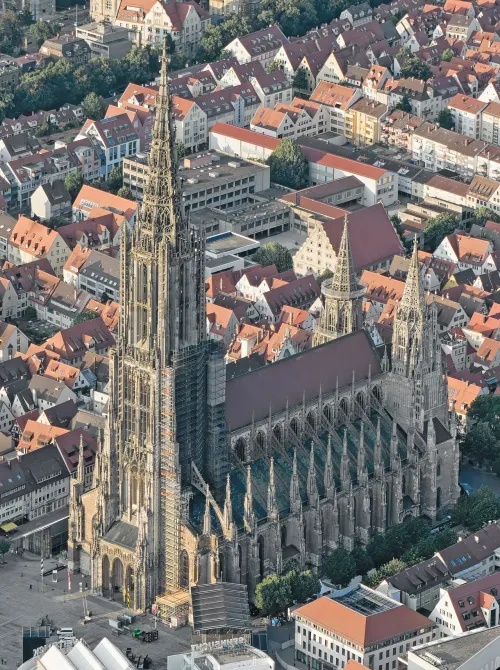
Start beside Ulm Minster and tip your head back. The steeple measures 161.53 metres. When its towers were completed in 1890, the church ranked as the fourth-tallest structure in the world, and for 135 years it held the title of tallest church anywhere. Since 2025 it has counted as the second-tallest church building in the world, which is still a lot of church for a city of Ulm's size.
Now look at the walls instead of the spire. The towers and all the decorative work are stone, the tower itself mostly sandstone, but the façades of the nave and choir are largely visible brick. That puts Ulm among the largest brick churches anywhere, after San Petronio in Bologna and alongside the Frauenkirche in Munich and St. Mary's in Gdańsk. People sometimes call it Ulm Cathedral because of its size, but it never was one: no bishop has ever had his seat here.
The building has a long backstory. Ulm's original parish church stood at the city gate, outside the walls, and in the conflicts of the 14th century that caused the citizens real trouble, Emperor Charles IV's siege of the city among them. The Minster was begun in the Gothic style of the late Middle Ages. When work stopped in the 16th century, everything except the towers and some outer decoration was already finished, far more than at Cologne Cathedral when its builders downed tools. Then came a pause of centuries, and only in the late 19th century did the towers rise to their full height.
Going in is free, and it's worth it for anyone, even if you only have a quarter of an hour. With time and energy to spare, the spire's top gallery sits at 143 m and looks out over Ulm and over Neu-Ulm across the state line in Bavaria; in clear weather the view reaches the Alps, from Säntis to the Zugspitze.
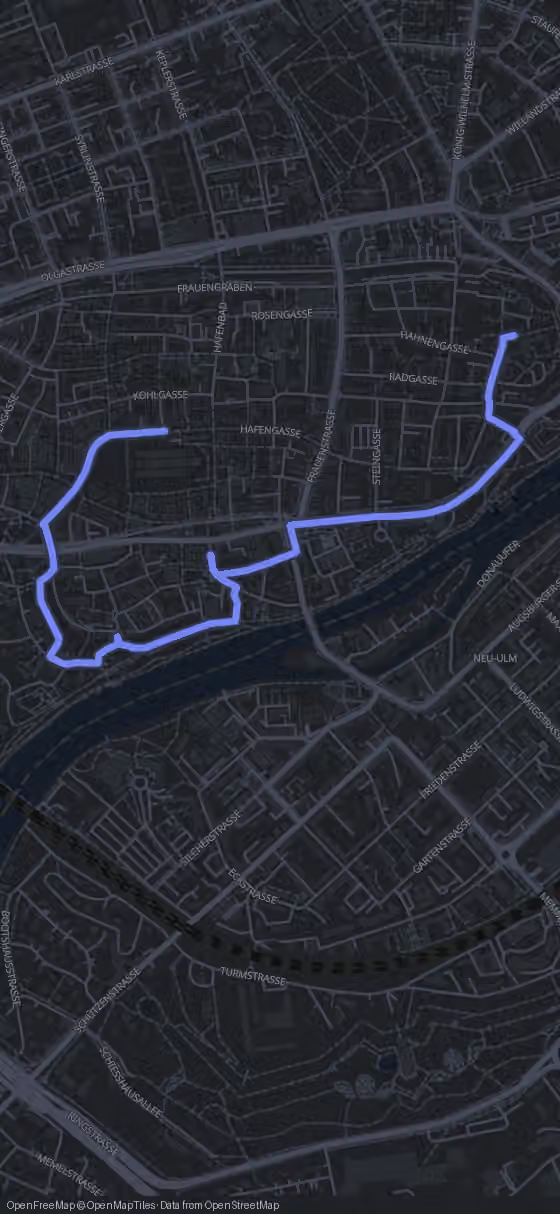
From the Minster it's 410 m, about 5 minutes, to Kussgasse, passing the Ulmer Wochenmarkt on the way.