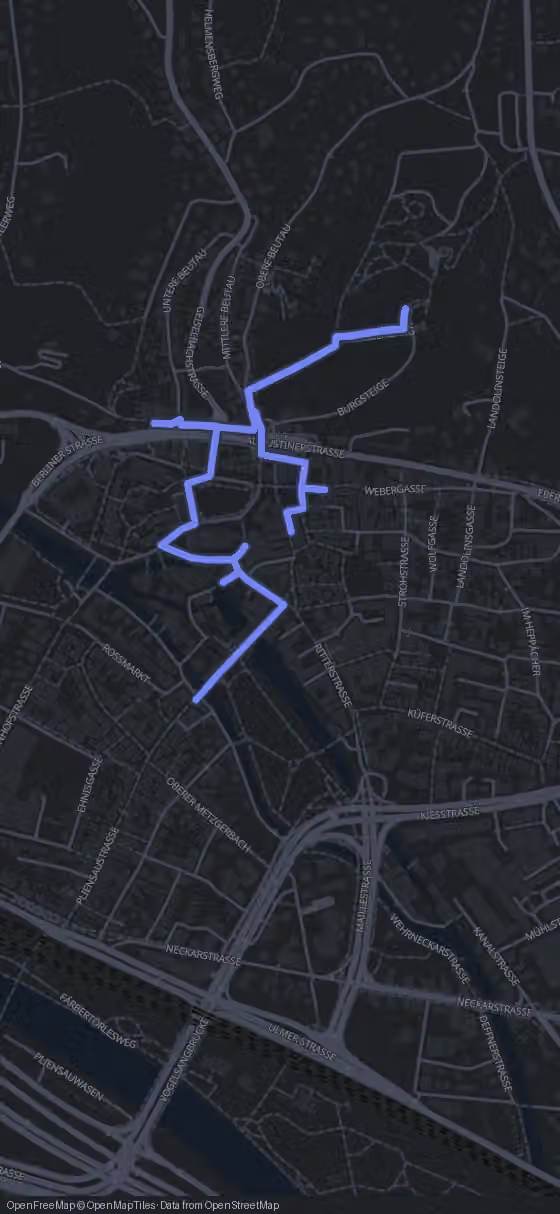
This walk links nine stops, from the Altes Rathaus to the Innere Brücke: 1.7 km and 28 minutes of pure walking, a little over two hours once you add the churches and a few pauses.
Lanes, castle walls, both churches and the canals cost nothing; only the J.F. Schreiber-Museum and a visit inside the Kessler Sekt-Keller are paid. The route with GPS navigation runs free in your browser, and the optional AI Tour Guide can lead the walk as a conversation.
Esslingen Walking Tour Stop by Stop: Walls, Churches, Water
1
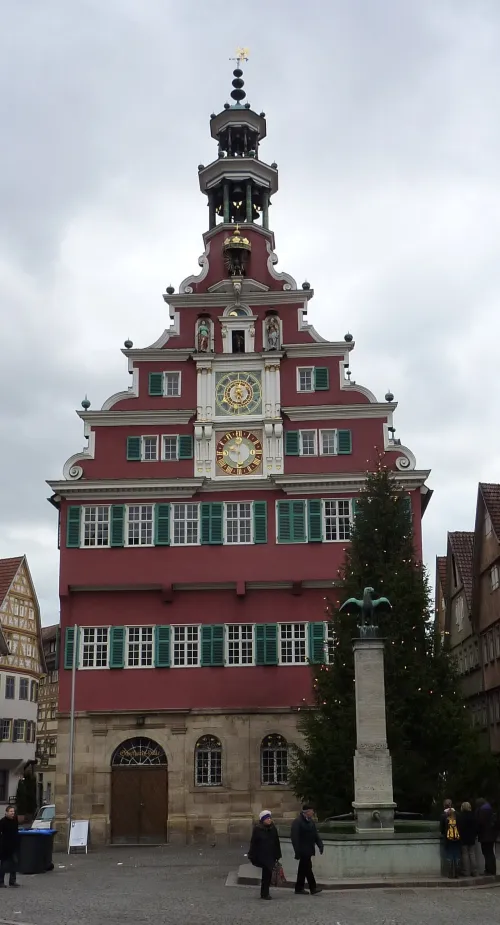
Altes Rathaus
You begin at the Altes Rathaus, and with it in a town where history is unusually complete. Esslingen am Neckar is one of the few German cities that suffered no significant destruction in the Second World War, so its streets still show buildings from more than 1200 years. Take a moment here before you set off: much of what you see on this walk is original, not rebuilt.
The main reason to time your arrival is the Glockenspiel. It plays daily at 12:03, 15:02, 18:02 and 19:32, and also at 8:02 except on Sundays. The exterior can be viewed at any hour and costs nothing, so if you are early, look over the facade and wait for the chimes; if you are late, you can always come back for the next one.
From here, Webergasse is just 100 m away, a one minute walk.
Hours
Always open (exterior); Glockenspiel plays daily at 12:03, 15:02, 18:02 and 19:32 (also 8:02 except Sundays)
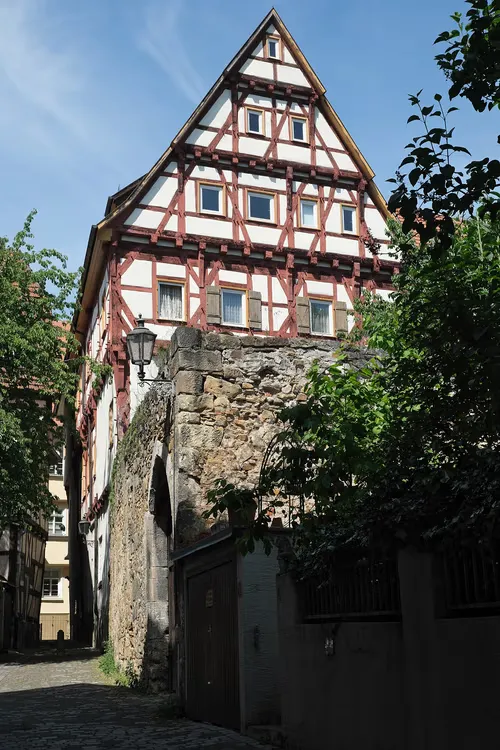
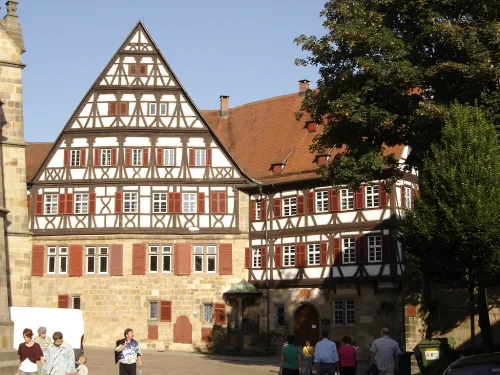
Webergasse, the weavers' lane, has an unremarkable name and a remarkable look. It is a historic lane of half-timbered houses, and you do not view them from behind a barrier: you walk straight through the middle of them, in open public space, free at any hour.
Slow down here, and not only for the photographs. Look at how the timber frames lean and line up along the lane, and how close the houses stand to one another. This is the kind of everyday old street that survived in Esslingen because the war largely spared the town.
Enjoy the easy pace while it lasts. The next stop, the Burg, sits above the old town, 440 m and about 9 minutes away, and the way there climbs.
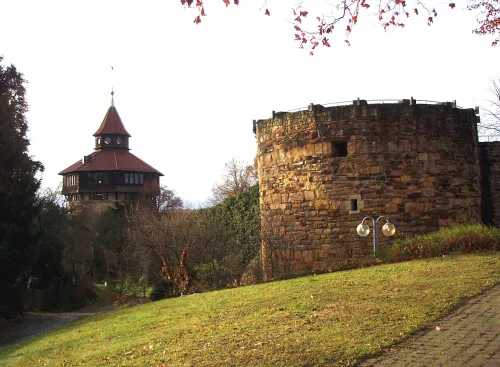
Despite the name, Burg Esslingen is not a castle in the usual sense. It is a preserved section of the medieval town fortifications, high above the old town and today's centre. Coming from the north, you cross a bridge from the outer Burgplatz, with the Kanonenbuckel to your left and the younger service buildings with the Burgschänke to your right. Climb onto the Kanonenbuckel first: from there you overlook the whole complex.
The walls grew in stages. Esslingen was probably first walled after Frederick II raised it to a town in 1219, but only in 1286 and 1287 did Rudolf of Habsburg link the outpost on the Schönenberg to the town walls with two connecting walls; a third followed in the 14th century. Between 1519 and 1531 the complex was extended with a fortified road up the hill and a rampart and moat on the town side. The defences proved themselves in 1519, when Duke Ulrich of Württemberg, fresh from taking Reutlingen, tried and failed to seize the Free Imperial City.
Look for the Dicker Turm, the thick tower built in 1525, and the small Mélac-Häuschen from 1529. Legend has it that in 1688 a woman of Esslingen gave herself to the French general Mélac in this little house to save her town; it did not work, and Mélac caused heavy destruction. A covered wall walk, the Seilergang, connects the Dicker Turm with the Hochwacht, the watch post from the 18th century. The tower's pointed roof is younger than it looks: it was added in 1887, modelled on the towers of Nuremberg.
Between the Kanonenbuckel and the Pulverturm lies an apothecary garden with a fountain and a sundial. The whole site was largely restored for the town's anniversary in 1977, and much of it is freely accessible at any time; in summer it doubles as a stage for open-air cinema. One quiet curiosity: beneath the lawns and playgrounds north of the walls lie drinking water reservoirs.
From the Burg you head back down to the Frauenkirche, 430 m and about 7 minutes. Its tower is visible from far around, so you will have it in sight as you descend.
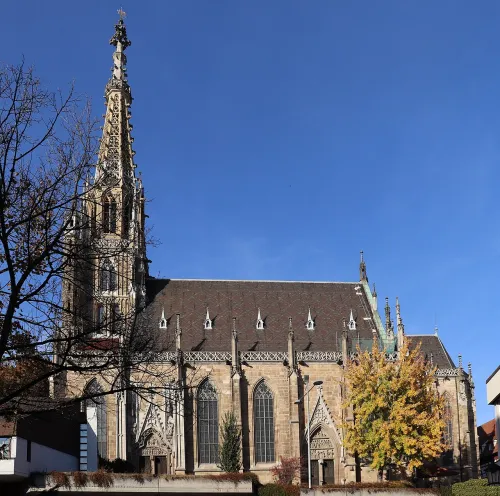
The Frauenkirche is considered the first Gothic hall church in southwest Germany, and it was a statement by the townspeople. Esslingen had been a Free Imperial City since 1181, yet its oldest church, St. Dionys, belonged to the cathedral chapter of Speyer. So on 26 May and 1 June 1321 the town council called on the citizens to build a church of their own, dedicated to Our Lady, on the site of a chapel of Mary. It has been known as the citizens' church ever since.
Construction began around 1325 with the choir at the east end and took almost 200 years, finishing in 1508 with the tower at the west front. The master builder families Ensinger and Böblinger, who also worked on the minster in Ulm, shaped it. Look up at the tower: the higher it rises, the richer and more delicate its tracery becomes. It is one of the few Gothic towers actually completed in the Middle Ages.
The church's later story is one of near loss. After Esslingen lost its independence in 1803 and passed to Württemberg, the building fell out of use and decayed, until court architect Joseph von Egle rescued and restored it in 1860 and 1863, adding neo-Gothic touches in the taste of the time. In the 1960s, a new ring road and the demolition of rows of houses cut the church off from the rest of the centre, which is why it stands so apart today. An extensive exterior restoration began in 1994 and was completed in 2016.
Going inside is free and worth a quarter of an hour: despite the long building time, the interior is remarkably unified in style. The J.F. Schreiber-Museum is only 60 m away, a minute's walk.
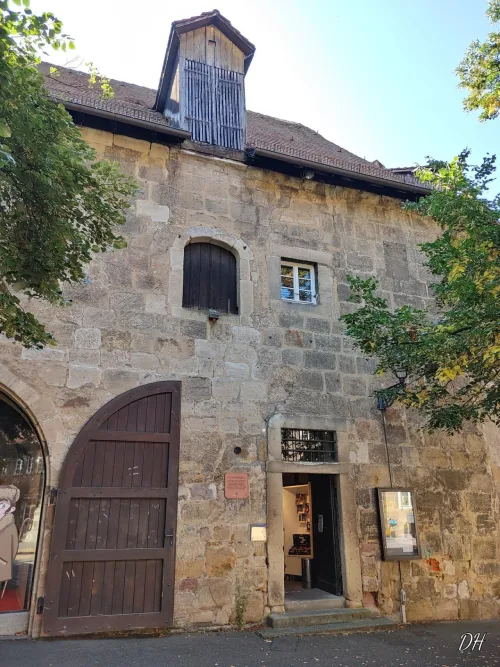
A minute from the church door, the J.F. Schreiber-Museum is housed in the Salemer Pfleghof. It charges admission, but children and teenagers go in free, which makes it an easy add-on for families.
Mind the opening days. The museum is not open every day, and its closing days catch out many plans, so check before you build your walk around it.
Is it worth it on this route? The substance of the walk is outdoors: lanes, walls, two churches and the water, all free. Go in if a museum interior is what you came for or the weather turns; skip it without regret if the sky is good.
From here it is 270 m, about 4 minutes, to the Stadtkirche St. Dionys; on the way you pass the Museum St. Dionys.
Hours
Tue–Thu 09:00–17:00, Sat–Sun 13:00–17:00, Mon and Fri closed
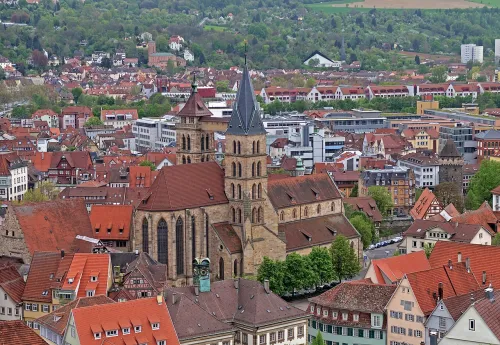
The Stadtkirche St. Dionys stands on the south side of the Marktplatz, and together with the Catholic Münster St. Paul and the Frauenkirche it forms the church ensemble that defines Esslingen's skyline. This is the church whose ties to Speyer pushed the townspeople to build the Frauenkirche, and its roots go much deeper.
Around 700, the first church rose on this spot: a small single-nave church dedicated to St. Vitalis, just 18 m long, with a graveyard. Around 764 a relic tomb was set into its choir. Excavations found 17 burials inside the nave, 15 men and two children. One gravestone carries the words IN NOMINE DOMINI NORDMAN, "In the name of the Lord, Nordman", probably from the second quarter of the 8th century and regarded as the oldest medieval grave inscription east of the Rhine.
In his will of 777, Abbot Fulrad of the monastery of Saint-Denis left six cells to his abbey, Esslingen among them. The relics of Vitalis, perhaps also of Dionysius, drew a market and pilgrims, and the first church had to make way for a bigger one. The second church, built in the late 9th century, was 40 m long with a spacious hall crypt, the largest stone church of its time in inner Swabia, and it was enlarged several times up to the end of the 12th century.
Entry is free, with the same hours as the Frauenkirche. The Kessler Sekt-Keller is just 70 m away, a minute's walk.
The Kessler Sekt-Keller, the Sektkellerei Kessler, was founded in 1826 and is the oldest Sekt producer in Germany. It is based in the historic Speyrer Pfleghof, and its wines mature in the medieval vaulted cellars beneath the Kessler-Haus on the Marktplatz. Much of the Sekt is still made by fermentation in the bottle, the classic Champagne method, and part of it is riddled by hand. Production runs to around 2 million bottles a year.
The founder learned his trade in Champagne. Georg Christian Kessler joined the house of Veuve Clicquot in 1807 as a clerk, received power of attorney from Barbe-Nicole Clicquot in 1810 and joined the management in 1815. After the Congress of Vienna he built up Clicquot's foreign business, above all in Russia, and became Madame Clicquot's partner in 1821.
On 1 July 1826 he founded G. C. Kessler & Compagnie in Esslingen, in the Kaisheimer Pfleghof. From local Frühburgunder wine he made the first 4000 bottles of German sparkling wine, which sold at once. In 1827 King Wilhelm I of Württemberg awarded him a medal for services to agriculture, and from 1829 Kessler exported to Russia, Britain and the USA. After an insolvency in 2004 and 2005, the house has been run by Esslingen businessman Christopher Baur.
Visits to the cellars cost admission; ask at the shop for the current price. A glass at the bar is the easy way in if you do not want a full cellar visit.
Klein Venedig starts just 60 m on, a minute's walk.
Local name
Sektkellerei Kessler
Hours
Shop: Mon–Fri 11:00–19:00, Sat 10:00–19:00, Sun closed; Bar: Mon–Fri 12:00–21:00, Sat 10:00–21:00, Sun closed
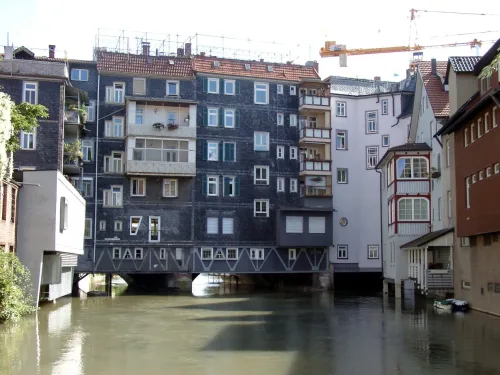
A minute from the Sekt house, the built-up block gives way to water. Klein Venedig, Little Venice, is the stretch where the Roßneckar and the Hammerkanal run through the old town, in open public space: no fence, no fee, no closing time.
This is the part of the walk that rewards going slowly. Follow the water, look at how the houses meet the canals, and give yourself time for photographs; here they take longer than the distance.
The last stop, the Innere Brücke, is 250 m away, about 4 minutes.
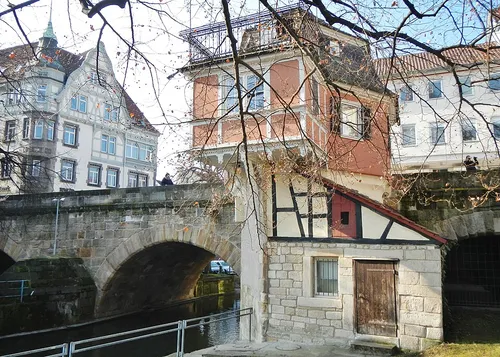
The walk ends on the Innere Brücke, a historic stone bridge lined with half-timbered houses, reserved for people on foot and open at any hour. Lean on the railing and let your pace drop to nothing for a moment.
Looking back, you have covered a town hall with a Glockenspiel, a castle that is really a wall, two Gothic churches, the oldest Sekt house in Germany and a canal quarter with a borrowed name. The route ends here; finish on the bridge or carry on as the evening suggests. And if you missed the chimes, the Altes Rathaus plays several times a day.
All 9 stops are already on the map. You just press start.
AI Tour Guide
Now walk these lanes with a guide in your ear
Press start wherever you are, even hundreds of kilometres from Esslingen, and the guide begins telling its stories right away. In the city, pick any of the 9 stops to start from: it leads you there, then talks with you the whole route, asking, listening, remembering, and shaping the tour around your answers.
Free to start · Runs in your browser · No app, no download
Shorter Ways Through Esslingen
You can join the route at any stop, and the order shown is the recommended one. If time or interest is limited, these cuts keep the walk coherent.
Old town and the Burg
Stops: 1, 2, 3, 4
For a first look with a view: the town hall, the half-timbered lane, the fortifications above town and down to the Frauenkirche. 970 m and 17 minutes of walking, everything free.
Churches, Sekt and water
Stops: 4, 5, 6, 7, 8, 9
For anyone who wants the lower town without the climb to the Burg: both Gothic churches, the museum, the Sekt house, the canals and the bridge. 710 m and 11 minutes of walking; only the museum and a visit inside the Kessler cellars cost money.
All outdoors, nothing to pay
Stops: 1, 2, 3, 4, 5, 6, 7, 8, 9
The full route, but you stay outside at the museum and the Sekt house and step only into the two free churches. The same 28 minutes of walking, no admission at all.
How Long the Esslingen Walk Takes
The pure walking time is 28 minutes, and most legs take a minute or two; only the way up to the Burg (9 minutes) and back down to the Frauenkirche (7 minutes) take longer. Give the Burg about 25 minutes, each church about 15, the Sekt house 20, and a few minutes to everything else, and you land at a little over two hours. With the J.F. Schreiber-Museum add roughly 45 minutes, which makes it about three.
If you are at the Altes Rathaus for the 12:03 chimes and keep to those stays, you reach the Frauenkirche around 13:00 and the museum a quarter of an hour later. The bridge then follows a little before 15:00 with the museum, or around 14:15 without it. The two shorter variants take about one hour each with stays.
Before You Set Off in Esslingen
Start and finish: Start at the Altes Rathaus and finish on the Innere Brücke. Any stop works as an entry point; the GPS navigation in your browser can lead you back to the start from the bridge if you want.
Best day and time: Not every day suits the whole route: the museum and the Kessler shop and bar each have closing days, so check before you go if you want to step inside.
Costs: The walk, the Burg and both churches are free. The museum charges admission, with free entry for children and teenagers; for the Kessler cellars, ask at the shop for the current price.
Timing the chimes: Plan your start around one of the Glockenspiel times at the Altes Rathaus; 12:03 fits the schedule best.
AI Tour Guide
Your Esslingen guide is ready when you are
Press start and a voice AI Tour Guide takes it from here: leading the route through Esslingen, telling the stories, and turning your walk into a real back-and-forth conversation. No app or download is needed; it runs in your browser.
Free to start · Runs in your browser · No app, no download
What the AI Tour Guide Adds on This Walk
On this route the AI Tour Guide leads the walk as a conversation: it greets you at the Altes Rathaus, tells the stories of each place as you reach it, asks what caught your eye and remembers it, so the talk at the Frauenkirche can follow up on what interested you at the Burg. It is the place to ask who J.F. Schreiber actually was, or how riddling Sekt by hand works, and you can interrupt it at any time. The route, map and GPS navigation stay free; the guide starts with 100 free credits, after which you choose this tour all-inclusive for €19.99 with no time limit or €5 per hour.
A Real Conversation
A voice AI Tour Guide greets you, leads the whole route, and tells the stories and facts as you walk, asking what you want to see and keeping a real conversation going. Not a recording you press play on.
Map Navigation
Follow the route on the map and walk at your own pace. You choose where to start and when to move to the next stop.
Ask Anything
Curious about a building you pass? Ask your AI Tour Guide on the spot and the conversation carries on.
13 Languages
Switch language anytime. No separate tour needed.
How do I get back to the start after the Innere Brücke?
The route ends at the bridge and does not loop back. If you want to return to the Altes Rathaus, the GPS navigation in your browser can guide you there from the last stop.
Is the walk good with children?
Yes. The legs are short, and the Burg has lawns and playgrounds on the north side of the complex. Under-18s enter the J.F. Schreiber-Museum free.
Which other towns pair well with Esslingen?
Stuttgart is only 10 km away and makes an easy combination on the same day. For another old town with half-timbered streets, try Tübingen or Schwäbisch Hall.
Can I go inside the Pulverturm at the Burg?
Not reliably. The restored Pulverturm was opened to visitors in 1981, but it has been closed off since. The walls, the Kanonenbuckel and the apothecary garden remain freely accessible.
Is the tour really free?
Yes. The whole tour is free: the route, the interactive map and the navigation cost you nothing. Only the voice AI Tour Guide is optional and paid: you test it with 100 free credits, then you pay either €5 per hour or €19.99 for this whole tour, with no time limit. Admission to 2 of the 9 stops is not included: J.F. Schreiber-Museum and Kessler Sekt-Keller charge their own entry fees.
Do I need to download an app?
No. Everything runs in your phone browser. Open the route and start walking, no download and no sign-up required.
Do I need to book the walking tour in advance?
No booking needed. This self-guided tour is available anytime. Open the route in your browser and start walking. The AI Tour Guide works instantly, no app, no reservation required.
What languages is the AI Tour Guide available in?
The AI Tour Guide speaks 13 languages, so you take the tour in your own language and can switch at any time.
Can I skip stops or change the route?
Yes. Skip any stop, spend extra time at places you like, or start the route from any point. It is your walk, you set the pace.