Free Walking Tour Schwäbisch Hall: Old Town to Comburg

Start below St. Michael's, cross the Executioner's Bridge, rest on an island in the Kocher, then walk out to a monastery on its hill and back to the town museum.

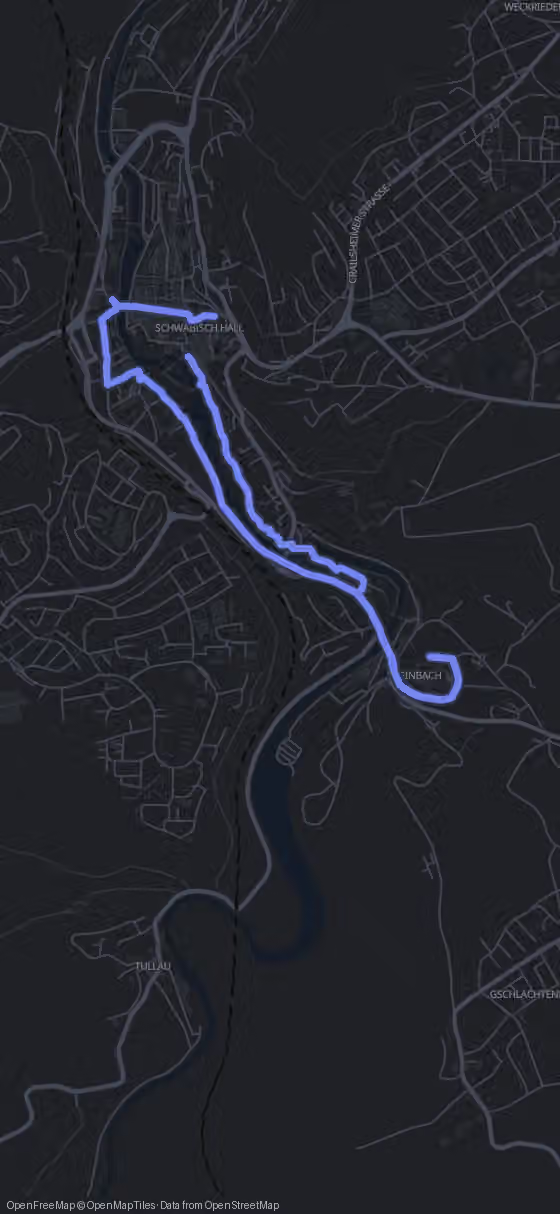
8 Stops 5.3 km ~1 h 18 min walking
Route map for the Schwäbisch Hall walking tour
Stop 1 of 8
380 m·5 min
St. Michael's Church
Walk down the steps and head west toward Henkersbrücke
Grüß Gott, welcome to Schwäbisch Hall. I'm Alex, and the grand staircase ahead has played a second role for a full century.
Try this tour with Alex

The Route at a Glance

Eight stops lead from St. Michael's Church over the Henkersbrücke to the Johanniterkirche, the Kunsthalle Würth, the Mauerstraße and the island of Unterwöhrd, then out to Großcomburg and back into town to the Hällisch-Fränkisches Museum: 5.3 km and 1 h 18 min of pure walking, about four and a half hours with visits.

Almost everything is free; only the church interior at Großcomburg costs a fee, on a guided tour, and the Kunsthalle is currently closed. The GPS route in your browser is free, the AI Tour Guide is optional.

Open free GPS & optional AI Tour Guide
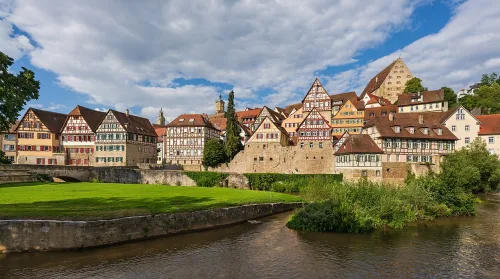
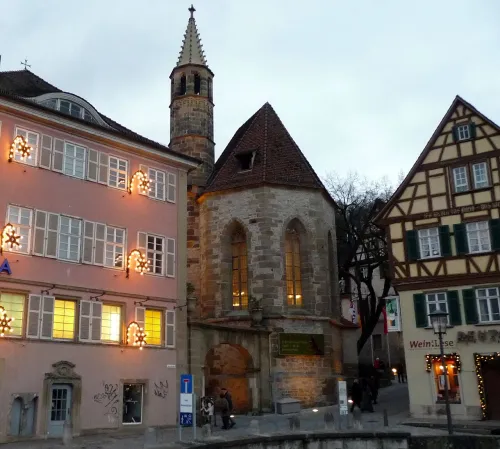
View of Schwäbisch Hall

The Route

Walking Map of Schwäbisch Hall: Old Town, River and Comburg

8 stops 5.3 km 1 h 18 min walking
Tap to load interactive map

The 8 stops along this route

  1. St. Michael's Church in Schwäbisch Hall, stop 1 on the self-guided walking tour
    1St. Michael's Church
  2. Henkersbrücke in Schwäbisch Hall, stop 2 on the self-guided walking tour
    2Henkersbrücke
  3. Johanniterkirche in Schwäbisch Hall, stop 3 on the self-guided walking tour
    3Johanniterkirche
  4. Kunsthalle Würth in Schwäbisch Hall, stop 4 on the self-guided walking tour
    4Kunsthalle Würth
  5. Mauerstraße in Schwäbisch Hall, stop 5 on the self-guided walking tour
    5Mauerstraße
  6. Unterwöhrd in Schwäbisch Hall, stop 6 on the self-guided walking tour
    6Unterwöhrd
  7. Großcomburg in Schwäbisch Hall, stop 7 on the self-guided walking tour
    7Großcomburg
  8. Hällisch-Fränkisches Museum in Schwäbisch Hall, stop 8 on the self-guided walking tour
    8Hällisch-Fränkisches Museum
  9. That's the full route.

    Walk it with an AI Tour Guide talking you through every one of these streets.

    Start free in your browser
    You made it

Your Schwäbisch Hall Walking Tour, From Church to Monastery

  1. 1

    St. Michael's Church

    St. Michael's Church in Schwäbisch Hall, stop 1 on the self-guided walking tour

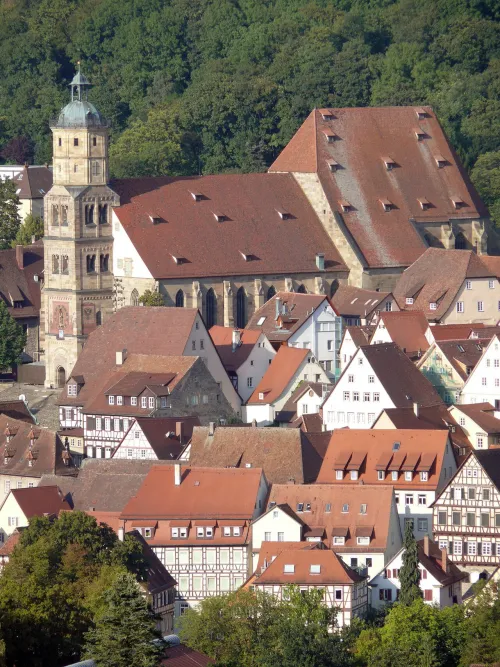
    St. Michael's sits high on a spur at the eastern edge of the old town, on the slope of the Kocher valley, and that position is why it dominates the townscape the way it does. The church stands on shell limestone rock, and just behind it ran the old town wall. The broad open space in front of the façade is more than a forecourt: it is the stage of the Freilichtspiele Schwäbisch Hall, the town's open-air theatre festival, so you may find the church framed by seating and stage lights.

    The church first appears in the records on 10 February 1156, when Bishop Gebhard von Henneberg of Würzburg consecrated the new building to Christ, Mary, the Holy Cross and the Archangel Michael. The push to build came from the citizens of Hall, backed by Abbot Adalbert of the nearby Benedictine monastery of Comburg, his successor Gernot and the Hohenstaufen rulers. Their motive was plain: a share in the booming economy of the salt-boiling town. Oddly, the charter calls this big church a mere branch of the much smaller but far older parish church of Steinbach, whose patronage belonged to the Comburg. Keep that in mind: you will meet the monastery again at the far end of the walk.

    The second great chapter starts after 1523, when Johannes Brenz preached here and St. Michael's became the starting point of the Reformation in the imperial city. Because Hall introduced the new faith gently, valuable furnishings from before the Reformation survived inside the church. Since October 2013 St. Michael's has carried the European Heritage Label as one of 20 Reformation sites in Germany, and today it also serves as a concert venue.

    Going in is free, with donations welcome, and it is worth it for anyone curious about how a Protestant church kept its medieval treasures. From here it is 380 m, about 5 minutes, down to the river and the Henkersbrücke.
    Hours
    Mar 1-Oct 31: Tue–Sat 10:00–17:00, Sun–Mon 12:00–17:00; Nov 1-Feb 29: Tue–Sat 11:00–15:00, Sun–Mon 12:00–15:00
    Price
    Free (donations welcome)
  2. 2

    Henkersbrücke

    Henkersbrücke in Schwäbisch Hall, stop 2 on the self-guided walking tour

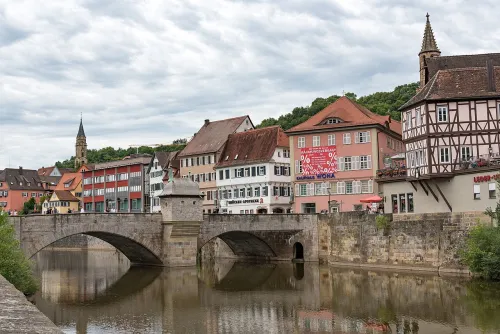
    The Henkersbrücke takes you across the Kocher, open at any hour, with no gate and no ticket. The name does the storytelling: Henkersbrücke means Executioner's Bridge, and a town that keeps the hangman in the name of a river crossing is telling you something about how it remembers itself.

    Pause in the middle and look up the far bank. The church above the bridge is your next stop, only 50 m and a minute away in the old Weiler suburb.

    Hours
    Always accessible
    Price
    Free
  3. 3

    Johanniterkirche

    Johanniterkirche in Schwäbisch Hall, stop 3 on the self-guided walking tour

    The Johanniterkirche sits in a prominent spot in the former Weiler suburb, which never had walls of its own, right above the Henkersbrücke. The church dates from the 12th century, began as a Romanesque building and was enlarged in Gothic style in the 14th century. It has come through every war and every round of town planning into the present day.

    It takes its name from the Order of St. John, the Knights Hospitaller, whose main task was caring for the sick and who ran a hospice next to the church. The knights left the town around 1600. Protestant services were held here from 1539 until 1812, when the church was secularised; in 1816 the town bought it from the Kingdom of Württemberg. The furnishings were sold off, and the pulpit and organ ended up in the Marienkirche in Rieden.

    What followed reads like a list of odd jobs: storage room, then from 1846 the town's first gymnasium, then from 1950 a cultural hall used among other things for rehearsals of the town festival. In 2004 the town sold the building to the Würth Group. Stuttgart architect Erich Fritz restored it thoroughly and added a cube-like glass extension, and in November 2008 it opened as an exhibition hall for art of the Middle Ages and the early modern period. In 2011 the renovation won the Hugo Häring Prize.

    The heart of the collection comes from the princely Fürstenberg collections in Donaueschingen, which Reinhold Würth bought in 2003 and which are being shown in public for the first time after restoration, alongside special exhibitions. Entry is free, so if you have any interest in Old Masters, go in; even if you don't, the contrast between the old nave and the glass cube is worth a look. The Kunsthalle Würth is 330 m away, about 5 minutes on foot.

    Hours
    Daily 11:00–17:00
    Price
    Free
  4. 4

    Kunsthalle Würth

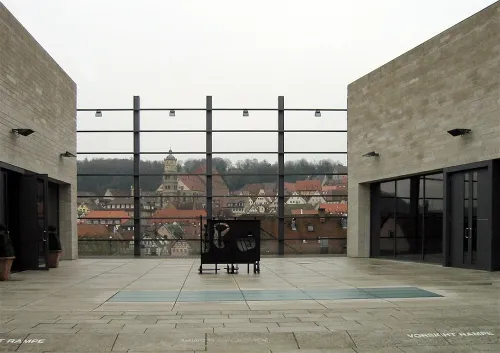
    Kunsthalle Würth in Schwäbisch Hall, stop 4 on the self-guided walking tour

    The Kunsthalle Würth is currently closed, so this is a stop for the outside. Look at the building itself: Danish architect Henning Larsen designed it to mediate between a modern idiom and the small-scale fabric of the old town. The façade is clad in Crailsheim shell limestone, set against concrete, steel and glass. Next door stands the old brewhouse, renovated and linked to the museum in 2004.

    Entrepreneur Reinhold Würth founded this private art museum in 2001 in the Katharinen suburb, ten years after he had opened the Museum Würth in Künzelsau. It shows changing exhibitions built on his collection, and past shows have included major retrospectives of Eduardo Chillida, Max Liebermann, Henry Moore, Fernando Botero, Edvard Munch, Georg Baselitz, David Hockney and Niki de Saint Phalle. Since 2023 it has been extended to 3,200 square metres of exhibition space, with a continuous circuit, a new welcome area with shop and day bar, and rooms for art education.

    The reopening marks the museum's 25th anniversary with an exhibition on Anselm Kiefer. Since 2025 Reinhold Würth's granddaughter Maria Würth has been in charge of the family's cultural work, including this house. From here, the Mauerstraße is just 150 m, about 2 minutes away.

    Status
    Currently closed
    Reopens
    16 October 2026
  5. 5

    Mauerstraße

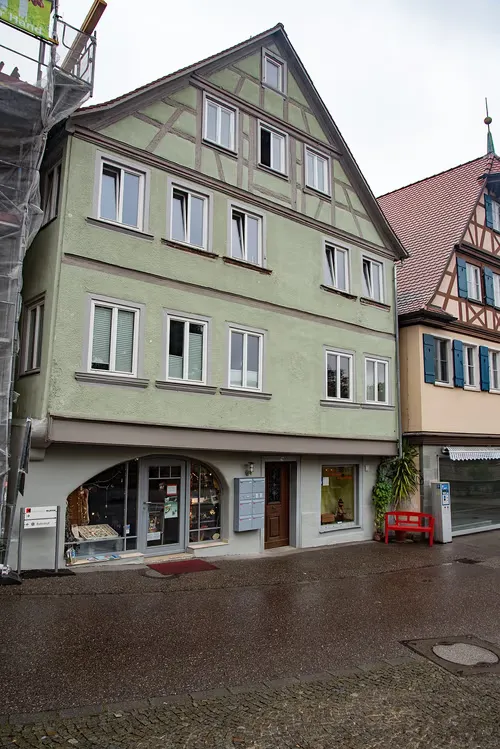
    Mauerstraße in Schwäbisch Hall, stop 5 on the self-guided walking tour

    Mauerstraße is a street, and it earns its place on the route through what runs beside it: the old city walls of the former imperial city of Hall. Walk it slowly on the wall side and read the stones rather than the clock. Nothing here opens or closes, so stay as long as your curiosity holds.

    These walls are the physical trace of the town whose story the Hällisch-Fränkisches Museum tells at the end of the walk. From here it is 370 m, about 5 minutes, to the island of Unterwöhrd, and on the way you pass the Freilichtspiele Schwäbisch Hall.

    Hours
    Always accessible
    Price
    Free
  6. 6

    Unterwöhrd

    Unterwöhrd in Schwäbisch Hall, stop 6 on the self-guided walking tour

    Unterwöhrd is an island in the Kocher, and the point where the route stops being sightseeing and becomes a place to simply be. There are open walkways and recreation areas, no gates and no closing time: the town keeps a park in the middle of its river and hands it to everyone around the clock, free of charge.

    Use the island as your last comfortable decision point, because the tour now changes scale. The leg out to Großcomburg is the longest of the route, 1,840 m or about 29 minutes, and the way back to the museum is a little longer still. If your legs or your day are running short, end the walk here and save the monastery for another time. If you carry on, sit down for a few minutes first and refill your water bottle if you can.

    Hours
    Always accessible
  7. 7

    Großcomburg

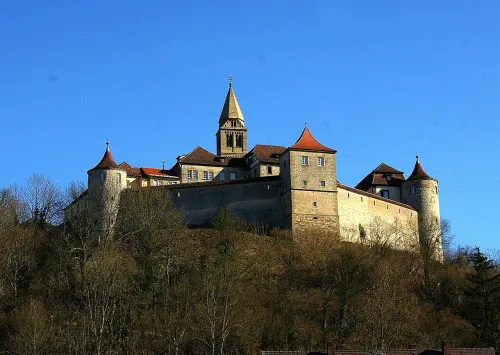
    Großcomburg in Schwäbisch Hall, stop 7 on the self-guided walking tour

    Großcomburg is a former Benedictine monastery on a hill overlooking the Kocher and Schwäbisch Hall. Its grounds and the walkways along its walls are free to explore, and walking the wall gives you the hilltop setting at its fullest. The church interior can only be seen on a guided tour, which costs a fee; book it if you want to see inside, otherwise the grounds alone justify the walk.

    The story begins in 1078, when Count Burkhardt II of Rothenburg-Comburg gave his family's ancestral castle on this hill to the Benedictines, founded an abbey and joined the order himself. His family also owned Hall and its salt works and served as protectors of the abbey until they died out early in the 12th century. The Hohenstaufen inherited that role, and in 1348 authority over the Comburg passed to Hall, by then a Free Imperial City. This is the same monastery whose abbot helped fund St. Michael's.

    Linked with Hirsau Abbey, the Comburg adopted the Hirsau Reforms in 1086 and flourished on donated land. Under its third abbot, Hertwig of Hirsau, it reached its peak in the early 13th century, running a scriptorium and possibly a metal foundry. The 14th century brought debt; at times the monks had to pawn their treasures. From the 14th century the monks came from Hall's gentry, from the mid 15th century from Franconian noble families.

    In 1485 the Bishop of Würzburg took over, and three years later turned the abbey into a collegiate foundation for nobles only. That tie to Würzburg let the Comburg survive the Reformation with its property intact while Hall and the towns around it became Protestant. The walk back into town to the Hällisch-Fränkisches Museum is the longest leg of the route: 2,220 m, about 31 minutes.

    Hours
    Grounds and battlement walkways freely accessible during daylight; interior/Stiftskirche accessible via guided tours only
    Price
    Free (grounds and wall walks); church interior with guided tour: 5.00 EUR adults, 2.50 EUR reduced, 12.50 EUR family
  8. 8

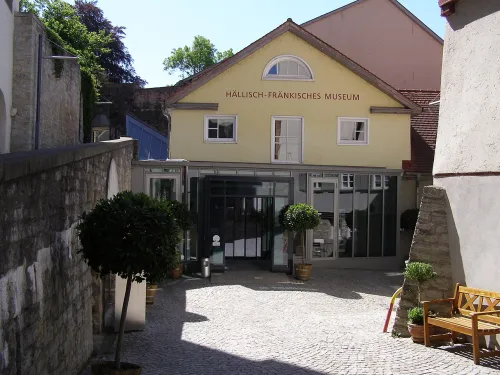
    Hällisch-Fränkisches Museum

    Hällisch-Fränkisches Museum in Schwäbisch Hall, stop 8 on the self-guided walking tour

    The Hällisch-Fränkisches Museum fills seven buildings in the heart of the town, built between the 13th and the 19th century, with more than 3,000 square metres on the history, art and culture of the former imperial city of Hall and its surroundings. After the walls, the churches and the monastery, this is where the pieces of the day come together.

    The collection goes back to 1847, when the Historical Society for Württemberg Franconia was founded; collecting began in 1851, first in the castle at Künzelsau. Since 1872 the collections have been in Schwäbisch Hall, moving from the Pulverturm to the Gräterhaus and, in 1936, into the Keckenburg, a Hohenstaufen residential tower that gave the museum its earlier name.

    From 1986 director Harald Siebenmorgen redesigned the departments and turned the museum into a model for presenting town history. He staged internationally noted exhibitions, among them one on the sculptor Leonhard Kern, who worked in Schwäbisch Hall, and was one of the first in Germany to set historical displays against contemporary art. Since June 2024 the museum has been led by art historian Dinah Rottschäfer.

    Entry is free, with a voluntary donation, so even a short visit is worthwhile; give it an hour if you want the town's story in order. This is the end of the route, and the GPS navigation can lead you back to St. Michael's Church if you want to close the loop.

    Hours
    Tue–Sun 10:00–17:00, Mon closed
    Price
    Free (voluntary donation / pay-what-you-wish)
Walking tour route map of Schwäbisch Hall Route loaded
St. Michael's ChurchHenkersbrückeJohanniterkircheKunsthalle Würth+4
All 8 stops are already on the map.
You just press start.
AI Tour Guide

You've read the route. Now walk it with a guide in your ear.

Press start wherever you are, even hundreds of kilometres from Schwäbisch Hall, and the guide begins telling its stories right away. In the city, pick any of the 8 stops to start from: it leads you there, then talks with you the whole route, asking, listening, remembering, and shaping the tour around your answers.

8stops 5.3km 1 h 18 minwalking 13languages
▶Start the tour free

Free to start · Runs in your browser · No app, no download

Shorter Ways to Walk Schwäbisch Hall

The route splits naturally at the island of Unterwöhrd: everything before it is a compact old town walk, everything after it is the long trip out to the monastery and back.

Old town and river only

Stops: 1, 2, 3, 4, 5, 6

For a half day or tired legs. You walk from St. Michael's Church to Unterwöhrd in 18 minutes of pure walking, about 1.3 km, and nothing on this stretch charges admission. With time inside St. Michael's and the Johanniterkirche, plan about an hour and a half.

Monastery and museum

Stops: 6, 7, 8

For history lovers who have already seen the centre or want to start fresh. From Unterwöhrd it is 29 minutes out to Großcomburg and 31 minutes back to the Hällisch-Fränkisches Museum, an hour of walking in total. The grounds and wall walks are free; only the Comburg church interior costs a fee on a guided tour, and the museum is free with a voluntary donation. Plan about three hours.

The full route

Stops: 1, 2, 3, 4, 5, 6, 7, 8

For a full day out: all eight stops, 5.3 km and 1 h 18 min of pure walking, and the whole arc from the town church to the monastery its abbot helped to fund.

How Long This Schwäbisch Hall Tour Takes, With or Without the Comburg

The pure walking time is 1 h 18 min, and the two legs to and from Großcomburg account for an hour of it. The town half is quick: five stops lie within a few minutes of each other, so the time there goes into looking, not walking.

Realistically, the full route takes about four and a half hours if you spend half an hour in the Johanniterkirche, take a proper look around the Comburg and give the Hällisch-Fränkisches Museum an hour. The old town loop alone fits into about an hour and a half; the monastery and museum half needs about three hours.

Before You Set Off in Schwäbisch Hall

  • Start and finish: The recommended start is St. Michael's Church and the walk ends at the Hällisch-Fränkisches Museum, but you can join at any stop. From the museum, the GPS navigation in your browser can lead you back to the start if you want.
  • Time of day: Start in the morning if you plan the full route, so the long walk to the Comburg and a proper museum visit still fit comfortably into the day.
  • What costs money: St. Michael's Church, the Johanniterkirche and the Hällisch-Fränkisches Museum are free, with donations welcome at the church and museum. At Großcomburg the grounds and wall walks are free, while the church interior can only be seen on a paid guided tour.
  • Currently closed: The Kunsthalle Würth is closed for now, so you see its architecture from outside only.
Walking tour route map of Schwäbisch Hall
AI Tour Guide

Your guide is ready when you reach St. Michael's.

Press start and a voice AI Tour Guide takes it from here: leading the route through Schwäbisch Hall, telling the stories, and turning your walk into a real back-and-forth conversation. No app or download is needed; it runs in your browser.

8stops 5.3km 1 h 18 minwalking 13languages
▶Start the tour free

Free to start · Runs in your browser · No app, no download

What the AI Tour Guide Adds Between Salt Town and Monastery

On this route the big story runs between two places: the salt town that built St. Michael's and the monastery on the hill that helped pay for it. The AI Tour Guide carries that thread from stop to stop as a conversation, notices whether you lean towards art, the Reformation or monastic life, and goes deeper where you want it to. Ask it what the Hirsau Reforms actually changed for the monks, or how a town lived from boiling salt, and interrupt it whenever something catches your eye.

A Real Conversation A voice AI Tour Guide greets you, leads the whole route, and tells the stories and facts as you walk, asking what you want to see and keeping a real conversation going. Not a recording you press play on.
Map Navigation Follow the route on the map and walk at your own pace. You choose where to start and when to move to the next stop.
Ask Anything Curious about a building you pass? Ask your AI Tour Guide on the spot and the conversation carries on.
13 Languages Switch language anytime. No separate tour needed.
Start free in your browser

Common Questions About Walking Schwäbisch Hall

Can I combine Schwäbisch Hall with another historic town?

Yes. Rothenburg ob der Tauber and Dinkelsbühl are both within about 45 km and have their own free walking routes.

Which stops suit an art lover best?

The Johanniterkirche, with Old Masters from the Würth Collection, and the Hällisch-Fränkisches Museum, which sets town history against art. Once it reopens, the Kunsthalle Würth adds modern and contemporary exhibitions.

Why does the route end at a museum instead of back at the church?

Because the Hällisch-Fränkisches Museum tells the story of the imperial city whose church, walls and monastery you have just walked past. It is the natural place to put the pieces together, and the GPS navigation can still take you back to St. Michael's afterwards.

Is the tour really free?

Yes. The whole tour is free: the route, the interactive map and the navigation cost you nothing. Only the voice AI Tour Guide is optional and paid: you test it with 100 free credits, then you pay either €5 per hour or €19.99 for this whole tour, with no time limit.

Do I need to download an app?

No. Everything runs in your phone browser. Open the route and start walking, no download and no sign-up required.

Do I need to book the walking tour in advance?

No booking needed. This self-guided tour is available anytime. Open the route in your browser and start walking. The AI Tour Guide works instantly, no app, no reservation required.

What languages is the AI Tour Guide available in?

The AI Tour Guide speaks 13 languages, so you take the tour in your own language and can switch at any time.

Can I skip stops or change the route?

Yes. Skip any stop, spend extra time at places you like, or start the route from any point. It is your walk, you set the pace.
Image credits
▶ Start free in your browser Runs in your browser, no app, no download