Free Walking Tour Milan: Duomo to Leonardo

From the marble Duomo past La Scala and the Sforza Castle to Leonardo's convent and Ambrose's basilica, then back into the medieval heart of Milan.

10 Stops 6.9 km ~1 h 35 min walking
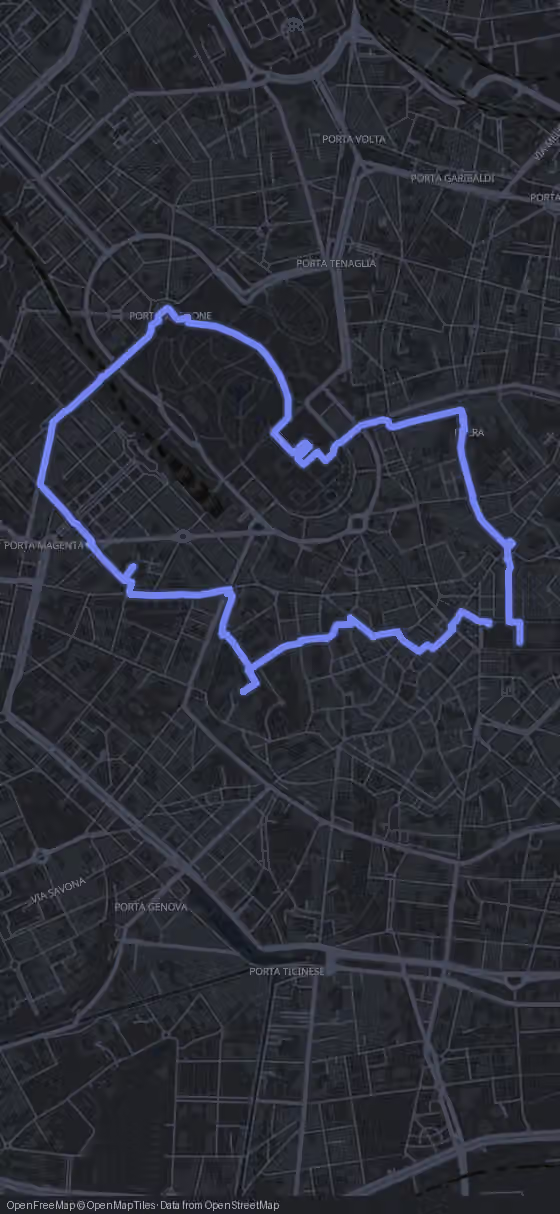
Route map for the Milan walking tour
Stop 1 of 10
220 m·3 min
Milan Cathedral
Head north into the Galleria Vittorio Emanuele II
Buongiorno, welcome to Milan. I'm Alex, and this city has never been gentle with ambitious artists.
Try this tour with Alex

This Milan Walk at a Glance

Ten stops lead from Milan Cathedral to Piazza dei Mercanti over 6.9 km, with 1 h 35 min of pure walking. With short looks at each stop you need a little over three hours; with the Duomo and one museum inside, plan about five and a half.

Galleria Vittorio Emanuele II, the Arch of Peace, Santa Maria delle Grazie and Basilica di Sant'Ambrogio are free; the Duomo, the museums and The Last Supper charge entry. The GPS route in your browser costs nothing, and the AI Tour Guide is optional.

Open free GPS & optional AI Tour Guide
This short shows highlights of the route. All 10 stops follow below.

The Route

Walking Map of Milan: Cathedral, Castle and Convent

10 stops 6.9 km 1 h 35 min walking
Tap to load interactive map

The 10 stops along this route

  1. Milan Cathedral, stop 1 on the self-guided walking tour
    1Milan Cathedral
  2. Galleria Vittorio Emanuele II in Milan, stop 2 on the self-guided walking tour
    2Galleria Vittorio Emanuele II
  3. La Scala Theatre in Milan, stop 3 on the self-guided walking tour
    3La Scala Theatre
  4. Pinacoteca di Brera in Milan, stop 4 on the self-guided walking tour
    4Pinacoteca di Brera
  5. Sforza Castle in Milan, stop 5 on the self-guided walking tour
    5Sforza Castle
  6. Arch of Peace in Milan, stop 6 on the self-guided walking tour
    6Arch of Peace
  7. Santa Maria delle Grazie in Milan, stop 7 on the self-guided walking tour
    7Santa Maria delle Grazie
  8. Basilica di Sant'Ambrogio in Milan, stop 8 on the self-guided walking tour
    8Basilica di Sant'Ambrogio
  9. Pinacoteca Ambrosiana in Milan, stop 9 on the self-guided walking tour
    9Pinacoteca Ambrosiana
  10. Piazza dei Mercanti in Milan, stop 10 on the self-guided walking tour
    10Piazza dei Mercanti
  11. That's the full route.

    Walk it with an AI Tour Guide talking you through every one of these streets.

    Start free in your browser
    You made it

Your Milan Walking Tour, Stop by Stop from the Duomo to the Merchants' Square

  1. 1

    Milan Cathedral

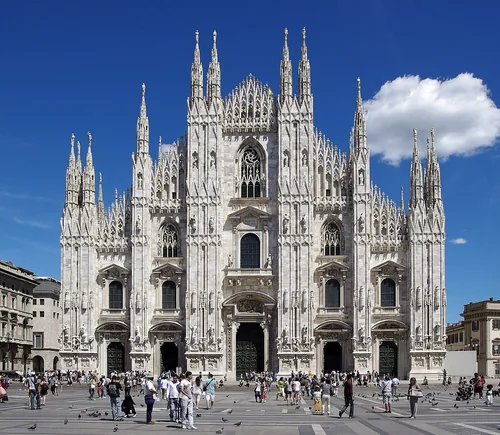
    Milan Cathedral, stop 1 on the self-guided walking tour

    You start in front of the white marble mass of Milan Cathedral, the Duomo, dedicated to the Nativity of Saint Mary and seat of the Archbishop of Milan. It took nearly six centuries to finish: building began in 1386 and the final details were completed in 1965. It is the largest church in the Italian Republic; St Peter's in Rome is bigger, but it stands in the Vatican, a separate state.

    Look at the street plan around you. Milan's streets either radiate from the Duomo or circle it, because the cathedral occupies the most central site of Roman Mediolanum, where the public basilica faced the forum. A first cathedral, the basilica nova dedicated to Saint Thecla, stood here by 355, and the octagonal baptistery from 335 can still be visited beneath the cathedral. After a fire in 1075, the old churches were rebuilt as the Duomo.

    The present building was a political statement. Archbishop Antonio da Saluzzo began it in 1386, just as his cousin Gian Galeazzo Visconti took power. It was meant as a gift to nobles and workers who had suffered under the tyrant Barnabò Visconti, and as a reminder that Milan, not Pavia where the new lord kept his court, was the centre that mattered.

    Going inside is worth the ticket on a first visit, and reduced tickets are available. Come early in the morning and you have the nave before the day gets going.

    From the cathedral square it is only 230 m, about 3 minutes, to the great glass arcade on its northern side.
    Local name
    Duomo di Milano
    Hours
    Daily 09:00–19:00 (last entry 17:50); Duomo Museum daily 10:00–19:00 (closed Wed)
    Price
    15 EUR full, 13 EUR reduced (Culture Pass)
  2. 2

    Galleria Vittorio Emanuele II

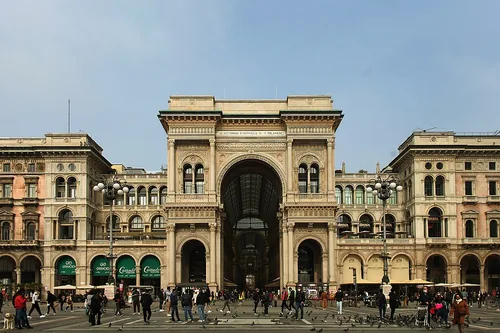
    Galleria Vittorio Emanuele II in Milan, stop 2 on the self-guided walking tour

    The Galleria Vittorio Emanuele II is Italy's oldest active shopping arcade, named after Victor Emmanuel II, the first king of united Italy. Designed in 1861, it was built by architect Giuseppe Mengoni between 1865 and 1877. Two glass vaulted arcades cross in an octagon under a glass dome, covering the street that links Piazza del Duomo with Piazza della Scala.

    Arcades of iron and glass already existed in London, Brussels and St Petersburg, but Milan built on a larger scale, and the Galleria became the direct ancestor of the modern enclosed shopping mall. Its name stuck: many shopping centres around the world are still called a galleria.

    Look down in the central octagon. Four mosaics show the coats of arms of Italy's three capitals, Turin, Florence and Rome, plus Milan. Tradition says that spinning around three times with your heel on the testicles of the Turin bull brings good luck. So many people have done it that a hole wore into the mosaic, which was restored in 2017 and again in 2026. If you want to join in, be gentle.

    The Galleria is free and open day and night, so if you are short on time, walk straight through now and come back after dark. Leave by the far end: La Scala is just 240 m and 3 minutes away.

    Hours
    Open 24/7
    Price
    Free
  3. 3

    La Scala Theatre

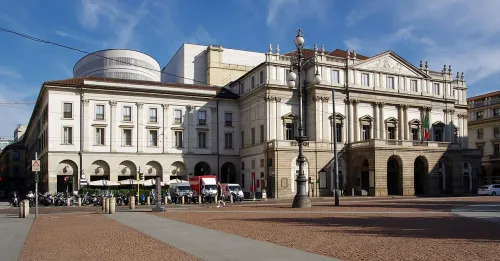
    La Scala Theatre in Milan, stop 3 on the self-guided walking tour

    The plain facade in front of you belongs to one of the great opera houses of the world. La Scala Theatre opened on 3 August 1778 as the New Royal Ducal Theatre at the Scala, on a site that had previously been a church. The first performance was Antonio Salieri's Europa riconosciuta. Since then most of Italy's leading opera artists and many of the finest singers from abroad have stood on this stage.

    The house is home to its own chorus, ballet, orchestra and the Filarmonica della Scala, and runs an academy that trains musicians, dancers and stage technicians. Its season opens every year on 7 December, the feast of Saint Ambrose, Milan's patron saint, whose basilica you will reach later on this walk. All performances must end before midnight, so long operas simply start earlier.

    Up under the roof, above the boxes, is the loggione, the gallery for those with less money. It fills with the loggionisti, the most demanding opera fans in the house, who can cheer a singer to the skies or bury a poor performance in a storm of disapproval that Milan remembers for years.

    The La Scala Theatre Museum is reached from the foyer and holds paintings, sketches, statues and costumes from the theatre's history. Entry is charged, with reduced tickets available. For opera lovers it is a must; if opera leaves you cold, the outside is enough.

    From here you walk 570 m, about 8 minutes, into the Brera quarter.

    Local name
    Teatro alla Scala
    Hours
    Daily 09:30–17:30 (last entry 17:00)
    Price
    12 EUR full, 8 EUR reduced (Museum)
  4. 4

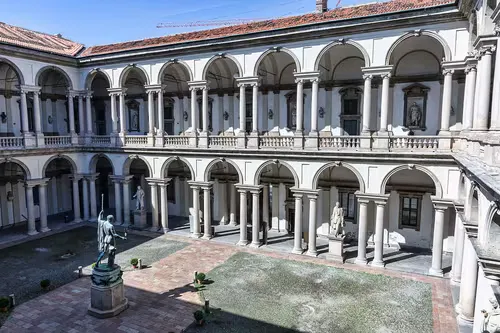
    Pinacoteca di Brera

    Pinacoteca di Brera in Milan, stop 4 on the self-guided walking tour

    The Pinacoteca di Brera is Milan's main public painting gallery, with one of the foremost collections of Italian art from the 13th to the 20th century. It shares the Palazzo Brera with the Brera Academy, and the name comes from the Germanic word braida, a grassy open space within the city.

    The building has had many lives. A convent passed to the Jesuits in 1572, and Francesco Maria Richini rebuilt it radically in 1627 and 1628. When the Jesuit order was dissolved in 1773, the palace kept their astronomical observatory and the Braidense National Library, and a botanical herbarium arrived in 1774. The Academy was formally founded in 1776, with the poet Giuseppe Parini as dean and the architect Giuseppe Piermarini as professor. Students learned from a collection of casts after ancient sculpture.

    The paintings came with Napoleon. During the reshuffling of Italian art in that era, the Academy acquired its first works, and Raphael's Marriage of the Virgin became the centrepiece. From 1805 annual exhibitions with prizes, modelled on the Paris Salons, made Milan the capital of contemporary painting in Italy throughout the 19th century.

    The gallery charges entry, and the reduced ticket is very cheap. If you love painting, give it at least an hour and a half. If not, admire the courtyard and keep walking.

    The next leg is 920 m, about 13 minutes, to the castle of the Sforza.

    Hours
    Tue–Sun 08:30–19:15 (last entry 18:00), Mon closed
    Price
    20 EUR full, 4 EUR reduced (Grande Brera)
  5. 5

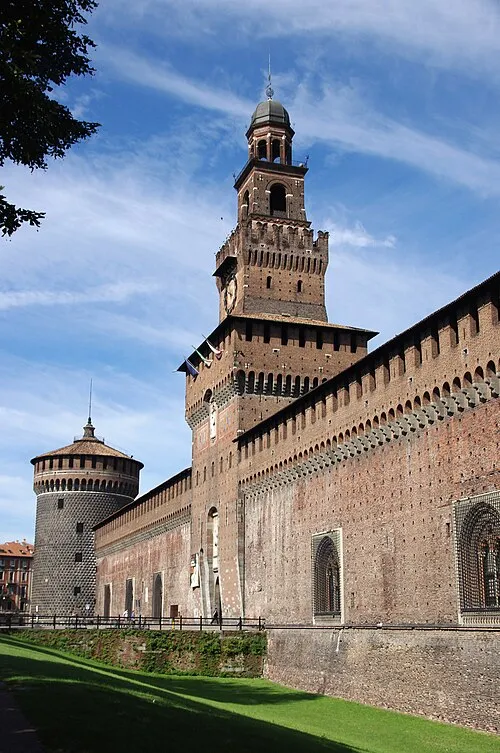
    Sforza Castle

    Sforza Castle in Milan, stop 5 on the self-guided walking tour

    Sforza Castle, the Castello Sforzesco, was built in the 15th century by Francesco Sforza, Duke of Milan, on the remains of an older fortress. Galeazzo II Visconti had started the first castle in 1358, called the Castello di Porta Giova after a nearby city gate, on the site of a Roman fortification. His successors expanded it into a square castle with sides 200 m long, four corner towers and walls up to 7 m thick.

    When the short lived Golden Ambrosian Republic drove out the Visconti in 1447, the castle was torn down. Francesco Sforza crushed the republicans and began rebuilding in 1450, turning it into his princely residence. In 1452 he hired the sculptor and architect Filarete to design the central tower, still called the Torre del Filarete. In 1476, during the regency of Bona of Savoy, the tower bearing her name was added, and in 1494 Ludovico Sforza brought numerous artists to decorate the rooms.

    One detail travels far: the architect Pietro Antonio Solari drew on this castle when he worked on the Moscow Kremlin in 1485. In the 16th and 17th centuries it was one of the largest citadels in Europe. What you see today owes much to Luca Beltrami, who rebuilt it extensively between 1891 and 1905.

    The courtyards are free. The museums inside charge a modest entry, with reduced tickets available; at that price they are an easy yes if you have the time.

    Walk through the castle and out the other side: the Arch of Peace is 1060 m away, about 14 minutes.

    Local name
    Castello Sforzesco
    Hours
    Courtyards: daily 07:00–19:30 | Museums: Tue–Sun 10:00–17:30 (last entry 16:30), Mon closed
    Price
    5 EUR full, 3 EUR reduced (Museums)
  6. 6

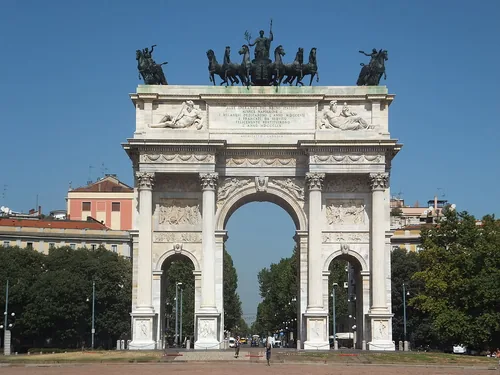
    Arch of Peace

    Arch of Peace in Milan, stop 6 on the self-guided walking tour

    The Arch of Peace, Arco della Pace, stands at the start of Corso Sempione, on what was once the parade ground behind the castle and is now Parco Sempione. It is one of Milan's major neoclassical monuments, and its story follows the changing masters of the city.

    It began as a party decoration. In January 1806 the Marchese Cagnola designed a temporary triumphal arch of canvas, plaster and timber for the entry of Eugène de Beauharnais, Viceroy of Italy, and his new wife Augusta of Bavaria. It went up in a few days on today's Corso Venezia, and it was such a success that on 8 February the city council decided to build a permanent arch in marble.

    The first stone was laid on 14 October 1807, when Milan was capital of Napoleon's Kingdom of Italy. Cagnola designed it as an Arch of Victory, marking the first anniversary of the French win at Jena, and bronze plates with the names of the council members were set into the foundation. Work stopped when Napoleon fell in 1814. The Austrians resumed it in 1826 and rededicated it to the peace among European nations agreed at the Congress of Vienna in 1815. Emperor Ferdinand I of Austria inaugurated it on 10 September 1838.

    History turned once more in 1859, when Napoleon III and Victor Emmanuel II rode into Milan after their victory at Magenta. The arch is free and open at all hours.

    Now comes the longest leg of the walk: 1460 m, about 20 minutes, to Leonardo's convent.

    Local name
    Arco della Pace
    Hours
    Open 24/7
    Price
    Free
  7. 7

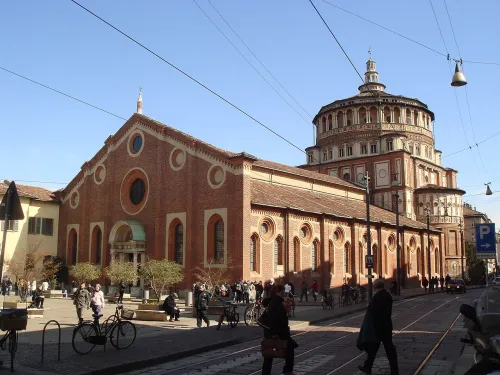
    Santa Maria delle Grazie

    Santa Maria delle Grazie in Milan, stop 7 on the self-guided walking tour

    Santa Maria delle Grazie is a Dominican church and convent and a UNESCO World Heritage Site. In its refectory is Leonardo da Vinci's mural of The Last Supper. Duke Francesco I Sforza ordered the convent built on the site of an older chapel, and the main architect, Guiniforte Solari, completed the Gothic nave by 1469.

    Ludovico Sforza then chose the church as his family's burial place and rebuilt the cloister and the apse, both finished after 1490. His wife Beatrice was buried here in 1497. The apse is often credited to Donato Bramante, whose name is inscribed on a piece of marble delivered in 1494, but scholars still argue whether he worked here at all; some documents point to Giovanni Antonio Amadeo instead.

    Inside, look for the Chapel of the Holy Crown to the right of the nave, frescoed with stories of the Passion by Gaudenzio Ferrari. Its Titian altarpiece of Christ crowned with thorns was looted by French troops in 1797 and now hangs in the Louvre. On the night of 15 August 1943 an Allied air raid struck both church and convent.

    The church is free. The Last Supper charges entry and must be booked in advance, so plan your walk around your slot. Without a booking, the church alone still rewards a visit.

    From here it is 1080 m, about 15 minutes, to the basilica of Milan's patron saint.

    Hours
    Mon–Sat: 09:00–12:20, 15:00–17:50 | Sun: 15:00–17:50
    Price
    Free (church), 15 EUR (The Last Supper, advance booking required)
  8. 8

    Basilica di Sant'Ambrogio

    Basilica di Sant'Ambrogio in Milan, stop 8 on the self-guided walking tour

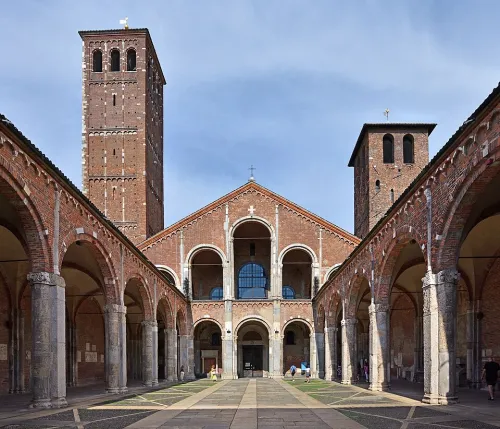
    The Basilica di Sant'Ambrogio is one of the oldest churches in Milan. Saint Ambrose himself commissioned it between 379 and 386, in an area where many martyrs of the Roman persecutions lay buried, which is why it was first called the Basilica Martyrum. Only later did it take the name of its founder.

    When Ambrose became bishop, the churches of the region were split over the dispute between Arianism and the Nicene Creed. He took the Nicene side firmly and wanted northern Italy allied with the papacy, and he fought with sermons and with buildings. Around the city he raised the Basilica Apostolorum, now San Nazaro in Brolo, the Basilica Virginum, now San Simpliciano, and this Basilica Martyrum, all dedicated with pointedly anti Arian language.

    What you see today is mostly 12th century Romanesque rebuilding. The basilica first stood outside the Roman walls, and the city grew up around it. In 789 a monastery was founded on its grounds, yet the canons who already served the church kept their own community, so for centuries two separate religious groups shared one basilica. In the 11th century the canons adopted a rule and became Canons Regular.

    Entry is free, and the church that gives La Scala its opening night date is worth a quiet quarter of an hour.

    Next you walk 1040 m, about 14 minutes, back towards the centre and the gallery named after Ambrose.

    Hours
    Mon–Sat 07:30–12:30, 14:30–19:00 | Sun 08:00–13:00, 15:00–20:00
    Price
    Free (church)
  9. 9

    Pinacoteca Ambrosiana

    Pinacoteca Ambrosiana in Milan, stop 9 on the self-guided walking tour

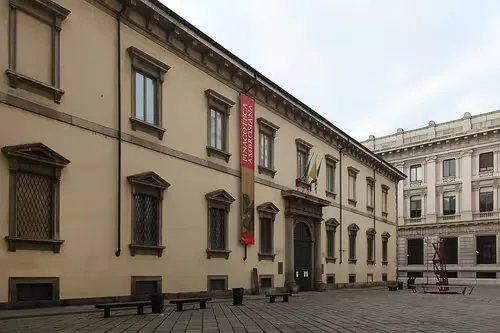
    The Pinacoteca Ambrosiana is named after Saint Ambrose and shares the Palazzo dell'Ambrosiana with the Biblioteca Ambrosiana. It began in 1618, when Cardinal Federico Borromeo, Archbishop of Milan, gave his private collection of more than 250 paintings, sculptures and drawings to the library. Three years later he founded an academy of painting, and the works were meant to train its young artists.

    Today the collection fills 24 rooms with art from the 14th to the early 20th century, five of them holding the cardinal's original gift. The crowd pleasers are Leonardo da Vinci's Portrait of a Musician and Caravaggio's Basket of Fruit. Look also for the only surviving cartoon for Raphael's School of Athens, plaster casts of the Laocoön and of Michelangelo's Pietà, and works by Botticelli, Titian, Tiepolo and Hayez.

    A detail that links back to your walk: Borromeo commissioned copies of famous paintings for teaching, including copies of Leonardo's Last Supper, whose original you passed at Santa Maria delle Grazie. If you could not get a ticket there, this is a thoughtful consolation.

    There is an entry fee, with cheaper reduced tickets available. Worth it for Leonardo, Caravaggio and Raphael fans.

    The final leg is short: 340 m, about 5 minutes, to the old merchants' square.

    Hours
    Thu–Tue 10:00–18:00 (last entry 17:30), Wed closed
    Price
    17 EUR full, 10-13 EUR reduced
  10. 10

    Piazza dei Mercanti

    Piazza dei Mercanti in Milan, stop 10 on the self-guided walking tour

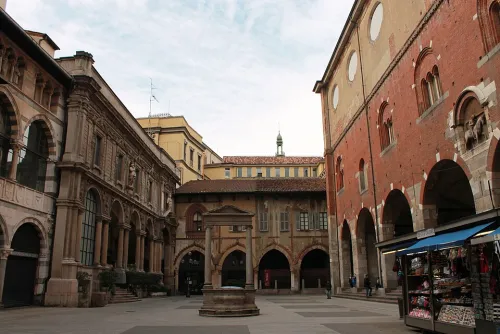
    Piazza dei Mercanti lies between Piazza del Duomo and Piazza Cordusio and was the heart of Milan in the Middle Ages. Back then it was larger and called Piazza del Broletto, after the palace in its middle. In the 13th century six entrances led into the square, each tied to a trade, from sword smiths to hat makers, and until the late 19th century it hosted Oh bej! Oh bej!, Milan's most important traditional fair.

    The big arcaded building is the Palazzo della Ragione, also known as the Broletto Nuovo, built in 1233 as the city's administrative headquarters. Opposite stands the Loggia degli Osii of 1316, built for Matteo I Visconti, with its parlera, the balcony from which the authorities addressed the people. Next to it is the baroque Palazzo delle Scuole Palatine, designed by Carlo Buzzi in the 17th century, and on another side the Gothic Casa Panigarola, the notaries' palace from the 15th century.

    The Palazzo dei Giureconsulti, built in 1561 to a design by Vincenzo Seregni, once closed the square and now faces Via Mercanti. Its tower is far older, from the 13th century, though largely restored in the 17th.

    The square is free and open at all hours, a quiet ending after the grand stops. Your walk ends here; if you want to return to the cathedral, the GPS navigation in your browser takes you back.

    Hours
    Open 24/7
    Price
    Free
Walking tour route map of Milan Route loaded
Milan CathedralGalleria Vittorio Emanuele IILa Scala TheatrePinacoteca di Brera+6
All 10 stops are already on the map.
You just press start.
AI Tour Guide

You've read the route. Now walk it with a guide in your ear.

Press start wherever you are, even hundreds of kilometres from Milan, and the guide begins telling its stories right away. In the city, pick any of the 10 stops to start from: it leads you there, then talks with you the whole route, asking, listening, remembering, and shaping the tour around your answers.

10stops 6.9km 1 h 35 minwalking 13languages
▶Start the tour free

Free to start · Runs in your browser · No app, no download

Shorter Ways to Walk Milan

The route runs in one line, so it splits neatly into sections. Pick the one that fits your time and your budget.

The compact centre: Duomo to Brera

Stops: 1, 2, 3, 4

For a first morning in Milan or a short stopover. Only 14 minutes of walking over 1040 m, so nearly all your time goes into the sights. Entry applies to the Duomo, the La Scala museum and the Pinacoteca di Brera; the Galleria is free.

Castle, arch and Leonardo

Stops: 5, 6, 7, 8

For history lovers who want the Sforza story from fortress to family church. About 3.6 km and 49 minutes of walking. The castle courtyards, the Arch of Peace and both churches are free; you pay only for the castle museums and, if you have booked it, The Last Supper.

The whole route without tickets

Stops: 1, 2, 3, 4, 5, 6, 7, 8, 9, 10

For a tight budget: all ten stops from the outside, plus the free interiors of the Galleria, the castle courtyards, Santa Maria delle Grazie and Basilica di Sant'Ambrogio. Walking time stays at 1 h 35 min, and the day costs nothing.

How Long Does This Milan Tour Take on Foot and Inside?

The pure walking time is 1 h 35 min across nine legs. The first three are short hops through the centre, while the stretch from the Arch of Peace to Santa Maria delle Grazie is the longest at 1460 m and 20 minutes.

Seeing every stop from the outside with a few minutes at each takes a little over three hours. Add an hour inside the Duomo and an hour and a half in the Brera gallery and you are at about five and a half hours. Trying to go into every museum on one day is too much; choose the two that interest you most and leave the rest for another visit.

The compact centre section needs only 14 minutes of walking, so museum time decides its length. The castle and Leonardo section has 49 minutes of walking plus whatever time your Last Supper slot and the castle museums take.

Before You Set Off in Milan

  • Start and finish: The recommended start is Milan Cathedral and the walk ends at Piazza dei Mercanti. You can join at any stop; the GPS navigation in your browser guides you back from the last stop to the start if you want.
  • Best days: The Pinacoteca di Brera, the castle museums, the Pinacoteca Ambrosiana, the Duomo Museum and Santa Maria delle Grazie do not all open on the same days, so check them before you pick your date.
  • Time of day: Start at the Duomo in the morning and book an afternoon slot for The Last Supper.
  • Costs: The Duomo, the La Scala museum, Brera, the castle museums, The Last Supper and the Ambrosiana all charge entry. Brera's reduced ticket is especially cheap, so check whether you qualify.
  • Booking: The Last Supper requires advance booking. All other stops on the route can be visited without reserving ahead.
Walking tour route map of Milan
AI Tour Guide

Your guide is ready when you reach the Duomo.

Press start and a voice AI Tour Guide takes it from here: leading the route through Milan, telling the stories, and turning your walk into a real back-and-forth conversation. No app or download is needed; it runs in your browser.

10stops 6.9km 1 h 35 minwalking 13languages
▶Start the tour free

Free to start · Runs in your browser · No app, no download

What the AI Tour Guide Adds in Milan

This route is full of the same families: the Visconti start the Duomo and the castle, the Sforza rebuild the castle and turn Santa Maria delle Grazie into their burial church. The AI Tour Guide follows those threads as a conversation from stop to stop, notices what you care about and goes deeper there, whether you want to hear more about Ludovico Sforza's court or about the loggionisti of La Scala. You start with 100 free credits; after that you choose between this tour all-inclusive for €19.99 with no time limit, or €5 per hour.

A Real Conversation A voice AI Tour Guide greets you, leads the whole route, and tells the stories and facts as you walk, asking what you want to see and keeping a real conversation going. Not a recording you press play on.
Map Navigation Follow the route on the map and walk at your own pace. You choose where to start and when to move to the next stop.
Ask Anything Curious about a building you pass? Ask your AI Tour Guide on the spot and the conversation carries on.
13 Languages Switch language anytime. No separate tour needed.
Start free in your browser

Common Questions about Walking Milan

Is this walk worth doing in the evening?

Partly. The Galleria Vittorio Emanuele II, the Arch of Peace and Piazza dei Mercanti are open around the clock and free, so you can see them after the museums have closed. The churches and museums need daytime hours.

If I only have time for one art museum, which one?

Choose the Pinacoteca di Brera for a broad sweep of Italian painting and Raphael's Marriage of the Virgin. Choose the Pinacoteca Ambrosiana if Leonardo and Caravaggio are your priority. On a tight budget, the castle museums are the cheapest option.

Can I combine Milan with a day trip?

Yes, the walk fills one day well and leaves the next free. Como is 39 km away and Bergamo 46 km; both have their own walking tour. Further afield, Verona and Turin make longer day trips.

Is the tour really free?

Yes. The whole tour is free: the route, the interactive map and the navigation cost you nothing. Only the voice AI Tour Guide is optional and paid: you test it with 100 free credits, then you pay either €5 per hour or €19.99 for this whole tour, with no time limit. Admission to 5 of the 10 stops is not included: Milan Cathedral, La Scala Theatre, Pinacoteca di Brera, Sforza Castle and Pinacoteca Ambrosiana charge their own entry fees.

Do I need to download an app?

No. Everything runs in your phone browser. Open the route and start walking, no download and no sign-up required.

Do I need to book the walking tour in advance?

No booking needed. This self-guided tour is available anytime. Open the route in your browser and start walking. The AI Tour Guide works instantly, no app, no reservation required.

What languages is the AI Tour Guide available in?

The AI Tour Guide speaks 13 languages, so you take the tour in your own language and can switch at any time.

Can I skip stops or change the route?

Yes. Skip any stop, spend extra time at places you like, or start the route from any point. It is your walk, you set the pace.
Image credits
▶ Start free in your browser Runs in your browser, no app, no download