



Barbican
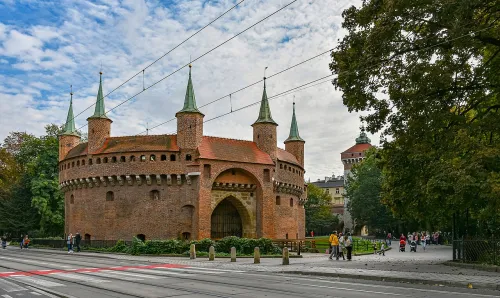
Begin at the round brick fortress in front of the old walls. The Barbican went up around 1498 as a fortified outpost before the city gate, and it is one of only three such outposts still standing in Europe, and the best preserved. Take in the moat, the seven turrets on its rim and the walls themselves: they are 3 metres thick and pierced by 130 embrasures.
Krakow built it out of fear. After King John I Albert's defeat at the Battle of the Cosmin Forest, Tatar and Ottoman forces with their Moldavian vassal invaded south-eastern Poland in the spring of 1498, plundering Red Ruthenia and Podolia and carrying off as many as a hundred thousand people. The city strengthened its walls and added the Barbican in case the Ottomans reached Krakow.
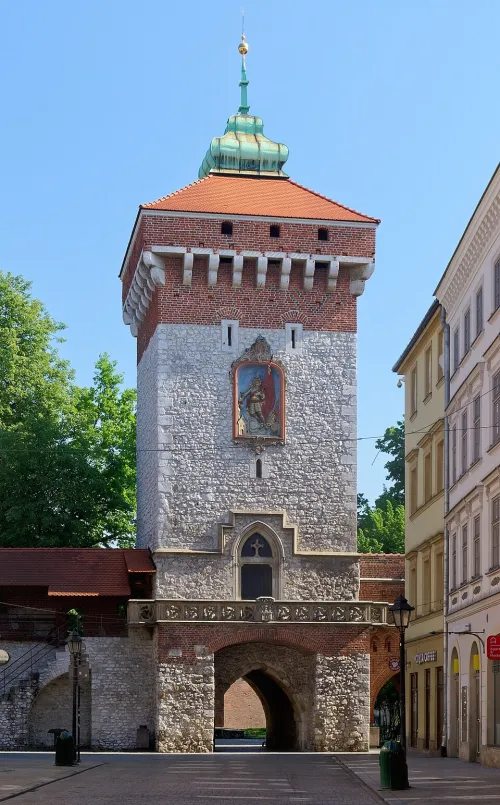
It earned its keep. The Barbican helped defend the city against Archduke Maximilian III of Austria in 1587, in the sieges of 1655 and 1657, and against Russian troops in 1792. A covered passage once linked it to St. Florian's Gate, so it served as the checkpoint every visitor had to pass before entering the city.
Inside, you stand in a courtyard 24.4 metres across, with displays on how Krakow's fortifications developed, run by the Historical Museum of the City of Krakow. The ticket is worth it if military history interests you; otherwise the outside tells the story well.
Follow the line of the vanished passage: St. Florian's Gate is 110 m ahead, a 2-minute walk.