

Market Square
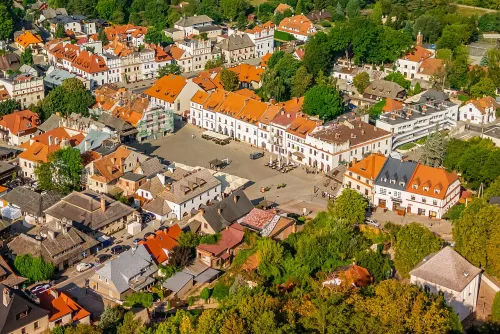
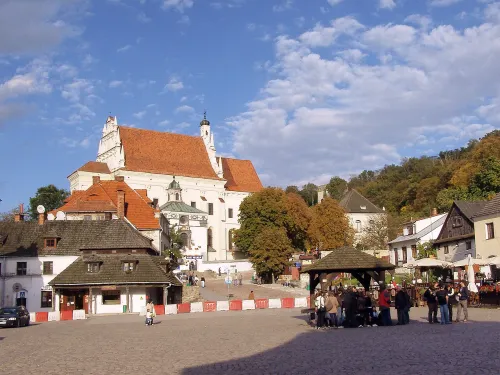
You start in the heart of the town, on a square laid out in the Middle Ages, most likely around the turn of the 14th and 15th centuries. Look at the low houses with their arcaded fronts. Much of what you see is a careful reconstruction: after the damage of both world wars, rebuilders worked from the drawings of Michał Elwiro Andriolli, who had sketched the arcaded masonry and timber houses that went up after the great fires of the 16th century.
The town's paperwork has gaps of its own. No original founding charter survives. Kazimierz lived under Polish law as early as the reign of Władysław I the Elbow-high, and became a chartered town in the formal sense only under Casimir III the Great. On 28 February 1406 King Władysław II Jagiełło moved it to Magdeburg law, a clear rise in status, and granted Saturday markets. Wednesday markets followed in 1408 or 1420, and on 9 July 1558 the Saturday market moved to Mondays.
The square has not always had this shape. In the 15th century the market ran from the parish church to Lubelska Street, today's upper part, and later grew from there down to the little Grodarz stream. Fires around 1560 and in 1585 swept through the wooden town, and from the turn of the 17th century the houses were rebuilt in Renaissance style. In 1627 the square counted 21 houses, several of them owned by wealthy patrician families.
Then came the Swedes. They wrecked town and castle in 1656, and on 12 April 1657 they set the buildings alight; everything from Lubelska Street to the church burned. By the end of the 18th century only one side of the square still had a closed row of houses.
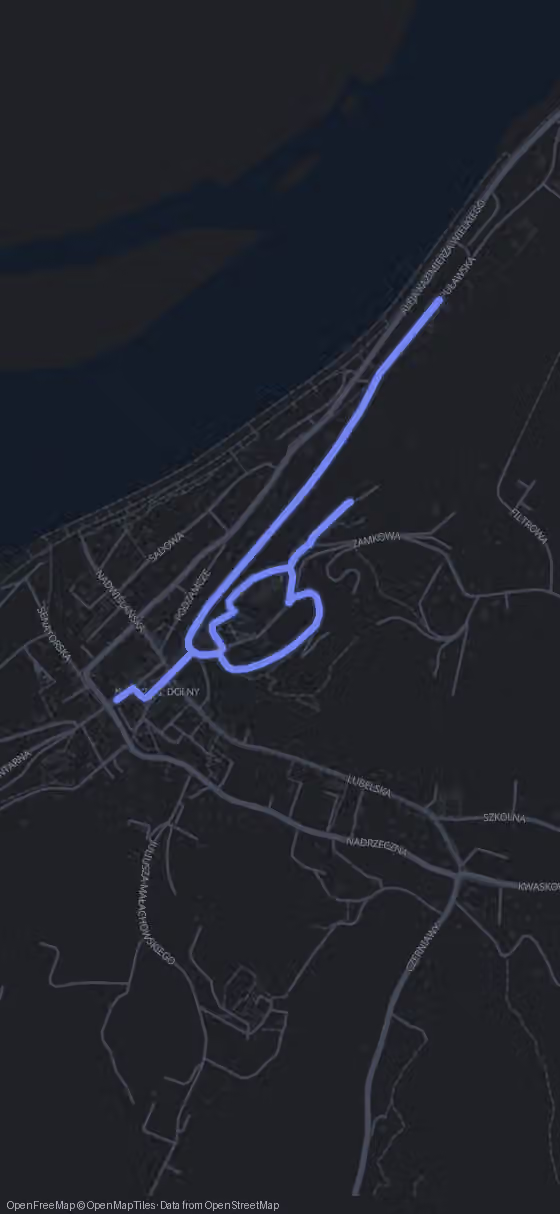
The square is free and open at any hour, so take your time. Then head down to the river: 860 m, about 11 minutes, to the granaries.