

Vogtturm
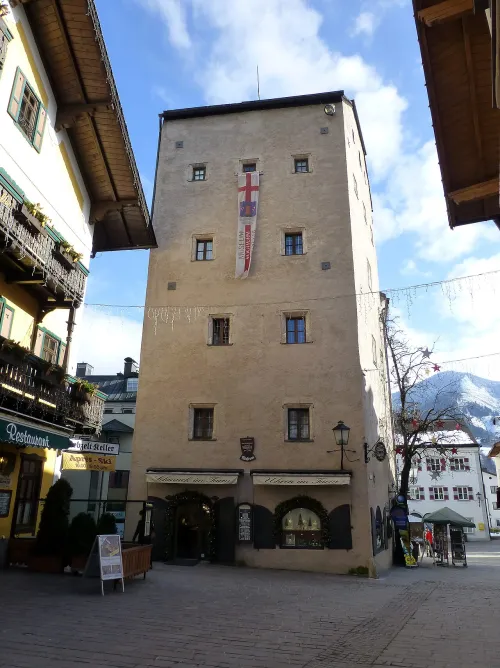
You start at the corner where the Stadtplatz meets the Dreifaltigkeitsgasse and the Turmplatzl, in front of a stout stone tower 23.5 m tall. Look at its outline: the north, south and west walls each measure 8.6 m, but the east wall runs to 13.5 m, which gives the tower a trapezoid footprint. It was once also called the Kastnerturm, and together with the neighbouring residence and the church of St. Hippolyt it counts among the oldest buildings in town.
The tower goes back to the High Middle Ages, when lords built residences and fortifications at the foot of the Alpine passes. It did three jobs at once. As a keep it offered protection, as a checkpoint it controlled travellers and collected road tolls, and as a show of status it announced who was in charge: the Counts of Lechsgemünd-Frontenhausen-Mittersill-Pinzgau, a Swabian Bavarian family who held the Pinzgau as stand-ins for the Salian and Staufer kings.
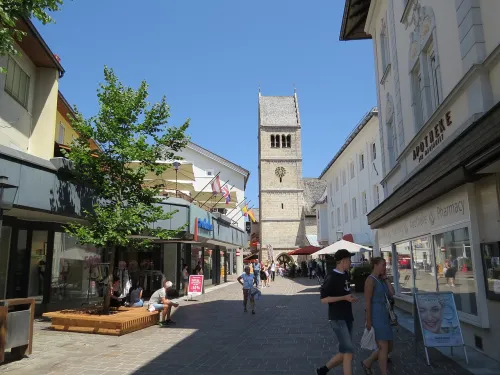
Around the middle of the 12th century, the tower and the counts' residence belonged to a group of houses that framed a triangular courtyard closed off by gates. That courtyard was the old market square and is today's Stadtplatz, so you are standing inside the medieval town's core. The residence next door, once the Fuscher Haus and the Neue Propstei, now houses the Bankhaus Carl Spängler. Tower and residence held a special legal status as 'free property' well into the modern era.
Inside is the Museum Vogtturm, reopened in July 2020 after a thorough restoration, with four of its five floors used for exhibitions. It charges admission, so it is worth it if you want the town's history in depth; if you are short on time, the outside tells the main story. From here the church is just 80 m away, a one minute walk, and on that short stretch you pass the spot of the Zell am See weekly market.