Free Walking Tour Innsbruck: Old Town in 10 Stops

Walk 2.9 km from a wedding arch to a golden balcony, an emperor's tomb without the emperor and a park where Maria Theresa's own plants still grow.

10 Stops 2.9 km ~39 min walking
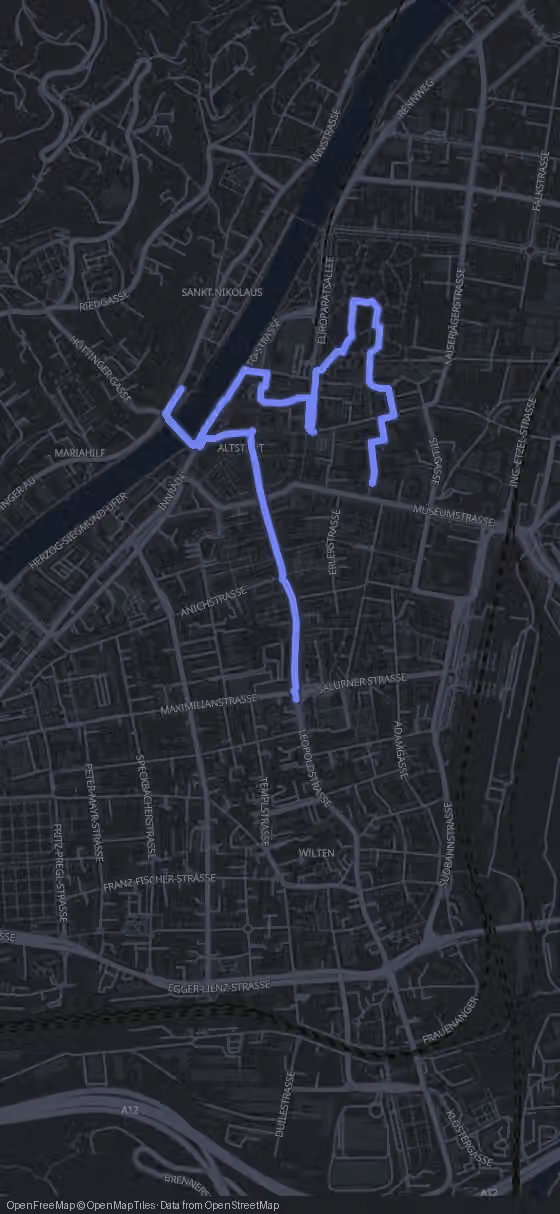
Route map for the Innsbruck walking tour
Stop 1 of 10
300 m·4 min
Triumphal Arch
Head north up Maria-Theresien-Straße
Servus, welcome to Innsbruck. I'm Alex, and one stone arch here holds a royal wedding and a family tragedy on opposite faces.
Try this tour with Alex

Innsbruck's Old Town Walk at a Glance

Ten stops over 2.9 km, from the Triumphal Arch along Maria-Theresien-Straße into the Old Town, down to the Innbrücke and on to the Ferdinandeum. Pure walking time is 39 minutes; with short looks at each stop allow about an hour and a half, with a few interiors around three hours.

The streets, the Innbrücke, the Hofgarten and the Cathedral of St. James are free. The City Tower, Golden Roof, Imperial Palace and Court Church charge entry; the Ferdinandeum is closed. The GPS route runs free in your browser, the AI Tour Guide is optional.

Open free GPS & optional AI Tour Guide
This short shows highlights of the route. All 10 stops follow below.

The Route

Walking Map of Innsbruck: Triumphal Arch to Ferdinandeum

10 stops 2.9 km 39 min walking
Tap to load interactive map

The 10 stops along this route

  1. Triumphal Arch in Innsbruck, stop 1 on the self-guided walking tour
    1Triumphal Arch
  2. Maria-Theresien-Straße in Innsbruck, stop 2 on the self-guided walking tour
    2Maria-Theresien-Straße
  3. City Tower in Innsbruck, stop 3 on the self-guided walking tour
    3City Tower
  4. Golden Roof in Innsbruck, stop 4 on the self-guided walking tour
    4Golden Roof
  5. Innbrücke in Innsbruck, stop 5 on the self-guided walking tour
    5Innbrücke
  6. Cathedral of St. James in Innsbruck, stop 6 on the self-guided walking tour
    6Cathedral of St. James
  7. Imperial Palace in Innsbruck, stop 7 on the self-guided walking tour
    7Imperial Palace
  8. Court Church in Innsbruck, stop 8 on the self-guided walking tour
    8Court Church
  9. Hofgarten in Innsbruck, stop 9 on the self-guided walking tour
    9Hofgarten
  10. Ferdinandeum in Innsbruck, stop 10 on the self-guided walking tour
    10Ferdinandeum
  11. That's the full route.

    Walk it with an AI Tour Guide talking you through every one of these streets.

    Start free in your browser
    You made it

Your Innsbruck Walking Tour, Stop by Stop: Ten Places and Their Stories

  1. 1

    Triumphal Arch

    Triumphal Arch in Innsbruck, stop 1 on the self-guided walking tour

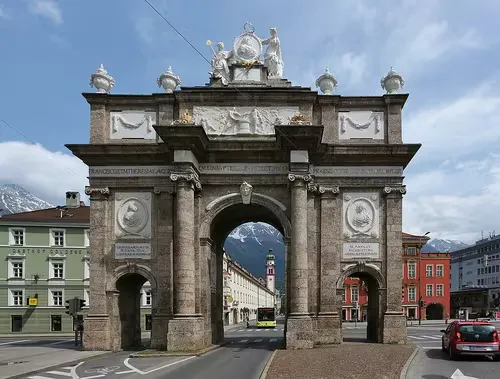
    You begin at the southern end of Maria-Theresien-Straße, in front of the Triumphal Arch, the Triumphpforte. When it was built in 1765 this was the southern way out of town. It is an outdoor monument and free, so take your time and look at it from both sides.

    It was built for a wedding. On 5 August 1765 Archduke Leopold, second son of Empress Maria Theresa and Franz Stephan of Lorraine, married the Spanish princess Maria Ludovica. Thirteen days later, on 18 August, Franz Stephan died unexpectedly. The arch took in both events: the south side carries the motifs of the young couple's wedding, the north side mourns the emperor. Walk through and turn around, and you have read the family's summer of 1765 in stone.

    The stone itself is unusual. Arches like this were normally built of wood, but Innsbruck chose stone and reused blocks of Höttinger breccia from the demolished suburban gate at the edge of the Old Town. Constantin Walter and Johann Baptist Hagenauer carried out the work, and in 1774 Balthasar Ferdinand Moll turned Hagenauer's stucco reliefs into marble from Sterzing.

    Look for the Austrian archducal hat with the Order of the Golden Fleece, the Bohemian crown of St Wenceslas with the Hungarian Order of St Stephen, Maria Theresa and Franz Stephan with a laurel wreath and portrait medallions, the profiles of Leopold and Maria Ludovica, and portraits of Duchess Karoline and Duke Charles of Lorraine, the emperor's brother.

    From here it is 300 metres, about 4 minutes, north along the street the arch was built to frame.
    Local name
    Triumphpforte
    Hours
    Always accessible (outdoor monument, no interior)
    Price
    Free
  2. 2

    Maria-Theresien-Straße

    Maria-Theresien-Straße in Innsbruck, stop 2 on the self-guided walking tour

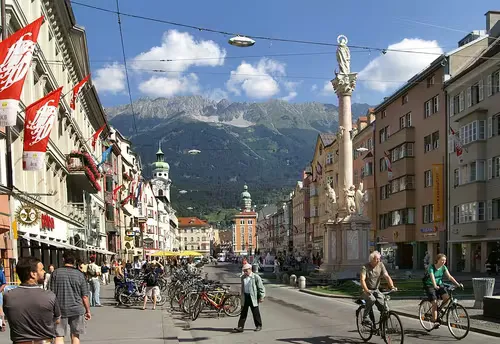
    Maria-Theresien-Straße is broad, gently curving and about 490 metres long, a grand shopping street and one of the busiest in the city. It carries the empress's name, but it is much older than her: it goes back to Innsbruck's first expansion in the 13th century.

    The town was founded in 1180 as a market, on land exchanged between Wilten Abbey and the Counts of Andechs, and it soon outgrew its walls and moat, today's Old Town. Along the road south towards Wilten and on to the Brenner a suburb grew up, called nova civitas, the new town. At first it fell under the abbey's court. On 5 June 1281 Count Meinhard II struck a deal: the abbey was freed from the wine toll, and the town gained jurisdiction over the new town.

    That first new town did not reach as far as the arch. It ended roughly level with today's Old Landhaus, where the Upper Gate, also called St George's Gate, stood; it was first recorded in 1350 and pulled down in 1570. The southern stretch, the outer new town, has only counted as part of Innsbruck since about 1440. As you walk north you cross a medieval boundary that no longer has a gate.

    Passages lead east to Sparkassenplatz and Landhausplatz and west through the Rathausgalerien to Adolf-Pichler-Platz. At the northern end the street crosses Burggraben and Marktgraben and continues as Herzog-Friedrich-Straße into the Old Town. The City Tower is 350 metres, about 5 minutes, ahead.

    Hours
    Always open
    Price
    Free
  3. 3

    City Tower

    City Tower in Innsbruck, stop 3 on the self-guided walking tour

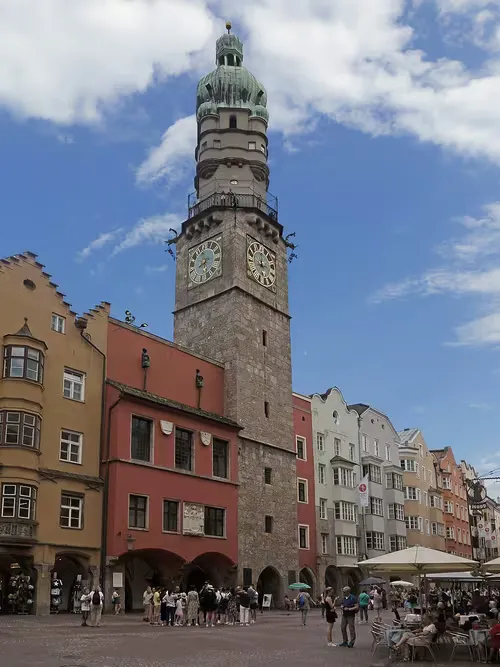
    The City Tower, the Stadtturm, stands at Herzog-Friedrich-Straße 21, set into the row of houses and jutting slightly forward. It was added to the old town hall between 1442 and 1450, and it tells you something about the townspeople of the time: a Gothic tower of their own, built to show they would defend their rights and freedoms against anyone. Like the Triumphal Arch it is built of Höttinger breccia; only the octagonal top is rendered.

    Read it from the bottom up. The square lower part has six storeys in three zones divided by cornices. In the Middle Ages the lower section served as the town prison, and the barred windows on the first two floors still show it. The first tower clock was fitted in 1479. In 1560 town master builder Caspar Schäbl replaced the Gothic spire with the Renaissance onion dome you see today, and in 1586 four wrought-iron gargoyles shaped like dolphins were added.

    Watchmen kept guard here day and night. The first on record was appointed by the town council in 1529 to call out the hours and warn people in time of fire and other dangers. The last tower keeper, a woman, served until 1967. Since 1951 the room beneath the keeper's flat has hosted the literary meetings of the Turmbund.

    The viewing platform with its iron railing sits at 31 metres, reached through the historic town hall; the whole tower is 51 metres high. The climb costs a fee, and it is worth it if you want to see the Old Town from above before walking through it. The Golden Roof is only 40 metres away, a minute's walk.

    Local name
    Stadtturm
    Hours
    Jun–Sep daily 10:00–20:00 (last entry 19:30); Oct–May daily 10:00–17:00 (last entry 16:30)
    Price
    4.50 EUR adults, 3 EUR seniors (60+)/students, 2 EUR children 6-15, free under 6
  4. 4

    Golden Roof

    Golden Roof in Innsbruck, stop 4 on the self-guided walking tour

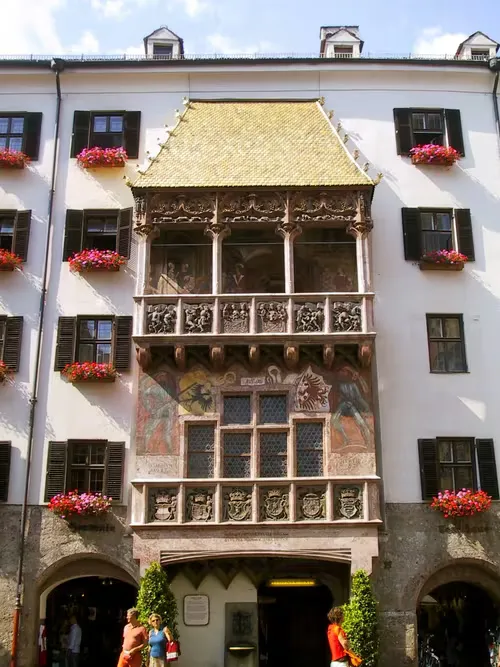
    Round the corner you stand under the Golden Roof, the Goldenes Dachl, considered the city's most famous symbol. Completed in 1500, it is covered with 2,657 fire-gilded copper tiles, made for Emperor Maximilian I to mark his marriage to Bianca Maria Sforza. The building behind it is older: Archduke Friedrich IV built it in the early 15th century as the residence of the Tyrolean rulers, and in 1493 Maximilian commissioned the loggia from the court builder Nikolaus Turing the Elder. From this balcony the emperor and his wife watched festivals and tournaments in the square.

    Now look at the two balustrades. On the first floor eight carved coats of arms stand for Maximilian's territories; over them Jörg Kölderer painted, in 1500, two knights carrying the flags of the Holy Roman Empire and Tyrol. On the second floor the two central reliefs show Maximilian himself: once between Bianca Maria Sforza and his beloved first wife, Maria of Burgundy, once with his court jester and his chancellor. The outer panels show Moorish dancers in acrobatic, grotesque poses, a popular entertainment of the day with roots in Andalusia. Inside the loggia, Kölderer also painted scenes of aristocratic life.

    Everything you see outside is a careful replica; the original reliefs belong to the Ferdinandeum, where this walk ends.

    Going inside the building costs entry, with reduced tickets available. If time is short, the façade from the square is the main event and costs nothing. From here it is 350 metres, about 5 minutes, to the Innbrücke.

    Local name
    Goldenes Dachl
    Hours
    May–Sep daily 10:00–17:00; Oct–Apr Tue–Sun 10:00–17:00, closed Mon
    Price
    6 EUR standard, 3 EUR reduced (seniors/students/JUFF/Ö1 members), free under 6, family ticket 12.50 EUR
  5. 5

    Innbrücke

    Innbrücke in Innsbruck, stop 5 on the self-guided walking tour

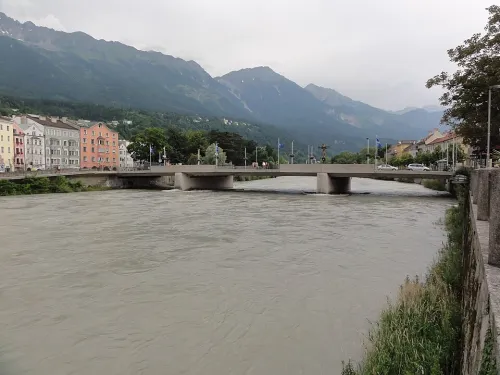
    The Innbrücke, also called the Old Inn Bridge, links the Old Town with Mariahilf-St. Nikolaus on the other bank. It is free, always open, and it is the reason for the city's name: Innsbruck, the bridge over the Inn. It also sits in the city's coat of arms.

    Around 1165 or 1170 Berchtold of Andechs had a bridge built where there had been a ford or a ferry, and founded a market on the left bank called Ynbruggen, today's Mariahilf-St. Nikolaus. In 1180 he and his son bought land from Wilten Abbey on the right bank, trans pontem, beyond the bridge. There the Old Town grew up as a fortified bridgehead. Until the Mühlau bridge was built in 1581, this was the only bridge over the Inn in the Innsbruck area.

    The first bridge was probably a simple timber beam bridge on piers made of tree trunks filled with stones. Its many heavy piers blocked the river in floods, so it was regularly destroyed, repaired or rebuilt. The Schwaz Mining Book of 1556 shows it on seven spans; a view from 1577 shows five stone-box piers; by 1649 it stood on five narrower timber trestles, probably because the stone boxes held back too much water.

    The bridge has been the town's seal since 1267. The oldest surviving seals, from 1267 and 1282, show it running vertically with three piers; from 1325 it runs horizontally with two, as it still does in the coat of arms. From here it is 340 metres, about 5 minutes, to the Cathedral of St. James.

    Hours
    Always open
    Price
    Free
  6. 6

    Cathedral of St. James

    Cathedral of St. James in Innsbruck, stop 6 on the self-guided walking tour

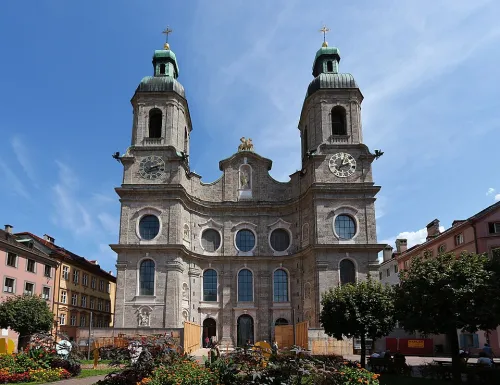
    The Cathedral of St. James, the Dom zu St. Jakob, is the Baroque cathedral of the Diocese of Innsbruck, dedicated to the apostle James. Johann Jakob Herkomer designed it, and it was built between 1717 and 1724 on the site of a 12th-century Romanesque church. A church here is first mentioned in 1180, in the very document that moved the market to the right bank of the Inn and founded the Old Town. In the 13th and 14th centuries fires and earthquakes damaged it again and again.

    Inside, three domed vaults span the nave and a dome with a lantern crowns the chancel. Part of the lavish decoration is by the Asam brothers, and the cathedral is considered among the most important Baroque buildings in Tyrol. It was heavily damaged in the Second World War and fully restored within a few years.

    Two treasures are worth finding. Over the main altar hangs Maria Hilf, Mary of Succour, painted by Lucas Cranach the Elder around 1530 and considered among the most venerated images of Mary in Christendom. In the north aisle stands the canopied tomb of Archduke Maximilian III, Grand Master of the Teutonic Knights, from 1620.

    Entry is free, and twenty minutes is enough for everyone. Sightseeing pauses during services, so plan your visit outside mass times. The Imperial Palace is 280 metres, about 4 minutes, away.

    Local name
    Dom zu St. Jakob
    Hours
    Daily from 08:30, closing 18:30 (winter/standard time) or 19:30 (summer/daylight saving); guided sightseeing visits limited to weekdays from 10:15 and Sun/holidays from 12:30 due to services
    Price
    Free
    Website
    dibk.at ↗
  7. 7

    Imperial Palace

    Imperial Palace in Innsbruck, stop 7 on the self-guided walking tour

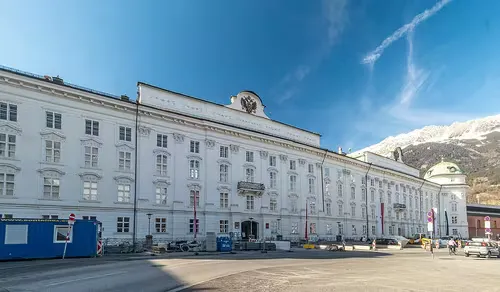
    The Imperial Palace, the Hofburg, is a former Habsburg residence, considered one of the three most significant cultural buildings in Austria alongside the Hofburg and Schönbrunn in Vienna. It is the main building of a whole complex that also includes the Court Church, the cathedral and the Hofgarten. The Habsburgs owned it for more than 450 years.

    The first palace was put together around 1460 under Archduke Sigismund, on the site of the medieval fortifications along the eastern town wall. It took in the Rumer Gate, which Jörg Kölderer, the painter of the Golden Roof frescoes, turned into the Heraldic Tower for Maximilian I in 1499.

    Its Baroque look comes from Maria Theresa. Between 1754 and 1756 J. M. Gumpp the Younger added the south wing on Hofgasse, and between 1766 and 1773 the main façade on Rennweg followed, after plans by C. J. Walter. The Giants' Hall received ceiling frescoes by Franz Anton Maulbertsch. In 1765 the Imperial Chapel was built in the very room where her husband, Emperor Francis I, had died: the same Franz Stephan whose death the north side of the Triumphal Arch mourns.

    Inside are five themed areas: Maria Theresa's Rooms, Empress Elisabeth's Apartment, a Furniture Museum, an Ancestral Gallery and a Painting Gallery. The imperial apartments and the Maximilian1 exhibition each have their own ticket. It is worth it if the Habsburg story pulls you in; allow over an hour.

    The Court Church is just 170 metres, about 2 minutes, away; on the way you pass the Tyrolean Folk Art Museum, which shares its entrance with the church.

    Local name
    Hofburg
    Hours
    Daily 09:00–17:00, last entry 16:30
    Price
    10.50 EUR Kaiserappartements, 8.50 EUR Maximilian1 exhibition, combo tickets up to 21 EUR (reduced 6-16 EUR), free under 19
  8. 8

    Court Church

    Court Church in Innsbruck, stop 8 on the self-guided walking tour

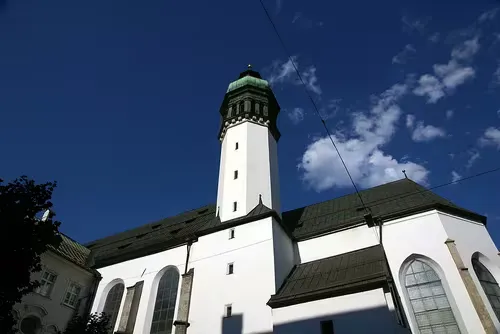
    The Court Church, the Hofkirche, at Universitätsstraße 2 was built in 1553 by Emperor Ferdinand I as a memorial to his grandfather, Emperor Maximilian I. Maximilian had planned his memorial in detail, and its cenotaph holds a remarkable collection of German Renaissance sculpture, the figures known locally as the Schwarze Mander.

    There is one catch: Maximilian is not here. His will asked for burial in the castle chapel at Wiener Neustadt, but the huge memorial could not be built there, so Ferdinand planned a new church in Innsbruck instead. Maximilian's simple tomb stayed in Wiener Neustadt, and this grand monument is empty. The church does hold the tomb of Andreas Hofer, Tyrol's national hero.

    Andrea Crivelli of Trento designed it as a hall church with three naves, mixing late Gothic and Renaissance; Hieronymus de Longhi and Anton de Bol carved the fine Renaissance portal. Inside, slender red marble columns carry white capitals. After an earthquake in the 17th century the main vault was rebuilt in Baroque style. The high altar of 1755 is by Nikolaus Pacassi, with a crucifixion by Johann Carl Auerbach and bronze statues by Balthasar Moll. The Renaissance organ of 1560 by Jörg Ebert of Ravensburg, its panels painted by Domenico Pozzo, is described locally as one of the five most famous organs in the world.

    The church charges entry, with reduced tickets, and a combo ticket covers several Tyrolean state museum sites. If you go into only one paid sight on this walk, make it this one. The Hofgarten is 430 metres, about 6 minutes, away.

    Local name
    Hofkirche
    Hours
    Mon–Sat 09:00–17:00 (last entry 16:30); Sun & holidays 12:30–17:00
    Price
    9 EUR standard, 7 EUR reduced, free under 19; combo ticket covering multiple Tiroler Landesmuseen sites 14 EUR (11 EUR reduced)
  9. 9

    Hofgarten

    Hofgarten in Innsbruck, stop 9 on the self-guided walking tour

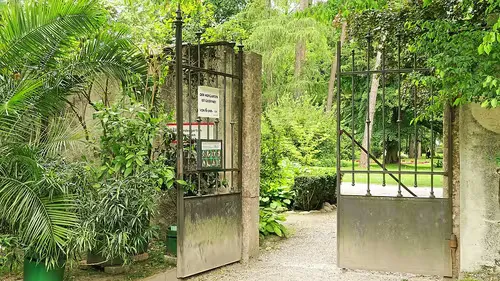
    The Hofgarten is a listed park of ten hectares on the edge of the Old Town, next to the Imperial Palace, the Congress and the Tyrolean State Theatre. Entry is free. It is a place to sit down after the churches and palaces.

    In around 600 years it has gone from riverside meadow to Renaissance garden, Baroque garden and, for about 150 years now, an English landscape park. Friedrich Ludwig von Sckell drew up the last redesign, but it was only carried out four decades later, by an unknown master who changed his plans considerably. Some plants here were put in by Maria Theresa herself.

    At the centre stands a pavilion from 1733 that hosts concerts, and two oversized chess boards draw players for tournaments. For a long time the delicate lawns were off limits; since 2014 you can walk and sit on them. There is also a pond, a playground, a palm house and a popular garden restaurant.

    Take a break on the lawns before the last stretch: the Ferdinandeum is 590 metres, about 8 minutes, away.

    Hours
    Apr–Oct daily 06:00–22:00; Nov–Mar daily 07:00–17:30 (closing time varies with daylight)
    Price
    Free
  10. 10

    Ferdinandeum

    Ferdinandeum in Innsbruck, stop 10 on the self-guided walking tour

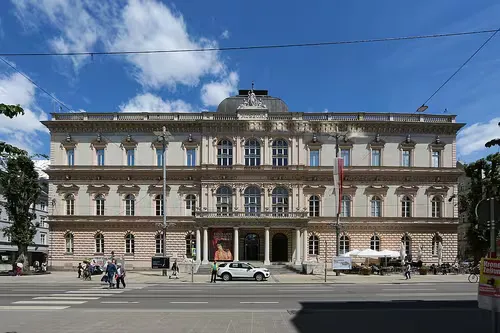
    The walk ends at the Ferdinandeum, the Tyrolean State Museum. It is currently closed: it shut in July 2024 for a 60-million-euro rebuild. There is no interior to visit for now, just the building and the street around it.

    It still makes a fitting finish, because this is where the original reliefs of the Golden Roof belong. By now you have the shape of the city in your legs: an arch for a wedding and a funeral, a tower built by proud townspeople, a bridge that named the city, a golden balcony, and a tomb without its emperor. The route does not loop back; if you want, the GPS navigation in your browser guides you back to the Triumphal Arch.

    Local name
    Tiroler Landesmuseum Ferdinandeum
    Status
    Currently closed
Walking tour route map of Innsbruck Route loaded
Triumphal ArchMaria-Theresien-StraßeCity TowerGolden Roof+6
All 10 stops are already on the map.
You just press start.
AI Tour Guide

You know the route now. Walk it with a guide talking you through it.

Press start wherever you are, even hundreds of kilometres from Innsbruck, and the guide begins telling its stories right away. In the city, pick any of the 10 stops to start from: it leads you there, then talks with you the whole route, asking, listening, remembering, and shaping the tour around your answers.

10stops 2.9km 39 minwalking 13languages
▶Start the tour free

Free to start · Runs in your browser · No app, no download

Shorter Ways to Walk Innsbruck

Short on time or only after one theme? Each cut keeps the same order, just with fewer stops.

Free and outdoors: from the arch to the river

Stops: 1, 2, 3, 4, 5

For a first look at the city without paying anything. About 1,040 metres and 15 minutes of walking from the Triumphal Arch to the Innbrücke. Everything is free from outside; the City Tower platform and the Golden Roof building are optional tickets.

The Old Town and Habsburg core

Stops: 3, 4, 5, 6, 7, 8

For visitors with half a day who want the big names. About 1,180 metres and 17 minutes of walking from the City Tower to the Court Church. The cathedral is free; tower, Golden Roof, Imperial Palace and Court Church charge entry.

Imperial quarter and garden

Stops: 6, 7, 8, 9

For Habsburg enthusiasts who want time indoors. About 880 metres and 12 minutes of walking from the Cathedral of St. James to the Hofgarten. Tickets for the Imperial Palace and the Court Church; cathedral and park are free.

How Long Does This Innsbruck Walk Take with the Tower and Hofburg?

The walking itself takes 39 minutes. With five or ten minutes at each stop and nothing visited inside, you finish in about an hour and a half.

The balanced version goes up the City Tower, into the Cathedral of St. James and the Court Church, and takes the rest from outside: about three and a quarter hours. Leave the Triumphal Arch at 10:00 on a weekday and you reach the Ferdinandeum around 13:15, just in time for a lunch menu.

Add the Golden Roof building and the imperial apartments in the Imperial Palace and the day grows to close to five hours. The shorter variants need 12, 15 or 17 minutes of pure walking, plus whatever time you spend inside.

Before You Set Off at the Triumphal Arch

  • Start and finish: The recommended start is the Triumphal Arch, but you can join at any stop. The route ends at the Ferdinandeum rather than looping back; if you want, the GPS navigation in your browser guides you from there back to the start.
  • Best day and time: A weekday morning works best: set off once the City Tower has opened, and you have time for the inside visits along the way.
  • Costs: The walk is free. The City Tower, the Golden Roof, the imperial apartments of the Imperial Palace and the Court Church each charge entry for adults.
  • City cards: Staying two nights or more? Your Welcome Card already covers buses and trams, so the Innsbruck Card only pays off through its entry tickets. Do the sum before you buy.

Food and Breaks Along the Route: Lunch Menus, Strudel and Sausage Stands

Make lunch your main meal: a weekday lunch menu in a side street is the single best value in Innsbruck dining, and the Old Town has good cafés tucked just off the main streets.

Weekday lunch menuMany restaurants offer a fixed lunch menu on weekdays. At Posidonas Der Grieche, Innrain 38, three lamb chops with soup make a good-value lunch.
La Trattoria am SparkassenplatzPizza that locals rate highly, a short detour from the main street. (Sparkassenplatz 5, through the passage off Maria-Theresien-Straße)
Die VitrineA vegetarian and vegan option right at the start. (near the Triumphal Arch)
AltstadtstandlA mobile sausage stand for a quick bite between sights. (often near the Golden Roof)
Strudel Café KröllStrudel and coffee off the main drag. (Hofgasse 6, in the Old Town)
FischerhäuslA traditional Old Town address away from the busiest lanes. (side street by the Cathedral of St. James)
Café SacherCoffee and cake inside the palace complex, handy before or after the imperial apartments. (in the Imperial Palace)
Fuchs & HaseA bar for an evening drink if you walk the route later in the day. (Domplatz, by the Cathedral of St. James)
Grill Imbiss RennwegA no-frills sausage stand, good for a cheap snack in the park. (northwest corner of the Hofgarten, by the Inn)
CasoinN da GiorgioItalian fine dining at the finish, for a special occasion rather than a quick lunch. (next to the Ferdinandeum)

Tourist Traps to Avoid in Innsbruck's Old Town

  • Dinner under the arcades by the Golden Roof: The Old Town is known for Old Town prices on food and shopping. Eat your main meal at lunch, or head to Sparkassenplatz or Wilten for the same Tyrolean and Italian food at fairer prices.
  • Sunday without a plan: Shops close early and many restaurants and pubs shut entirely on Sundays. Book ahead; places that do open often serve the traditional Sunday meal of pork and dumplings.
  • Late dinner: Kitchens often close fairly early in the evening, and some traditional places such as Ottoburg close after lunch.
Walking tour route map of Innsbruck
AI Tour Guide

Your guide is ready when you are, right at the Triumphal Arch.

Press start and a voice AI Tour Guide takes it from here: leading the route through Innsbruck, telling the stories, and turning your walk into a real back-and-forth conversation. No app or download is needed; it runs in your browser.

10stops 2.9km 39 minwalking 13languages
▶Start the tour free

Free to start · Runs in your browser · No app, no download

What the AI Tour Guide Adds Between Arch and Hofgarten

The AI Tour Guide walks this route with you as a conversation. It greets you at the Triumphal Arch, tells the stories as you go, asks whether the Habsburg family drama or the self-confident medieval townspeople interest you more, remembers your answer and shapes the next stops around it. It can go where this walk only touches: why Andreas Hofer became Tyrol's national hero, or who the Asam brothers were. You can interrupt it at any time. You start with 100 free credits; after that, this tour costs €19.99 all-inclusive with no time limit, or €5 per hour.

A Real Conversation A voice AI Tour Guide greets you, leads the whole route, and tells the stories and facts as you walk, asking what you want to see and keeping a real conversation going. Not a recording you press play on.
Map Navigation Follow the route on the map and walk at your own pace. You choose where to start and when to move to the next stop.
Ask Anything Curious about a building you pass? Ask your AI Tour Guide on the spot and the conversation carries on.
13 Languages Switch language anytime. No separate tour needed.
Start free in your browser

Common Questions Before Walking Innsbruck

Are there reduced tickets for young visitors?

Yes. The Imperial Palace and the Court Church are free for young visitors, the City Tower has reduced tickets for children, and the Golden Roof offers a family ticket.

Where can I see the original Golden Roof reliefs?

They belong to the Ferdinandeum, which is closed for its rebuild. Until it reopens, the replicas on the balcony are what you can see.

Can I visit the palm house in the Hofgarten?

Usually, yes: its collection of around 1,700 plant species is regularly open to visitors, and during the temporary art and sculpture exhibitions in summer it opens more often.

Should I carry cash in Innsbruck?

Yes. Several well-loved places take cash only, among them Café Munding in Kiebachgasse and Treibhaus at Die Bögen.

Where can I go after Innsbruck?

Good next stops are Kitzbühel at 77 km, Bolzano at 85 km across the Alps, Munich at 98 km and Salzburg at 137 km.

Is the tour really free?

Yes. The whole tour is free: the route, the interactive map and the navigation cost you nothing. Only the voice AI Tour Guide is optional and paid: you test it with 100 free credits, then you pay either €5 per hour or €19.99 for this whole tour, with no time limit. Admission to 4 of the 10 stops is not included: City Tower, Golden Roof, Imperial Palace and Court Church charge their own entry fees.

Do I need to download an app?

No. Everything runs in your phone browser. Open the route and start walking, no download and no sign-up required.

Do I need to book the walking tour in advance?

No booking needed. This self-guided tour is available anytime. Open the route in your browser and start walking. The AI Tour Guide works instantly, no app, no reservation required.

What languages is the AI Tour Guide available in?

The AI Tour Guide speaks 13 languages, so you take the tour in your own language and can switch at any time.

Can I skip stops or change the route?

Yes. Skip any stop, spend extra time at places you like, or start the route from any point. It is your walk, you set the pace.
Image credits
▶ Start free in your browser Runs in your browser, no app, no download