Free Walking Tour Salzburg: Mirabell to Mozart's Birthplace

From the archbishop's pleasure palace to the house where Mozart was born: ten stops, one fortress on the hill and 2.9 km of Salzburg on foot.

10 Stops 2.9 km ~44 min walking
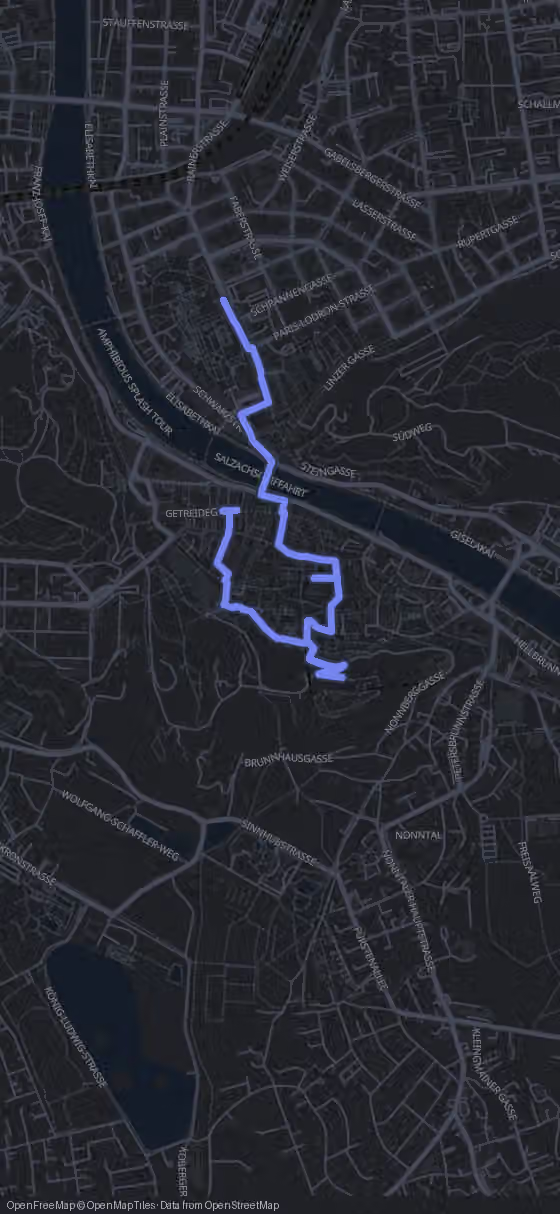
Route map for the Salzburg walking tour
Stop 1 of 10
420 m·5 min
Mirabell Palace & Gardens
Head south toward the Mozart Residence on Makartplatz
Grüß Gott, welcome to Salzburg. I'm Alex, and Mirabell's formal gardens began with a decidedly informal princely household.
Try this tour with Alex

What This Route Covers

Ten stops lead from Mirabell Palace & Gardens through the Old Town to Mozart's Birthplace: 2.9 km and 44 minutes of pure walking. Outside only, plan about two and a half hours; with the fortress and a Mozart museum, most of a day.

The gardens, the squares, Salzburg Cathedral and St. Peter's Abbey are free. Hohensalzburg Fortress, the Mozart Residence and the birthplace charge admission. The GPS route in your browser is free; the AI Tour Guide is optional.

Open free GPS & optional AI Tour Guide
This short shows highlights of the route. All 10 stops follow below.

The Route

Walking Map of Salzburg from Mirabell to Getreidegasse

10 stops 2.9 km 44 min walking
Tap to load interactive map

The 10 stops along this route

  1. Mirabell Palace & Gardens in Salzburg, stop 1 on the self-guided walking tour
    1Mirabell Palace & Gardens
  2. Mozart Residence in Salzburg, stop 2 on the self-guided walking tour
    2Mozart Residence
  3. Mozartplatz in Salzburg, stop 3 on the self-guided walking tour
    3Mozartplatz
  4. Salzburg Cathedral, stop 4 on the self-guided walking tour
    4Salzburg Cathedral
  5. Residenzplatz in Salzburg, stop 5 on the self-guided walking tour
    5Residenzplatz
  6. Kapitelplatz in Salzburg, stop 6 on the self-guided walking tour
    6Kapitelplatz
  7. Hohensalzburg Fortress, stop 7 on the self-guided walking tour
    7Hohensalzburg Fortress
  8. St. Peter's Abbey in Salzburg, stop 8 on the self-guided walking tour
    8St. Peter's Abbey
  9. Getreidegasse in Salzburg, stop 9 on the self-guided walking tour
    9Getreidegasse
  10. Mozart's Birthplace in Salzburg, stop 10 on the self-guided walking tour
    10Mozart's Birthplace
  11. That's the full route.

    Walk it with an AI Tour Guide talking you through every one of these streets.

    Start free in your browser
    You made it

Your Salzburg Walking Tour, from Palace Gardens to Mozart's Front Door

  1. 1

    Mirabell Palace & Gardens

    Mirabell Palace & Gardens in Salzburg, stop 1 on the self-guided walking tour

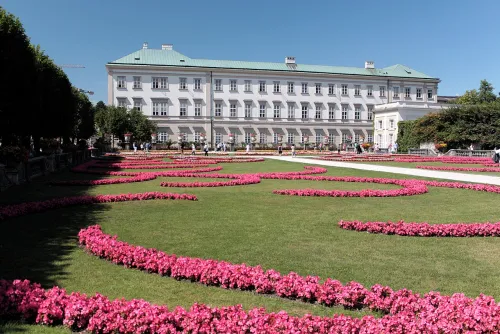
    Begin in the gardens and turn back towards the palace. The calm Neoclassical front you see dates from around 1818, when the building was restored after a fire; underneath lies a lavish Baroque rebuild by Johann Lukas von Hildebrandt from between 1721 and 1727. Palace and gardens are a listed monument and part of the UNESCO World Heritage Site of Salzburg's historic centre, and the gardens are free to wander.

    The beginnings were far less official. Around 1606 Prince-Archbishop Wolf Dietrich von Raitenau, plagued by gout and weakened by a stroke the year before, wanted to get away from the narrow streets of the walled town. On the bank of the Salzach, north of the medieval walls, he had a pleasure palace built for himself and his mistress Salome Alt, reportedly in six months and after Italian and French models. He called it Schloss Altenau.

    The idyll ended in 1612. Wolf Dietrich was deposed and arrested at Hohensalzburg Fortress, the castle you will see up on its hill later on this walk. His successor Mark Sittich von Hohenems expelled Salome Alt and her family and renamed the house after the Italian mirabile and bella: amazing, beautiful.

    The palace kept collecting stories. On 1 June 1815 the later King Otto of Greece was born here, while his father, the Bavarian crown prince Ludwig I, governed Salzburg as stadtholder. Remember Ludwig; he turns up again at Mozartplatz. The city bought the palace in 1866, and since the Second World War it has housed the mayor's office. Its Marble Hall is the stage of the Salzburg Palace Concerts and a popular place to get married.

    From the gardens it is 400 m, about 5 minutes, to Makartplatz and the Mozart Residence.
    Hours
    Mirabell Gardens: daily from about 06:00 until dusk (Orangery 09:00–16:00; some sections closed in winter)
    Price
    Free
  2. 2

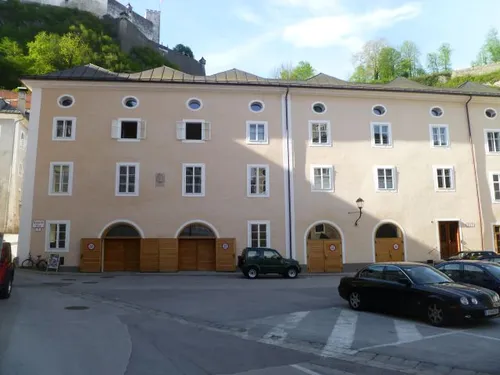
    Mozart Residence

    Mozart Residence in Salzburg, stop 2 on the self-guided walking tour

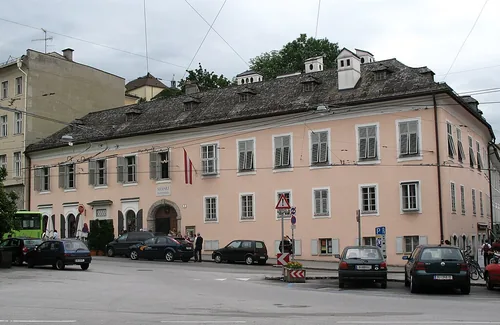
    At Makartplatz 8 stands the house the Mozarts moved into in 1773, when their flat on Getreidegasse had become too small for the family and for the gatherings Leopold liked to host. Salzburg calls it the Tanzmeisterhaus, the Dancing Master's House. The square was then Hannibalplatz, and from 1711 the court dancing master Johann Lorenz Spöckner taught young nobles here how to move at court.

    The link to the Mozarts was personal. Spöckner's son Franz Gottlieb, who took over as dancing master, was best man at Leopold Mozart's wedding to Anna Maria Pertl in 1747. Six years after his death, the family rented a spacious eight-room apartment, including his large dance hall. They used it for lessons, for house concerts, for storing the keyboard instruments Leopold sold, and for Bölzlschiessen: family and guests firing air guns at comically painted paper targets.

    Wolfgang lived here between the ages of 17 and 25, until he moved to Vienna in 1781. His mother died in 1778, his sister Nannerl married in 1784, and Leopold stayed on with his servants, from 1785 with his baby grandson Leopold Alois, whom Nannerl had entrusted to him, until his death in 1787. In 1944 aerial bombs destroyed two thirds of the long, simple building; today it is a museum.

    Admission is charged. Go in if you are curious about Mozart's grown-up years in Salzburg and the family's daily life; his childhood violin and the clavichord of The Magic Flute wait at the birthplace at the end of the walk, and a combined ticket covers both houses.

    Now comes the longest leg of the route: 670 m, about 9 minutes, into the Old Town to Mozartplatz.

    Local name
    Mozart-Wohnhaus
    Hours
    Daily: 09:00–17:30
    Price
    Adults 18 EUR, reduced 15 EUR (groups of 10+, students, seniors); combined ticket with Mozart's Birthplace 25 EUR, reduced 22 EUR
  3. 3

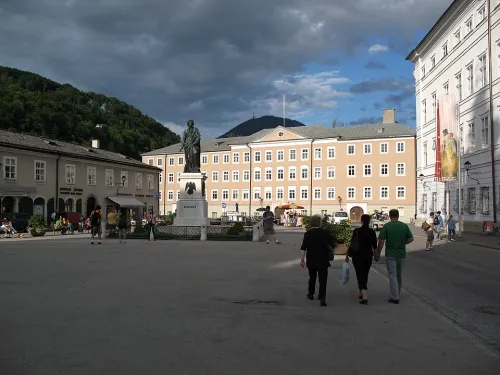
    Mozartplatz

    Mozartplatz in Salzburg, stop 3 on the self-guided walking tour

    In the middle of the square stands the Mozart Monument by Ludwig Schwanthaler. It was meant to be unveiled in 1841, on the 50th anniversary of Mozart's death, but workers digging for the foundation found a Roman mosaic. Only after it had been excavated was the statue unveiled, on 4 September 1842. The marble pedestal was a gift from King Ludwig I of Bavaria, the same Ludwig who once governed the city from Mirabell.

    Look down at the foot of the statue: a copy of the Roman mosaic is set there, with its inscription 'hic habitat felicitas, nihil intret mali', roughly: here lives happiness, let nothing evil enter. Before Mozart, the square was called Michaelsplatz, and its centrepiece was a Baroque fountain with a statue of St. Michael, removed in 1841 to make room.

    The square itself is Wolf Dietrich's work again: in the early 17th century he had a row of houses demolished to create it. Turn around slowly. On the north side, the low Imhofstöckl holds the tourist information office, with a piece of the old city wall from the time of Paris Lodron behind it. To the south rises the Neue Residenz, home of the Salzburg Museum. Of the three uniform 17th-century houses on the east side, number 8 was the home of Constanze Mozart-Nissen, Mozart's widow. On the west side are the Salzburg Christmas Museum and Café Glockenspiel. The Wackersdorf Memorial, put up in 2000 by an anti-nuclear platform, also stands on the square.

    Salzburg Cathedral is only 120 m away, about 2 minutes on foot.

    Hours
    Always open
    Price
    Free
  4. 4

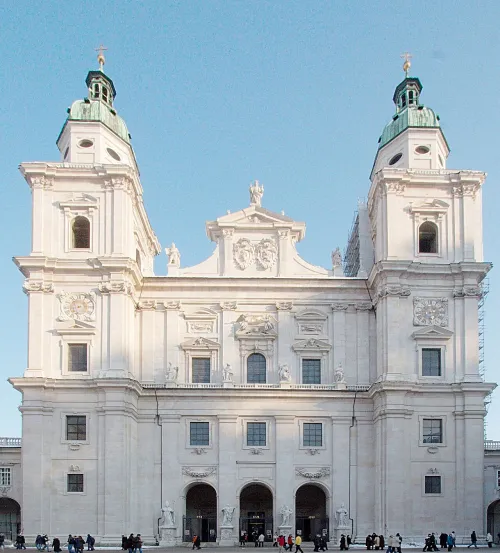
    Salzburg Cathedral

    Salzburg Cathedral, stop 4 on the self-guided walking tour

    The great Baroque church in front of you is the cathedral of the Archdiocese of Salzburg, dedicated to Saint Rupert and Saint Vergilius. It is free to enter, and even a short visit is worth it.

    The site is far older than the building. Vergilius founded a church here in 774 on the remains of a Roman town; after a fire it was rebuilt in 1181. The present appearance goes back to the 17th century, when the cathedral was completely rebuilt in the Baroque style, a project started under Wolf Dietrich von Raitenau, the archbishop whose name follows you through the whole Old Town.

    Inside, look for the baptismal font. Wolfgang Amadeus Mozart was baptised in it, so in a few minutes you can stand where his life in Salzburg began, before seeing the house where he was born at the end of the walk.

    Residenzplatz opens right beside the cathedral, 20 m and a minute away.

    Local name
    Salzburger Dom
    Hours
    Mon–Sat 09:00–11:40 and 12:30–18:00, Sun 13:00–18:00
    Price
    Free
  5. 5

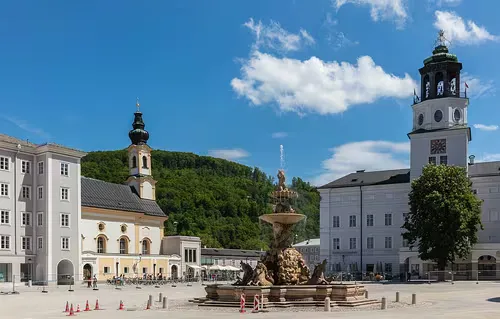
    Residenzplatz

    Residenzplatz in Salzburg, stop 5 on the self-guided walking tour

    Step out onto the big square and head for the fountain in its centre. The Residenzbrunnen was designed by Tommaso di Garona and built between 1656 and 1661 from Untersberg limestone; a Triton on the upper basin sprays the water upwards. It is considered the largest Baroque fountain in Central Europe.

    Read the square from its edges. The cathedral closes it to the south and the Alte Residenz, the palace of the prince-archbishops after which the square is named, to the west. To the east stands the Neue Residenz, a Renaissance building begun in 1588, with its prominent bell tower. The town houses on the north side include number 2, where the Baroque painter Johann Michael Rottmayr stayed around 1690 while painting the ceiling frescoes in the Alte Residenz.

    Before 1587 a monastery cemetery lay here. Wolf Dietrich had it abandoned and many private houses demolished to lay out a main square, the Hauptplatz, at the same time as the cathedral was rebuilt to plans by the Italian architect Vincenzo Scamozzi. Remains of the medieval cemetery have recently been found beneath the paving. The square also carries a darker memory: on 30 April 1938 the Nazis held a book burning here, and the planned refurbishment includes a monument to it. In summer the square turns into an open-air cinema.

    Kapitelplatz is 220 m away, about 3 minutes, and on the way you pass the DomQuartier.

    Hours
    Open 24/7
    Price
    Free
  6. 6

    Kapitelplatz

    Kapitelplatz in Salzburg, stop 6 on the self-guided walking tour

    This wide square lies on the south side of the cathedral and is the best place on the walk to get your first proper look at the fortress above you. Towards the east you see the Dompropstei and the Archbishop's Palace; to the south, the Kapitelschwemme and the fortress on its hill.

    The buildings behind continue the church quarter: the Kardinal-Schwarzenberg-Haus, the cathedral chapter and the Mühlenhof of St. Peter's, while the novices' wing of the abbey closes the square to the west. The name comes from the cathedral chapter, the body of canons whose seat was in Kapitelgasse 4 and the neighbouring houses.

    From here the route climbs for 480 m, about 10 minutes, towards Hohensalzburg Fortress.

    Hours
    Always open
    Price
    Free
  7. 7

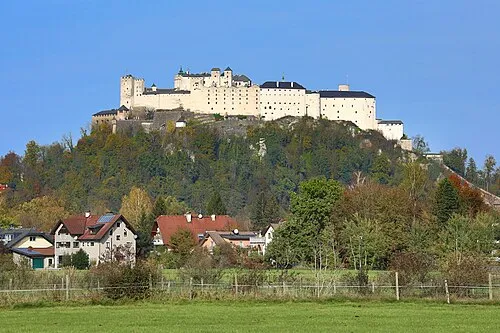
    Hohensalzburg Fortress

    Hohensalzburg Fortress, stop 7 on the self-guided walking tour

    Hohensalzburg sits on the Festungsberg at 506 m, and at 250 m long and 150 m wide it is one of the largest medieval castles in Europe. A Roman fort once stood on the highest point. The fortress itself began in 1077 under Archbishop Gebhard von Helfenstein as a simple bailey with a wooden wall; his feud with Emperor Henry IV in the Investiture Controversy, in which he sided with Pope Gregory VII, was a reason to build it stronger.

    Later archbishops kept adding. The ring walls and towers came in 1462 under Burkhard II von Weißpriach, Leonhard von Keutschach expanded the castle further during his reign from 1495, and the outer bastions were built in the 16th and 17th centuries out of fear of a Turkish invasion. Only once was the fortress actually besieged: in the Peasants' War of 1525, miners, farmers and townspeople tried to drive out Archbishop Matthäus Lang and failed. Less than a century later, Wolf Dietrich, the builder of Mirabell, was held prisoner here.

    Watch for the Reisszug, the freight lift that hauled goods to the upper courtyard. Matthäus Lang described it in 1515; in updated form it still runs and is probably the oldest operational railway in the world.

    Going inside costs admission, and it is worth it if you have two hours and want the views and the story. Without a ticket you only reach the mid-way station of the funicular and miss the views from the top. You can walk up instead of riding the FestungsBahn: the walking ticket is cheaper, has the same content and includes the ride down, and the path from Festungsgasse, about 20 minutes, is often quicker than the funicular queue in July and August. Choose All-Inclusive over Basic: Basic leaves out the Prince's Chambers and the Magic Theatre, and the difference is small.

    Back down, St. Peter's Abbey is 440 m away, about 7 minutes.

    Local name
    Festung Hohensalzburg
    Hours
    Jan–Apr and Oct–Dec: daily 09:30–17:00; May–Sep: daily 08:30–20:00 (museums 09:00–19:00)
    Price
    All-Inclusive ticket incl. FestungsBahn funicular 19.20 EUR (children 6–14 7.30 EUR); Basic ticket incl. funicular 15.50 EUR (children 6–14 6.30 EUR)
  8. 8

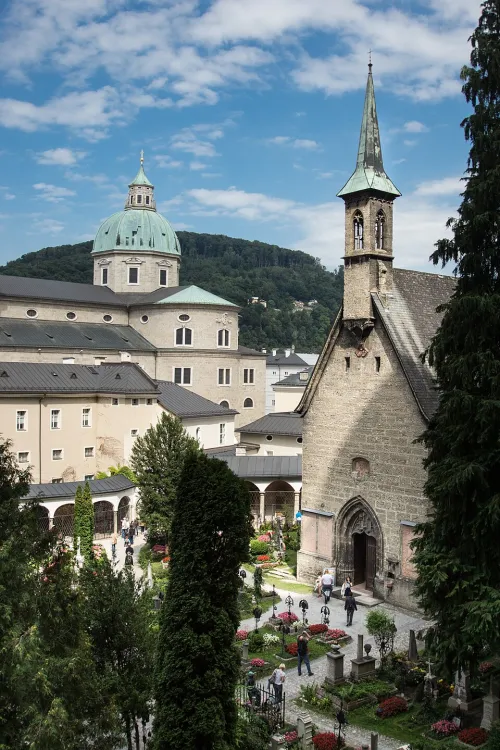
    St. Peter's Abbey

    St. Peter's Abbey in Salzburg, stop 8 on the self-guided walking tour

    At the northern foot of the Mönchsberg lies a Benedictine monastery that is considered the oldest in the German-speaking area with a continuous history. Saint Rupert founded it in 696 on the site of a late antique church, to push the mission into the Eastern Alps. Until 987 one man was both abbot here and Archbishop of Salzburg. Entry is free.

    The Romanesque abbey church was built from around 1130 on the site of a Carolingian church and dedicated to Saint Peter in 1147. Inside, the abbey once had an organ built by Daniel Hayl the younger between 1618 and 1620.

    The monks shaped the town's learning. In the Middle Ages St. Peter's was known for its exceptional school, in 1074 monks from here went off to found Admont Abbey in Styria, and in 1623 Archbishop Paris Lodron founded the Benedictine University of Salzburg, closely tied to the abbey until it was dissolved in 1810. A Benedictine college founded here in 1926 helped bring the modern university back to life, and in 1927 St. Peter's became an archabbey.

    After the Anschluss in 1938 the Nazis seized the buildings and expelled most of the monks, but the monastery was never dissolved, and the monks returned after the war. Take a few quiet minutes in the church and the courtyards; this is one of the stops on the route where you can sit down without paying anything.

    Getreidegasse is 510 m away, about 7 minutes on foot.

    Local name
    Stift Sankt Peter
    Price
    Free
  9. 9

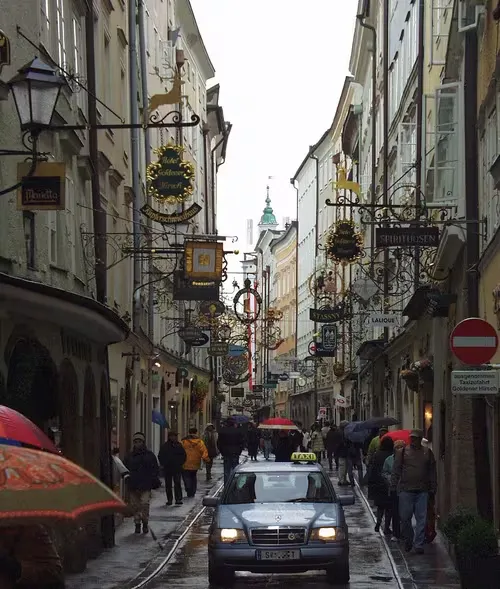
    Getreidegasse

    Getreidegasse in Salzburg, stop 9 on the self-guided walking tour

    Getreidegasse, Grain Lane, is a narrow street of tall town houses standing shoulder to shoulder, and the thing to look up at is the wrought-iron guild signs hanging over the shop doors. Duck into the passageways where they open: many houses hide courtyards behind the street front. It runs one block back from the Salzach and is part of the Old Town's pedestrian zone.

    Around 1150 it was called Trabegasse, from traben, to trot, because it led from the old trade centre to the suburb of Mülln. In the 14th century the prince-archbishops granted the citizens staple rights, large trading houses began displaying their goods along the street, and it became a favoured address of patricians and officials.

    The street has its own small history of faces. August Bebel, later a politician, was an apprentice in a woodturner's workshop at number 3 in 1859 and 1860. For more than three decades, until 2019, the puppet woman with her brown basket sold marionettes here every day. Many of the old houses are shops now, and the city has repeatedly tried to keep the street's character intact.

    Mozart's Birthplace is at number 9, just 40 m and a minute away.

    Hours
    Open 24/7
    Price
    Free
  10. 10

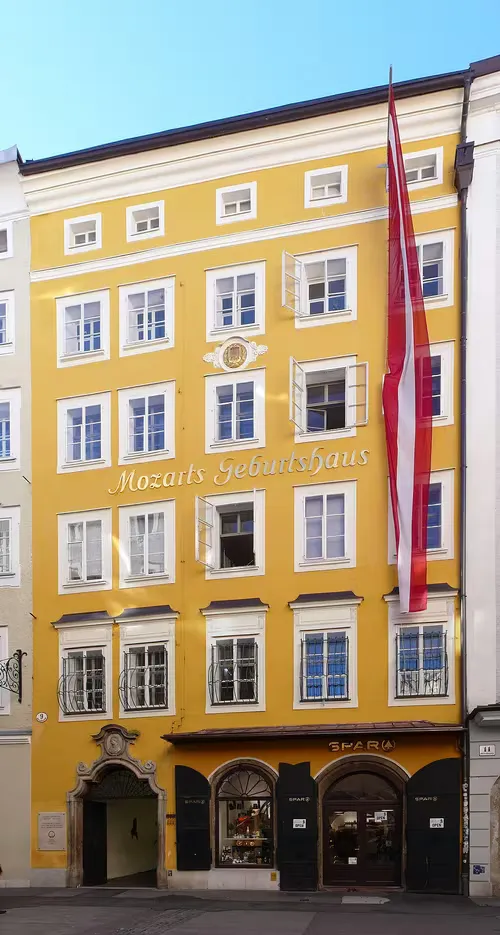
    Mozart's Birthplace

    Mozart's Birthplace in Salzburg, stop 10 on the self-guided walking tour

    Number 9 Getreidegasse is where the walk ends and where Mozart's life began, on 27 January 1756. The family rented the third floor from 1747, right after Leopold married Anna Maria Pertl: a kitchen, a small cabinet, a living room, a bedroom and an office. Seven children were born here; only two survived, Nannerl and Wolfgang.

    Before you go in, look at the doorway. The coiled serpent in a lion's mouth, symbol of Asclepius, goes back to the court apothecary Chunrad Fröschmoser, who bought the house in 1585. The house itself dates from the 12th century and stands on land that once belonged to the garden of the monks of St. Peter's. From 1703 it belonged to the Hagenauer family, and Johann Laurenz Hagenauer was Mozart's landlord; Leopold wrote to him constantly during the family's grand tour between 1763 and 1766.

    Since 1880 the house has been a museum of the Mozart Foundation, and it charges admission. On the third floor you see Mozart's childhood violin, portraits, documents and early editions of his music; the second floor is about his passion for opera and holds the clavichord on which he composed The Magic Flute. Go in if those objects matter to you; if you have already seen the Mozart Residence, the combined ticket makes the second house easy.

    In 1773 the family left for the Dancing Master's House on Makartplatz, where you started the Mozart part of the day. If you want to close the loop, the GPS navigation leads you back to Mirabell Palace & Gardens.

    Local name
    Mozarts Geburtshaus
    Hours
    Daily: 09:00–17:30
    Price
    Adults 18 EUR, reduced 15 EUR; combined ticket with Mozart Residence 25 EUR, reduced 22 EUR
Walking tour route map of Salzburg Route loaded
Mirabell Palace & GardensMozart ResidenceMozartplatzSalzburg Cathedral+6
All 10 stops are already on the map.
You just press start.
AI Tour Guide

You've read the route. Now walk it with a guide in your ear.

Press start wherever you are, even hundreds of kilometres from Salzburg, and the guide begins telling its stories right away. In the city, pick any of the 10 stops to start from: it leads you there, then talks with you the whole route, asking, listening, remembering, and shaping the tour around your answers.

10stops 2.9km 44 minwalking 13languages
▶Start the tour free

Free to start · Runs in your browser · No app, no download

Shorter and Longer Ways to Walk Salzburg

The full route works for most people, but you can trim it or build it around Mozart.

Free walk, all ten stops from outside

Stops: 1, 2, 3, 4, 5, 6, 7, 8, 9, 10

For anyone on a tight budget or a short visit: walk the whole 2.9 km in 44 minutes of pure walking, go inside Salzburg Cathedral and St. Peter's Abbey, which are free, and see the fortress and both Mozart houses from outside. No tickets needed.

Old Town core with the fortress

Stops: 3, 4, 5, 6, 7, 8, 9, 10

For a first visit with limited time: start at Mozartplatz and skip the walk from Mirabell. The legs add up to about 1.8 km and 31 minutes of walking. Tickets for Hohensalzburg Fortress and, if you like, Mozart's Birthplace at the end.

Mozart day

Stops: 1, 2, 3, 4, 5, 6, 7, 8, 9, 10

For music lovers: the full route with time inside both the Mozart Residence and Mozart's Birthplace, so you follow the family from their larger home back to the house where Wolfgang was born. Same 44 minutes of walking; both museums charge admission, and the cathedral with Mozart's baptismal font is free.

How Long This Salzburg Tour Takes, With and Without Interiors

The walking is the small part: 44 minutes in total, and the longest legs are the 670 m from the Mozart Residence into the Old Town and the 10 minutes up from Kapitelplatz towards the fortress. Everything else is a few minutes apart, so the time goes into looking, not walking.

The free walk, with a look inside Salzburg Cathedral and St. Peter's Abbey, takes about two and a half hours. The fortress adds about two hours including the ride or the climb, and each Mozart museum about an hour. The Old Town core with the fortress and the birthplace comes to about four and a half hours; the full route with the fortress and one Mozart museum to about five and a half hours, with a lunch break more.

Before You Set Off from Mirabell

  • Start and finish: The recommended start is Mirabell Palace & Gardens, but you can join at any stop. The walk ends at Mozart's Birthplace on Getreidegasse, and the GPS navigation can lead you back to the start if you want.
  • Time of day: Set off in the morning. You reach St. Peter's while the bakery courtyard still smells of fresh bread, and you have the afternoon for the fortress.
  • Tickets: Hohensalzburg Fortress, the Mozart Residence and Mozart's Birthplace charge admission; everything else on the route is free. Buy the fortress ticket in advance if you plan to go up.

Food and Breaks Between the Fortress and Getreidegasse

The route runs right past some of Salzburg's long-standing places to eat, most of them around St. Peter's and the foot of the fortress, which suits a lunch break in the middle of the walk.

Stiftskeller St. PeterA traditional meal of Wiener schnitzel with roasted potatoes and other Austrian classics, right where you come down from the fortress. (Sankt-Peter-Bezirk 1, below Hohensalzburg Fortress)
Stiftsbäckerei St. PeterThe monastery bakery is almost a thousand years old: a small cellar bakery with a handful of choices. Come in the morning, when the whole courtyard smells of fresh bread. (At St. Peter's Abbey)
Stiegl-KellerA terrace with wide views over the town and a local favourite for a drink on the way up. (On the walk up to the fortress)
Pauli StubmA tucked-away Old Town address that keeps coming up among locals' recommendations. (Herrengasse 16, in an alley at the base of the fortress)
Balkan Grill WalterCheap, quick sausage in the middle of the Old Town, ideal when you only want a bite before the birthplace. (Getreidegasse 33, in a tiny alley)
Augustiner Bräu MüllnThe place for cheap beer and atmosphere: grab a stein, rinse it at the communal fountain, pay and have it poured from wooden barrels. The food stalls are overpriced, so bring your own snack from a supermarket, which is expressly allowed.

Tourist Traps to Avoid in Salzburg's Old Town

  • Tourist menus on Getreidegasse: Restaurants directly on Getreidegasse near Mozart's Birthplace and pavement cafes on Alter Markt are known for upselling tourist menus. Look for a handwritten daily chalkboard menu, not a rotating stand with a menu in twelve languages. (Getreidegasse and Alter Markt)
  • Overpriced Mozartkugeln: Mozartkugeln from market stalls and souvenir shops in the centre are almost always overpriced. The dominant brand is Mirabell; the original is Fürst, in silver foil with a blue Mozart portrait. Buy them at a supermarket or at the airport instead.
  • Clipboard petitions: Someone with a clipboard asks you to sign while an accomplice goes for your pocket, often at busy cafe terraces. Never leave valuables on an outdoor table, ignore the clipboard and say a firm 'nein danke'. (Getreidegasse, Residenzplatz and Mozartplatz)
  • Fake Sound of Music ticket sellers: Unauthorised sellers approach tourists here. Buy Sound of Music tours only from the operator's own office or official website; the main licensed operators include Panorama Tours on Mirabellplatz and Bob's Special Tours on Rudolfskai. (Residenzplatz, outside the cathedral and on Getreidegasse)
  • Pickpockets at the Christmas markets: Pickpocket teams work the dense crowds around the mulled wine stalls and the cathedral archway. Keep cash and cards in a front zip pocket or inner coat pocket, not in a back pocket or an open tote bag. (Domplatz and Residenzplatz in Advent)
Walking tour route map of Salzburg
AI Tour Guide

Your guide is ready when you are, at Mirabell or any stop

Press start and a voice AI Tour Guide takes it from here: leading the route through Salzburg, telling the stories, and turning your walk into a real back-and-forth conversation. No app or download is needed; it runs in your browser.

10stops 2.9km 44 minwalking 13languages
▶Start the tour free

Free to start · Runs in your browser · No app, no download

What the AI Tour Guide Adds in Salzburg

On this route the same few people keep coming back: Wolf Dietrich von Raitenau, the Mozart family, a king of Bavaria. The AI Tour Guide walks with you as a conversation, ties these threads together from stop to stop and notices whether you care more about the archbishops or the music. Ask what became of Wolf Dietrich after his arrest, how the Reisszug actually hauled goods up the hill, or what Leopold wrote to his landlord during the grand tour, and it picks up the story from there, in one of 13 languages.

A Real Conversation A voice AI Tour Guide greets you, leads the whole route, and tells the stories and facts as you walk, asking what you want to see and keeping a real conversation going. Not a recording you press play on.
Map Navigation Follow the route on the map and walk at your own pace. You choose where to start and when to move to the next stop.
Ask Anything Curious about a building you pass? Ask your AI Tour Guide on the spot and the conversation carries on.
13 Languages Switch language anytime. No separate tour needed.
Start free in your browser

Common Questions About Walking Salzburg

Is the Salzburg Card worth it for this walk?

Only if you plan two or more paid attractions. It includes public transport, entry to Hohensalzburg Fortress and many museums, so it pays off on a day with the fortress and a Mozart museum, not on the free walk.

Can I see both Mozart museums on one ticket?

Yes. A combined ticket covers the Mozart Residence and Mozart's Birthplace, is valid for 48 hours and costs less than two single tickets. If you only want one, note that many visitors find the birthplace on its own just an okay experience.

Should I buy fortress tickets in advance?

Yes, if you know you want to go up. Visitors who turned up without tickets have regretted it, especially in summer when the funicular has a queue.

What else can I visit from Salzburg?

The lake villages make easy day trips: Hallstatt and St. Wolfgang both have their own walking routes, and Munich is close enough for a longer stay across the border.

Is the tour really free?

Yes. The whole tour is free: the route, the interactive map and the navigation cost you nothing. Only the voice AI Tour Guide is optional and paid: you test it with 100 free credits, then you pay either €5 per hour or €19.99 for this whole tour, with no time limit. Admission to 3 of the 10 stops is not included: Mozart Residence, Hohensalzburg Fortress and Mozart's Birthplace charge their own entry fees.

Do I need to download an app?

No. Everything runs in your phone browser. Open the route and start walking, no download and no sign-up required.

Do I need to book the walking tour in advance?

No booking needed. This self-guided tour is available anytime. Open the route in your browser and start walking. The AI Tour Guide works instantly, no app, no reservation required.

What languages is the AI Tour Guide available in?

The AI Tour Guide speaks 13 languages, so you take the tour in your own language and can switch at any time.

Can I skip stops or change the route?

Yes. Skip any stop, spend extra time at places you like, or start the route from any point. It is your walk, you set the pace.
Image credits
▶ Start free in your browser Runs in your browser, no app, no download