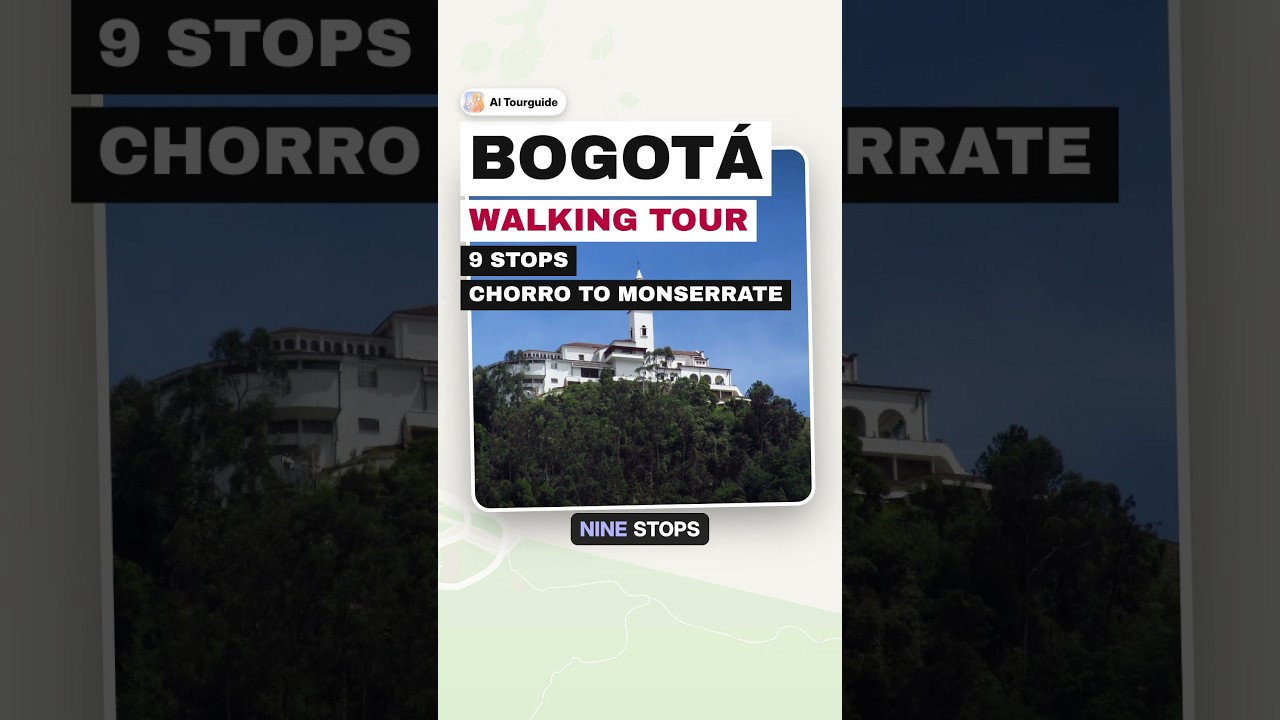
Free Walking Tour Bogotá: Candelaria to Monserrate

From the plaza where Bogotá is said to have begun, past Botero and Muisca gold, up to the mountain above the city. Nine stops, most of them free.

9 Stops 5.9 km ~1 h 42 min walking
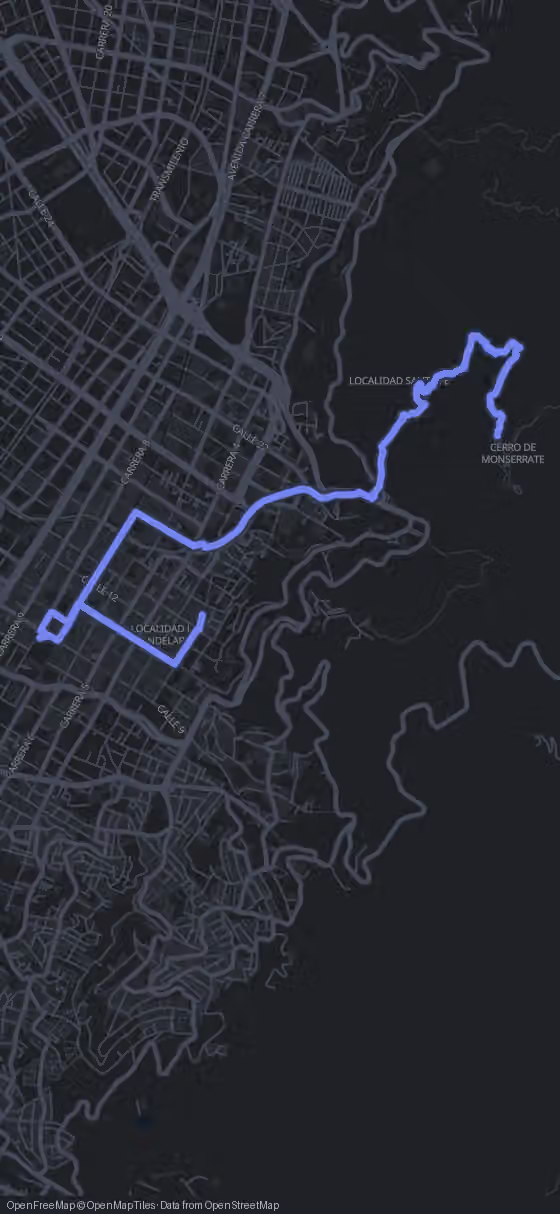
Route map for the Bogotá walking tour
Stop 1 of 9
610 m·8 min
Plazoleta del Chorro de Quevedo
Head west along Calle 12B toward Museo Botero
Hola, welcome to Bogotá. I'm Alex, and one beloved artist gave his country far more than his own paintings.
Try this tour with Alex

This Bogotá Route at a Glance

Nine stops over 5.9 km, from Plazoleta del Chorro de Quevedo in La Candelaria to Cerro de Monserrate. Pure walking time is 1 h 42 min; with three museum visits and the mountain, plan close to a full day.

Plaza de Bolívar, Parque Santander, Capitolio Nacional from outside, Museo Botero and Catedral Primada de Colombia cost nothing. Museo Iglesia de Santa Clara, Museo del Oro and the ride up the mountain charge entry. The GPS route is free in your browser; the AI Tour Guide is optional.

Open free GPS & optional AI Tour Guide
This short shows highlights of the route. All 9 stops follow below.

The Route

Walking Map of Bogotá: La Candelaria to Monserrate

9 stops 5.9 km 1 h 42 min walking
Tap to load interactive map

The 9 stops along this route

  1. Plazoleta del Chorro de Quevedo in Bogotá, stop 1 on the self-guided walking tour
    1Plazoleta del Chorro de Quevedo
  2. Museo Botero in Bogotá, stop 2 on the self-guided walking tour
    2Museo Botero
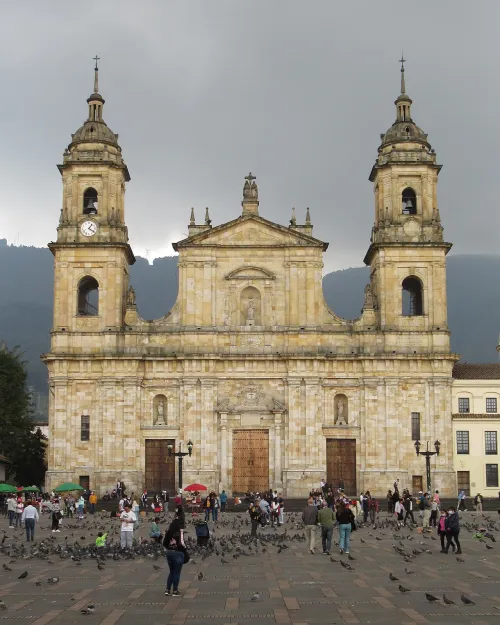
  3. Catedral Primada de Colombia in Bogotá, stop 3 on the self-guided walking tour
    3Catedral Primada de Colombia
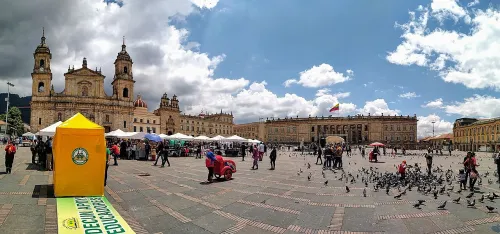
  4. Plaza de Bolívar in Bogotá, stop 4 on the self-guided walking tour
    4Plaza de Bolívar
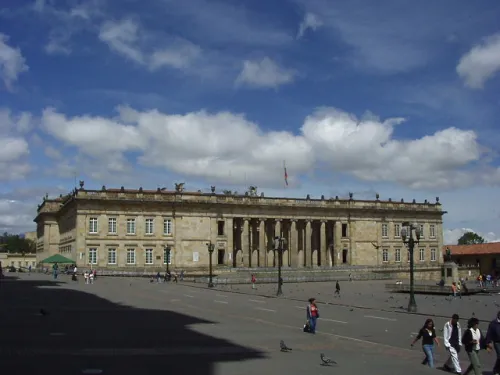
  5. Capitolio Nacional in Bogotá, stop 5 on the self-guided walking tour
    5Capitolio Nacional
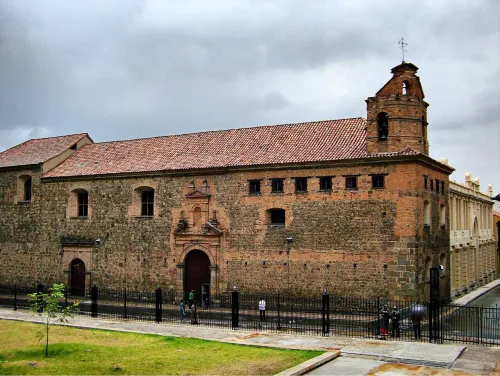
  6. Museo Iglesia de Santa Clara in Bogotá, stop 6 on the self-guided walking tour
    6Museo Iglesia de Santa Clara
  7. Parque Santander in Bogotá, stop 7 on the self-guided walking tour
    7Parque Santander
  8. Museo del Oro in Bogotá, stop 8 on the self-guided walking tour
    8Museo del Oro
  9. Cerro de Monserrate in Bogotá, stop 9 on the self-guided walking tour
    9Cerro de Monserrate
  10. That's the full route.

    Walk it with an AI Tour Guide talking you through every one of these streets.

    Start free in your browser
    You made it

Your Bogotá Walking Tour Stop by Stop, from Founding Plaza to Mountaintop

  1. 1

    Plazoleta del Chorro de Quevedo

    Plazoleta del Chorro de Quevedo in Bogotá, stop 1 on the self-guided walking tour

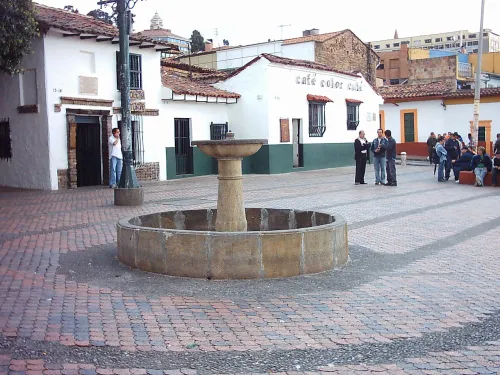
    This small square in La Candelaria is where, by tradition, the Spanish conquistador Gonzalo Jiménez de Quesada laid the foundations of Bogotá in 1538. Long before that, the Zipa, chief of the Muisca, is said to have come here regularly to survey the Bogotá savanna. So you are standing at a spot that matters to both sides of the city's story.

    The name came later. In 1832 an Augustinian priest, Father Quevedo, bought the site and built a fountain here. It did not last: in 1896 a collapsing bridge damaged its pipes and the original fountain was destroyed.

    The small white chapel is the Hermitage of San Miguel del Príncipe, rebuilt in 1969 on the site of Bogotá's very first chapel. Its design is based on a church that once stood in Santander Plaza and was torn down because its exterior was thought too plain. Look for the nearby arch: Javier Olave made it to honor the neighborhood's well known eccentrics, the Bobo del Tranvía, the Conde Cuchute and the Loca Margarita.

    The plaza has a bohemian streak that filmmakers love; La Estrategia del Caracol and Diástole y Sístole were both shot here. In the narrow alleys around it you will find artist studios, hostels, colorful street art and places that serve chicha, and storytellers sometimes gather an audience in the square itself. It is open around the clock and free, so take your time.

    From here it is 610 m, about 8 minutes, to Museo Botero.
    Hours
    Open 24/7
    Price
    Free (public plaza)
  2. 2

    Museo Botero

    Museo Botero in Bogotá, stop 2 on the self-guided walking tour

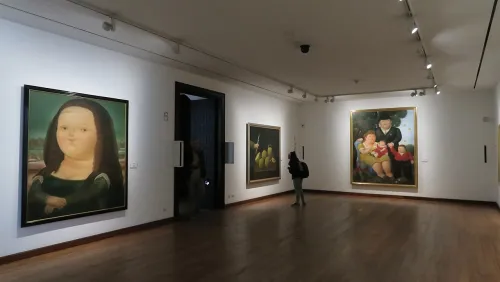
    Museo Botero fills a colonial mansion in La Candelaria with the round, generous figures of Colombia's best known artist, Fernando Botero, plus works by international artists from his private collection. Entry is free, and has been since the museum opened on 1 November 2000. Over 500,000 people come each year, among them some 2,000 students a month. If you only go inside one building today, this is the easy choice: no ticket, and an hour gives you a good look.

    Botero collected long before he donated. From the late 1960s he bought pre-Columbian pieces, then colonial art, then drawings, paintings and modern sculpture. Until 1999 it was all scattered across his homes in New York, Paris, Monte Carlo and Pietrasanta, with part of it in a Swiss bank deposit in Bogotá.

    He first thought of giving everything to the Museum of Antioquia in Medellín, but the authorities there were slow to decide. Bogotá's then mayor, Enrique Peñalosa, proposed donating it to the nation through the central bank instead, and Botero agreed. In 2000 he gave 208 pieces to the Bank of the Republic: 123 of his own and 85 by other artists. The bank bought this mansion, and Botero himself shaped how it was adapted for the collection.

    The museum belongs to the same cultural complex as the Gold Museum, the Luis Ángel Arango Library, the Miguel Urrutia Art Museum and the Museo Casa de Moneda.

    The cathedral is 250 m away, about 3 minutes, and on the way you pass the Casa de Moneda de Colombia.

    Hours
    Mon, Wed–Sat 09:00–19:00, Sun 10:00–17:00, Tue closed
    Price
    Free
  3. 3

    Catedral Primada de Colombia

    Catedral Primada de Colombia in Bogotá, stop 3 on the self-guided walking tour

    The neoclassical cathedral on the east side of Plaza de Bolívar is the seat of the Archbishop of Bogotá, who also carries the title Primate of Colombia, granted by Pope Leo XIII in 1902. Domingo de Petrés designed the present building, which went up between 1807 and 1823. It was declared a national monument in 1975.

    It is the fourth church on this spot. On 6 August 1538 Friar Domingo de las Casas celebrated the first Mass here in a modest chapel of mud with a straw roof, in front of a banner that is still kept in the cathedral. The Spanish named the place Nuestra Señora de la Esperanza.

    The next attempt is a cautionary tale. In 1553, on the initiative of Friar Juan de los Barrios, a cathedral of mud and brick was commissioned from Baltasar Díaz and Pedro Vásquez, working with the bricklayer Juan Rey, on a budget of 1,000 pesos. By 1560 more than 6,000 pesos had been spent, and on the eve of its inauguration the roof collapsed.

    Going inside is free and worth a few quiet minutes, but the doors are not open all day, so fit it into your morning.

    Step back out onto the plaza: Plaza de Bolívar is 80 m, a minute away.

    Hours
    Mon–Fri 09:30–12:30, 14:00–16:00, Sat 10:00–12:00, Sun services 10:30 & 12:00
    Price
    Free
  4. 4

    Plaza de Bolívar

    Plaza de Bolívar in Bogotá, stop 4 on the self-guided walking tour

    This is the main square of Bogotá and of Colombia, and the buildings around it read like a map of power. To the north stands the Palacio de Justicia, to the south the Capitolio Nacional, to the east the cathedral with the Casa del Cabildo Eclesiástico, the Capilla del Sagrario and the Palacio Arzobispal. To the west is the Palacio Liévano, seat of the city's mayor, and to the southeast the Jesuit Colegio Mayor de San Bartolomé.

    The ground is older than the city. It was part of the Muisca settlement of Teusacá, a ceremonial and astronomical center within the domain of Bacatá. The Muisca read the sky from here: at the June solstice the sun rises exactly from behind Monserrate, the mountain at the end of this route, as seen from this square.

    When the Spanish founded Santa Fe de Bogotá in 1538, they made this the central point of the new street grid and raised the first administrative and religious buildings here. It became the civic and symbolic heart of the colonial capital, and was declared a national monument in 1995.

    A study by the Universidad de los Andes puts its area at 13,903 m², including the surrounding streets, with room for up to 55,612 people. It is open at all hours and free.

    The Capitolio Nacional fills the south side, 130 m and 2 minutes across the square.

    Hours
    Open 24/7
    Price
    Free
  5. 5

    Capitolio Nacional

    Capitolio Nacional in Bogotá, stop 5 on the self-guided walking tour

    The long neoclassical front on the south side of Plaza de Bolívar is the seat of Colombia's Congress. It is one of the city's key works of republican and neoclassical architecture and became a national monument in 1975.

    Before it existed, Congress had no permanent home and met wherever it could: in schools, prisons, churches and convents. President Tomás Cipriano de Mosquera wanted that to end. On 27 August 1846 his envoy in Venezuela, Manuel Ancízar, hired the Danish architect Thomas Reed, then working in Caracas. Reed was to design a single government palace for both chambers of Congress, the Supreme Court, the district court, the registry and the presidency. Within weeks he had moved to Bogotá, named his design the Capitolio Nacional, and Congress approved it.

    Building it took far longer than designing it: construction ran from 1848 to 1926 under a succession of architects. The site already had a long official past. Under the Viceroyalty of New Granada this side of the square held the Real Audiencia, the audit court, the main jail and the Viceregal Palace, which burned down in May 1786.

    For most visitors the facade is the visit, and you can see it any time for free. Guided tours inside must be arranged in advance.

    Museo Iglesia de Santa Clara is 240 m away, about 3 minutes.

    Local name
    Capitolio Nacional de Colombia
    Hours
    Guided tours typically Fri 09:30–12:30 by prior appointment; exterior viewable anytime
    Price
    Free
  6. 6

    Museo Iglesia de Santa Clara

    Museo Iglesia de Santa Clara in Bogotá, stop 6 on the self-guided walking tour

    From outside this looks like a plain colonial church. Inside, it is one of the finest examples of 17th and 18th century baroque decoration in Bogotá. The building was the church of the Royal Convent of Santa Clara, home to the Poor Clares, the Franciscan order of nuns founded in Santa Fe de Bogotá in 1629. The Spanish architect Matías de Santiago began it in 1619 and finished it in 1647.

    Its decoration came in two phases. Through the 17th and part of the 18th century the whole church was covered in murals; in the second half of the 18th century wooden paneling was fixed to the walls and the ensemble of paintings, sculptures and altarpieces took its final form. Look for the surviving murals in the choirs, the presbytery, the triumphal arch and the sacristy, with animal and plant motifs, saints and angels.

    The collection spans four centuries of painting and sculpture, with colonial works by Gregorio Vásquez de Arce y Ceballos, Gaspar and Baltasar de Figueroa and Agustín García Zorro de Useche. The museum also stages contemporary art shows that set current questions against the colonial setting.

    This is the paid stop of the morning, and it is worth it if churches and colonial art interest you: about 45 minutes is enough.

    Next comes the longest walk in the old center: 920 m, about 13 minutes, to Parque Santander.

    Hours
    Tue–Sun 09:00–16:30, Mon closed
    Price
    COP$15.000 adult foreign visitors, COP$10.000 youth (13-17), COP$5.000 children (6-12); COP$6.000 adult Colombian nationals; under 6 & 60+ free
  7. 7

    Parque Santander

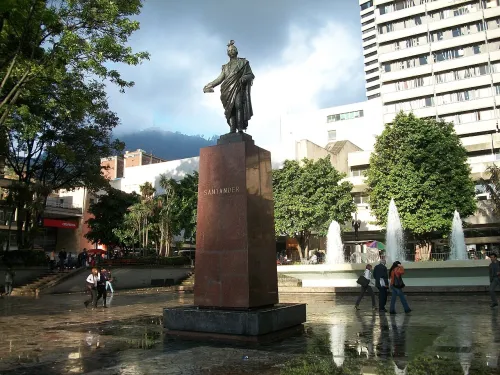
    Parque Santander in Bogotá, stop 7 on the self-guided walking tour

    A statue of Francisco de Paula Santander, a fountain and old trees mark this park at Carrera Séptima and Calle 16. The Museo del Oro and the Avianca building frame it, and its southeast side opens onto the Eje Ambiental.

    Its old name was Plaza de las Hierbas, after the regional market held here since before the conquest. Some accounts even call it the city's true founding site. In the early colonial years Gonzalo Jiménez de Quesada and Captain Juan Muñoz de Collantes lived here, and the Franciscans and Dominicans settled around it. For a while it rivaled the Plaza Mayor, today's Plaza de Bolívar, until Bishop Juan de los Barrios moved the market there in the 1550s.

    Even so, the square stayed important and pulled the city's growth northward. On its northwest corner stood the Capilla del Humilladero, opened on 6 August 1544 and the oldest chapel in the city until the state ordered it demolished in the late 19th century. In 1557 the square was renamed Plaza de San Francisco, and the church of San Francisco went up between 1585 and 1595. In 1631 work began on rebuilding the Veracruz church, until then a small chapel on the northwest corner.

    The park is free and open at all hours; a few minutes here help you picture the old market before you go inside. Museo del Oro is just 70 m, a minute, away.

    Hours
    Open 24/7
    Price
    Free
  8. 8

    Museo del Oro

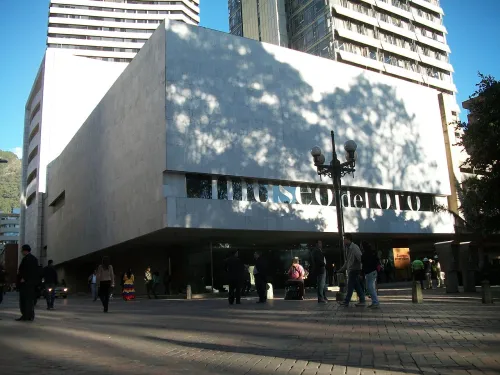
    Museo del Oro in Bogotá, stop 8 on the self-guided walking tour

    The Gold Museum holds the largest collection of gold artifacts in the world, and around 500,000 people visit it each year. The exhibition rooms on the second and third floors show pre-Columbian gold and alloys such as tumbaga, alongside pottery, stone, shell, wood and textiles from the societies that lived in present-day Colombia before the Spanish arrived.

    The key idea to carry through the rooms: many of these cultures did not see gold as wealth. For them it was a sacred metal, charged with symbolic and religious meaning. The Spanish reported that the Inca royal family called gold the sweat of the sun and silver the tears of the moon.

    Don't miss the Muisca golden raft, found in Pasca in 1969. It shows the ceremony in which a new zipa took power: the heir stands at the center of a raft, surrounded by chieftains adorned with gold and feathers, ready to make a great offering to the gods. This ritual is the root of the El Dorado legend. The collection itself began in 1934, when the Bank of the Republic started protecting the country's archaeological heritage; its first piece was the Poporo Quimbaya, on display for 70 years.

    After a decade of work the museum reopened in October 2008 with five permanent rooms and an interactive room. It is worth going in for almost anyone; give it an hour and a half. Entry is paid, with a lower rate for Colombians and foreign residents.

    Now comes the big leg: 3,590 m and about 72 minutes on foot to Cerro de Monserrate.

    Hours
    Tue–Sat 09:00–18:00, Sun 10:00–16:00, Mon closed
    Price
    COP$21.000 adult foreign visitors, COP$10.000 Colombian nationals & foreign residents, COP$5.000 students; free Sundays, children under 12 & adults 60+
  9. 9

    Cerro de Monserrate

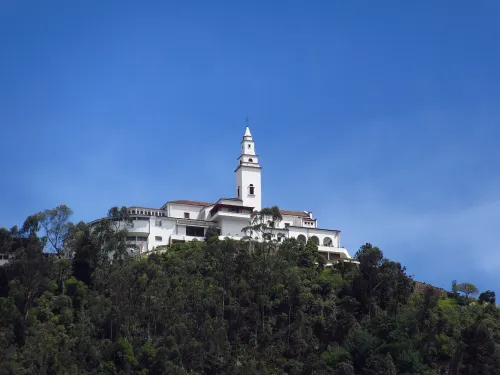
    Cerro de Monserrate in Bogotá, stop 9 on the self-guided walking tour

    The mountain that overlooks Bogotá's center rises to 3,152 m above sea level. It takes its name from Montserrat in Catalonia, and at the top stands a 17th century church with a shrine to El Señor Caído, the Fallen Lord. It is a pilgrimage site and one of the city's major attractions, with restaurants, a cafeteria and souvenir shops at the summit.

    The Muisca already held this mountain sacred. They called it quijicha caca, grandmother's foot, and their sun god Sué rose from behind it at the June solstice. The Spanish replaced Muisca temples with Catholic buildings, and in the 1620s the Cofradía de la Vera Cruz began using the hilltop for religious celebrations.

    You can go up by cable car, by funicular or on foot, the way pilgrims prefer. The footpath was closed for a time after wildfires and landslides caused by drought and reopened in 2017. On this route you arrive in the afternoon, when walkers can no longer start up the footpath, so take the funicular or cable car; both charge for the round trip. If you want to climb on foot, come on a separate morning.

    From the top, all of downtown and southern Bogotá and parts of the north spread out to the west, which is why people come up for sunset. If you stay on, you can watch the city lights come on.

    Hours
    Funicular/Cable car Mon–Sat 06:30–22:00, Sun 05:30–18:00; pedestrian path ascent 05:00–13:00, descent until 16:00 (Tue closed)
    Price
    Funicular/cable-car transport: COP35,000 round trip Monday–Saturday and public holidays; COP21,000 round trip Sunday.
Walking tour route map of Bogotá Route loaded
Plazoleta del Chorro de QuevedoMuseo BoteroCatedral Primada de ColombiaPlaza de Bolívar+5
All 9 stops are already on the map.
You just press start.
AI Tour Guide

You know the way now. Walk it with a guide talking you through Bogotá.

Press start wherever you are, even hundreds of kilometres from Bogotá, and the guide begins telling its stories right away. In the city, pick any of the 9 stops to start from: it leads you there, then talks with you the whole route, asking, listening, remembering, and shaping the tour around your answers.

9stops 5.9km 1 h 42 minwalking 13languages
▶Start the tour free

Free to start · Runs in your browser · No app, no download

Shorter Ways to Walk Bogotá's Old Center

Not everyone wants museums and a mountain on the same day. These three cuts use consecutive stretches of the route, so the walking times stay exact.

La Candelaria and the museums, without the mountain

Stops: 1, 2, 3, 4, 5, 6, 7, 8

For a first day in the city when you want the history and the art but no long walk at the end. 2.3 km and 31 minutes of walking; with Museo Botero, Santa Clara and the Gold Museum inside, about five hours. Santa Clara and Museo del Oro charge entry, everything else is free.

Free morning around Plaza de Bolívar

Stops: 1, 2, 3, 4, 5

For a tight budget or a short morning: 1,070 m and 14 minutes on foot, not a single ticket. With a proper hour for Botero and a look inside the cathedral, a little over two hours.

Gold and the mountain

Stops: 7, 8, 9

For an afternoon when you have already seen the plazas: 3,660 m and 73 minutes of walking, the Gold Museum and the ride up Monserrate. Count on about four hours.

How Long Does This Bogotá Tour Take with the Museums?

The pure walking time is 1 h 42 min, but it is unevenly spread. The first eight stops sit within 2.3 km and only 31 minutes of walking; the final leg to Cerro de Monserrate alone takes 72 minutes. That is why the route works as a morning in the old center followed by an afternoon on the mountain.

Realistically, give Museo Botero an hour, Santa Clara about 45 minutes and the Gold Museum an hour and a half, plus a quarter of an hour at each plaza and the cathedral. Start at 9:00 and you leave Museo del Oro around 14:00 and reach Monserrate shortly after 15:00. With the ride up and time at the summit, the whole route fills close to eight hours. The free morning variant takes a little over two hours, the version without the mountain about five, and gold plus Monserrate about four.

Before You Set Off in La Candelaria

  • Start and finish: The recommended start is Plazoleta del Chorro de Quevedo, and the route ends at Cerro de Monserrate. You can join at any stop; the order here is simply the one that flows best.
  • Best day: Choose a day when every museum on the route is open, since Museo Botero, Santa Clara, the Gold Museum and the Monserrate footpath each have a weekly closing day. Guided tours of the Capitolio only run on certain days.
  • Time of day: Start around 9:00. That gets you to the cathedral in the morning and leaves the afternoon for the mountain, when you will ride up rather than walk.
  • Costs: Plazas, Museo Botero, the cathedral and the Capitolio exterior are free. You pay at Museo Iglesia de Santa Clara, Museo del Oro and for the funicular or cable car up Monserrate.
  • Route and guide: Map, route and GPS navigation from stop to stop are free in your browser. The AI Tour Guide starts with 100 free credits; after that you choose this tour all-inclusive for €19.99 with no time limit, or €5 per hour.
Walking tour route map of Bogotá
AI Tour Guide

Your guide for La Candelaria is ready when you are

Press start and a voice AI Tour Guide takes it from here: leading the route through Bogotá, telling the stories, and turning your walk into a real back-and-forth conversation. No app or download is needed; it runs in your browser.

9stops 5.9km 1 h 42 minwalking 13languages
▶Start the tour free

Free to start · Runs in your browser · No app, no download

What the AI Tour Guide Adds between Botero and Monserrate

On this route the stories connect: the Muisca who watched the savanna from the Chorro de Quevedo, the ceremonial center under Plaza de Bolívar, the golden raft in Museo del Oro, the sacred mountain at the end. The AI Tour Guide leads you through them as a conversation, notices whether the Muisca or the colonial churches pull you in more, and carries that thread to the next stop. Ask it who the Bobo del Tranvía actually was, or what Botero did to make an old mansion fit his collection, and it takes the conversation there.

A Real Conversation A voice AI Tour Guide greets you, leads the whole route, and tells the stories and facts as you walk, asking what you want to see and keeping a real conversation going. Not a recording you press play on.
Map Navigation Follow the route on the map and walk at your own pace. You choose where to start and when to move to the next stop.
Ask Anything Curious about a building you pass? Ask your AI Tour Guide on the spot and the conversation carries on.
13 Languages Switch language anytime. No separate tour needed.
Start free in your browser

Common Questions about Walking Bogotá

Are there discounts for children and seniors on this route?

Yes, at the two paid museums. Museo Iglesia de Santa Clara is free for children under 6 and visitors aged 60 and over, and children and teenagers pay a reduced rate. Museo del Oro is free for children under 12 and adults 60 and over, and students pay COP$5,000.

Is there somewhere to eat inside the Gold Museum?

Yes. Since its renovation in 2008, Museo del Oro has a café and a restaurant, along with a souvenir shop, so you can take a break before the long walk to Monserrate.

Does the Gold Museum exist only in Bogotá?

No. There are other Museo del Oro branches in Calima, Quimbaya, Santa Marta and Cartagena, so you can continue the story on a walk in Cartagena or Santa Marta.

What makes a good day trip from Bogotá?

The closest of our other routes is Villa de Leyva, about 130 km away. Salento, at 166 km, suits a longer trip.

Is the tour really free?

Yes. The whole tour is free: the route, the interactive map and the navigation cost you nothing. Only the voice AI Tour Guide is optional and paid: you test it with 100 free credits, then you pay either €5 per hour or €19.99 for this whole tour, with no time limit. Admission to 2 of the 9 stops is not included: Museo Iglesia de Santa Clara and Museo del Oro charge their own entry fees.

Do I need to download an app?

No. Everything runs in your phone browser. Open the route and start walking, no download and no sign-up required.

Do I need to book the walking tour in advance?

No booking needed. This self-guided tour is available anytime. Open the route in your browser and start walking. The AI Tour Guide works instantly, no app, no reservation required.

What languages is the AI Tour Guide available in?

The AI Tour Guide speaks 13 languages, so you take the tour in your own language and can switch at any time.

Can I skip stops or change the route?

Yes. Skip any stop, spend extra time at places you like, or start the route from any point. It is your walk, you set the pace.
Image credits
▶ Start free in your browser Runs in your browser, no app, no download