Free Walking Tour Medellín: Botero, Basilicas and a Hill

Start at the city's oldest church, meet 23 Botero giants on their own plaza and finish on Cerro Nutibara with Medellín spread out around you.

9 Stops 5.7 km ~1 h 22 min walking
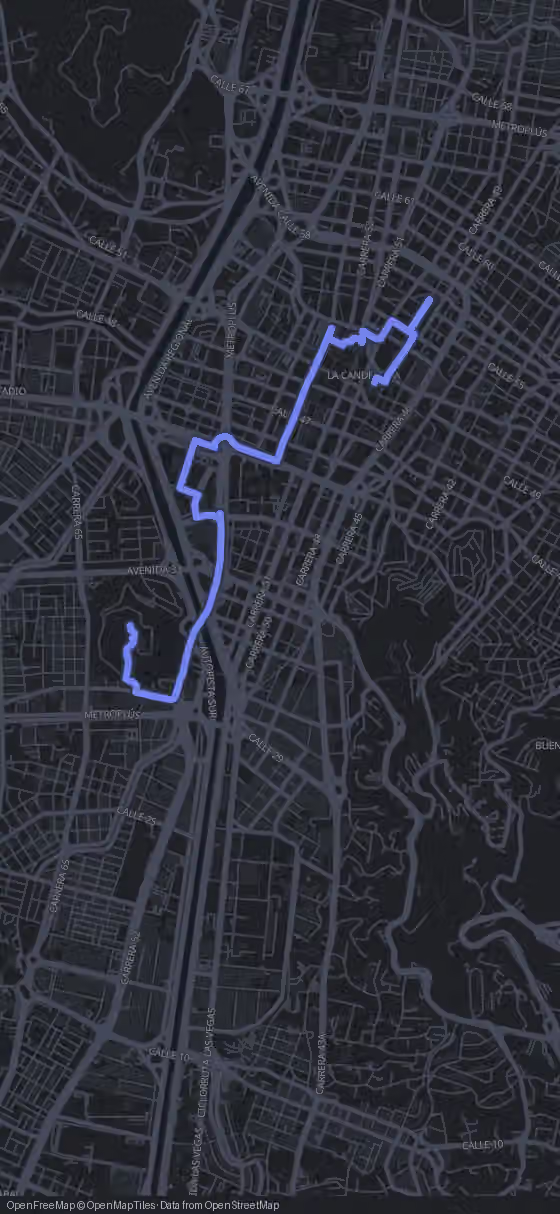
Route map for the Medellín walking tour
Stop 1 of 9
690 m·9 min
Basílica de Nuestra Señora de la Candelaria
Head north-east toward the Catedral Metropolitana
Hola, welcome to Medellín. I'm Alex, and this city once answered one of its roughest corners with a forest of light.
Try this tour with Alex

Medellín Walking Route at a Glance

Nine stops lead from the Basílica de Nuestra Señora de la Candelaria in the old center to the Cerro Nutibara (Pueblito Paisa) hilltop: 5.7 km and 1 h 22 min of pure walking. Plan about four and a half hours, or a little over six with a museum visit.

Every stop is free except the Museo de Antioquia. The GPS route runs free in your browser and leads you from stop to stop; the AI Tour Guide is an optional companion that tells the stories as you walk.

Open free GPS & optional AI Tour Guide
This short shows highlights of the route. All 9 stops follow below.

The Route

Walking Map of Medellín's Center and Cerro Nutibara

9 stops 5.7 km 1 h 22 min walking
Tap to load interactive map

The 9 stops along this route

  1. Basílica de Nuestra Señora de la Candelaria in Medellín, stop 1 on the self-guided walking tour
    1Basílica de Nuestra Señora de la Candelaria
  2. Catedral Metropolitana de Medellín, stop 2 on the self-guided walking tour
    2Catedral Metropolitana de Medellín
  3. Parque de Bolívar in Medellín, stop 3 on the self-guided walking tour
    3Parque de Bolívar
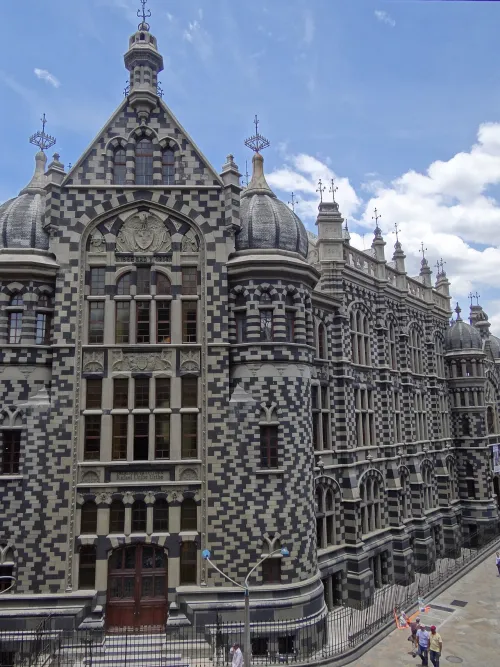
  4. Palacio de la Cultura Rafael Uribe Uribe in Medellín, stop 4 on the self-guided walking tour
    4Palacio de la Cultura Rafael Uribe Uribe
  5. Plaza Botero in Medellín, stop 5 on the self-guided walking tour
    5Plaza Botero
  6. Museo de Antioquia in Medellín, stop 6 on the self-guided walking tour
    6Museo de Antioquia
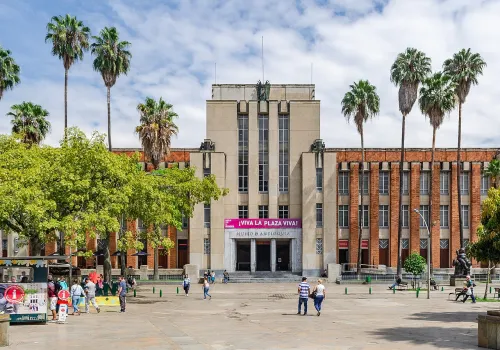
  7. Plaza de Cisneros in Medellín, stop 7 on the self-guided walking tour
    7Plaza de Cisneros
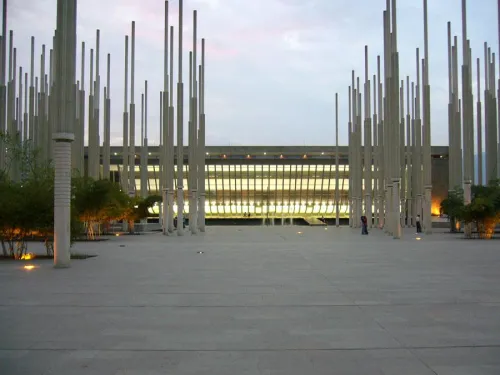
  8. Parque de los Pies Descalzos in Medellín, stop 8 on the self-guided walking tour
    8Parque de los Pies Descalzos
  9. Cerro Nutibara (Pueblito Paisa) in Medellín, stop 9 on the self-guided walking tour
    9Cerro Nutibara (Pueblito Paisa)
  10. That's the full route.

    Walk it with an AI Tour Guide talking you through every one of these streets.

    Start free in your browser
    You made it

Your Medellín Walking Tour, from La Candelaria to the Hill

  1. 1

    Basílica de Nuestra Señora de la Candelaria

    Basílica de Nuestra Señora de la Candelaria in Medellín, stop 1 on the self-guided walking tour

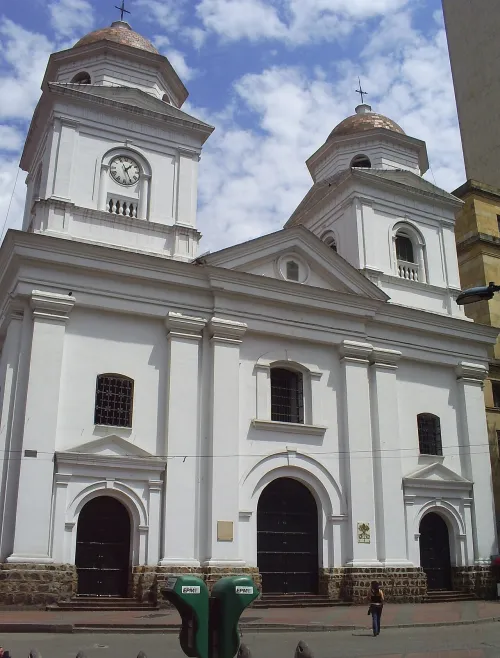
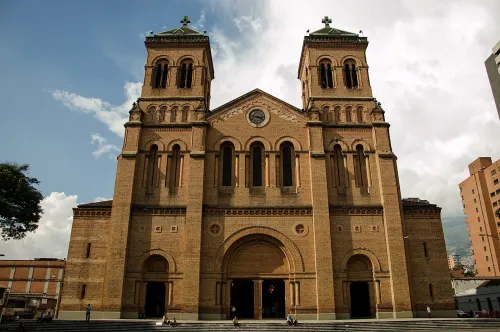
    You start on the east side of Parque Berrío, facing the plastered facade of the Basílica de Nuestra Señora de la Candelaria. Read it from left to right: three portals, the side sections leading into the two bell towers, the middle one closing with a triangular pediment. Above the crossing rises a dome on an eight-sided drum. It is a colonial building in neoclassical style, and its stone and mortar walls have been reworked more than once over the centuries.

    This is the oldest church in Medellín, and it is older than the town itself. In 1649 a simple wooden chapel with a thatched roof stood here, thirty years before the town was formally founded. The devotion to Our Lady of Candelaria came with Spanish settlers from Tenerife and is tied to the feast of the Presentation of the Lord. The image on the main altar is said to have been a gift from the Spanish queen Mariana of Austria and her son Charles II.

    When the old church grew unsafe, work on a new one began in 1768, and it was consecrated in 1776. The nineteenth century kept adding: a new altar and organ in 1850, the dome in 1860. In 1868 La Candelaria became the cathedral of the new diocese and held that role until 1931. The towers were completed on 28 February 1888, and two years later three bells arrived from New York. Pope Paul VI made it a minor basilica in 1970, and since 1998 it has been a national monument.

    Entry is free, and a quiet look at the three naves and the main altar fits easily before the day gets going. Then walk 690 m, about 9 minutes, to the building that took over its cathedral title.
    Hours
    Mon–Sat: 06:00–18:30 | Sun: 07:00–19:30
    Price
    Free
  2. 2

    Catedral Metropolitana de Medellín

    Catedral Metropolitana de Medellín, stop 2 on the self-guided walking tour

    The Catedral Metropolitana de Medellín fills the north side of Parque de Bolívar in the Villanueva neighborhood, and its sheer mass is the first thing you notice. It is a structure of solid brick: roughly 1,120,000 bricks bound with mortar, enclosing 97,000 cubic meters of space. The two towers rise 53.20 m to the tips of their crosses.

    While it was going up, people called it the Catedral de Villanueva, to tell it apart from La Candelaria, which was still the bishop's seat at the time; you will still hear the old name now and then. French architect Charles Émile Carré designed it in neo-Romanesque style on a Latin cross plan, with three naves crossed by a transept. Pope Pius XII granted it the title of minor basilica in 1948, and today it is the seat of the Archbishop of Medellín.

    The interior is the work of Italian architect Giovanni Buscaglione, who designed the baldachin, the altars, the pulpit, the choir, the stained glass windows and the floors. Renowned workshops such as Maumejean, Poussielgue-Rusand, Rambusch and Ugo Luisi supplied pieces, so take your time with the glass and the metalwork if you get in.

    Getting in takes timing. The doors open only for short windows, so you may find them closed. Entry is free, as this is a place of worship. Arrive between windows and the brick facade is still worth the visit from outside. The park begins right at the cathedral's door, just 10 m away.

    Hours
    Mon–Fri: 7:00–08:00, 10:00–11:00, 18:00–19:00 | Sat–Sun: 7:00–08:00, 10:00–11:00, 12:00–13:00, 18:00–19:00
    Price
    Free (worship; internal museum closed to public)
  3. 3

    Parque de Bolívar

    Parque de Bolívar in Medellín, stop 3 on the self-guided walking tour

    Parque de Bolívar stretches over two blocks, about 14,400 m² of lawns, paved paths and native trees. For locals it is much more than a green space: it counts as a symbol of the city and as the meeting place where every generation turns up. The park opened in 1892 and is named after the liberator Simón Bolívar.

    Its centerpiece arrived in 1923: the equestrian statue of Bolívar, designed by the Italian sculptor Giovanni Anderlini and cast by his compatriot Eugenio Maccagnani. Walk a full circle around it before you look at the edges of the park.

    On the southeast corner stands the Lido Theater, and the older houses nearby are a reminder that this was once the center's upscale residential quarter. Carrera Junín ends on the south side of the park; it is named after the Battle of Junín and is one of the traditional shopping streets of downtown. Today the surrounding blocks mix homes, offices, shops and services.

    Take a bench for a few minutes and watch the city pass: it is a good pause between the two churches and the busy blocks around Plaza Botero. Then walk 650 m, about 9 minutes, to the Gothic Revival palace on the edge of that plaza.

    Hours
    Open 24/7
    Price
    Free
  4. 4

    Palacio de la Cultura Rafael Uribe Uribe

    Palacio de la Cultura Rafael Uribe Uribe in Medellín, stop 4 on the self-guided walking tour

    The Palacio de la Cultura Rafael Uribe Uribe looks as if it had been carried over from Flanders, and in a sense it was: Belgian architect Agustín Goovaerts designed it in Gothic Revival style. Look up at its large dome; inside, that space now serves as an auditorium and a projection room where films are shown.

    The building began as a seat of power. On 17 April 1826 the governor of Antioquia moved his headquarters to Medellín, into an old two-floor house on the corner of Bolívar and Boyacá streets with just 16 offices. For a century there was talk of a proper government building. In 1920 governor Pedro Nel Ospina, later President of Colombia, finally commissioned it along with several other buildings for the city. The plans were disputed, so the final palace turned out more modest than first imagined. Construction began in 1925 and ended in 1937, and for years it was known as the Calibío Palace.

    Today it carries the name of Rafael Uribe Uribe, a general of the Colombian Liberal Party, and it is a national monument. It houses the Institute of Culture and Heritage of Antioquia, with a historical and photographic archive, a music and sound archive, a library, a documentation center, a permanent art gallery, a café and a museum room dedicated to Uribe Uribe.

    Entry is free. Half an hour inside is well spent if you like architecture or quiet galleries. Plaza Botero begins right outside, only 90 m away.

    Hours
    Mon–Fri 8:00–17:00, Sat 8:00–14:00, Sun closed
    Price
    Free
  5. 5

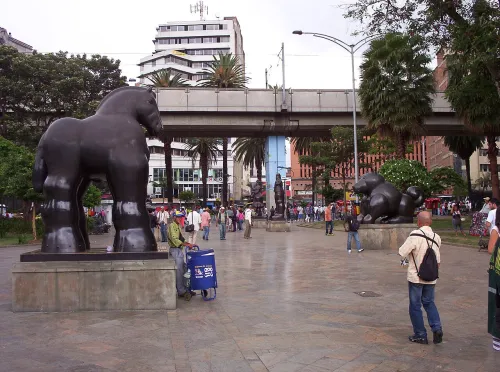
    Plaza Botero

    Plaza Botero in Medellín, stop 5 on the self-guided walking tour

    Plaza Botero is an open square of about 7,000 m², framed by the Museo de Antioquia and the Palacio de la Cultura in a traditional part of the city known as the Barrio Viejo. Scattered across it stand 23 monumental sculptures by Fernando Botero, born in Medellín, with his unmistakably rounded figures. They are free to see, so walk among them, compare their shapes from different angles and let the scale surprise you.

    The plaza exists because of a near miss. In the mid 1990s, the museum, then still called the Museo de Zea, was in deep crisis. Botero had been donating works to it since 1974, but nobody followed up on his offers, and eventually he announced he would give part of his work and his private collection to Bogotá instead.

    The newly appointed director, Pilar Velilla, picked up the phone and called him. Botero said he was still willing to give to Medellín, and she asked him to put it in writing. On 23 May 1997 a fax arrived in his own handwriting, offering a painting gallery, a sculpture gallery and a drawing gallery, plus one million dollars toward a new building. Medellín, he wrote, needed a great museum, an easy to reach, safe place where gardens would be an attraction alongside the art, a place for rest and contemplation.

    With mayor Juan Gómez Martínez and businessman Tulio Gómez Tapias on board, the project took shape. The sculptures were donated in 2000, the museum opened in its new home on 14 October that year, and the plaza was inaugurated in 2001. The museum entrance is 240 m away, about 3 minutes.

    Hours
    Open 24/7
    Price
    Free
  6. 6

    Museo de Antioquia

    Museo de Antioquia in Medellín, stop 6 on the self-guided walking tour

    The Museo de Antioquia holds a large collection by Fernando Botero and by Pedro Nel Gómez, two artists from Medellín. It was the first museum founded in the department of Antioquia and the second in all of Colombia.

    Its story goes back to 1881, when Manuel Uribe Ángel, Antonio José Restrepo and Martín Gómez founded the Zea Museum in honor of Francisco Antonio Zea, housed in the library of what was then the Sovereign State of Antioquia. Uribe Ángel donated his own collection on one condition: that he become the first director. The early museum gathered documents, weapons and flags from independence to the Thousand Days' War, pre-Columbian pieces, minerals, coins and a library that included the country's first newspapers.

    When the 1886 constitution turned Antioquia from a sovereign state into a department, the museum came to depend on the government, and it was eventually closed; part of the collection went into storage, the rest to the University of Antioquia and the Historical Academy. In 1946 Teresa Santamaría de González and Joaquín Jaramillo Sierra, worried that the city had no museum worthy of it, revived it as a private non-profit to shield it from political control.

    Is it worth the ticket? If Botero's sculptures outside made you curious about his paintings and drawings, yes: plan about two hours. From the museum, walk 810 m, about 11 minutes, to Plaza de Cisneros.

    Hours
    Mon–Sat 9:40–17:30, Sun & holidays 9:40–16:30
    Price
    COP 46,000 foreigners, COP 18,000 nationals
  7. 7

    Plaza de Cisneros

    Plaza de Cisneros in Medellín, stop 7 on the self-guided walking tour

    Plaza de Cisneros honors Francisco Javier Cisneros, the Cuban engineer who pioneered the Antioquia Railway. The square sits among the Biblioteca EPM, the Vásquez and Carré buildings and the old railway station. Its current look dates from a 2002 remodeling, so expect a modern public space set against historic facades.

    The history here is about how Medellín grew. In the Spanish model, the main square gathered every kind of power: the church, the town council, the tax office, and the public market selling farm produce and goods. In Medellín, some of these functions eventually moved out of the main square, today's Parque Berrío, into covered market halls.

    Behind that move was money. In the late nineteenth century, after frequent civil wars, the new class of merchants and miners founded banks and looked for safe ways to protect their capital. They found it in land: opening streets and squares, dividing plots and building new projects raised the value of urban ground. The big prize of the day was the contract for a covered market to replace the one on the main square, and two rival groups competed to build it on land they owned.

    Take a few minutes to look at the old station and the surrounding buildings with that story in mind. Then walk 840 m, about 12 minutes, to Parque de los Pies Descalzos.

    Hours
    Open 24/7
    Price
    Free
  8. 8

    Parque de los Pies Descalzos

    Parque de los Pies Descalzos in Medellín, stop 8 on the self-guided walking tour

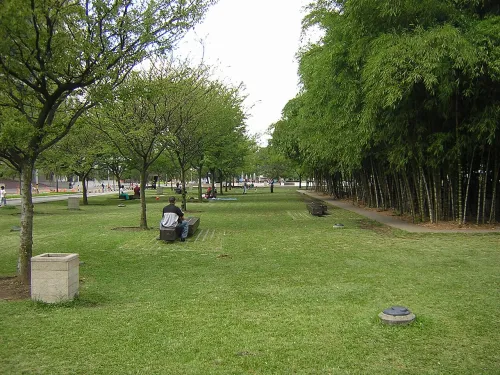
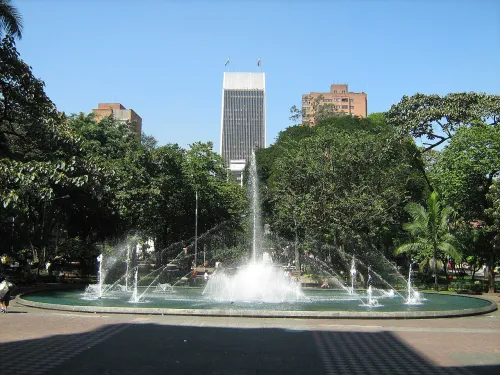
    The name says it all: the Parque de los Pies Descalzos, the Barefoot Park, invites you to take off your shoes. Created by the city utility Empresas Públicas de Medellín between 1998 and 2000, it sits in the administrative district next to the Museo Interactivo EPM, the Teatro Metropolitano, Plaza Mayor and the Edificio Inteligente.

    The idea behind it is playful and simple: go barefoot to reconnect with nature in the middle of the city. Walk through the fountains, the bamboo grove known as the lovers' forest, the zen garden and the sand park. After a morning on pavement, your feet will thank you.

    The park is free. Its guides and water features do not run every day, so on some visits you will find it quieter and drier. Twenty minutes is enough for a barefoot loop.

    Put your shoes back on for the longest leg of the day: 2,380 m, about 36 minutes, to Cerro Nutibara and the Pueblito Paisa on its summit.

    Hours
    Open 24/7 (guides & water features Tue–Sun & holidays 9:00–22:00)
    Price
    Free
  9. 9

    Cerro Nutibara (Pueblito Paisa)

    Cerro Nutibara (Pueblito Paisa) in Medellín, stop 9 on the self-guided walking tour

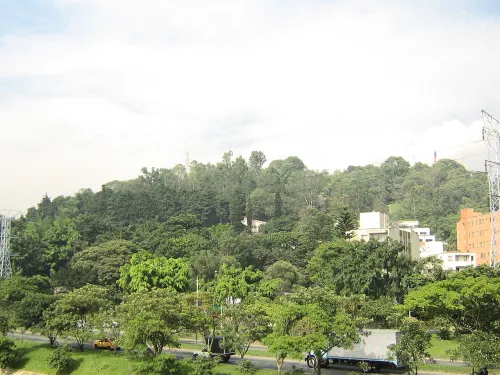
    Cerro Nutibara is a small hill in the geographic center of the Aburrá Valley, on the west bank of the Medellín River, right in the middle of the city. It covers 33 hectares and rises eighty meters above the city, enough for a wide panorama over all of Medellín. It is also one of the few natural ecosystems preserved within the city.

    The hill has changed names several times. In the time of the Spanish conquerors it was the Morro de Marcela de la Parra, later the Morro de los Cadavides, and finally Cerro Nutibara. It belongs to the city's cerros tutelares, the guardian hills that line the valley along with Pan de Azúcar, El Salvador, El Volador, La Asomadera, Las Tres Cruces, El Picacho and Santo Domingo, valued for their history, archaeology and nature.

    On the summit stands Pueblito Paisa, built in 1977 as a tribute to the small towns of the Paisa region. The hill also holds the Carlos Vieco open-air theater, with room for 3,800 spectators and named after the composer Carlos Vieco Ortiz, and the Sculpture Park, created in 1983, with works by eleven Colombian and international artists set into the slopes along a short trail.

    Entry is free. Allow about 45 minutes to wander the village, follow the sculpture trail and look back over the valley you have just crossed on foot. This is where the route ends.

    Hours
    Daily 5:30–22:00 (hill grounds) / Pueblito Paisa 8:00–22:00
    Price
    Free
Walking tour route map of Medellín Route loaded
Basílica de Nuestra Señora de la CandelariaCatedral Metropolitana de MedellínParque de BolívarPalacio de la Cultura Rafael Uribe Uribe+5
All 9 stops are already on the map.
You just press start.
AI Tour Guide

You've read the route. Now walk it from La Candelaria to Nutibara with a guide in your ear.

Press start wherever you are, even hundreds of kilometres from Medellín, and the guide begins telling its stories right away. In the city, pick any of the 9 stops to start from: it leads you there, then talks with you the whole route, asking, listening, remembering, and shaping the tour around your answers.

9stops 5.7km 1 h 22 minwalking 13languages
▶Start the tour free

Free to start · Runs in your browser · No app, no download

Shorter Ways to Walk Medellín's Center

Not everyone has a full day. These cuts keep the route's logic and let you choose between history, art and the view.

Churches, plazas and Botero

Stops: 1, 2, 3, 4, 5, 6

For a morning in the historic core. About 23 minutes of walking from La Candelaria to the Museo de Antioquia, roughly two hours with short visits. The museum is the only ticket; add about two hours if you go in.

From Botero to the hilltop

Stops: 5, 6, 7, 8, 9

For an afternoon that starts with art and ends with a panorama. About 62 minutes of walking, most of it on the long final leg to Cerro Nutibara. Everything is free unless you choose to enter the Museo de Antioquia.

The whole route without tickets

Stops: 1, 2, 3, 4, 5, 6, 7, 8, 9

For walkers on a tight budget: all nine stops, 1 h 22 min of walking, and you only admire the Museo de Antioquia from the plaza. Without the museum, the day stays at around four and a half hours and costs nothing.

How Long Does This Medellín Tour Take on Foot?

The walking itself is short: 1 h 22 min for 5.7 km, and more than a third of it is the 36-minute stretch out to Cerro Nutibara. The rest of the day goes to looking. Count on about four and a half hours with short visits to the churches, the Palacio de la Cultura and the parks, and a little over six hours if you give the Museo de Antioquia two hours.

A schedule that works on a weekday: leave La Candelaria at 9:45 and you reach the cathedral in time for its morning opening. After the park and the Palacio you are at Plaza Botero around 11:15 and inside the museum before noon. Leave the museum around 13:40, and you reach Parque de los Pies Descalzos shortly after 14:00 and the top of Cerro Nutibara a little after 15:00, with plenty of light left for the view.

Before You Set Out in Medellín

  • Start: The Basílica de Nuestra Señora de la Candelaria on Parque Berrío is the recommended start, but you can join the route at any stop.
  • Finish: Cerro Nutibara, where Pueblito Paisa sits on the summit. The route does not loop back to the center.
  • Best days: Tuesday through Saturday work best, when the Palacio de la Cultura is open and the water features at Parque de los Pies Descalzos are running.
  • Time of day: Start around 9:30 so you reach the cathedral as its doors open for the morning; the Museo de Antioquia will already be open when you arrive.
  • Costs: Only the Museo de Antioquia charges admission. The churches, plazas, parks and the hill are free, and so is the GPS route.
  • Getting there: Parque Berrío metro station is right by the start area, close to the Palacio de la Cultura and the Museo de Antioquia.
Walking tour route map of Medellín
AI Tour Guide

Your guide is ready when you reach La Candelaria.

Press start and a voice AI Tour Guide takes it from here: leading the route through Medellín, telling the stories, and turning your walk into a real back-and-forth conversation. No app or download is needed; it runs in your browser.

9stops 5.7km 1 h 22 minwalking 13languages
▶Start the tour free

Free to start · Runs in your browser · No app, no download

What the AI Tour Guide Adds Between La Candelaria and Nutibara

The map gets you from stop to stop; the AI Tour Guide turns the walk into a conversation. It greets you at La Candelaria, tells the stories of each place, asks what caught your attention and remembers it, so by Plaza Botero it knows whether you care more about art or about how the city grew. Want to know who Francisco Antonio Zea was, or what the Thousand Days' War meant for Antioquia? Just interrupt and ask. You start with 100 free credits; after that, unlock this tour all-inclusive for €19.99 with no time limit, or pay €5 per hour.

A Real Conversation A voice AI Tour Guide greets you, leads the whole route, and tells the stories and facts as you walk, asking what you want to see and keeping a real conversation going. Not a recording you press play on.
Map Navigation Follow the route on the map and walk at your own pace. You choose where to start and when to move to the next stop.
Ask Anything Curious about a building you pass? Ask your AI Tour Guide on the spot and the conversation carries on.
13 Languages Switch language anytime. No separate tour needed.
Start free in your browser

Common Questions About Walking Central Medellín

Is there anything special on weekends at Parque de Bolívar?

On the first three Sundays of each month, the Banda Sinfónica Universidad de Antioquia plays an open-air concert there at 11:15. On the first Saturday of each month, the traditional San Alejo market fills the park.

Can I visit the museum inside the Catedral Metropolitana?

No. The cathedral's internal museum is closed to the public; only the church itself opens, free, during its hourly worship windows.

Why do the streets around Parque de Bolívar have country names?

They honor Bolívar's campaigns: calles Perú and Bolivia and carreras Venezuela and Ecuador are named after nations he liberated, and two more streets are Caracas and La Paz. La Paz runs behind the cathedral.

Which other Colombian cities can I explore on foot the same way?

Coffee-country Salento is 179 km away, the capital Bogotá 247 km, and on the Caribbean coast there is Cartagena de Indias. Each has its own free GPS walking route.

Is the tour really free?

Yes. The whole tour is free: the route, the interactive map and the navigation cost you nothing. Only the voice AI Tour Guide is optional and paid: you test it with 100 free credits, then you pay either €5 per hour or €19.99 for this whole tour, with no time limit. Admission to one of the 9 stops is not included: Museo de Antioquia charges its own entry fee.

Do I need to download an app?

No. Everything runs in your phone browser. Open the route and start walking, no download and no sign-up required.

Do I need to book the walking tour in advance?

No booking needed. This self-guided tour is available anytime. Open the route in your browser and start walking. The AI Tour Guide works instantly, no app, no reservation required.

What languages is the AI Tour Guide available in?

The AI Tour Guide speaks 13 languages, so you take the tour in your own language and can switch at any time.

Can I skip stops or change the route?

Yes. Skip any stop, spend extra time at places you like, or start the route from any point. It is your walk, you set the pace.
Image credits
▶ Start free in your browser Runs in your browser, no app, no download