Free Walking Tour Cartagena de Indias: Gate to Fortress

Walk in under the old clock gate, cross the square of the Inquisition, climb onto the walls and end at San Felipe castle and a quiet bench in Getsemaní.

11 Stops 5.3 km ~1 h 14 min walking
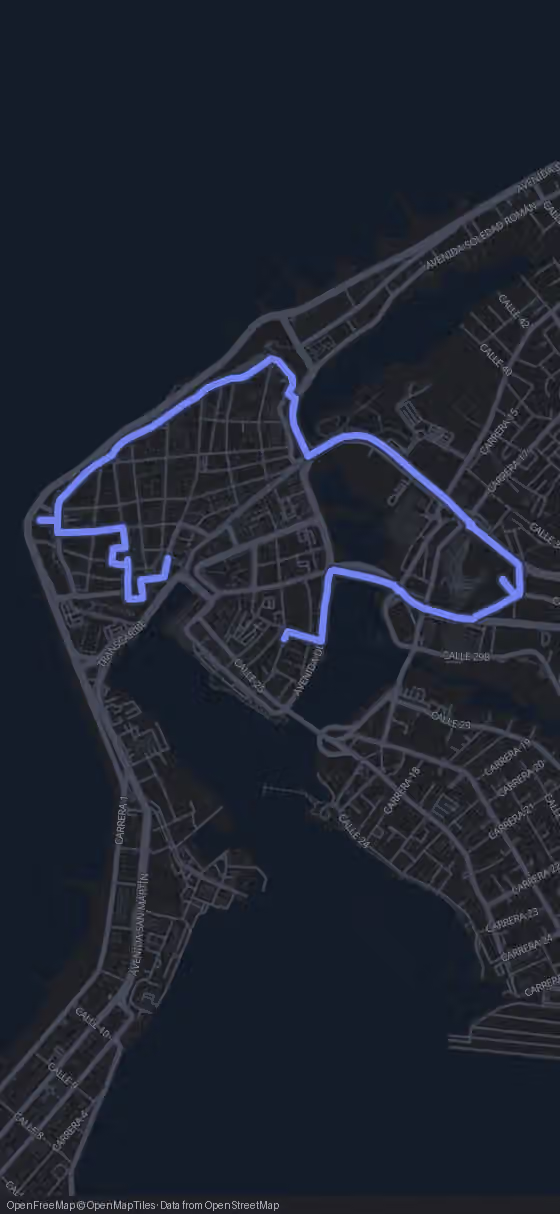
Route map for the Cartagena de Indias walking tour
Stop 1 of 11
190 m·2 min
Torre del Reloj
Head south-west toward Parque de Bolívar
Hola, welcome to Cartagena. I'm Alex, and one priest here devoted his work to enslaved arrivals at the port.
Try this tour with Alex

This Route at a Glance

11 stops from the Torre del Reloj to the Plaza de la Trinidad (Getsemaní): 5.3 km and 1 h 14 min of pure walking, about six hours with the interiors worth your time.

Free: the Parque de Bolívar, the Museo del Oro Zenú, the Catedral de Santa Catalina de Alejandría, the Iglesia y Convento de Santo Domingo, the Baluarte de Santo Domingo and the Murallas de Cartagena. Tickets: the museum of the Iglesia de San Pedro Claver, the Palacio de la Inquisición and the Castillo San Felipe de Barajas. The GPS route is free; the AI Tour Guide is optional.

Open free GPS & optional AI Tour Guide
This short shows highlights of the route. All 11 stops follow below.

The Route

Walking Map of Cartagena de Indias, Clock Gate to Getsemaní

11 stops 5.3 km 1 h 14 min walking
Tap to load interactive map

The 11 stops along this route

  1. Torre del Reloj in Cartagena de Indias, stop 1 on the self-guided walking tour
    1Torre del Reloj
  2. Parque de Bolívar in Cartagena de Indias, stop 2 on the self-guided walking tour
    2Parque de Bolívar
  3. Iglesia de San Pedro Claver in Cartagena de Indias, stop 3 on the self-guided walking tour
    3Iglesia de San Pedro Claver
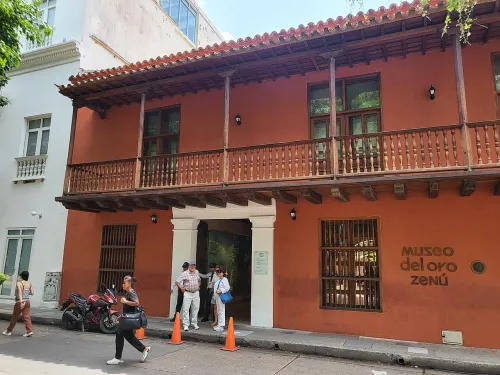
  4. Museo del Oro Zenú in Cartagena de Indias, stop 4 on the self-guided walking tour
    4Museo del Oro Zenú
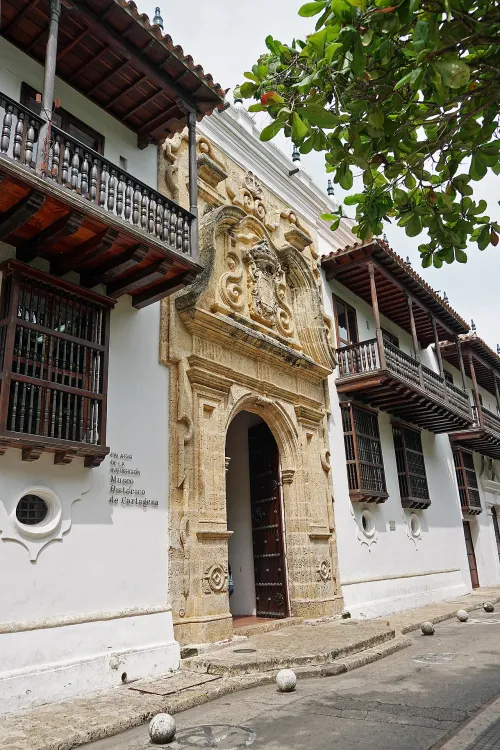
  5. Palacio de la Inquisición in Cartagena de Indias, stop 5 on the self-guided walking tour
    5Palacio de la Inquisición
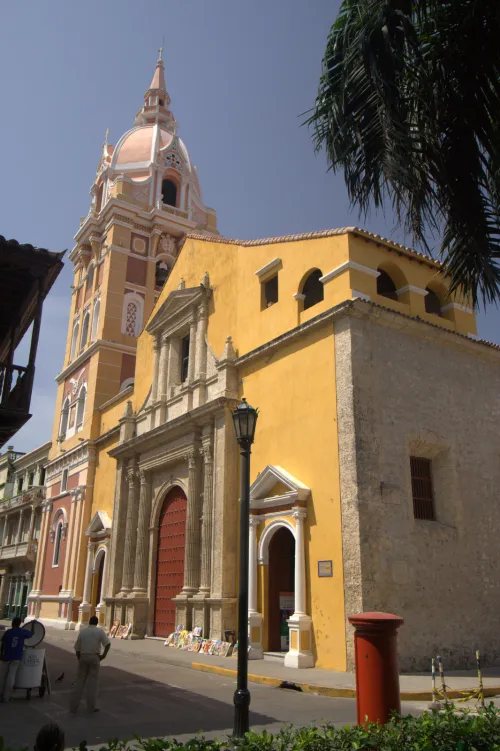
  6. Catedral de Santa Catalina de Alejandría in Cartagena de Indias, stop 6 on the self-guided walking tour
    6Catedral de Santa Catalina de Alejandría
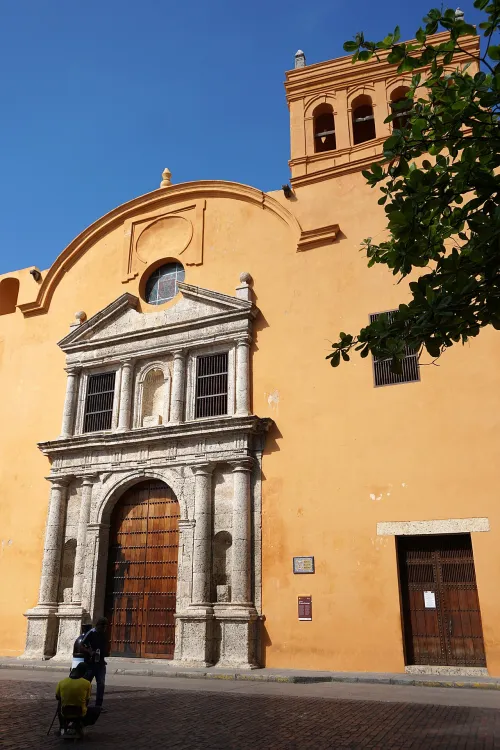
  7. Iglesia y Convento de Santo Domingo in Cartagena de Indias, stop 7 on the self-guided walking tour
    7Iglesia y Convento de Santo Domingo
  8. Baluarte de Santo Domingo in Cartagena de Indias, stop 8 on the self-guided walking tour
    8Baluarte de Santo Domingo
  9. Murallas de Cartagena in Cartagena de Indias, stop 9 on the self-guided walking tour
    9Murallas de Cartagena
  10. Castillo San Felipe de Barajas in Cartagena de Indias, stop 10 on the self-guided walking tour
    10Castillo San Felipe de Barajas
  11. Plaza de la Trinidad (Getsemaní) in Cartagena de Indias, stop 11 on the self-guided walking tour
    11Plaza de la Trinidad (Getsemaní)
  12. That's the full route.

    Walk it with an AI Tour Guide talking you through every one of these streets.

    Start free in your browser
    You made it

Your Cartagena de Indias Walking Tour, All 11 Stops in Order

  1. 1

    Torre del Reloj

    Torre del Reloj in Cartagena de Indias, stop 1 on the self-guided walking tour

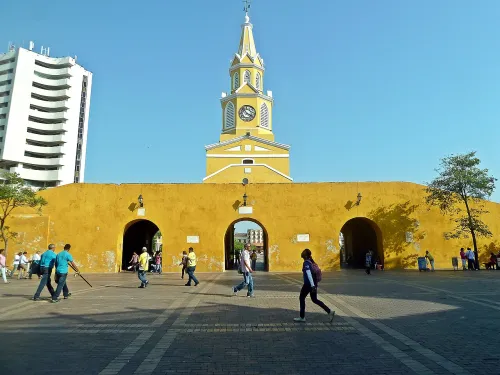
    Begin under the clock. The Torre del Reloj is the main gate into the historic center and the original entrance to the fortified city that Cartagena still calls the Ciudad Amurallada, standing between the Plaza de la Independencia and the Plaza de los Coches. Before you walk through, look at the façade: a Roman semicircular arch, flanked by two pairs of Tuscan columns, under an entablature with a frieze of triglyphs. The clock that crowns the tower and gives it its name was added at the start of the 18th century.

    Locals rarely use that name. To them this is the Boca del Puente, the mouth of the bridge, because a drawbridge once spanned the old San Anastasio canal here and linked the walled city with the Getsemaní neighborhood. The bridge was part of the defense too: when an enemy attacked, it was raised to keep pirates and buccaneers out, while the bastions of San Pedro Apóstol and San Juan Bautista guarded the gate on either side.

    The gate is the work of the military engineer Juan de Herrera y Sotomayor, founder of the Academia de Cartagena, and its lines recall the church façade of the San Francisco convent in Santo Domingo. Specialists count it among the most successful works of the Spanish American school of fortification, built strictly along Vauban's principles. Keep Herrera's name in mind; you will meet his work again on the bastion later.

    There is nothing to buy and nothing to queue for: it is a passage, open around the clock. Walk through and it is 190 m, about 3 minutes, to the green heart of the old town at the Parque de Bolívar.
    Hours
    24/7
    Price
    Free (open-air city gate/monument, walk-through passage)
  2. 2

    Parque de Bolívar

    Parque de Bolívar in Cartagena de Indias, stop 2 on the self-guided walking tour

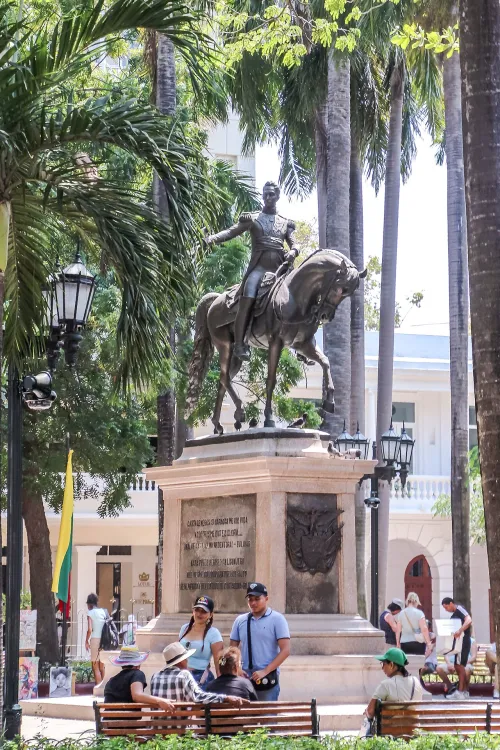
    This square has changed its name with every regime that mattered. It began as the plaza de la iglesia, became the Plaza Mayor where military ceremonies were held, and after the Holy Tribunal of the Inquisition settled in Cartagena in 1610 it was known as the plaza de la Inquisición. Only in 1896, when the equestrian statue of Simón Bolívar arrived, did it become the Parque de Bolívar.

    Walk up to the statue. It was modeled in Munich by the Venezuelan sculptor Eloy Palacios, cast in bronze and set on a pedestal of Finnish granite, and two replicas of it stand in Maracaibo and Guayaquil. Around it you get trees, lawns, paved paths, benches and fountains; the park was remodeled and reopened in November 2023.

    Now turn slowly and read the edges of the square, because half of this walk is lined up around it. There is the baroque Palacio de la Inquisición, the cathedral in Herrerian style, the Palacio de la Proclamación, which served as city hall and until 2016 as seat of the government of the Bolívar department, the Banco de la República building and the Museo del Oro Zenú. The streets around mix homes, shops and services, in a UNESCO World Heritage old town of narrow lanes and colonial and republican buildings that rarely rise above three or four floors.

    It is free and always open, so treat it as your base: you will come back past it twice. First, a short detour of 100 m, about a minute, to the Iglesia de San Pedro Claver.

    Hours
    24/7
    Price
    Free (open-air public park/plaza)
  3. 3

    Iglesia de San Pedro Claver

    Iglesia de San Pedro Claver in Cartagena de Indias, stop 3 on the self-guided walking tour

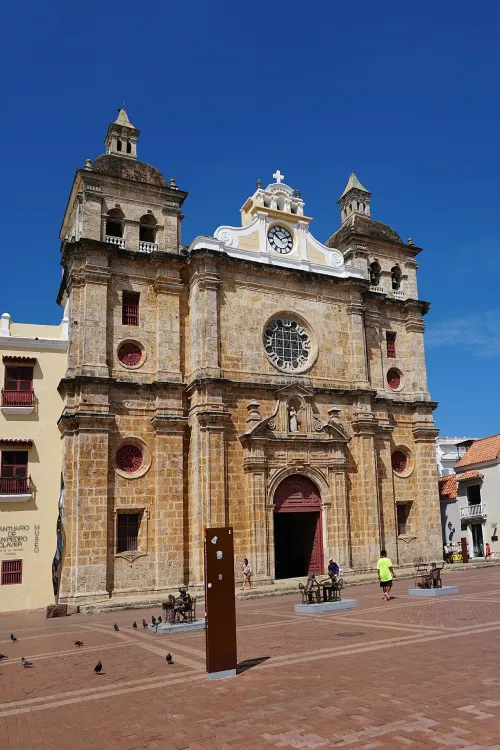
    The Iglesia de San Pedro Claver stands at the corner of Calle 31 and Carrera 4, facing the Plaza de la Aduana, and it is dedicated to the saint whose remains lie in its high altar. The Jesuits run it, and it forms one ensemble with the Claustro de San Pedro Claver and an archaeological museum.

    Building took the better part of a century, from 1580 until 1654, following the rules of colonial construction. The church also took three names along the way: it began as the church of San Juan de Dios, was called San Ignacio de Loyola from 1622, and today carries the name of San Pedro Claver, revered as the Patron of Human Rights. In 1995 it was declared a National Monument, and it remains one of the churches Cartagena likes most for weddings, so do not be surprised to find flowers at the door.

    The decision here is about the museum, not the church. The temple is free to enter. The museum and cloister charge admission; that is worth it if you want to understand the life of the man whose name the church carries and to see the cloister. If you only want the architecture, a look inside the free church is enough.

    From here it is 150 m, about 2 minutes, back toward the park and the Museo del Oro Zenú.

    Hours
    Museum: Mon–Fri 09:00–16:30, Sat–Sun & holidays 10:00–16:00; Masses: Mon–Sat 18:00, Sun 07:00, 10:00, 12:00, 18:00
    Price
    Temple free; Museum & cloister COP $30,000 foreign adults, COP $22,000 foreign children/students/seniors 60+; COP $21,000 Colombian adults, COP $13,000 Colombian children/students/seniors; COP $8,000 Bolívar residents
  4. 4

    Museo del Oro Zenú

    Museo del Oro Zenú in Cartagena de Indias, stop 4 on the self-guided walking tour

    The Museo del Oro Zenú is the easiest yes on the route: entry is free, and the collection is small enough to see properly in half an hour. The Banco de la República opened it on 27 March 1982, and on 20 July 1984 it was reorganized as a regional museum devoted to the Zenú culture.

    Inside you find pre Columbian gold and ceramics, with the Zenú at the center. Since a full renovation in 2006 the museum has shown 902 archaeological objects: 747 in metal, 105 ceramics, 11 in bone, 34 in shell and five ceramic fragments. The goldwork is the reason to come; take your time with the small pieces, because their fine detail is what makes the collection.

    Plan around the museum's hours: it is not open every day, and on Sundays it closes early. If it is shut when you pass, the façade on the square is all you get, and the rest of the morning still works.

    Back out on the square, the Palacio de la Inquisición is just 100 m away, about a minute's walk.

    Hours
    Tue–Sat 09:00–17:00, Sun 09:00–14:00, Mon closed
    Price
    Free entry
  5. 5

    Palacio de la Inquisición

    Palacio de la Inquisición in Cartagena de Indias, stop 5 on the self-guided walking tour

    The baroque palace on the park was the seat of the Holy Office in Cartagena. Philip III of Spain decreed the tribunal, which was established in 1610, though the building you see was completed only in 1770. Today it houses the Museo Histórico de Cartagena, with exhibits on the city's colonial and republican past and on how the Inquisition worked here.

    Why Cartagena? As a hub of trade between the Caribbean and the Spanish settlements of western South America, it became only the third city in the Spanish empire to receive a tribunal. Many merchants were Portuguese, and between 1580 and 1640, when one monarch ruled both Spain and Portugal, many of them were suspected of being crypto Jews, practicing Judaism while passing as Christians.

    Go in with a skeptical eye. The museum displays alleged torture instruments, but many appear to be modern replicas or generic medieval reconstructions with little evidence that the Cartagena tribunal ever used them. The so called iron maiden is now considered a 19th century invention for sensational exhibitions. The real story is more sobering in a different way: the tribunal worked for more than two centuries until 1821 and handled about 800 cases, but only between three and five people were executed; most of the convicted were sentenced to flogging.

    Entry is paid, and if you only pay for one interior in the old town, make it this one, and give it an hour. Then cross 100 m, about a minute, to the cathedral.

    Hours
    Mon–Sat 09:00–18:00, Sun & holidays 10:00–16:00
    Price
    COP $24,000 adults; COP $20,000 children, students, teachers & seniors 60+; free for children under 5
  6. 6

    Catedral de Santa Catalina de Alejandría

    Catedral de Santa Catalina de Alejandría in Cartagena de Indias, stop 6 on the self-guided walking tour

    The Catedral de Santa Catalina de Alejandría, known locally as the Catedral de Cartagena de Indias, rises on the eastern corner of the Parque de Bolívar at the Plaza de la Proclamación. It is the seat of the Archbishop of Cartagena, one of the oldest episcopal sees in the New World, and its plain, severe Herrerian style belongs to the reign of Philip II.

    The master builder Simón González modeled it on basilicas in Andalusia and the Canary Islands. Work began in 1577, replacing a humble cathedral of straw and cane, and was still underway in 1586 when the pirate Francis Drake attacked the city and badly damaged it; completion slipped to 1612. Look up at the tower and you see a later hand: the French architect Gastón Lelarge designed it during a remodeling at the start of the 20th century.

    Inside, the basilica plan divides into three naves, with a row of chapels along the Gospel side. Pope Pius XII made it a Minor Basilica in 1953, and in 1995 it was declared a National Monument of Colombia. Entry is free, so even 25 minutes inside are worth it.

    Mind the hours: the cathedral closes early in the afternoon, earlier still on Saturdays, and it is not open every day. From the cathedral, walk 200 m, about 3 minutes, to the Iglesia y Convento de Santo Domingo.

    Local name
    Catedral de Cartagena de Indias
    Hours
    Tue–Sun 08:00–15:00; Sat 08:00–12:00
    Price
    Free
  7. 7

    Iglesia y Convento de Santo Domingo

    Iglesia y Convento de Santo Domingo in Cartagena de Indias, stop 7 on the self-guided walking tour

    This is the last interior before the route heads out onto the fortifications, and the one that asks the least of you. Santo Domingo is a working church and convent, free to enter, with masses held separately. Guided visits run on a suggested donation rather than a fixed ticket.

    If three churches in an hour have filled your cup, walk past with a clear conscience. If not, go in; the only cost is time. And the name carries straight on: the next stop, 230 m and about 3 minutes away, is the bastion of the same saint, the Baluarte de Santo Domingo.

    Hours
    Daily 9:00–17:00 (masses separate)
    Price
    Free entry (doors open for visits; suggested donation COP $25,000 for guided tour)
  8. 8

    Baluarte de Santo Domingo

    Baluarte de Santo Domingo in Cartagena de Indias, stop 8 on the self-guided walking tour

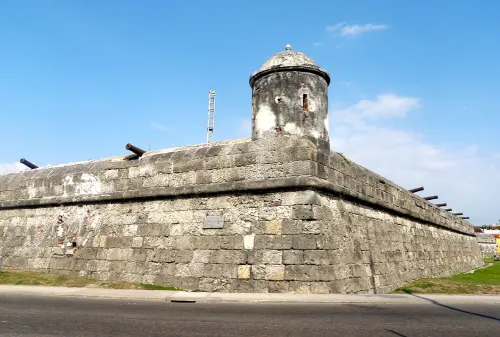
    The walls of Cartagena started here. Around 1602 the engineer Bautista Antonelli and his nephew Cristóbal de Roda, also an engineer, planned this bastion right across the avenue where Francis Drake had broken into the city in 1586. At the time Cartagena had no stone defenses at all, and its few defenders, dug into a makeshift trench on the narrow isthmus to Bocagrande where the Avenida Santander runs today, could not hold.

    The city paid dearly. A curious document survives from the episode, written in Latin and signed by Drake, confirming receipt of the large ransom the authorities were forced to hand over. A few years later came the decision to close the Bocagrande approach with this bastion, which became the most important of the great bastions in Cartagena's walls.

    Read it as a textbook of the Italian school of fortification. Its neck once opened onto lower gun platforms, where cannons stood in the 16th and 17th centuries. In the early 18th century Juan de Herrera y Sotomayor, the engineer of the clock gate, removed those platforms, but the vaults that gave access to them remain on both sides of the ramp. From the same era come the channels that carry water from hidden cracks in the bastion to the public cistern, and the large watchtower Herrera added on the main angle, looking out to sea. He also moved the San Felipe gate from the left side to the opposite flank, where you can still walk through it.

    Access is free at any hour. From the bastion it is 1,270 m, about 17 minutes, to the next point on the Murallas de Cartagena.

    Hours
    24/7
    Price
    Free (part of the Murallas, free to walk)
  9. 9

    Murallas de Cartagena

    Murallas de Cartagena in Cartagena de Indias, stop 9 on the self-guided walking tour

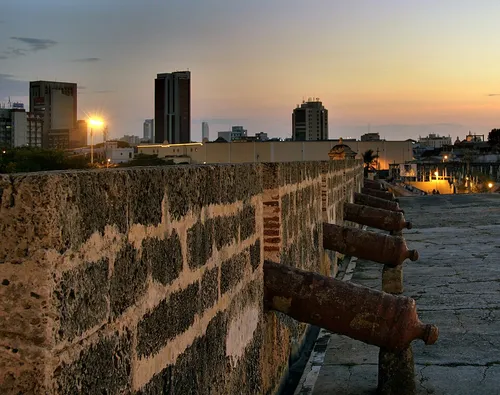
    The wall walk is the free centerpiece of the route. The circuit along the top of the walls is a public walkway, open at any hour, and that matters: almost everything behind you closes by late afternoon. The walls do not, which makes them a flexible late day stop and a natural backup plan if the morning ran long.

    Antonelli's bastion was the first piece; the ring grew around the city in stages over the following centuries. In 1984 UNESCO listed the historic center together with its fortifications as World Heritage, a reminder that the defenses are as much part of the monument as the churches inside them.

    Up on the wall top the scale inverts. The churches and palaces you spent the morning inside shrink to roof tiles, and the defense system around them turns out to be the city's real architecture, the thing it actually spent its money on. Treat the top as a promenade: no ticket, no queue, no gate.

    The next leg is the longest of the day: 1,610 m, about 23 minutes, out to the Castillo San Felipe de Barajas.

    Hours
    24/7
    Price
    Free (open-air city walls, public walkway)
  10. 10

    Castillo San Felipe de Barajas

    Castillo San Felipe de Barajas in Cartagena de Indias, stop 10 on the self-guided walking tour

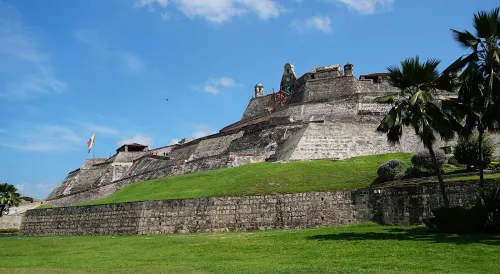
    The fortress sits on the Hill of San Lázaro, 41 m above sea level, in a position that commanded every approach to the city by land and sea. It was built in 1639, first under the name Castillo de San Lázaro, and later named in honor of Philip IV of Spain. It was African slave labor, under Spanish supervision, that raised it.

    Its history is a run of sieges. In 1697, during the War of the Grand Alliance, the castle fell to the French privateer Baron de Pointis. In 1741 the British admiral Edward Vernon attacked it in the Battle of Cartagena de Indias, part of the War of Jenkins' Ear, and was driven off by the Spanish admiral Blas de Lezo. Antonio de Arévalo expanded it again in 1763, and in the wars of independence the royalist expedition under Pablo Morillo took Cartagena in December 1815.

    What you walk through is a triangular core ringed by batteries, with walls wide at the base and narrow toward the parapet so that the batteries and parapets cover one another. Its 68 guns all faced away from the city. The grand entrance is striking, but the maze of tunnels is what most people remember.

    This is the one ticket on the outer half of the route. Give it about 75 minutes. Then walk 1,330 m, about 19 minutes, to Getsemaní, passing the Los Zapatos Viejos sculpture on the way to the Plaza de la Trinidad.

    Hours
    Mon–Sun 07:00–18:00
    Price
    COP $38,000 general admission (foreigners); COP $33,000 Colombian nationals; COP $16,000 reduced (children 6-13, students & teachers); free for children under 6
  11. 11

    Plaza de la Trinidad (Getsemaní)

    Plaza de la Trinidad (Getsemaní) in Cartagena de Indias, stop 11 on the self-guided walking tour

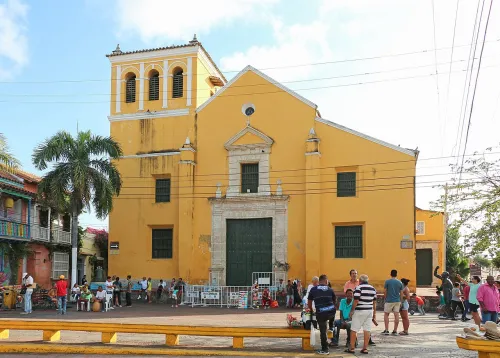
    The walk ends in the neighborhood the drawbridge at the Torre del Reloj once existed to reach. The Plaza de la Trinidad is Getsemaní's front room, an open public square in front of the Iglesia de la Santísima Trinidad: no tickets, no gates, no closing time, and of everything on this route the place least in need of explanation. After a day of tribunals, cathedrals and artillery, the assignment here is simply to sit.

    This is the end of the line, not a loop back to the start. The old city lies back across the place where the San Anastasio canal once ran, and the clock gate you started beneath is the landmark to walk toward when you want back in. The canal is gone; the crossing point is still the crossing point, and the GPS navigation will lead you there if you ask.

    Hours
    24/7
    Price
    Free (open-air public plaza)
Walking tour route map of Cartagena de Indias Route loaded
Torre del RelojParque de BolívarIglesia de San Pedro ClaverMuseo del Oro Zenú+7
All 11 stops are already on the map.
You just press start.
AI Tour Guide

You know the way now. Walk the walls with a guide in your ear.

Press start wherever you are, even hundreds of kilometres from Cartagena de Indias, and the guide begins telling its stories right away. In the city, pick any of the 11 stops to start from: it leads you there, then talks with you the whole route, asking, listening, remembering, and shaping the tour around your answers.

11stops 5.3km 1 h 14 minwalking 13languages
▶Start the tour free

Free to start · Runs in your browser · No app, no download

Shorter Ways to Walk Cartagena de Indias

The route splits naturally into a compact old town half with most of the interiors and a longer half along the fortifications. Pick the part that suits your day.

Squares and interiors of the walled city

Stops: 1, 2, 3, 4, 5, 6

For museum lovers and anyone with a single morning. Only 640 m and about 8 minutes of walking, yet it covers the gold museum, the Inquisition palace and the cathedral. Tickets only at the San Pedro Claver museum and the Palacio de la Inquisición.

Walls and fortress

Stops: 7, 8, 9, 10, 11

For readers who care more about cannons than chapels. 4.4 km and about 62 minutes of walking from Santo Domingo over the bastion and the walls to the castle and Getsemaní. The only ticket is the Castillo San Felipe de Barajas.

Walled city without the castle

Stops: 1, 2, 3, 4, 5, 6, 7, 8, 9

For a day without the long legs out to the fortress. About 31 minutes of walking, ending on the wall top. Tickets at the San Pedro Claver museum and the Palacio de la Inquisición; the castle can wait for another day.

How Long the Cartagena de Indias Tour Takes with Museums and Castle

The pure walking time is 1 h 14 min, and it is very unevenly spread. The first seven stops sit so close together that the walks between them add up to about 11 minutes; the long legs out to the walls, the castle and Getsemaní take up most of the hour.

Plan about six hours if you go inside the places that reward it: around 45 minutes at San Pedro Claver, half an hour in the gold museum, an hour in the Inquisition palace, 25 minutes in the cathedral and 75 minutes in the castle, plus short pauses at the open air stops. Start at 9:00 on a weekday and you reach the castle around 13:40 and the Plaza de la Trinidad a little after 15:00.

The squares and interiors half takes about three hours, the walls and fortress half about the same. Leave out the castle and the walled city alone fills a little over four hours.

Before You Set Off from the Torre del Reloj

  • Start and finish: The recommended start is the Torre del Reloj, and the walk ends at the Plaza de la Trinidad in Getsemaní. You can join at any stop; the order here is simply the one that flows best. From the end, the GPS navigation leads you back to the clock gate if you ask it to.
  • Best day: Choose your day with care and start in the morning: the gold museum and the cathedral are not open every day, and at the weekend both close early, so keep moving.
  • Costs: As a foreign adult, you pay for three tickets: the San Pedro Claver museum, the Palacio de la Inquisición and the Castillo San Felipe de Barajas. Everything else is free, and the guided visit at Santo Domingo runs on a donation. Skip the paid interiors and the whole walk costs nothing.
Walking tour route map of Cartagena de Indias
AI Tour Guide

Your guide is waiting at the clock tower

Press start and a voice AI Tour Guide takes it from here: leading the route through Cartagena de Indias, telling the stories, and turning your walk into a real back-and-forth conversation. No app or download is needed; it runs in your browser.

11stops 5.3km 1 h 14 minwalking 13languages
▶Start the tour free

Free to start · Runs in your browser · No app, no download

What the AI Tour Guide Adds between Bastions

On a route where the long walks come late, the AI Tour Guide fills them: it greets you at the gate, tells the stories of each place as you arrive, asks what you want more of and remembers it. If the Inquisition trials grip you, it goes deeper into the people behind them; if it is the Zenú goldsmiths or Blas de Lezo's defense of the castle, it follows that thread instead, and you can interrupt it whenever you like. It does not change the route. You start with 100 free credits; after that, this tour costs €19.99 all-inclusive with no time limit, or €5 per hour.

A Real Conversation A voice AI Tour Guide greets you, leads the whole route, and tells the stories and facts as you walk, asking what you want to see and keeping a real conversation going. Not a recording you press play on.
Map Navigation Follow the route on the map and walk at your own pace. You choose where to start and when to move to the next stop.
Ask Anything Curious about a building you pass? Ask your AI Tour Guide on the spot and the conversation carries on.
13 Languages Switch language anytime. No separate tour needed.
Start free in your browser

Common Questions about Walking Old Cartagena

Are there reduced tickets for students, children and seniors?

Yes. The San Pedro Claver museum, the Palacio de la Inquisición and the Castillo San Felipe de Barajas all have reduced tickets for children and students, and seniors pay less at the museum and the palace. Young children enter the palace and the castle free.

When are masses held at San Pedro Claver?

Monday to Saturday at 18:00, and on Sundays at 07:00, 10:00, 12:00 and 18:00. The church itself is free; the museum is a separate ticket.

Do Colombians and local residents pay less?

Yes. Colombian adults pay less at the San Pedro Claver museum and at the castle, and residents of Bolívar get an even lower rate at the San Pedro Claver museum.

Where can I walk a similar old town route elsewhere on the coast?

Along the Caribbean, Santa Marta and Barranquilla both have their own free routes; inland, Medellín and Bogotá follow the same format.

Is the tour really free?

Yes. The whole tour is free: the route, the interactive map and the navigation cost you nothing. Only the voice AI Tour Guide is optional and paid: you test it with 100 free credits, then you pay either €5 per hour or €19.99 for this whole tour, with no time limit. Admission to 2 of the 11 stops is not included: Palacio de la Inquisición and Castillo San Felipe de Barajas charge their own entry fees.

Do I need to download an app?

No. Everything runs in your phone browser. Open the route and start walking, no download and no sign-up required.

Do I need to book the walking tour in advance?

No booking needed. This self-guided tour is available anytime. Open the route in your browser and start walking. The AI Tour Guide works instantly, no app, no reservation required.

What languages is the AI Tour Guide available in?

The AI Tour Guide speaks 13 languages, so you take the tour in your own language and can switch at any time.

Can I skip stops or change the route?

Yes. Skip any stop, spend extra time at places you like, or start the route from any point. It is your walk, you set the pace.
Image credits
▶ Start free in your browser Runs in your browser, no app, no download