Free Walking Tour Bregenz: Lake, Old Town, Pfänder

From the floating stage along the lake, past Zumthor's glass Kunsthaus, up into the walled upper town and on to the 1,062 m Pfänder, Bregenz's own mountain.

8 Stops 10.2 km ~2 h 58 min walking
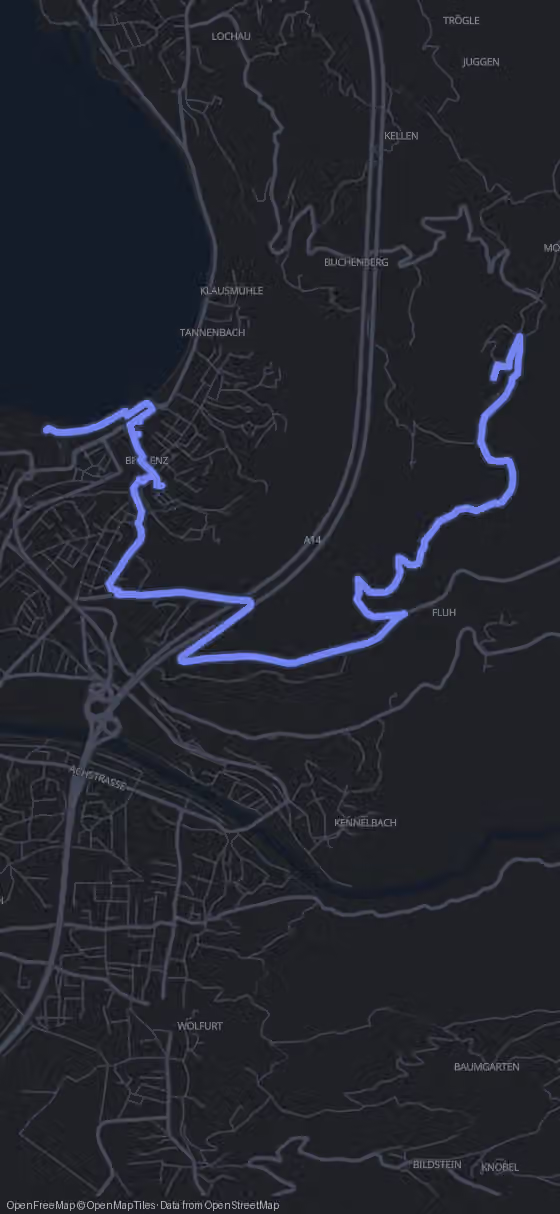
Route map for the Bregenz walking tour
Stop 1 of 8
770 m·10 min
Bregenz Festival Floating Stage (Seebühne / Festspielhaus)
Head east along the promenade toward the Bregenzer Seepromenade
Grüß Gott, welcome to Bregenz. I'm Alex, and here, the lake itself becomes part of the theatre.
Try this tour with Alex

Bregenz on Foot: What This Route Covers

Eight stops, from the Bregenz Festival Floating Stage (Seebühne / Festspielhaus) on the lakefront to the summit of the Pfänder (Pfänderbahn cable car): 10.2 km and 2 h 58 min of pure walking, most of it the final hike up the mountain. With two museums and a break, plan around seven hours.

The Bregenzer Seepromenade, the Kornmarktplatz and the Kapuzinerstiege & Gebhard Statue are free; the Kunsthaus Bregenz (KUB), the Vorarlberg Museum and the Martinsturm charge admission. The GPS route in your browser costs nothing, and the AI Tour Guide is optional.

Open free GPS & optional AI Tour Guide
This short shows highlights of the route. All 8 stops follow below.

The Route

Walking Map of Bregenz from the Lakefront to the Pfänder

8 stops 10.2 km 2 h 58 min walking
Tap to load interactive map

The 8 stops along this route

  1. Bregenz Festival Floating Stage (Seebühne / Festspielhaus), stop 1 on the self-guided walking tour
    1Bregenz Festival Floating Stage (Seebühne / Festspielhaus)
  2. Bregenzer Seepromenade, stop 2 on the self-guided walking tour
    2Bregenzer Seepromenade
  3. Kunsthaus Bregenz (KUB), stop 3 on the self-guided walking tour
    3Kunsthaus Bregenz (KUB)
  4. Vorarlberg Museum in Bregenz, stop 4 on the self-guided walking tour
    4Vorarlberg Museum
  5. Kornmarktplatz in Bregenz, stop 5 on the self-guided walking tour
    5Kornmarktplatz
  6. Martinsturm in Bregenz, stop 6 on the self-guided walking tour
    6Martinsturm
  7. Kapuzinerstiege & Gebhard Statue in Bregenz, stop 7 on the self-guided walking tour
    7Kapuzinerstiege & Gebhard Statue
  8. Pfänder (Pfänderbahn cable car) in Bregenz, stop 8 on the self-guided walking tour
    8Pfänder (Pfänderbahn cable car)
  9. That's the full route.

    Walk it with an AI Tour Guide talking you through every one of these streets.

    Start free in your browser
    You made it

Bregenz Walking Tour Stop by Stop: Lake, Upper Town, Mountain

  1. 1

    Bregenz Festival Floating Stage (Seebühne / Festspielhaus)

    Bregenz Festival Floating Stage (Seebühne / Festspielhaus), stop 1 on the self-guided walking tour

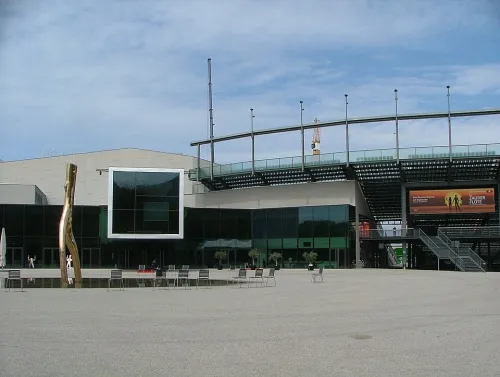
    Start at the water, where the Bregenz Festival plays out every summer. The stage stands in the lake, and behind it rises the Festspielhaus, the festival and congress centre that opened in July 1980. It is the home of the Bregenz Festival, and for the rest of the year it hosts conferences, congresses and cultural events. The city owns it through its operating company, Kongresskultur Bregenz.

    The building you see is the result of two rounds of growth. In 1990 the city held an architecture competition, won by Helmut Dietrich and Much Untertrifaller, whose practice works from Bregenz and Vienna. The first phase in 1996 and 1997 added a workshop stage, the lake studio and the lake foyer; in 2005 and 2006 the original 1980 building was renovated and enlarged by 10,000 cubic metres.

    Now look at the square in front, the Platz der Wiener Symphoniker. Its centrepiece is “Ready Maid” by the Vorarlberg artist Gottfried Bechtold, a polished bronze tree about seven metres tall, standing upside down. Bechtold describes it as a striding tree woman, a deliberate counterpoint to what is performed inside. Not everyone loves the square: in 2025 Greenpeace Austria put it on its “Nine squares, nine concrete treasures” list of the country's worst building sins. Make up your own mind. Then look up at the roof for Cerith Wyn Evans' white neon line “299.792.458 m/s”, the speed of light; it shows up again as a reflection in the windows and on the water.

    Should you go further? Festival performances are a summer affair, with tickets ranging from moderate to very expensive. Guided tours of the house, free for children and students, are a good choice if stagecraft interests you. For everyone else, the outside is the visit. From here, 770 m and 10 minutes along the shore bring you to the promenade.
    Hours
    Season Jul – Aug; performance times vary; phone orders Mon – Fri 09:00–17:00
    Price
    EUR 8.00 - EUR 9.50 guided tours (free for children/students up to 26); performances vary (approx. EUR 30 to EUR 300+)
  2. 2

    Bregenzer Seepromenade

    Bregenzer Seepromenade, stop 2 on the self-guided walking tour

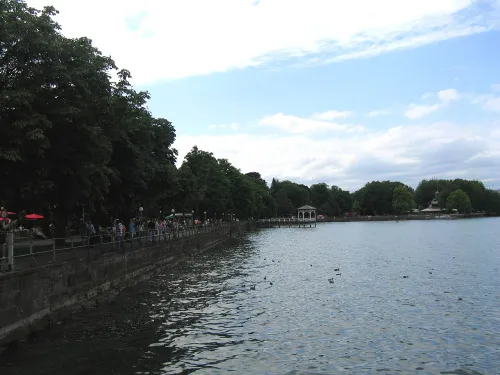
    On the Bregenzer Seepromenade the ticket counters disappear. This is public shoreline, open around the clock, and its two anchors are the Molo pier and the Sunsetstufen. It is also the free view of the lake stage you just left: whatever production is installed that summer, you can take it in from the water's edge at your own pace.

    Think of the promenade as the backbone of the town part of the walk. The Kunsthaus stands just off it, the Vorarlberg Museum a little further on, and none of the town stops takes you far from the lake. So this is the moment to settle the museum question. The two houses stand so close together that doing both, or skipping both, costs almost the same walking; what decides it is your time and your interest.

    A grey day is no disaster here either. The lakefront section is short enough to enjoy between showers. When you are ready, it is 250 m and 4 minutes to the Kunsthaus.

    Hours
    Open 24/7
    Price
    Free
  3. 3

    Kunsthaus Bregenz (KUB)

    Kunsthaus Bregenz (KUB), stop 3 on the self-guided walking tour

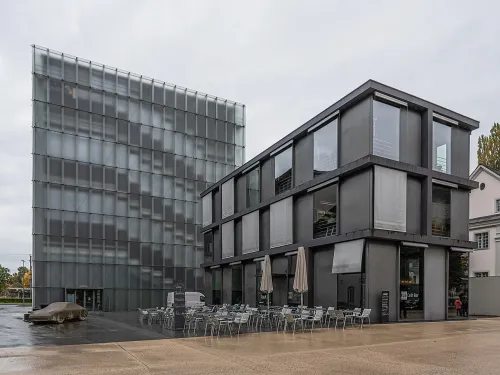
    The glass cube by the lake is the Kunsthaus Bregenz, known simply as KUB. The State of Vorarlberg commissioned it, and the Swiss architect Peter Zumthor built it between 1990 and 1997. Zumthor later won the Pritzker Prize in 2009; the building itself earned him the Mies van der Rohe Award for European Architecture in 1998.

    Stand back for a moment and watch the facade. Glass and steel wrap a mass of cast concrete, and from outside the house looks like a lamp. It takes on the changing light of the sky and the haze of the lake, so it looks different depending on where you stand, the time of day and the weather, while giving little away about what is inside. Zumthor conceived it as a daylight museum, a quiet place where people can meet art in peace.

    The KUB shows temporary exhibitions of international contemporary art and has no permanent collection on display. It opened in July 1997 with a show by the American light artist James Turrell. Founding director Edelbert Köb was followed by Eckhard Schneider and Yilmaz Dziewior, and Thomas D. Trummer has led the house since May 2015. Curator Rudolf Sagmeister shaped it for 30 years, and for its 25th anniversary the KUB took an exhibition to the Venice Biennale in 2022.

    Is it worth going in? If contemporary art or architecture means anything to you, yes: the interior is where Zumthor's daylight idea makes sense. Admission is charged, with reductions for young adults and free entry for children and teenagers. The Vorarlberg Museum is only 140 m away, 2 minutes on foot.

    Hours
    Tue–Sun 10:00–18:00, Thu 10:00–20:00, Mon closed
    Price
    EUR 14.00 regular, EUR 12.00 reduced (seniors 60+, disabled), EUR 8.00 young adults (20-27), free for children and youths up to 19
  4. 4

    Vorarlberg Museum

    Vorarlberg Museum in Bregenz, stop 4 on the self-guided walking tour

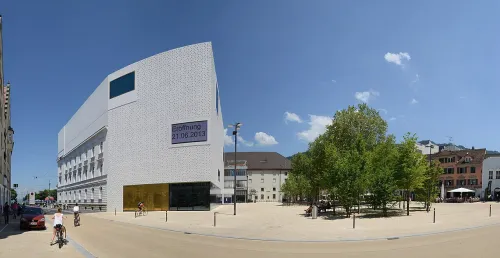
    Next door to modern art stands the memory of the region. The Vorarlberg Museum, formerly the Vorarlberger Landesmuseum, is the state museum of art and culture for Austria's westernmost province. Its collection holds 150,000 objects from archaeology, history, art history and folk culture, always read in a context that reaches beyond the state's borders.

    The museum began as a rescue mission. In 1857 a private association founded it to keep Vorarlberg's cultural heritage at home, stop important pieces from being sold abroad and, where possible, bring back what had already left. The first building opened in 1860 and was soon too small. Money for a proper museum came only in 1902, with help from local industry and the town, and the new house by Georg Baumeister opened in 1905 with heating, fire and flood protection, modern for its time.

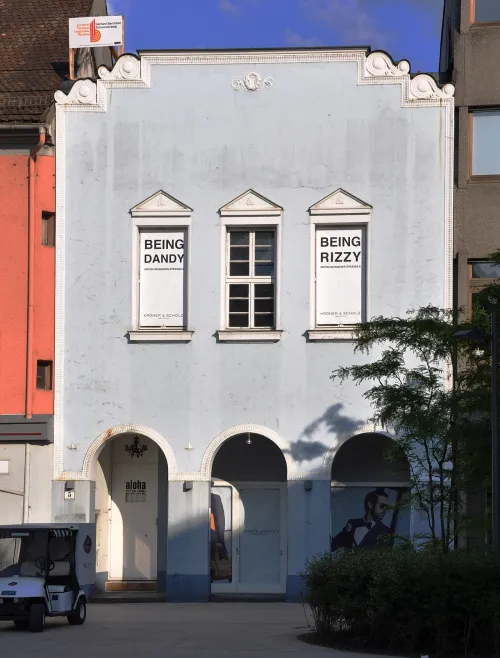
    The collections kept outgrowing their walls. After complaints in the 1930s, the next rebuild came only in the 1950s: a storey was added, the decorative facade removed, and the museum reopened in 1960. In 1947 and 1948 the collections and building passed to the State of Vorarlberg.

    Go in if you want to understand the region behind the lakeside postcard. Admission is charged, with reductions for young adults and free entry for children and teenagers. The Kornmarktplatz is just 90 m away, a one-minute walk.

    Hours
    Tue–Sun 10:00–18:00, Mon closed (except public holidays and daily in Jul–Aug), 1st Thu of the month 10:00–20:00
    Price
    EUR 12.00 regular, EUR 10.00 reduced (seniors 60+, disabled), EUR 8.00 young adults (20-27), free for children and youths up to 19
  5. 5

    Kornmarktplatz

    Kornmarktplatz in Bregenz, stop 5 on the self-guided walking tour

    The Kornmarktplatz is the town's front room: a plain public square, always open, never ticketed. What you find here depends on your timing. On Tuesday and Friday mornings it fills with the farmers market, and by early afternoon the stalls are gone, so a market breakfast is a morning decision. In the weeks around Christmas the square turns into the Bregenzer Weihnacht, open daily from late morning into the evening.

    For the walk, this is the place to pause before the town starts climbing. Sit down, eat something and take stock of your day: from here the route turns uphill for good, first into the upper town and then onto the mountain, and that leg deserves to start on a full stomach. The Martinsturm is 480 m and 8 minutes away.

    Hours
    Open 24/7
    Price
    Free
  6. 6

    Martinsturm

    Martinsturm in Bregenz, stop 6 on the self-guided walking tour

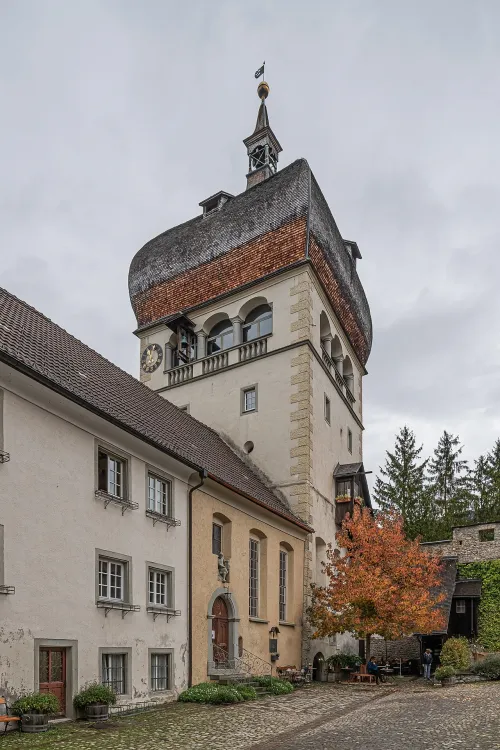
    Above the lower town lies the Oberstadt, the old walled core of Bregenz. Its town walls, built between the 13th and 16th centuries, enclose a roughly rectangular area and survive for the most part. At one corner stands the Martinsturm, at Martinsgasse 3b, the tower with the huge onion dome that has become a landmark of Bregenz.

    It started out modest. Right after the walls went up in the first half of the 13th century, a low tower with a cellar and two upper floors was built here as a granary, under a pyramid roof only a little higher than the wall. Early in the 14th century a small chapel with frescoes was set up on its upper floor. In 1362 Wilhelm VII of Montfort endowed the St Martin's chapel that gave the tower its name, and the chapel spread across the whole floor. Late in the 15th century it took in the ground floor too; look for the sacrament niche dated 1497.

    The decisive change came between 1599 and 1601, when the town hired Benedetto Prato, a master builder from Graubünden. He raised the tower by three storeys, added a loggia with three arches on each side and crowned it with the onion dome and lantern. The dome is unusual for its wooden shingles and square plan, and its very shape rules out a serious military purpose. The Martinskapelle on the side was added early in the 18th century and opens into the tower's ground floor.

    Going in is worth it for the chapel and for the 360-degree view over the town from the top floor. The tower charges admission and is not open all year; when it is closed, you see it from outside. Then it is 400 m and 6 minutes via Kirchstraße to the Kapuzinerstiege.

    Hours
    May to October: Tue–Sun 10:00–18:00, Mon closed; Nov to Apr: closed
    Price
    EUR 5.00 adults, EUR 3.50 reduced (students, seniors, military/civil service), EUR 2.00 children up to 15, EUR 8.00 family pass
  7. 7

    Kapuzinerstiege & Gebhard Statue

    Kapuzinerstiege & Gebhard Statue in Bregenz, stop 7 on the self-guided walking tour

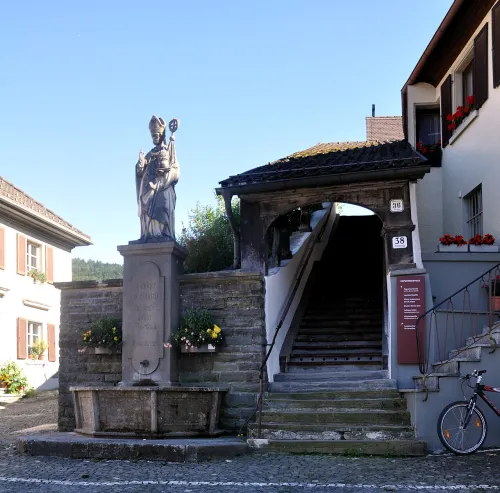
    The Kapuzinerstiege is a historic passage that stitches the lower town to the upper town and to the site of the former Capuchin monastery of St. Antonius. Beside it stands the statue of Saint Gebhard, keeping quiet watch.

    This stop is a connector and does not pretend otherwise: no ticket, no queue, no interior, just old stone and a saint. Give it a few unhurried minutes and catch your breath. From here the route has one direction left, and it is up: 8,040 m and 146 minutes of walking to the Pfänder summit.

    Hours
    Open 24/7
    Price
    Free
  8. 8

    Pfänder (Pfänderbahn cable car)

    Pfänder (Pfänderbahn cable car) in Bregenz, stop 8 on the self-guided walking tour

    The Pfänder is Bregenz's own mountain, 1,062 m high, even though most of it lies in the neighbouring municipality of Lochau. With its view over Lake Constance and, as the locals count them, 240 Alpine peaks, it is one of the best-known viewpoints in the region. Strictly speaking it is a secondary summit of the Hochberg in the Pfänder range, which stretches for about 5 km; the highest point is the Hirschberg at 1,095 m, followed by the Hochberg at 1,069 m.

    The mountain is made of Molasse, rock that formed in the foreland basin as the Alps were pushed up. Its coarser parts became the conglomerate called Nagelfluh and sandstone, which you can see in the cliffs of the Känzele below the Gebhardsberg. Higher up the slope above Lochau, finds in the Wellenstein cave point to settlement in the Late Bronze Age.

    The Pfänder also has a war story. During the Thirty Years' War, the Swedish field marshal Carl Gustav Wrangel occupied Schloss Hofen above Lochau in 1646 and prepared his attack on Bregenz. It came by surprise on 4 January 1647, down from the Pfänder: the imperial positions were overrun, and the Swedish force of 8,000 men is said to have followed the fleeing defenders' tracks in the snow. That flank is still called the Schwedenhang, and since 2007 a themed trail, “Schwedenweg anno 1647”, explains the events with information boards.

    Early in the 20th century there were plans for a rack railway up the mountain; they were never built. Instead, in 1927 the firm Adolf Bleichert & Co. built the cable car from Bregenz to the ridge, renewed several times since, with its valley station at 419 m. After the hike, ride down on a one-way ticket, with reduced fares for seniors, youths and children.

    Hours
    Daily 8:00–19:00 (cable car operates on the hour and half hour)
    Price
    EUR 19.00 round trip adults (EUR 12.70 one-way), EUR 18.00 seniors (EUR 12.00 one-way), EUR 16.30 youths (EUR 10.90 one-way), EUR 9.50 children (EUR 6.30 one-way)
Walking tour route map of Bregenz Route loaded
Bregenz Festival Floating Stage (Seebühne / Festspielhaus)Bregenzer SeepromenadeKunsthaus Bregenz (KUB)Vorarlberg Museum+4
All 8 stops are already on the map.
You just press start.
AI Tour Guide

You know the route now. Walk it with a guide in your ear.

Press start wherever you are, even hundreds of kilometres from Bregenz, and the guide begins telling its stories right away. In the city, pick any of the 8 stops to start from: it leads you there, then talks with you the whole route, asking, listening, remembering, and shaping the tour around your answers.

8stops 10.2km 2 h 58 minwalking 13languages
▶Start the tour free

Free to start · Runs in your browser · No app, no download

Shorter Ways to Walk the Route

Not everyone wants a mountain at the end of the day. The route breaks cleanly at two points, so you can stop by the lake, stop in the upper town, or go all the way.

Lake and two museums

Stops: 1, 2, 3, 4, 5

For art and history lovers with half a day. You stay on the lakefront and in the lower town: 1,250 m and 17 minutes of walking in total. Admission applies at the Kunsthaus Bregenz and the Vorarlberg Museum; everything else is free.

Lake to upper town

Stops: 1, 2, 3, 4, 5, 6, 7

For anyone who wants the town without the climb. You add the walled upper town for 2,130 m and 31 minutes of walking. Tickets: the two museums plus the Martinsturm, which is not open all year.

The full route with the Pfänder

Stops: 1, 2, 3, 4, 5, 6, 7, 8

For walkers with a full day and good shoes. 10.2 km and 2 h 58 min of walking, ending on the summit. Besides the three tickets in town, budget for a one-way ride down on the Pfänderbahn.

How Long Does This Bregenz Tour Take with the Pfänder Hike?

The pure walking time is 2 h 58 min, but the town part takes only 31 minutes of it; the rest is the 146-minute hike from the Kapuzinerstiege up to the Pfänder. That split shapes the day: take your time in the museums, then leave enough daylight for the climb.

A realistic full day looks like this. Start at the Floating Stage at 9:30 and give it 20 minutes; you reach the promenade at 10:00 and the Kunsthaus at 10:24. An hour there and an hour in the Vorarlberg Museum bring you to the Kornmarktplatz at 12:27. After a 45-minute break, you are at the Martinsturm at 13:20, leave it at 13:50, pass the Kapuzinerstiege at 13:56 and set off uphill at 14:01. You reach the summit around 16:27, comfortably in time for the cable car down. That is about seven hours in all.

The shorter versions scale down accordingly: lake and two museums take around three hours with both visits, the walk to the upper town around four and a half hours including the Martinsturm and a break.

Before You Set Off in Bregenz

  • Start and finish: The recommended start is the Floating Stage by the Festspielhaus; you can join at any stop, but the order here works best. The route ends on the Pfänder summit, from where the Pfänderbahn takes you back down.
  • Best day: Plan around the closing days: the Kunsthaus and the Vorarlberg Museum are not open every day of the week. On market mornings the farmers market fills the Kornmarktplatz.
  • Best season: The Martinsturm is not open all year, so check before you plan the upper town. Festival performances on the lake stage are a summer event.
  • Costs: The lake, the square and the Kapuzinerstiege are free. The Kunsthaus, the Vorarlberg Museum and the Martinsturm charge admission, and the Pfänderbahn sells one-way and return tickets. Children and teenagers enter both museums free.
Walking tour route map of Bregenz
AI Tour Guide

Your guide is ready at the lakefront whenever you are.

Press start and a voice AI Tour Guide takes it from here: leading the route through Bregenz, telling the stories, and turning your walk into a real back-and-forth conversation. No app or download is needed; it runs in your browser.

8stops 10.2km 2 h 58 minwalking 13languages
▶Start the tour free

Free to start · Runs in your browser · No app, no download

What the AI Tour Guide Adds Between Lake and Summit

This route has a long quiet stretch: almost two and a half hours of climbing after the upper town. That is where the AI Tour Guide earns its place. It leads the walk as a conversation, picks up whatever caught your interest in town, whether that was Zumthor's concrete or the counts of Montfort, and keeps going deeper while you climb; you can interrupt it at any point. Ask it, for example, how Bregenz grew from a walled square into a lakeside town, or what the Molasse rock tells about how the Alps formed. You start with 100 free credits; after that, credits cost €5 per hour, or you unlock this tour all-inclusive for €19.99 with no time limit, which pays off on a seven-hour day like this one.

A Real Conversation A voice AI Tour Guide greets you, leads the whole route, and tells the stories and facts as you walk, asking what you want to see and keeping a real conversation going. Not a recording you press play on.
Map Navigation Follow the route on the map and walk at your own pace. You choose where to start and when to move to the next stop.
Ask Anything Curious about a building you pass? Ask your AI Tour Guide on the spot and the conversation carries on.
13 Languages Switch language anytime. No separate tour needed.
Start free in your browser

Common Questions about Walking Bregenz

Is this walk a good idea with children?

Yes, and it is kind on the budget: children and teenagers enter the Kunsthaus and the Vorarlberg Museum free, the Martinsturm has reduced child tickets and a family pass, and children ride the Pfänderbahn at a reduced fare. With younger children, the town loop without the hike is the easier choice.

Can I take the cable car up instead of hiking?

Yes, take a return ticket on the Pfänderbahn. That turns the full route into a town walk plus a ride, with the summit view as the finale.

What can I do on a rainy day?

Keep the lake part short and spend the time indoors: the Kunsthaus and the Vorarlberg Museum stand a two-minute walk apart, so a wet morning can become a museum morning without extra walking. Save the Pfänder for a clear day, since the view is the point.

What is worth combining with Bregenz?

Lindau is only 7 km away and makes an easy second walk on the same trip. Across the border, St. Gallen lies 29 km away, and for a bigger Austrian city, Innsbruck is 127 km from Bregenz.

Is the tour really free?

Yes. The whole tour is free: the route, the interactive map and the navigation cost you nothing. Only the voice AI Tour Guide is optional and paid: you test it with 100 free credits, then you pay either €5 per hour or €19.99 for this whole tour, with no time limit. Admission to 3 of the 8 stops is not included: Kunsthaus Bregenz (KUB), Vorarlberg Museum and Martinsturm charge their own entry fees.

Do I need to download an app?

No. Everything runs in your phone browser. Open the route and start walking, no download and no sign-up required.

Do I need to book the walking tour in advance?

No booking needed. This self-guided tour is available anytime. Open the route in your browser and start walking. The AI Tour Guide works instantly, no app, no reservation required.

What languages is the AI Tour Guide available in?

The AI Tour Guide speaks 13 languages, so you take the tour in your own language and can switch at any time.

Can I skip stops or change the route?

Yes. Skip any stop, spend extra time at places you like, or start the route from any point. It is your walk, you set the pace.
Image credits
▶ Start free in your browser Runs in your browser, no app, no download